Archive for May 19, 2015

This is What American Soldiers Fought and Died For?

May 19, 2015

Iraqi troops retreat from Ramadi as Isis militants move in – video
Via The Guardian 5-19-2015 Source: Reuters

CLICK HERE FOR VIDEO

(To say something like ‘what a waste’ is a huge understatement. That sort of comment must be reserved for going into Iraq in the first place. – LS)

Iraqi government forces retreat from Ramadi as Isis militants claim control of the city on Sunday. Iraqi military vehicles are shown driving away from the city. Up to 500 people, Iraqi civilians and soldiers, have been killed in the battle for the city, and 8,000 have fled their homes. One woman describes the situation on the streets of Ramadi as chaotic and violent. On Monday, Iraqi militias were belatedly attempting to push back against Islamic State forces in Anbar province.

Next challenge for US after Ramadi defeat: Iranian ship nears Yemeni shore

May 19, 2015

Next challenge for US after Ramadi defeat: Iranian ship nears Yemeni shore, DEBKAfile, May 19, 2015

Iran_Shahed_21.5.15Iranian aid vessel with “medical relief” personnel

DEBKAfile’s analysts strongly doubt that the USS Theodore Roosevelt carrier and strike force, which have been monitoring the Iranian flotilla’s movements, will be ordered to intervene against the Iranian ships reaching the Yemeni port.

Tehran, for its part has threatened to treat any such inspections as an act of war.

********************

Tuesday, May 19, two days after Ramadi’s fall to the Islamic State landed a major blow to Baghdad and US strategy in the region, 10,000 troops – more than half American – ended a large US-led military exercise in Jordan that was designed to practice tactics for countering ISIS. Taking part surprisingly in the two-week exercise was a heavy US nuclear-capable B-52H bomber, which flew in from the United States, crossing through Israeli air space and returning to home base when it was over.

This was the first time in the 12 years since the US invasion of Iraq that a B-52H, which can deliver nuclear weapons and bunker buster bombers, has appeared in Middle East skies for any military mission.

East of Jordan, as some 25,000 refugees from Ramadi slept in the open, the Islamist conquerors began moving on their next target, the Habbaniyah air base some 70 km west of Baghdad. Its fall would cut Baghdad off from northern and eastern Iraq and place it under siege from three directions – north, east and west.

Most Arab members have dropped out of the US-led coalition committed to fighting the Islamist terrorists in Iraq and Syria. This has left the US Air Force to bear the brunt of the aerial campaign. Its average of 19 air strikes a day is far too few to have any real effect on ISIS’s battle momentum. It certainly did not stop the long columns of black-clad Islamist fighters swarming on Ramadi from all directions in hundreds of tanks, APCs and minivans armed with heavy machine guns, and taking control of the capital of Iraq’s largest province, Anbar.

Western intelligence from the Ramadi region offered disturbing accounts of thousands of fully-armed ISIS fighters springing up apparently from nowhere to descend on the city, with no one able to see where they came from and no air action to scatter them before they entered the city.

After the Ramadi defeat, the Obama administration’s next major test in the region comes from an Iranian cargo vessel heading, accompanied by two warships, for the Yemeni Red Sea port of Hodeida and scheduled to dock Thursday, May 21. According to Tehran, the ship will unload 2,500 tons of humanitarian aid for Yemen, and the hundreds of passengers who disembark are Red Crescent medical relief workers.

The Saudi, US and Egyptian fleets have imposed a sea and air blockade on Yemen to prevent Iran provding the Yemeni Houthi rebels with fresh arms. Saudi and other regional intelligence agencies are convinced that the “paramedics” are in fact Revolutionary Guards officers and instructors in disguise, sent to strengthen the Houthi revolt.

Washington, Riyadh and Cairo have all vowed to stop the Iranian flotilla from putting into port in Yemen and said that its vessels will be forced to submit to inspections to make sure no illicit weapons are aboard and to confirm the passengers’ identities.

Tehran, for its part has threatened to treat any such inspections as an act of war.

Deputy Revolutionary Guards Commander Gen. Masoud Jazayeri put it plainly when he said: “I am distinctly stating that the patience of Iran has limits. If the Iranian aid ship is prevented from reaching Yemen then they, Saudi Arabians and United States, should expect action from us.”

DEBKAfile’s analysts strongly doubt that the USS Theodore Roosevelt carrier and strike force, which have been monitoring the Iranian flotilla’s movements, will be ordered to intervene against the Iranian ships reaching the Yemeni port. It is not a good moment for President Barack Obama to upset Tehran when he is in dire need of the Iraqi Shiite militias controlled by Iran to stand up to ISIS before its columns reach Baghdad.

Without the US, it is hard to see Saudi and Egyptian warships directly engaging an Iranian naval force and risking a major military conflagration.

Therefore, just as the B-52H came and went without action to impede ISIS’s creep closer to Baghdad, the Roosevelt is not likely to halt Iranian warships before they reach Yemen.

Documents: Feds Knew Benghazi Attack Planned in Advance

May 19, 2015

Documents: Feds Knew Benghazi Attack Planned in Advance, Washington Free Beacon, May 18, 2015

(Please see also, Arab military chiefs approve Egyptian-led intervention in Libya — DM)


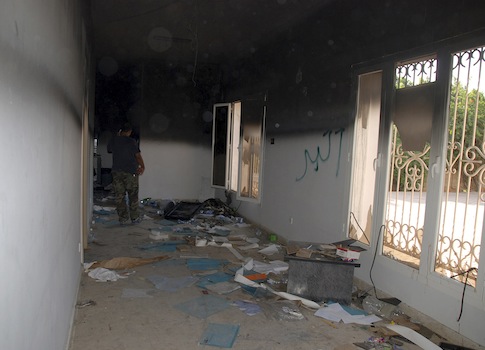
Gutted U.S. consulate in Libya / AP

Documents obtained by Judicial Watch from their May 2014 Freedom of Information Act (FOIA) lawsuits filed against the State Department and the Department of Defense revealed that the Obama administration knew about the attacks on the U.S. Consulate in Benghazi at least 10 days before the attack.

The documents also revealed that the DOD immediately reported the attacks on the consulate.

The documents included an August 2012 analysis predicting the failure of President Obama’s policy of a regime change in Syria as well as a warning about the rise of the Islamic State. The documents also included a confirmation that United States was aware of an arms shipment from Benghazi to Syria.

One of the documents from the DOD’s Defense Intelligence Agency dated September 12, 2012, the day after the attacks in Benghazi, lays out the details of the attack on the consulate and assesses that it was carefully planned by the terrorist group “Brigades of the Captive Omar Abdul Rahman.”

The group is known to have connections to the Muslim Brotherhood as well as  to al Qaeda. Rahman is serving a life sentence in prison for his role in the 1993 bombing of the World Trade Center.

The group’s goal was to “kill as many Americans as possible,” according to the documents, which were sent to Secretary of State Hillary Clinton, Defense Secretary Leon Panetta, the Joint Chiefs of Staff, and the National Security Council.

An October 2012 DOD document contained the first official document that the Obama administration knew of the shipment of weapons from the Benghazi to rebel forces in Syria.

Weapons from the former Libya military stockpiles were shipped from the port of Benghazi, Libya to the Port of Banias and the Port of Borj Islam, Syria. The weapons shipped during late-August 2012 were Sniper rifles, RPG’s, and 125 mm and 155 mm howitzers missiles.

During the immediate aftermath of, and following the uncertainty caused by, the downfall of the (Qaddafi) regime in October 2011 and up until early September of 2012, weapons from the former Libya military stockpiles located in Benghazi, Libya were shipped from the port of Benghazi, Libya to the ports of Banias and the Port of Borj Islam, Syria. The Syrian ports were chosen due to the small amount of cargo traffic transiting these two ports. The ships used to transport the weapons were medium-sized and able to hold 10 or less shipping containers of cargo.

The heavily redacted document did not reveal which weapons were sent to Syria

The DIA consistently warned of the deterioration of the situation in Iraq and warned that it creates an ideal situation for Al Qaeda to return to Mosul and Ramadi, according to an August 2012 report. During this time the U.S. was monitoring weapons flows from Libya to Syria. The agency warned of dire consequences but blocked out what most of what those consequences were.

The State Department produced a single document from a separate lawsuit that Judicial Watch had filed against the department. The document was created by Hillary Clinton’s office the morning after the attacks on the consulate in Benghazi and was sent throughout the State Department.

Neither the State Department nor Hillary Clinton have turned over any documents in regards to Benghazi or her personal email account that was used during her as well as other top aides during her time as Secretary of State.

Judicial Watch has filed multiple FOIA requests and has waited over two years for the documents that they have received.

“These documents show that the Benghazi cover-up has continued for years and is only unraveling through our independent lawsuits,” said Tom Fitton, president of Judicial Watch. “The Benghazi scandal just got a whole lot worse for Barack Obama and Hillary Clinton.”

Arab military chiefs approve Egyptian-led intervention in Libya

May 19, 2015

Arab military chiefs approve Egyptian-led intervention in Libya, DEBKAfile, May 19, 2015

(Obama will be displeased. — DM)

Arab military chiefs held an unpublicized meeting in Cairo Monday to confirm coordinated plans for Egyptian-led regional intervention into the eastern Libya region of Cyrenaica to drive out the armed extremists, who have kept the country locked in chaos since Muammar Qaddafi’s ouster, and install a stable government in the region;s capital of Benghazi. The meeting was attended by the chiefs of staff of Egypt, Jordan, Saudi Arabia, UAE, Kuwait, Bahrain, Sudan and the Libyan Tobruk government. Talks are ongoing with France and Libya to take part in the operation. Both have a direct interest in putting a stop to the ungoverned flow of African refugee migrants to Europe through Libya, which is being used by Islamic State terrorists to infiltrate Europe. France will be asked for logistic support and special forces for the Libyan operation and Italy to provide naval support. Egyptian President Abdel-Fatteh El-Sisi is seeking  early military action cut down the fast-expanding ISIS threat to his country, the region and southern Europe.

How the Islamic Republic Is Manipulating the U.S.

May 19, 2015

How the Islamic Republic Is Manipulating the U.S., Front Page Magazine, May 19, 2015

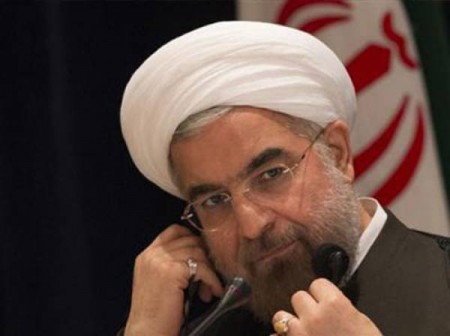
iran-s-rouhani-phones-pm-nawaz-after-soldier-s-killing-1395854702-4802-450x336

Rouhani and the moderate camp have persuaded Ayatollah Ali Khamenei that superficial diplomatic ties with the Obama administration will, in fact, empower the Islamic Republic, further its hegemonic ambitions, and raise Tehran’s economic status without the need for the Iranian leaders to give up on their revolutionary principles, anti-Americanism and anti-Semitism.

****************

There is a crucial Machiavellian (but not a strategic) tactical shift in the Islamic Republic’s foreign policy and its pursuit of regional preeminence.

First of all, Iranian leaders have realized that by superficially showing the Obama administration that the Islamic Republic is willing to restore diplomatic ties with his administration, they can in fact further advance their ideological and national interests.

Second, knowing that President Obama is desperate for a “historic” nuclear deal and the establishment of diplomatic ties with the Islamic Republic, Iranian leaders have played the role very well by attempting to satisfy President Obama’s empty goals.

Third, the ruling clerics of the Islamic Republic became cognizant of the fact that dealing with the Obama administration does not necessarily mean that they have to give up anything with respect to its domestic suppression, revolutionary Islamist principles, human rights abuses, regional hegemonic ambitions, anti-Americanism, hatred towards Israel, and foreign policy objectives.

The tactical shift, currently, is to satisfy President Obama’s personal and shallow objectives by allowing him to project that he is making historic moves (such speaking on the phone with the Iranian leaders), while simultaneously pursuing their own ideological objectives.

For example, most recently, Rouhani and the Obama administration agreed on opening new diplomatic offices in Tehran and Washington. For President Obama, opening diplomatic offices can be viewed as another “historic move” cited in his records or on his Wikipedia page. From the perspective of Iranian leaders, it is a crucial pillar for the advancement of Iran’s foreign policy and ideological objectives in the region without pressure from the US.

To pursue their objectives more efficiently, Iranian leaders have agreed to meet frequently with the diplomats at the highest level of the Obama administration, “negotiating,” and having some of their interactions publicly televised on American and Western media. In addition, the American and the Iranian flags are repeatedly shown next to each other in the high level meetings.

These moves, in fact, give legitimacy to the theocratic regime to further its ambitions.

The president was also delighted to make another “historic move” by speaking on the phone with his Iranian counterpart, President Hassan Rouhani. (One would wonder what a great accomplishment it is to pick up a phone and call another president.)

Washington and Tehran broke diplomatic ties in 1979. After the hostage crisis, high American officials and diplomats have not set foot on the Iranian soil due to Iran’s continuous violation of international norms and anti-Americanism.

Nevertheless, President Obama and Secretary of State John Kerry have decided to turn a blind eye on Iran’s egregious human rights abuses, aggressiveness and violations of international laws.

In another shallow move, Kerry claimed to be proud to set foot on Iranian “territory.” He met with Iran’s Foreign Minister, Mohammad Javad Zarif, at the residence of the Iranian ambassador to the United Nations, Gholamali Khoshroo, in New York.

Instead of attempting to change the behavior of the Ayatollahs and their revolutionary principles, President Obama and Kerry are satisfied with these superficial “historic moves.”

Since Iran’s political establishments and policies are driven, not solely by national and geopolitical interests, but also by ideological Islamist (Shiite) principles, hardliners and the office of the Supreme Leader will always view a real rapprochement with the US as taboo.

Restoring full diplomatic ties can also be analyzed as betraying the revolutionary principles of the Islamic Republic, which were based on anti-Americanism, as well as their opposition to Western models of socio-political and socio-economic landscapes.

From the perspective of Iran’s Supreme Leader, Ayatollah Ali Khamenei — who has the final say in foreign policy decisions — genuine diplomatic ties with the US will lead to the empowerment of Iranian civil society and secular factions. From the prism of the senior cadre of the IRGC, relationships with the American government might lead to the opening of the Iranian market, endangering the economic monopoly of IRGC institutions.

On the other hand, Rouhani and his technocrat team, who share the same objectives with the hardliners and want to preserve the interests of the Islamic Republic, came to the realizations that satisfying President Obama’s superficial and shallow objectives of “historic moves,” can indeed assist them in advancing their ambitions.

In conclusion, similar to the ongoing nuclear negotiations, Rouhani and the moderate camp have persuaded Ayatollah Ali Khamenei that superficial diplomatic ties with the Obama administration will, in fact, empower the Islamic Republic, further its hegemonic ambitions, and raise Tehran’s economic status without the need for the Iranian leaders to give up on their revolutionary principles, anti-Americanism and anti-Semitism.

The veneer of civilization

May 19, 2015

The veneer of civilization, Israel Hayom, Sarah N. Stern, May 19, 2015

Throughout the negotiations with Iran over its nuclear program, U.S. President Barack Obama frequently stated that “no deal is better than a bad deal” and that “all options are on the table.”

And then, on April 2, after a framework agreement was concluded in Lausanne, Switzerland (but without even a piece of paper to wave, Neville Chamberlain-like), Obama said, “Do you really think that this verifiable deal, if fully implemented … is a worse option than the risk of another war in the Middle East?”

As soon as the choice was altered from “a good deal or no deal” to “either this deal or war,” we witnessed a sudden surge in Iranian swagger and bravado, in both their words and their actions.

On May 7, Iranian Revolutionary Guard Corps Deputy Commander Brig. Gen. Hussein Salami told Fars television: “We welcome war with the United States, as we do believe that it will be the scene for our success, to display the real potential of our power. We have prepared ourselves for the most dangerous scenarios, and this is no big deal.”

On May 12, Mojtaba Zolnour, a member of the IRGC and a close personal friend of Supreme Leader Ali Khamenei, said: “The government of the Islamic Republic of Iran has divine permission to destroy Israel. The noble Quran permits the Islamic republic to destroy Israel. Even if Iran gives up its nuclear program, it will not weaken this country’s determination to destroy Israel.”

This Iranian saber rattling has been accompanied by renewed provocations. On April 28, in the Strait of Hormuz — a major oil route — an Iranian crew commandeered the Maersk Tigris, a cargo ship flying under the flag of the Marshall Islands, a U.S. protectorate. They held the ship for six days before releasing it and its crew members. And just a few days after that, Iranian gunboats opened fire on the Alpine Eternity, a Singaporean-flagged ship, and tried to force it into Iranian territorial waters.

The more the U.S. treats Iranians with kid gloves so as not to offend them and to keep them at the negotiating table, the more the Iranians feel a renewed sense of triumph, and disdain toward the United States and its allies. (One would think the Americans were the ones who needed sanctions lifted to help our ailing economy).

On May 6, Jason Rezaian, a Washington Post reporter who has been held in an Iranian prison since July 2014, was charged with espionage. This trumped-up charge was a direct rebuke to the United States, demonstrating just how much contempt the Iranians have for the U.S. It is clear that the Iranians believe that we are determined to give them their cake, and to let them eat it, too. And like a spoiled child in the midst of a temper tantrum, the more we give the Iranians, the more they demand.

The sad fact is that the American negotiating team is basing its entire strategy on little more than wishful thinking. While visiting Beijing at the weekend, U.S. Secretary of State John Kerry said that a deal with Iran “will have a positive influence on North Korea” (although he did add that he wasn’t sure that the North Koreans were capable of “internalizing the message”). One wonders whether the secretary of state also believes in unicorns and fairies.

History indicates that the nuclear negotiations with North Korea were precisely what led to their possession of a nuclear bomb. It is actually the Iranians who have taken note and learned from the North Koreans, and not the other way around.

It has become increasingly obvious that the Obama administration does not know how to negotiate. It seems that they are intent on making a deal, any deal, with the Iranians. And the more they grovel, the more contemptible the United States becomes in the eyes of the Iranians.

That is why the United States Senate needs to hold a free and open debate on the details of the negotiations. Over the last two weeks, the leadership of both the House and the Senate did no one any favors by putting the Iran Nuclear Review Act of 2015 (Corker-Cardin) on the suspension calendar. This means it requires a straight up or down vote, with no room for attaching amendments or for discussion.

The real danger in the Iran Nuclear Review Act of 2015 is that it has turned this negotiation, which has the standing of an international arms treaty, into a bill that would require a veto-proof majority to block. That means that it will become law even if only 34 Senate Democrats support it. While a treaty requires a positive action of two-thirds of the Senate to approve it, now it will take two-thirds of the Senate to veto it, which is much more difficult to achieve, particularly during the immediate aftermath of a euphoric deal-signing ceremony, probably on the White House Lawn, replete with lofty speeches of “peace in our time.”

The framers of the Constitution were prescient when they required two-thirds of the Senate to ratify a treaty. And these negotiations are nothing short of a nuclear arms treaty that will impact the order of the world for generations to come.

When the final deal is signed on June 30, the U.S. Senate must insist that it has the international standing of a treaty and demand that if it does not have the support of 67 senators, it is null and void.

In the meantime, those congressmen and senators who want to pretend that they are attentive to the genuine concerns of the Saudis, the Israelis and patriotic Americans wary of the Iranian negotiations, are now able to hide behind the Iran Nuclear Review Act, this piece of paper that they recently signed.

As the late Congressman Tom Lantos — the only Holocaust survivor in the U.S. House of Representatives — was fond of saying, “The veneer of civilization is paper thin.”

You Can Put Lipstick on a Pig, But It’s Still a Pig

May 19, 2015

If (When) Baghdad Falls, Keep American Soldiers Away From the Mess Created By Bush and Obama
BY H.A. Goodman Posted: 10/24/2014 6:57 am EDT Updated: 12/24/2014 5:59 am EST


(I’m not one to fully agree with a left of center blog such as the Huffington Post, but I have to say, in this case I fully agree and am a bit surprised that myself and so many others here in the USA are finding common ground on this important matter. Many, myself included, do not want to engage our young and brave soldiers in yet another pointless and politically correct war. While there are a growing number of reasons to go to war in the Mideast, none of these hellholes are worth another drop of their precious blood, especially if the means and a plan for total victory are AWOL.  While this article is over a half a year old, I feel it still carries a relevant and somewhat prophetic message. – LS)

When President Bush invaded Iraq in 2003, long before ISIS controlled an estimated 12,000-35,000 square miles of territory between Iraq and Syria, the Decider stated the following in his now infamous “Mission Accomplished” speech:

In the Battle of Iraq, the United States and our allies have prevailed…

In this battle, we have fought for the cause of liberty, and for the peace of the world…

In the images of celebrating Iraqis, we have also seen the ageless appeal of human freedom…

The Battle of Iraq is one victory in a war on terror that began on September the 11th, 2001, and still goes on…

Our mission continues. Al-Qaida is wounded, not destroyed…

The war on terror is not over, yet it is not endless.

From today’s vantage point, such rhetoric seems ludicrous, but it sounded good in the euphoria of the moment. Bush and his team made endless mistakes, proving time and again that flowery sentiments can’t stop a Sunni suicide bomber from blowing up a Shia mosque; even though both sides are Muslim. Removing Saddam from Iraq caused catastrophic upheaval and aroused a hornet’s nest of ancient hatreds. Also, Bush’s lofty nation building aspirations didn’t account for the fact that our soldiers would ultimately become targets of an unseen enemy.

Almost two-thirds of Americans killed or wounded in combat in both Iraq and Afghanistan have been victims of IED’s. Ultimately, 4,487 U.S. soldiers have lost their lives during Operation Iraqi Freedom, while 2,349 American soldiers have died in Operation Enduring Freedom. Including “non-fatal injuries,” which are often times life altering and debilitating, close to one million Americans (out of the 2.5 million Americans who served in both wars) have been wounded in Iraq and Afghanistan. Needless to say, the decision by Bush and his neocon advisors to play Stratego with the map of the world is one of the biggest foreign policy blunders in U.S. history.

Fast forward to 2014 and President Obama is quoted in The New Yorker as calling ISIS the “jayvee” squad of Al-Qaeda:

In the 2012 campaign, Obama spoke not only of killing Osama bin Laden; he also said that Al Qaeda had been “decimated.” I pointed out that the flag of Al Qaeda is now flying in Falluja, in Iraq, and among various rebel factions in Syria; Al Qaeda has asserted a presence in parts of Africa, too.

“The analogy we use around here sometimes, and I think is accurate, is if a jayvee team puts on Lakers uniforms that doesn’t make them Kobe Bryant,” Obama said, resorting to an uncharacteristically flip analogy.

While President Obama and others have disputed he was actually referring to ISIS with this remark, Politifact.com has ruled that “…it’s pretty clear this is the group that was being referenced in the conversation. The transcript backs this up, as do news events from the time of the discussion.”

Not only did Obama grossly underestimate the threat posed by ISIS, but he’s on record in September as stating, “We don’t have a strategy yet” in Syria. U.S. weapons intended for Kurdish fighters recently ended up in the hands of ISIS and Syrian Kurds have stated recent U.S. airstrikes are not working. Bush’s initial debacle of invading Iraq has now turned into Obama’s inability to adequately address threats like ISIS in a timely and effective manner.

While Baghdad has yet to fall, Gen. Martin Dempsey states, “I have no doubt there will be days when they use indirect fire into Baghdad,” meaning ISIS mortars or artillery shells could hit the city. Baghdad is more heavily guarded than most other places in Iraq, but ISIS already commits terror attacks inside Baghdad and hasclaimed responsibility for the October 11 suicide booming that killed 43 people. Also, ISIS isn’t far from the Iraqi capital, controlling an estimated 80% of the Anbar Province. A quick glance at the map shows just how much territory Islamic State controls and how fragile Iraq looks in the face of imminent collapse. All this happened under Obama’s watch and although he isn’t Nostradamus, he nonetheless failed to accurately predict the capabilities of al-Qaeda’s jayvee team.

With Iraq falling apart and a new enemy on the horizon that’s simply a rebranding of the old one, there’s a striking observation to be made about two presidents, Congress, and the leaders who send our soldiers off to war. Whereas we are perhaps governed by intelligent people, these bureaucrats don’t necessarily possess the wisdom needed to put this country, and our soldiers, in a position to win against a word called “terror.” The days of presidents like Washington, Lincoln, Roosevelt, and Eisenhower seem long gone, and instead we’re stuck with a generation of Bush’s and Obama’s; or the latest LBJs and Nixons.

Therefore, if and when Baghdad falls, President Obama should leave American troops out of any strategy to save Iraq.

A recent poll conducted by NBC News and The Wall Street Journal finds that 41% of Americans believe the military campaign against ISIS should include “air strikes and combat troops.” This poll runs in striking contrast to The Military Times poll indicating 70% of troops say “no more boots on the ground.” Unlike the vast majority of American’s who’ve never been to Iraq, a Marine interviewed in the poll states, “It’s kind of futile in the end — regardless of how well we do our job, the Iraqi government isn’t going to be able to hold up.

This sentiment is backed up not only by recent events, but also the fundamental reason why both Bush and Obama were clueless in recognizing their leadership faults in regards to the Iraq War. While Bush was convinced in his prediction that liberty would reign in Iraq, Obama was focused solely on not being another Bush. As a result, both presidents ignored the biggest obstacle to any military endeavor in Iraq: the Shia and Sunni rivalry and the implications of this centuries old sectarian battle.The Council on Foreign Relations explains this bloody conflict in The Sunni-Shia Divide:

In Iraq, for instance, remnants of the Ba’athist regime employed Sunni rhetoric to mount a resistance to the rise of Shia power following the ouster of Saddam. Sunni fundamentalists, many inspired by al-Qaeda’s call to fight Americans, flocked to Iraq from Muslim countries, attacking coalition forces and many Shia civilians. Abu Musab al-Zarqawi, who founded al-Qaeda’s franchise in Iraq, evoked ancient anti-Shia fatwas, or religious rulings, to spark a civil war in hopes that the Shia majority would eventually capitulate in the face of Sunni extremist violence.

Al-Qaeda in Iraq, decimated by the “Awakening” of Sunni Iraqis who joined the fight against extremists, the U.S.-led military surge, and the death of Zarqawi, found new purpose in exploiting the vacuum left by the receding Syrian state. It established its own transnational movement known as the Islamic State in Iraq and Syria (ISIS).

No amount of American ground troops, or military might from other Western nations, will adequately address the hatred fostered by this Shia and Sunni rivalry. Consequently, any further involvement by U.S. soldiers will turn into another counterinsurgency war where the ally in the day turns into the enemy at night.

We’re still learning in Afghanistan (the longest war in U.S. history and a war that is still ongoing) the same lessons we’ve already learned in Iraq: counterinsurgency wars don’t put our soldiers and our military in a position to win or create a lasting political reality. We already learned this in Vietnam, but repeated the mistake with Iraq, and now might repeat the mistake once again because of ISIS. As stated by General Daniel Bolger regarding the lessons of the Iraq War, “This enemy wasn’t amenable to the type of war we’re good at fighting, which is a Desert Storm or a Kosovo.”

American soldiers have done enough in Iraq. Even if Bagdad falls, ISIS will never achieve the caliphate it desires; especially if both Saudi Arabia and Iran view them as heretics. In addition, with territorial gains comes the responsibility of holding this territory and that costs money, resources, and lives; something ISIS might not have in the long run. Most importantly, both Bush and Obama have proven that they’re not capable of using the U.S. Armed Forces for a war with decisive battles or a definite end date. So, until a war doesn’t involve religious rivalries and sectarian violence (or raiding houses in the middle of the night to capture insurgents), let’s keep our soldiers away from another Middle Eastern quagmire. Congress, as well as President Obama, should do everything possible to arm and fund the enemies of ISIS rather than send one more American to the Middle East.