As Ramadi Falls to Islamic State Terrorists, WH Says Their Momentum Has Been ‘Blunted’,Washington Free Beacon via You Tube, May 15, 2015
(It’s not even good spin. — DM)
As Ramadi Falls to Islamic State Terrorists, WH Says Their Momentum Has Been ‘Blunted’,Washington Free Beacon via You Tube, May 15, 2015
(It’s not even good spin. — DM)
Islamic Supremacism: The True Source of Muslim ‘Grievances’, Front Page Magazine,

In the ongoing debate (or debacle) concerning free speech/expression and Muslim grievance—most recently on exhibition in Garland, where two “jihadis” opened fire on a “Prophet Muhammad” art contest organized by Pamela Geller—one thing has become clear: the things non-Muslims can do to provoke Islamic violence is limitless—and far exceeds cartoons.
Writes Victor Davis Hanson for example:
[Pamela] Geller, and not the jihadists who sought to kill those with whom they disagreed, was supposedly at fault. Her critics could not figure out that radical Muslims object not just to caricatures and cartoons, but to any iconographic representation of Mohammed. Had Geller offered invitations to artists to compete for the most majestic statue of the Prophet, jihadists might still have tried to use violence to stop it. Had she held a beauty pageant for gay Muslims or a public wedding for gay Muslim couples, jihadists would certainly have shown up. Had she offered a contest for the bravest Islamic apostates, jihadists would have galvanized to kill the non-believers. Had she organized a support rally for Israel, jihadists might well have tried to kill the innocent, as they did in Paris when they murderously attacked a kosher market.
But it’s even worse than that. The list of things that non-Muslims can do to provoke Islamic violence grows by the day and accords with the list of things subjugated “infidels” must never do, lest they provoke their Islamic overlords as laid out by Islamic law, or Sharia.
As such, the West needs finally to come to terms with the root source of these ubiquitous, easily sparked “Muslim grievances.”
Enter Muslim supremacism.
Islamic doctrine—which teaches that Muslims are superior to non-Muslims, who are further compared to dogs and cattle—imbues Muslims with this sense of supremacism over the rest of mankind. And a good portion of Islamic history—when Muslims were for centuries on the warpath, subjugating large swathes of the Old Word—further enforced it.
This sense of Islamic supremacism was dramatically humbled after European powers defeated and colonized much of the Muslim world. Bred on the notion that “might makes right,” Muslims, for a time, even began emulating the unapologetic and triumphant West. Turkey, for example, went from being the epitome of Islamic supremacy and jihad against Christian Europe for five centuries to desperately emulating Europe in all ways. By the mid-1900s, Turkey became perhaps the most Westernized/secularized “Muslim” nation.
Today, however, as Western peoples willingly capitulate to Islamic mores—in the name of tolerance, multiculturalism, political correctness, or just plain cowardice—Muslims are becoming more emboldened, making more demands and threats, as they realize they need not militarily defeat the West in order to resuscitate their supremacist birthright. (More appeasement from the bullied always brings about more demands from the bully.)
To understand all this, one need only look to Muslim behavior where it is dominant and not in need of pretense, that is, in the Muslim world. There, non-Muslim minorities are habitually treated as inferiors. But unlike the many Western appeasers who willingly accept a subservient role to Islam, these religious minorities have no choice in the matter.
Thus in Pakistan, as Christian children were singing carols inside their church, Muslim men from a nearby mosque barged in with an axe, destroyed the furniture and altar, and beat the children. Their justification for such violence? “You are disturbing our prayers…. How dare you use the mike and speakers?”
And when a Muslim slapped a Christian and the latter reciprocated, the Muslim exclaimed “How dare a Christian slap me?!” Anti-Christian violence immediately ensued.
All of this revolves around what I call the “How Dare You?!” phenomenon. Remember it next time “progressive” media, politicians, and other talking heads tell you that Muslim mayhem and outbursts are products of grievances against the West. Missing from their rationale is the supremacist base of these grievances.
The Conditions of Omar, a foundational medieval Muslim text dealing with how subjugated “infidels” must behave, spells out their inferiority vis-à-vis Muslims. Among other stipulations, it commands conquered Christians not to raise their “voices during prayer or readings in churches anywhere near Muslims” (hence the axe-attack in Pakistan). It also commands them not to display any signs of Christianity—specifically Bibles and crosses—not to build churches, and not to criticize the prophet. (See Crucified Again:Exposing Islam’s New War on Christians for my translation of “The Conditions of Omar.”)
If the supremacist nature of Islamic law is still not clear enough, the Conditions literally commands Christians to give up their seats to Muslims as a show of respect.
By way of analogy, consider when Rosa Parks, a black woman, refused to give up her bus seat to white passengers. Any white supremacist at the time had sincere grievances: how dare she think herself equal?
But were such grievances legitimate? Should they have been accommodated? Are the endless “grievances” of Muslims legitimate and should they be accommodated? These are the questions missing from the debate about easily bruised Muslim sensitivities.
One can go on and on with examples from all around the Islamic world:
In Turkey, a Bible publishing house was once stormed and three of its Christian employees tortured, disemboweled, and finally murdered. One suspect later said: “We didn’t do this for ourselves, but for our religion [Islam]…. Our religion is being destroyed.”
In Egypt, after a 17-year-old Christian student refused to obey his Muslim teacher’s orders to cover up his cross, the teacher and some Muslim students attacked, beat, and ultimately murdered the teenager.
These Turkish and Egyptian Muslims were truly aggrieved: Islamic law makes clear that Christians must not “produce a cross or Bible” around Muslims. How dare the Egyptian student and Turkish Bible publishers refuse to comply—thus grieving their Muslim murderers?
In Indonesia, where it is becoming next to impossible for Christians to build churches, Christians often congregate outside to celebrate Christmas—only to be attacked by Muslims hurling cow dung and bags of urine at the Christians as they pray.
These Muslims are also sincerely aggrieved: how dare these Christians think they can be a church when the Conditions forbid it?
In short, anytime non-Muslims dare to overstep their Sharia-designated “inferior” status—which far exceeds drawing cartoons—supremacist Muslims will become violently aggrieved.
From here, one can begin to understand the ultimate Muslim grievance: Israel.
For if “infidel” Christian minorities are deemed inferior and attacked by aggrieved Muslims for exercising their basic human rights, like freedom of worship, how must Muslims feel about Jews—the descendants of pigs and apes, according to the Koran—exercising power and authority over fellow Muslims in what is perceived to be Muslim land?
How dare they?!
Of course, if grievances against Israel were really about justice and displaced Palestinians, Muslims—and their Western appeasers—would be aggrieved by the fact that millions of Christians are currently being displaced by Muslim invaders.
Needless to say, they are not.
So the next time you hear that Muslim rage and terrorism are products of grievance—from cartoons to territorial disputes and everything in between—remember that this is absolutely true. But these “grievances” are not predicated on any human standards of equality or justice, only a supremacist worldview.
Key Iraqi town of Ramadi falls to ISIS, along with Jubbah next door to US training base, DEBKAfile, May 15, 2015
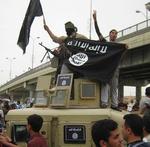 ISIS rolls into Iraqi town of Ramadi
In the current situation prevailing in western Iraq, the Americans and Iraqis might as well forget about their plans for retaking Iraq’s second city, Mosul, from ISIS control, this year.
*********************
Ramadi, the provincial capital of western Iraqi Anbar, fell to the Islamic State of Iraq and the Levant Friday, May 15 after its inhabitants were put to mass flight. The town, 110 km west of Baghdad, controls the traffic on the Euphrates River. Small pockets of Iraqi troops are still stranded there after taking hundreds of casualties.
The jihadists are in mid-momentum of a fresh multi-pronged offensive, which they launched shortly after they lost Tikrit last month to the biggest counter-offensive they had faced since seizing large tracts of land in Iraq nearly a year ago.
This momentum has carried the Islamists across Anbar province which touches the Syrian and Jordanian borders to capture another key location – Jubba, next door to Iraq’s biggest air base at Al-Ansar. There, hundreds of US officers and soldiers are training Iraqi troops to fight ISIS and helping the Iraqi army manage the fighting in the province.
Parts of this base have already come under Islamist gun and mortar fire.
Not far from Ramadi, ISIS is threatening the oil-producing town of Baiji where a small Iraqi army force of no more than a few hundred soldiers is surrounded by the jihadists, with slim chances of holding out much longer before they are wiped out or forced to surrender.
Yet another ISIS arm is pushing east towards Baghdad, with the object of disabling the international airport by bringing its runways within mortar range.
To conquer Ramadi, ISIS used bulldozers to knock gaps in the sand earthworks built by the Iraqi army to defend the town, then sending half a dozen bomb cars through the gaps to the Iraqi military command centers where they detonated.
Some of those bomb cars were driven by Muslims from West Europe, who had traveled through Syria to join up with ISIS in Iraq. The jihadists named one of them as “Abu Musa al-Britani.”
Just Thursday, May 14, the British police revealed that more than 700 potential terror suspects had traveled to Syria from the U.K. to fight or support extremists, and about half are believed to have returned, primed for terrorist operations on home ground.
In response to the British police statement, ISIS released a video recording of a message delivered by its leader Abu Bakr al-Baghdadi calling on supporters around the world to join the fight in Syria and Iraq or to “take up arms wherever they live.”
It was Baghdadi’s first message since a number of media reports said he was killed or critically injured, and was intended to refute claims that he was no longer in active charge of the group.
DEBKAfile’s counter-terror sources outline the common operational tactic, modus operandi, employed by the Islamist group in all its Iraq offensives.
After singling out a targeted location, their fighters first seize control of its environs. That way, they can block off in advance any incoming and outgoing movements of Iraqi troops – whether in retreat or for bringing up reinforcements. Next, their fighters storm into the core of the targeted location. Fleeing Iraqi soldiers and their local allies and civilians are summarily put to death.
This new ISIS impetus in Iraq has wiped out the military advantages the Iran-backed Shiite militias and US air force gained from the capture of the central Iraqi town of Tikrit in late March and early April. When the Shiie mlitias turned on the local Sunni populace for murder, burning and looting, the Obama administration turned to Tehran and Baghdad and demanded those militias be removed from the city.
Since the Iraqi army is incapable of recovering control and holding Tikrit after the Islamists were driven out, the town has sunk into anarchy with innumerable armed gangs battling each other for control of its quarters, some of them ISIS loyalists.
In the current situation prevailing in western Iraq, the Americans and Iraqis might as well forget about their plans for retaking Iraq’s second city, Mosul, from ISIS control, this year.
Obama’s Not-So-Ironclad Guarantee, Commentary Magazine, Jonathan S. Tobin, May 15, 2015
Now that the nuclear deal makes an Iranian bomb only a matter of when rather than if, the Gulf nations were hoping for more than just a carefully worded expression of American indifference.
***********
This was supposed to be the week when President Obama put on a show of his desire to reaffirm America’s support for its Arab allies. Saudi Arabia and the other Gulf states have spent the last year in the unusual position of agreeing more with Israel than the United States, as Obama pushes for détente with Iran. Like the Israelis, the Arabs are pondering their future in a region dominated by an Iranian nuclear threshold state that appears to be the lynchpin of the president’s foreign policy legacy. So to demonstrate his good will, Obama invited these nations to a summit at which he would convince them they had nothing to fear. But with the U.S. putting nothing on the table of substance that would allay those concerns about the weak nuclear deal being negotiated with Iran, the Saudi king and other leaders snubbed the event, turning it into a fiasco even before it began. But it turned out King Salman didn’t miss much. Though Obama offered what he called an “ironclad guarantee’ of America’s support for the Arabs, it was phrased in the kind of ambiguous language that rendered it meaningless. The meeting and especially the statement epitomized an Obama administration foreign policy that puts a premium on appeasing foes and alienating friends.
The wording of the president’s “guarantee” is a marvel of lawyerly ambiguity that any connoisseur of diplomatic doubletalk must appreciate:
In the event of such aggression or the threat of such aggression, the United States stands ready to work with our GCC partners to determine urgently what action may be appropriate, using the means at our collective disposal, including the potential use of military force, for the defense of our GCC partners.
Let’s unpack this carefully so we’re clear about what the United States isn’t promising its Arab allies. As even Obama’s cheerleaders at the New York Times noted, this “carefully worded pledge that was far less robust than the mutual defense treaty the Gulf nations had sought.” In the event of aggression, the U.S. isn’t going to spring into action to defend them. Instead it will “work” with them to “determine” what they might do. That falls quite a bit short of a hard promise of collective action, let alone the drawing of a line in the sand across which the Iranians may not cross. In other words, if something bad happens, Obama will talk with the threatened parties but he won’t say what he will do in advance or if he will do anything at all. If that is an “ironclad guarantee,” I’d hate to see what a less binding promise might sound like.
To understate the matter, this is not the sort of pledge that will deter an Iran that is emboldened by its diplomatic victory in the negotiations that let them their nuclear infrastructure and continuing working toward a bomb. Iran’s push for regional hegemony has also been boosted by the triumph of their Syrian ally Bashar Assad with the help of Tehran’s Hezbollah terrorist auxiliaries. With the Iran-backed Houthi rebels threatening to take over Yemen and Iran also resuming its alliance with Hamas in Gaza, the axis of Iranian allies has Arab states understandably worried about their future. Now that the nuclear deal makes an Iranian bomb only a matter of when rather than if, the Gulf nations were hoping for more than just a carefully worded expression of American indifference.
That’s why the statement at the end of the summit made no mention of America’s chief worry about the Gulf states: the possibility that the Saudis will, either acting alone or in concert with their neighbors, seek to match Iran’s nuclear potential. As critics of the Iran deal foretold, far from saving the Middle East from an Iranian bomb, it has set off an arms race that has will make the world a fare more dangerous place.
This omission will likely make the Iranians even more reluctant to give in to U.S. demands about sanctions, Tehran’s military research and the disposition of its stockpile of enriched uranium in the final stages of the nuclear talks. A better guarantee for the Arabs might have convinced the Islamist state that the president really meant business about strengthening the deal. In its absence, they have no reason to think Obama won’t fold as he has at every other stage of the negotiations.
Under the circumstances, it’s little wonder that Bahrain’s King Hamad preferred to go to a horse show London rather than confer with Obama. Just as Israel has learned that the United States is more interested in a new Iran-centric policy than it backing its traditional allies, so, too, must the Arabs come to grips with a new reality in which their Iranian foe is no longer restrained by the United States.
Hezbollah hiding 100,000 missiles that can hit north, army says
BY AP May 13, 2015, 10:49 pm

(Surely the Lebanese people know they are at risk. Afterall, Hezbollah is a big operation that is flush with cash and needs food, clothing, etc as well as weapons. In other words, a good portion of thier money must end up in the hands of the locals. Do the economic benefits outweigh the risk to the Lebanese people? I’m sure they will find out in the near future. – LS)
The Lebanese group Hezbollah has built up a massive arsenal of rockets and other advanced weapons in Shi’ite villages of southern Lebanon, a senior Israeli intelligence official said Wednesday, warning civilians would be at risk if war breaks out.
According to the official, Hezbollah has an estimated 100,000 short-range rockets capable of striking northern Israel, several thousand missiles that can reach Tel Aviv and central Israel and hundreds more that can strike the entire country.
Most of the weapons have been transferred to Lebanon through war-torn Syria, coming from Hezbollah’s key allies, the Syrian government and Iran, he said.
The official showed reporters satellite photos of what Israeli intelligence believes are Hezbollah positions in dozens of Shiite villages in southern Lebanon.
The photos were marked with dozens of red icons, signaling what are believed to be missile launchers, arms depots, underground tunnels and command posts.
The official, who spoke on condition of anonymity under military guidelines, said an estimated 200 villages have been turned into “military strongholds.”
One photo showed the village of Muhaybib, with a population of around 1,000 people and 90 buildings, of which more than a third had been marked as Hezbollah assets. In the larger village of Shaqra, with some 4,000 people, Israeli intelligence identified Hezbollah targets in around 400 out of some 1,200 buildings.
The army refused to allow publication of the images.
If war breaks out and Hezbollah fires missiles at Israel, these buildings will be targeted by Israel’s air force, the official said, adding that Israel would give civilians time to evacuate.
Israel and Hezbollah fought a month-long war in 2006 that killed some 1,200 Lebanese, including hundreds of civilians, and 160 Israelis and caused heavy damage to Lebanon’s infrastructure.
Though another Israel-Hezbollah war is always possible, analysts say the group has no interest in renewing hostilities while it is busy fighting alongside President Bashar Assad’s forces against rebels trying to topple him in Syria.
Pressed on Syria Crossing Red Lines, Obama Says Chlorine isn’t ‘Historically’ a Chemical Weapon
Via the Washington Free Beacon 5-15-2015
(Prepare to be underwhelmed. – LS)
Fig leaves falling, Power Line, Scott Johnson, May 14, 2015
Certain impediments complicate Barack Obama’s selling of the arrangement with the Islamic Republic of Iran. Obama seeks to camouflage the arrangement as one that deters Iran from the acquisition of nuclear weapons. In reality, the arrangement will finance and expedite the mullahs’ acquisition of nuclear weapons.
John Kerry has issued ludicrous “guarantees” in connection with the arrangement. One such guarantee is categorical, but it’s not a money-back sort of a guarantee: “I say to every Israeli that today we have the ability to stop [the Iranians] if they decided to move quickly to a bomb and I absolutely guarantee that in the future we will have the ability to know what they are doing so that we can still stop them if they decided to move to a bomb.”
We may doubt the omniscience that is the predicate of Kerry’s guarantee. But this is strictly a limited warranty. Kerry doesn’t even “guarantee” that his boss would do anything about it if Iran were to break out. Kerry only guarantees that “we” could. Good to know. Kerry’s “guarantee” amounts to nothing more than meaningless verbiage two or three time over.
The arrangement will also provoke an equal and opposite reaction from the Sunni rivals of Iran such as Saudi Arabia. The Sunni rivals understand the nature of the arrangement in process. Their understanding accounts for Obama’s “lonely Arab summit.”
President Obama’s dubious fact-sheet setting forth Parameters for a Joint Comprehensive Plan of Action reflects the fig leaves with which the president seeks to cover the nuts of the deal. Senator Rubio couldn’t get to first base in his proposal requiring any final deal to include the fig leaves. (Eli Lake dubbed it “Rubio’s new and improved poison pill.”)
The fig leaves are falling. The official Farsnews outlet reports that inspection of military sites is not included in the arrangement in process — this according to Iranian envoy to the IAEA Reza Najafi and despite the alleged parameter requiring Iran “to grant access to the IAEA to investigate suspicious sites or allegations of a covert enrichment facility, conversion facility, centrifuge production facility, or yellowcake production facility anywhere in the country.”
The alleged parameters regarding sanctions provide that Iran “will receive sanctions relief, if it verifiably abides by its commitments” and that “U.S. and E.U. nuclear-related sanctions will be suspended after the IAEA has verified that Iran has taken all of its key nuclear-related steps. If at any time Iran fails to fulfill its commitments, these sanctions will snap back into place.”
We have already learned that President Obama intends to reward Iran with a huge “signing bonus” at the outset of the arrangement. He will agree to the removal of all United Nations sanction on Iran at the same time. He will also waive our own statutory sanctions on Iran. Just about the last fig leaf remaining on this element of the deal is the (utterly meaningless) assertion: “If at any time Iran fails to fulfill its commitments, these sanctions will snap back into place.”
Now Bloomberg News reports that this fig leaf is falling too: “Russia rejects automatic sanctions return if Iran cheats on deal.” Bloomberg quotes Russia’s UN Ambassador Vitaly Churkin bluntly asserting yesterday, “There can be no automaticity, none whatsoever” in reimposing UN sanctions if Iran violates the terms of an agreement to curb its nuclear program.
Omri Ceren writes to comment this morning (footnotes omitted):
The statement really shouldn’t count as breaking news, even though it is. Reuters reported toward the very end of Lausanne that the Russians and Chinese were still rejecting the multilateral snapback. But then the Lausanne announcement happened, and President Obama declared from the Rose Garden that in fact “if Iran violates the deal, sanctions can be snapped back into place.” But then a week later the Associated Press reported that, no, “Russia and China are unlikely to accept any process that sees them sacrifice their veto power.”
At the end of April the American Enterprise Institute quoted Russian Deputy Foreign Minister Sergey Ryabkov saying the exact same thing that Churkin just told Bloomberg News: “in the hypothetical situation that Iran should fail to honour its commitments, then this process should not in any way be automatic.”
And yet the policy conversation has been proceeding as if multilateral snapback is actually a real thing that could happen in our reality.
Part of the reason is that snapback is all the Obama administration has left on the sanctions debate. White House officials had assured lawmakers for literally years that sanctions relief would be phased out only as Iran met a series of nuclear obligations. But after Lausanne, Supreme Leader Ayatollah Ali Khamenei set a new red line, in which he demanded that the relief must be immediate. The administration began trying to find ways to concede to his demand without violating its previous “phase out” promises, which is how the WSJ’s scoop about a $50 billion signing bonus came to be.
That apparently didn’t work, and so instead the administration went all-in on snapback. At his press conference with Renzi in the middle of April the President signaled the that he was prepared to cave on upfront sanctions relief because – he told journalists – what was actually important was snapback: “with respect to the issue of sanctions coming down, I don’t want to get out ahead of John Kerry and my negotiators… [o]ur main concern here is making sure that if Iran doesn’t abide by its agreement that we don’t have to jump through a whole bunch of hoops in order to reinstate sanctions. That’s our main concern.”
The arrangement’s alleged Iranian concession are, you might say, phony baloney all the way down.




 anneinpt
 artaxes
 danmillerinpanama
 davidking1530
 Peter Hofman
 Joseph Wouk
 Peter
Peter Louisiana Steve
 WarSclerotic
Recent Comments