Archive for April 2015

Shia Militia Leader Explodes Over Possibility of U.S. Support for Kurdish Forces

April 30, 2015

Shia Militia Leader Explodes Over Possibility of U.S. Support for Kurdish Forces, Center for Security PolicyKyle Shideler, April 30, 2015

In the United States, the Obama Administration finds itself on the same side of the argument as Moqtada Al-Sadr, opposing the bill to permit arms for Kurdish forces.

******************

Shia leader Moqtada Al-Sadr, head of the Jaish al-Mahdi (JAM), issued a stark denunciation of the U.S. Defense Bill currently in front of the U.S. House of Representatives this week, threatening to fight U.S. interests both in Iraq and overseas, in the event that the bill passed.

Al Sadr opposes the bill, because it would authorize the direct transfer of military aid to Kurdish Peshmerga and Sunni tribal forces in order to fight the Islamic State, outside of the direct control of the central government in Baghdad.

“The U.S. House of Representatives intends to pass a draft law on Iraq making each sect independent from the other, and this will be the beginning of Iraq’s division,” Sadr said in a statement. If the U.S. passes such law, “then we will be obliged to lift the freeze on the military wing which is tasked with (fighting) the American side, to start hit the U.S. interests in Iraq and even abroad possibly,” Sadr warned.

Al Sadr’s JAM was one of the primary Shia militia forces used by Iran during Operation Iraqi Freedom, and responsible the deaths of numerous American fighting men and women. Iraq has primarily leaned on the use of Shia militias, operating under the rubric of the Popular Moblization Forces, but many of the 30,000+ militia fighters operate under direct command and control from the Iranian Islamic Revolutionary Guards Corps.

The Baghdad government, which is heavily supported by Iran, has also vocally opposedthe measure:

We will reject the arming of the Peshmerga directly by the US,” Iraq’s Defense Minister Khalid Al-Obeidi, told Rudaw on Thursday.

Kurdish forces have repeatedly complained that aid designated for use by their forces has repeatedly been redirected by the Baghdad government to Shia militias, some of whom are responsible for sectarian war crimes. Kurdish forces have also expressed concern over the entry of Shia forces into areas viewed by the Kurds as traditionally Kurdish, such as Kirkuk.

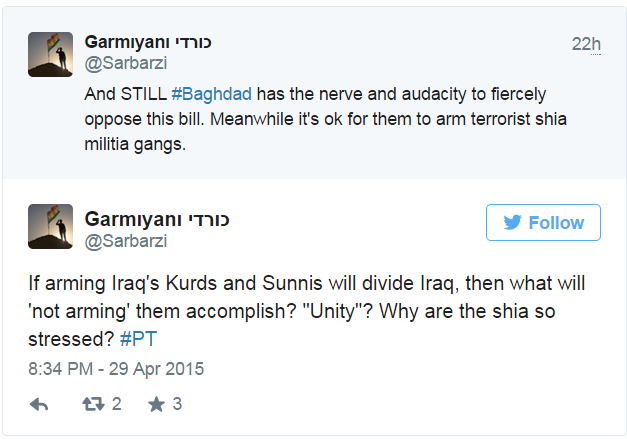
Supporters of the Peshmerga took to twitter to complain about the double standard:

garmiyani-tweet

In the United States, the Obama Administration finds itself on the same side of the argument as Moqtada Al-Sadr, opposing the bill to permit arms for Kurdish forces. As State Department Spokeswoman Marie Harf confirmed yesterday:

QUESTION: Yes. Do you have any comment about this draft resolution at the Armed Services Committee that calls for the recognition of the Sunni fighters and the Kurdish Peshmerga forces as a country, and so they can be – directly receive aid and weapons from the U.S., not through the central government?

MS HARF: I saw that. I saw that. And to be very clear: The policy of this Administration is clear and consistent in support of a unified Iraq, and that we’ve always said a unified Iraq is stronger, and it’s important to the stability of the region as well. Our military assistance and equipment deliveries, our policy remains the same there as well, that all arms transfers must be coordinated via the sovereign central government of Iraq. We believe this policy is the most effective way to support the coalition’s efforts.

So we look forward to working with congress on language that we could support on this important issue, but the draft bill, as you noted, in the House – this is very early in the process here for the NDAA – as currently written on this issue, of course, does not reflect Administration policy.

By opposing the direct arming of Sunni and Kurdish forces (and the Kurdish forces in particular), the administration is continuing a policy arc in the region that continues to serve the interests of the Iranians because it creates a dynamic where the only viable players are either Sunni jihadists (whether Islamic State, or in the case of Syria, Al Qaeda-linked groups such as Jabhat al-Nusra), or Iranian-backed forces, such as Assad and the Shia militias operating in Iraq, who are no less committed enemies of the United States.  Bringing supplies directly to Kurdish forces will give the United States a third option to positively affect the outcome of events in Iraq without requiring the modus vivendi with the Iranians.

Recognize Israel or Take This Deal and Shove It

April 30, 2015

Rubio Has Just Aligned With Netanyahu In Protecting Israel Against Obama’s Nuke Deal With Iran
Norvell Rose April 30, 2015 at 7:31am Via Western Journalism

(Excellent candidate for POTUS.  I strongly recommend everyone watch Mr. Rubio’s eloquent speech…without a teleprompter.  Of course, Iran would have nothing to with such a thing. – LS)

A writer for Time magazine says it could be a potential “killer” — a proposed change to the bill now being debated in the Senate that would give Capitol Hill lawmakers a big say in whether President Obama’s emerging nuke deal with Iran goes forward. According to the lead paragraph in the Time article: “Sen. Marco Rubio has proposed a change to the Iran nuclear review bill that could unravel a carefully crafted compromise and kill the Obama Administration’s negotiations.”

There are certainly those who would challenge Time‘s assertion that the arrangement contemplated with Iran’s theocratic regime is a “carefully crafted compromise,” in part because it doesn’t include what Rubio wants to help protect Israel. The Republican senator and 2016 GOP candidate for president has introduced an amendment to the proposed review bill in the Senate insisting that any deal contains Iran’s official recognition of Israel’s right to exist as a Jewish state.

Time notes that a similar proposal was put forth by Israeli Prime Minister Benjamin Netanyahu, who has been harshly critical of the Obama administration’s concessions to Iran in the negotiations intended to prevent the country from obtaining a nuclear weapon. Obama has previously indicated his opposition to the sort of amendment Rubio has introduced with a passionate floor speech.

“Israel is not just a country,” Rubio said. “It has a special and unique purpose that sets it apart from any other nation on Earth. It was created as a homeland for a persecuted people.”

By clicking on the video above, you can see Sen. Marco Rubio’s speech on the floor of the Senate in which he urged his colleagues to approve his one-page amendment protecting Israel’s future.


Off topic | Britain’s Labour Party Vows to Ban Islamophobia

April 30, 2015

Britain’s Labour Party Vows to Ban Islamophobia, Gatestone InstituteSoeren Kern, April 30, 2015

  • “In Miliband’s Britain, it will become impossible to criticise any aspect of Islamic culture, whether it be the spread of the burka or the establishment of Sharia courts or the construction of colossal new mosques. … If he wins, Miliband will ensure that the accelerating Islamification of our country will go unchallenged.” — Leo McKinstry, British commentator.
  • The report shows that Britain’s Muslim population is overwhelmingly young and will exert increasing political influence as time goes on. The median age of the Muslim population in Britain is 25 years, compared to the overall population’s median age of 40 years.

The leader of Britain’s Labour Party, Ed Miliband, has vowed, if he becomes the next prime minister in general elections on May 7, to outlaw “Islamophobia.”

The move — which one observer has called “utterly frightening” because of its implications for free speech in Britain — is part of an effort by Miliband to pander to Muslim voters in a race that he has described as “the tightest general election for a generation.”

With the ruling Conservatives and the opposition Labour running neck and neck in the polls just days before voters cast their ballots, British Muslims — who voted overwhelmingly for Labour in the 2010 general election — could indeed determine who will be the next prime minister.

In an interview with The Muslim News, Miliband said:

“We are going to make it [Islamophobia] an aggravated crime. We are going to make sure it is marked on people’s records with the police to make sure they root out Islamophobia as a hate crime.

“We are going to change the law on this so we make it absolutely clear of our abhorrence of hate crime and Islamophobia. It will be the first time that the police will record Islamophobic attacks right across the country.”

Miliband appears to be trying to reopen a long-running debate in Britain over so-called religious hatred. Between 2001 and 2005, the then-Labour government, led by Prime Minister Tony Blair, made two attempts (here and here) to amend Part 3 of the Public Order Act 1986, to extend existing provisions on incitement to racial hatred to cover incitement to religious hatred.

Those efforts ran into opposition from critics who said the measures were too far-reaching and threatened the freedom of speech. At the time, critics argued that the scope of the Labour government’s definition of “religious hatred” was so draconian that it would have made any criticism of Islam a crime.

In January 2006, the House of Lords approved the Racial and Religious Hatred Act 2006, after amending the text so that the law would be limited to banning only “threatening” words and not those that are merely abusive or insulting. Lawmakers also said that the offense would require the intention — not just the possibility — of stirring up religious hatred. They added that proselytizing, discussion, criticism, abuse and ridicule of religion, belief or religious practice would not be an offense.

Miliband’s renewed promise to make “Islamophobia” (a term he has not defined) an “aggravated crime” may signal an attempt to turn the 2006 Act — which already stipulates a maximum penalty of seven years in prison for stirring up religious hatred — into a full-blown Muslim blasphemy law.

According to British commentator Leo McKinstry, “Miliband’s proposal goes against the entire tradition of Western democracy, which holds that people should be punished only for their deeds, not their opinions.” In an opinion article, he added:

“In Miliband’s Britain, it will become impossible to criticise any aspect of Islamic culture, whether it be the spread of the burka or the establishment of Sharia courts or the construction of colossal new mosques. We already live in a society where Mohammed is now the most popular boy’s name and where a child born in Birmingham is more likely to be a Muslim than a Christian. If he wins, Miliband will ensure that the accelerating Islamification of our country will go unchallenged.”

McKinstry says Miliband is currying favor with Britain’s three million-strong Muslim community to “prop up Labour’s urban vote.”

Muslims are emerging as a key voting bloc in British politics and are already poised to determine the outcome of local elections in many parts of the country, according to a report by the Muslim Council of Britain, an umbrella group.

The report shows that Britain’s Muslim population is overwhelmingly young and will exert increasing political influence as time goes on. The median age of the Muslim population in Britain is 25 years, compared to the overall population’s median age of 40 years.

An extrapolation of the available data indicates that one million British Muslims aged 18 and above will be eligible to vote in this year’s election. According to one study, Muslims could determine the outcome of up to 25% of the 573 Parliamentary seats in England and Wales.

Others say that although Britain’s Muslim community is growing, it is also ethnically diverse and unlikely to vote as a single group. One analyst has argued that the potential for Muslim influence in this year’s election “will remain unrealized because the Muslim vote is not organized in any meaningful way on a national level.”

A study produced by Theos, a London-based religious think tank, found that although Muslims consistently vote Labour, they do so based on class and economic considerations, not out of religious motives.

Indeed, a poll conducted by the BBC on April 17 found that nearly one-quarter of “Asian” voters still do not know which party they will support at the general election. Some of those interviewed by the BBC said that economic issues would determine whom they vote for.

In any event, Muslim influence in the 2015 vote will be largely determined by Muslim voter turnout, which has been notoriously low in past elections: Only 47% of British Muslims were estimated to have voted in 2010.

Since then, several grassroots campaigns have been established to encourage British Muslims to go to the polls in 2015, including Get Out & Vote, Muslim Vote and Operation Black Vote. Another group, YouElect, states:

“A staggering 53% of British Muslims did not vote in the 2010 General Election, such a high figure of Muslim non-voters indicates that many Muslims feel ignored by politicians and disillusioned by the political process.

“With the rise of Islamophobic rhetoric in politics and an ever increasing amount of anti-terror legislation which specifically targets Muslims, it is now more important than ever that Muslims use the vote to send a message to politicians that their attitudes and policies must change.

“YouElect wants to get the message across that there is something you can do about the issues you care about. We have launched a new campaign using the hashtag #SortItOut, which calls on Muslims to use the political process to address the issues that concern them most.

“With 100,000 new young Muslims eligible to vote this year and 26 parliamentary constituencies with a Muslim population of over 20%, the Muslim community has a very real opportunity to make an impact on British politics.”

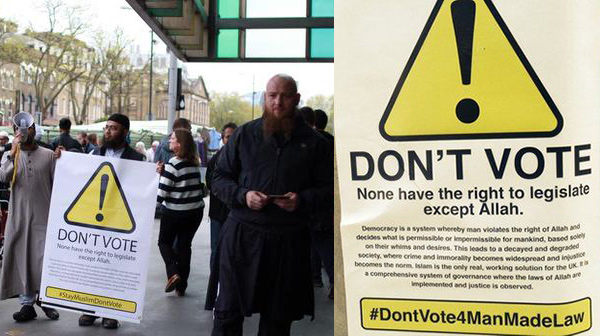
Not all Muslims agree. The British-born Islamist preacher Anjem Choudary is actively discouraging Muslims from voting. In a stream of Twitter messages using the #StayMuslimDontVote hashtag, Choudary has argued that voting is a “sin” against Islam because Allah is “the only legislator.” He has also said that Muslims who vote or run for public office are “apostates.”

1050Despite several grassroots campaigns to encourage British Muslims to vote in greater numbers, some prominent Islamists in the UK claim that voting is a “sin.”

Other British Islamists are following Choudary’s lead. Bright yellow posters claiming that democracy “violates the right of Allah” have been spotted in Cardiff, the capital of Wales, and Leicester, as part of a grassroots campaign called #DontVote4ManMadeLaw.

One such poster stated:

“Democracy is a system whereby man violates the right of Allah and decides what is permissible or impermissible for mankind, based solely on their whims and desires.

“Islam is the only real, working solution for the UK. It is a comprehensive system of governance where the laws of Allah are implemented and justice is observed.”

The Bad Deal That Could Lead to Nuclear War in the Mideast

April 30, 2015

Senator Warns That Zarif’s Comments Show Iran ‘Cannot Be Trusted,’ Challenges Him to Debate
by TheTower.org Staff | 04.30.15 10:10 am


(Iran seems to be saying it will do an end-run around the US and go directly to the UN if sanctions are not lifted, deal or no deal. – LS)

Shortly after Iranian foreign minister and chief nuclear negotiator Mohammad Javad Zarif spoke at New York University, Senator Tom Cotton (R-Ark.) responded, criticizing Zarif’s demand that U.N.-imposed sanctions on Iran must be lifted immediately upon completing a nuclear deal and challenging Zarif to a debate.

On his website, Cotton pointed out that Zarif’s remarks contradicted President Barack Obama, who has insisted that sanctions can only be lifted once Iran complies with the obligations of any future deal:

“President Obama promised sanctions would only be lifted when Iran’s compliance with restrictions on their nuclear program were verified. But earlier today, Iranian Foreign Minister Javad Zarif once again contradicted the President’s interpretation saying:

If we have an agreement on the 30th of June, within a few days after that, there will be a resolution before the UN Security Council under Article 41 of Chapter 7 which will be mandatory for all member states whether Senator Cotton likes it or not.

“Sanctions relief isn’t about what I like, but what will keep America safe from a nuclear-armed Iran. But I suspect Foreign Minister Zarif is saying what President Obama will not because the President knows such terms would be unacceptable to both Congress and the American people. The repeated provocative statements made by members of the Iranian leadership demonstrate why Iran cannot be trusted and why the President’s decision to pursue this deal and grant dangerous concessions to Iran was ill-advised from the beginning. These aren’t rhetorical tricks aimed at appealing to hard-liners in Iran; after all, Mr. Zarif was speaking in English in New York. Rather, they foreshadow the dangerous posture Iran will take and has taken repeatedly—including as recently as yesterday with the interception of a U.S.-affiliated cargo ship—if this deal moves forward.

In addition to pointing out Zarif’s contradiction of the president, Cotton, a graduate of Harvard Law School, responded to Zarif’s mention of his name by challenging him to a debate on Twitter, and to discuss Iran’s support of “tyranny, treachery, & terror.”

In his talk yesterday, Zarif also defended Iran’s seizure of a cargo ship in an internationally recognized shipping lane, as well as the espionage trial of Washington Post reporter Jason Rezaian.

Cotton was the lead author of an open letter, signed by 47 senators last month, that asserted that Congress would have a Constitutionally-mandated role in ending any American-imposed sanctions on Iran. In response, Zarif revealed that Iran intended to have sanctions first lifted by the United Nations Security Council as a means of pressuring the United States to lift the sanction it had imposed on Iran.

In an interview earlier this month, Cotton asserted that moderates in Iran were not being empowered through the negotiations, and that a bad deal could lead to nuclear war in the Middle East.

IDF Mission Commander in Nepal Motivates his Soldiers

April 30, 2015

IDF Mission Commander in Nepal Motivates his Soldiers – YouTube.


News from the Russian Front: Why Russia Will Lose in Ukraine

April 29, 2015

Why Russia Will Lose in Ukraine
By Alexander J. Motyl 24 February 2015 Via The World Affairs Journal


(While the rest of the world moves forward, Putin finds it necessary to return to a cold war posture. Something is terribly wrong with Putin and his ability to deal with the rest of the world. Of course, we have our own problems here in the US with our very own lightweight so-called leader. Anyway, this article contains some interesting commentary regarding Putin’s antics. – LS)

So who’s winning the war in eastern Ukraine—Russia or Ukraine? The answer is not as simple as it might seem, because victory means different things for each side.

A Russian victory could take one of two forms: territorial expansion into large parts of southeastern Ukraine or the imposition on Ukraine of disadvantageous peace terms. Or it could take both forms. But neither has happened, and neither is likely to happen.

Anything short of such a victory amounts to a defeat for Russia. Having destroyed the Russian economy, transformed Russia into a rogue state, and alienated Russia’s allies in the “near abroad,” Vladimir Putin loses if he doesn’t win big.

In contrast, Ukraine wins as long as it does not lose big. If Ukraine can contain the aggression, it will demonstrate that it possesses the will and the military capacity to deter the Kremlin, stop Putin and his proxies, and survive as an independent democratic state.

The balance of forces could change. Russia could throw hundreds of thousands of regular troops against Ukraine in order to seize Kyiv or build a land corridor to Crimea. But this would dramatically increase Putin’s risk factor. In that case, Ukrainians would fight to the finish, a partisan war would ensue, the United States would supply weapons to Ukraine, other Eastern European countries might get involved in the fighting, Western sanctions would be ratcheted up, and Russia would be excluded from the SWIFT international banking system. Russian losses—human, financial, and material—would likely be enormous, inviting a palace coup against Putin.

Although Putin is driven by a bizarre vision of reestablishing Holy Russia’s greatness, he is enough of a realpolitik policymaker to understand that attempting to overrun Ukraine would have dire consequences for Russia and himself.

Putin is therefore likely to maintain the military pressure on Ukraine—having the separatists strike here, strike there, withdraw, regroup, make nice, and then repeat the cycle—in the hope of draining Ukraine’s economic, military, and human resources.

But that, too, won’t result in territorial expansion into large parts of southeastern Ukraine or the imposition on Ukraine of disadvantageous peace terms.

Thus far skittish about military aid, the Obama administration is coming under increasing pressure to provide Ukraine with lethal weapons and real-time intelligence. Provided that meaningful economic reforms move forward in Kyiv, chances are good that other Western states and institutions will give Ukraine significant economic assistance, especially now that the IMF has committed itself to a $40 billion aid package. And the more Western money is sunk into Ukraine, the greater the likelihood that Western states will follow with military aid, if only as a guarantee of their financial investment. Meanwhile, Ukrainian elites—prodded by the West and compelled by Putin’s threat to annihilate Ukraine—will embark on (more or less) radical economic reforms.

The Ukrainian armed forces are getting stronger and more effective by the day, inflicting high casualties on the militants and Russians and maintaining their positions. Even the retreat from the Debaltseve salient, mistakenly portrayed in the Western press as a “debacle,” was anything but. (In order to know that, however, you need to be able to read Ukrainian- and Russian-language sources.) According to one of Ukraine’s top military analysts, Yuri Biryukov, Ukraine’s losses were 179 dead and 89 missing and presumed dead in the period from January 18th to February 18th, while Russian and proxy losses amounted to 868 dead—roughly three to four times as many. And small wonder. As Ukraine’s other top military analyst, Yuri Butusov, has repeatedly argued on his Facebook page, there is simply no comparison between the Ukrainian army of today and the ragtag band of soldiers that was Ukraine’s armed forces in March of 2014, when Putin seized the Crimea. More important, Ukraine’s less than competent military command appears to be on the verge of a major change in personnel.

The situation on the front is a military stalemate that is as deleterious to the Donbas enclave’s economic viability as it is beneficial to Ukraine’s ability to survive as an independent political entity. As this blog has argued ad nauseam, a frozen conflict—which may be in the process of emerging, even though everyone denies it—would be the best thing that could possibly happen to Ukraine.

Finally, although Ukrainians are one-fourth as many as Russians, Ukrainians are fighting for their homeland. In both eastern and western Ukraine, they know this is perhaps their last chance to break free of Moscow’s imperial grip. The remarkable thing about Ukraine’s dedicated volunteer battalions is the high number of eastern Ukrainians in them. Western Ukrainians dominated in both the 2004 Orange Revolution and the 2014 Maidan Revolution. Russian-speaking eastern Ukrainians have demonstrated that, when it comes to defending their own homes, they’re more than willing to step up.

Russia can’t win big. Ukraine can’t lose big. And that means that Russia is losing and Ukraine is winning—and that Russia will lose and Ukraine will win.

The West should know that, in supporting Ukraine, it’s not just doing the right thing. It’s also betting on the winner.

How Iran Saved Obama’s “Blame America” Foreign Policy

April 29, 2015

How Iran Saved Obama’s “Blame America” Foreign Policy, Front Page Magazine, April 28, 2015

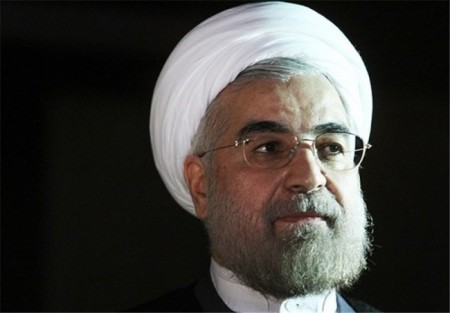
rouh-450x313

Obama’s public rejection of every ally, from Israel to Egypt to Saudi Arabia, has finally created the Post-American Middle East that his “Blame America” doctrine sought. The Post-American Middle East is a hive of terrorist groups and a region of nuclear arms races where murderous despots with vast armies dream of resurrecting the Ottoman Empire, the Persian Empire and the Abbasid Caliphate.

*********************

Obama’s Middle East policy was doomed to fail because it was based on the myth that everything wrong with the region was America’s fault.

Senator Obama had argued that Iraq would fix itself once we pulled out. Without America, the Iraqis would create a “political solution”. Instead the Shiites used the withdrawal to take over the government and Al Qaeda rebounded to dominate the Sunnis. After years of denying what was going on, he was forced back into Iraq after genocide and beheadings filled every television screen.

From the White House, he deployed the “Iraq Solution” across the Middle East by withdrawing support from American allies and backing terrorist groups like the Muslim Brotherhood. The chaos tore apart the region and turned over entire cities and countries to terrorists.

Egypt went through multiple coups. Street violence in Tunisia wrecked the country and supplied thousands of fighters to ISIS. His regime change war in Libya led to terrorist takeovers of its capital. Al Qaeda nearly took over Mali. Houthi Jihadists backed by Iran took over Yemen’s capital. The Saudis are bombing Yemen. The Egyptians are bombing Libya. The French are still fighting in Mali.

Iran and Al Qaeda have divided up Iraq, Syria and Yemen between themselves.

Withdrawing American power and influence didn’t work because we were never the problem. American soldiers weren’t causing the Sunnis and Shiites to fight each other. They were the only thing preventing it. American power and influence across the Middle East wasn’t holding back freedom and human rights, it was the only thing keeping a modicum of freedom alive in places like Egypt and Tunisia that quickly fell to Islamist rule in the Arab Spring, resulting in street violence, torture, terrorism and military coups.

The left had been fundamentally wrong about the cause of the problems in the Middle East. Obama trashed the region by following its wrongheaded doctrines.

Once the “Blame America” foreign policy has been implemented and the region went to hell, he had no idea what to do next. Intervening in Libya made sense according to the “Blame America” doctrine because Gaddafi had recently cut a deal with the United States and was obstructing the Jihadists who were implementing the local version of the Arab Spring in coordination with the Muslim Brotherhood.

But intervening in Syria didn’t. Assad wasn’t an American ally. Therefore the “Blame America” doctrine said that he should be left alone. But he was obstructing the Arab Spring. Overthrowing him would let the Muslim Brotherhood claim another country, but would alienate Iran and spoil any reconciliation.

Unable to make a final decision, Obama veered back and forth between Iran and the Muslim Brotherhood. Some days he seemed on the verge of bombing Syria and other days he was against even providing the promised weapons to the Sunni rebels. Even his supporters accused him of having no plan.

Syria’s real red line was the one that it had drawn through his foreign policy. Instead of making the Middle East better, his withdrawals had made it worse. And the beneficiaries of his foreign policy, especially the Muslim Brotherhood, were clamoring for more American military intervention.

Even Iraq’s Shiite government, backed by Iran, wanted American intervention.

Obama’s foreign policy had created a new set of untrustworthy client states which had to be kept alive by American intervention. The great joke of his foreign policy was that his new terrorist states acted just like the old dictators they were supposed to replace. They wanted American weapons and soldiers. Their own people hated them and hated America by extension. The climax of the Arab Spring came with crowds in Tahrir Square denouncing Obama and the Muslim Brotherhood for acting as his client state.

The “Blame America” foreign policy had led to even more blame of America. The new “democratic” Islamist governments that he helped bring to power to appease the Arab Street and atone for the sins of supporting the old secular-ish dictators backfired by making the Arab Street hate us more than ever.

Iran saved Obama’s foreign policy. Just as he was stumbling around Syria and weeping at being stuck back in Iraq, the agents of the Iran Lobby suggested that the whole mess could be put back together again. Iran and the US would fight on the same side against ISIS in Syria and Iraq. And this cooperation could be used to hammer out a nuclear accord that would retroactively justify Obama’s Nobel Prize.

The only problem was that everyone else in the region was completely against the idea.

The Iran Lobby threw Obama’s failed foreign policy a lifeline and he grabbed it. The bombing of Syria was off. Assad turned over some WMDs, but went on using others. The US began acting as the air force for Iran’s Shiite militias in Iraq while the Kurds and the Sunni Sheikhs of the Awakening were shut out.

When the Houthis took over Yemen, Obama shrugged. When the Saudis began bombing Yemen, they didn’t tell him because they were afraid the news would leak to Iran. And the administration covertly began pressuring them to stop, confirming that it now took its marching orders from Tehran, not Riyadh.

Obama ignored the vocal opposition, particularly from Israel’s Netanyahu, because the Iran deal was the only thing holding his foreign policy together. It made it seem as if he knew what he was doing. Take away the Iran deal and there was no longer a strategy, just a series of incoherent panicked responses.

That is why he continues to cling to the Iran deal. Without it, the Emperor’s foreign policy is naked.

The Iran deal salvaged the “Blame America” foreign policy by reorienting it away from the Muslim Brotherhood to deal with our great enemy in the region. By acceding to Iran’s nuclear program, Obama could finally fix everything by atoning for America’s biggest foreign policy sin in the region.

Despite his Muslim family background, Obama never understood the Middle East. Instead he looked at the region through a left-wing lens and saw only America’s crimes.

The Sunnis and Shiites, the Arabs, Kurds, Persians and Turkmen, weren’t fighting because of America. They were fighting over differences in religion, ethnicity and clan. The left has always thought that the way to fix the Middle East was to withdraw American influence. Instead doing that destabilized the region and created a power vacuum that Russia and Iran have been more than happy to fill.

Obama’s final foreign policy act was to fall directly into Iran and Al Qaeda’s trap.

Iran and the various Al Qaeda groups had effectively split parts of the region among themselves. By embracing Iran, Obama alienated the Sunni Middle East and shoved entire populations into Al Qaeda’s waiting embrace. He completed the polarizing process that he began with the Arab Spring by selling out the moderates to the extremists and waiting for everyone in the region to love America again.

But the Muslim Brotherhood lost out to its edgier Al Qaeda children. Egypt and the Saudis are scrambling to hold together some sort of Sunni center without the United States and against its wishes. Obama’s alignment with Iran, his rejection of Egypt’s new government and his failure to back the Saudis in Yemen has sent the message that the only legitimate alternative to Al Qaeda is Iran.

That’s not an alternative that most Sunnis can accept. Many would rather stand with Al Qaeda than Iran.

Obama’s public rejection of every ally, from Israel to Egypt to Saudi Arabia, has finally created the Post-American Middle East that his “Blame America” doctrine sought. The Post-American Middle East is a hive of terrorist groups and a region of nuclear arms races where murderous despots with vast armies dream of resurrecting the Ottoman Empire, the Persian Empire and the Abbasid Caliphate.

While genocide goes on, sex slaves are raped under the rule of a Caliph and black flags are unfurled and nuclear weapons are developed to fulfill apocalyptic Islamic prophecies, Obama smiles for the camera and waits for his second Nobel Prize.

It had been America’s fault all along. Now that Iran and Al Qaeda are in charge, everything will be okay.
DEBKA reveals: Hizballah officers land in Tehran with Syrian defense chief. Iran OKs anti-Israel strategy

April 29, 2015

DEBKA reveals: Hizballah officers land in Tehran with Syrian defense chief. Iran OKs anti-Israel strategy
DEBKAfile Special Report April 29, 2015, 8:50 AM (IDT)


(I imagine Hizballah has already forgotten how costly in terms of lives and resources it is by taking on Israel. ‘Saving face’ must be more important to them. – LS)

A high-level Hizballah delegation arrived secretly in Tehran Tuesday, April 28, along with the large military group led by Syrian Defense Minister Fahad Jassim al-Freij, DEBKAfile’s intelligence sources report exclusively. Both are taking part in the four days of military and intelligence consultations with Iranian officials on the war situation in Syria and the steps planned against Israel. According to a senior Gulf intelligence official, “The parties quickly finalized their plans of action against Israel, and the IDF will no doubt face on the Golan a far more active and intense front than they have seen yet.”
The failed attempt Sunday, April 26, by a Druze squad to plant a bomb near an Israeli military border post in northern Golan was just a foretaste of the coming offensive, according to the source.
He found Hizballah’s active participation in the Syrian-Iranian military talks in Tehran entirely natural, in view of the doubling of the Lebanese Shiite organization’s combat troops fighting alongside the Syrian army to roughly 7,000. This figure is over and above the missile, intelligence and logistics units assisting the Syrian war effort now in its fifth year.
DEBKAfile reported earlier that the Syrian rocket-mortar fire on Golan Tuesday was timed for Gen. Freij’s arrival in Tehran to collect his next orders.
The two rockets or mortar shells from Syria which exploded on the Golan at noon Tuesday, April 28, followed by alerts along the Galilee border with Syria, were timed to coincide exactly with the arrival in Tehran of a large Syrian military delegation led by Defense Minister Fahad Jassim al-Freij. High on the agenda of his consultations with Iranian leaders was no doubt the explosive situation developing on the Syrian-Israeli border.
Syrian President Bashar Assad and Hizballah’s leader Hassan Nasrallah are reported by DEBKAfile’s intelligence sources to have held urgent discussions in the last few days on how to react to the two Israeli air strikes reported by Arab media to have been conducted Wednesday, April 22 and Friday, April 24, on their Qalamoun mountain missile bases.
Both needed to hear from Tehran how far they could count on Iranian support in the event of a military showdown with Israel.
Israeli military spokesmen have gone out of their way to play down the risk of any further security deterioration. After the fragments of at two rockets or mortar shells were discovered Tuesday on the land of Kibbutz Ein Zivan near the border fence opposite Quneitra, military sources tried to calm people by attributing them to “spillover” from the fighting on the Syrian side of the border. The farmers were nonetheless advised to stop work in the apple and cherry orchards, and would not be surprised if the Syrians kept up their cross-border fire to provide “background music” for their defense minister’s discussions in Tehran.
The IDF also omitted mentioning that the squad of four terrorists which tried Sunday, April 26, to plant an explosive device near an Israeli border post in this same area – and was liquidated by the Israeli Air Force – were Druze militiamen, recruited and trained by Hizballah and given their assignment by Syria’s southern intelligence chief, Wafeeq Naser.
DEBKAfile’s military sources calculate that the coming hours may be critical for Israel’s northern front against Syria and Hizballah. If Tehran gives the nod, both are liable to ratchet up their assaults on northern Israel’s Golan and Galilee regions.
They won’t have to wait for Gen. Al-Freij’s return to learn about this decision. The appropriate directives may be flashed directly from Tehran to the Iranian officers based at Syrian staff headquarters in Damascus and serving in the military facilities in southern Syria and opposite the Golan.
Assad may welcome this outlet to vent his frustration as his army licks its wounds from the loss Saturday, April 25, of the strategic town of Jisr al-Shukjhour in the northern Syrian Idlib province, to a coalition of opposition forces calling itself the Army of Conquest. This puts the rebels in position to threaten one of Assad’s most important strongholds, Latakia. The Syrian ruler, if he wants to survive, can’t hope to weather both the Idlib defeat and Israeli air strikes in less than a week, without hitting back.

Report: Kerry Told Iran He Wishes ‘U.S. Had a Leader like Iran’s Supreme Leader’

April 29, 2015

Report: Kerry Told Iran He Wishes ‘U.S. Had a Leader like Iran’s Supreme Leader’ Washington Free Beacon, April 29, 2015

(Who is fibbing?– DM)

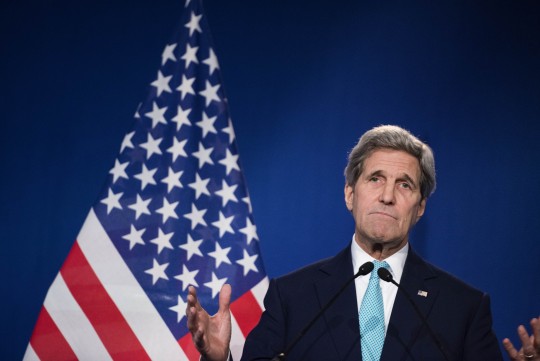
Kerry againAP

Secretary of State John Kerry told his Iranian counterpart that he wished the United States had a leader more like Supreme Leader Ayatollah Khamenei, according to comments made by a senior Iranian cleric and repeated in the country’s state-run media.

Ayatollah Alam al-Hoda claimed during Friday prayer services in Iran that in negotiations over Tehran’s contested nuclear program, Kerry told the country’s foreign minister that he “wished the U.S. had a leader like Iran’s supreme leader,” according to a Persian-language report on the remarkspublished by the Asriran news site.

“In the negotiations Kerry told [Iranian Foreign Minister Javad] Zarif that he [Kerry] wished U.S. had a leader like Iran’s supreme leader,” according to Alam al-Hoda, who is a senior member of the Iran’s powerful Assembly of Experts.

A senior administration official told the Washington Free Beacon that such a contention is patently absurd.

The remarks are the latest in a string of comments made by Iranian leaders purporting to reveal private details of the talks.

Iranian newspapers have carried multiple reports in recent months suggesting that Iranian Foreign Minister and chief negotiator Javad Zarif was ordered to stop screaming at Kerry behind closed doors.

In his Friday remarks, al-Hoda went on to say that Obama is set on striking a deal with Iran by June.

“Both Republicans and Democrats want these negotiations with Iran, but they fight each other for partisan interests,” he was quoted as saying. “Obama wants the negotiation to succeed so his party can win the next election and Republicans want to stop him.”

Alam al-Hoda also celebrated Iran’s expansion in the region and controversial activities in war-torn countries such as Syria and Yemen.

“Today, the resistance crescent has gone beyond Syria and Lebanon and reached to Yemen,” he said. “Today the resistance front is in control of Strait of Hormuz and Bab-el-Mandeb.”

The “U.S. and Israel have not been so weak anytime before,” he continues. “All these events are being managed by the hidden Imam,” a revered religious figure in Shia Islam.

Saeed Ghasseminejad, an Iranian dissident and fellow at the Foundation for Defense of Democracies (FDD), said U.S. overtures to Iran at the negotiating table have failed to win it any respect from the Islamic Republic’s leaders.

“President Obama thinks that by making more concessions he can gain the trust and respect of Iranian leaders,” Ghasseminejad said. “However, Iranian leaders neither trust him nor respect him.

“Seeing unprecedented weakness in the U.S. president, Iranian leaders do not fear the United States anymore. Partnership, trust, and alliance between the radical Islamist regime of Tehran and United States cannot and should not exist.”

Meanwhile, Zarif said over the weekend that fighting between the Obama administration and Congress over a potential final deal could not stop America from implementing any agreement the White House signs.

“As we have stated since the beginning, we consider the U.S. administration responsible for implementing the agreement and internal problems and conflicts in the U.S. are not related to us and to the implementation of the agreement, and based on the international laws, the countries’ internal problems don’t exempt them from implementing their undertakings and this is the main framework that we attach importance to,” Zarif said, according to the Fars News Agency.

On Monday, Zarif urged the United States to woo Iran.

“Maintaining an uncertain and unstable situation is not acceptable to Iran and the Americans should take practical and confidence-building measures to reach a comprehensive nuclear agreement,” Zarif was quoted as telling reporters.

Natan Sharansky: When did America forget that it’s America?

April 29, 2015

Natan Sharansky: When did America forget that it’s America? – Tulsa World: Opinion.

Posted: Wednesday, April 29, 2015 12:00 am | Updated: 1:29 am, Wed Apr 29, 2015.

On a number of occasions during the negotiations over Iran’s nuclear program, the Israeli government has appealed to the United States and its allies to demand a change in Tehran’s aggressive behavior. If Iran wishes to be treated as a normal state, Israel has said, then it should start acting like one. Unfortunately, these appeals have been summarily dismissed.

The Obama administration apparently believes that only after a nuclear agreement is signed can the free world expect Iran to stop its attempts at regional domination, improve its human rights record and, in general, behave like the civilized state it hopes the world will recognize it to be.

As a former Soviet dissident, I cannot help but compare this approach to that of the United States during its decades-long negotiations with the Soviet Union, which at the time was a global superpower and a existential threat to the free world. The differences are striking and revealing.

For starters, consider that the Soviet regime felt obliged to make its first ideological concession simply to enter into negotiations with the United States about economic cooperation. At the end of the 1950s, Moscow abandoned its doctrine of fomenting a worldwide communist revolution and adopted in its place a credo of peaceful coexistence between communism and capitalism. The Soviet leadership paid a high price for this concession, both internally — in the form of millions of citizens, like me, who had been obliged to study Marxism and Leninism as the truth and now found their partial abandonment confusing — and internationally, in their relations with the Chinese and other dogmatic communists who viewed the change as a betrayal. Nevertheless, the Soviet government understood that it had no other way to get what it needed from the United States.

Imagine what would have happened if instead, after completing a round of negotiations over disarmament, the Soviet Union had declared that its right to expand communism across the continent was not up for discussion. This would have spelled the end of the talks. Yet today, Iran feels no need to tone down its rhetoric calling for the death of America and wiping Israel off the map.

Of course, changes in rhetoric did not change the Soviet Union’s policy, which included sending missiles to Cuba, tanks to Prague and armies to Afghanistan. But each time, such aggression caused a serious crisis in relations between Moscow and Washington, influencing the atmosphere and results of negotiations between them. So, for example, when the Soviets invaded Afghanistan shortly after the SALT II agreement had been signed, the United States quickly abandoned the deal and accompanying discussions.

Today, by contrast, apparently no amount of belligerence on Iran’s part can convince the free world that Tehran has disqualified itself from the negotiations or the benefits being offered therein. Over the past month alone, as nuclear discussions continued apace, we watched Iran’s proxy terror group, Hezbollah, transform into a full-blown army on Israel’s northern border, and we saw Tehran continue to impose its rule on other countries, adding Yemen to the list of those under its control.

Then there is the question of human rights. When American negotiations with the Soviets reached the issue of trade, and in particular the lifting of sanctions and the conferring of most- favored-nation status on the Soviet Union, the Senate, led by Democrat Henry Jackson, insisted on linking economic normalization to Moscow’s allowing freedom of emigration. By the next year, when the Helsinki agreement was signed, the White House had joined Congress in making the Soviets’ treatment of dissidents a central issue in nearly every negotiation.

Iran’s dismal human rights record, by contrast, has gone entirely unmentioned in the recent negotiations. Sadly, America’s reticence is familiar: In 2009, in response to the democratic uprisings that mobilized so many Iranian citizens, President Barack Obama declared that engaging the theocratic regime would take priority over changing it.

Reality is complicated, and the use of historical analogies is always somewhat limited. But even this superficial comparison shows that what the United States saw fit to demand back then from the most powerful and dangerous competitor it had ever known is now considered beyond the pale in its dealings with Iran.

Why the dramatic shift? One could suggest a simple answer: Today there is something the United States wants badly from Iran, leaving Washington and its allies with little bargaining power to demand additional concessions. Yet in fact Iran has at least as many reasons to hope for a deal. For Tehran, the lifting of sanctions could spell the difference between bankruptcy and becoming a regional economic superpower, and in slowing down its arms race it could avoid a military attack.

I am afraid that the real reason for the U.S. stance is not its assessment, however incorrect, of the two sides’ respective interests but rather a tragic loss of moral self-confidence.

While negotiating with the Soviet Union, U.S. administrations of all stripes felt certain of the moral superiority of their political system over the Soviet one. They felt they were speaking in the name of their people and the free world as a whole, while the leaders of the Soviet regime could speak for no one but themselves and the declining number of true believers still loyal to their ideology.

But in today’s postmodern world, when asserting the superiority of liberal democracy over other regimes seems like the quaint relic of a colonialist past, even the United States appears to have lost the courage of its convictions.

We have yet to see the full consequences of this moral diffidence, but one thing is clear: The loss of America’s self-assured global leadership threatens not only the United States and Israel but also the people of Iran and a growing number of others living under Tehran’s increasingly emboldened rule. Although the hour is growing late, there is still time to change course — before the effects grow more catastrophic still.

Natan Sharansky, a human rights activist and former political prisoner in the Soviet Union, is chairman of the Jewish Agency for Israel.