Archive for March 12, 2015

Now the Saudis are developing a nuclear arsenal

March 12, 2015

Now the Saudis are developing a nuclear arsenal, Examiner, March 12, 2015

(????????????? — DM)

US nuke testThe “Baker” explosion, part of Operation Crossroads, a nuclear weapon test by the United States military at Bikini Atoll, Micronesia, on 25 July 1946.

Thus far, South Korea has been secure behind America’s nuclear arsenal. But, that country seems to have lost confidence with President Obama as well. It also might be disposed to share the technology with Japan, a country that has cast an anxious eye toward North Korea and China. In turn, the latter country will become very much alarmed.

************************

One of the terrible side effects of the impending Munich-style nuclear arms deal between President Obama and Iran is the possibility of a Middle East nuclear arms race. Hot Air reported on Thursday that the other shoe has dropped, and Saudi Arabia and South Korea has signed a nuclear agreement. The agreement suggests that the Saudis have concluded that there is no hope for President Obama preventing Iran from acquiring the Bomb. Therefore, the Kingdom is moving to acquire a native nuclear enrichment capacity in advance of building a nuclear arsenal.

By pretending that it is engaged in serious diplomacy with Iran, the Obama administration has managed to frighten the rest of the region to death. Israel is the only other country in the Middle East with a nuclear arsenal. Nearby Pakistan has the Bomb as well, but its nuclear weapons are geared toward countering its main enemy, India. The Saudis have concluded that it is time for an Arabic bomb to counter the impending Iranian bomb. Thus proliferation and the bone chilling possibility that a nuclear weapon might find its way into the hands of terrorists proceeds apace.

It gets worse. South Korea, besides an infusion of petrodollars, gets access to the nuclear technology it will build for its new desert customers. South Korea faces a country, North Korea, run by an insane man with its nuclear arsenal. Thus far, South Korea has been secure behind America’s nuclear arsenal. But, that country seems to have lost confidence with President Obama as well. It also might be disposed to share the technology with Japan, a country that has cast an anxious eye toward North Korea and China. In turn, the latter country will become very much alarmed.

So, the president, with his “smart diplomacy,” is about to create more nuclear powers across the world. Moreover, these countries will have, under the right circumstances, every incentive to use their nuclear arsenals. Who would have thought it possible?

IDF on alert for coordinated ISIS assault on Eilat or vicinity

March 12, 2015

IDF on alert for coordinated ISIS assault on Eilat or vicinity

DEBKAfile March 12, 2015, 5:55 PM (IDT)


(Stay safe JW. – LS)

The commander of the IDF’s 80th Division, Col. Arik Hen, announced Thursday that the army is deployed ready to fend off a large-scale coordinated attack on Israel’s southernmost town of Eilat, which the Islamic State is believed to be planning with speedboats and aquatic motor bikes combined with an overland incursion and rocket bombardment from Egyptian Sinai. Israeli troops are also ranged on Route 12 north of Eilat and the civilian locales along the highway in case they too come under jihadi attack.

Col. Hen reported that hundreds of ISIS terrorists have gathered in Sinai, but there is not enough intelligence to keep track of all their plans and movements. DEBKAfile adds: The IDF has released this nformation as a warning because the Islamist terrorists may intend to strike during the eight-day Feast of Passover, when Eilat and southern Israel teem annually with holidaymakers and trippers.

It’s Not Just Islam, It’s the Tribal Mentality

March 12, 2015

It’s Not Just Islam, It’s the Tribal Mentality, Front Page Magazine, March 12, 2015

fft-450x253

Islam in part is the “theologizing” of the tribal mentality. Islam’s important innovation was to redefine the “tribe” as the whole umma of believers, creating in effect a “super tribe” that transcends mere blood as the bonding agent. But the tribal warrior ethos persists–– in the doctrine of jihad, tribal atrocities in contemporary terror and its gruesome videos, the privileging of men in polygamy, honor killings, and social restrictions on women, the disdain for the infidel “other” in the Koranic belief that Muslims are the “best of nations,” the betrayal of alliances in the religious sanction of lying to infidels (taqiyya), and the obsession with “honor” that today we find in violent Muslim reactions to “blasphemy” against Mohammed or the Koran.

Ignoring the tribal mentality is as dangerous for our foreign policy as downplaying Islamic doctrine.

The Obama administration’s serial appeasement of Iran––currently the “strongest tribe” spreading its influence throughout the region–– has damaged our prestige among allies like Jordan, Saudi Arabia, and Egypt, who are already shopping around for a more reliable and forceful partner. If we want to destroy the jihadists, check Iran’s nuclear ambitions, and protect our interests, we must again become the “strongest tribe.”

********************

The “nothing to do with Islam” mantra took a hit recently in one of the premier organs of liberal received wisdom, The Atlantic. Many have greeted as a revelation Graeme Wood’s article on the Islamic doctrines behind ISIS’s atrocities. Regular readers of FrontPage and Jihad Watch will not be as impressed. For years they have understood the link between jihadism and Islam. In 1994 Andy McCarthy made this connection when he prosecuted the perpetrators of the first World Trade Center bombing the previous year, a connection that the FBI ignored or discounted at the time––a failure, by the way, that has become a pernicious tradition for those charged with protecting our nation’s security and interests. For everyone else who has been paying attention to the rise of modern jihadism, Wood’s article is a dog bites man story.

One can hope that perhaps now, with the truth revealed by one of the Acela corridor’s oracles, the jihad deniers will wise up, though I wouldn’t bet on it. Unexamined opinions comprise the bulk of the progressive mind, and are notoriously resistant to empirical evidence and sound argument. But the current mess in the Middle East results from more than just Islam and its traditional belligerence, supremacist pretensions, and illiberal religious laws and doctrines. These characteristics reflect variations on the mentality of the tribe, one antithetical to modernity and the principles of liberal democracy, and still powerful in the Middle East, the region once described as “tribes with flags.”

For all the differences among tribal peoples, the components of this mentality are consistent, from the ancient Gauls and Germans Caesar conquered and the Vikings terrorizing much of Europe, to the American Indians the U.S. Cavalry fought and the jihadist gangs rampaging in the Middle East.

First, there is little notion of a common humanity that transcends ethnicity or culture. Universal principles are scarce, and personal identity is found solely in the collective customs and traditions of the tribe. Outsiders are to be distrusted, plundered, or conquered when possible. Loyalty is not to principle, but to blood. Most tribal peoples consider their tribe the acme of humanity, the only genuine humans. Hence their word for “human” is usually identical to the name of their tribe. They are literally ethnocentric.

Second, violence, particularly against outsiders, is an acceptable instrument for resolving conflict and asserting tribal superiority. Not just the violence of war, but also the cruel torture and slaughter of outsiders, including women and children, are legitimate for serving the interests of the tribe. Indeed, what we call terrorism was a tactic of tribal warfare to prevent a full-scale war by so terrorizing enemies that they would give up without a fight, a phenomenon common in the various Indian wars of American history. Hence the scary face-paint, tattoos, war cries, bizarre hairstyles, tortures like scalping, mutilation of enemies, or slaughter of their women and children, all of which are meant to frighten and demoralize the enemy. The same intent explains the blustering threats, braggadocio, and insults typical of tribal warfare and diplomacy. These practices can be documented in tribal societies from the Iroquois to the ancient Gauls.

Next, loyalty in tribal societies counts only for those within the tribe. Alliances with other tribes or peoples are ad hoc and contingent on the immediate interests of the tribe. They can be abandoned or betrayed if circumstances or perceptions change. Moreover, respect for others beyond the tribe is based solely on their capacity to inflict violence on their enemies. The “strongest tribe,” a status based on its effectiveness and success in conflict, will attract allies, who will abandon the hegemon once it loses that perception of its strength. Thus during Caesar’s wars in Gaul various Gallic and Germanic tribes would ally with the Romans when they appeared dominant, and betray them in an instant if they thought them weak. Likewise during the U.S. Cavalry’s wars against the Plains Indians, many tribes victimized by the Sioux or Apache or Cheyenne would ally with the Americans if they seemed to be winning, then switch sides the moment they seemed weak.

Finally, tribal societies are centered on the male warrior and his honor. Forget the Women’s Studies fantasies of matriarchal tribal societies. Tribal cultures privilege males, for men fight, and the survival and honor of the tribe depends on martial valor. Women bear children and work, as the skeletons of pre-contact American Indian remains demonstrate. Female bones show much more damage from hard physical labor than do male. This doesn’t mean that women had no status within the tribe, or did not enjoy somewhat more equality than women in more sophisticated civilizations. But warrior males still dominated, and culture in the main centered on men and their prowess in war, which earned honor, what we call prestige, for the whole tribe.

Sound familiar? It should, for Islam in part is the “theologizing” of the tribal mentality. Islam’s important innovation was to redefine the “tribe” as the whole umma of believers, creating in effect a “super tribe” that transcends mere blood as the bonding agent. But the tribal warrior ethos persists–– in the doctrine of jihad, tribal atrocities in contemporary terror and its gruesome videos, the privileging of men in polygamy, honor killings, and social restrictions on women, the disdain for the infidel “other” in the Koranic belief that Muslims are the “best of nations,” the betrayal of alliances in the religious sanction of lying to infidels (taqiyya), and the obsession with “honor” that today we find in violent Muslim reactions to “blasphemy” against Mohammed or the Koran.

Ignoring the tribal mentality is as dangerous for our foreign policy as downplaying Islamic doctrine. The chronic disorder in northern Iraq today is not just about the Sunni-Shi’a divide, or ISIS’s dream of a caliphate. It also reflects the bewildering number of tribes and clans in the region, whose complex alliances and enmities continually shift depending on circumstances and the perceptions of which tribe is the stronger. Our ally today can instantly become our enemy tomorrow. Factions that appear “moderate” today can become jihadist terrorists tomorrow. Our “friends” will tell us what we want to hear today, and then betray their words tomorrow. Most important, anything we do that creates the perception of weakness––especially concessions, or failure to inflict revenge, or acts of mercy––will also damage our prestige as the “strongest tribe” and invite tribes to abandon us.

These tribal practices defined most peoples, including Europeans, before the advent of modernity. They have survived among Middle Eastern Muslims because they were encoded in religious doctrines that promise global power for the tribe of the faithful in this life, and paradise in the next, especially for jihadist warriors. This amalgamation in part explains the spectacular success of Muslim warriors for a 1000 years, a record of martial achievement the memory of which today fuels the resentment and anger of those Muslims who wish to restore that lost honor. It also contributes to the difficulty of many Muslim societies to reconcile with modernity, particularly liberal democracy and its cargo of human rights, confessional tolerance, and equality for women and those of other faiths.

Of course, worldwide millions of Muslims have managed to transcend tribalism and adjust their faith to modernity. But millions more haven’t, and it is they who are fomenting most of the mayhem and murder on every continent except Antarctica. Our tactics and strategies in confronting this threat must indeed be based on a correct understanding of the spiritual imperatives that motivate the jihadists. But they also must take into account the tribal mentalities that respect force and honor the strong.

The Obama administration’s serial appeasement of Iran––currently the “strongest tribe” spreading its influence throughout the region–– has damaged our prestige among allies like Jordan, Saudi Arabia, and Egypt, who are already shopping around for a more reliable and forceful partner. If we want to destroy the jihadists, check Iran’s nuclear ambitions, and protect our interests, we must again become the “strongest tribe.”

Obama Gives Sisi the Netanyahu Treatment

March 12, 2015

Obama Gives Sisi the Netanyahu Treatment, Commentary Magazine, March 11, 2015

[O]ne of the major changes that took place on President Obama’s watch was a conscious decision to downgrade relations with Cairo, a nation that his predecessors of both parties had recognized as a lynchpin of U.S. interests in the region. The current weapons supply squeeze is not only a blow to the efforts of a nation that is actually willing to fight ISIS and other Islamist terrorists; it’s a statement about what it means to be an American ally in the age of Obama.

******************************

In a Middle East where Islamist terror groups and the Iranian regime and its allies have been on the offensive in recent years, the one bright spot for the West in the region (other, that is, than Israel) is the way Egypt has returned to its old role as a bulwark of moderation and opposition to extremism. The current government led by former general Abdel Fattah el-Sisi has clamped down on Hamas terrorists and has been willing to deploy its armed forces to fight ISIS in Libya while also clamping down on a Muslim Brotherhood movement that seeks to transform Egypt into another Islamist state. Yet despite this, the Obama administration is unhappy with Egypt. Much to Cairo’s consternation, the United States is squeezing its government on the military aid it needs to fight ISIS in Libya and Sinai terrorists. As the Israeli government has already learned to its sorrow, the Egyptians now understand that being an ally of the United States is a lot less comfortable position than to be a foe like Iran.

The ostensible reason for the holdup in aid is that the Egyptian government is a human-rights violator. Those concerns are accurate. Sisi’s government has been ruthless in cracking down on the same Muslim Brotherhood faction that was running the country until a popular coup brought it down in the summer of 2013. But contrary to the illusions of an Obama administration that hastened the fall of Hosni Mubarak and then foolishly embraced his Muslim Brotherhood successors, democracy was never one of the available options in Egypt.

The choice in Egypt remains stark. It’s either going to be run by Islamists bent on taking the most populous Arab country down the dark road of extremism or by a military regime that will keep that from happening. The obvious Western choice must be the latter, and Sisi has turned out to be an even better ally than Washington could have dreamed of, as he ensured that the Brotherhood would not return to power, took on Hamas in Gaza, and even made public calls for Muslims to turn against religious extremists.

But rather than that endearing him to the administration, this outstanding record has earned Sisi the Netanyahu treatment. Indeed, like other moderate Arab leaders in the Middle East, Sisi understands that President Obama has no great love for his country’s allies. Besotted as he is by the idea of bringing Iran in from the cold, the American government has allied itself with Tehran in the conflicts in both Iraq and Syria. He also understands that both of those ongoing wars were made far worse by the president’s dithering for years, a stance that may well have been motivated by a desire to avoid antagonizing Iran by seeking to topple their Syrian ally.

But those issues notwithstanding, one of the major changes that took place on President Obama’s watch was a conscious decision to downgrade relations with Cairo, a nation that his predecessors of both parties had recognized as a lynchpin of U.S. interests in the region. The current weapons supply squeeze is not only a blow to the efforts of a nation that is actually willing to fight ISIS and other Islamist terrorists; it’s a statement about what it means to be an American ally in the age of Obama.

As the Times of Israel reported:

On Monday Sisi was asked what he and the other Arab allies thought of U.S. leadership in the region. It is hard to put his response in words, mainly due to his prolonged silence.

“Difficult question,” he said after some moments, while his body language expressed contempt and disgust. “The suspending of US equipment and arms was an indicator for the public that the United States is not standing by the Egyptians.”

It turns out that although the American administration recently agreed to provide the Egyptian Air Force with Apache attack helicopters; it has been making it increasingly difficult for Cairo to make additional military purchases.

For example, the U.S. is delaying the shipment of tanks, spare parts and other weapons that the army desperately needs in its war against Islamic State.

This development raises serious questions not only about U.S.-Egyptian relations but the administration’s vision for the region.

This is, after all, a time when the administration is going all out to make common cause with Iran, an open enemy that is currently the leading state sponsor of terrorism in the world. President Obama is pursuing a diplomatic arrangement that will strengthen the Iranian regime and guarantee the survival of a nuclear program that moderate Arabs see as being as much of a threat to them as it is to Israel or the West.

The Egyptians understand that Washington isn’t interested in their friendship. Nor is the administration particularly supportive of Cairo’s efforts to rein in Hamas or to fight ISIS. Indeed, the Egyptians are now experiencing the same sort of treatment that has heretofore been reserved for the Israelis. That’s especially true in light of the arms resupply cutoff against Israel Obama ordered during last summer’s war in Gaza.

Despite flirting with Russia, Egypt may, like Israel, have no real alternative to the United States as an ally. Perhaps that’s why Obama takes it for granted. But if the U.S. is serious about fighting ISIS as opposed to just talking about it, Washington will have to start treating Egypt and its military as a priority rather than an embarrassment.

Obama’s Surrender to Iran

March 12, 2015

Obama’s Surrender to Iran, Front Page Magazine, March 12, 2015

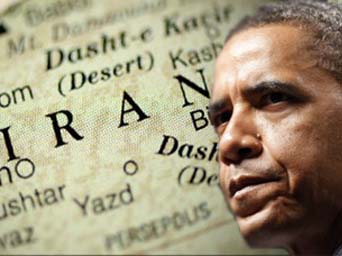
obama-iran

Iran, therefore, needs nuclear weapons to protect itself should it fail to derail Obama’s ambitious plans. Should the Pan Arabic (Sunni) Islamic Union become a reality, the Iranian rulers believe that having the capability of ushering in Armageddon will keep the Sunni’s at bay.

At the very least, the Mullahs in Iran rest better knowing, should they fall, that they can take everyone else down with them. Think “mutually-assured destruction.” A sort of “MAD” amongst madmen.

***************************

It is becoming increasingly clear that Obama’s agenda in the Middle East is to help the Islamists regain the land they once controlled but lost in 1924 with the fall of the Ottoman Empire.

The Arab Spring was not a movement to replace ruthless dictators with democratic governments. It was an Islamic movement to replace secular governments with Islamic ones.

Step by step, this administration is helping to establish the Islamists’ dream of a revived caliphate, or “Pan Arabic Islamic Union” as it has been called by Islamist leaders recently.

There is a mistaken school of thought that believes such an Islamic Union would function like an Arabic European Union, growing their economies and enabling them to take their place among the other nations of the world as equals.

This school neglects to answer the most salient question: How do you contain a movement that recognizes no borders but its own and is compelled by dint of faith to dominate the rest of the world or die in the effort?

Unfortunately, the primary opposition to this plan isn’t coming from the American people. Sadly, much of America is suffering from confusion, ignorance, self-loathing and a dedication to bending over backwards in an attempt to avoid the confrontation that looms ahead.

Rather than marshaling a strong core of support for the hard choices that must be made, our administration is creating a huge chasm between citizens over trivialities and over-amplified slights. We are far weaker for it.

One might ask then, who is opposing the mighty President of the United States? Who dares stand in the way of the Nobel Peace prize winner “Barack Obama?”

The answer will be something of a shock to many.

In no particular order, listed below are those who are arrayed against the designs of our “Dear Leader.”

Putin

Standing most prominently, is Vladimir Putin, the Russian bear. Putin has designs on the former Soviet satellite nations and he needs a strong economy and the leverage that an oil monopoly over the European market provides to fuel his aspirations.

His Ukraine adventure is proving more troublesome than originally thought, and Obama’s push to topple Assad in Syria threatens Putin’s access to a warm water port for Russia’s oil exports to Europe.

The Russian oligarchs are growing restive under the thumb of Putin, seeing his dreams of Sovietus revivivus as bad for business and potentially catastrophic. Putin’s leash is shortening, and his tenure is by no means a sure thing.

While Putin remains in power, he will oppose Obama’s Ottoman revival. He has no choice.

Old Guard and Monarchies of the Middle East

Next are the old guard and monarchies of the Middle East. We like to call them “dictators” even though in reality, while they are all Sunni Muslims, they are more concerned with maintaining their own wealth and power than in recreating an Islamic caliphate.

Among these were Gaddafi, Mubarak and the others deposed in the Arab Spring, but also numbered in this groups is the Hashemite kingdom of Jordan and both Saudi Arabia and the Emirates.

All are in danger of being ejected from this game. But just like Putin, they will not go bloodlessly.

Islamic Republic

The final player is also the strongest: Iran.

Iran, a Shiite nation, is a natural enemy to any Sunni Islamic caliphate system. The Iranian rulers know from Islamic history (the same history we completely ignore here in the West) that any Sunni caliphate will soon swallow and erase the Shi’a, destroying all opponents to their well-established ideals of Islamic religious and political structure.

Iran, therefore, needs nuclear weapons to protect itself should it fail to derail Obama’s ambitious plans. Should the Pan Arabic (Sunni) Islamic Union become a reality, the Iranian rulers believe that having the capability of ushering in Armageddon will keep the Sunni’s at bay.

At the very least, the Mullahs in Iran rest better knowing, should they fall, that they can take everyone else down with them. Think “mutually-assured destruction.” A sort of “MAD” amongst madmen.

Don’t let this apocalyptic scenario, however, lead you to think that Iran is going quietly into oblivion. On the contrary, it has tirelessly worked to thwart Obama’s plans.

Iran’s use of terror and terror proxies is on the upswing. It will distract and misdirect, strike and cajole, but it will not permit a Sunni caliphate to appear on its border without a nuclear capability of its own to deter Sunni adventurism.

Obama’s setbacks in Syria and Benghazi have forced him to negotiate with the Iranians. He wants to assure them that they have nothing to fear from a caliphate, while simultaneously keeping the American people from recognizing the monumentally stupid policy objective he is pursuing.

To this end, he tells us he has gotten Iran to agree to postpone its nuclear work for ten years, under the ridiculously naive idea that the dynamics of the Middle East will have changed. Many believe Obama is in fact a Muslim. In reality, that really doesn’t matter.

His administration believes that all conflict can be framed in Marxist terms. Empower those who have little and they will join the community with smiles and slaps on the back. The administration fundamentally misunderstands the problem and is applying a solution akin to gasoline on a grease fire.

Economics are unimportant to the Islamists. Power is their currency and they spend all they have to purchase the world for Allah. The establishment of an Islamic caliphate will not calm the Arab street, it will invigorate it to greater conquests, as Islam demands.

Of course, in the eyes of the neo-progressives in the White House, to speak truthfully about this “Islamophobia.”

To Obama, a nuclear Iran is an acceptable trade-off for a revived caliphate, To Israel, however, both Iran and a caliphate are threats to their very existence.

Iran with a nuclear weapon has no reason not to make good on its long-standing promise to “wipe Israel from the face of the earth.” A reconstituted caliphate modeled after the former Ottoman Empire has no room for Israel, indeed, on Iran’s maps, Israel doesn’t exist at all.

America is negotiating nuclear policy with a terrorist state, and geopolitical hegemony with an ideology/religion that knows no borders but its own.

In 2013, President Obama told us we can all take a deep breath, he was able to wring an invaluable concession out of the Iranians. He breathlessly announced that Iran had issued a fatwa against nuclear weapons.

It appeared that we had been brought back from the brink by the president’s keen ability to negotiate.   Notwithstanding the obvious (and wholly inappropriate) grandstanding by the POTUS, there are a few other issues that need to be addressed in relation to this irrelevant fatwa.

Most Americans aren’t aware that the foundation of Iran’s nuclear program was laid on March 5th, 1957 by the United States, under an Eisenhower program called “Atoms for Peace.”  Iran established the Tehran Nuclear Research Center (TNRC) in 1967, which was a 5 megawatt nuclear research reactor, fueled by enriched uranium.

In 1968, Iran signed the Nuclear Non-Proliferation Treaty (NPT) ratifying it in 1970, making Iran’s nuclear program subject to International Atomic Energy Agency (IAEA) verification and accountability.

Following the 1979 Revolution, nearly all international nuclear cooperation with Iran was cut off.  With little hope of regaining international cooperation, Iran elected to continue the program on their own, although they thought it best to save face and attempt to “shame” America (and by extension its advanced nuclear technology) by condemning all things nuclear.

It was for this reason and this reason alone, that the fatwa was issued. It had nothing to do with any humanitarian interests held deeply in the hearts of Iranian leaders; they are certainly more than amenable to any method that allows them to more efficiently eliminate their enemies, most especially Israel.

The anti-nuclear fatwa, is fully revealed to be a sham five years later, when we see the destruction of a reputedly “non-existent” Iranian nuclear program by Iraqi forces.

All of this is still occurring under the reign of the same Ayatollah that issued the nuclear fatwa a brief five years previous. Clearly, the Iranians had continued their nuclear program, despite the fatwa.

The next time we saw any reference to the 1979 “nuclear fatwa” was in 2003.  The IAEA issued a report, condemning the Iranian nuclear program, accusing it of once again, trying to weaponize the technology.

Still, Iran didn’t budge.  It wasn’t until the U.S. threatened to get involved militarily (the full might and power of the U.S. military was on display right next door in Iraq under the leadership of President Bush) that the Iranians finally caved.

What did this concession look like?  Well, as you might have guessed, Iran simply reaffirmed the old stand-by fatwa from 1979, condemning nuclear weapons and promising to play nice.

So, for the record, we have clear evidence that the Iranians consider their anti-nuclear fatwa to be toilet paper, so Obama’s “concession” is more enabling than disarming. Iran had cast the ‘79 fatwa out again in 2013, hoping we’ll bite on it one more time. Obama readily obliged.

President Obama appears willing to do whatever it takes to build his legacy on reestablishing the Islamic state after an 80 year absence. He also appears willing to endanger both the United States and Israel to get it done.

European colonization didn’t create terrorists; Islam and Mohammed birthed terrorism in order to spread a brutal and unforgiving ideology.

Absent European intervention, Muslims might yet be centuries further behind than they already are. Islam is a crippling force. Science has never been particularly important to the Islamists.

European contact brought Muslim countries out of the Stone Age; the same stone age to which the Islamic jihad intends to return us all.

Cartoon of the day

March 12, 2015

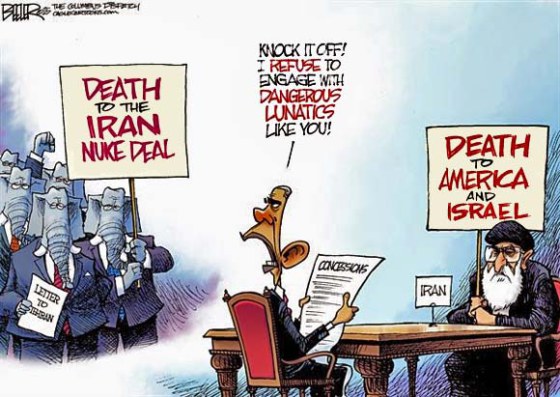
Via Vermont Loon Watch, March 12, 2015

(That’s not funny! — DM)

Obama Iran

Iranian President: Diplomacy With U.S. is an Active ‘Jihad’

March 12, 2015

Iranian President: Diplomacy With U.S. is an Active ‘Jihad’, Washington Free Beacon, March 12, 2015

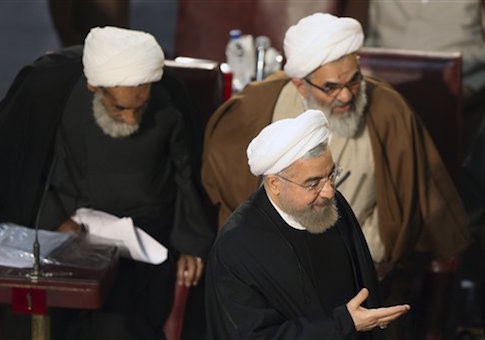
Hassan RouhaniHassan Rouhani / AP

Iranian President Hassan Rouhani described his country’s diplomacy with the United States as an active “jihad” that is just as significant to Tehran’s advancement as the slew of new weapons and missiles showcased by the Islamic Republic’s military.

Rouhani praised the country’s military leaders for standing “against the enemy on the battlefield” and said as president, he would carry out this “jihad” on the diplomatic front.

Rouhani’s comments echo those of foreign minister and lead nuclear negotiator Javad Zarif, who said Tuesday that Iran has emerged as “the winner” in talks with Western powers. Like Zarif, Rouhani boasted that Iran’s years-long diplomacy with Western nations over its nuclear program established the Islamic Republic as a global power.

Iran has made headway in convincing the U.S. to allow it to maintain much of its core infrastructure through diplomatic talks that Rouhani said are viewed as a “jihad.”

“Our negotiations with the world powers are a source of national pride,” Rouhani said earlier this week. “Yesterday [during the Iran-Iraq War], your brave generals stood against the enemy on the battlefield and defended their country. Today, your diplomatic generals are defending [our nation] in the field of diplomacy–this, too, is jihad.”

“Our power is growing each day, but we don’t intend to be aggressive toward anyone. However, we will certainly defend our country, nation, independence, and honor wholeheartedly.”

Iran stands “10 times more powerful” than it was during the time of the Iran-Iraq War, Rouhani said, which “reflects a serious deterrence to the enemies’ threats.”

Iranian leaders view the ongoing talks with the United States and other nations as a source of global legitimacy.

Rouhani’s remarks have “significant domestic implications,” according to an analysis published by the American Enterprise Institute.

“Iran’s negotiations team to the status of Iran-Iraq War commanders, who are traditionally revered by the regime as upholders of Islamic Revolutionary values, could potentially lead to rhetorical backlash from regime hardliners opposed to the nuclear negotiations,” AEI wrote.

Matan Shamir, director of research at United Against Nuclear Iran, said Rouhani’s latest comments show he is not a moderate leader.

“While Rouhani talks about a ‘win-win’ nuclear deal to global audiences, his comments make clear that he continues to view the U.S. an antagonistic global oppressor that must be triumphed over, in this case by a diplomatic ‘jihad,’” Shamir said. “This is clearly not the language of a moderate or of a regime with which rapprochement is at all realistic.”

Zarif said Tuesday that a final nuclear deal with the United States is meaningless at this point.

“We are the winner whether the [nuclear] negotiations yield results or not,” Zarif was quoted as saying by the Tasnim News Agency. “The capital we have obtained over the years is dignity and self-esteem, a capital that could not be retaken.”

As Rouhani and Zarif grandstand on the nuclear front, Iranian military leaders have begun to unveil a host of new missiles and sea-based weapons.

General Amir Ali Hajizadeh, a leader in the Iranian Revolutionary Guard Corps, said Iran’s defensive capabilities “are non-negotiable in the nuclear talks,” AEI reported.

The comments came the same day Iran paraded its new cruise missiles.

Hajizadeh also dismissed economic sanctions on Iran, saying that “his is a message which should be understood by the bullying powers which raise excessive demands.”

On Wednesday, the State Department said any final deal with Iran was “nonbinding,” meaning that neither party would be legally obliged to uphold the agreement.