Anger simmers as EU Parliament shoots down anti-Semitism task-force
via Anger simmers as EU Parliament shoots down anti-Semitism task-force – Diaspora – Jerusalem Post.
Anger simmers as EU Parliament shoots down anti-Semitism task-force
via Anger simmers as EU Parliament shoots down anti-Semitism task-force – Diaspora – Jerusalem Post.
IDF soldier seriously injured in Gaza border incident
Palestinians say Hamas surveillance commander killed in Israeli response to shooting attack on army patrol near Kissufim
By Lazar Berman
December 24, 2014, 11:41 am Updated: December 24, 2014, 2:07 pm
via IDF soldier seriously injured in Gaza border incident | The Times of Israel.

An IDF soldier wounded in a cross-border attack outside Gaza is carried into Soroka Hospital in the southern city of Beersheba on December 24, 2014 (photo credit: Flash90)
Palestinians opened fire on an Israeli patrol late Wednesday morning along the southern Gaza Strip. One soldier from the Bedouin Reconnaissance Battalion was shot in the chest and severely injured. He was evacuated to a hospital, the IDF said.
The patrol was operating on the Israeli side of the border near Kibbutz Kissufim when it came under sniper and machine gun fire.
Palestinian sources said that a heavy exchange of fire ensued, with IDF tank fire striking a target east of Khan Younis. The air force also fired on Gaza targets.
Palestinians said that the commander of Hamas’s surveillance unit in the area was killed in the IDF response, Israel Radio reported. Hamas fighters were abandoning positions across the Strip, the report said.
Medical sources said Tayseer al-Ismary, 33, died after being hit by a bullet fired by the IDF, while Hamas sources confirmed he was a member of the movement’s military wing, the Izz ad-Din al-Qassam Brigades.
“This attack, the second of this week, is a lethal violation of the relative quiet along the Gaza border and is a blatant breach of Israel’s sovereignty,” said IDF spokesman Peter Lerner. “The IDF will continue to use all necessary means in order to maintain the safety of the citizens of southern Israel and will not hesitate to respond to any attempt to harm IDF soldiers.”
Israeli farmers were told to cease all work near the border fence, the Ynet news site reported, and roads in the area were closed.
On Friday, after a Palestinian rocket attack prompted an Israeli airstrike, Hamas informed Israel that it was not interested in an escalation in the Gaza Strip, and would crack down on the Palestinians who fired the rocket.
Hamas conveyed its message to Israel through an Egyptian mediator, emphasizing that it did not stand behind the rocket attack — the third of its kind since a ceasefire agreement in August ended the most recent conflagration in the Strip.
The terror group pledged to locate those responsible for firing the projectile, which drew a retaliatory Israeli airstrikes over the weekend. The air raid targeted a Hamas factory that was producing cement to rebuild the attack tunnels destroyed and damaged in last summer’s war, Prime Minister Benjamin Netanyahu said.
The airstrikes Friday night were the first by Israel on the Palestinian enclave since the summer truce that ended the 50-day war between the sides.
Adiv Sterman and AFP contributed to this report.
How Obama briefly shut down North Korea’s internet, Dan Miller’s Blog, December 23, 2014
Obama’s confidential adviser on all matters Islamic, Mohamed Allah-dork, is disgusted with Obama’s recent attack on North Korea’s internet because the methods He used were contrary to true Islamic doctrine. Concerned that his silence might be viewed as agreement with Obama’s methods, Allah-dork decided to divulge what really happened and how.

Mohamed Allah-dork
Great technological sophistication was needed to take down North Korea’s internet. Therefore, experts who had created the ObamaScare website, together with experts from the Federal Communications Commission (FCC), managed the project. Together, they provided an elegant solution which, unlike the ObamaScare website, worked perfectly (if only briefly) on the second attempt.
First, all of the glitches thus far identified in the ObamaScare website were recycled and combined in one enormous package. Next, FCC experts working diligently to degrade the U.S. internet devised a set of protocols to accomplish the same for North Korea. ObamaScare website experts then translated the FCC protocols into binary code and placed it in a massive glitch package for transmission by the National Security Agency (NSA) to all computers and internet hubs in North Korea.
Initially, the outages were limited, sporadic and hence disappointing. NSA had been unaware of the substantial time differences between Washington and North Korea and therefore made their transmissions during periods of highest internet usage in the Washington, D.C. area (during the day and early evening hours). When it was discovered that North Korea does not operate on Eastern Standard Time, NSA repeated the transmissions during periods of lowest D.C. area internet usage (late at night). That required overtime pay, but the necessary funds were easily diverted from the Department of Defense. The cyber attack worked beautifully until it failed.
According to Mohamed Allah-dork, the technology that Obama used to take down North Korea’s internet was un-Islamic for at least two reasons. First: no modern technology, including computers and the internet, is mentioned in the Holy Koran and all are therefore prohibited. Second: such technology — unlike tried and true Islamic methods — does not kill apostates and other infidels efficiently. Indeed, the first (but not, of course, the second) was the basis for the unwritten fatwa issued by Iran’s Supreme Leader declaring nuclear weapons un-Islamic. Iran does not even use modern technology to execute its domestic enemies.


Allah-dork had explained to Obama that the Islamic Republic of Iran would never develop nuclear weapons due to the Supreme Leader’s fatwa and its basis in proper Koranic interpretation. Obama agreed, and that continues to be the foundation of His superb leadership of the P5+1 negotiations with Iran which, as all true Islamic scholars know, desires only Islamic peace and tranquility for all.
North Korea’s internet has recovered from Obama’s efforts. Although not previously reported, it is due to Allah’s displeasure with Obama’s deviation from true Islamic doctrine. Despite His universally understood transparency and candor, Obama will never admit the truth of Allah-dork’s revelations because He is embarrassed about the un-Islamic methods He used and their ultimate failure due to Allah’s displeasure. Hence, it is my civic duty to relay here what really happened and why.
The very highest credibility should be assigned to Allah-dork’s revelations because, as is well known, truth telling and the enlightenment it brings are among the greatest and most treasured of all Islamic values. Truth telling is no less important than slaughtering all who are unwilling to submit to the proper version of Islam, the religion of true (Islamic) peace everlasting.
ISIS sneaks behind US-backed Kurdish victories in Iraq to retake Baiji refinery city, DEBKAfile, December 22, 2014
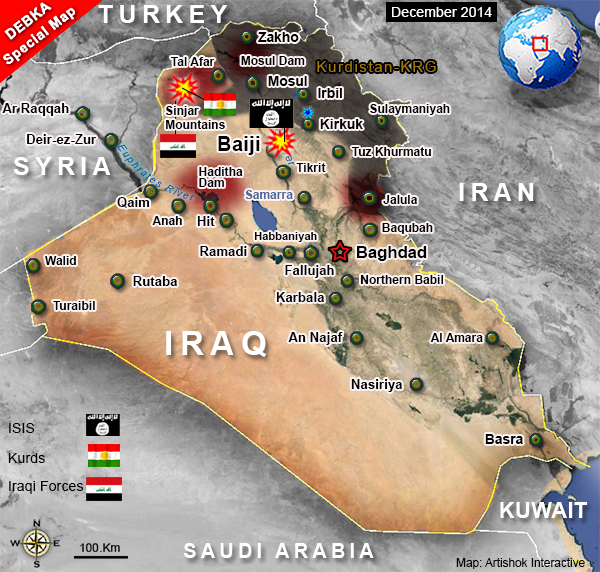
American, Kurdish and Iraqi officials have hailed as a “major victory” the release of thousands of distressed members of the Yazdi community, trapped for four months on on Mt. Sinjar in northern Iraq, since Islamic State thugs overran their town. Many more fled to Syria while Yazdi women were kidnapped.
This was a necessary rescue operation, but hardly a major victory, say DEBKAfile’s military experts. ISIS continues to maintain its grip on vast stretches of Iraq and Syria, defying the efforts of sparse US and coalition air strikes to dislodge them – beyond minor tactical withdrawals.
The town of Sinjar is not mentioned in the US and Kurdish releases, because large sections are still in jihadi hands.
Even less is heard about the situation on the northern Iraqi-Syrian border, where Abu Bakr Al-Baghdadi has achieved almost total supremacy.
But the most telling omission by the US-led allies is the fact that, while they focused on Mt. Sinjar, ISIS forces restored their siege of Baiji, Iraq’s main oil refinery center, after pushing Iraqi troops out.
This happened after a majority of the local Sunni tribes who fought alongside the Iraqi army up until November, switched sides.
The tribal chiefs complained that the Iraqi Prime Minister Haider al-Abadi, who was installed in Baghdad with Washington’s support last year, as a figure able to unite the country’s Sunni and Shiite communities for the war on ISIS, reneged on his promise of pay checks and weapons for the tribesmen who threw in their lot with the national army.
Instead, he is accused of aggravating disunity in the armed forces by firing Sunni officers and replacing them with officers loyal to Iraq’s pro-Iranian Shiite militias, who take their orders from Iranian Revolutionary Guards Corps commanders.
DEBKAfile’s military and counter-terrorism sources describe the current military state of play in Iraq as bizarre, fought on three more or less disconnected levels:
1. In the north, a mixed Iraqi-Kurdish force, accompanied by US military advisers, is poised to attack the key town of Tal Afar, which lies 50 km west of Mosul.
Friday, Dec. 21, they took the town’s Iraqi military base that fell to ISIS in June. But, like in Sinjar, the assault force has not yet occupiedy the town.
This Tel Afar operation was a compromise in the disagreement the Iraqis and Kurds had with Washington. They asserted they were fully capable of recapturing Mosul from the Islamists, while the US military advisers disagreed and warned that this offensive was doomed to failure.
2. While Iraqi and Kurdish peshmerga forces are concentrating their assaults on areas where ISIS forces are thin on the ground (like Mt. Sinjar), the jihadis are throwing strength into capturing and controlling the Iraqi and Syrian oil industries (like Baiji). They are by now accruing revenues running into $2 to 2.5 billion, despite falling crude prices. In fact they are dumping the looted oil for $25-30 per barrel, well below the world market prices.
3. Washington is sparing too little attention for the ISIS outgrowths mushrooming outside Iraq and Israel – especially in Libya, Egypt and Egyptian Sinai.
Israel, the Obsession, American Thinker, Richard Baehr, December 22, 2014
[T]here is no clear path back to sanity, nor is there a clear path to the end of the obsession with Israel.
*****************
It has been a pretty typical week on the hate Israel front. A European Union Court has decided that Hamas is not a terrorist organization, and their previous designation as such had not been justified by real evidence that Europeans had developed, as opposed, say, to information supplied by the United States or Israel. An international court in Geneva is hearing evidence of Israeli human rights violations. The United Nations Security Council has been considering a resolution developed by the Palestinian Authority, as well as one by the French that would effectively lay out the terms for Israel’s capitulation over the next few years. Israel’s peace camp has been working with U.S. Secretary of State John Kerry, encouraging a delay in consideration of the Security Council resolutions, since any action before the upcoming Israeli parliamentary elections could benefit the right-wing parties in Israel. In other words, there is not even an attempt to hide anymore that the United States is putting its foot down for one particular side in the Israeli election. Various European countries are endorsing Palestinian statehood on the terms demanded by the Palestinian Authority. Academic groups, unions, and churches in Europe and the United States are endorsing the boycott, divestment, and sanctions (BDS) movement. Certain European communities are now “Israeli-frei” – free of Israeli goods (or at least those they can identify and care to avoid). The U.N. Human Rights Council and the General Assembly, as well as specific agencies whose only task is to bash Israel, are set to get back to work, creating more resolutions and condemnations of the Jewish state.
As Joshua Muravchik makes clear in his outstanding new book, Making David Into Goliath, this obsession with Israel by most nations of the world and the United Nations – or as they are collectively known, “the international community” – as well as by “the global left,” could not have been imagined a half-century back, prior to the Six-Day War. At that time, Israel was championed by Socialist political parties, and viewed sympathetically as a beleaguered democracy fighting for its existence against a collection of larger anti-Western Arab tyrannies. There was residual sympathy for Jewish survivors of the Holocaust, many of whom had moved to Israel. There was no movement for Palestinian nationhood, though certainly violent actions by Arabs aimed at Israel and Jews in the region had been going on for decades.
Muravchik’s book attempts to explain what has happened during this period and why. A lot changed after the 1967 war, when, instead of little Israel facing off with 21 Arab nations, the conflict was recast with Israel as the big dog, oppressing the Palestinians and occupying their land. Since the left tends to root for the underdog, Israel no longer fit the bill. The description of the conflict in the post-1967 telling is of course neither factual nor historical, since there had never been a unique nation of Palestinian Arabs, denied their nationhood – say, the way the Tibetans or the Kurds have been for sixty years, or forever. The Palestinians became refugees because their leaders refused to accept half a loaf – a state on half of the mandate territory in 1947 – and instead chose to go to war to deny the Zionists their state. The Arabs of Palestine, even with the support of armies from their Arab neighbor states, lost the war.
When you start a war and lose, there are consequences.
Since 1967, the Palestinians and their allies have been trying to reverse not just the war of 1967, but the 1948 war as well. Refugees from the 1948 war (and there are not many of them left) are still in refugee camps, unlike any other refugees from any other conflicts then or in the years since, and the descendants of the original refugee population, now from three generations, demands a “right of return” to homes in Israel where they never lived and in fact to a country where they have never been.
The 1948 war produced a population exchange – a larger number of Jews were driven out of Egypt, Tunisia, Morocco, Algeria, Yemen, Iraq, Libya, and other countries than Arabs who left their homes in what became Israel. Most of the Jewish refugees moved to Israel, where in relatively short order they were out of any temporary refugee camps and absorbed as regular citizens of the state. That the Arabs have sacrificed generations of their own people to maintain their inflexible hatred of Israel is all one needs to know about why there has been no resolution of the conflict despite serious efforts over the years to accomplish this.
Muravchik, who was once a leftist himself, spends a fair amount of time in the book documenting the impact of Edward Said , who with his disciples has mentored the current U.S. president, Barack Obama. Said, despite his faked personal history, has had enormous impact introducing moral relativism to studies of the regions, declaring that the West cannot understand “the Orient” and has no right to judge the regimes, the religions, the people. What the West calls a terrorist group is instead viewed as a resistance fighting for freedom. The combination of mosque and state is what those in the region know and prefer, not Western parliamentary systems. Israel is not a beacon with much to offer those in the region, but an imperialist creation and a predator. Muravchik outlines how in Israel itself, a part of the population is at war with Zionism and is in fact in league with Israel’s external enemies, assisting viperish non-governmental organizations (often funded by European nations) and bigoted journalists. An increasing number of left-wing Jews in the United States behave as if Israel is an embarrassment, claiming that Israel’s behavior is “not in its name” and calling for an end to the “racist, apartheid“ state.
At one time, the United Nations consisted primarily of democracies who had fought the Axis powers. With the decolonization of Africa and Asia after the war, dozens of new nations, since dubbed “the Third World,” became the dominant block at the U.N., particularly in the General Assembly and other international organizations. These new nations included many Arab and Islamic countries, and their power in numbers shifted these organizations into full-blown assault forces directed at Israel. Three quarters of all U.N. General Assembly resolutions that are directed at a single country are rebukes of Israel. It is fairly obvious that the international community considers Israel the worst country in the world (or at least the closest thing to a piñata for the purposes of diplomatic assault) and has ignored the human rights disasters at play in Sudan, Somalia, Nigeria, Iran, North Korea, Pakistan, Bangladesh, Libya, Saudi Arabia, and dozens of other easy targets, since there is no real interest in fairness, and Israel is always held to a different standard.
The Palestinians and their allies have also scored with the terror weapon and the oil weapon. One nation after another demonstrated that cowardice was the preferred policy for dealing with Palestinian terror groups, rather than risking confrontation with them, and many nations thought they could buy peace and security by becoming harsh critics of Israel and allies of the Palestinians. In countries with large populations of Arab or Muslim immigrants, taking on Israel politically, and ignoring violence directed against Israel or threats against Jews, was seen as a safety valve to prevent terrorism and violence directed against such countries’ own citizens. After the 1973 Yom Kippur War, OPEC, dominated by Arab oil producers, began a more systematic effort to use the threat of cutting off oil deliveries to force changes in policy by oil-importing nations, particularly in Europe.
Muravchik is an honest historian of the conflict, and he documents how Israel contributed to changing the narrative of the conflict. Some of Israel’s leaders were poor spokespersons for the country. The invasion of Lebanon in 1982, followed by the attacks carried out by Christian Phalangists in Sabra and Shatila to avenge the assassination of their leader by Palestinians, with Israeli forces seemingly looking the other way, were particularly damaging. Many Israelis, not all on the hard left, have opposed the settlement enterprise in Judea and Samaria. Muravchik makes clear, however, much as Caroline Glick has done in her book The Israel Solution, that to a large extent it is irrelevant what Israel has offered in any peace process to achieve a deal. In essence, the country has entered a bidding war against itself.
Muravchik has laid out why Israel is now in the dock, facing more critics on more fronts all the time. But what is most depressing is that there is no clear path back to sanity, nor is there a clear path to the end of the obsession with Israel. In fact, the momentum is all with those ganging up on the Jewish state. In the United States, Barack Obama is a president more comfortable with the thinking of the international community than any prior president since Israeli statehood in 1948, and he seems anxious to end America’s isolation on this issue (since it alone has stood in Israel’s corner for several decades) and move American policy so we are more in line with Sweden or Spain with regard to the conflict.
Muravchik calls for vigilance (Obama will be around only another two years and one month), but with America’s rapidly shifting demography, and the takeover of so many parts of the culture by the left – most of the media, the arts, the universities, Hollywood, many churches and synagogues – the struggle for those who stand with Israel will be uphill.
“We are brothers,” says ISRAELI Prime Minister Benjamin Netanyahu as he applauds Christian IDF soldiers
Via Bare Naked Islam

(‘Let There Be Peace on Earth and let it begin with me.
Let There Be Peace on Earth, the peace that was meant to be!
With God as our Father, brothers all are we.
Let me walk with my brother in perfect harmony.’
-Sy Miller and Jill Jackson -LS)


EU Gives Hamas Green Light to Attack Israel, Gatestone Institute, Khaled Abu Toameh, December 22, 2014
Although the EU court has said that its controversial decision was “technical” and was not a reassessment of Hamas’s classification as a terrorist group, leaders of the Islamist movement believe that the move will eventually earn them legitimacy in the international arena.
The EU court’s decision represents a “severe blow to the Palestinian Authority and Egypt,” according to Palestinian political analyst Raed Abu Dayer.
Any victory for Hamas, albeit a small and symbolic one, is a victory for the Islamic State, Al-Qaeda, Islamic Jihad, the Muslim Brotherhood and other fundamentalist groups, and causes tremendous damage to those Muslims who are opposed to radical Islam.
Hours before the EU court’s decision was made public, Hamas leader Mahmoud Zahar announced that his movement would never recognize Israel, and that Hamas seeks to overthrow the Palestinian Authority and seize control of the West Bank.
The EU court’s decision also coincided with a rapprochement between Hamas and Iran. Now, the Iranians and other countries, such as Turkey and Qatar, are likely to interpret the EU court’s decision as a green light to resume financial and military aid, including rockets and missiles, to Hamas — not only to Gaza but to the West Bank as well — to support those Palestinians whose aim it is to eliminate Israel.
Less than 48 hours after a top European Union court ruled that Hamas should be removed from the bloc’s list of terrorist groups, supporters of the Palestinian Islamist movement responded by firing a rocket at Israel. The attack, which did not cause any casualties or damage, did not come as a surprise.
Buoyed by the EU court’s ruling, Hamas leaders and spokesmen see it as a “political and legal achievement” and a “big victory” for the “armed struggle” against Israel.
Musa Abu Marzouk, a top Hamas leader, issued a statement thanking the EU court for its decision. He hailed the decision to remove his movement from the terrorist list as a “victory for all those who support the Palestinian right to resistance.”
When Hamas leaders talk about “resistance,” they are referring to terrorist attacks, such as the launching of rockets and suicide bombings against Israel. In other words, Hamas has interpreted the court’s decision as a green light to carry out fresh attacks as part of its ambition to destroy Israel.
The rocket that was fired from the Gaza Strip at Israel only days after the court decision is not likely to be the last.
Although the EU court has said that its controversial decision was “technical” and was not a reassessment of Hamas’s classification as a terrorist group, leaders of the Islamist movement believe that the move will eventually earn them legitimacy in the international arena.
Ironically, the EU court’s decision coincided with Hamas celebrations marking the 27thanniversary of its founding. Once again, Hamas used the celebrations to remind everyone that its real goal is to destroy Israel. And, of course, Hamas used the event to display its arsenal of weapons that include various types of rockets and missiles, as well as drones.
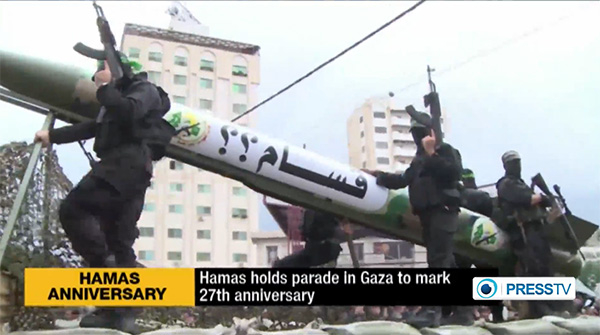 Thousands of armed Hamas troops showed off their military hardware at a Dec. 14, 2014 parade in Gaza, marking the organization’s 27th anniversary. (Image source: PressTV video screenshot)
Hours before the EU court decision was made public, Hamas leader Mahmoud Zahar announced that his movement would never recognize Israel. Zahar also made it clear that Hamas seeks to overthrow the Palestinian Authority [PA] regime and seize control over the West Bank.
The EU court’s decision also coincided with increased efforts to achieve rapprochement between Hamas and Iran. Recently, a senior Hamas leadership delegation visited Tehran as part of efforts to mend fences between the two sides. The main purpose of the visit was to persuade the Iranians to resume military and financial aid to Hamas. The visit, according to senior Hamas officials, appears to have been “successful.”
“There are many signs that our relations are back on the right track,” explained Hamas’s Musa Abu Marzouk. “Hamas and Iran have repaired their relations, which were strong before the Syrian crisis.” Relations between Hamas and Iran deteriorated due to the Islamist movement’s refusal to support the regime of Syrian President Bashar Assad.
Now the Iranians are likely to interpret the EU court decision to remove Hamas from the list of terrorist groups as a green light to resume financial and military aid to the movement.
Iran’s leaders recently announced that they intend to dispatch weapons not only to the Gaza Strip, but to the West Bank as well, as part of Tehran’s effort to support those Palestinians who are fighting to eliminate Israel.
Moreover, the EU court’s move will also embolden other countries that provide Hamas with political and financial aid, first and foremost Qatar and Turkey. Oil-rich Gulf countries such as Kuwait, Bahrain, Oman and Saudi Arabia will now face pressure from many Arabs and Muslims to join Qatar, Turkey and Iran in extending their support to Hamas.
The biggest losers, meanwhile, are Palestinian Authority President Mahmoud Abbas and Egypt’s President Abdel Fattah el-Sisi. Over the past few months, the two men have been doing their utmost to undermine Hamas and end its rule over the Gaza Strip.
Abbas has been fighting Hamas by blocking financial and humanitarian aid and arresting its supporters in the West Bank, while Sisi continues to tighten the blockade on the Gaza Strip and destroy dozens of smuggling tunnels along the border with Egypt.
The EU court’s decision represents a “severe blow to the Palestinian Authority and Egypt,” noted Palestinian political analyst Raed Abu Dayer. “As far is Abbas is concerned, the decision grants Hamas political legitimacy and challenges his claim to be the sole legitimate leader [of the Palestinians]. With regards to Egypt, the European court decision calls into question rulings by Egyptian courts that Hamas is a terrorist organization.”
Even if the EU court decision is reversed in the future, there’s no doubt that it has already caused tremendous damage, especially to those Muslims who are opposed to radical Islam.
Any victory for Hamas, albeit a small and symbolic one, is a victory for the Islamic State, Al-Qaeda, Islamic Jihad, the Muslim Brotherhood and other fundamentalist groups around the world.
The decision has left many Arabs and Muslims with the impression that Hamas, after all, is not a terrorist organization, especially if non-Muslims in Europe say so through one of their top courts. Even worse, the decision poses a real and immediate threat to Israel, as evident from the latest rocket attack.
If the Europeans have reached the conclusion that Hamas is not a terrorist organization, then why don’t their governments openly invite tens of thousands of Hamas members and supporters to move to London, Paris and Rome? And they should not forget to ask the Hamas members to bring along with them their arsenal of weapons.
Why is Israel blamed for evil while Islamic nations are not? Dan Miller’s Blog, December 21, 2014
Blaming Israel for evil, rather than her many Islamic neighbors and enemies is, despite the views of Obama and His colleagues, contrary to American values. Doing so is based on Jew hatred, envy of success, and the multicultural absurdity that no culture or religion is better or worse than any other.
As I argued most recently here and here, Israel is fighting for her survival against regimes that want her to cease to exist because she is Jewish, not Islamic, and her government is free and democratic, not dictatorial. She is, therefore, an outsider in the Middle East.
This video identifies many of the reasons why Israel is viewed harshly by other Western civilizations while Islamic nations, which are neither free nor democratic, are viewed favorably.
I suspect that Dr. Ben Carson, who recently visited Israel and was much impressed, would agree with the points made in the video.
Although the U.S. remains Israel’s closest and most important ally, Obama and Israeli Prime Minister Benjamin Netanyahu have little personal chemistry and have frequently clashed. The U.S. has been outspoken in its criticism of Israeli settlement construction in the West Bank and east Jerusalem — captured areas claimed by the Palestinians as parts of a future state. At the same time, U.S. Secretary of State John Kerry has made numerous trips to the region and elsewhere to try to broker a peace deal.
Carson said the criticism of the settlements has been exaggerated, and he asserted that Palestinian hostility toward Israel is what is preventing peace in the region. Of Netanyahu, Carson said, “I think he’s a great leader in a difficult time.” [Emphasis added.]
Israeli intervention in Syria looking more likelyThis is following an alliance between the rebel Yarmouk Martyrs Brigades and IS.Dec 21, 2014, 12:11PM | Rachel Avraham
via Israel News – Israeli intervention in Syria looking more likely – JerusalemOnline.

Photo Credit: Channel 2
Defense Minister Moshe Ya’alon spoke with outgoing US Defense Secretary Chuck Hagel to discuss increased Israeli involvement in the war against IS. According to a report in Haaretz, Israel has been assisting villages around the Golan in exchange for keeping extremist Islamist groups away from the border. But with the recent defection of the Yarmouk Martyrs Brigade from the FSA to the IS dominated Islamist axis, a fact which has been confirmed on Debka and by retired Major General Amos Gilad on Reshet Bet, Israel may have to become more actively involved in the Syrian civil war due to the ascendancy of Islamic State in strategically sensitive areas near the Israeli border.
Additionally, the National reported that Mousab Zaytouneh, a leading figure in the Yarmouk Martyrs Brigades that was killed last Monday, was secretly in league with Islamic State. The report noted that there have been numerous reports from opposition sources that various FSA brigades have been secretly aligned with Islamic State. According to a report in Al Monitor, media leaks on some jihadist pages indicated that the most important sleeper cells in Daraa, which might have pledged their allegiance to IS, include Saraya al-Jihad led by Abu Musab; Tawheed al-Janoub Brigades; and Yarmouk Martyrs.
Although Yarmouk has not pledged formal alliance to IS, but merely signed an operational cooperation pact with it, it still represents a major danger to Israel. This sudden defection leaves IDF defense formations on the Golan, US and Jordanian deployments in the northern part of the kingdom, and pro-Western rebel conquests in southern Syria in danger of collapse. It provides IS with direct access to a long section of Israel’s Golan Heights border with Syria for the first time, as the Yarmouk Martyrs Brigade is primarily based in southwestern Daraa Province near the crossroads between Jordan, Syria and the Golan Heights.
According to a report in American Thinker, the Yarmouk Martyrs Brigades was behind taking 21 Filipinos working for UNDOF hostage in March 2013. The group is believed to be named after a battle that took place along the Yarmouk River near the Golan Heights, when the Rashidun Caliphate fought against the Byzantines in 636 AD. The battle ended Byzantine control in the area and led to Islamic rule in the region. For the Yarmouk Martyrs Brigade, the naming of their group after the Yarmouk battle symbolizes their political aims; the BBC notes that their ideology is Islamist, implying that signing an operational cooperation pact with Islamic State should not come as a surprise.
“Israel cannot stand by while red lines which endanger its security are being crossed,” Ya’alon stated previously. “This year, we find ourselves facing radical Islamic terrorism, which lurks in every Middle Eastern corner, seeking to destroy us only for who we are. The relentless terrorism is activated by cruel organizations which do not hold back on means, and will do everything to try and sabotage our existence here in Israel.”




 anneinpt
 artaxes
 danmillerinpanama
 davidking1530
 Peter Hofman
 Joseph Wouk
 Peter
Peter Louisiana Steve
 WarSclerotic
Recent Comments