Archive for September 26, 2014

Satire: Become an Islamist and save the Earth. Or else.

September 26, 2014

Become an Islamist and save the Earth. Or else, Dan Miller’s Blog, September 25, 2014

This is a guest post by Imam Mohamed al-Jihadi, a friend of (my also imaginary) friend Senator Ima Librul (L., Utopia, the Unicorn State). Imam Al-Jihadi is a renowned Islamic scholar and author of “The Real Dreams of My Real Father,” soon to be published by the Religion of Peace Publishing Company. After explaining the truth about Islam, Imam al-Jihadi tells us how to please Allah by combating climate change.

Imam Mohamed Al-Jihadi

Imam Mohamed Al-Jihadi

A message of true peace through submission to the Most Holy will of Allah the all merciful:

In the name of Allah the all merciful, may the peace of submission be upon you whether you believe that you desire it or not, إن شاء الله‎. As even Imperialist Obama has told you repeatedly, Islam is the religion of peace and abhors all violence. True, we engage in some peaceful efforts on behalf of Holy Islam — wrongly called “violence” by unbelievers and apostates — but only to seek the submission of unbelievers and apostates to the One True God, Allah, may His Holy Name be praised and may His blessings be upon all who submit willingly to His righteous commands. Any who refuse to do so shall be dealt with as Allah directs, إن شاء الله‎.

If you hope to be saved, first become politically correct. That will propel you along the righteous path of adherence to Allah’s Holy Word with proper devotion, submission and humility. Cease, therefore, your evil disparagement of the Religion of Peace Through Submission and also your futile efforts to fight hopeless battles against us. Rise up as one to battle the worst crisis ever, the climate change demon.

Climate change demon

Climate change demon

Even the American Imperialist in Chief, Obama, has often commanded you to defeat the greatest demon of all, as he did again on September 24th during his remarks at the United Nations. The horrors of climate change are the product of the Obama Nation’s rejection of Allah the all-mighty and all-merciful, the one and only green God. The Obama Nation must change, radically, its wicked ways and join wholeheartedly with the righteous defenders of Allah’s Earth. Many photos of useful idiots those in California who are trying to do so are at the link. Here’s a video of remarks by one of them:

Do not, however, be misled by her fantasies about Communism, an evil religion because it spurns the Holy teachings of The Prophet Mohamed. Although she did speak semi-truthfully about Capitalism, it is no less evil than Communism because it also is un-Islamic and engages in numerous violations of Allah’s Holy Sharia law. It must and shall be abolished, إن شاء الله‎.

As to oil, there is ample environmentally friendly oil in Islamist countries and it must be used — exclusively — to support Holy Islam. Those who use oil from elsewhere, and of course coal, scornfully defy the will of Allah and must be dealt with as are other unbelievers and apostates who stubbornly reject His commands. Allah orders it.

As you, our inferiors, begin to accept Allah’s commands others will learn from and come to follow even you — not to a world based on false Capitalist or Communist doctrine but to an Islamist world where truth, mercy and justice reign supreme. It is written. All un-believers and apostates who reject this wise counsel must, and therefore shall, be punished severely now and in the hereafter, إن شاء الله‎. As we have preyed prayed, the Mahdi will soon come. Beware.

.

.

When you instead submit totally to Allah, virgins anxious to please you in every way will greet you as you go to meet Him. Here is a picture of only one of the many anxiously awaiting you.

I await you. Please come soon!

I await you. Please come soon!

Editor’s comments

I  was privileged to select the graphics to be associated with Imam al-Jihadi’s presentation and hope that he will find them pleasing unto Allah.

There is no truth to any rumor that Imam al-Jihadi has been placed in charge of the Obama Nation’s Department of Homeland Security, Environmental Protection Agency, Department of Justice or all of them. It would make little difference. However, if and when he is appointed, and if and when the Mahdi arrives, updates may be posted.

UPDATE:

Oh well.

UPDATE:

An article by Bryan Preston at PJ Tatler is titled Is the US Waging ‘Green War’ In Syria?

If we are avoiding destroying ISIS’ oil-basket, it would represent a decisive break from US strategy in previous wars. In both world wars, Vietnam and to a lesser extent in the two wars in Iraq, US forces targeted infrastructure in order to cripple the enemy’s economy. We bombed everything from highways to railways to power grids and fuel refineries and depots, to break the enemy’s ability to wage war. The more we focused on disrupting the enemy’s economy, the more damage we did to the enemy’s ability to wage war against us.

If we are going green in Syria, Imam Mohamed al-Jihadi will doubtless approve.
We Don’t Need to Ally with Terrorists to Defeat ISIS

September 26, 2014

We Don’t Need to Ally with Terrorists to Defeat ISIS, Front Page Magazine, Daniel Greenfield, September 26, 2014

(OK, but assuming that the defeat of the Islamic State is our goal, how is that to happen? Clearly, we will not go to war with Islam. Yet. — DM)

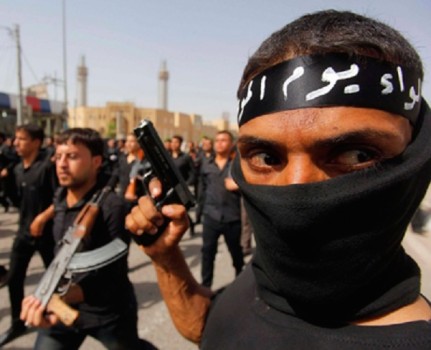
isis-431x350

Allying with terrorists to defeat terrorists is counterproductive. The Muslim world will always have its Jihadists, at least until we make a serious effort to break them which we won’t be doing any time soon. But we can at least stop making the problem worse by arming and training our own enemies.

******************

The big foreign policy debate now is whether we should ally with Sunni or Shiite Jihadists to defeat ISIS.

The pro-Iranian camp wants us to coordinate with Iran and Assad. The pro-Saudi camp wants us to arm the Free Syrian Army and its assorted Jihadists to overthrow Assad.

Both sides are not only wrong, they are traitors.

Iran and the Sunni Gulfies are leading sponsors of international terrorism that has killed Americans. Picking either side means siding with the terrorists.

It makes no sense to join with Islamic terrorists to defeat Islamic terrorists. Both Sunni and Shiite Jihadists are our enemies. And this is not even a “the enemy of my enemy” scenario because despite their mutual hatred for each other, they hate us even more.

The 1998 indictment of bin Laden accused him of allying with Iran. (Not to mention Iraq, long before such claims could be blamed on Dick Cheney.) The 9/11 Commission documented that Al Qaeda terrorists, including the 9/11 hijackers, freely moved through Iran. Testimony by one of bin Laden’s lieutenants showed that he had met with a top Hezbollah terrorist. Court findings concluded that Iran was liable for Al Qaeda’s bombing of US embassies. Al Qaeda terrorists were trained by Hezbollah.

While Shiite and Sunni Jihadists may be deadly enemies to each other, they have more in common with each other than they do with us. Our relationship to them is not that of “the enemy of my enemy is my friend.” That’s their relationship to each other when it comes to us. In these scenarios we are the enemy.

The pro-Saudi and pro-Iranian factions in our foreign policy complex agree that we have to help one side win in Syria. They’re wrong. We have no interest in helping either side win because whether the Sunnis or Shiites win, Syria will remain a state sponsor of terror.

It’s only a question of whether it will be Shiite or Sunni terror.

Our interest is in not allowing Al Qaeda, or any of its subgroups, to control Syria or Iraq because it has a history of carrying out devastating attacks against the United States. We don’t, however, need to ally with either side to accomplish that. We can back the Kurds and the Iraqi government (despite its own problematic ties) in their push against ISIS in Iraq and use strategic strikes to hit ISIS concentrations in Syria. We should not, however, ally, arm or coordinate strikes with either side in the Syrian Civil War.

Both the pro-Saudi and pro-Iranian sides insist that ISIS can’t be defeated without stabilizing Syria. But it doesn’t appear that Syria can be stabilized without either genocide or partition. Its conflict is not based on resistance to a dictator as the Arab Springers have falsely claimed, but on religious differences.

Helping one side commit genocide against the other is an ugly project, but that would be the outcome of allying with either side.

Stabilizing Syria is a myth. The advocates of the FSA claimed that helping the Libyan Jihadists win would stabilize Libya. Instead the country is on fire as Jihadists continue to fight it out in its major cities.

Even if the FSA existed as an actual fighting force, which it doesn’t, even if it could win, which it can’t, there is every reason to believe that Syria would be worse than Libya and an even bigger playground for ISIS. The FSA enthusiasts were wrong in Egypt and Libya and everywhere else. They have no credibility.

The pro-Iranians claim that helping the Syrian government will subdue ISIS, but Assad hasn’t been able to defeat the Sunni Jihadists even with Russian help. The Syrian army and its Hezbollah allies are still struggling despite having an air force, heavy artillery and WMDs. Not only shouldn’t we be allying with Shiite terrorists who have killed plenty of Americans over the years, but it would be extremely stupid to ally with incompetent terrorists. Allying with the FSA or Assad makes as much sense as allying with ISIS.

The difference is that ISIS at least seems to be able to win battles.

Some pro-Iranian wonks claim that if we don’t get Assad’s approval for air strikes, he will shoot down Americans planes. That’s about as likely as Saddam Hussein returning from the dead to audition for American Idol. Assad didn’t even dare shoot down Israeli planes who were buzzing his palace. The odds of him picking a fight with the United States Air Force are somewhere between zero, nil and zilch.

We don’t need Assad’s permission to hit ISIS targets in Syria and, in one of the few things that this administration is doing right, we aren’t asking for it. Unless Assad experiences a bout of severe mental illness, he isn’t going to fight us for the privilege of losing to ISIS. Not even Saddam was that crazy.

The big potential problem in this war is mission creep. That’s why we should avoid committing to any overarching objectives such as stabilizing Syria. Unfortunately that is exactly what Obama has done.

It’s not our job to stabilize Syria and short of dividing it into a couple of majority states in which the Sunni and Shiite Arabs, the Kurds, the Christians and maybe even the Turkmen get their own countries, it’s not a feasible project. We have the equipment and power to pound ISIS into the dirt when its forces concentrate in any area. We can send drones to target their leaders. If Assad or the FSA want to provide us with intel, we can use it as long as we don’t begin working to help them fulfill their own objectives.

We need to remember that we are not there for the Syrians or Iraqis; we’re there for ourselves.

After September 11 we learned the hard way the costs of letting enemy terrorists set up enclaves and bases. But we also learned the hard way the costs of trying to stabilize unstable Muslim countries.

Al Qaeda, in its various forms, will always find sanctuaries and conflicts because the Muslim world is unstable and widely supportive of terrorism. For now this is a low intensity conflict that denies the next bin Laden the territory, time and manpower to stage the next September 11. We can do this cheaply and with few casualties if we keep this goal in mind.

This isn’t nation building. It’s not the fight for democracy. All we’re doing is terrorizing the terrorists by using our superior reach and firepower to smash their sandcastle emirates anywhere they pop up.

Allying with terrorists to defeat terrorists is counterproductive. The Muslim world will always have its Jihadists, at least until we make a serious effort to break them which we won’t be doing any time soon. But we can at least stop making the problem worse by arming and training our own enemies.

ISIS Baghdad March: Is Islamic State Targeting The Iraqi Capital?

September 26, 2014

ISIS Baghdad March: Is Islamic State Targeting The Iraqi Capital? International Business Times, September 26, 2014

(How difficult might it be for the IS, et al, to move more troops into already occupied places near Baghdad, consolidate them there, and then send them to take Baghdad? The Iraqi armed forces have functioned poorly in the past and might well not put up a successful defense.

Were the IS to take Baghdad, what might the “coalition of the willing” do about it? Air strikes on a city of more than 7,216,040, many of them civilians, seem unlikely. In any event, civilian deaths would not likely concern the IS more than they concerned Hamas, and would provide gruesome photos welcomed for propaganda purposes.– DM)

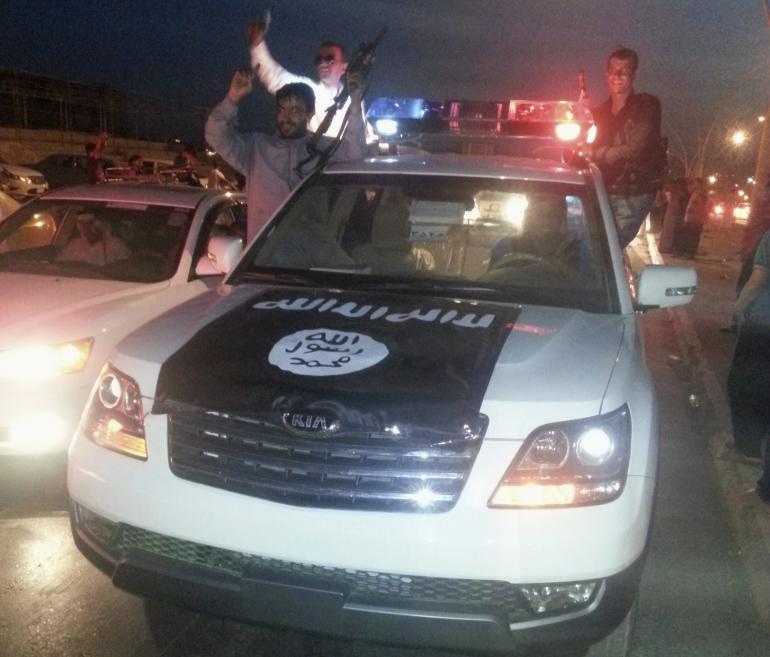
cop car in MosulFighters of the Islamic State group, also known as ISIS or ISIL, celebrate on a police vehicle along a street in the city of Mosul, June 23, 2014. Reuters

ISIS has been circling Baghdad for years. The Islamic State carried out 641 operations in Baghdad last year, up from 371 operations in 2012, including car bombs, armed assaults and assassinations, according to the Institute for the Study of War.

The multi-nation campaign against ISIS might have prodded the militants to refocus their efforts in Iraq, where the Islamic State has many strategic territories near Baghdad . . .

*****************

The Islamic State may be refocusing its sights on Baghdad after the extremist group overran an Iraqi military base and executed 300 soldiers Sunday amid ongoing U.S. airstrikes aimed at weakening the militants’ infrastructure and resources, according to military analysts. Other targeted attacks in recent weeks also suggest the militants are plotting against the Iraqi capital more than three months after international leaders first warned of the group’s aspirations to take Baghdad.

The base attack came days after the militant group also know as ISIS launched 14 mortar rounds during a foiled attempt to break into the Adala Prison in northern Baghdad. ISIS also launched an attack earlier this month in Baghdad’s Iskan neighborhood that likely targeted the offices of the political group and militia, the Badr Organization, according to the Institute for the Study of War in Washington, D.C.

“This attack is very significant. It is the first infantry-like, complex, and penetrating attack in Baghdad city by ISIS since the fall of Mosul in June of this year,” the think-tank wrote on its website. “ISIS likely carried out the attack to release some of the pressure it is facing as a result of the recent U.S. air campaign targeting its positions. The attack also signifies that, despite the heightened defenses of Baghdad in the aftermath of the fall of Mosul, ISIS is still able to carry out attacks in an area where it is unlikely to have active sleeper cells.”

It’s unclear if the U.S. airstrikes in Iraq have accomplished the Obama administration’s stated mission to “degrade and destroy” ISIS. Some military analysts and U.S. critics have said the Obama administration needs to send ground troops to Iraq to wipe out ISIS, while others have said the airstrikes have successfully managed to slow down the militant group’s advances.

“The U.S. has made it pretty much impossible to undertake the large-scale mobile operations that ISIS was doing earlier in the summer,” Michael Knights, who specializes in military and security affairs in Iraq for the Washington Institute for Near East Policy, said. “It has changed the nature of the beast.”

But ISIS’ goal of taking most of western and central Iraq hasn’t changed since the airstrikes, said Bill Roggio, a senior fellow with the Foundation for Defense of Democracies in Washington who specializes in Iraq. While Baghdad might be out of their reach, other territories remain vulnerable, Roggio said.

“They are just continuing their operations,” he said in a telephone interview. “The airstrikes haven’t stopped them for continuing to do what they have been doing all along, which is take control of territory.”

ISIS has been circling Baghdad for years. The Islamic State carried out 641 operations in Baghdad last year, up from 371 operations in 2012, including car bombs, armed assaults and assassinations, according to the Institute for the Study of War.

ISIS gained international prominence in June when it seized northern cities such as Tikrit, Saddam Hussein’s hometown, and Mosul, Iraq’s second largest city, and began holding mass executions of Iraqi soldiers. At the time, military analysts predicted the Sunni militants had their sights on Baghdad. Obama responded by sending 300 military advisers to Iraq to share intelligence with Iraqi soldiers. More recently, the Obama administration began offensive airstrikes against ISIS territories near Baghdad last week in its latest effort to pushback the militant group. At the same time, the U.S. began airstrikes against the Islamic State and other militant groups in Syria.

The multi-nation campaign against ISIS might have prodded the militants to refocus their efforts in Iraq, where the Islamic State has many strategic territories near Baghdad, Knight said.

“Most of the people who watch Iraq say if ISIS is going to punch, it’s going to be in the Baghdad area,” he said in a telephone interview. “I have been surprised that it hasn’t happened … They are well positioned for that.”

Armed Company Official Shot Oklahoma Beheading Suspect, Saved Others From Being Killed

September 26, 2014

Off-Duty Cop Stops Beheading Attack by Shooting Suspect
BY: Washington Free Beacon Staff
September 26, 2014 12:30 pm


Alton Nolen – yet another Muslim wanna be.


(Another case of workplace violence? I think not.-LS)

Mark Vaughn was able to stop Alton Nolen’s violent rampage through an Oklahoma food distribution warehouse by shooting him with a rifle.

(Good shot Mr. Vaughn! Just remember, always fire no less than 3 rounds to make sure the threat is neutralized.-LS)

Vaughn came upon Nolen while he was brutally attacking his coworkers. He then shot Nolen and ended his attack,  according to KFOR.

Sgt. Jeremy Lewis says the alleged suspect, 30-year-old Alton Nolen had just been fired when he drove to the front of the business, hit a vehicle and walked inside.

He walked into the front office area where he met 54-year-old Colleen Hufford and began attacking her with a knife.

Police have said that Nolen, who reportedly converted to Islam recently and had tried to convert others, beheaded his first victim.

Lewis confirms that Hufford was stabbed several times and that Nolen “severed her head.”

He then started stabbing a second woman. As the second stabbing was ongoing Vaughn arrived at the scene and shot Nolen.

Officials say at that point, Mark Vaughn, an Oklahoma County reserve deputy and a former CEO of the business, shot him as he was actively stabbing Johnson.

“He’s a hero in this situation,” Sgt. Lewis said, referring to Vaughn. “It could have gotten a lot worse.”

WTVR reports that Mark Vaughn is both an employee of the company Nolen attacked and a police officer. He was off duty at the time of the attack.

The person who shot and injured Nolen was the company’s chief operating officer, Mark Vaughn, who also is a Oklahoma County reserve sheriff’s deputy.

The woman Nolen was stabbing when Vaughn shot him is reportedly alive and in stable condition. She is expected to survive, according to NewsOK.

The second victim in the attack was Traci Johnson, 43. Her injuries are not thought to be life-threating.

Megyn Kelly Grills State Dept’s Marie Harf After Obama Invokes Anti-American Islamic Cleric

September 26, 2014

Megyn Kelly Grills State Dept’s Marie Harf After Obama Invokes Anti-American Islamic Cleric, You Tube, September 26, 2014

(How difficult must it be to find a prominent Islamic scholar who has not issued a fatwa encouraging the killing of Americans?  The one chosen for Obama’s remarks at the UN, Bin Bayyah who issued such a fatwa, appears to have become rather an embarrassment. — DM)


Taliban Militants Attack Afghan Villages, Burning Homes And Beheading Civilians

September 26, 2014

Taliban Militants Attack Afghan Villages, Burning Homes And Beheading Civilians
AP By AMIR SHAH 09/26/2014 5:38 am EDT


(Meanwhile, back in sunny Afghanistan…-LS)

KABUL, Afghanistan (AP) — The Taliban beheaded 12 Afghan civilians, mostly family members of local policemen, in an assault that was part of a week-long offensive that has so far killed 60 people and wounded scores in a remote province in eastern Afghanistan, officials said Friday.

The violence comes amid the annual Taliban offensive, which this year will be an important gauge of how well Afghan government forces are able to face insurgent attacks ahead of the withdrawal of foreign combat troops at the end of the year.

According to the Ghazni provincial deputy police chief, Asadullah Ensafi, the Taliban on Thursday night captured and beheaded 12 civilians and torched some 60 homes in an attack in the province’s district of Arjistan.

Details were sketchy because of the remoteness of the rugged mountainous area, about 100 kilometers (60 miles) southwest of the capital, Kabul, but Afghan officials said women and children were believed to be among the casualties. There are no NATO troops stationed in the district.

Beheadings are rare in Afghanistan, though they occasionally take place as part of the Taliban campaign to intimidate and exact revenge on the families of Afghan troops and security forces.

Over the past week, the Taliban have been attacking several villages in Ghazni’s Arjistan district, Ensafi said, and battles in the area were still raging Friday, he said.

On Friday morning, the Taliban detonated a car bomb in front of an encampment where some 40 Afghan policemen were based in Arjistan, killing at least 8 policemen, said the province’s deputy governor, Mohammad Ali Ahmadi.

Ensafi said it was not immediately possible to reach the area to determine the exact number of casualties because the insurgents had mined the roads.

Ahmadi, who also confirmed the beheadings, said that attack and the car bomb brought the overall death toll in the Taliban offensive in Ghazni to 60. The victims included both civilians and policemen, he said.

Ahmadi said Afghan commandos have been airlifted from Kabul to the area to battle the Taliban and prevent the district from falling to the insurgents.

In Kabul, Ghazni lawmaker Nafisa Azimi said the situation in the province remains very dangerous, adding that the Taliban have taken scores of civilians from Arjistan hostage.

Each spring and summer bring an escalation in fighting in Afghanistan with the end of snowy winter weather, which hampers movement. The melting of the snows also opens up mountain passes, allowing militant forces to move in from neighboring Pakistan.

Iran nuclear talks yield no progress, French FM says

September 26, 2014

Iran nuclear talks yield no progress, French FM says Fabius says

Friday meeting canceled for lack of advancement; Israel objects to US proposal to ease some sanctions on Tehran

By Times of Israel staff September 26, 2014, 4:26 pm

via Iran nuclear talks yield no progress, French FM says | The Times of Israel.


A meeting at the P5+1 talks with Iran at UN headquarters in Vienna, on July 3, 2014 (photo credit: AFP/Joe Klamar)


rench Foreign Minister Laurent Fabius said Friday that six-power talks with Iran being held at the United Nations had failed to yield progress on curbing Tehran’s nuclear program.

“At this time as I speak, there is no significant progress,” Fabius told journalists on the sidelines of the UN General Assembly.

“We were due to have a meeting this morning of the P5+1 on one side and the Iranians on the other but because of a lack of progress, this meeting (had) to be called off,” Reuters quoted him saying.

Israel, meanwhile, voiced vociferous objections to a reported American proposal to soften its present demands that Iran gut its uranium enrichment program in favor of a new proposal that would allow Tehran to keep nearly half of the project intact while placing other constraints on its possible use as a path to nuclear weapons.

Diplomats who spoke to the Associated Press said the deal envisages letting Iran keep up to 4,500 centrifuges but would reduce the stock of uranium gas fed into the machines to the point where it would take more than a year of enriching to create enough material for a nuclear warhead.

Intelligence Minister Yuval Steinitz said that Israel “strongly opposes leaving thousands of [uranium] centrifuges active in Iran,” adding that “this deal is reminiscent of the failed deal reached in 2007 with North Korea, which now possesses 10 nuclear warheads.”

The initiative, revealed late Thursday, came after months of nuclear negotiations between Iran and six world powers that have failed to substantially narrow differences over the future size and capacity of Tehran’s uranium enrichment program. Iran insists it does not want atomic arms but the West is only willing to lift nuclear-related sanctions if Tehran agrees to substantially shrink enrichment and other activities that Iran could turn toward making such weapons.


Let i make it a bit more funny !

Germany: ‘We have never been so close’ to solving Iran crisis

FM Steinmeier says the most difficult phase of nuclear negotiations lies ahead, but ‘a collapse of the talks now is not permissible’

By Times of Israel staff and AFP September 26, 2014, 8:57 am

http://www.timesofisrael.com/germany-we-have-never-been-so-close-to-solving-iran-crisis/

Misunderstanding al Qaeda

September 26, 2014

Misunderstanding al Qaeda

The threat remains—and spreads.Oct 6, 2014, Vol. 20, No. 04 •

By THOMAS JOSCELYN

via Misunderstanding al Qaeda | The Weekly Standard.


On Tuesday, September 23, the U.S. government announced that a new bombing campaign was under way in Syria. The Obama administration had been building the case for airstrikes for weeks. The president and his surrogates repeatedly highlighted the threat posed by the Islamic State (often called the Islamic State of Iraq and the Levant, or ISIL), which has captured large swaths of territory across Iraq and Syria. Unexpectedly, the administration announced that American missiles had also struck something called the “Khorasan group,” which was in the final stages of planning attacks in the West. The group may even have been close to striking inside the United States.

Above, Muhsin al Fadhli; below, a September 23 bombing run

Above, Muhsin al Fadhli; below, a September 23 bombing run

NEWSCOM

Widespread confusion ensued. The press wondered aloud, “What is the Khorasan group?” It is a “new” terrorist organization, some reported. It is an “al Qaeda offshoot,” others claimed. All of the following descriptors were used of the group: “little-known,” “shadowy,” “mysterious,” “previously unknown.”

But you have heard of the Khorasan group before. It is, to put it simply, al Qaeda.

Ayman al Zawahiri, the head of al Qaeda, ordered trusted operatives from Afghanistan, Chechnya, Iran, Pakistan, Yemen, and North Africa to relocate to Syria. Some of the al Qaeda operatives involved are so notorious that U.S. counterterrorism officials have tracked them, off and on, for more than a decade.

Zawahiri tasked his men with plotting mass-casualty attacks in the West. And, al Qaeda reasoned, Syria offered distinct advantages over other prospective launching pads. Until the U.S.-led military intervention, al Qaeda’s terrorists had established safe havens inside the country that allowed them to set up laboratories and bomb-making factories for testing new explosive devices. Western counterterrorism defenses have made it difficult for al Qaeda to get bombs on board planes and well-trained operatives in place to carry out their missions. So the terrorists are seeking undetectable explosives, like the underwear bomb that nearly took down a Detroit-bound plane on Christmas Day 2009.

The number of Western foreign fighters inside Syria today is unprecedented, providing al Qaeda with a deep pool of recruits. Many Western fighters have gone off to fight for Jabhat al Nusrah, al Qaeda’s official branch in Syria. Al Qaeda was sorting through these fighters looking for dedicated and skilled jihadists like the members of the Hamburg cell that produced the kamikaze pilots responsible for attacking New York and Washington on 9/11. Syria also offers a geographic advantage. It is much easier for al Qaeda recruits to travel to and from Syria than, say, the remote regions of Afghanistan and northern Pakistan. Indeed, American and European counterterrorism authorities are already attempting to track hundreds of fighters who have returned to the West from Syria.

It is easy to see why Ayman al Zawahiri and his subordinates decided to establish a new base of operations in Syria. Why, then, did U.S. officials and reporters have such a hard time, at first, explaining that the airstrikes targeting the Khorasan group were really just part of our long war against al Qaeda?

The confusion is no accident. The way President Obama, his subordinates, and some U.S. intelligence officials think and talk about al Qaeda is wrong.

On September 24, national security adviser Susan Rice appeared on NBC’s Today show. Citing the airstrikes against the Khorasan group and ISIL in Syria and other recent developments, host Matt Lauer asked a commonsensical question, “What happened to the days when the administration was able to say it felt confident that we had dealt a crippling blow to al Qaeda and Islamic militants?”

Rice responded, “Well, Matt, understand what we’ve been saying. We have been focused for many years, as you know, on al Qaeda in Afghanistan and Pakistan, what we call al Qaeda core. And that element of al Qaeda, which is the one that hatched the 9/11 plot and executed it, has been substantially degraded and doesn’t at this stage pose nearly the same type of threat that it used to.”

She continued, “What has happened, though, over years, is that al Qaeda has metastasized. Imagine a cancer that had an original tumor. Now elements of the cells of that tumor have moved to places like the Arabian Peninsula, Yemen, parts of Africa, Somalia, and what we call the Sahel region, Mali. And now also to Syria. So we are having to deal with each of these cells. As you’ve seen, we’ve taken action in Yemen, we’ve taken action in Somalia, and now we’re taking action, as necessary, in Syria.”

Rice’s answer is both wrong and myopic.

First, the so-called Khorasan group is part of core al Qaeda. The idea that terrorists cannot be core al Qaeda solely because they are located outside of Afghanistan and Pakistan is obtuse. Documents recovered in Osama bin Laden’s compound show that the al Qaeda master ordered some of his minions out of the drones’ kill box in northern Pakistan and maintained ongoing communications with terrorists around the globe. The general manager of al Qaeda’s global network today is in Yemen.

Al Qaeda operatives can and do travel around the world, especially to and from Syria. Muhsin al Fadhli, a Kuwaiti who was targeted in the airstrikes, was first involved in al Qaeda’s attack planning as early as 2002. Fadhli has been tied to the October 6, 2002, attack on the French ship MV Limburg, as well as the October 8, 2002, attack against U.S. Marines stationed on Kuwait’s Faylaka Island. One Marine was killed in the Faylaka Island shootout. Fadhli is so trusted within al Qaeda that he was one of the few jihadists to have foreknowledge of the 9/11 attacks, which, for obvious reasons, were kept secret beforehand. The U.S. government first designated Fadhli an al Qaeda terrorist in 2005.

One of Fadhli’s co-leaders in al Qaeda’s Khorasan group is a jihadist known as Sanafi al Nasr, who is a third cousin of Osama bin Laden. Nasr, who leads a senior planning committee within al Qaeda, in addition to other duties, was groomed to rise through al Qaeda’s ranks at a young age because of his impeccable pedigree. Several of his brothers, two of whom were once detained at Guantánamo before being freed, became loyal al Qaeda operatives. Other family members, including his father, have been tied to al Qaeda as well. Gulf donors know that Nasr will put their money to good use for al Qaeda because he is a fully made man.

Fadhli, Nasr, and their cohorts in the Khorasan group are, by any reasonable definition, core al Qaeda members. In addition, Fadhli and Nasr once oversaw al Qaeda’s Iran-based network, which the Obama administration has described as a “core facilitation pipeline” for al Qaeda. Al Qaeda terrorists with similar backgrounds have been identified in each of the other geographic areas Rice listed.

Second, al Qaeda’s planned attacks, staged from Syria, directly refute Rice’s claim that “it doesn’t at this stage pose nearly the same type of threat that it used to.” Administration officials justified the airstrikes on the Khorasan group—that is, al Qaeda—by explaining that it posed an “imminent” threat to the West. “Intelligence reports indicated that the group was in the final stages of plans to execute major attacks against Western targets and potentially the U.S. homeland,” Lieutenant General William Mayville, director of operations for the Joint Chiefs of Staff, explained to reporters after the airstrikes. In other words, “core” al Qaeda in Syria was planning 9/11-style attacks.

Third, by likening al Qaeda to cancer, Rice employed the same tortuous metaphor that administration officials have repeated over and over. As anyone who has had a loved one pass away from cancer knows, however, metastatic cancer is one of the worst-case scenarios. Even if the “original tumor” is “substantially degraded,” tumors elsewhere can be just as lethal, if not more so. No one wants to hear that a cancer has metastasized, and doctors desperately try to prevent it from doing so. And, of course, it is no comfort to family and friends of the deceased
to learn that they died from a secondary tumor rather than the original one.

The administration’s cancer metaphor is particularly absurd with respect to al Qaeda. Only by defining “core” al Qaeda in exceptionally narrow terms can one claim it has been decimated. The attack planning in Syria alone is enough to undermine this perception.

What administration officials also ignore is that al Qaeda’s geographic expansion, or “metastasis,” has always been part of the plan. Despite al Qaeda’s leadership disputes with ISIL, there are more jihadist groups openly loyal to al Qaeda today than on 9/11 or when Barack Obama took office in January 2009. Earlier this month, the group announced the creation of a fifth regional branch, Al Qaeda in the Indian Subcontinent (AQIS), which likely subsumes several existing jihadist organizations. On September 6, AQIS-trained fighters boarded a Pakistani ship. Al Qaeda says they were attempting to launch missiles at an American warship, which would have been catastrophic, both in terms of the immediate damage and the ensuing political crisis in Pakistan. AQIS joins Al Qaeda in the Arabian Peninsula (AQAP), Al Qaeda in the Islamic Maghreb (AQIM), Jabhat al Nusrah (Syria), and Al Shabaab (Somalia) as formal branches of al Qaeda, all of which owe their loyalty to Zawahiri. Other unannounced branches of al Qaeda probably exist, too. These are not just “cells,” as Rice put it, but fully developed insurgency organizations that challenge governments for control of nation-states.

Other administration officials did a better job than Rice of explaining the Khorasan group. Ben Rhodes, a deputy national security adviser to the president, explained that it was made up of “core al Qaeda operatives” who had relocated to Syria. President Obama said they are “seasoned al Qaeda operatives.” But accurate descriptions such as these have been the exception, not the rule, when it comes to the Obama administration’s descriptions of al Qaeda.

President Obama has long spoken of al Qaeda in exactly the terms used by Rice. “Today, the core of al Qaeda in Afghanistan and Pakistan is on the path to defeat,” Obama said in a speech at the National Defense University on May 23, 2013. “Their remaining operatives spend more time thinking about their own safety than plotting against us.”

It is no wonder that, initially, there was such public confusion over the Khorasan group. Its very existence refutes the U.S. government’s paradigm for understanding the terrorist threat. Now more than ever, the administration should revisit its assessments of al Qaeda. The idea that there is a geographically confined “core” of al Qaeda in South Asia that has little to do with what happens elsewhere is undermined by a mountain of evidence. Al Qaeda is still a cohesive international network of personalities and organizations. The details of al Qaeda’s plotting in Syria make this clear.

And, according to the administration itself, al Qaeda was close to striking the West once again.

Thomas Joscelyn is a senior fellow at the Foundation for Defense of Democracies. 

Palestinians to demand UN set timeline for ‘end of occupation’

September 26, 2014

Palestinians to demand UN set timeline for ‘end of occupation’

Palestinian President Abbas to lobby UN to set a timeframe for Israel’s withdrawal from the West Bank ahead of the establishment of a Palestinian state as part of UN General Assembly.

Ynetnews Published: 09.26.14, 13:10 / Israel News

via Palestinians to demand UN set timeline for ‘end of occupation’ – Israel News, Ynetnews.

Nice now canceling the  Oslo agreements ?

Palestinian President Mahmoud Abbas has said that he will launch a bid at the United Nations on Friday to set a timeline for the “end of the Israeli occupation,” Palestinian news agency Ma’an reported.

Abbas is set to address the UN at 7 pm (noon EST) amid growing anger within the Palestinian street that the Palestinian Authority which he leads has failed to make substantial gains regarding the Palestinian’s national ambitions; anger further exacerbated by Operation Protective Edge and ongoing security cooperation with Israel.


Is Abbas’s UN trip Israel’s last hope for peace? (Photo: EPA)
 

According to Ma’an, Saeb Erekat, the chief Palestinian peace negotiator, said that Palestinian leadership have lost faith in the US-led talks, the last round of which ended uneventfully in April, and despite US Secretary of State John Kerry’s disapproval have decided to go ahead with the UN bid.

According to Israel Radio, Abbas met with Kerry last week and told him about the plan. Kerry expressed his disapproval, to which Abbas responded that if the US uses its veto power in the Security Council to shoot down the initiative, then the Palestinians would move to join over 500 international bodies, including the International Criminal Court in The Hague.

The US has urged Abbas not to turn to the Security Council, but has not offered an alternative, a Palestinian official speaking on condition of anonymity because he was not allowed to discuss internal deliberations with the media said last week.

Erekat confirmed for Ma’an that the Palestinians – whom currently enjoy the status of observer non-member state in the UN – will propose the resolution on Friday to end the occupation and implement all previous international decisions regarding Israel and Palestine.

Erekat said that Riyadh Mansour, the Palestinian envoy to the UN, expects that the application would take 2-3 weeks until it reaches the “blueprint” stage..

Abbas adviser Nabil Abu Rdeneh has said in the past that the Palestinian leader would present a new strategy in his UN speech. In recent weeks, Abbas and his aides have hinted at the content of the proposal, according to which Abbas would ask the UN Security Council to issue a binding resolution, with a three-year deadline for ending Israel’s occupation.

‘End occupation, make peace’

“Prime Minister Netanyahu: End the occupation, make peace,” Palestinian President Mahmoud Abbas said on Monday ahead of the UN General Assembly, AFP reported.

Prime Minister Netanyahu is also set to travel to the UN as well, where he will deliver a speech in the general assembly, and then meet with US President Obama to discuss the Islamic State terror group. Israeli officials say the Palestinian issue will play a peripheral role in this year’s UN meet, in light of the chaos in Syria and Iraq.

Nonetheless, speaking at the Cooper Union hall, Abbas said: “The international community has the responsibility to protect our people, living under the terror of settlers, an occupying army,” AFP reported.

“We cannot understand how the Israeli government can be so misguided as to fail to understand that the indiscriminate bombing of Gaza that killed thousands of women and children only sowed more hate,” Abbas reportedly said, according to AFP.

“This week I will propose to the United Nations a new timetable for peace talks,” Abbas said, AFP reported.

In an interview with Palestinian TV last month, Abbas said it should only take “half an hour or an hour” to delineate the borders of a Palestinian state, since the United States agreed they should be based on the 1967 borders that existed before the war in which Israel captured the West Bank and East Jerusalem.

Cameron: It is our duty to fight Islamic State

September 26, 2014

Cameron: It is our duty to fight Islamic State

UK lawmakers debate airstrikes on militants ahead of likely approval, as Denmark says it too will join the fight in the Middle East

By AP September 26, 2014, 2:14 pm

via Cameron: It is our duty to fight Islamic State | The Times of Israel.


British Prime Minister David Cameron delivers a speech on joining Iraq air strikes to The House of Commons in London, September 26, 2014 (Photo credit: AFP/Parliament TV)


British Prime Minister David Cameron made an impassioned plea Friday for Britain to join the United States and a coalition of Western and Arab nations in airstrikes meant to thwart Islamic State group militants in Iraq.

Cameron told a tense House of Commons that there was no more serious issue than asking the country to devote armed forces to conflict. He repeatedly stressed that no combat troops were planned, but he could barely get through his statement, as lawmakers peppered him with questions about the move.

“I believe it is our duty to take part,” he said. “This international operation is about protecting our people, too, and protecting the streets of Britain should not be a task that we are prepared to entirely subcontract to other air forces of other countries.”

Lawmakers are expected to approve the motion, which is supported by all three main parties and comes only days after Iraq’s prime minister requested help.

The motion does not address any action in Syria. Critics say that would be illegal because Syrian President Bashar Assad has not invited outsiders to help.

Foreign Secretary Philip Hammond refused to speculate Friday on how long the military campaign could last, but lawmakers envision a long-term action.

“We are going into this with our eyes open,” Hammond told Sky News, adding that the Islamic State group is a threat to national security.

The Danish government said Friday it was joining the coalition to hit IS, sending seven F-16 fighter jets to take part in airstrikes against the group in Iraq.

Prime Minister Helle Thorning-Schmidt said her left-leaning government had a parliamentary majority backing the deployment of four operational planes and three reserve jets along with 250 pilots and support staff. She said a vote in Parliament was planned and was considered a formality. However, no date was immediately set for the vote.

The Netherlands has already agreed to join the US-led coalition in Iraq. Neither country plans to strike in Syria.

Belgium was also considering on Friday whether to join the coalition.