Archive for May 2014

FBI Confronts Reality of War on Terror

May 19, 2014

FBI Confronts Reality of War on Terror, Commentary Magazine, , May 19, 2014

(Better late than never, but it would be even better were President Obama to acknowledge it and act accordingly. — DM)

Comey has learned that al-Qaeda’s affiliates and fellow travelers – in such countries as Libya, Yemen, Syria, Iraq, Sudan, and Nigeria – are more threatening than ever, not just to local citizens (such as the girls kidnapped by Boko Haram) but to American interests and even the American homeland. He tells the Times: “I didn’t have anywhere near the appreciation I got after I came into this job just how virulent those affiliates had become. There are both many more than I appreciated, and they are stronger than I appreciated.”

Michael Schmidt of the New York Times has a fascinating article on the new FBI director, James Comey, who came into office expecting to downsize the agency’s focus on terrorism. After all, hasn’t President Obama himself repeatedly said that al-Qaeda is “decimated” and on the “path to defeat”? Not so fast.

With access to top-secret intelligence, Comey has learned that al-Qaeda’s affiliates and fellow travelers–in such countries as Libya, Yemen, Syria, Iraq, Sudan, and Nigeria–are more threatening than ever, not just to local citizens (such as the girls kidnapped by Boko Haram) but to American interests and even the American homeland. He tells the Times: “I didn’t have anywhere near the appreciation I got after I came into this job just how virulent those affiliates had become. There are both many more than I appreciated, and they are stronger than I appreciated.”

Thus Comey has elected to continue making counter-terrorism the bureau’s primary responsibility. That sounds like a wise choice and it is also a brave one because it undermines the president’s attempts to make all wars–including the one on terrorism–go away. Even the very term “Global War on Terror” has been banished from the administration’s lexicon.

Reality, alas, is not cooperating. The “tide of war” is actually cresting, not receding, and in some measure (although not entirely) because Obama has chosen to pull back from the Middle East. His attempt to follow a less interventionist (though, to be sure, not isolationist) path is not reducing anti-American antagonism. It is instead giving al-Qaeda and its affiliates–not to mention the Iranian Quds Force and its affiliates–more room to operate.

It would be nice if the president, who is presumably reading the same intelligence as Comey (and even getting access to information that the FBI director doesn’t see), had a similar awakening and reversed the drastic drawdown in U.S. defense spending which puts at risk our military readiness. That, alas, seems unlikely to happen because the president is so locked into his own narrative that he is ending wars, not starting them.

U.S.-Armed Syrian Rebel Group Seeks ‘All Syrian Land Occupied by Israel’

May 19, 2014

U.S.-Armed Syrian Rebel Group Seeks ‘All Syrian Land Occupied by Israel’ Washington Free Beacon,  , May 19, 2014

Militant rebel group with advanced U.S. missiles calls Israel occupier, seeking “the return of all Syrian land occupied by Israel,” a stance that could potentially complicate U.S. military support to the armed rebel group.

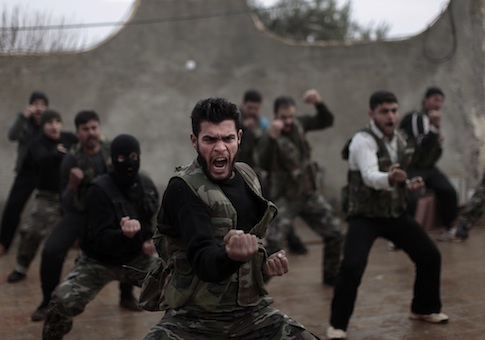
APTOPIX Mideast Syria Training RebelsSyrian rebel training session / AP

One of the militant Syrian rebel groups provided access to advanced U.S. missiles said that it is seeking “the return of all Syrian land occupied by Israel,” a stance that could potentially complicate U.S. military support to the armed rebel group.

The leader of an official rebel group sanctioned by the Syrian Military Council and in possession of sophisticated U.S. arms expressed his opinion in an interview published over the weekend by the Syrian news organization Tahrir Souri.

Ahmad Al-Sa’oud, who heads the rebel unit Division 13, was asked by the interviewer to explain “your stance, as an armed opposition group, on Israel.”

“We are for the return of all Syrian land occupied by Israel,” Al-Sa’oud responded.

Al-Sa’oud’s 13th Division was among the first armed Syrian opposition groups to receive U.S.-made TOW anti-tank missiles from the Obama administration, which is said to have carefully vetted each of those rebel factions receiving American-made arms.

Al-Sa’oud’s stance on Israel’s presence in the Golan Heights—territory annexed from Syria during 1967’s Six Day War—caused concern among terrorism experts, who have long warned that U.S. arms could fall into the hands of radical militant groups that joined the years-long fight to depose President Bashar al-Assad.

“This is precisely the problem we’ve faced in arming the Syrian opposition,” said terrorism analyst Patrick Poole. “Despite repeated promises that we would only arm ‘vetted rebels’ there’s no confidence that anyone in the U.S. government has any idea who they’re dealing with or what their agenda might be.”

The Obama administration has been hesitant to provide a large quantity of arms to Syrian opposition fighters due to the wide diversity of those fighting against Assad and evidence that extremist Muslim groups have joined the fight, making it difficult for Western officials to differentiate between moderate rebels and those tied to al Qaeda and other terror organizations.

“Undoubtedly there is someone at the State Department that has vouched for Ahmad Al-Sa’oud and declared him ‘vetted’ for giving him TOW missiles and other heavy weaponry, completely unaware that he would like to retake the Golan Heights from Israel—our closest ally in the region—and would use weapons we provided to do it,” Poole said.

These concerns have been bolstered by recent report that Islamist fighters in Syria recently used the U.S. TOW missiles during a fight in the town of Aleppo.

The Islamic Front was reported to have been fighting alongside Jabhat al-Nusra, an al Qaeda-tied group designated as a terror organization by the U.S. government.

Asked how the 13th Division obtained the U.S. arms and the criteria used to vet it, Al-Sa’oud said that the unit’s legitimacy was bestowed by “the Syrian people.”

The intermediary, and who has bestowed their trust upon us, are the Syrian people,” Sa’oud was quoted as saying. “The Syrian people who trust that we will face these weapons at the tyrannical Assad regime.”

The U.S. missiles were provided to rebel groups via an intermediary known as the Friends of Syria, a coalition of Western nations and Arab states seeking to bolster the opposition’s fight to depose Assad.

The rebel groups reportedly must return the empty missile shells and have promised not to resell the arms, according to the Washington Post.

Al-Sa’oud confirmed in the interview that the U.S. missiles had been provided to it by the Friends of Syria, which also provided training on how to use the advanced weaponry.

Al-Sa’oud said he expects to receive more shipments of U.S. arms because, “day after day, we are increasing our legitimacy and credibility on the ground.”

Factions like the 13th Division also are exploring the possibility of sending some of the U.S. TOW missiles to other rebel factions fighting in Ghouta, thesite of deadly chemical gas attacks.

“Right now, we have no way to deliver these missiles to the Eastern Ghouta,” Al-Soud was quoted as saying. “When a path opens up, we will absolutely lend our support to the rebels there.”

Persian film shows nuke war with Israel

May 19, 2014

Persian film shows nuke war with Israel, Times of IsraelYifa Yaakov, May 19, 2014

(Oh well, Iranians will be Iranians. What might “world opinion” say were Israel to create and post a comparable video? — DM)

Video titled ‘Point of No Return’ and peppered with Islamic themes shows Iran ‘emptying’ Haifa, Tel Aviv of population.

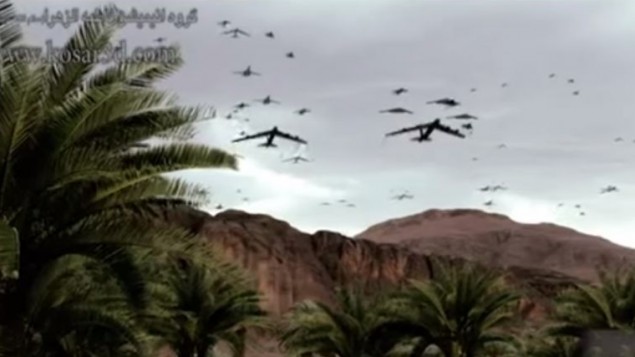
Israeli attack on IranA frame from an Iranian animated film showing Israeli planes poised to attack Iran with nuclear weapons. (screen capture, YouTube)

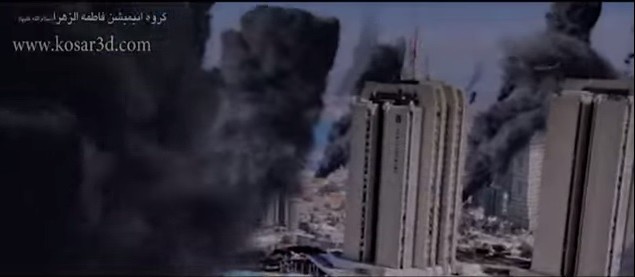
Persian-language animated film released earlier this year shows an Iranian invasion of Tel Aviv, the word “Holocaust” being trampled, and a nuclear attack.

The film, called “The Rachel Corrie Message 2: The Point of No Return” purports to show an Iranian reprisal for a failed Israeli nuclear attack on Iran.

The approximately four explosive-laden-minute long clip depicts Israelis surrendering en masse to invading Iranian troops and Israel’s airport being renamed as “Martyr Rachel Corrie Airport.”

Corrie was an American pro-Palestinian activist killed by an Israeli bulldozer in Gaza in 2003.

The film, released on YouTube in February and which reportedly first appeared on Iranian hard-line websites, was made by an animation company named Fatimah al-Zahra, a likely reference to the daughter of Islam’s prophet Muhammad and an important figure in Shi’ite Islam.

The movie opens with shots depicting Iranian fighter planes over Israeli cities.

A caption in Persian then reads, “Iran will act on its promises on the nuclear issue.”

The action largely takes place in the sky, with a niqab-clad Iranian girl looking up from a field, where an Iranian tank lies abandoned, to observe Iranian planes racing to intercept Israel Air Force jets.

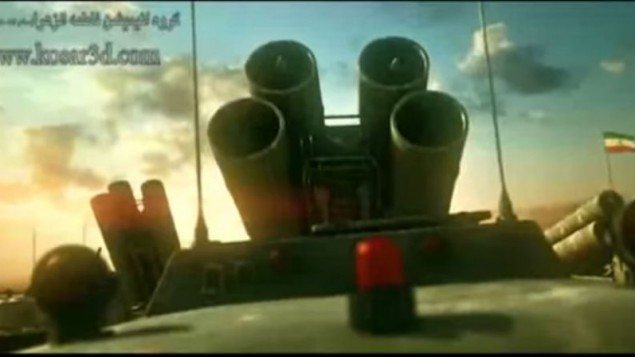
In the background, a female Iranian news presenter announces that Israel has shot several nuclear missiles at Iran during the course of the war, but all have been intercepted by defense systems built by the Iranian Revolutionary Guard Corps-controlled Khatam al-Anbia engineering firm, named after the prophet Muhammad.

Though the Iranian defense systems try to intercept the Israeli invasion, eventually a nuclear bomb explodes in the desert, presumably in Iranian territory.

Israeli cities after attack A simulated Iranian attack on Israeli cities. (screen capture, YouTube)

Undeterred by Western entreaties to “show self-restraint,” Iranian forces advance on Israel in retaliation for the nuclear attack.

The Iranian attack is visualized both literally and symbolically in the film, with the symbolic rendition showing a man in a cloak — possibly a cleric who symbolizes Iran and the “resistance” movement, which includes Hezbollah — stepping on a piece of a downed Israeli plane bearing the word “Holocaust” and a Star of David.

The plane also bears the word “Palmachim,” the location of the IAF airbase from which anti-ballistic Arrow missiles are launched.

The film then shows Iranian planes and air defense systems attacking Israeli jets, and Iranian tanks rolling through smoke-filled Israeli streets. About two minutes into the film, the news presenter announces that units of the “Armored Corps of Islam” — presumably a joint Iranian-Lebanese Shi’ite force — have started advancing toward the al-Aqsa Mosque, with Haifa and Tel Aviv “practically emptied of their population.”

The words “victory” and “resistance” flash on the screen in Persian as the news presenter announces that over 2,500 “Zionist soldiers” have surrendered to the force.

The film, one of several animations depicting wars with Israel or the US to appear in recent years on Iranian websites, implicitly criticizes the West for failing to honor its commitments towards Iran, suggesting that Iran cannot be held accountable for acting against Israel independently.

Iranian defense systemsIranian defense systems poised to defend the country against Israeli warplanes carrying nuclear missiles. (screen capture, YouTube)


IDF, US Rehearse for Iran Missile Attack

May 19, 2014

IDF, US Rehearse for Iran Missile Attack – Defense/Security – News – Arutz Sheva.

About 5,000 soldiers take part in simulation of missile attack from Gaza , Lebanon, Syria and Iran.
First Publish: 5/18/2014, 9:53 PM


Israel's Iron Dome in action

Israel’s Iron Dome in action
Flash 90

The IDF and the US military cooperated Sunday in a large drill simulating a multi-front missile attack on Israel by Gaza, Lebanon, Syria and Iran, Channel 2 reported Sunday.

During the exercise, about 1,000 American soldiers stationed in Israel joined more than 4,000 Israelis, to practice the protection of the State of Israel in a series of scenarios that simulate the firing of rockets and missiles from several arenas simultaneously: Gaza , Lebanon, Syria and Iran.

The exercise reportedly tested various scenarios, including one in which the U.S. sent Patriot missiles to Israel and some Aegis-type ships, which carry rockets and other defense systems against ballistic missiles, meant to assist Israel in protecting its population and territory.

The drill also rehearsed particularly complex scenarios in which missiles and rockets are fired in large quantities from many different arenas. Israel is rehearsing the use of its Arrow missiles, as well as Patriots, the Iron Dome and Magic Wand systems – the last of which is still in development. At the same time as the exercise in Israel, hundreds of American troops are practicing a similar exercise in Jordan

The exercise began shortly after the arrival of U.S. Secretary of Defense Chuck Hagel in Israel.

Judiciary Chief: Iraq Favors Broadening Ties with Iran

May 18, 2014

Judiciary Chief: Iraq Favors Broadening Ties with Iran, FARS News Agency (Iran), May 18, 2014

(See also Why are We Surprised that Iran is Exporting Weapons to Iraq? — DM)

Al-Shammari, for his part, hailed Iran’s determination to support the Iraqi stability and security as well as the democratic process.

Iran and Iraq judges

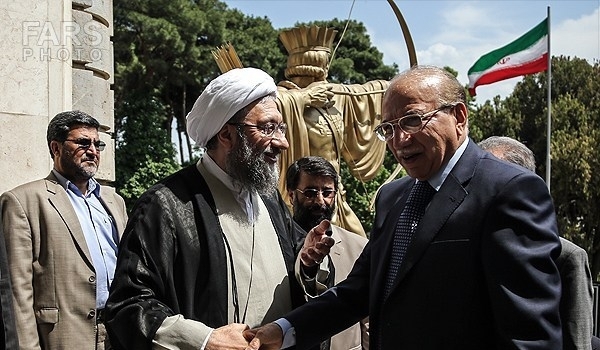
“Broadening judicial relations between Iran and Iraq is the most important goal of my four-day visit to Tehran,” al-Mahmoud told reporters after a meeting with his Iranian counterpart Amoli Larijani in Tehran on Sunday.

He noted that the two countries’ judicial delegations should exchange visits in a bid to deepen the bilateral relations.

Al-Mahmoud pointed to his meeting Amoli Larijani, and said, “The meeting pursued expansion of ties and achieving the planned objectives.”

During his four-day visit to Iran, al-Mahmoud is also slated to confer with other high ranking officials, including President Hassan Rouhani and Parliament Speaker Ali Larijani.

Iran and Iraq have enjoyed growing ties ever since the overthrow of the former Iraqi dictator, Saddam Hussein, during the 2003 US invasion of the Muslim country.

In mid-April, Iranian Justice Minister Mostafa Pour Mohammadi and his Iraqi counterpart Hassan al-Shammari in a meeting in Baghdad explored avenues for bolstering and reinvigorating mutual cooperation.

Pour Mohammadi pointed to the current Iran-Iraq judicial relations, and said, “The two countries should expand judicial cooperation, organize cross-border travel, tackle illegal entries and determine the fate of detainees.”

Al-Shammari, for his part, hailed Iran’s determination to support the Iraqi stability and security as well as the democratic process.

During the meeting, the Iranian and Iraqi justice ministers signed a memorandum of understating (MoU) on extradition of prisoners.

According to the agreement, the Iranian and Iraqi justice ministries will set up a joint committee at the earliest to examine the situation of the prisoners and prepare the ground for their extradition.

Grading Obama’s Foreign Policy

May 18, 2014

Grading Obama’s Foreign Policy, New York Times, , May 17, 2014

(This is from the New York Times. Although President Obama’s “foreign policy” seems to have very low priority for American voters, some of the comments, available at the NY Times article, are interesting. — DM)

In the Holy Land, Kerry’s recent push for Israeli-Palestinian negotiations ended in predictable failure, and in Iraq the caldron is boiling and Iranian influence is growing — in part, The New Yorker’s Dexter Filkins suggested last month, because the White House’s indecision undercut negotiations that might have left a small but stabilizing U.S. force in place.

[T]he global stage hasn’t been a second-term refuge for President Obama; it’s been an arena of setbacks, crises and defeats. His foreign policy looked modestly successful when he was running for re-election. Now it stinks of failure.

[R]ecent events do not inspire much confidence. Instead, future defenses of Obama’s foreign policy may boil down to just six words: “At least he didn’t invade Iraq.”

SECOND terms are often a time when presidents, balked by domestic opposition, turn to the world stage to secure their legacy — opening doors to China, closing out the Cold War, chasing Middle Eastern peace.

But the global stage hasn’t been a second-term refuge for President Obama; it’s been an arena of setbacks, crises and defeats. His foreign policy looked modestly successful when he was running for re-election. Now it stinks of failure.

Failure is a relative term, to be sure. His predecessor’s invasion of Iraq still looms as the largest American blunder of the post-Vietnam era. None of Obama’s difficulties have rivaled that debacle. And many of the sweeping conservative critiques of his foreign policy — that Obama has weakened America’s position in the world, that he’s too chary about using military force — lack perspective on how much damage the Iraq war did to American interests, and how many current problems can be traced back to errors made in 2003.

But the absence of an Iraq-scale fiasco is not identical to success, and history shouldn’t grade this president on a curve set by Donald Rumsfeld. Obama is responsible for the initiatives he’s pursued, the strategies he’s blessed and the priorities he’s set. And almost nothing on that list is working out.

Start with Libya, the site of Obama’s own war of choice. The consuming Republican focus on Benghazi has tended to obscure the fact that post-Qaddafi Libya is generally a disaster area — its government nonfunctional, its territory a safe harbor for jihadists, its former ruler’s weaponry and fighters destabilizing sub-Saharan Africa. (Some of those weapons, for instance, appear to be in the hands of Nigeria’s most-wanted kidnappers, Boko Haram.)

Then swing northeast to Syria, where this administration’s stated policy is that Bashar al-Assad has to go, and that there is a “red line” — backed by force, if necessary — around the use of chemical weapons. Well, Assad isn’t going; he’s winning. And the White House’s claims of progress on the chemical weapons front were undermined by Secretary of State John Kerry’s acknowledgment last week that “raw data” suggested a “number of instances” in which Assad’s governmentrecently used chlorine gas.

The picture doesn’t look better when you turn south or east. In the Holy Land, Kerry’s recent push for Israeli-Palestinian negotiations ended in predictable failure, and in Iraq the caldron is boiling and Iranian influence is growing — in part, The New Yorker’s Dexter Filkins suggested last month, because the White House’s indecision undercut negotiations that might have left a small but stabilizing U.S. force in place.

Similar status-of-forces negotiations are ongoing in Afghanistan, and the backdrop is even grimmer: The surge of forces ordered by Obama (also amid much indecision) failed to replicate the success of Gen. David Petraeus’s salvage operation in Iraq, and even with an American presence the Taliban are barely being held at bay.

As for the White House’s major diplomatic projects, one — the “reset” with Russia — has ended in the shambles of the Ukraine crisis. A second, the opening to Iran, is still being pursued, with deadlines looming, and it’s the administration’s best remaining hope for a paradigm-altering achievement. But that hope is still a thin one (complicated, for instance, by Iran’s continuing pursuit of ballistic missiles), and it’s just as likely that Obama will have unsettled America’s existing alliances in the region to very little gain.

As for the promised “pivot to Asia,” let me know when it actually happens, and maybe I’ll have something to say about it.

But most presidents do win some clear victories. Not everyone gets to end the Cold War, but there’s usually some diplomatic initiative that leaves a positive legacy (even Jimmy Carter had the Camp David accords), some military or humanitarian intervention (even George W. Bush had his AIDS-in-Africa initiative) that looks like a success.

Osama bin Laden — an “except” that has to be qualified by Islamist terrorism’s resurgence — if Obama’s presidency ended today I have no idea what major foreign policy achievements his defenders could reasonably cite.

There is still time for it to be otherwise — for the administration to brilliantly exploit Vladimir Putin’s possible overreach, or seal a lasting nuclear deal with Iran, or craft a strategy to soothe the nationalisms gathering on the Indian subcontinent and the Pacific Rim.

But recent events do not inspire much confidence. Instead, future defenses of Obama’s foreign policy may boil down to just six words: “At least he didn’t invade Iraq.”

Why are We Surprised that Iran is Exporting Weapons to Iraq?

May 18, 2014

Why are We Surprised that Iran is Exporting Weapons to Iraq? Jewish PressJ.E. Dyer, May 18, 2014

(See also Iraq signs deal to buy arms, ammunition from Iran. — DM)

Reuters reported in February that Iraq and Iran signed an arms deal in November of 2013, right after Nouri al-Maliki got home from a visit to Washington (during which he petitioned Obama for more arms to fight off the “ISIS” insurgency waging war across Syria and western Iraq).

Iran’s approach to Jerusalem – where the radical clerics quite literally expect to fight under the Mahdi’s banner (see here for more from Ayatollah Khamenei on the 12th Imam) – has to be incremental and cumulative. Defeating the ISIS insurgency is a step along the way to consolidating an unresisting client corridor across the heart of the Middle East.

Iran’s motivation to involve herself in the fight against ISIS is strong. So is her motivation to make a de facto ally of Iraq. Although the U.S. has provided Baghdad with some arms to combat ISIS, it would take a much greater level of commitment and involvement on our part to overcome the geopolitical forces that drive Baghdad and Tehran together in this instance.

It’s an opportunity for the United States as well, but it’s clear we’re not going to take it. The best thing we could possibly do is strengthen a loose coalition of regional pragmatists in defeating the threat posed by ISIS – and thereby sideline Iran.
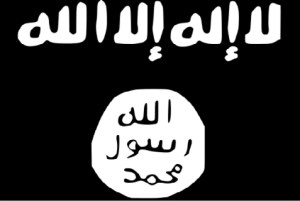
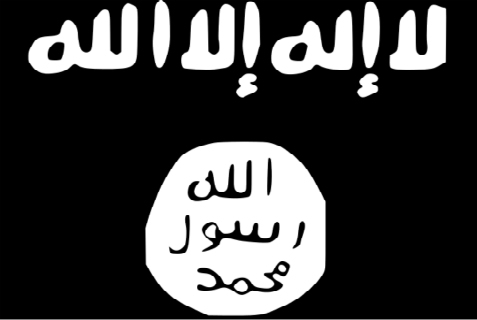
Flag_of_Islamic_State_of_Iraq.jpgFlag of the Islamic State of Iraq and al-Sham (a/k/a Islamic State of Iraq and the Levant, ISIL)

There are two layers to this question, which is popping up on TV screens this weekend. One is the geopolitical layer; the other is the simple-tracing-of-facts layer.

Starting with the latter, Reuters reported in February that Iraq and Iran signed an arms deal in November of 2013, right after Nouri al-Maliki got home from a visit to Washington (during which he petitioned Obama for more arms to fight off the “ISIS” insurgency waging war across Syria and western Iraq).

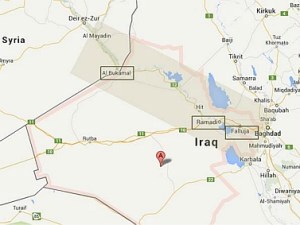
The ISIS insurgency – “Islamic State of Iraq and al-Sham” – is often rendered “ISIL” in English, for Islamic State of Iraq and the Levant. In either case, the territorial reference is to Iraq, Syria, Lebanon, and Israel. The insurgents are Sunni jihadists, and their principal focus at the moment has been scoped by the Syrian civil war, in which they are fighting the Assad regime. Most of the ISIS guerrillas come from abroad; a major contingent of them is from the Chechen Caucasus, where Islamist insurgents have waged a war against Russian rule for nearly a quarter century now. (For more on all this, see the last link above to my January 2014 post. The map shows the corridor between Syria and Baghdad where the ISIS insurgency has sought to plant roots.)
ISIS corrodor

ISIS corridor in the Euphrates valley. Google map; author annotation.

The bottom line is that ISIS is fighting to gain control of territory over which radical Iran wants control herself. Iraq, under the current government, has no interest in wielding an outsize influence over her neighbors to the west; the priority in Baghdad is reestablishing control over Anbar Province. But the larger aspirations of ISIS clash directly with those of the mullahs in Tehran.

Tehran is still arming Assad and still seeking to arm Hezbollah and Hamas, as evidenced by the attempt in March to ship advanced artillery rockets to one or the other, or both. Besides the shadowy nature of the shipping route, a key feature of that attempt at arming the terrorists was that it combined arms stocks from both Iran and Syria. That aspect of the transaction is informative on multiple levels. At the most general level, it suggests how Iran sees Syria and the overall fight in the region: as an Iranian military and geopolitical campaign.

The mullahs don’t see themselves as narrowly locked in combat with a single opponent (ISIS). They have a much broader strategic objective of maintaining decisive influence where they have had it, and gaining it where they don’t. They want to turn the same territory that ISIS is after into a quiescent client-region. Much of it had fallen to them already, at the onset of the Arab Spring in January 2011: all of Syria, and the southern portion of Lebanon.

The Iranian leaders know they can’t just make abrupt moves against central Lebanon or Israel; their interim goal is to hold sway over vulnerable territories that border Beirut and Israel. And that’s a hydra-headed problem. Under today’s conditions, the Saudis would spearhead an Arab coalition to fight Iran for Lebanon – and for the West Bank, for that matter. Cairo won’t stand by and let Iranian influence build up – or, more accurately, let it change course or take new initiatives – in Gaza. Israel, of course, will defend her territory.

So Iran’s approach to Jerusalem – where the radical clerics quite literally expect to fight under the Mahdi’s banner (see here for more from Ayatollah Khamenei on the 12th Imam) – has to be incremental and cumulative. Defeating the ISIS insurgency is a step along the way to consolidating an unresisting client corridor across the heart of the Middle East.

The ISIS guerrillas constitute an emerging operational problem for Iran, one that has arisen because of the Arab Spring and the Syrian civil war. It’s part of the regional jockeying predicted in this series from 2009 (see here for an update in 2011). The jockeying will intensify, and the alignment of Iraq is actually quite an important factor in the mix, one that can either slow Iran down significantly, or greatly accelerate the establishment of conditions friendly for her long-term goals.

Iran’s motivation to involve herself in the fight against ISIS is strong. So is her motivation to make a de facto ally of Iraq. Although the U.S. has provided Baghdad with some arms to combat ISIS, it would take a much greater level of commitment and involvement on our part to overcome the geopolitical forces that drive Baghdad and Tehran together in this instance.
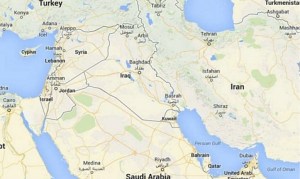
Key terrainKey terrain for the Mahdi. (Google map)

The bottom line is that ISIS is fighting to gain control of territory over which radical Iran wants control herself. Iraq, under the current government, has no interest in wielding an outsize influence over her neighbors to the west; the priority in Baghdad is reestablishing control over Anbar Province. But the larger aspirations of ISIS clash directly with those of the mullahs in Tehran.Tehran is still arming Assad and still seeking to arm Hezbollah and Hamas, as evidenced by the attempt in March to ship advanced artillery rockets to one or the other, or both. Besides the shadowy nature of the shipping route, a key feature of that attempt at arming the terrorists was that it combined arms stocks from both Iran and Syria. That aspect of the transaction is informative on multiple levels. At the most general level, it suggests how Iran sees Syria and the overall fight in the region: as an Iranian military and geopolitical campaign.

The mullahs don’t see themselves as narrowly locked in combat with a single opponent (ISIS). They have a much broader strategic objective of maintaining decisive influence where they have had it, and gaining it where they don’t. They want to turn the same territory that ISIS is after into a quiescent client-region. Much of it had fallen to them already, at the onset of the Arab Spring in January 2011: all of Syria, and the southern portion of Lebanon.

The Iranian leaders know they can’t just make abrupt moves against central Lebanon or Israel; their interim goal is to hold sway over vulnerable territories that border Beirut and Israel. And that’s a hydra-headed problem. Under today’s conditions, the Saudis would spearhead an Arab coalition to fight Iran for Lebanon – and for the West Bank, for that matter. Cairo won’t stand by and let Iranian influence build up – or, more accurately, let it change course or take new initiatives – in Gaza. Israel, of course, will defend her territory.

So Iran’s approach to Jerusalem – where the radical clerics quite literally expect to fight under the Mahdi’s banner (see here for more from Ayatollah Khamenei on the 12th Imam) – has to be incremental and cumulative. Defeating the ISIS insurgency is a step along the way to consolidating an unresisting client corridor across the heart of the Middle East.

The ISIS guerrillas constitute an emerging operational problem for Iran, one that has arisen because of the Arab Spring and the Syrian civil war. It’s part of the regional jockeying predicted in this series from 2009 (see here for an update in 2011). The jockeying will intensify, and the alignment of Iraq is actually quite an important factor in the mix, one that can either slow Iran down significantly, or greatly accelerate the establishment of conditions friendly for her long-term goals.

Iran’s motivation to involve herself in the fight against ISIS is strong. So is her motivation to make a de facto ally of Iraq. Although the U.S. has provided Baghdad with some arms to combat ISIS, it would take a much greater level of commitment and involvement on our part to overcome the geopolitical forces that drive Baghdad and Tehran together in this instance.

The coming together is cause for alarm in Saudi Arabia and Jordan, and for speculation at the very least in Turkey, Russia, and the Gulf nations. Al-Maliki’s affinity for Iran (he’s a Shia and a long-time friend of Iran) doesn’t mean that he wants to sit in Tehran’s pocket. He will inevitably want to retain some level of independence – and there may be someone who wants badly enough to help him do that. It’s a window of opportunity for, say, Russia, China, or even India, from their various strategic perspectives. It’s not beyond the realm of possibility for France or Germany to get back into a bit of power-brokering, along this regional axis.

It’s an opportunity for the United States as well, but it’s clear we’re not going to take it. The best thing we could possibly do is strengthen a loose coalition of regional pragmatists in defeating the threat posed by ISIS – and thereby sideline Iran. Iraq, Syria, and Lebanon all have viable factions that would do their own work, and produce outcomes that were an improvement for their people and that we could live with, if we gave them active help and showed ourselves reliable. No American boots on the ground would be necessary. The whole point would be for the Iraqis to win their battle, and the Syrians theirs, and so forth.

To have that opportunity, what the local peoples need that only America can provide is protection from the interventions of Iran and Russia. Some active shouldering of the two predators would be required. But the best such protection is success for the alternative client model: the model of a nation doing its own security work with U.S. backing.

That’s what is missing in this situation. And as long as it is, the arms trade between Iran and Iraq will do nothing but grow, and the State Department will vow every few months that it’s “looking into” this unacceptable development, which – all but irrelevantly – violates the UN sanctions on Iran.
Blaming Israel again

May 18, 2014

Israel Hayom | Blaming Israel again.

Elliot Abrams

Friday’s New York Times carried a useful guide to President Barack Obama’s understanding of his own failures in the “Middle East peace process.” He blames the Palestinians a tiny bit, the Israelis a great deal, and himself not at all.

Here are the key paragraphs:

“Publicly, Mr. Obama has said that both sides bear responsibility for the latest collapse. But the president believes that more than any other factor, Israel’s drumbeat of settlement announcements in the West Bank and East Jerusalem poisoned the atmosphere and doomed any chance of a breakthrough with the Palestinians.

“‘At every juncture, there was a settlement announcement,’ said [a senior administration] official, who spoke on condition of anonymity because of the sensitivity of the issue. “It was the thing that kept throwing a wrench in the gears.'”

There are a number of comments worth making about these remarks. First, note that the term “settlement” is used for construction in Jerusalem, Israel’s capital. Second, note that there is no reference to the 10-month settlement freeze Israel undertook in November 2009. For that decision Prime Minister Benjamin Netanyahu paid a domestic political price, but got nothing in return from the Palestinians — who did not come to the table until the 10th month, when they knew the freeze was ending — or from Obama, who apparently has forgotten the whole thing.

Third, note that the reference is to a “drumbeat of settlement announcements,” rather than actual construction. That’s because there is no big increase in settlement activity, in new construction or in confiscation of land for settlements. Government officials at various levels of responsibility in the municipal and national governments can and do make announcements, sometimes for political reasons.

A careful analysis would show that the administration’s accusation of vast increases in construction activity is wrong, but it seems there has been no such analysis done. Instead, the president and envoy Martin Indyk make vague references to “rampant” activity and “large-scale” land confiscation, offering no evidence for their charges.

Surely they are sophisticated enough to know that such announcements are political acts, often meant to embarrass Netanyahu and often misleading as to whether additional new construction is coming. And if they are sophisticated enough to know this, then their continuing insistence that Israel is to blame for the breakdown in talks is simply misleading and unfair. Because they know that according to the numbers there is no explosion of settlement activity; they know that when Israel did undertake a construction freeze, it did not bring the Palestinians to the table; they know that such a freeze has never been a precondition for talks before the Obama administration tried to make it so.

One thing missing in every account of the administration’s reaction to the breakdown of the talks, and it is introspection. Never do we read of any serious internal effort to assess what the president, or Secretary of State John Kerry, or Indyk, may have gotten wrong. It seems easier to blame Israel and “settlement announcements.”

US accepts Shahab-3s in Iran’s missile arsenal, but not long-range ICBMs. Deep resentment in Jerusalem

May 18, 2014

US accepts Shahab-3s in Iran’s missile arsenal, but not long-range ICBMs. Deep resentment in Jerusalem.

DEBKAfile Special Report May 18, 2014, 9:16 AM (IDT)

 Iran's Shahab-3 can reach all Mid East points

Iran’s Shahab-3 can reach all Mid East points

Two high-ranking US visitors to Israel, National Security Adviser Susan Rice and Defense Secretary Chuck Hagel, publicly assured Israel this month that the Obama administration “would do what it must” to prevent Iran obtaining a nuclear weapon. Yet at the same time, the same administration informed Tehran that the demand to restrict Iran’s missile arsenal did not apply to the Shahab-3 ballistic missile, whose range of 2,100km covers any point in the Middle East, including Israel. This missile carries warheads weighing 760 kg, to 1.1 tons, which may also be nuclear.
Prime Minister Binyamin Netanyahu and Defense Minister Moshe Ya’alon challenged both Rice and Hagel on this omission. It came to light from Washington’s demand, in its direct dialogue with Tehran outside the framework of the six-power talks in Vienna, to place restrictions on Iran’s arsenal of ICBMs whose 4,000 km range places Europe and the United States at risk.
The Obama administration said it was not demanding restrictions on the medium-range missiles capable “only” of striking Israel, Saudi Arabia and the Persian Gulf. But the comprehensive nuclear accord when it is finally negotiated must apply restrictions on the Sajjil1, Safir, Simorg (satellite launcher), Ashura1 and  Ashura2 (other versions of the Sajjil class).
But this US “concession” did not placate Tehran. Supreme leader Ayatollah Ali Khamenei burst out on May 11: “They expect us to limit our missile program while they constantly threaten Iran with military action. So this is a stupid idiotic expectation.” He thereupon ordered missile plants to shift to mass production.
Hagel was not just queried in Israel on this point, but also by Saudi Arabia and the Gulf Cooperation Council, when he attended their defense ministers’ meeting in Jeddah Wednesday, May 14. Saudi Crown Prince Salman was in the chair.
When Hagel assured those present that their countries had nothing to fear from the rapprochement between Washington and Tehran, he was asked to fully explain President Obama’s policy on Iran’s missile arsenal. He replied that the plan was to establish a common anti-missile defense network for the region.
In Jerusalem, the defense secretary assured Netanyahu and Ya’alon that the close US-Israeli collaboration in maintaining one of the most sophisticated anti-missile shields in the world was sufficient security against Iranian Shahab-3 ballistic missiles.
A joint US-Israeli exercise against missile attack, Cobra Juniper, which takes place every two years, began Sunday, May 18, with the participation of 1,000 US servicemen.

However, neither Jerusalem nor the Gulf leaders accepted Washington’s explanations. Their disquiet was further exacerbated by the failure of latest round of nuclear negotiations with the six powers, which took place in Vienna Thursday, May 15, to bridge gaps between the sides and so prevented a start on the drafting of a final accord.

These widening gaps reflect the growing controversy over nuclear diplomacy in Tehran.

Saturday night, May 17, President Hassan Rouhani speaking to associates at a private meeting voiced his frustration with Khamenei: “That person thinks he knows everything and lays down policy without considering all the facts,” he complained.

Rouhani understands that tactical compromises will not bring about substantial relief from economic sanctions that at preying on his country. He is urging substantial concessions of Iran’s nuclear aspirations, enough to convince the world that his country is not after a nuclear weapon.

Khamenei and the Revolutionary Guards have rejected this approach. They are not open to real concessions either on their nuclear program or missile arsenal. This intransigence shows no sign of softening under the Obama administration’s willingness for compromise at the expense of Iran’s potential targets.

Iran defiant on Arak facility, right to enrich uranium as nuclear talks appear to falter

May 18, 2014

Iran defiant on Arak facility, right to enrich uranium as nuclear talks appear to falter | JPost | Israel News.

By JPOST.COM STAFF, REUTERS, MICHAEL WILNER

05/18/2014 10:01

As the recent round of talks in Vienna ends with few signs of progress, Deputy Foreign Minister Abbas Araqchi says heavy water reactor, seen as potential source of plutonium for nuclear bomb, will continue to function.

Arak

Iran’s heavy-water production plant in Arak, southwest of Tehran. Photo: REUTERS

As talks between world powers and Iran came to a close without any signs of progress, Tehran said Sunday that the Arak research reactor, which the West fears can be used to make plutonium for a nuclear bomb, would continue its work with 40 megawatts of power.

In comments carried by Iran’s Press TV, Iranian Deputy Foreign Minister Abbas Araqchi emphasized that the Arak reactor would remain a heavy water facility and also stressed that Iran has the right to enrich uranium.

The fate of Arak which has not yet been completed is one of the central issues in negotiations between Iran and the world powers, aimed at reaching a long-term deal on Tehran’s nuclear program by a July 20 deadline.

Araqchi said on Friday that no progress had been made during the fourth round of negotiations in Vienna.

“The talks were serious and constructive but no progress has been made,” Araqchi told reporters at the end of the fourth round of negotiations between Iran and the United States, France, Germany, Britain, China and Russia.

The negotiations began in February and are aimed at reaching a long-term deal to curb sensitive parts of Iran’s nuclear program in exchange for a gradual lifting of sanctions.

“We have not reached the point to start drafting the final agreement,” he said.

“Talks have been slow and difficult. Significant gaps remain,” a US official said after the talks concluded. “Iran still has some hard decisions to make. We’re concerned that progress is not being made and that time is short.”

After three months of comparing expectations rather than negotiating possible compromises, the sides had planned at the May 13-16 meeting to start drafting the text of a final agreement that could overcome many years of enmity and mistrust and dispel fears of a devastating, wider Middle East war.

Tehran claims its nuclear program is for only power generation and medical purposes.

In April, Ali Akbar Salehi, head of the Atomic Energy Organization of Iran, said the P5+1 powers had agreed to a proposal presented by Iran to alter thea course of production at the Arak plant.

Heavy-water reactors such as Arak, fueled by natural uranium, are seen as especially suitable for yielding plutonium.

To do so, however, a spent fuel pre-processing plant would be needed to extract it. Iran is not known to have any such plant.

If operating optimally, Arak – located about 250 km. southwest of Tehran – could produce about 9 kg. of plutonium annually, the US Institute for Science and International Security says.

Any deal must lower that amount, Western experts say.

In April, Princeton University experts said that annual plutonium production could be cut to less than a kilogram – well below the roughly 8 kg. needed for an atomic bomb – if Iran altered the way Arak is fueled and lowered its power capacity.