Archive for May 5, 2014

Iran Inches Toward Total Economic Empowerment

May 5, 2014

Iran Inches Toward Total Economic Empowerment, Front Page Magazine, May 5, 2014

The view claiming that Iran’s ideological and hegemonic ambitions will diminish if a final nuclear deal is reached is very unsophisticated and naïve. Even when Iran’s nuclear program was not in the spotlight, for example in the 1980s and early 1990s, the Islamic Republic was at its peak in meddling in other countries’ domestic affairs and showed no sign of tempering its aspiration for regional supremacy.

In fact, these were the times that the Iranian leaders were notably and outstandingly attempting to alter the regional balance of power in its interest by intervening in Lebanon, giving birth to one of the most formidable Shiite non-state actors, Hezbollah, fighting with Israel through its proxies, forming one of the most long-standing Middle Eastern alliances with the Syrian government, and continuing the war in Iraq for an extra six years despite the fact it was offered full compensation by other countries to cease the war.
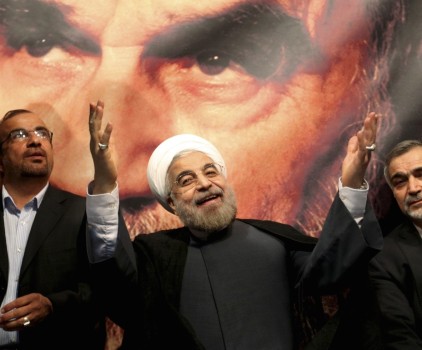
Hasan Rowhani

The nuclear talks between the Islamic Republic of Iran and six world powers (P5+1: China, France, Germany, Russia, and the United Kingdom) have inched forward toward the permanent nuclear deal and the removal of all economic sanctions against the Iranian regime.

Some proponents of the Iranian regime in the West and in Iran have been spreading a specific interest-driven narrative by pointing out that if a final nuclear is achieved, Iranian leaders are more likely to tone down their ideological and regional hegemonic ambitions as well.

According to this argument, if a permanent nuclear deal is achieved, and if the diplomatic thaw between Tehran and Washington continues, Iran’s foreign policies in the region will not turn more aggressive or interventionist regarding regional and foreign policies. As a result, other countries should not be concerned about Iran’s policies and they should push for a final nuclear deal and the removal of sanctions.

In other words, those who advocate for Rouhani’s government and the Islamic Republic contend that Iranian leaders will instead become more cooperative, conciliatory, and will decrease their hegemonic ambitions and policies in the region.

This view fails to take into account the realities on the ground. Since the interim nuclear deal has been reached, the Islamic Republic has become more emboldened to achieve its ideological, geopolitical, and regional hegemonic ambitions. Some of the sanctions relief and billions of dollars that the Iranian regime has received from the United States and international community has empowered its assertive and aggressive stance.

According to Lieutenant Commander of Khatam al-Anbia Air Defense Base General Ali Reza Sabahi-Fard, Iran is rapidly upgrading its defense system. And as Commander of the Army Ground Force Brigadier General Ahmad Reza Pourdastan announced last week, Iran’s Ground Force has test-fired new mid-range ballistic missiles and has equipped S-200 air defense system with new missiles. The S-200 system is characterized as having much longer-range capabilities as compared to previous missile systems.

According to Reuters, Iran’s military is planning to target a mock-up American aircraft carrier. The newspaper Haft-e Sobh daily quoted Adm. Ali Fadavi, navy chief of the powerful Revolutionary Guards, as saying, “target the carrier in the trainings, after it is completed.” Accordingly, Adm. Fadavi pointed out, “We should learn about weaknesses and strengths of our enemy.”

Recently, Iran’s National Army Day orchestrated a large-scale military parade through the capital, Tehran, where fighter jets and military technology manufactured by Russia and other countries, were part of the show. Iranian leaders have made clear that their military capabilities and their missile systems are non-negotiable in the nuclear talks. The United States and other members have also overlooked this threat, and are instead focusing on reaching a final nuclear deal.

Due to the recent sanction relief, several countries, including Turkey, China, Germany, and Austria, have boosted or are planning to boost their economic ties with the Islamic Republic. Iran’s oil exports, in legal or black markets, have also significantly increased.

The case that Iran’s desire for regional supremacy will be tempered if a permanent nuclear deal is sealed, and if the U.S. and Iran thawed diplomatic relations, does not take into account the underlying geopolitical and economic fundamentals, as well as historical context of the Islamic Republic.

The view claiming that Iran’s ideological and hegemonic ambitions will diminish if a final nuclear deal is reached is very unsophisticated and naïve. Even when Iran’s nuclear program was not in the spotlight, for example in the 1980s and early 1990s, the Islamic Republic was at its peak in meddling in other countries’ domestic affairs and showed no sign of tempering its aspiration for regional supremacy.

In fact, these were the times that the Iranian leaders were notably and outstandingly attempting to alter the regional balance of power in its interest by intervening in Lebanon, giving birth to one of the most formidable Shiite non-state actors, Hezbollah, fighting with Israel through its proxies, forming one of the most long-standing Middle Eastern alliances with the Syrian government, and continuing the war in Iraq for an extra six years despite the fact it was offered full compensation by other countries to cease the war.

More recently, even after reaching a preliminary nuclear deal, the Islamic Republic has shown no sign of tempering its foreign policies when it comes to affecting the domestic politics of other countries including Yemen, Syria, Bahrain, and Lebanon. The Yemeni president pointed out in an interview, “Unfortunately, Iran still meddles in Yemen whether by supporting the separatist [Southern] Movement or some religious groups in the north.” He asked the Shiite-dominated Iran to “keep its hands off Yemen” and to halt giving support to “armed groups” in the country. Reportedly, the Houthis are receiving Iranian support, and have been capable of dominating the northern Yemeni province of Saada. Asir, the Saudi province, borders the Yemeni Shiite rebel strongholds.

The second part of the argument made by the proponents of Rouhani’s government and the Islamic Republic is very simplistic in the sense that it overlooks the sophistication and complexity of Iran’s politics in Middle East.

The reason that other countries are not concerned about Iran’s foreign policies in the region if a final nuclear deal is reached (as well as in case Iran tempers its policies and regional geopolitical position), is that they take no notice of the Middle Eastern political chessboard and the Islamic Republic’s role in this political jigsaw puzzle.

The issue is that Iran’s nuclear file has been filled up with frequent clandestine nuclear sites revealed by external governments and organizations, a robust determination to become a nuclear power, non-transparency, secrecy, and a lack of clarity about Iran’s nuclear developments. How can other nations accept these terms of security if another country in the region is on the verge of significantly tipping the balance of power in its favor through reaching a breakaway nuclear capacity?

Most likely, the permanent nuclear deal will leave the Islamic Republic with some breathing space to pursue its nuclear ambitions and achieve its objectives and nuclear breakthrough. If this occurs, the chessboard that is the Middle East will witness a critical reshaping in favor of the nuclear state. This will naturally be followed by a nuclear arms race and competition in the region, which will further destabilize the region and its security. In addition, the nuclear deterrence will boost and facilitate Tehran’s regional ambitions from economic, geopolitical, and strategic prisms.

Even if an efficient permanent nuclear deal is reached between the P5+1 and Iran, should other countries, as some policy analysts and proponents of Rouhani’s government argue, not be concerned about Iran’s regional hegemonic ambitions? It is very unrealistic and naïve to argue that the Islamic Republic will temper its ideological and regional hegemonic ambitions even if a permanent nuclear deal is reached and even if Washington and Tehran mend diplomatic ties. Iran is strongly involved in influencing the domestic affairs of other countries, through founding or backing some Shiite groups, which makes a shift in Tehran’s regional policies inconceivable. Furthermore, Tehran’s regional policies are not only aimed at achieving geopolitical and economic supremacy, but also founded on ideological landscapes, attempting to spread the Shiite version of Islam through either political movements or well-established religious seminary centers such as in the city of Qom.

US aid indirectly helps Hamas, under deal with Palestinian Authority

May 5, 2014

US aid indirectly helps Hamas, under deal with Palestinian Authority, Fox News, May 5, 2014

(Obama’s foreign “policy” at its finest: it’s unimportant that Hamas has already said that it will have military control over a unity government. Don’t bother with the small stuff until it gets big, then dither forcefully and blame Israel. — DM)

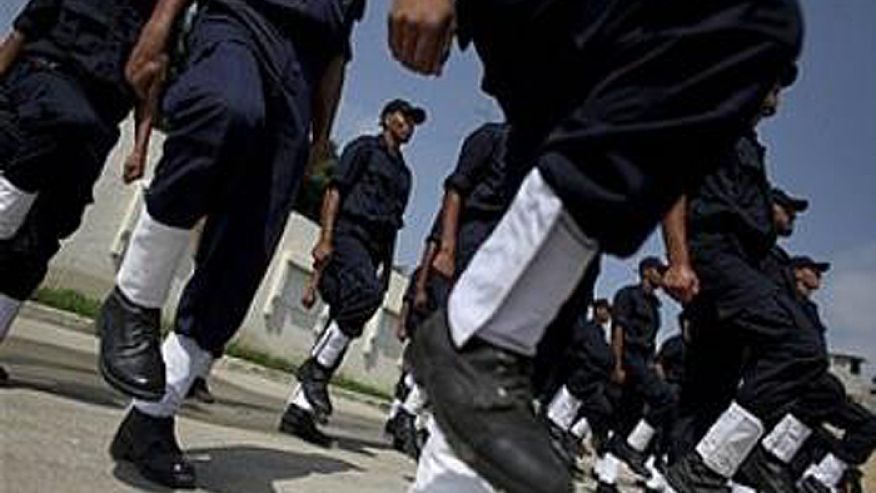
The Palestinian Authority’s announcement that it will send 3,000 police officers to Gaza as part of a unity agreement with Hamas could mean U.S. taxpayers are now at least indirectly helping an officially designated terror organization maintain law and order — and its grip on power.

“Proponents of the recent reconciliation process insist that the next step is a technocratic government that would include figures approved by Hamas and Fatah,” he said. “But they insist that this is not grounds for cutting aid — that only an elected national unity government would prompt such a cut. The integration of Hamas and PA security forces would destroy this argumentUntil the integration of these forces, U.S. funds are not used to aid Hamas. However, the moment this happens, it is grounds for a full cut in assistance.” 

hamaspoliceHamas police cadets march in Gaza. (AP

The Palestinian Authority’s announcement that it will send 3,000 police officers to Gaza as part of a unity agreement with Hamas could mean U.S. taxpayers are now at least indirectly helping an officially designated terror organization maintain law and order — and its grip on power.

The police deployment came as part of a deal between the mainly secular government of the West Bank and the radical Islamist regime of Hamas that rules in Gaza. That agreement effectively ended hopes for the Israeli-Palestinian peace process championed by U.S. Secretary of State John Kerry, but it also raises questions about U.S. foreign aid to the Palestinian Authority going forward. Since the U.S. subsidizes the PA budget to the tune of approximately $400 million per year, any effort to help Hamas indirectly spends U.S. dollars, say observers in Israel. That could be prohibited by U.S. policy, if it is read as part of a power-sharing agreement.

“No aid is permitted for a power-sharing PA government that includes Hamas as a member, or that results from an agreement with Hamas and over which Hamas exercises “undue influence,” unless the President certifies that the PA government, including all ministers, has accepted the following two principles… (1) Recognition of “the Jewish state of Israel’s right to exist” and (2) acceptance of previous Israeli-Palestinian agreements,” Jim Zanotti, a specialist in Middle Eastern Affairs, wrote in a report last September for the Congressional Research Service titled “U.S. Foreign Aid to the Palestinians.”

“ …. U.S. funds are not used to aid Hamas. However, the moment this happens, it is grounds for a full cut in assistance.”- Jonathan Schanzer, author

Those conditions have been met by the PA, but Hamas, under whose control Gaza has continued to be a launching pad for cross-border missile attacks into Israel and a safe haven for Islamic Jihad and even Al Qaeda, steadfastly refuses to acknowledge Israel’s right to exist and is reportedly pressuring the PA to cease security co-operation with Israel in the West Bank. Zanotti’s report, however, highlights a clause that might leave wiggle room for the PA to avoid losing U.S. support.

“It is unclear whether a consensus government of the type anticipated under various Fatah-Hamas agreements since 2011 would come under the legal definition of a “power-sharing PA government that includes Hamas as a member” or a government over which Hamas exercises “undue influence.” It is also unclear whether it would come under the legal definition of a “Hamas controlled” PA government, and thus trigger the additional conditions on U.S. aid cited above.”

The emerging bond between the PA and Hamas has Western diplomats concerned and Israel outraged. Today, PA President Mahmoud Abbas and Hamas leader Khaled Meshaal met face-to-face in Doha, Qatar, for the first time in 16 months, in a further sign of the warming relationship between the two parties. AFP reported a Palestinian official as saying, “The meeting was positive, with both leaders expressing a serious willingness to turn over a new leaf based on national partnership.”

In his recent interview with Fox News just a day after the new PA-Hamas rapprochement was announced, Israeli Prime Minister Benjamin Netanyahu — whose refusal to release the final batch of convicted Palestinian terrorists from Israeli custody was blamed by the Palestinians for finally derailing the peace talks — was scathing in his criticism of PA President Mahmoud Abbas.

“It’s a blow to Israel; it’s a blow to peace,” Netanyahu said. “It’s a terrible blow to the Palestinian people, because they must choose… whether they want to go forward or go backward. Yesterday, with the pact with Hamas, the Palestinian people… took a huge step backward, away from peace, away from a good future for themselves.”

Jonathan Schanzer, author of the recently published book, State of Failure: Yasser Arafat, Mahmoud Abbas and the Unmaking of the Palestinian State, told Fox News.com a power-sharing deal between the two factions, if reached, would warrant a move by the U.S. to cut aid. Kerry has not commented on whether the U.S. agrees.

“Proponents of the recent reconciliation process insist that the next step is a technocratic government that would include figures approved by Hamas and Fatah,” he said. “But they insist that this is not grounds for cutting aid — that only an elected national unity government would prompt such a cut. The integration of Hamas and PA security forces would destroy this argumentUntil the integration of these forces, U.S. funds are not used to aid Hamas. However, the moment this happens, it is grounds for a full cut in assistance.”

Abd al-Salam Siyam, secretary-general of the Hamas cabinet in Gaza, announced Sunday in a carefully worded official statement that the security officers would be deployed in Gaza for an “interim period” as a step toward the unity agreement between the two Palestinian factions. Reports suggest that many of the 3,000 PA men heading to Gaza had previously been involved in security in the territory prior to the election of Hamas in 2006 and the subsequent internal blood-letting and mass murders that followed Gaza’s lurch toward a radical Islamic regime.

“Reconciliation is positive in the sense that it would solve the problem of identifying the interlocutor on the Palestinian side” Schanzer suggests. “But it is virtually impossible to imagine peace between the Palestinians and Israelis when Hamas is involved. In other words, Fatah’s embrace of Hamas may lead to national unity, [but] it portends poorly for peace.”

Off Topic: Palestinian Official: Soak the Land with Blood to ‘Liberate’ Jerusalem

May 5, 2014

Palestinian Official: Soak the Land with Blood to ‘Liberate’ Jerusalem, Front Page Magazine, , May 5, 2014

Even at the height of the peace negotiations with Israel, in December 2013, Fatah official Tawfiq Tirawi said that Palestinians were not committed to non-violence. Rather, he said that negotiations are just one option, and do not preclude use of the “rifle,” which the Palestinians have never abandoned.

Last week, Palestinian Media Watch reported that Tirawi had essentially proclaimed the end of the peace process, saying that “the two-state solution does not exist.” He further called for Israel’s destruction, asserting that “Palestine is Gaza… the West Bank… and Haifa, Jaffa, Acre,” meaning all of Israel is “Palestine.”

In his earlier statement, Tirawi made it clear that violence, killing and Martyrdom are the keys to Palestinian future success. “Not a centimeter of Jerusalem will be liberated unless every grain of Palestinian soil is soaked in the blood of its brave people,” Tirawi stated at an event marking World Teachers’ Day in December 2013. “Negotiations will not bring Jerusalem back to us,” he continued, explaining that Palestinians before “have conducted negotiations, while not laying down the rifle”:

“I say, from a position of responsibility, not a centimeter of Jerusalem will be liberated unless every grain of Palestinian soil is soaked in the blood of its brave people. For Jerusalem doesn’t need negotiations, because negotiations will not bring Jerusalem back to us. What will bring back Jerusalem are the struggle and the resolve… We have conducted negotiations, while not laying down the rifle. It [the rifle] may be resting but we will not neglect our principles. We will rest the fighter’s rest, but each period has its method of struggle.”

[Official PA TV Live, Dec. 19, 2013]

 Click to view

PMW has documented the PA and Fatah’s principle of alternating violence with diplomacyas a means to achieve political results. Tirawi’s statement that Palestinians “will rest the fighter’s rest, but each period has its method of struggle,” reflects this policy.

The official PA daily similarly reported that Tirawi has stated that

“the [Fatah] movement has not, and will not, lay down its weapons until the national goals of the Palestinians are achieved… [Fatah] has used a variety of means, including military struggle, popular struggle, diplomatic activity at the UN and negotiations, to achieve these goals.” [Al-Hayat Al-Jadida, Feb. 2, 2014]

In August 2013, right after the negotiations with Israel began, Tirawi likewise stated on Lebanese TV that armed struggle is as valid an option as negotiations:

“There are many options we could turn to, beginning with resistance by political confrontation, [resistance] by stones, and ending with armed struggle and everything in between.” [Al-Mayadeen TV (Lebanon), Aug. 13, 2013]

He added that “the principle of armed struggle should not be abandoned,” and addressed those who have criticized Fatah for doing so:

“I would also like to say to all who say that the Fatah Movement has cast away the rifle: This is not true.”

Then, at the outset of the peace negotiations, Tirawi also reiterated the principle of alternating between the use of violence and diplomacy:

“[At] the sixth Fatah Conference [August 2009] the Fatah Movement approved all the resistance options, including the armed struggle. Nonetheless, sometimes there are circumstances, factors and situations when the time is perhaps not right for this type of struggle. Maybe in other months a different type of struggle will be suitable.”

The following are longer excerpts of Tirawi and Sahwil’s statements:

Official PA TV Live broadcast the main event marking World Teachers’ Day in Bethlehem. Several PA officials attended the event: PA Minister of Education Ali Zaidan (Abu Zuhri), Fatah Central Committee member Tawfiq Tirawi, Advisor to PA Chairman Abbas on NGOs and Member of Fatah Central Committee Sultan Abu Al-Einein, District Governor of Bethlehem Abd Al-Fattah Hamayel and Director of the Bethlehem Education Administration Nisreen Yasser Amr.

Fatah Central Committee member Tawfiq Tirawi:

“I say, from a position of responsibility, not a centimeter of Jerusalem will be liberated unless every grain of Palestinian soil is soaked in the blood of its brave people. For Jerusalem doesn’t need negotiations, because negotiations will not bring Jerusalem back to us. What will bring back Jerusalem are the struggle and the resolve… We have conducted negotiations, while not laying down the rifle. It [the rifle] may be resting but we will not neglect our principles. We will rest the fighter’s rest, but each period has its method of struggle. From fighting to Intifada, to popular resistance, to negotiations – but we will not abandon [our principles] – not in negotiations and not in any other way. I say, from a position of responsibility, the negotiations resulted in nothing except for the [release of the] prisoners.”
[Official PA TV Live, Dec. 19, 2013]

Lebanese Al-Mayadeen TV host: ”Tawfiq Al-Tirawi, the truth is, we’re talking today about the July Victory (i.e., the Second Lebanon War). You said that you’re opposed to the current negotiations. What other option do the Palestinian people or Palestinian leaders have apart from negotiating? Do they have other options?”

Fatah Central Committee member Tawfiq Al-Tirawi: ”Of course. Look, brother, despite all the circumstances, someone who wants to lead a nation under occupation must always create options, and make all the existing calculations. There are many options we could turn to, beginning with resistance by political confrontation, [resistance] by stones, and ending with armed struggle and everything in between. I wish to say that given the current balance of power and the current factors, the principle of armed struggle should not be abandoned, nor should the principle of resistance [be abandoned]. I would also like to say to all who say that the Fatah Movement has cast away the rifle: This is not true.

In the political guidelines [determined] in the sixth Fatah Conference [August 2009] held in Bethlehem, the Fatah Movement approved all the resistance options, including the armed struggle. Nonetheless, sometimes there are circumstances, factors and situations when the time is perhaps not right for this type of struggle. Maybe in other months a different type of struggle will be suitable. The important thing is for the struggle to remain, and for us to be engaged in constant activity against this occupation, until it ends… The other point I would like to say is that the Israelis say that Beit El and Ma’ale Adumim are Israeli areas, but we also haven’t forgotten that Haifa, Jaffa, Acre and Nazareth are Palestinian and will remain Palestinian forever… The last war in 2008 (i.e., Israel’s Operation Cast Lead in the Gaza Strip from December 2008-January 2009 with the aim of stopping Hamas’ launching of rockets into Israel.) and the bombing of Tel Aviv (i.e., reference to Hamas and Islamic Jihad’s rockets hitting near Tel Aviv in 2012), I salute the Islamic Jihad, because the Islamic Jihad and the Al-Aqsa [Martyrs’] Brigades and all the Palestinian resistance brigades, their role was more central than the Hamas Movement’s role…

[Hamas leader] Khaled Mashaal said in an official statement: ‘We authorize Mahmud Abbas to negotiate for a period of one year,’ while I, your humble servant sitting before you, named Tawfiq Tirawi, oppose negotiations and I am from the Fatah Movement and am proud to be from the Fatah Movement. Don’t come and say ‘They [Fatah] sold the [Palestinian] cause and gave it away, etc.’ I’m telling you,there is not a single Palestinian who could sell or barter one grain of Palestine’s soil, all of historic Palestine. We are under occupation and we will resist.

By resisting, the resistance forces were victorious in Lebanon and in several countries, and we say here: We will win, Allah willing, with different forms of resistance – popular resistance, resisting the occupation through political confrontation, resisting it on the international level, as well as armed resistance at any time. We can act in this positive manner for our cause and for our land, Allah willing.” (emphasis added.)

[Al-Mayadeen TV (Lebanon), Aug. 13, 2013]

Freedom Center pamphlets now available on Kindle: Click here.

President Obama and the World – NYTimes.com

May 5, 2014

President Obama and the World – NYTimes.com.

( They must turn against their (soon gone) master to preserve their “credibility.” – JW )

Two years after winning an election in which foreign policy was barely mentioned, President Obama is being pummeled at home and abroad for his international leadership. The world sometimes seems as if it is flying apart, with Mr. Obama unable to fix it.

Through a combination of a few significant missteps, circumstances beyond his control, unreasonable expectations and his maddeningly bland demeanor, Mr. Obama has opened himself to criticism that he is not articulating a strong, overarching blueprint for the exercise of American power and has not been able to bend authoritarian leaders to his will.

It is paradoxical that, in key respects, Mr. Obama is precisely the kind of foreign policy president most Americans and their allies overseas wanted. He rejected the shoot-first tendencies of George W. Bush, who pretended to have all the answers, bungled two wars and asserted an in-your-face American exceptionalism that included bullying allies. We know where that got us.

But Mr. Obama has long been fully responsible for his own foreign policy. While he has made mistakes, and can be frustratingly cautious, he has done a better job than his detractors allow, starting with salvaging an economy that is at the core of American power. He has produced the first possibility of a deal on Iran’s nuclear weapons. Even though shrinking budgets and a public that is tired of war and unconvinced of the need for international engagement have undoubtedly put a check on his ambitions, talk of America shrinking from the world is overblown.

Still, too often, Mr. Obama’s ambitions seem in question. It does not feel as if he is exercising sufficient American leadership and power, even if he is in fact working to solve a problem. Some analysts have suggested he lacks a passion for foreign policy. Others say he has no inspiring ideological prism through which the world can understand his choices. Others say he is too resigned to the obstacles that prevent the United States from being able to control world events as easily as it may once have done. These criticisms have some truth to them, and Mr. Obama sometimes makes things worse when he deigns to explain himself.

By last week, when he was in the Philippines defensively talking about his inability to affect outcomes in places like Syria, Egypt and Israel, he offered a sadly pinched view of the powers of his office. “You hit singles, you hit doubles; every once in a while we may be able to hit a home run,” Mr. Obama said. You don’t inspire a team to go out and bloop a single over an infielder. American presidents who stood as strong global leaders did so by setting high expectations in clear, if sometimes overly simplistic, ways. Mr. Obama’s comments last week fanned the anger of people on the left and the right who find him unfocused, weak and passive.

What follows is an examination of some of the world’s problems, the areas where Mr. Obama has done well, and the areas where he has stumbled.

THE TRANSFORMATION TRAP Mr. Obama positioned himself as a transformational leader, but in foreign affairs, as in domestic policy, he overestimated the degree to which the mere fact of his election could achieve that transformation. He has run up against the realities of a chaotic and increasingly multipolar world. As a senator running for president in 2008, Mr. Obama spoke of a “new strategy for a new world” that focused on nuclear disarmament and ending the wars in Iraq and Afghanistan, but also promised the United States is “ready to lead again.” When he won his premature Nobel Peace Prize in 2009, Mr. Obama explained his belief in just wars, including those waged on humanitarian grounds.

It is tempting to dismiss criticism from right-wing Republicans like Senator Ted Cruz, who knows little about foreign policy; from Senator John McCain, who knows quite a lot but advocates a military response to almost every crisis; and from former Bush officials. They have an interest in seeing this president fail. It was disquieting to hear some Republicans speak almost admiringly about Vladimir Putin’s macho boldness when the Russian president invaded Crimea. There was a time when both political parties saw real value in cooperating to advance America’s security interests, and the country was better for it.

But there is also powerful criticism from Democrats, liberals and centrists, who fault Mr. Obama’s handling of Syria (some want airstrikes, some want more weapons for rebels) and Ukraine (many want weapons for the government). His critics are inconsistent in their philosophies and have failed to offer cogent alternatives to Mr. Obama’s policies. But the perception — of weakness, dithering, inaction, there are many names for it — has indisputably had a negative effect on Mr. Obama’s global standing.

RED LINES Mr. Obama has been right to avoid direct military involvement in Syria, even though the horrors there — more than 150,000 killed, President Bashar al-Assad of Syria denying aid to starving people, the rise of jihadi groups — have worsened. But he bungled the Assad government’s chemical weapons attack against civilians last year (vowing there was a “red line” and then allowing it to be crossed), and that has left doubts about his willingness to use force in other circumstances.

Mr. Obama made the right choice when he went for a diplomatic solution, under which Syria’s chemical arms stockpile is being dismantled. But did he learn that no president should threaten military action and make a public case for it unless he plans to follow through? America has provided the most humanitarian aid to beleaguered Syrians and led the push for a diplomatic solution to the war. That failed in large measure because Russia and Iran are enabling Mr. Assad. Now, according to news reports, the administration has begun to provide certain rebels with more lethal weapons; the shipments should be monitored and halted if there is evidence of diversion.

USE OF FORCE Mr. Obama has delivered on his promise to end the American-led war in Iraq and is withdrawing troops from Afghanistan, although too slowly. He has committed to pursue diplomacy first and war as a last resort, but he is no pacifist. Mr. Obama joined France and Britain in military strikes to aid rebels in ousting Col. Muammar el-Qaddafi of Libya, authorized the killing of Osama bin Laden and — to a degree that is far too excessive — shifted military actions to the shadows by authorizing drone campaigns in Pakistan, Yemen and Somalia.

He has asserted the right to order the killing even of Americans who plot against this country abroad. In Asia on April 24, he gave assurances that America’s treaty commitments to Japan included defending islands disputed with China. Accusations that he is soft on terrorism are simply without merit. In fact, his policies are too similar to his predecessor’s for our comfort.

RUSSIA AND UKRAINE When he came to office, Mr. Obama was right to pursue a better relationship with Russia. He has not acted precipitously since Mr. Putin displayed his true colors by invading Crimea and destabilizing eastern Ukraine. Instead, he gave Mr. Putin a diplomatic option that would allow him to back down and then, when Putin did not take it, imposed sanctions on Russians and Ukrainians connected to the turmoil.

Suggestions from the right that Mr. Obama should somehow use the military, or at least the threat of it, against Russia over Ukraine are irresponsible, to put it politely. Mr. Obama’s efforts to work with Europe on tougher sanctions have the best chance of restraining Russia.

But that takes time, and the Europeans, entwined economically with Russia, are balking at adding new sanctions, even as Mr. Putin gobbles up more of Ukraine. A lot is riding on Mr. Obama’s ability to lead the trans-Atlantic response, which includes strengthening Ukraine politically and economically, reasserting international law, and forcing Russia to reconsider its campaign to turn Ukraine into a failed, partitioned state. Mr. Obama has rejected arming the Ukrainians but has beefed up military assets in nearby NATO member countries. He should consider unilaterally imposing more sanctions if the Europeans continue temporizing.

IRAN’S NUCLEAR AMBITION One of Mr. Obama’s most promising initiatives is working with other major powers on a deal to ensure Iran does not build nuclear weapons. An interim agreement, reached last November, has decreased Iran’s ability to produce a weapon quickly, and a final deal is expected by the end of July. While that is anything but guaranteed, Mr. Obama deserves credit for taking the risk of engaging with Iran, and for persuading Congress to hold off on actions that could threaten the negotiations. Now he has to deal with members of Congress who say they want to stop Iran from becoming a nuclear power but do everything they can to stymie any agreement.

THE ASIAN PUZZLE With his recent trip to Asia , Mr. Obama breathed new life into his commitment to focus more of America’s attention on the world’s most economically dynamic region. The trip produced a military base agreement with the Philippines, improved relations with Malaysia, and, officials say, progress during talks in Japan on a 12-nation trade deal. That will be crucial to making his Asia rebalance policy a success and demonstrating that it involves more than a military hedge against China. One country to which he should pay far more attention is India.

ISRAEL AND THE PALESTINIANS Mr. Obama showed leadership in empowering Secretary of State John Kerry to undertake a nine-month negotiation on an Israeli-Palestinian peace deal after fumbling badly with his first peacemaking overture in 2009. The second effort, which seemed better prepared, is now in tatters and seems unlikely to be revived soon. But it demonstrated a serious American commitment and was still worth it, especially if it results in a set of American principles that point the way to a peace deal if the two sides ever muster the will to agree on one.

THE ARAB TURMOIL More than anything else, perhaps, the revolutions in this region have demonstrated the limits of American influence when countries are in turmoil. Egypt is the most important and difficult case. While it is an example of the realpolitik that some of his critics say Mr. Obama lacks, Egypt is Exhibit A in the case against his claim to be supporting democracy in the Middle East. The Obama administration finds itself defending and continuing to finance a repressive military government in Cairo that comes nowhere near to fulfilling the promise of the Arab Spring and that recently ordered more than 1,000 political prisoners put to death.

Taken as a whole and stripped as much as possible of ideological blinkers, Mr. Obama’s record on foreign policy is not as bad as his critics say. It’s just not good enough.

Getting Ready for a Bad Deal

May 5, 2014

Getting Ready for a Bad Deal, Weekly Standard, Elliot Abrams, May 16, 2014 (print edition)

[PM Netanuahu:] the truth is evident to all: Iran seeks an agreement that will lift the sanctions and leave it as a nuclear threshold state with the capability to manufacture nuclear weapons within several months at most. Iran wants a deal that will eliminate the sanctions and leave its capabilities intact. A deal which enables Iran to be a nuclear threshold state will bring the entire world to the threshold of an abyss. I hope that the lessons of the past have been learned, and that the desire to avoid confrontation at any cost will not lead to a deal that will exact a much heavier price in the future. I call on the leaders of the world powers to insist that Iran fully dismantle its capacity to manufacture nuclear weapons, and to persist until this goal is achieved.

The world’s attention was largely turned to Ukraine last week. To the extent that the Middle East was on the front pages, the focus was the new agreement between the PLO and Hamas, its implications for the “peace process,” and John Kerry’s comment about Israel as an “apartheid state.”

But in Israel a different subject was getting a lot of attention: Iran’s nuclear program. April 28 was Holocaust Remembrance Day, and that was the context in which Prime Minister Netanyahu spoke about Iran at the Yad Vashem Holocaust Memorial.

Netanyahu discussed the world’s blind refusal to see what was coming in the 1930s despite all the evident warnings: “How is it possible that so many people failed to understand reality? The bitter, tragic truth is this: It is not that they did not see. They did not want to see.” He then asked, “Has the world learned [from] the mistakes of the past? Today we again face clear facts and a tangible threat. Iran calls for our destruction. It is developing nuclear weapons.”

Netanyahu turned then to the current negotiations with Iran and drew the analogy:

This time too, the truth is evident to all: Iran seeks an agreement that will lift the sanctions and leave it as a nuclear threshold state with the capability to manufacture nuclear weapons within several months at most. Iran wants a deal that will eliminate the sanctions and leave its capabilities intact. A deal which enables Iran to be a nuclear threshold state will bring the entire world to the threshold of an abyss. I hope that the lessons of the past have been learned, and that the desire to avoid confrontation at any cost will not lead to a deal that will exact a much heavier price in the future. I call on the leaders of the world powers to insist that Iran fully dismantle its capacity to manufacture nuclear weapons, and to persist until this goal is achieved.

He then repeated a pledge he has made in the past that Israel will not tolerate Iran as a nuclear threshold power: “The people of Israel stand strong. Faced with an existential threat, our situation today is entirely different than it was during the Holocaust. .  .  . Today, we have a sovereign Jewish state. Unlike the Holocaust, when the Jewish people were like a wind-tossed leaf and utterly defenseless, we now have great power to defend ourselves, and it is ready for any mission.”

Of course, Netanyahu has been saying these things for years, and listeners may wonder whether this is just more of the same: rhetoric, or at best a kind of “psy-op” meant to toughen the American position at those talks with Iran. After all, though Netanyahu is said to have come close to ordering a strike at Iran in the summer of 2012, it didn’t happen. In addition to feeling great American pressure against acting, Netanyahu clearly did not have a consensus in the Israeli security establishment for such a grave decision.

Those who consider Netanyahu’s words just more rhetoric should consider, then, two additional statements made last week—by two key figures in the security establishment, both viewed as balanced and sensible voices.

On April 23, five days before Netanyahu spoke, retired general Amos Yadlin, the former head of Israeli Military Intelligence and now director of the Institute for National Security Studies, wrote a piece for theJerusalem Post. Like Netanyahu, he objected to a deal with Iran that would allow it to preserve its nuclear weapons program—and said that appears to be where the West is headed. The Iranian “concessions” are not real, he wrote: “Iran is trying to portray itself as a country prepared to make fundamental concessions, but at the same time it is preserving the core abilities in both routes it is developing for a nuclear weapon.”

Yadlin rejected the view that inspections alone could prevent Iran from cheating: Inspections are “insufficient. The international inspection systems are not perfect and have always been known to fail. They already failed in the past to discover on time the efforts made by Iraq, Libya, North Korea, Syria, and Iran to secretly develop a military nuclear program. These systems can cease to exist in case of a unilateral Iranian decision—like what happened with North Korea.”

So what should a deal with Iran contain?

The powers must demand that Iran will dissolve most of the centrifuges and leave a symbolic number of non-advanced centrifuges. They must demand that the uranium enrichment stockpile in Iran will be limited to a low level and symbolic amount (less than the amount required for one bomb). They must also demand the dismantlement of the enrichment site inside a mountain near Qom, which aims to guarantee a protected site immune to a quick breakthrough towards a bomb. They must demand that the Arak reactor will be altered so that it would not be used for military purposes and demand an answer to the open questions regarding the military dimensions of the Iranian nuclear program.

Yadlin said the mark of an acceptable deal with Iran is that “the time it takes Iran to develop a nuclear weapon, if it decides to do so, will be measured in years rather than in months.”

General Yaakov Amidror, the former Israeli national security adviser and before that head of research for Israeli Military Intelligence, wrote a piece for the Jerusalem Post one day later. Like Yadlin, he brushed aside assurances that inspections and intelligence will spot any Iranian moves toward making a bomb: “There is no such thing as a monitoring system that cannot be sidestepped. There is no way to guarantee that the world will spot Iran’s efforts to cheat. American intelligence officials have publicly admitted that they cannot guarantee identification in real time of an Iranian breakout move to produce a nuclear weapon.”

Chlorine, nukes, and U.S. credibility

May 5, 2014

Chlorine, nukes, and U.S. credibility, Israel Hayom, Elliot Abrams, May 5, 2014

(Again, protecting the process is more important to the process makers than are any results, good, bad or indifferent. — DM)

Officials who have gone out on a limb to negotiate a deal despite criticism of it, rejected the criticism, defended the deal, and indeed celebrated the deal as a great diplomatic achievement, do not wish to find that it has been violated and that their achievement is in tatters.

One of the greatest Israeli concerns about a possible nuclear deal with Iran goes beyond the terms of any deal itself to the issue of enforcement. The issue is summed up in a Laura Rozen piece: “The Israelis are also deeply concerned, [an unidentified] former U.S. diplomat said, that if there is a violation by Iran of a final nuclear accord, that the violation will be seen by Washington as too ambiguous or incremental, that there ‘is no smoking gun.’ The Israelis are ‘nervous that the U.S. will continuously say, we are checking into it, we need more proof,’ the former diplomat described. ‘At what point does the cumulative effect of the small things add up to a violation?'”

She describes the diplomat as “a senior former U.S. diplomat involved in the April consultations in Israel.”

The Israeli concern is serious, because the pattern they fear is familiar. Officials who have gone out on a limb to negotiate a deal despite criticism of it, rejected the criticism, defended the deal, and indeed celebrated the deal as a great diplomatic achievement, do not wish to find that it has been violated and that their achievement is in tatters. This was a key problem in our strategic arms limitations negotiations with the USSR. In the early 1980s, Congress passed legislation requiring the administration to report to it on any Soviet treaty violations precisely because it understood and feared the temptation to avoid finding violations or doing anything about them. (See, for example, the McClure-Symms-Helms amendment to the State Department authorization bill in 1983.)

Fast forward to today, when it’s clear that the Assad regime is using chlorine gas in bomb attacks. This week the Daily Telegraph in London reported as follows: “President Bashar Assad is still using chemical weapons against civilians, a scientific analysis of samples from multiple gas attacks has shown. In the first independent testing of its kind, conducted exclusively for The Telegraph, soil samples from the scene of three recent attacks in the country were collected by trained individuals known to this news organization and analyzed by a chemical warfare expert. Our results show sizable and unambiguous traces of chlorine and ammonia present at the site of all three attacks. The use in war of ‘asphyxiating, poisonous or other gases’ — both of which can be produced by chlorine and ammonia — is banned by the Geneva Protocol, of which Syria is a signatory.”

The facts are reasonably clear. The use of chlorine may not be covered by the agreement reached between the United States and Russia for the removal of Syria’s more potent chemical weapons, but it does violate international law. So, now what? Here’s the CNN account: “The latest revelation poses a new dilemma for the administration on Syria, where civil war continues to rage. While chlorine is not as poisonous as chemicals like mustard gas or sarin, it would violate of Syria’s international obligations. While some of the administration feel a strong response is needed, officials said others are concerned a robust response would complicate ongoing cooperation with Syria on its more dangerous stockpiles. ‘There is not a consensus,’ another U.S. official said. ‘Some would like to be stronger and some are more cautious. It can’t go unanswered but if we equate it to a chemical attack then the question becomes what are we going to do about it? And I don’t think we have figured that out yet.'”

The chlorine gas incident in question occurred on April 11. What will the U.S. response be?: “I don’t think we have figured that out yet.”

This is precisely what concerns the Israelis. Syria is a weak country, yet the United States has acted as if it is strong — excusing the failure to enforce the “red line” against use of chemicals by fanciful accounts of the military force that would be needed to punish the regime. As I noted in this blog last June, the chairman of the Joint Chiefs of Staff, Gen. Martin Dempsey, fought off action this way: “Dempsey informed Kerry that the Air Force could not simply drop a few bombs, or fire a few missiles, at targets inside Syria: To be safe, the U.S. would have to neutralize Syria’s integrated air-defense system, an operation that would require 700 or more sorties.” This absurd argument apparently carried the day — while Israel was repeatedly attacking Syria from the air and never losing a plane.

Iran is larger and stronger than Syria, and the achievement of a nuclear deal will be touted by the administration as a far greater achievement than Kerry’s deal on Syria with Sergey Lavrov. Will the administration admit violations when they arise, or look the other way and try not to hear the bad news? If the bad news is clear, will we find that “there is not a consensus. Some would like to be stronger and some are more cautious. … The question becomes what are we going to do about it? And I don’t think we have figured that out yet.”

Agreements are not self-enforcing; enforcement depends on the willpower and determination of the parties, and in this case of the United States. Our response to the Syrian gas attacks is teaching Syria, Iran and Israel that the necessary determination is lacking. No wonder the Israelis worry.

China aims to boost military relations with Iran

May 5, 2014

China aims to boost military relations with Iran, Ynet News, May 5, 2014

China has exported arms to Iran and the two countries have close energy and trade ties.

BEIJING – China wants deeper defense ties with Iran, Chinese Defense Minister Chang Wanquan told his Iranian counterpart on Monday, according to Chinese state media, as Beijing moves to cement already close ties with a major oil supplier.

Chang told Iranian Defense Minister Hossein Dehqan the development of bilateral relations has “remained positive and steady, featuring frequent high-level exchanges and deepened political mutual trust”, the official Xinhua news agency said.

Chang is “confident that the friendly relations between the two countries as well as the armed forces will be reinforced” due to “increased mutual visits and personnel training cooperation between the armed forces”, Xinhua added.

Dehqan “voiced the hope that the two countries will continue to play a positive role in safeguarding regional peace and stability”, the agency said.

It gave no other details.

China has exported arms to Iran, and last month expressed anger after Washington laid charges against a Chinese businessman accused of allegedly procuring missile parts for Iran.

Last month, Iran terminated China National Petroleum Corp’s (CNPC) contract to develop the Azadegan oilfield after the Chinese energy giant ignored repeated appeals to work on it.

China and Iran have close energy and trade ties, and Beijing has repeatedly resisted US-led demands to impose tougher economic sanctions on Iran to curb its nuclear ambitions.

However, differences have arisen between China and Iran in the development of Iran’s oil and gas resources.

