Safavi, who presently serves as an adviser to Iran’s Supreme Leader Ayatollah Seyyed Ali Khamenei, also revealed a powerful hypothetical. If the Assad regime fell, he noted, “… it will be the turn of Hezbollah of Lebanon, the Islamic government of Iraq, and finally the Islamic Republic of Iran ….” Safavi’s formulation best explains why Iran is so invested in Syria. It’s not just interests, it is a matter of regime survival.
[W]hat many analysts fear to be the emergence of a “Shiite axis” seems to already be taking place. Iran’s involvement in Syria is presently widening. Recent reports, as described in The Wall Street Journal, indicate that Iran is actively soliciting Afghans to go to Syria and fight. Other Persian media reports cited by The Wall Street Journal reportedly claim that “an all-Afghan battalion … is fighting in Syria to protect Shiite shrines.”
In the aftermath of several controversial statements by two former IRGC Officers, a “pro-Hezbollah” forum recently became engulfed in a discussion of the organization’s true allegiance. According to a statement obtained and translated by the SITE Intelligence Group, Qawem, the aforementioned forum, became host to debate over Hezbollah’s role and perceptions of Lebanon’s sovereignty. The online controversy also brought to the fore the Islamic Republic of Iran’s thinking on Syria and other regional matters.
The comments, initially made on May 4 by IRGC Brigadier General Hossein Hamadani about Iran’s involvement in Syria, shed light on the origins of Hezbollah. According to Mehr News Agency, Hamadani stated, “By the grace of God, Iranians created a second Hezbollah in Syria ….” Later, Radio Free Europe Radio Libertyreported that Hamadani’s statements were removed from the website of another prominent Iranian news outlet.
The impact of these comments was heightened due to earlier statements by a former IRGC commander, Major General Yahya Rahim Safavi. According to the Islamic Republic of Iran News Network (IRINN), Safavi said, “The influence of Iran and Iran’s Islamic Revolution has spread to the borders of the Zionist regime ….” Back on the forum, one user took issue with the fact that the Lebanese government allegedly never responded to this charge.
Safavi, who presently serves as an adviser to Iran’s Supreme Leader Ayatollah Seyyed Ali Khamenei, also revealed a powerful hypothetical. If the Assad regime fell, he noted, “… it will be the turn of Hezbollah of Lebanon, the Islamic government of Iraq, and finally the Islamic Republic of Iran ….” Safavi’s formulation best explains why Iran is so invested in Syria. It’s not just interests, it is a matter of regime survival.
Moreover, Iran’s narrative of its role in Syria is continually evolving. Despite disavowals by Iran’s Foreign Ministry in 2012 of an IRGC presence in Syria as reported by the Mehr News Agency, in 2013 Qassem Soleimani, the Commander of the IRGC’s Quds-Force (IRGC-QF), claimed that, “We will defend Syria to the end,” Hamshahri reported. More recently, in his controversial statements, Brigadier General Hamadani also specified that, “[i]n the present conditions, Iran is a hidden and unknown power in Syria ….”
The forces of Hezbollah in Syria, however, may not be so disguised. According to a recent piece in Haaretz, the number of Hezbollah fighters who have died in Syria is estimated to be around 500. In March, The New York Times cited an Israeli military source as claiming that “Hezbollah has 4,000 to 5,000 soldiers today in Syria.”
Thus, what many analysts fear to be the emergence of a “Shiite axis” seems to already be taking place. Iran’s involvement in Syria is presently widening. Recent reports, as described in The Wall Street Journal, indicate that Iran is actively soliciting Afghans to go to Syria and fight. Other Persian media reports cited by The Wall Street Journal reportedly claim that “an all-Afghan battalion … is fighting in Syria to protect Shiite shrines.”
Back on the Qawem forum, however, another user opined that, “I want the Lebanese to rule the land and not Iran or any other country.” This sentiment is in direct contradiction to a previous statement by former IRGC Commander Jafari, who said that “Lebanon, Iraq and Syria are now under Iranian influence.”
U.S. and European officials said it was possible, if not likely, Messrs. Burns and Sullivan could re-engage in the diplomatic process with Iran in a final push to get the agreement over the line. They stressed that no final decision has been made.
Both men are held in high esteem by President Barack Obama, said these officials, and Iran might need to see the White House’s direct commitment to the final agreement. Negotiations through the P5+1 format can also be unwieldy due to the sometimes competing interests of the Western powers and Russia and China.
American and European diplomats said it was unlikely any negotiations involving Messrs. Burns and Sullivan would require the secrecy displayed last year.
TEHRAN – The Obama administration may reopen a bilateral negotiating channel with Iran in an effort to cinch a final agreement on Tehran’s nuclear program by this summer, the Wall Street Journal on Wednesday quoted U.S. and European officials involved in the diplomacy as saying.
The Wall Street Journal claimed that the White House secretly used this bilateral track last year to reach an interim deal with Iran in November that froze parts of its nuclear activities in return for a temporary easing of Western economic sanctions.
The stealth American team was purportedly led by Deputy Secretary of State William Burns and Jake Sullivan, national security adviser for Vice President Joe Biden. Their meetings with Iranian negotiators took place in Oman, New York, and Geneva, without the knowledge of the U.S.’s closest Middle East allies including Israel and Saudi Arabia.
Negotiations to reach a final deal on Iran’s nuclear program are currently taking place in Vienna. They involve Tehran and the five permanent members of the United Nations Security Council plus Germany, a diplomatic bloc known as the P5+1.
The U.S.’s lead negotiator is Undersecretary of State Wendy Sherman.
U.S. and Iranian diplomats are planning for a frenzied two months of negotiations in a bid to make a soft July 20 deadline that Tehran and the P5+1 set to forge a final nuclear agreement. Both sides concede there remain large gaps between their positions, particularly on the issue of the size and scope of Iran’s uranium enrichment program.
U.S. and European officials said it was possible, if not likely, Messrs. Burns and Sullivan could re-engage in the diplomatic process with Iran in a final push to get the agreement over the line. They stressed that no final decision has been made.
Both men are held in high esteem by President Barack Obama, said these officials, and Iran might need to see the White House’s direct commitment to the final agreement. Negotiations through the P5+1 format can also be unwieldy due to the sometimes competing interests of the Western powers and Russia and China.
“I think, ultimately, we’ll need to return to the bilateral track,” said a senior U.S. official, noting that any agreement in Vienna will likely boil down to the positions of Tehran and Washington. Iran is demanding the rollback of vast U.S. financial sanctions as part of the deal.
American and European diplomats said it was unlikely any negotiations involving Messrs. Burns and Sullivan would require the secrecy displayed last year. Ms. Sherman and her negotiating team now regularly meet directly with their Iranian counterparts, including holding a three-hour session in Vienna last week.
Messrs. Burns and Sullivan have both indicated they’re preparing to leave the Obama administration by the end of the year, according to U.S. officials. But both men are expected to remain in their positions through the duration of the Iran talks.
[T]he Obama administration in the last week of April reached two important decisions:
1. To postpone the deadline for a final nuclear accord with Iran from July 2014 to January 15, 2015 – possibly not for the last time – a delay which is viewed by Israel as extremely problematic.
2. In a move to dissuade Israel from resorting to military action to curb this process, the White House is drafting legislature that would empower the president to use force against Iran without referring back to Congress, if Tehran was found cheating on its nuclear commitments.
No one in Washington or Tehran believes President Barack will actually use military force against Iran. However, prior congressional endorsement of his military option might, Obama hopes, hold Israel back and provide extra leverage in the negotiations with Iran, which he is determined to continue notwithstanding their futility.
All hands on board the project for proving that Iran is amenable to dialogue and concessions on its nuclear program worked overtime this week to mask the truth, which is that negotiations were going nowhere.
On May 21, Iran’s President Hassan Rouhani, for instance, said “The nuclear negotiation is progressing and is on the threshold of reaching a conclusion.”
On May 23, the Vienna-based nuclear watchdog, the International Atomic Energy Agency, reported that the nuclear stockpile left to Iran after most of its enriched material, 80 percent, had been either converted or diluted “was far below the 250 kg which experts say is needed for one nuclear bomb.”
In other words, the IAEA was affirming that Tehran had lived up to the commitments it undertook in last November’s interim nuclear accord.
But the agency report was careful to edit out the negative side of the picture, which is: Iran is left with a stockpile of 3.5 tons of lower-grade 5.3 percent enriched uranium, which can quickly be enriched further to 20 percent grade. It would then be sufficient to produce 5-7 nuclear bombs. Dilution of the higher grade material is moreover reversible and could provide fuel for another bomb.
But the 80 percent figure captured the headlines of the world media and usefully fueled the show of optimism surrounding the stalled nuclear talks with Iran.
For more than a year, DEBKAfile has been following the back-channel talks the Obama administration has kept going with Tehran through a hub in the Omani capital of Muscat. They have been handled by Undersecretary of State William Burns and Vice President Joe Biden’s national security adviser Jake Sulllivan. Friday, the Wall Street Journal reported that the two diplomats were told to give this track “a last push” this summer, in order to bring it to a successful conclusion in time for the July deadline.
But nothing has gone according to plan.
The mid-May round of six-power talks with Iran in Vienna broke up without assent on essential points. The gaps between Washington and Tehran on the two tracks, the official one in Vienna and the private one through Muscat, are widening instead of closing.
In Tehran itself, the omnipotent Ayatollah Ali Khamenei has clipped the wings of the pro-diplomacy President Rouhani and curtailed his leeway for concessions on Iran’s nuclear program.
A severe crisis in relations is also developing between Washington and Jerusalem over dissonant approaches to Iran’s nuclear advances, its ballistic missile arsenal and the Islamic Republic’s Middle East designs.
Because of all these constraints, the Obama administration in the last week of April reached two important decisions:
1. To postpone the deadline for a final nuclear accord with Iran from July 2014 to January 15, 2015 – possibly not for the last time – a delay which is viewed by Israel as extremely problematic.
The commitment undertaken by Tehran under the November interim accord – not to use its advanced IR2 centrifuges for rapid uranium enrichment – was valid for only six months, during which a final agreement was supposed to have been negotiated to take its place.
Therefore, the discussions conducted in the current rounds of talks on the number of centrifuges and the amount of enriched uranium Iran is allowed to stockpile are meaningless. Once the extra-fast centrifuges are spinning, neither Washington nor Jerusalem can tell any longer how much enriched material the Iranians are producing.
DEBKAfile’s military sources quote the Israeli experts involved in national policy-making on Iran as determining that, with the diplomatic track dragging into limbo and Iran off the hook of its interim commitments, Tehran will be able to reach the nuclear threshold in two to three months’ time, i.e. by July-August.
2. In a move to dissuade Israel from resorting to military action to curb this process, the White House is drafting legislature that would empower the president to use force against Iran without referring back to Congress, if Tehran was found cheating on its nuclear commitments.
No one in Washington or Tehran believes President Barack will actually use military force against Iran. However, prior congressional endorsement of his military option might, Obama hopes, hold Israel back and provide extra leverage in the negotiations with Iran, which he is determined to continue notwithstanding their futility.
(How about pushing Iran instead of Israel? Is resumption of a peace process in Israel more important? Or do Kerry et al think that the world is the way they wish it were rather than the way it is? Unicorn stew may be hearty, but it is indigestible. — DM)
Harf said the US “would like to resume peace negotiations” and was urging both sides to refrain from actions that would undermine the groundwork for restarting the talks that broke down in late April.
“There is an emerging consensus that we don’t have a partner who can challenge constituencies, do something unpopular, do something that is difficult. Abbas has not done anything to challenge the prevailing Palestinian consensus. In fact, he’s doing the opposite: the Hamas reconciliation, internationalizing the conflict, not giving one iota on the right of return, not giving an iota on the Jewish state. He wouldn’t deal with Kerry’s framework,” Netanyahu said.
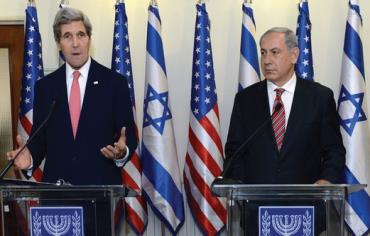
BB and Kerry dec 5 Photo: MATTY STERN / US EMBASSY / FLASH 90
The United State reiterated its opposition to any unilateral step made by either Israel or the Palestinians amid the absence of peace negotiations, State Department spokeswoman Marie Harf said on Friday in response to remarks made by Prime Minister Binyamin Netanyahu in a BloombergView interview earlier Friday.
Harf said the US “would like to resume peace negotiations” and was urging both sides to refrain from actions that would undermine the groundwork for restarting the talks that broke down in late April.
She state[d] that: “we don’t think either side should do anything to complicate efforts right now to build the trust necessary to resume negotiations.”
The State Department’s comments came following Netanyahu’s comments in the interview dismissing the possibility of unilateral territorial withdrawals and appeared open to annexation plans for portions of the West Bank in the absence of a peace process.
“The idea of taking unilateral steps is gaining ground, from the center-left to the center-right,” Netanyahu said in the interview with Jeffrey Goldberg.
“Many Israelis are asking themselves if there are certain unilateral steps that could theoretically make sense,” he added.
But Netanyahu appeared to dismissed left-wing ideas of territorial withdrawal from portions of the West Bank as one possible unilateral option.
He explained that Israel’s 2005 disengagement from Gaza, a unilateral plan designed to rescue a frozen peace process, had strengthened terrorist groups bent on destroying Israel and had failed to bring peace.
“People also recognize that the unilateral withdrawal from Gaza didn’t improve the situation or advance peace — it created Hamastan, from which thousands of rockets have been fired at our cities,” Netanyahu said.
There are some points of consensus in Israel around the peace process with the Palestinians and the nation’s future, he said.
“The first point of consensus is that we don’t want a binational state. Another point of consensus is that we don’t want an Iranian proxy in territories we vacate.
“We want a demilitarized Palestinian state that recognizes the nation-state of the Jews. How do you get that if you can’t get it through negotiations? “The Palestinians don’t agree to recognizing Israel as the Jewish nation-state, and it’s not clear to me that they’ll agree to elements of demilitarization that are required in any conceivable plan that works,” Netanyahu said.
The problem with a negotiated solution he said, is that at present there is no ground for consensus with the Palestinians.
“The minimal set of conditions that any Israeli government would need cannot be met by the Palestinians,” Netanyahu said.
He spoke with Goldberg, after a nine-month US led negotiating process ended on April 29th, with no tangible results. Initially when nine-month negotiating period began, the US had hoped to arrive at a final status agreement, but then downgraded that expectation to a framework document of agreed upon principles. Israelis and Palestinians were unable to even agree on those principles. Discussion about simply renewing negotiations came to a screeching halt, however, when Fatah announced that it planned to unite with Hamas to form one government.
In response, Israel suspended talks with Fatah and said that it could not negotiate with an entity that aligned itself with a terrorist group bent on Israel’s destruction. Netanyahu explained that he preferred to solve the issue through negotiations, but did not think that it was possible at this time.
“No matter what the spin is about blaming Israel, do we actually expect Abbas, who seems to be embracing Hamas, to give a negotiated deal? In all likelihood, no. I hope he does, but I’m not sure he’s going to do it,” Netanyahu said.
“There is an emerging consensus that we don’t have a partner who can challenge constituencies, do something unpopular, do something that is difficult. Abbas has not done anything to challenge the prevailing Palestinian consensus. In fact, he’s doing the opposite: the Hamas reconciliation, internationalizing the conflict, not giving one iota on the right of return, not giving an iota on the Jewish state. He wouldn’t deal with Kerry’s framework,” Netanyahu said.
John Kerry’s recent failed effort to get the Israelis and the Palestinians closer to a peace agreement shows what happens when you see the world the way you want it to be rather than the way it really is.
The good news is that the negotiations wouldn’t have started without Kerry. But that’s the bad news, too. He wanted talks far more than the Israelis and the Palestinians did. The secretary of state fell into one of the classic traps of negotiation and mediation: He became convinced of his own indispensability and centrality to the process — and badly exaggerated his ability to achieve a breakthrough.
I’ve worked for several of his predecessors, and never have I encountered a more self-confident secretary of state. Willful, relentless and a true believer in a two-state solution, Kerry miscalculated his role in three ways: He thought it was his time; it wasn’t. He thought he had the persuasive skills to pull it off; he didn’t. And he thought that this was his last chance; it wasn’t that, either.
The timing
Kerry’s timing did seem fortuitous. President Obama, in his second term and determined to focus on his domestic legacy, had to delegate more of his foreign policy decisions, not dominate them, as he had with Hillary Rodham Clinton. And there were many international headaches that required managing, including Russia, Iran and Syria, which became a much bigger crisis in Obama’s second term.
Yet, while this might have been Kerry’s moment, it wasn’t Benjamin Netanyahu’s nor Mahmoud Abbas’s, at least not for peacemaking. That the first phase of these negotiations, the direct meetings between the two sides, couldn’t get traction might have set off alarm bells for a less-confident diplomat. An Israeli prime minister preoccupied with Iran and never imagining himself to be the father of Palestinian statehood would not or could not make the decisions on the core sticking points — such as borders and how to divide Jerusalem — required for an agreement. Abbas, trapped in a rigid Palestinian consensus on those same questions and profoundly mistrustful of Netanyahu, wouldn’t oblige Kerry, either.
Without enough urgency to do a deal, the talks became Kerry’s process far more than one fashioned and owned by Israel and the Palestinians. Nor was Obama all that seized with the matter, either — and a secretary needs a president’s total support to succeed. By the spring, the Kerry effort devolved into an attempt just to keep the talks going. And in the end, he couldn’t do even that.
The skills
Kerry’s conviction that this was his moment invariably led him to believe too much in his own skills. By all accounts, he was a one-man show. Having served in the Senate and dealt with the Israelis, Arabs and Palestinians for years, Kerry rightly fashioned himself an expert on these matters. His capacity to listen, according to those who know him well, is legendary. But he soon became his own best analyst and policymaker, surrounding himself with former Senate staffers and aides who were not going to challenge their strong-willed boss.
I’ve been told by those familiar with the recent talks that Kerry had little use for experts and no use for skeptics. James Baker would let his advisers argue with one another; so would Madeleine Albright. They’d take what was useful and discard the rest. Kerry dove into the substance with a fervor and certainty the peace process hadn’t seen since Jimmy Carter. Too much analysis, he seemed to believe, led to paralysis. The only way around this was to ignore the doubters, deal directly with the leaders and push them relentlessly on his agenda. This risk-readiness might have paid off if Kerry had Israeli and Palestinian partners willing and able to take risks,too.
With the exception of Henry Kissinger, who had the 1973 war to motivate him, none of Kerry’s predecessors who worked this process — George Shultz, James Baker, Lawrence Eagleburger, Warren Christopher, Madeleine Albright, Colin Powell, Condoleezza Rice, Hillary Clinton — were that willing to plunge ahead and risk their reputations, political capital and credibility. They were quite skeptical and very often uncertain about how to proceed, and they depended to varying degrees on a small circle of advisers for analysis and recommendations.
These reality checks could be constraining. But they also kept U.S. diplomacy grounded. Even Baker, who scored a major success with the Madrid Peace Conference in 1991, wouldn’t travel to the region during his first two years as secretary because he knew he had no chance of getting anywhere close to an agreement between Israelis and Palestinians. And several of these secretaries of state had far more to work with than Kerry did: Israelis and Palestinians, Jordanians and Syrians who were prepared to make serious sacrifices, some who were even ready to reach an agreement.
We don’t know what assurances Kerry received from Netanyahu and Abbas on the borders of a Palestinian state, whether it would recognize Israel as a Jewish state, how to handle Palestinian refugees. or whether he was getting the sides closer to a zone of agreement. Kerry managed to keep the leaders publicly silent when it came to the substance. I’ve been told two stories by people who were in a position to know: first, that the leaders came far on substance, and conversely, that there wasn’t really much there.
One thing we do know: After nine months of intensive effort, the process devolved from an attempt to reach a comprehensive deal on borders, security, refugees and Jerusalem, to discussions of a more general framework agreement, to a losing fight over a mere extension of the talks.
All mediators need to believe in themselves. But it’s possible to lose perspective, believe too deeply and think about negotiations largely in terms of personalities and personal relationships. And perhaps with the best of intentions, Kerry got lost in a “can do” mind-set when the leaders and negotiators were saying, “Oh, no you won’t.”
As a mediator, you spend hundreds of hours with these leaders while in negotiations. They encourage you by seeming willing to consider fixes and compromises that appear new and potentially historic, even on the most sensitive issues. They pledge not to reveal what they’ve heard, through you, from the other side. And you think that somehow your personal ties can move a leader on a specific issue. So you are tempted to believe that you can deliver something that none of your predecessors have. Quite understandably, you tend to diminish other factors more important to the deal than your persuasive skills — namely domestic politics and national interest. Indeed, you forget the thought attributed to Charles de Gaulle, that cemeteries are filled with indispensable people.
I saw this happen to Israeli and Palestinian negotiators during secret talks in Sweden in May 2000, and to Bill Clinton after his masterful success with Netanyahu and Yasser Arafat at the Wye River peace summit in October 1998. The president emerged from that meeting having impressed the Israelis, the Palestinians, himself and the rest of us with his formidable personal and negotiating skills. The Palestinians were amazed that he could rattle off the names and affiliations of their prisoners held in Israeli jails. And the Israelis were impressed with his commitment to their security and his willingness to use the CIA to facilitate Israeli-Palestinian security cooperation. One factor in the decision to convene the Camp David Summit in July 2000 — this time with a risk-averse Arafat and a more risk-ready Israeli Prime Minister Ehud Barak — was Clinton’s conviction that he could bring these two together by virtue of his persuasive power. We had no real strategy at Camp David other than Clinton as our secret weapon. Not surprisingly, it was insufficient. And so was Kerry’s confidence in his ability to persuade the Israelis and the Palestinians to make decisions they didn’t want to make.
The opportunity
Kerry’s faith and conviction created a last-chance trope that was counterproductive. Like the ghost of Christmas future in Charles Dickens’s “A Christmas Carol,” Kerry told the world that if there were no two-state solution, calamity would follow. He warned of a third intifada , an end to Israel as a Jewish state, international boycotts , and even Israel emerging as an apartheid state .
The future without a two-state solution is grim, no doubt. But the question is not whether Kerry believes that; it’s whether the two sides do. Kerry cannot scare Israeli and Palestinian leaders into doing things they don’t want to do. And this approach is an empty demonstration of American resolve and power, particularly if it’s not backed up by the White House.
Nor is this, as Kerry has maintained , the last chance for Middle East peace. That reflects a certain narcissism and lack of perspective. If this really is the final chance, then the question for the president and his talented secretary of state is: Why not make this the focus of your foreign policy and do everything you can — risk it all — to bring about an agreement? The answer seems pretty obvious.
When the Kerry peace process does resume, as it surely will, the United States needs to get the two sides to own it as least as much as Washington does — and to heed the words of another Frenchman, Charles-Maurice de Talleyrand-Périgord, who cautioned diplomats everywhere: Above all, not too much zeal.
Aaron David Miller, a vice president at the Woodrow Wilson International Center for Scholars, has served as a Middle East adviser for Republican and Democratic secretaries of state. He is the author of the forthcoming “The End of Greatness: Why America Can’t Have (and Doesn’t Want) Another Great President.”
(Al Arabiya is a Saudia owned publication. This article takes a different approach than Behind the Lines: Saudi shuffle but there are points of at least partial congruence. “There is a new trend in the region, and the most prudent step is to be an early follower, not a late comer.” The position of the U.S. — whatever it may seem to be from time to time — can be considered at least in passing. If it eventually seems useful to get in step, so be it.– DM)
Some would say one should wait and see how the matter between the U.S. and Iran develops. Who knows what the Iranians are up to? Who knows if they will live up to their commitments or not? I think that waiting is wrong. There is a new trend in the region, and the most prudent step is to be an early follower, not a late comer. The Saudis can always withdraw if this trend recedes or changes direction.
A Saudi-Iranian rapprochement that did not seem possible a few months ago is now happening.
Saudi Arabia invited Iran’s foreign minister to visit the country. Hashemi Rafsanjani is also coming. This is good news for the future of a region that has suffered from devastating conflicts since 1980 when the Iran-Iraq war broke out. Yet there are analysts who insist that it will fail, or that this is not the right time for it. And I think they are mistaken.
Let us take, as an example of major analytical mistakes, the prevailing expectations after the U.S.-Iran rapprochement. The Gulf countries in general were angered by that surprising and fast paced rapprochement; and most analysts could only think of how the American step would push away the Gulf States from America, and make them seek other alliances to ensure their security. Some even suggested that the Saudis and the Israelis would form an alliance against Iran. Of course they were all wrong. The U.S. – Gulf alliance is still as secure as ever, and will remain so as long as there is a mutual need between both. For the foreseeable future, the U.S. will consider Gulf oil an integral part of its national security. And the Gulf countries will consider the U.S. the only reliable and dependable ally in the world.
The fact is that Saudi-Iranian strategic interests are much more important that the conflict in Syria
Abdullah Hamidaddin
The reason those analysts made such a mistake about Gulf-U.S. relations is that they looked at them through the prism of issues of conflict, and not through the prism of strategic geo-political realities. They saw the U.S. and the Saudis disagree over Syria and Egypt and then they concluded that Iran will be the last straw. They didn’t see that the balance of power which created the Gulf-Saudi alliance has not shifted for the past 70 years. Lots of things have happened over those seven decades, but the reasons to stay together have remained intact. So regardless of all differences, regardless of all political rhetoric, this is an alliance that will continue.
Now they are making the same mistake. They see the Iran-Saudi Arabia conflict through the prism of regional conflict. Iran’s position in Syria, in Yemen, in Iraq and Lebanon are at odds with Saudi interests. They miss looking at it from a geo-political perspective. The Saudi-Iranian conflict was mainly about the Iranian-American conflict. Saudi Arabia has no inherent conflict with the Iranians, on the contrary positive relations with them would benefit the Saudis. But Iran had to first realign its positions in a way that meets the interests of the U.S. and the world. Then the Saudis could step in. And this is exactly what is happening.
Wait and see
Some would say one should wait and see how the matter between the U.S. and Iran develops. Who knows what the Iranians are up to? Who knows if they will live up to their commitments or not? I think that waiting is wrong. There is a new trend in the region, and the most prudent step is to be an early follower, not a late comer. The Saudis can always withdraw if this trend recedes or changes direction.
There will remain issues which the Saudis and the Iranians will never agree on. That’s normal in any relationship between states. But the strategic value of those differences will change. The Syrian tragedy serves as an example. The Iranians would have wanted it to spill over into Jordan to threaten the Saudis. This was when they were head to head against the Americans. Today the Iranians will continue to support Bashar, but will no longer been keen for a spillover. What some of us forget, is that the nuclear deal has a subtext, which is to stop seeking to disrupt Gulf security affairs.
The Saudis and the Iranians will continue to disagree over Syria, but they will no longer use it against each other. The strategic value of Syria has changed. But we need to acknowledge that the only way the Syrian crisis will come to an end is when the Saudis and the Iranians reach an agreement over it. This agreement will not succeed overnight. But it needs to start. And now is a good time.
The fact is that Saudi-Iranian strategic interests are much more important that the conflict in Syria. And for that reason the Saudi-Iran rapprochement will succeed; with a few bumps along the way, eventually we will have warm relations with our neighbor across the river.
The IAEA report, which has a pivotal role in verifying that Iran is living up to its part of the six-month accord reached in November, made clear that Iran so far is undertaking the agreed steps to curb its nuclear program.
M-302 rockets from Iran’s weapons shipment to Gaza Photo: IDF
VIENNA – Iran has sharply reduced its most sensitive nuclear stockpile in implementing an interim pact with world powers and has begun engaging with a long-stalled IAEA investigation into suspected atom bomb research, the UN nuclear agency said on Friday.
The findings, in a quarterly report by the International Atomic Energy Agency, are likely to be welcomed by the six powers that are trying to negotiate a long-term deal with Iran on ending a decade-old dispute over its nuclear program.
Iran rejects Western allegations that it has been trying to develop the capability to build nuclear weapons.
The monthly update by IAEA, which has a pivotal role in verifying that Iran is living up to its part of the six-month accord reached in November, made clear that Iran so far is undertaking the agreed steps to curb its nuclear program.
As a result, it is gradually gaining access to some previously blocked overseas funds, under the interim accord that was struck with the United States, Russia, France, Germany, Britain and China in November.
Under the breakthrough half-year agreement that took effect on Jan. 20, Iran halted some aspects of its nuclear program in exchange for a limited easing of international sanctions that have laid low the major oil producer’s economy. It was designed to buy time for talks on a permanent settlement.
The IAEA report showed that Iran since January had acted to reduce its stockpile of higher-grade enriched uranium gas – a relatively short technical step away from weapons-grade material – by more than 80 percent.
(“Unexpectedly,” winners are more popular and more relied upon than losers — particularly when the losers appear to support the winners. How odd is that? — DM)
Saudi gestures should be placed in a context of clear US pressure on their Gulf clients to get “on board” with Washington’s regional diplomacy, close to the center of which appears to be a desire to “flip” Iran from foe to friend.
According to a report on the Intelligence Online website, both US President Barack Obama and Secretary of Defense Chuck Hagel stressed this matter in their recent visit to the Gulf. Obama reportedly raised the matter in his meeting with King Abdullah bin Abdulaziz.
Hagel, meanwhile, urged greater Saudi “openness” to Iran in meetings with Saudi Arabia’s Crown Prince Salman, Deputy Crown Prince Muqrin and Foreign Minister Saud al-Faisal.
The lesson of all this is that there is no simple regional substitute for US leadership in the effort to hold back the advance of Iran – both on the nuclear track and with regard to Tehran’s broader regional ambitions, of which the nuclear drive constitutes a crucial component. The problem is that the current US administration is embarked on a course which is producing Iranian victories.
Saudi Arabia, because of perceived necessity, appears for now to be adjusting its own course to follow this path.
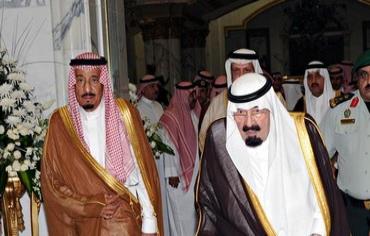
Saudi Arabia’s King Abdullah (R) and his brother Prince Salman. Photo: REUTERS
A number of recent Saudi moves and official statements have led to speculation regarding a possible shift on the kingdom’s stance toward Iran.
The Saudis appear to be moving, at least on a declarative level, away from a position according to which Iranian ambitions are a threat to be resisted – toward an attempt to accommodate Tehran.
The speculation regarding a changed Saudi stance rests largely on three recent public events.
The first was the meeting last month between newly minted Saudi ambassador to Tehran Abdul Rahman al-Shehri, and former Iranian president Ali Akbar Hashemi Rafsanjani.
Shehri demonstrably kissed Rafsanjani on the forehead during the meeting. In addition to displaying the depth of the ambassador’s patriotism, this act was held by some commentators to portend a renewed Saudi determination to set relations with Iran on a new footing.
The second was the Saudi announcement of an invitation to Iranian Foreign Minister Mohammad Javad Zarif to visit the kingdom.
The third element that many analysts have pointed to in asserting a change in the direction of Saudi policy is the recent replacement of Prince Bandar bin Sultan from his position as head of the Saudi intelligence services.
Bandar had been associated with a proactive Saudi policy in Syria, Lebanon, Bahrain and other points of Saudi-Iranian tension. His replacement by Muhammad Bin Nayef was seen as portending a less activist regional policy.
This was accompanied by the replacement of deputy defense minister Salman bin Sultan. Bin Sultan is the half-brother of Bandar, and like him was associated with a policy of activist resistance to Iran’s regional advance.
These Saudi gestures should be placed in a context of clear US pressure on their Gulf clients to get “on board” with Washington’s regional diplomacy, close to the center of which appears to be a desire to “flip” Iran from foe to friend.
According to a report on the Intelligence Online website, both US President Barack Obama and Secretary of Defense Chuck Hagel stressed this matter in their recent visit to the Gulf. Obama reportedly raised the matter in his meeting with King Abdullah bin Abdulaziz.
Hagel, meanwhile, urged greater Saudi “openness” to Iran in meetings with Saudi Arabia’s Crown Prince Salman, Deputy Crown Prince Muqrin and Foreign Minister Saud al-Faisal.
As the nuclear negotiations with Tehran stumble on, and Iran’s clients hold their own or emerge victorious in Lebanon, Syria and Iraq, the US apparently remains convinced of its strategy to normalize relations with Tehran through meeting it halfway.
Saudia Arabia, along with Bahrain and the United Arab Emirates, has hitherto remained similarly convinced that Iranian ambitions cannot be accommodated, without Saudi and Western surrender of vital interests. It is for this reason that they have regarded the current US push for rapprochement with Tehran to be a fool’s errand.
According to Intelligence Online, Gen. Khalifa bin Ahmad al-Khalifa, the Bahraini chief of staff, bluntly articulated the concerns of the Gulf Cooperation Council countries with regard to the Iranian threat and the current US response to it.
The Gulf countries, he said, were “profoundly concerned about Iran’s ambitions to destabilize the region, via its sponsorship of terrorism from the shores of the Mediterranean to the provinces of southern Yemen… Your [US] intelligence services have proof of this terrorism enterprise.
What are you doing to halt its spread?” Khalifa went on to accuse the US of “backing down” over Syria and letting President Bashar Assad’s “chemical attacks go unpunished.”
Gulf concerns are not hard to understand. The goal of ending the presence of foreign (i.e. US) forces in the Gulf is a core Iranian strategic objective. Tehran regards its own domination of the Persian Gulf as a “natural” state of affairs reflecting Iran’s greater demographic and societal strength compared with the fragile, energy-rich Arab monarchies on the other side of the Gulf.
Iran has also shown skill and determination in pursuit of its goals further afield, over the last turbulent decade in the region.
How, then, to explain the Saudis’ apparent about-face and attempt to get behind US policy? The Saudis are aware that the US remains the main physical guarantor of Gulf security, whatever the problems with its current strategy. Other Gulf countries are aware of this, too.
There are no indications that the current administration has any intention of reducing the US military presence of 35,000 personnel in the Gulf, including the Fifth Fleet and a number of advanced missile defense systems.
Indeed, Hagel went out of his way during his visit to the Gulf to stress the continued US commitment to this presence and to Gulf security, regardless of the differences over Iran policy.
It has also long been the contention of the most astute Gulf analysts that it would be mistaken to imagine that Saudi Arabia will constitute an unyielding bulwark to Iranian ambitions, if it becomes clear that the US and the West prefer to accommodate the Iranians.
The Saudi kingdom is simply too fragile an entity to play such a role. Rather, if Western weakness in the face of the Iranian advance becomes apparent, Riyadh is likely to accommodate itself to the new situation.
The shifting Saudi strategy in Syria – which over the last three years has gone from supporting Islamist and jihadi groups to seeking to offer limited support to the rebels, largely within the definitions and dictates of US policy – may offer a window into the current broader direction of Saudi policy toward Tehran.
This runs along clear lines of basic disagreement toward the regional strategy being pursued by the Obama administration, a pragmatic awareness of the need to appear to accommodate Washington’s declared direction, and energetic efforts to prepare as best Riyadh can to cope with the challenges of a Middle East in which a continued Iranian advance seems to be a given.
Are these, on the evidence available, likely to produce a changed Saudi policy with regard to Iran? The answer is yes. Increased direct or mediated dialogue between the two is, at the very least, likely.
It may also be that the shift will produce concrete policy results in specific regional “files” of contention – such as Yemen, Lebanon or even Syria – as the Saudis seek to avoid confrontation with the advancing Iranian power.
The lesson of all this is that there is no simple regional substitute for US leadership in the effort to hold back the advance of Iran – both on the nuclear track and with regard to Tehran’s broader regional ambitions, of which the nuclear drive constitutes a crucial component. The problem is that the current US administration is embarked on a course which is producing Iranian victories.
Saudi Arabia, because of perceived necessity, appears for now to be adjusting its own course to follow this path.
The international community does not seem to be listening to what Hamas is saying. Hamas is telling everyone not to believe Abbas when he say that the Palestinian Unity Government will renounce violence and recognize Israel’s right to exist.
“The reconciliation will actually consolidate the resistance … from one intifada to another until the liberation of Palestine.” — Khaled Mashaal, leader of the Hamas political bureau.
“Who is this crazy guy who would be able to go to the resistance groups and ask them to hand over their weapons?” — Mahmoud Zahhar, senior representative of Hamas.
Abbas is especially interested in winning the backing of the U.S. and EU for the deal with the Islamist movement because his Palestinian Authority is almost entirely dependent on American and European financial aid.
Palestinian Authority President Mahmoud Abbas is busy these days trying to persuade the West to accept his recent unity accord with Hamas.
Abbas is especially interested in winning the backing of the U.S. and EU for the deal with the Islamist movement because his Palestinian Authority is almost entirely dependent on American and European financial aid.
Abbas’s main argument is that the “reconciliation” deal with Hamas, signed last month in the Gaza Strip, would not affect the peace process with Israel.
Abbas was quoted as saying that there is “no contradiction” between the unity deal and the peace talks with Israel and that he remains committed to a “just peace on the basis of a two-state solution in accordance with international legitimacy.”
Earlier, Abbas, in the context of his efforts to calm the U.S. Administration and EU governments over the unity accord, declared that the new Palestinian government would recognize Israel and reject violence. His remarks, however, have been strongly denied by Hamas leaders, who say their movement intends to pursue “jihad” against Israel.
Musa Abu Marzouk, deputy chairman of Hamas’s political bureau, announced that his movement would never recognize Israel. “This is a red line that cannot be crossed,” he said.
In other words, Hamas is telling everyone not to believe Abbas when he says that the Palestinian unity government will renounce violence and recognize Israel’s right to exist.
This week, further evidence emerged that Hamas has no intention of changing its ideology in the wake of the unity agreement with Abbas’s Fatah faction.
Hamas’s two most senior representatives, Khaled Mashaal and Mahmoud Zahar, have both made it clear that their movement is planning to continue “resistance” actions against Israel even after the formation of the unity government. They also emphasized that Hamas has no intention of dismantling its military wing, Izaddin al-Kassam, as part of the unity accord.
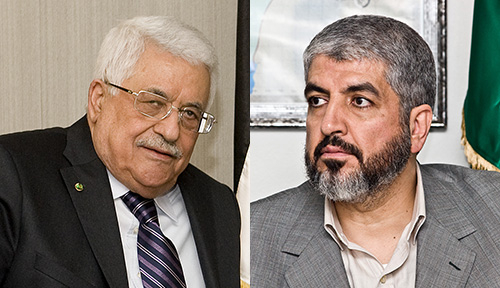
Mahmoud Abbas (left) and Khaled Mashaal. (Image source: Abbas – European Union / Mashaal – Wikimedia Commons)
Asked about the possibility that Hamas would disarm, Zahar said: “Who is this crazy guy who would be able to go to the resistance groups and and ask them to hand over their weapons? Who would dare to do so?”
Zahar also disclosed that Hamas is planning to take advantage of the unity deal to move its terror attacks against Israel to the West Bank. Worse, he declared that after its men set foot in the West Bank, Hamas will target Palestinians who “collaborate” with Israel. “Who said that those who are conducting security coordination with Israel would remain forever?” he asked, referring to the Fatah-dominated security forces in the West Bank.
Zahar, who also said that Hamas would pursue the fight against Israel until the “liberation of all Palestine,” is in fact sending a warning message to the Western-funded Palestinian Authority security forces in the West Bank. “We believe in what was mentioned in the Quran: that Palestine, all of Palestine, will be liberated,” he added. “The Israeli entity should expect more from Hamas after our rockets reached Tel Aviv.”
His remarks may also been seen as a direct and personal threat to Abbas, who has repeatedly vowed to continue security coordination with Israel.
Mashaal, for his part, also vowed that Hamas will never abandon the armed struggle against Israel. Like Zahar, he sees the “reconciliation” as an opportunity for Hamas and all Palestinians to “solidify the resistance” against Israel.
“The reconciliation and politics are not an alternative to resistance,” he said. The reconciliation will actually consolidate the resistance. Our steadfast people are continuing to move from one revolution to another and from one intifada to another until the liberation of Palestine.”
Abbas says that the unity agreement with Hamas is a chance to bolster the peace process and achieve the two-state solution. This is the message that Abbas is trying to relay to the international community, above all, to American and European donors.
Hamas, on the other hand, considers the unity agreement with Fatah an opportunity to extend its control beyond the Gaza Strip and use the West Bank as a launching pad for more terror attacks against Israel.
The international community does not seem to be listening to what Hamas is saying.
Ignoring Hamas’s declared intentions will pave the way for the movement to use the unity agreement to seize control over the Palestinian Authority and many parts of the West Bank. It will also facilitate Hamas’s plans to launch terror attacks from the West Bank against Israel.
It now remains to be seen whether the U.S. Administration and EU governments, by blindly endorsing the new unity government, will help Hamas to achieve its goals.
Israel’s prime minister, Benjamin Netanyahu, has some uncharacteristically positive words for one of U.S. President Barack Obama’s most controversial foreign policy initiatives: the deal struck last year to remove chemical weapons from Syria.
I met Netanyahu last Friday afternoon in his bunkerlike office in Jerusalem. During the course of our discussion, I asked him about the famous “red line” crisis — Obama’s last-minute decision to abort a missile strike and instead negotiate the destruction of Syria’s chemical weapons stockpile — that colors so much of foreign-policy commentary today.
Netanyahu issued what was for him a full-throated endorsement of an Obama initiative, calling it “the one ray of light in a very dark region.”
“It’s not complete yet,” he went on. “We are concerned that they may not have declared all of their capacity. But what has been removed has been removed. We’re talking about 90 percent. We appreciate the effort that has been made and the results that have been achieved.”
The chemical weapons of Syrian President Bashar al-Assad’s regime have posed a murderous threat to Israel, and there is broad relief in Jerusalem that this particular menace appears to be dissipating. Obama actually gets more credit for the deal in Israel — particularly among leaders of the country’s national-security apparatus — than he often does in Washington.
Netanyahu is only intermittently pro-Obama, of course. The two men have a famously contentious relationship. During our discussion, Netanyahu did not hesitate to highlight broad areas of disagreement with the U.S. administration, particularly on matters related to the ongoing Iran nuclear negotiations and the defunct Israeli-Palestinian talks led by Obama’s secretary of state, John Kerry. The latest round of peace talks failed, according to U.S. negotiators, in good part because of Israel’s insistence on expanding settlements in the West Bank.
Netanyahu was careful to stress his pro-American bona fides, and he vociferously denied recent reports that Israel is engaged in aggressive acts of espionage in the U.S. “Israel has not conducted any espionage operations in the United States, period. Full stop,” he said. “Not direct espionage, not indirect espionage, nothing, zero.”
The prime minister was expansive; he had just completed what both Israeli and U.S. participants described to me as a productive meeting with U.S. Secretary of Defense Chuck Hagel. (It is my impression that Netanyahu would prefer to see Hagel — who was accused during his confirmation process of being anti-Israel — than to find the indefatigable peace processor Kerry showing up in his office.)
But Netanyahu, though seemingly relaxed, was also quite difficult. We spent the first 10 minutes of our discussion renegotiating the terms of our meeting (when I could use a digital recorder, topics we could cover on the record, and so on). I quickly remembered a truism about Netanyahu: that he would give live television interviews on background if such a thing were possible.
We soon enough turned to business — first, to the mostly dead peace process. In his most extensive comments to date on the reasons he thinks the process has failed, Netanyahu made it clear he believes his Palestinian counterpart, Mahmoud Abbas — who sometimes refers to Netanyahu as “that man,” according to officials — is unable or unwilling to grapple with the core issues of the conflict. Netanyahu also hinted that he is weighing suggestions from a large number of Israelis that he should consider taking unilateral steps to disengage from sections of the West Bank that are heavily populated by Palestinians, even if this means uprooting Jewish settlements.
“We want a demilitarized Palestinian state that recognizes the Jewish state,” Netanyahu said. “How do you get that if you can’t get it through negotiations? It’s true that the idea of taking unilateral steps is gaining ground, from the center-left to the center-right. Many Israelis are asking themselves if there are certain unilateral steps that could theoretically make sense.”
But he was quick to add that Israelis — himself included — don’t want a repeat of their Gaza experience. In 2005, then-Prime Minister Ariel Sharon unilaterally withdrew Israeli soldiers and settlers from Gaza; it was soon taken over by the radical Islamist group Hamas, which has since used the territory to launch rockets at Israeli civilian targets.
Nevertheless, Netanyahu said that something must be done to prevent the collapse of Israel as a Jewish-majority democratic nation. “We don’t want a binational state, and we don’t want a Palestinian-Iranian state next door,” he said. “There is an emerging consensus that we don’t have a partner who can challenge constituencies, do something unpopular, do something that is difficult. Abbas has not done anything to challenge the prevailing Palestinian consensus.”
Similar criticism has been leveled at Netanyahu, both domestically and internationally. Obama administration officials and European leaders doubt his willingness to confront the powerful settler lobby head-on in order to convince Palestinians that he is ready for painful compromise. He rejects this criticism.
“Look at what I’ve done,” he said. “I gave the speech at Bar-Ilan University, a religious university, five years ago recognizing the two-state solution. Second, I tried a 10-month [settlement] freeze, and Abbas did nothing. Then I did something that was the toughest of all — I released terrorist prisoners, killers of innocent people. That was the hardest decision.”
“And what has Abbas done? Nothing,” he said. “He’s refused to entertain Kerry’s efforts to try and lock horns on the core issues. He internationalized the conflict. He went to the UN organizations in express violation of Oslo and all the interim agreements. And now he’s embracing Hamas” by bringing the organization into a unity government.
I asked Netanyahu why he simply doesn’t bypass the current impasse and declare an indefinite settlement freeze, particularly in areas outside the thickly settled suburbs of Jerusalem and communities near Tel Aviv. Right now, the burden is on Netanyahu to prove that he is interested in compromise. Such a move — while politically difficult — would shift the onus onto Abbas and restore some of Israel’s international standing.
“I don’t think it would work. Having tried once, I saw that it doesn’t work,” he said, referring to the time-limited settlement freeze during Obama’s first term. “The Americans said the only way Abbas is going to come into negotiations is either you release prisoners or freeze settlements: Choose. We chose [to release prisoners]. We made it very clear to the U.S. and to the Palestinians exactly how much we would build, including in Jerusalem. We built exactly what we said we would build in every one of the tranches. It wasn’t that we surprised anyone with extra construction.”
Here are excerpts from our conversation. I’ve edited my questions for length and clarity.
Chuck Hagel and Benjamin Netanyahu in Jerusalem on May 16. Photographer: Mandel Ngan – Pool/Getty Images
JEFFREY GOLDBERG: The peace process is in a coma. When do you go to a Plan B? How do you extract Israel from a situation that many people say is unsustainable?
BENJAMIN NETANYAHU: There are a couple of points of consensus in Israel that are beginning to emerge. The first point of consensus is that we don’t want a binational state. Another point of consensus is that we don’t want an Iranian proxy in territories we vacate. We want a demilitarized Palestinian state that recognizes the nation-state of the Jews. Now how do we get that? The Palestinians don’t agree to recognizing Israel as the Jewish nation-state, and it’s not clear to me that they’ll agree to elements of demilitarization that are required in any conceivable plan that works.
GOLDBERG: A lot of people in Israel, from [former Israeli Ambassador to the U.S.] Michael Oren to [former head of Israeli military intelligence] Amos Yadlin, are looking at the idea of taking unilateral steps to disengage from the Palestinians.
NETANYAHU: We want a demilitarized Palestinian state that recognizes the Jewish state. How do you get that if you can’t get it through negotiations? It’s true that the idea of taking unilateral steps is gaining ground, from the center-left to the center-right. Many Israelis are asking themselves if there are certain unilateral steps that could theoretically make sense. But people also recognize that the unilateral withdrawal from Gaza didn’t improve the situation or advance peace — it created Hamastan, from which thousands of rockets have been fired at our cities.
GOLDBERG: So you’re still committed to negotiations?
NETANYAHU: Let me be clear — negotiations are always preferable. But six prime ministers since Oslo have failed in their pursuit of a negotiated settlement. They’ve always thought we were on the verge of success, and then [Yasser] Arafat backed off, Mahmoud Abbas backed off, because they can’t conclude these negotiations. We don’t have a Palestinian leadership that is willing to do that. The minimal set of conditions that any Israeli government would need cannot be met by the Palestinians. No matter what the spin is about blaming Israel, do we actually expect Abbas, who seems to be embracing Hamas, to give a negotiated deal? In all likelihood, no. I hope he does, but I’m not sure he’s going to do it.
GOLDBERG: So go back to this question of what to do next.
NETANYAHU: We don’t want a binational state, and we don’t want a Palestinian-Iranian state next door. There is an emerging consensus that we don’t have a partner who can challenge constituencies, do something unpopular, do something that is difficult. Abbas has not done anything to challenge the prevailing Palestinian consensus. In fact, he’s doing the opposite: the Hamas reconciliation, internationalizing the conflict, not giving one iota on the right of return, not giving an iota on the Jewish state. He wouldn’t deal with Kerry’s framework.
GOLDBERG: Do you still think that the Palestinians embrace the idea of destroying Israel in stages — by setting up a state and then using that state to continue to press their demand through violence and other means for all of Palestine?
NETANYAHU: What the Palestinians keep saying is, Look, we want the maximum. We will not make any adjustments in our demands. Nothing. Not tactical, not strategic. I said to them, You tell me that you want me to draw a map of a state, but you won’t tell me that the state on the map will recognize the Jewish state next to it. They want a map without an end of conflict.
I think Palestinian society is divided into two. The first half openly calls for Israel’s destruction. And the second half refuses to confront this and refuses to confront the demons inside their own camp.
In Israel, there is a vigorous debate about what compromise would entail. There is no such debate in the Palestinian Authority. I’m not talking about Hamas. I’m talking about the so-called moderates who will not talk about the minimal conditions that are necessary for peace from the point of view of any Israeli government and just about any Israeli. They expect us to just leave, shut our eyes, tear out the settlements. Well, been there, done that. We did it in Gaza. And what we got was not peace, but rocket fire.
GOLDBERG: What I don’t understand is why you don’t just leapfrog this negotiations morass and declare an indefinite settlement-building freeze — not tearing them out, but freezing them? That way, the onus will be on the Palestinian side, not on you, to prove that they are interested in compromise.
NETANYAHU: I don’t think it would work. Having tried once, I saw that it doesn’t work. The Americans said the only way Abbas is going to come into negotiations is either you release prisoners or freeze settlements: Choose. We chose [to release prisoners]. We made it very clear to the U.S. and to the Palestinians exactly how much we would build, including in Jerusalem. We built exactly what we said we would build in every one of the tranches. It wasn’t that we surprised anyone with extra construction.
GOLDBERG: Why continue to grow settlements at all when you’re trying to negotiate? The American critique of your position is that you keep building in ways that set back the possibility of a Palestinian state.
NETANYAHU: The settlements are an important issue, but they are not the core of the problem. This conflict has been going on for almost a century. During the first half of that century, there wasn’t a single settlement. From 1920, when this conflict effectively began, until 1967, there wasn’t a single Israeli settlement or a single Israeli soldier in the territories, and yet this conflict raged. What was that conflict about? It was about the persistent refusal to recognize a Jewish state, before it was established and after it was established.
GOLDBERG: You’ve spoken about this before as an illusion.
NETANYAHU: Just a few years ago, we were told that the Palestinian issue was the core of the conflict in the Middle East. Now you see Syria imploding, Lebanon imploding Yemen imploding, Iraq imploding, Libya imploding. Until three years ago, people believed this, and I was laughed out of court when I mentioned this. This absurdity was widely believed. There was no challenging it.
Then there was a second illusion: that if you solved the Palestinian problem, you’ll get the Arabs to agree with you on a tougher policy on Iran. Well, that’s out the window now because they oppose Iran regardless of the Palestinian issue.
Now the last illusion remains: The core of the problem in the Israel-Palestinian conflict is the settlements. That’s about as truthful as the previous illusions. The real issue was and remains opposition to the Jewish state. That’s the demon that they have to confront, just as we’ve confronted the demon of a greater Israel. Not easy, but we did it.
GOLDBERG: A lot of people would say you haven’t done this yet, because you haven’t risked the stability of your ruling political coalition in pursuit of territorial compromise with the Palestinians.
NETANYAHU: Look at what I’ve done. I gave the speech at Bar-Ilan University, a religious university, five years ago recognizing the two-state solution. Second, I tried a 10-month [settlement] freeze, and Abbas did nothing. Then I did something that was the toughest of all — I released terrorist prisoners, killers of innocent people. That was the hardest decision.
That’s what I did to facilitate the negotiations. And what has Abbas done? Nothing. He’s refused to entertain Kerry’s efforts to try and lock horns on the core issues. He internationalized the conflict. He went to the UN organizations in express violation of Oslo and all the interim agreements. And now he’s embracing Hamas.
GOLDBERG: Why do you think that Kerry and [U.S. special envoy] Martin Indyk believe that the settlements are a great impediment to peace? Indyk in particular has denounced “rampant settlement activity” as a key factor undermining negotiations.
NETANYAHU: Most of the settlement population, between 80 to 90 percent, is clustered in three urban blocs, in suburbs of Tel Aviv and Jerusalem that everyone knows will stay in a final peace settlement. Effectively, the territory that is involved has not increased. It’s marginal. It’s been marginal for the last 20 years. No new settlements have been built since the time I was first prime minister, which was 1996.
What you are talking about is an increasing population within these urban blocs. It doesn’t materially affect the map. If you took an aerial photograph to see how much territory has been “consumed” by so-called “rampant” settlement activity, the answer is practically nothing. If you can make a deal, you can make a deal. The addition of a few hundred housing units a year in this territory doesn’t alter it. Successive Israeli governments have offered deals and couldn’t get them because the Palestinians would not lock horns with the primary obstacle to peace, which is the refusal to end the conflict with Israel once and for all. To recognize that the Jewish people have the right to self-determination, just as the Palestinian people do. My insistence on recognition of the Jewish state is not a tactical PR stunt. It goes to the core of the conflict.
GOLDBERG: There are people in Washington who think that John Kerry is borderline delusional for pursuing negotiations so hard.
NETANYAHU: Kerry made a big effort. We made a huge effort together. I think he tried very hard. It’s a tough go.
GOLDBERG: Come back to this point: If the settlements aren’t a big deal, then what’s a big deal?
NETANYAHU: In the Middle East today, there are two great threats. The threat is militant Islam in its Shia variety or Sunni variety. The threat is what happens when radicals get a state. Shia militants have taken over a state called Iran that is seeking nuclear weapons and which threatens everyone in the region. The Arabs see both threats as supreme. There is very broad agreement. Does the Palestinian issue play a role here? It hinders more open relations, but such relations are taking place anyway.
GOLDBERG: What will you say to the Americans if they come to you and say, “We’ve got a deal that keeps Iran perpetually a year or more from reaching the possibility of nuclear breakout”? That seems like a reasonable conclusion, no?
NETANYAHU: I think this is a setup for the same mistake that was done with North Korea. You leave Iran with a breakout capability — let’s say a year. During that year, you have two problems. Will you muster the political will and capability to deal with this in a year? What if there is another unfolding crisis somewhere? Second, on the matter of inspections that are promised — they built their underground bunkers when they were under inspection!
Intelligence isn’t perfect — far from it. Intelligence did not prevent enrichment sites from being built without anyone knowing for years.
Everybody in the region — everybody — shares my assessment that what you have to do is dismantle Iran’s enrichment capability. If you leave them with enrichment capability, then everybody will scramble to get their own capability. They might do two things simultaneously: They might actually kowtow to Iran and begin relations with Iran, and at the same time scramble for their [own] nuclear weapons. So this agreement that is meant to stop the proliferation of nuclear weapons will be instead a tremendous force for proliferation.
Look at what Iran does without nuclear weapons. They’re in Syria; they’re in Gaza, sending ships with weapons. They’re in Yemen, in Bahrain, Iraq, everywhere. So if [Ayatollah Ali] Khamenei’s Iran becomes a threshold nuclear power, what do you think will happen? Is this going to move Iran into greater moderation, when he has greater force, or is he going to be even less moderate?
GOLDBERG: There’s been a lot of criticism of President Obama on Syria, the “red line” controversy, and the deal he engineered with [Russian President Vladimir] Putin to bring about the removal of Assad’s chemical weapons. It’s now nine months or so after that particular crisis. What’s your assessment of the chemical weapons deal today?
NETANYAHU: I think this is the one ray of light in a very dark region. It’s not complete yet. We are concerned that they may not have declared all of their capacity. But what has been removed has been removed. We’re talking about 90 percent. We appreciate the effort that has been made and the results that have been achieved.
READ MORE: Jeffrey Goldberg’s exclusive interview with President Barack Obama
GOLDBERG: Chuck Hagel was just here. He was under fire during his confirmation process for being anti-Israel. How do you view him today?
NETANYAHU: The relationship has truly been fine. Our defense cooperation and intelligence sharing, which has been substantial in both directions, and our work on anti-missile and anti-rocket defense have been very good, and this work continues under Chuck Hagel and President Obama, and I’m pleased with that. That doesn’t mean we can’t have differences of opinion on Iran.
GOLDBERG: So how deep are those differences?
NETANYAHU: The Americans say, “We will not let Iran have nuclear weapons.” We say we should not let Iran have the capability to produce nuclear weapons. There’s a difference. If Iran is allowed to maintain what is called a threshold capability, then in all likelihood, they will break out. We think they should be pushed back so that they don’t have that capability to produce nuclear weapons. We need to dismantle their capability, to take away their enriched uranium and, of course, to address the other components of their system. What is the justification for giving it [enrichment] to them? They are a systematic violator of every UN resolution, including a UN report that shows they’re still violating even today.
GOLDBERG: Recently, we’ve seen charges that Israel continues to aggressively spy on the United States. Does your government run spying operations against American targets?
NETANYAHU: This is an outright lie. Since [Jonathan] Pollard, almost 30 years ago, Israel has not conducted any espionage operations in the United States, period. Full stop. Not direct espionage, not indirect espionage, nothing, zero. We do not conduct in any way, shape or form espionage operations in the United States.
GOLDBERG: You just got off the phone with the newly elected prime minister of India. You’re increasingly isolated in parts of Europe. Are you looking east in ways that Israel hasn’t before?
NETANYAHU: We still have a ways to go to solve the Israel-Palestinian dispute. But there is a broader recognition that this issue shouldn’t hold us hostage. Israel is rapidly developing relations in Asia. I was recently in China, and I just came back from Japan. We have conversations with many Asian countries, Latin American countries, African countries. These countries want to seize the future, and they recognize that the only way they can win is to innovate, and Israel is one of the great centers of innovation in the world. These countries understand that they have to upgrade their products and services with technology in order to compete in a rapidly changing world. Israel is seen as an R&D lab by many governments and companies, and they’re interested in Israeli technology. These countries and companies are not being held back by the continuing conflict.
I hope we resolve it, for our sake. I hope we resolve it because I don’t want a binational state. I hope we resolve it because I’d like to have broader and more open relations with the Arab world, and I hope to resolve it in order to remove the unjustified attacks on Israel. But we are proceeding ahead despite this. We don’t mortgage our future to the maturation of Palestinian politics.
To contact the writer of this article: Jeffrey Goldberg at jgoldberg50@bloomberg.net.





 anneinpt
 artaxes
 danmillerinpanama
 davidking1530
 Peter Hofman
 Joseph Wouk
 Peter
Peter Louisiana Steve
 WarSclerotic
Recent Comments