Archive for May 2014

Hamas Talks to US, “Senses Change in US Position”

May 27, 2014

Hamas Talks to US, “Senses Change in US Position,” Front Page Magazine, May 27, 2014

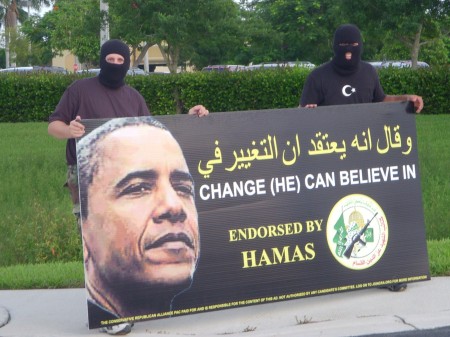
1obama-hamas-450x337

The only question is how the new Hamas-PLO government will be repackaged as Israel’s mandatory peace partners by Obama Inc.

Assuming this Frankenpalestine monster holds together, Kerry will just insist that Hamas will eventually change its position once everything has been negotiated.

I don’t know that it’s much of a change since Obama Inc. started out with backdoor contacts with Hamas and is back to backdoor contacts with Hamas.

There’s no change at all. The only question is how the new Hamas-PLO government will be repackaged as Israel’s mandatory peace partners by Obama Inc.

Hamas deputy leader Moussa Abu Marzouk, who is deeply involved in ongoing negotiations between Hamas and Fatah, said in a newspaper interview that Hamas is not opposed to the appointment of Palestinian Authority (PA) “prime minister” Rami Hamdallah as the “prime minister” of the Palestinian Arab “unity” government.

Abu Marzouk also revealed that Hamas recently held talks with the European Union (EU) and an unofficial American representative.

Hamas officials “sensed a change in the American position,” he said – hinting that the US is becoming more open to the idea of a Hamas-led “unity” Palestinian Arab government.

History suggests this unity government will fall apart, but Abbas needs it badly to sabotage negotiations with Israel, while Hamas needs to reestablish its relevance before the next conflict breaks out.

Assuming this Frankenpalestine monster holds together, Kerry will just insist that Hamas will eventually change its position once everything has been negotiated.

A Palestinian terror government

May 27, 2014

A Palestinian terror government, Israel Hayom, Zalman Shoval, May 27, 2014

The question remains as to whether Obama has internalized lessons from the mistake made by former President George W. Bush’s administration (the pressure it put on Israel to agree to Palestinian elections in which Hamas took part) or from his own mistakes regarding the Arab Spring and his support for the Muslim Brotherhood. Obama must not err again now in regard to a Palestinian government that includes Hamas.

According to unconfirmed reports from Washington, the U.S. intends to recognize the Palestinian unity government when it is established, even if Hamas does not accept the Quartet’s conditions (recognition of Israel, cessation of terror and adherence to past Israeli-Palestinian agreements). The official excuse will be that the Palestinian government will be one comprised of “technocrats,” that is to say experts, not political figures. This argument is not exactly convincing, as half of the ministers will be appointed by Hamas, a group that the U.S. itself has defined as a terrorist organization. The practical result is that the U.S. will ipso facto become a dialogue partner with a terrorist government.

We do not know yet who the experts (experts in what?) will be in the Palestinian government, but it must be assumed that they will not deviate from the line Hamas dictates to them.

In 1991, Israel demanded that the Palestinian delegation to the Madrid Conference not include official representatives of the Palestine Liberation Organization, but the U.S. chose to turn a blind eye to the fact that the members of the Palestinian delegation were receiving daily orders from the PLO headquarters in Tunis.

This time, Israel has decided not to play the game of false appearances, and it expected that the U.S. would take a similar position (Israel’s demand would have been more credible and effective had all of its government ministers stood behind it). But, as mentioned before, it appears that Jerusalem’s expectations on this matter will not be met by Washington.

“So why does Israel insist on rejecting Hamas?” some will ask. “At one time, it was also forbidden to talk with the PLO, and now it is a dialogue partner on everything.” This is indeed true, but the PLO and Fatah accepted, at least outwardly, certain rules and commitments, particularly regarding terrorism and violence, that enabled the ban on talking with them to be lifted. Hamas, on the other hand, has never forsworn terrorism. If, on occasion, Hamas has offered a “hudna” or agreed to a temporary halt of violence against Israel, this was only after the Israeli military had dealt it heavy blows or was about to. Moreover, at the Wye River Conference in 1998, Israel said that for the Palestinian commitment to peace to earn at least minimal credibility, the Palestinians would have to cancel clauses in the Palestinian National Charter that denied Israel’s right to exist and did not recognize the Jews as a people. Then-President Bill Clinton justifiably backed the Israeli demand, and the relevant clauses were annulled, at least in theory.

Israel thought President Barack Obama would follow that path and not have any contact, direct or indirect, with a Palestinian government that included Hamas unless it were to accept the Quartet’s conditions and also cancel its jihadist charter that calls for Israel’s destruction and is laced with anti-Semitic statements.

I will not go into the various theories regarding the Palestinian “reconciliation” or the doubts about the veracity or durability of this dubious move, but it is not inconceivable that this time Palestinian Authority President Mahmoud Abbas and Hamas leaders are striving for something more than just an appearance of unity.

It certainly may be that the move will set the needle in the direction of extremism, rather than moderation. Hamas officials have made it clear that they plan to follow the “Hezbollah model” from Lebanon. That is to say it will place a very limited role in civilian and administrative matters, but will reserve for itself total freedom of action as a “popular resistance organization.” The implication is clear: gaining political legitimacy while maintaining the terror option.

The question remains as to whether Obama has internalized lessons from the mistake made by former President George W. Bush’s administration (the pressure it put on Israel to agree to Palestinian elections in which Hamas took part) or from his own mistakes regarding the Arab Spring and his support for the Muslim Brotherhood. Obama must not err again now in regard to a Palestinian government that includes Hamas.

Iran Leader: Jihad Will Continue Until America is No More

May 26, 2014

Iran Leader: Jihad Will Continue Until America is No More | The Daily Caller.

Iran’s supreme leader, Ayatollah Ali Khamenei, all but said on Sunday that negotiations over the country’s illicit nuclear program are over and that the Islamic Republic’s ideals include destroying America.

“Those [Iranians] who want to promote negotiation and surrender to the oppressors and blame the Islamic Republic as a warmonger in reality commit treason,” Khamenei told a meeting of members of parliament, according to the regime’s Fars News Agency.

Khamenei emphasized that without a combative mindset, the regime cannot reach its higher Islamic role against the “oppressors’ front.”

“The reason for continuation of this battle is not the warmongering of the Islamic Republic. Logic and reason command that for Iran, in order to pass through a region full of pirates, needs to arm itself and must have the capability to defend itself,” he said.

“Today’s world is full of thieves and plunderers of human honor, dignity and morality who are equipped with knowledge, wealth and power, and under the pretense of humanity easily commit crimes and betray human ideals and start wars in different parts of the world.”

In response to a question by a parliamentarian on how long this battle will continue, Khamenei said,“Battle and jihad are endless because evil and its front continue to exist. … This battle will only end when the society can get rid of the oppressors’ front with America at the head of it, which has expanded its claws on human mind, body and thought. … This requires a difficult and lengthy struggle and need for great strides.”

Khamenei cited the scientific advancement of the country. “The accelerated scientific advancement of the last 12 years cannot stop under any circumstances,” he said, referring to the strides the regime has made toward becoming a nuclear power.

As reported on May 19 on The Daily Caller, Iran has put up new roadblocks to reaching a deal with the P5+1 world powers over its illicit nuclear program. The powers are the permanent members of the U.N. Security Council, plus Germany.

Three days of negotiations in the fourth round of Geneva meetings ended recently without concrete results when the Iranian team presented the country’s new “red lines” — diminishing any hope by the Obama administration to claim victory in its approach to Iran’s nuclear ambitions, according to reports from Iran.

The Obama administration had hoped that with Iranian President Hassan Rouhani and Foreign Minister Javad Zarif showing an eagerness to solve the nuclear issue and address the West’s concerns, there would be a possibility for a negotiated solution. An interim agreement penned last November in Geneva was touted as an “historic nuclear deal.”

Under that agreement, Iran, in return for billions of dollars in sanctions relief, limited its enrichment activity to the 5 percent level with a current stockpile of over 10 tons (enough for six nuclear bombs), converted much of its 20 percent enriched stock to harmless oxide, and agreed to allow more intrusive inspections of its nuclear plants by the International Atomic Energy Agency, whose inspections were limited to only agreed-upon facilities.

The Iranian delegation last week presented new red lines that could not be crossed, including the expansion of the country’s research and development for its nuclear program, the need of the country to continue enrichment, and the fact that the country’s ballistic missile program — despite U.N. sanctions — is not up for negotiation.

At the same time, IAEA officials met again with their Iranian counterparts last week in Tehran to discuss information on the work on detonators and needed collaboration by the regime to clear outstanding issues on its nuclear program as part of seven transparency steps Iran had agreed to fulfill by May 15, which has yet to take place.

Reza Kahlili is a pseudonym for a former CIA operative in Iran’s Revolutionary Guards and author of the award winning book “A Time to Betray” (Simon & Schuster, 2010). He serves on the Task Force on National and Homeland Security and the advisory board of the Foundation for Democracy in Iran (FDI).
Read more: http://dailycaller.com/2014/05/25/irans-supreme-leader-jihad-will-continue-until-america-is-no-more/#ixzz32qgVMQI5

Despite nuclear probe progress, IAEA access to key Iran site elusive

May 26, 2014

Despite nuclear probe progress, IAEA access to key Iran site elusive | JPost | Israel News.

By REUTERS

05/26/2014 14:59

Iran will not be ready to address concerns about nuclear activities until the UN has access to a location at the Parchin base southeast of Tehran.

Interior of Bushehr nuclear plant

Interior of Bushehr nuclear plant Photo: REUTERS/Stringer Iran

VIENNA – The UN nuclear watchdog appears no closer to finding out what happened at a military site at the center of its investigation into suspected atom bomb research by Iran, despite signs Tehran is becoming more cooperative.

A confidential report by the International Atomic Energy Agency said Iran for the first time in years had begun engaging with a long-stymied IAEA inquiry into allegations that it may have worked on designing a nuclear weapon.

But any hope that Iran may be ready to fully address concerns about its nuclear activities will be tempered as long as it refuses to give the UN agency access to a location at the Parchin base southeast of Tehran, and information about it.

US officials say it is vital for Iran to answer IAEA questions if Washington and five other powers are to reach a broader nuclear settlement with Iran by a self-imposed deadline of July 20. However, Tehran’s repeated denials of any nuclear bomb aspirations will make it hard for it to admit to any wrongdoing in the past without losing face.

The IAEA report issued to member states late on Friday said satellite images showed “ongoing construction activities” at Parchin, a finding that could add to Western suspicions that Iran has been trying to hide any incriminating evidence of illicit nuclear-related experiments there.

“It seems clear that there is more sanitization going on,” one Western envoy said, noting indications of major alteration work at Parchin since early 2012, such as soil removal and asphalting of the specific place the IAEA wants to see.

“I can think of no other explanation for 28 months of cleanup and denied IAEA access at Parchin except an attempt to hide all traces of something from IAEA environmental sampling.”

The IAEA, which has requested Parchin access for more than two years, says it has information that Iran built a large steel chamber there for explosives tests, possibly more than a decade ago. It said back in 2011 that “such experiments would be strong indicators of possible nuclear weapon development.”

Iran denies Western suspicions that it has been seeking to develop the capability to assemble nuclear weapons. It says Parchin is a conventional military facility and has dismissed the cleansing allegations.

“The activity at Parchin gives ample reason for continued concern that Iran may be trying to remove any remaining vestiges of nuclear-related experiments,” said Mark Fitzpatrick, director of the non-proliferation program at the International Institute for Strategic Studies (IISS) think-tank in London.

But one should not leap to conclusions of guilt, he added. “The activity may also be for some entirely innocuous purpose.”

IRANIAN COOPERATION “IMPROVING”

The IAEA’s suspicions about Parchin were part of a 2011 report that included a trove of intelligence information pointing to Iranian research in the past that could be relevant for nuclear weapons, some of which it said may be continuing.

Iran says it was based on false and baseless information. But it has offered to work with the IAEA to clear up the case since pragmatist Hassan Rouhani won the presidency last year, pledging to end Tehran’s international isolation.

The IAEA-Iran talks are separate from those between Tehran and the United States, France, Germany, Britain, China and Russia. But they are complementary as both focus on fears that Iran may covertly be using a nuclear power and research program as a cover for developing a weapons capability.

Friday’s IAEA report said Iran had started engaging on one issue in the investigation, by providing explanations about the development of detonators that can, among other things, be used to set of an atomic explosive device.

It also agreed last week to provide the IAEA with information in two other areas of the inquiry, including allegations about the initiation of high explosives.

“The engagement and cooperation (shown by Iran) has been improving all the time,” a senior diplomat said.

But the IAEA report showed little progress so far regarding Parchin, saying the UN agency continues to seek answers to “detailed questions” submitted to Iran about it.

It said the activities it had noticed “appear to show the removal/replacement or refurbishment of the external wall structures of the site’s two main buildings”. The alleged test chamber was believed to have been constructed in one of them.

Nasrallah’s latest war speech is taken literally by Israeli military chiefs

May 26, 2014

Nasrallah’s latest war speech is taken literally by Israeli military chiefs.

DEBKAfile Special Report May 26, 2014, 1:14 PM (IDT)
Hassan Nasrallah on the warpath

Hassan Nasrallah on the warpath

The Hizballah leader Hassan Nasrallah’s belligerent speech Sunday night, May 25, on the 14th anniversary of the IDF’s withdrawal from south Lebanon, was taken by Israel’s top military chiefs as the precursor for operational plans to bring his forces up to the Israel border in South Syria and the Golan – not just to fight Syrian rebels, but to challenge the IDF.

This conclusion is shared by Defense Minister Moshe Ya’alon, Chief of Staff Lt. Gen. Benny Gantz and his deputy Maj. Gen. Gady Eizenkott. debkafile’s military sources say they have been watching the spate of reports Damascus and Beirut have been planting in the last fortnight, which describe Hizballah as poised for a major offensive to prevent Syrian rebels taking Quneitra opposite Israel’s Golan border.

The Israeli army is accused of backing them with firepower.

The official Saudi publication Okaz reported Saturday, May 17, that Hizballah had sent surveillance teams to the battle ground to lay the ground for an operation to keep the vitally important Golan town from falling to rebel forces.
The next day, Sunday, Damascus issued an official notice of the death of Lt. Gen. Hussein Ishaq, Syrian Air Defense Chief, of wounds he sustained Saturday in an Islamist Jabhat al-Nusra attack on the Mleia base outside Damascus.

The Syrian government is known never to report the deaths of high-ranking officers. This unusual release raised suspicions in Western intelligence sources. They wondered what an officer so senior was doing in this small base, and how he came to be caught up in a local firefight.

The answer they came up with was that the late general was sent to Mleia to prepare Syria’s air defenses as cover for a Hizballah operation. The rebels discovered this and ambushed his convoy before it reached the base.

Other Saudi sources disclosed Saturday, May 24 that the Iranian Al Qods Brigades chief, Gen. Qassem Soleimani, who is in charge of his country’s military operations in the Syria conflict, had arrived in Damascus to study the state of battle on the Golan, although no other source has confirmed this.

From the Israeli side, our sources report that no major Hizballah troop advances have been sighted heading in the direction of southern Syria and the Golan – only the advance surveillance teams which turned up briefly last week on the Syrian side of the Hermon range overlooking the Golan.

Nevertheless, Nasrallah’s speech set off alarm signals.
In all the many pugnacious speeches the Hizballah chief has delivered against Israel in his 22 years as secretary general of the Lebanese Shiite Hizballah, he has never before gone into detail on the intelligence he claims to have obtained on IDF operations. But in his latest peroration, he did just that – in reference to alleged IDF actions in southern Syria.
“When the senior strategist of Hizballah – or any military group – shows off his intelligence on enemy moves in detail, that is a declaration of war,” said one Western military source.

Nasrallah made it clear he was not talking about Israel’s medical aid to rebels wounded in battle, but the IDF fire he said was aimed at Syrian units and positions on the Golan. Its purpose, he said, was to carve out a security zone in southern Syria.

“This would not be a ‘good fence,’” he said (in reference to the friendly border between South Lebanon and Israel in the years 1978 and 2000, that was manned by the IDF-founded South Lebanese Army). It will be much more than that.”
Nasrallah accused Israel of incursions across the “land border between Hizballah and Israel,” including the shooting of farmers. “Until now we haven’t reacted, but left it to the Lebanese army and UNIFIL,” he said. “But no more: For the next violations, we will hit back at once,” he said.
This was taken by Israel’s military chiefs as a threat by Hizballah to make war on Israel from two fronts: Lebanon and Syria.

After prayer at Western Wall and Herzl’s tomb, pope heads to Yad Vashem

May 26, 2014

WATCH LIVE: After prayer at Western Wall and Herzl’s tomb, pope heads to Yad Vashem | JPost | Israel News.

By YONAH JEREMY BOB, JPOST.COM STAFF

LAST UPDATED: 05/26/2014 09:36

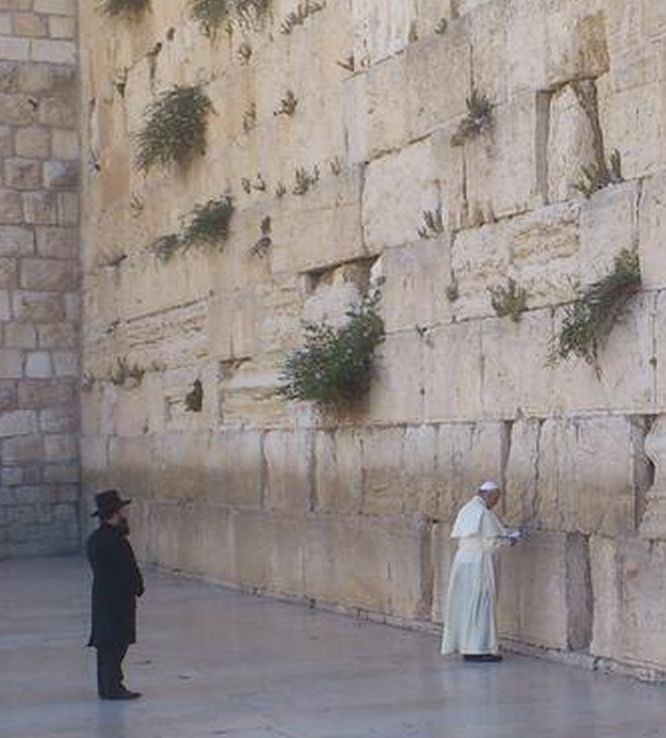
Pope Francis places note in Western Wall, sends message of tolerance at Temple Mount; pope calls for all religions to respect each other as “brothers and sisters” and “not to use violence in the name of God.”

pope high

Pope Francis laid a wreath at the tomb of Theodor Herzl before continuing on to the Yad Vashem Holocaust Memorial in Jerusalem on Monday. The pontiff is wrapping up his historic visit to the region with a message of peace and reconciliation between the three monotheistic faiths in the Holy Land.

Following his visit with the Grand Mufti of Jerusalem at the Temple Mount, Pope Francis continued on to the Western Wall where he was greeted by the Rabbi of the Western Wall, Shmuel Rabinovitch.

The pope was treated to a short history lesson about the First and Second Temples, which was followed by a short speech from Rabbi Rabinovitch on the importance of Jerusalem to the Jews.

Rabinovitch also spoke about the threat of anti-Semitism, making reference to the shooting in Brussels at the Jewish Museum on Saturday. Rabinovitch stressed that Jerusalem must be a city of peace for all nations.

The pope declined to speak at this event, but he approached the Wall, where he prayed for about 90 seconds before he placing a note inside.

Rabbi Avraham Skorka, a close friend of the pontiff who is accompanying him on this trip, told Channel 10 that Francis prayed “that the [West Bank] security barrier and that genuine peace will come.”

“The last time we spoke was last night,” Skorka said. “This isn’t an easy visit for him, and it included important acts and events with special significance.”

“Nonetheless, he’s content, calm, and he knows how to balance emotions and to be level-headed.”

Security at the Wall was tight, with hundreds of policemen standing guard, and helicopters and snipers keeping watch from above.

Pope Francis set the tone for the second day of his visit to Israel with a message of tolerance at the Temple Mount.

He called upon all those who identify with Abraham – Christians, Jews and Muslims – to respect one another as brothers and sisters.

“Let us learn how to understand the pain of others and no one will use violence in the name of God,” he said.

The pope was expected to visit Yad Vashem later on Monday, where he will shake the hands of six Holocaust survivors, each with a survival story relating to Christianity.

The pontiff toured the Temple Mount complex Monday morning before paying a visit to the Western Wall.

Francis also met Muslim communal leaders, among them the mufti of Jerusalem.

Off Topic: Pope Francis nods to Palestinian case with unscheduled visit to West Bank barrier

May 25, 2014

Pope Francis nods to Palestinian case with unscheduled visit to West Bank barrier, DEBKAfile, May 25, 2014

Abbas “forgot” to mention [to the Pope] that the barrier finally put an end to years of Palestinian suicidal terrorist outrages in Israeli towns, schools, markets and restaurants. These atrocities also targeted West Bank Christians, especially in Bethlehem, and accounted for their dwindling numbers.

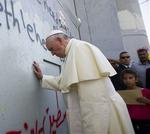
Ignoring this piece of history, the pope was persuaded to visit the West Bank barrier. He was also presented with a crucifix filled with stones from the “Wall.”

Pope_Francis_touches_the_wall_that_divides_Israel_25.5.14Pope Francis prays at West Bank security barrier in Bethlehem

Palestinian leader Mahmoud Abbas poured a litany of mostly unfounded anti-Israel grievances and propaganda in the ear of Pope Francis Sunday, May 25, taking advantage of his decision to visit Palestinian-controlled Bethlehem before spending a day in Israel. Abbas accused Israel of expelling Christians, complained about settlement construction and the plight of Palestinian prisoners and most of all, the “ugly wall” Israel had built.

Abbas “forgot” to mention that the barrier finally put an end to years of Palestinian suicidal terrorist outrages in Israeli towns, schools, markets and restaurants. These atrocities also targeted West Bank Christians, especially in Bethlehem, and accounted for their dwindling numbers.

Ignoring this piece of history, the pope was persuaded to visit the West Bank barrier. He was also presented with a crucifix filled with stones from the “Wall.”

Standing alongside Abbas, the pope delivered an even-handed statement, which called on “both sides to make sacrifices to create two states” and end the “unacceptable” Israeli-Palestinian stalemate.

He then conducted a Mass in Bethlehem’s Manger Square next to the Church of the Nativity, built over Jesus’ traditional birthplace, and was greeted by jubilant Palestinian Christians waving giant Palestinian and Vatican flags.

The Mass was superimposed by the muezzin’s call to prayer over a loudspeaker from a Bethlehem mosque. The Christian congregation reacted with whistles and stamped feet and the choir accompanying the Pope raised their voices higher.

In the official program, the Vatican referred to Abbas as the president of the State of Palestine.

Sunday afternoon, the head of the Catholic Church lands at Ben Gurion airport. Israeli President Shimon Peres will be on hand to welcome him before he is flown by helicopter to Mt Scopus for another welcoming ceremony.

His visit to Jerusalem, another religious and national minefield after the West Bank, will start Sunday evening with an ecumenical prayer service he is to conduct with the spiritual leader of the world’s Orthodox Christians at the Church of the Sepulcher, and heads of the various Christian churches and communities.

Francis has said that this encounter, marking the climax of his pilgrimage, falls on the 50th anniversary of a landmark meeting between Pope Paul VI and Ecumenical Patriarch Athenagoras, which ended nine centuries of Catholic-Orthodox estrangement.

He spends Monday in Israel, amid tight security for which thousands of police have been recruited.

The pope’s schedule includes a visit to Temple Mount and the Western Wall, Herzl’s Tomb and the Yad Vashem Holocaust Memorial Center.

It also includes a meeting on Temple Mount with the Grand Mufti of Jerusalem, Muhammad Ahmad Hussein, who is notorious for endorsing Jewish genocide.  In a Palestinian TV broadcast in 2012, Hussein declared: “The hour of [resurrection] will not come until you fight the Jews. The Jew will hide behind stones or trees. The stones or trees will call: ‘Oh Muslim, servant of Allah, there is a Jew behind me, come and kill him.’”

Not surprisingly, Muslim prayers on the mount are frequently the occasion for worshippers to hurl rocks at the Jews praying at the Western Wall below, an experience from which heavy Israeli police guards will be there to protect Pope Francis.

Israel has issued special visas for 23,000 Palestinians from the West Bank and 600 from the Gaza Strip to enter the country for the visit of Pope Francis Sunday and Monday.

The emotions inflamed by the visit were expressed early Sunday when a group of young Israelis barricaded themselves in the traditional Tomb of David on Mount Zion in Jerusalem. They were protesting reports that the building, whose upper floor is reputed to hold the Room of the Last Supper, would be presented to the Christian Church. Twenty-eight protesters were detained after attacking the police.

Netanyahu: Deadly Belgium attack result of anti-Israel incitement

May 25, 2014

Netanyahu: Deadly Belgium attack result of anti-Israel incitement | JPost | Israel News.

ADL says attack at Jewish museum in Brussels serves as reminder that anti-Semitism in Europe is still prevalent, must be taken seriously.
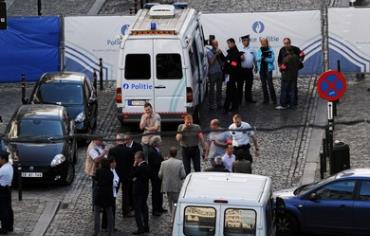
Brussels

Police personnel are seen at the site of a shooting in central Brussels, May 24, 2014. Photo: REUTERS

Prime Minister Benjamin Netanyahu condemned the shooting and killing of four people at the Jewish Museum in Brussels on Saturday.

He said he shares in the grief of the families of the victims. “This act of murder is the result of constant incitement against Jews and their state. Slander and lies against the State of Israel continue to be heard on European soil even as the crimes against humanity and acts of murder being perpetrated in our region are systematically ignored. Our response to this hypocrisy is to constantly state the truth, continue a relentless fight against terrorism and build up our strength,” the Prime Minister said.

Foreign Minister Avigdor Liberman blamed anti-Semitic and anti-Israeli incitement for inspiring the attack. Those who call for a boycott against Israel and those who act against Israel in international forums have contributed to this incitement, Liberman said.

“Recent anti-Semitic incidents in Kansas, Toulouse, and this evening in Brussels, should be a flashing warning signal to all those who cooperate with such incitement by rushing to condemn Israel and by comparing building a home for a Jewish family in the land of Israel with the cruel and murderous terrorist activity of anti-Semites,” Liberman said.

Justice Minister Tzipi Livni said Sunday that “every event against Jews in the world, such as the terror attack in Brussels, shocks us as Israelis – as it should.”

Writing on her Facebook page, Livni said, “The essence of Israel’s existence is to be a Jewish state in every sense of the word. But Israel is not just a safe place of refuge, we must also, in our values, represent the whole Jewish world.”

President Shimon Peres expressed his condolences on Sunday to a leader from the Jewish community of Brussels following a fatal shooting attack at a Jewish museum in the Belgian capital that left four dead on Saturday.

“We must act without hesitation against any form of anti-Semitism. The leaders of Europe should lead the struggle against anti-Semitism, which is rearing its head across the continent,” Peres in a phone conversation told told Maurice Sosnowski, president of the Coordinating Committee of Belgian Jewish Organizations.

“We are with you in this difficult time. We share your sense of shock and profound sadness,” he added.

The European Union’s foreign affairs chief Catherine Ashton condemned the attack, extending her sympathies to the families of the slain and calling for the perpetrators to be found.

“I condemn unreservedly the dreadful attack today at the Jewish Museum in Brussels. I send
my condolences to the families of the victims and express my solidarity with the Belgian
authorities and the Jewish community,” she said.

“Everything possible must be done to find those who carried out this attack. There must be no
impunity for terrorism,” Ashton added.

The Anti-Defamation League (ADL) also condemned the deadly attack, saying they were “horrified and deeply saddened” by the event.

Abraham H. Foxman, ADL National Director, said that “while violence against Jews in Belgium is extremely rare, the attack on the Brussels Jewish Museum is another tragic reminder of the frightening atmosphere for Jews in parts of Europe.”

Four people were killed at a Jewish museum in Belgium on Saturday in an attack that European Jewish leaders are already comparing to 2012’s massacre at the Ozar HaTorah school in Toulouse, France.

The attack, which took place at the Jewish Museum in central Brussels on Saturday, is being approached as racially motivated by Belgian authorities, who posited that it was motivated by anti-Semitism.

Belgium’s interior minister, Joëlle Milquet, was quoted saying by the RTBF Belgian television station that anti-Semitic motives could be behind the attack.

“It’s a shooting … at the Jewish Museum,” she was quoted as saying. “All of this can lead to suspicions of an act of anti-Semitism.”

Brussels Mayor Yvan Mayeur told the BBC that the shooting was likely a terror attack and that the choice of location “isn’t a coincidence.”

About half of Belgium’s 42,000-strong Jewish community lives in Brussels.

A spokesman for the Brussels fire brigade said the shooter drove up to the museum, went inside and fired shots.

“According to the information we have at the moment, it was a solitary shooter and it seems to have happened inside the museum,” Pierre Meys, Brussels fire brigade spokesman, told French channel BFM TV.

Security around all Jewish institutions in the country has been raised to the highest level, and Prime Minister Elio Di Rupo was meeting with police and senior officials to discuss the situation.

According to the European Jewish Congress, a crisis center organized by the Consistoire Central and the Coordinating Committee of Belgian Jewish Organizations (CCOJB) along with other communal leaders has opened and is in contact with local and national authorities.

Speaking with the Jerusalem Post, Consistoire head Baron Julien Klener said that he had met with the Prime Minister Elio Di Rupo and other senior officials and that authorities are “trying to find the suspects.”

Maurice Sosnowski, president of the CCOJB, compared the incident to the 2012 shooting of four Jews in a school in France by an Qaeda-inspired gunman, Mohamed Merah.

“This really reminds of what you experienced in France with Mr. Merah attacking a Jewish school,” he was quoted saying by BFM TV. “This is appalling. I would never have imagined something like that happening in Brussels.”

He said no threats have been issued to the Jewish community.

European and international Jewish organizations were quick to compare the two assaults.

“Two years after Toulouse, and on the eve of the European elections, this despicable attack is yet another terrible reminder of the kind of threats Europe’s Jews are currently facing,” World Jewish Congress President Ronald Lauder said in a statement shortly after the shooting. The attack was “clearly was targeted at Jews.”

“Tomorrow, we must all work together to ensure that this doesn’t happen again. If that means to improve security at Jewish sites in Europe, we have no choice. It must be done. If not, more people may be able to carry out such terrible crimes,” he added.

According to EJC President Dr. Moshe Kantor, while details of the attack are still lacking, it is clear that it is indicative of a “permanent threat to Jewish targets in Belgium and across the whole of Europe.”

“This is once again, much like the savage murders in Toulouse, a clear example of where hate and anti-Semitism leads. European government must send out a clear message of zero tolerance towards any manifestation of anti-Semitism.”

Kantor recently made waves by stating that without a significant reduction in the fear and insecurity plaguing European Jewry, normative Jewish life on the continent is “unsustainable.”

“Incidents such as this do not occur in a vacuum, and are the direct result of a systematic culture of hate and anti-Semitism against the Jewish community and the State of Israel in so many parts of Europe, including Belgium,” the Israeli Jewish Congress asserted.

A spokesman for the organization pointed out that according to a recent Anti-Defamation League Study, 27 percent of Belgians harbor anti-Semitic sentiments.

According to the ADL, Belgium comes in as the sixty third most anti-Semitic country out of one hundred territories polled around the world.

The shooting comes less than a day before polls open across Europe for elections to the European Union Parliament, with parties on the hard right expected to gain a significant plurality, though far from a majority, of mandates.
Two of the Brussels shooting victims confirmed Israeli citizens

May 25, 2014

Two of the Brussels shooting victims confirmed Israeli citizens – Israel News, Ynetnews.

The couple, tourists in their 50s from Tel Aviv, were not carrying any identifying documents; a fourth victim died of his wounds overnight.

Lior Zilberstein, Itamar Eichner

Published: 05.25.14, 08:03 / Israel News

Two of the four people killed in the shooting at the Brussels Jewish Museum Saturday were an Israeli couple in their 50s, the Foreign Ministry said overnight.

The two were not carrying any personal documents with them, so it took hours to identify them.

The other two killed were employees at the museum. One of the casualties suffered critical wounds to the face and neck and passed away from his wounds overnight.

Following the shooting, Belgium’s interior minister, Joelle Milquet, said Saturday night that anti-terror measures had immediately been heightened around all Jewish institutions in the country as a precaution.

“We decided to apply to a maximum level of protection to Jewish sites,” she said.

Ine Van Wymersch, a spokeswoman for Brussels prosecutors office, said there was no clear information about the perpetrator, although a fire brigade official said earlier that a man drew up to the museum in an Audi, exited the car and opened fire. He then reportedly reentered the car and fled the scene.

Milquet told reporters that the shooter apparently parked a car outside before entering the Jewish Museum. She added the gunman “apparently fired rather quickly, went outside and left.”

The president of one of the Jewish organizations in Belgium told Ynet that the entrance to the museum, where the shooting occurred, did not have a security guard.

“Regarding the motive, we have little information. Everything is possible,” Van Wymersch told a news conference.

“We know that the location, the Jewish Museum in Brussels, makes one think of it being an anti-Semitic attack, but we do not have enough to confirm this is the case.”

A source claimed the police will likely deem the incident anti-Semitic Sunday.

(Photo: EPA)

(Photo: EPA)

Van Wymersch said one suspect was detained after he drove away from the museum around the time of the attack.

“One person was seen leaving the scene of the crime and entering a car. We identified him and arrested him. We still don’t know if he is directly linked to the attack,” she said.

A second person being sought for questioning left the area on foot. Van Wymersch added security camera footage was being studied to try to identify the person.

Belgian Prime Minister Elio Di Rupo held a press conference on Saturday, condemning the attack: “All Belgians are united against the heinous crime at the Jewish Museum.”

Belgian Prime Minister Elio Di Rupo at the scene of the shooting (Photo: AFP)

‘Anti-Semitic attack’

The head of the Jewish community in Belgium, Julian Kllener, told Ynet: “The entire Jewish community is in shock. We did not get any special warnings from the police and the attack caught us by surprise. The Jewish community is in good standing with everyone, even the Muslim community.”

Prime Minister Benjamin Netanyahu commented on the shooting, saying it was the result of “of endless incitement against Jews and their state.”

“Slander and lies against the State of Israel continue to be heard on European soil even as the crimes against humanity and acts of murder being perpetrated in our region are systematically ignored. Our response to this hypocrisy is to constantly state the truth, continue a relentless fight against terrorism and build up our strength,” Netanyahu said.

(Photo: EPA)

(Photo: EPA)

Belgian Foreign Minister Didier Reynders, who was in the vicinity, said the scene “was terrible and left me shocked” as he saw the bodies of two of the victims lying at the entrance of the museum, located in the swanky Sablon neighborhood of Belgium’s capital.

Reynders said that “you cannot help to think that when we see a Jewish museum, you think of an anti-Semitic act. But the investigation will have to show the causes.”

European Jewish Congress President Moshe Kantor said that, even though it has yet to be established whether the attack was anti-Semitic, “we are acutely aware of the permanent threat to Jewish targets in Belgium and across the whole of Europe.”

“European governments must send out a clear message of zero tolerance toward any manifestation of anti-Semitism,” Kantor said in a statement.

(Photo: Reuters)

(Photo: Reuters)

The attack, which took place shortly before 4 pm, occurred in the Sablon area, which was hosting a three-day jazz festival and is usually clogged with tourists and shoppers on weekends. It has cobblestone streets with numerous antique shops, trendy cafes and museums, including the Jewish Museum.

Viviane Teitelbaum, a member of the Brussels legislature, said anti-Semitic attacks reached a peak in the early 1980s but had dropped off, but she noted a recent rise in anti-Jewish sentiment.

“It has been a very difficult place to live” for Jews, she said, adding that many young people are leaving the country. She said some 42,000 Jews live in Belgium, half of whom reside in Brussels.

Simone Susskind, another Brussels politician, said the museum has been at its current site for around a decade, after moving from an old synagogue in southern Brussels. She said her late husband David was a driving force behind the museum’s creation, believing that as home of the European Union and self-proclaimed “capital of Europe,” Brussels needed a museum to recount the history of Belgium’s Jewish community.

(Photo: AP)
(Photo: AP)

In neighboring France, President Francois Hollande condemned the “horrifying killings with the greatest force.” In a statement, he expressed France’s solidarity with Belgium and offered condolences to the families of the victims.

Jewish community officials drew parallels between the shooting and the 2012 killing of four Jews in a school in France by an al-Qaeda-inspired gunman, Mohamed Merah.

“This really reminds of what you experienced in France with Mr. Merah attacking a Jewish school,” Maurice Sosnowski, president of the Coordinating Committee of Belgian Jewish Organizations, was quoted saying by BFM TV.

“This is appalling. I would never have imagined something like that happening in Brussels.”

World Jewish Congress President Ronald S. Lauder urged Belgian authorities to protect Jewish sites in the country.

“Two years after Toulouse…this despicable attack is yet another terrible reminder of the kind of threats Europe’s Jews are currently facing.”

Reuters, the Associated Press, Itay Blumental, Attila Somfalvi and Moran Azulay contributed to this report.

Stung By Criticism, Obama Preps Sweeping Defense Of His Foreign Policy Approach

May 25, 2014

Stung By Criticism, Obama Preps Sweeping Defense Of His Foreign Policy Approach.

Posted: 05/24/2014 4:56 pm EDT Updated: 37 minutes ago

OBAMA


(Adds details about Syria)

By Steve Holland

WASHINGTON, May 24 (Reuters) – Stung by criticism, President Barack Obama will use a speech on Wednesday to launch a sweeping defense of his approach to foreign policy, one that he will say is reliant on multilateral diplomacy instead of military interventions.

Obama is to deliver the commencement address at the U.S. Military Academy at West Point, New York, the first in a series of speeches that he and top advisers will use to explain U.S. foreign policy in the aftermath of conflicts in Iraq and Afghanistan and lay out a broad vision for the rest of his presidency.

The president has come under withering fire in recent months for what his critics say is a passive approach to foreign policy, one that has allowed Russian President Vladimir Putin to flex his muscle in Ukraine, and left the Syrian civil war to fester and China to threaten its neighbors in the South China Sea.

Shortly after a trip to Asia late in April during which he strongly defended his incremental approach, he directed aides to frame a speech to explain his foreign policy and how he plans to handle world hot spots during his remaining two-and-a-half years in office.

“You will hear the president discuss how the United States will use all the tools in our arsenal without over-reaching,” a White House official said on Saturday. “He will lay out why the right policy is one that is both interventionist and internationalist, but not isolationist or unilateral.”

Obama, determined not to repeat what he views as the mistakes of his Republican predecessor, George W. Bush – U.S. involvement in wars in Iraq and Afghanistan – has leaned heavily on diplomatic activity instead of military force.

In the case of Ukraine, he has ordered sanctions against some of Putin’s inner circle and businesses associated with the Kremlin power structure but has made clear he will not threaten military force for Moscow’s seizure of Crimea.

The fear among some in Washington is that Obama’s handling of Russia will prompt China to flex its muscles in the South China Sea, where tensions have already been rising over such actions as the placement of a Chinese oil rig in waters claimed by Vietnam.

On Syria, Obama backed away from a threat to use military force over the use of chemical weapons against Syrian civilians by the Syrian government. While a deal struck with Russia is leading to the disarming of Syria’s chemical weapons stockpile, the three-year-old Syrian civil war rages on and President Bashar al-Assad remains in power.

Obama will emphasize that Syria remains a counter-terrorism threat as a haven for militant groups. U.S. officials have debated whether to supply heavier weapons and increase covert aid to Syrian rebels.

“We do see Syria as a counter-terrorism challenge. However, the right policy approach continues to be strengthening the moderate opposition, which offers an alternative to both the brutal Assad regime, and the more extremist elements within the opposition,” the White House official said.

The official said Obama will say the United States is the only nation capable of galvanizing global action and why “we need to put that to use in an international system that is sustainable and enduring, and that can address challenges from traditional ones, like maritime and trade issues, to emerging ones, like climate change.”

(Reporting By Steve Holland; Editing by Steve Orlofsky)