Archive for May 2014

News Bulletin: Obama Believes He’s Too Good for Us

May 6, 2014

News Bulletin: Obama Believes He’s Too Good for Us, Commentary Magazine, May 6, 2014

How hard life must be for The One We’ve Been Waiting For, who must travel in this fallen world, amongst mortal man, tolerating such folly and failure? It’s little wonder that Mr. Obama, whom top aides referred to in the 2008 campaign as the “Black Jesus,” is disappointed in the world.

The president thinks we have failed him. In reality, he has failed us

Poor Barack Obama.

According to David Remnick, a biographer of the president and the editor of the New Yorker, “The profile [of President Obama] that I published in the New Yorker was somebody that eerily, eerily seemed to be claiming himself–it was a sense of not giving up, but of deep frustration–that was the profile that I published in the New Yorker. Somebody frustrated and disappointed.”

Remnick went on to add, “And that’s what’s frustrating to me sometimes about Obama is that the world seems to disappoint him. Republicans disappoint him, Bashar al-Assad disappoints him, Putin as well.” (H/T: the Weekly Standard.)

How hard life must be for The One We’ve Been Waiting For, who must travel in this fallen world, amongst mortal man, tolerating such folly and failure? It’s little wonder that Mr. Obama, whom top aides referred to in the 2008 campaign as the “Black Jesus,” is disappointed in the world.

But in return consider this: Think about how disappointed the world must be in Barack Obama. The man who promised to slow the rise of the oceans, heal the planet, and end a politics that breeds division and conflict and cynicism–who promised us new beginnings and hope and change–has overseen an increasingly disordered and chaotic world, enemies who are emboldened and allies who are alienated, the worst economic recovery on record, startling failures plaguing his signature domestic achievement, a record number of Americans on food stamps and in poverty, a widening gap in income inequality, and a riven and polarized political culture.

These are the hallmarks of a failed presidency. And the president and his courtiers are already settling on their explanation: Barack Obama was simply too good for the world.

The president thinks we have failed him. In reality, he has failed us.

Rand Paul’s support for Israel

May 6, 2014

Our World: Rand Paul’s support for Israel | JPost | Israel News.

By CAROLINE B. GLICK

05/06/2014 10:26

The hard truth is that while American isolationism is bad for the US, it isn’t necessarily bad for Israel.

Rand Paul

US Senator Rand Paul (R – Kentucky) Photo: REUTERS

Republican Senator Rand Paul is an isolationist. This ought to make him a natural ally for appeasers like Steve Walt and John Mearshimer and the whole blame Israel first crowd.

And indeed, he has taken positions, like opposing additional sanctions on Iran that placed him in their camp.

But Paul is a mixed bag.

Last week, following the PLO’s unity deal with terrorist groups Hamas and Islamic Jihad, Paul introduced the Stand With Israel Act. If it had passed into law, Paul’s act would have required the US to cut off all funding to the Palestinian Authority, including its security forces. The only way the administration could have wiggled out of the aid cutoff would have been by certifying that the PLO, Hamas and Islamic Jihad had effectively stopped being the PLO, Hamas and Islamic Jihad.

Paul’s conditions for maintaining aid would have required the President to certify to Congress that the PA – run jointly by Hamas, Islamic Jihad and the PLO –formally and publicly recognized Israel as a Jewish state; renounced terrorism; purged all individuals with terrorist ties from its security services; terminated all anti-American and anti-Israel incitement, publicly pledged not to engage in war with Israel; and honored previous agreements signed between the PLO and Israel.

Paul’s bill was good for America. Maintaining financial support for the Palestinian Authority in the aftermath of the PLO’s unity-with-terrorists deal constitutes a breach of US anti-terror law.

Financing the PA also harms US national security. Hamas and Islamic Jihad are financed by Iran. So by funding the PLO’s PA, which just united its forces with theirs, the US is subsidizing Iran’s terror network.

Ending US financing of the PA would certainly be good for Israel. Indeed, just by sponsoring the bill Paul has helped Israel in two critical ways. He offered Israel friendship, and he began a process of changing the mendacious narrative about the nature of the Palestinian conflict with Israel to one based on the truth.

By extending his hand to Israel, Paul gave Israel an opening to build relationships with political forces with which it has not traditionally had close ties. Because most of Israel’s supporters in Washington support an interventionist US foreign policy, isolationists like Paul have generally either stood on the sidelines of the debate, or in light of their desire to beat a quick retreat from the region, they have been willing, even happy to support the Arabs against Israel and blame Israel’s supporters for getting the US involved in the Middle East.

The hard truth is that while American isolationism is bad for the US, it isn’t necessarily bad for Israel. To date, under Democratic and Republican administrations alike, there has been a direct correlation between the level of US involvement in Israel’s affairs and US hostility towards Israel.

Paul’s pro-Israel detractors note that he also supports cutting off US military aid to Israel. But that doesn’t necessarily make him anti-Israel.

Despite the protestations of AIPAC and other pro-Israel groups, it is far from clear that Israel would be worse off if it stopped receiving US aid. Indeed, it is likely that Israel’s economy and military strength would both be enhanced by the strategic independence that an aid cut-off would bring about.

Yes, Paul is a complicated character. But that doesn’t make him Israel’s enemy. His bill was an act of friendship. And Israel can use more friends in Washington who actually do things that help it rather than suffice with declaring their support for Israel while standing by as its reputation is trashed.

And that’s the thing of it. The Obama administration can’t stop trash talking Israel. And more than ever before, Israel needs allies who are willing to take real action to defend it.

Israel received yet another reminder of this basic fact last Friday when Yedioth Aharonoth’s senior writer Nahum Barnea published an interview with unnamed “senior American officials” involved in the Israeli-Palestinian negotiations. Those “officials,” it quickly became apparent, turned out to be the one and only Martin Indyk, Secretary of State John Kerry’s senior mediator.

In that interview, Indyk showed that among members of the Obama administration, Israel is friendless. Indyk’s interview, like serial anti-Israel statements made by Kerry, (most recently his anti-Semitic “Israel apartheid” remarks to the Trilateral Commission), and by President Barack Obama himself, was notable for its utter hostility to Israel and its Jewish leaders.

Not only did Indyk blame Israel for the failure of Kerry’s “peace process.” Like Obama and Kerry, Indyk insisted that Israel’s failure to bow to every PLO demand has opened it to the prospect of a renewed Palestinian terror war against it, to international isolation and to European trade embargoes.

Like Kerry, Indyk casually employed anti-Semitic stereotypes about Jewish cleverness and greed.

From the perspective of continued US aid to the PA, by far the most important part of Indyk’s remarks, like those that Kerry made to the Trilateral Commission, was his claim that the Palestinians will likely respond to the failure of Kerry’s peacemaking by initiating another terror war against Israel.

Indyk’s assertion – or was it a threat? – was notable because the US government is training and financing the Palestinian forces that would be directing the terror war.

Since 2007, the US has spent billions of dollars financing and training Palestinian security services and transforming them into a professional military. Trained using US doctrine, they are the strongest military force the Palestinians have ever fielded against Israel.

These forces – commanded by Abbas – share his supportive view of the terrorist mass murder of Jews. They share his position that Israel has no right to exist, that Jews have no history and are not a nation.

Since 1996, every Palestinian terror campaign has been directed by these security services. And as US Lt. Gen. Keith Dayton, who served as the first commander of the US training mission has stated publicly, these US trained forces can be expected to turn their guns at Israel.

While the PLO was competing with Hamas for leadership, Abbas deployed these US trained forces against Hamas. Now that the PLO and Hamas are unified, these operations will necessarily end.

Moreover, these US trained forces are already involved in terrorism. Over the past six months, IDF commanders have repeatedly pointed fingers at PA security forces claiming that the steep rise in terrorist attacks against Israelis in Judea and Samaria is being organized and directed by them.

This is brings us to the second reason why Paul’s initiative is so important. While it is important for Israel to find new friends in Washington, it is even more important for it to change the narrative about the Palestinians and their conflict with Israel.

The false narrative, which claims that the PLO is moderate and that Mahmoud Abbas is a statesman and a man of peace, has made Israel’s old friends in Washington unable to understand reality. So unlike Paul, these friends are incapable of taking actions that actually advance Israel’s interests and strengthen its alliance with the US.

The false narrative of PLO moderation has monopolized the discourse on the Palestinians to the point where adherence to the two-state policy has more in common with a religious faith than a policy preference.

Indyk’s hysterical assault on Israel is textbook behavior of a believer lashing out at a person who exposes the utter falsity of his faith.

The believer cannot disown his phony messiah. So his only option is to present the party that unmasked the lie as the devil.

Hence, Indyk’s vulgar assault on Israelis.

But while Indyk’s faith is fanatical, many others share it in more moderate, but still devastating forms. And they too lash out at anyone who exposes their irrationality.

Case in point is the pro-Israel community’s opposition to Paul’s bill.

The day after Paul introduced his bill, AIPAC came out against it. AIPAC opposed the bill, according to the Washington Post’s Jennifer Rubin, (who herself violently opposed it), because its leadership believes that the PA security forces play a key role in fighting Hamas.

So a week after the Israeli government formally ended negotiations because the PA supports terror, AIPAC opposed ending US aid to the PA because, AIPAC claimed, it fights terror.

For her part, Rubin railed against Paul’s initiative claiming that it was “a phony pro-Israel bill.”

Paul submitted his bill for unanimous consent in order to fast track it to a vote and into law. AIPAC convinced some senators to vote against Paul’s bill, and so killed it.

In an interview with Newsmax’s Steve Maltzberg after the vote, Paul attacked AIPAC saying, “I think the American people, if they knew that [AIPAC opposed his bill], would be very, very upset and think, you know what, those people are no longer lobbying in favor of America and Israel if they’re not willing to put restrictions on aid to Palestine.”

In other words, Paul was saying, it is time to move on, and those who insist on acting as though nothing has changed since 1994 are not behaving as one would expect Israel’s friends to behave.

And he is right.

Paul may be a cynical opportunist. But that’s better than a messianic that prefers to believe that Israel is the devil than accept that the Peace Fairy doesn’t exist.

And yes, his refreshing embrace of the truth as the basis for US policymaking makes him a better friend to Israel today than AIPAC that refuses to accept the truth, (and like him, failed to support additional sanctions against Iran).

Rand Paul told Fox News after his bill failed to pass that he will not abandon the fight against US aid to the PA. We must hope that he is true to his word.

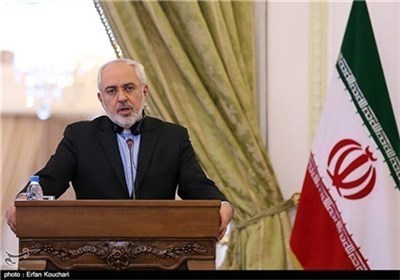
FM: Iran to Prevent Zionist Attempts at Spreading Iranophobia

May 6, 2014

FM: Iran to Prevent Zionist Attempts at Spreading Iranophobia, Tasnim News Agency (Iranian), May 6, 2014

(As right left thinking people know, Iran is a bastion of truth, peace and brotherhood like Fatah and Hamas. — DM)

Iranian Foreign Minister

“ill-wishers of the Iranian nation” have mounted a massive propaganda campaign to represent Iran as a global threat in order to achieve their vicious objectives against the Iranian nation and the regional revolutionary nations and anti-Israel resistance front.

Iranian foreign minister underlined that Tehran will never allow the Zionist regime of Israel to instigate Iranophobia in the world under the pretext that Iran is denying the Holocaust.

In an address to an open session of the Iranian parliament on Tuesday, Mohammad Javad Zarif lashed out at the Israeli regime for its propaganda campaign to demonize the Islamic Republic.

“Iran is an independent, mighty and stable country, but widespread propaganda and political activities are underway to portray Iran as a threat to the region and the global peace and security,” he explained.

He stated that “ill-wishers of the Iranian nation” have mounted a massive propaganda campaign to represent Iran as a global threat in order to achieve their vicious objectives against the Iranian nation and the regional revolutionary nations and anti-Israel resistance front.

Zarif made it clear that Tel Aviv seeks to provoke anti-Iran sentiments by resorting to the unsubstantiated claim that Tehran denies the Holocaust.

“(Israeli Prime Minister) Netanyahu shamelessly raises hue and cry that Iran is denying the Holocaust and says that Holocaust-denying Iran is after creating another Holocaust by producing an atomic bomb,” he noted.

Zarif also pledged that during his term as Iran’s foreign minister he will continue efforts to counter the Zionist-fomented misgivings about Iran’s denial of the Holocaust .

The foreign ministry will not allow the Zionists’ propaganda machine to portray Israel as a victim and to instill fear for Iran, Zarif stressed.

In September 2013, Foreign Minister Zarif had announced that Tehran condemns killing of Jews by Nazis but at the same time stressed that the Holocaust has become a pretext for Zionists to violate the rights of Palestinian nation.

Speaking to Tasnim News Agency at the time, Zarif stated that Iran always condemns any kind of massacre of mankind.

“We condemn killing of Jews by Nazis, in the very same way that we condemn massacre and suppression of Palestinians by Zionists.”

He stated that Iran will not allow Zionists to take advantage of the Holocaust for hiding their crimes, and added, “The Holocaust crime turned into a pretext which Zionists used 60 years ago to portray themselves as victims and provoke sympathy in the world in a bid to plunder the rights of Palestinian nation.”

The Incredible Shrinking Man

May 6, 2014

Belmont Club » The Incredible Shrinking Man.

May 5th, 2014 – 4:32 pm

It’s the day after the White House Correspondent’s extravaganza and Washington wakes up to its dismally shrunken state. The New York Times describes president Obama’s unsuccessful attempt to kiss and make up with Angela Merkel.

President Obama tried to mend fences with Chancellor Angela Merkel of Germany on Friday, calling her “one of my closest friends on the world stage.” But Ms. Merkel replied tartly that Germany still had significant differences with the United States over surveillance practices and that it was too soon to return to “business as usual.”

The crisis in the Ukraine is reported as a silver lining because of the power of shared danger to bring Germany and the US closer together again. “Some experts on Germany said the Ukraine crisis could give Mr. Obama and Ms. Merkel the foundation to rebuild their relationship, reminding them that despite the suspicion generated by the surveillance disclosures, their countries still have much in common.”

It’s just like the movies where Angela forgives Barack because he must save her from the menacing Putin, who has just entered the cave with a Tokarev in his hand. But if shared danger is the secret to romance then president Obama isn’t taking advantage of it. Instead, he’s hiding it.

The Daily Beast says “the Obama administration is seeking to hide the fact that North Korea possesses nuclear missile warheads, according to a report by Mark Schneider, a former Pentagon strategic analyst and director for forces policy at the office of the secretary of defense.”

According to the report, the Obama administration has sought to hide the alarming intelligence because it undermines efforts to eliminate nuclear weapons.Administration spokesmen sought to “walk back” the unwelcome intelligence of nuclear missile warheads with officials asserting that the nuclear strike capability is limited or untested.Defense Secretary Chuck Hagel, a proponent of the leftist “global zero” anti-nuclear initiative, said the same day that the intelligence was made public that neither Iran nor North Korea is capable of attacking the United States with nuclear weapons.


Israel should be flinging itself into Obama’s arms since it is being told that the coming agreement with Iran will have certain imperfections. “Some former U.S. officials and issue experts say Israel appears to have accepted Iran being allowed some degree of nuclear capability, Al-Monitor reports.”

Al-Monitor cites one former U.S. official who participated in consultations with Israel last month as saying officials there seem to “understand that there is a need for a domestic, indigenous civil nuclear program” if the Iranians are to satisfy their domestic opposition. Jerusalem officials instead have turned their attention to potential problems involved in policing any nuclear deal between Tehran and the the five permanent members of the U.N. Security Council plus Germany, the so-called “P-5+1″ group. …In addition, the U.S. insiders report Israel is concerned that any Iranian violations of a nuclear deal would be so gradual and slow that Washington would find it hard to identify a point in time when action is warranted.

“Some degree of nuclear capability” may result in Israel being somewhat nuked. Elliot Abrams at the Weekly Standard says Israel is getting ready for a bad Iran deal. Perhaps the deal will be similar to the one which disarmed Syria. Some Western analysts believe that despite the deal, it has a secret chemical arsenal, having surrendered one while keeping another.

Concerns are growing among Western intelligence services that Syria still has a significant and undeclared arsenal of chemical weapons, including crude chlorine-filled bombs, secret stockpiles of sophisticated nerve gasses or their components—and the scientific know-how to rebuild a larger-scale, higher-grade chemical weapons effort once the Bashar al-Assad regime has escaped the international spotlight. …To be sure, the deadly and publicly-declared chemical arsenal that Assad had a year ago, that allegedly was used to kill hundreds of people in August, and that he agreed to destroy in September under threat of an American attack is “no longer in existence” … but the inspectors are only commenting on the chemical arsenal Assad admitted he had. There’s mounting concern that the Syrian regime may have a second unconventional weapons program—one Assad never told the international community about.

If danger is the spice of life there’s plenty to come out of Southwest Asia.  The Daily Beast says “the CIA is dismantling its frontline Afghan counterterrorist forces in south and east Afghanistan, leaving a security vacuum that U.S. commanders fear the Taliban and al Qaeda will fill—and leaving the Pakistan border open to a possible deluge of fighters and weapons.”

These CIA teams are the actual “sword” against al-Qaeda; the men who come in the night to take them out. For security they relied on the “shield” us US conventional forces: “it relies on the U.S. military for protection and logistical support—especially at its far-flung bases in south and east Afghanistan. Just months ago, the talk in administration circles was that these paramilitaries would be significantly expanded in the near future. Now, it appears, the opposite is taking place.”

Now that the shield is being lowered then must the sword be sheathed. No sword and no shield means gone.

The CIA started recruiting and training these Afghan paramilitary groups only months after the intelligence agency first entered the country in 2001 ahead of invading U.S. troops, according to current and former U.S. and Afghan officials. They described the top-secret force in detail on condition of anonymity because they were not authorized to speak publicly. …The Khost and Kunar-based units “are instrumental in blocking the Haqqani/al Qaeda mix that are responsible for spectacular attacks,” said one senior U.S. military official. “It’s not clear what will happen to either unit; there is no plan so far to absorb them.”

Soon after the CIA shuts down its al-Qaeda hunting teams the terrorist group Obama declared dead will probably make a zombie-like recovery from its historical grave.

Rather than being driven into Obama’s arms by danger, Japan appears to have concluded it is better to rely on itself. The Military Times reports that Japan is in a political debate over whether to amend its constitution to remove restrictions on its military.

Abe advocates a “breakaway from the postwar regime” as a way to overcome the humiliation as well as the education system, social values and historical views set by the occupation.A 2012 draft revision proposed by the Liberal Democrats promotes a conformist Japan with traditional patriarchal values, which place family units above individuals and elevate the emperor to a head of state. Civil liberties such as freedom of speech and expression can be restricted if considered harmful to public interest, according to the draft.“Our goal is to write a new constitution of our own that envisions a new era and serves a new role,” Yasuhiro Nakasone, a 96-year-old former prime minister who heads a group of lawmakers campaigning for a revision, said last week at a Tokyo gathering attended by hundreds of lawmakers, supporters and business lobbies.

Tokyo will go it alone. Maybe not today or tomorrow, but soon and for keeps. And so perhaps will Berlin. Angela Merkel’s insistence on curbing the NSA as a condition for cooperating with Obama may be aimed at freeing Germany from the fear of betrayal by the White House.  Merkel doesn’t fear a powerful American intelligence apparatus per se;  she just fears one in Obama’s romantic hands.

The president has shrunk himself. Too bad he shrank America along with it.

An Iranian stealth submarine sinks before targeting a mock US carrier in an a naval exercise

May 6, 2014

An Iranian stealth submarine sinks before targeting a mock US carrier in an a naval exercise, DEBKAfile, May 6, 2014

The Iranians drew a tight veil of secrecy over the accident, curtailing the search for the estimated 10 crewmen to avoid drawing the notice of US or other intelligence agencies in the region.

Chinese and Russian teams secretly enlisted to help search for the sunken mini-submarine, quickly abandoned it saying that none of the crew could have survived. It was up to Iran to decide, they said, whether to continue the search at the risk of exposing its plans for sinking US carriers in a war contingency. So long as the sub stayed on the bottom, its stealth technology would make it hard for Western intelligence to locate it.

Ghadir_Class_sunk_4.14Iranian Ghadir-class mini-submarine

A new Iranian Ghadir-class stealth mini-submarine, home-built with Chinese technology, recently sank near the Strait of Hormuz, while preparing for a Revolutionary Guards naval exercise to practice sinking or disabling a mock-up US aircraft carrier, DEBKAfile’s military and intelligence sources report exclusively.

The sub was launched just a year ago.

The Iranians drew a tight veil of secrecy over the accident, curtailing the search for the estimated 10 crewmen to avoid drawing the notice of US or other intelligence agencies in the region.

Chinese and Russian teams secretly enlisted to help search for the sunken mini-submarine, quickly abandoned it saying that none of the crew could have survived. It was up to Iran to decide, they said, whether to continue the search at the risk of exposing its plans for sinking US carriers in a war contingency. So long as the sub stayed on the bottom, its stealth technology would make it hard for Western intelligence to locate it.

The ill-fated submarine was to have shown its paces by striking a replica of the USS Nimitz aircraft carrier Iran had built at the Bandar Abbas naval base.

The replica was spotted by US satellites. Challenged for an explanation, the Iranians first tried claiming it was to be used in a film documenting the naval forces present in the Persian Gulf.

But then on April 27, the Navy Commander Rear Adm. Ali Fadavi gave the game a way by saying: “Iranian forces should target the carrier in the trainings. We should learn about the weaknesses and strengths of our enemy.”

On May 6, Adm. Fadavi made a more warlike statement that clearly defined “the enemy” when he said: “They [Americans] know nothing. We have been making and sinking replicas of US destroyers, frigates and warships for long years, and we have sunk the replica of their vessels in 50 seconds through a series of operational measures.”

The semi-official Fars agency quoted him as saying also: “Destroying the US navy remains one of the top operational goals of the Tehran forces. If war with the United States breaks out, the Iranians will attack American aircraft carriers in the Persian Gulf, their size making them easy to target.”

Tehran assumed its aggressive face the day before US National Security Adviser Susan Rice and senior US nuclear negotiator Wendy Sherman were due in Israel to persuade Prime Minister Binyamin Netanyahu to live with the comprehensive nuclear accord shortly to be signed with Iran by the six world powers. They will also demand an Israel guarantee not to attack Iran’s nuclear facilities, although the prime minister made this threat on Holocaust Day on April 27.

The Iranian navy chief’s words were a message to Washington that if Netanyahu does engage in military action against Iran, the American fleet will be at risk.

Iran’s military planners had assigned the new Ghadir-class mini-submarines the task of an attack to bring the US navy fleet, especially the carriers, to a halt – easy prey for a thousand IRGC torpedo boats armed with sea-to-sea missiles to strike the stationary vessels from all directions.

Iranian naval experts count on sinking a carrier or leaving it too crippled to move to safety and forced to call on US bases in Qatar, Kuwait, Oman and Yemen for air cover.

Adm. Fadavi’s words, placing “destroying the US navy” among the operational goals of the Tehran forces” were meant to deter the US and Israel against military action.

DEBKAfile’s military sources reveal that IRGC chiefs are also looking at ways of disabling US warships in the Mediterranean, to put them out of action for a second-strike attack on the Lebanese Hizballah by missiles or for sending bombers over Iran.

Not all Western naval experts agree on Tehran’s objectives or capabilities. Some discount the Iran’s speedboats’ ability to carry more than one sea-to-sea rocket – or two at most. And the US helicopters taking off from the targeted warship or ground bases would soon be able to sink them.

Iranian forces recently tested the option of arming the explosive speedboat’s crews with shoulder-carried anti-helicopter rockets, but gave up after 10 boats tipped over during the test.

The Revolutionary Guards Corps has a fleet of 10,000 small boats which are capable of great speed but easily overbalance.

If the US or Israel do decide to strike Iran’s nuclear facilities, the anchorages of these boats would be among their first targets. Each of these anchorages, which are strung along the Iranian Persian Gulf coast, houses around 100 boats.

US denies report that peace team has been dismantled

May 6, 2014

US denies report that peace team has been dismantled, Times of Israel, May 6, 2014

(And so the “peace process” goes on and on. Where it may land nobody knows. Perhaps in a Nobel Process Prize for Secretary Kerry? — DM)

State Department says officials will be traveling back to the region ‘soon,’ Kerry may release document of US ‘principles.’

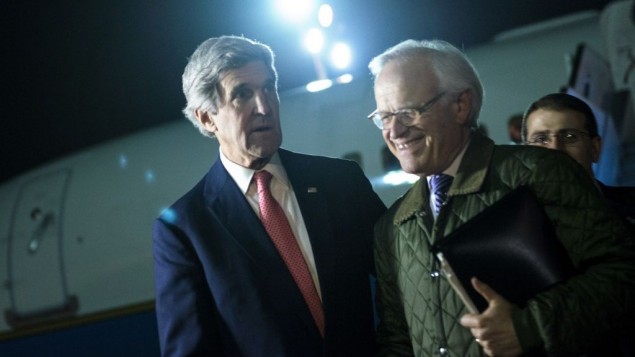
Kerry with U.S. envoyUS Secretary of State John Kerry, left, walks with US Special Envoy for Israeli-Palestinian Negotiations Martin Indyk, right, at Ben Gurion International Airport, Tel Aviv, Israel, on January 5, 2014. (photo credit: AP/Brendan Smialowski/Pool)

Senior US officials are planning to travel to Israel “soon” following the collapse of the Middle East peace talks led by Washington, a State Department official said Monday.

Deputy spokeswoman Marie Harf also dismissed reports that US Secretary of State John Kerry had decided to dismantle the team of American negotiators who have been based on the ground in Jerusalem for months trying to push forward the Israeli-Palestinian peace process.

Special envoy Martin Indyk, a former US ambassador to Israel, had returned to Washington for consultations, Harf confirmed, after last week’s April 29 deadline for a deal passed in a stalemate.

“We’re going to see where this goes from here and, you know, figure out what makes sense in terms of staffing,” she told reporters, saying “we have some senior officials that will be going soon” to the region, without going into specifics.

Indyk has “returned for consultations, but there’s no dismantling” of the team, she said, dismissing as “inaccurate” a report in the Israeli press to that effect over the weekend.

The Haaretz daily said Sunday, quoting Israeli officials, that Indyk was preparing to resign and return to his post at the Brookings Institution think tank.

It also said National Security Adviser Susan Rice would be travelling to Israel this week for consultations as Washington prepares to resume nuclear talks with Iran.

Indyk was said to have been quoted anonymously in an interview in another Israeli daily, Yedioth Ahronoth, in which US officials blamed Israel for the breakdown in the talks and said Israeli Prime Minister Benjamin Netanyahu “did not move more than an inch.”

Harf insisted no one side was to blame, saying “both sides did things that were incredibly unhelpful.”

She did confirm, however, that Kerry, who was returning Monday from a week-long tour of Africa, was mulling whether to release a document laying out some of the principles reached during the nine months of talks, although no decision had been made.

And Harf insisted the situation was not worse than it had been before the start of the talks in July.

“Even if these negotiations eventually don’t work, in the nine months, you have put the issues on the table,” she said.

“You’ve talked about them. Maybe you’ve seen something where, whenever we start this process again, it will help us make progress faster or make better progress or go further.”


Off Topic: The Muslim Brotherhood and Terrorist Organizations

May 6, 2014

The Muslim Brotherhood and Terrorist Organizations, Gatestone InstituteValentina Colombo, May 6, 2014

(Hamas united with Fatah will be a dandy “peace” process partner for Israel. — DM)

The link between the Muslim Brotherhood and Hamas is clear and straight, and confirmed by Article 2 of the Charter of Hamas, which reads: “The Islamic Resistance Movement is one of the wings of the Muslim Brothers in Palestine. The Muslim Brotherhood Movement is a world organization, the largest Islamic Movement in the modern era. It is characterized by a profound understanding, by precise notions and by a complete comprehensiveness of all concepts of Islam in all domains of life: views and beliefs, politics and economics, education and society, jurisprudence and rule, indoctrination and teaching, the arts and publications, the hidden and the evident, and all the other domains of life.”

“[T]he organization of the Muslim Brotherhood is a terrorist organization, and anyone who asks either to reconcile with them, to join them or to ally with them is himself a terrorist.” — Refaat Saïd, leader of Egypt’s Socialist party, al-Tagammu’, and previously close friend of former Muslim Brotherhood Supreme Guide, Mahdi Akef.

A new terror group, Ansar Bayt al-Maqdis [ABM], just officially entered the scene. Both the U.S. State Department and the British government included it, at the beginning of April, in their list of proscribed terrorist organizations.

The United Kingdom justified its decision as follows: “ABM is an Al Qa’ida inspired militant Islamist group based in the northern Sinai region of Egypt. The group is said to recruit within Egypt and abroad and aims to create an Egyptian state ruled by Sharia law. ABM is assessed to be responsible for a number of attacks on security forces in Egypt since 2011. The attacks appear to have increased since the overthrow of the Morsi government in July 2013. The group’s reach goes beyond the Sinai, with the group claiming responsibility for a number of attacks in Cairo and cross-border attacks against Israel. ABM has undertaken attacks using vehicle-borne improvised explosive devices and surface-to-air missiles. Examples of attacks for which the group has claimed responsibility include: an attack on the Egyptian Interior Minister in which a UK national was seriously injured (September, 2013); an attack on a police compound in Mansoura, killing at least 16 people, including 14 police officers (December 24, 2013), and an attack on a tourist bus in which three South Koreans and their Egyptian driver died (January 16, 2014).”

The decision taken by the British government against Ansar Bayt al-Maqdis came almost at the same time as the decision to start investigations on the activities of Muslim Brotherhood [MB] and its possible links with terrorism.
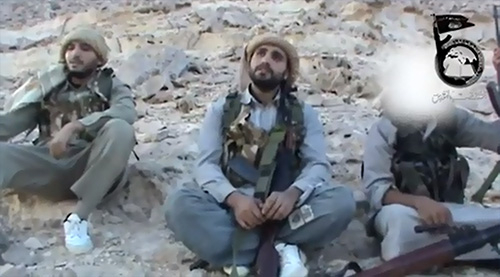
AnsarTerrorists from the group Ansar Bayt al-Maqdis.

There is however a link between ABM and the Muslim Brotherhood: the justification of jihad, based on the Koranic text.

Although in January 2014, after the December 24 attack — linked by the British government statement to ABM — the Egyptian Muslim Brotherhood issued a declaration in which it denied any connection with ABM, Refaat Saïd, the leader of the Socialist Party, Tagammu’, said otherwise.

Saïd pointed out, during the visit of Catherine Ashton to Egypt on the eve of its presidential elections, that Ashton “wants to open channels for a reconciliation with the Muslim Brotherhood despite knowing perfectly well that Dr. Mohammed Morsi himself imported the organization of Ansar Bayt al-Maqdis and placed it in the Sinai. Morsi released many of its members from prison so they could carry out terror attacks in the Sinai region to take him back to power.”

Saïd bluntly added that “the organization of the Muslim Brotherhood is a terrorist organization, and anyone who asks either to reconcile with them, to join them or to ally with them is himself a terrorist.”[1]

Saïd, previously a close friend of Mahdi Akef, the former MB Supreme Guide, knows the Brotherhood closely.

In September 2013, after an attack on the Egyptian Minister of the Interior, Major General Ahmad ‘Abd al-Halim explained that “Ansar Bayt al-Maqdis is an organization including 15 organizations acting and working in Gaza and belonging to the sphere of al-Qaeda and Hamas.”[2]

Colonel Farouq Hamdan — an aide to former Egyptian Interior Minister — also commented that “the attack was carried out with the blessing of, and consultation between the organizations of the Muslim Brotherhood and Ansar Bayt al-Maqdis, which was funded by the Brotherhood.”[3]

The connection between Ansar Bayt al-Maqdis, al-Qaeda and Hamas — already on the official lists of proscribed terrorist organizations in the West — and the Muslim Brotherhood — which is already presently on the proscribed terror organizations of Russia (February 2003), Syria (21 October 2013), Egypt (25 December 2013), Saudi Arabia (7 March 2013) and the United Arab Emirates (9 March 2014) — is sometimes a direct one, and sometimes an ideological link.

The link between the Muslim Brotherhood and Hamas is clear and straight, and confirmed by Article 2 of the Charter of Hamas, which reads: “The Islamic Resistance Movement is one of the wings of the Muslim Brothers in Palestine. The Muslim Brotherhood Movement is a world organization, the largest Islamic Movement in the modern era. It is characterized by a profound understanding, by precise notions and by a complete comprehensiveness of all concepts of Islam in all domains of life: views and beliefs, politics and economics, education and society, jurisprudence and rule, indoctrination and teaching, the arts and publications, the hidden and the evident, and all the other domains of life.”

It would appear rather more difficult to demonstrate the link between the Muslim Brotherhood and some markedly jihadist movements such as Al Qaeda, Gamaat al-Islamiyya — also internationally recognized as a terrorist organization — and Ansar Bayt al-Maqdis.

In 2005, Sylvain Besson published, for the first time in a Western language, a document in his book, The Conquest of the West: The Secret Project of Islamists, often referred to as “The Secret Project.”

The document, “Towards a global strategy of Islamic politics (starting points, elements, essential conditions and missions),” was found in 2001 by Swiss authorities in the house of Youssef Nada, one of the leaders of the Muslim Brotherhood in the West

similar version of the “Secret Project” was also aired in 2012 in a documentary film about the MB in the West by American journalist Glenn Beck. What is strange is that no one has given due importance to the contents of both documents.

“The Secret Project” explains the twelve starting points of the strategy of the Brotherhood in the West. For example:

“Step 5: Work to establish the Islamic state, in parallel make progressive efforts aiming at controlling the local centres of power through institutional work.

“Step 6: Work with loyalty alongside Islamic groups and institutions in various fields by agreeing on a common ground in order to cooperate on points of convergence while putting aside the points of divergence.

“Step 7: Accept the principle of temporary cooperation between Islamic movements and nationalist movements […]”

In Step 9, jihad is finally mentioned: “Build a permanent force of the Islamic preaching and support movements engaged in jihad in the Islamic world, in different ways and within the limits of the possible….Get in touch with any new movement engaged in jihad wherever in the planet, with Islamic minorities, and create walkways, according to requirements, to support and establish a partnership. Keep the jihad on alert in the umma [Muslim community] […].”

“The Secret Project” calls for a bond, a better collaboration with jihadi movements and it would seem that strategically, leaders and members of the MB consider both jihad and jihadi movements fundamental to achieve their goals.

Hasan al-Banna, the founder of the Muslim Brotherhood in 1936, issued a call to “kings and princes, members of legal organizations and Islamic societies, to those who own judgment and sense of honour in the Muslim world,” to the so-called “Fifty requests” to return to a true Islamic society.

The third request reads: “Reinforce the army, multiply sections of young people and inflame them on the grounds of Islamic jihad.”

Jihad appears always to have been part of MB ideology. Sayyid Qutb, possibly the most important MB ideologue, in his commentary of Koran, In the Shade of Qur’an, defines jihad: “Islam gives the name jihad to such cumulative efforts. This includes efforts to change people through verbal advocacy. It also includes the possible armed struggle to end an oppressive system and establish justice. […] among the radical concepts of the revolutionary party named “Muslim” the most foundational is to engage every rebellious force that comes in Islam’s way: fight them, muster everything possible to replace them.”

Sayyid Qutb’s books and his theory of jihad have been fundamental in building the foundation of Al-Qaeda ideology as Ayman al-Zawahiri clearly states in his book Knights under the Prophet’s Banner.

In 1978, a Sudanese reformist and political leader, Mahmud Muhammad Taha, who was sentenced to death for apostasy in 1985, wrote, in the first part of his reflection, These are the Muslim Brothers: “In this age when humanity was predisposed to spread Islam at the scientific level based on persuasion, on reconciliation and peace, when the world opinion was inclined to renounce violence and not to resort to war to solve problems, here came the organization of the Muslim Brotherhood calling Muslims to jihad! Here is the shaykh Hasan al- Banna, the founder of their preaching, consecrating a letter of his to jihad, ‘The Letter of jihad.’ He quotes many Koranic verses calling for jihad […] He concludes the document with the following invitation: ‘Brothers, the umma is a factory of death […] and Allah reserved you the precious life on earth and eternal bliss in the afterlife, what a fragility leads us to love this life and hate death, be ready for an important action and long for death since it will give you life.'”[4]

In a letter about “teachings” (Risalat al-ta’alim), in “Point 7,” the paragraph dedicated to action, Hasan al- Bannawrote: “We must be the masters in spreading the Islamic preaching in every place, ‘And fight them until there is nofitnah [upheaval] and [until] the religion, all of it, is for Allah’ (Surat al-Anfal, VIII:39) […] and I want jihad as an obligation of the past that will continues until the Day of Judgment and that has as its main purpose the hadith of the Messenger of Allah — upon him the greetings and blessing of Allah: whoever dies without having fought and without having any intention of fighting is as if he had died in the era of ignorance.'”

The importance of jihad in the history of MB is further underlined by the title of an essay that Yusuf al-Qaradawi, one of its main theologians: “The Muslim Brotherhood. Seventy years of preaching, education and jihad” (Beirut 2001).

Al-Qaradawi states that, “the movement engaged in real jihadi battles against the Zionists in Palestine and the British in Egypt and the movement sent the best of its sons to sacrifice.” (page 235)

It should come as no surprise, then, that the motto of Ansar Bayt al-Maqdis is also the verse singled out by Hassan al Banna: “Fight them until there is no fitnah [discord], and [until] the religion, all of it, is for Allah.” [Qur’an, Sura VIII, verse 39].

As stated in “The Secret Project” of the Muslim Brotherhood, the MB and Islamist movements are merely different but complementary ways to implement the goals of jihad.

Whereas the Muslim Brotherhood preaches jihad with pragmatism and “moderation,” the ABM, Hamas and al-Qaeda preach and practice it bluntly and with no delay. But whenever the Brotherhood enters what could be perceived as resistance, then open violence becomes permissible, as now in Egypt.

Recent statements to the Sunday Times by Ibrahim al-Mounir, whom many regard as the leader of the Brotherhood in Europe, sound as if they are a veiled threat: “If this [ban] happened, this would make a lot of people in Muslim communities think that [peaceful] Muslim Brotherhood values … didn’t work and now they are designated a terrorist group, which would make the doors open for all options.” When asked if he meant that the group was open to violence, he replied: “Any possibility.”

There can be no doubt about the ideological link between ABM and MB: both believe in jihad, in the conquest of power by Islam. The most important thing the West has to understand is the blunt pragmatism of MB, that is what Mohammed Charfi, former Tunisian minister of education, wrote in his essay, Islam et liberté: “Today the observers call a “moderate” Islamist the person who, with Westerners, uses reasonable language and who does not choose an openly violent action. However even though his style is calm and the rejection of violence seems sincere, since the movement is always linked to sharia and the sacralisation of history, his moderation remains provisional and indicates a strategy of waiting, because the ingredients of radicalization have not disappeared.”

▶ Yom HaAtzmaut – Israel celebrates 66 years of Independance

May 6, 2014

▶ Yom HaAtzmaut – Israel celebrates 66 years of Independance – YouTube.

Jerusalem – May 5, 2014

Happy birthday, Israel !  From the IDF…

The opening celebration in Jerusalem.

   !  חג שמח


Iran Inches Toward Total Economic Empowerment

May 5, 2014

Iran Inches Toward Total Economic Empowerment, Front Page Magazine, May 5, 2014

The view claiming that Iran’s ideological and hegemonic ambitions will diminish if a final nuclear deal is reached is very unsophisticated and naïve. Even when Iran’s nuclear program was not in the spotlight, for example in the 1980s and early 1990s, the Islamic Republic was at its peak in meddling in other countries’ domestic affairs and showed no sign of tempering its aspiration for regional supremacy.

In fact, these were the times that the Iranian leaders were notably and outstandingly attempting to alter the regional balance of power in its interest by intervening in Lebanon, giving birth to one of the most formidable Shiite non-state actors, Hezbollah, fighting with Israel through its proxies, forming one of the most long-standing Middle Eastern alliances with the Syrian government, and continuing the war in Iraq for an extra six years despite the fact it was offered full compensation by other countries to cease the war.

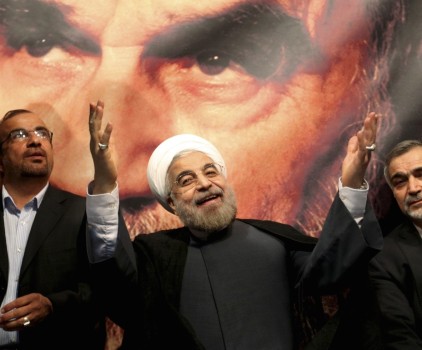
Hasan Rowhani

The nuclear talks between the Islamic Republic of Iran and six world powers (P5+1: China, France, Germany, Russia, and the United Kingdom) have inched forward toward the permanent nuclear deal and the removal of all economic sanctions against the Iranian regime.

Some proponents of the Iranian regime in the West and in Iran have been spreading a specific interest-driven narrative by pointing out that if a final nuclear is achieved, Iranian leaders are more likely to tone down their ideological and regional hegemonic ambitions as well.

According to this argument, if a permanent nuclear deal is achieved, and if the diplomatic thaw between Tehran and Washington continues, Iran’s foreign policies in the region will not turn more aggressive or interventionist regarding regional and foreign policies. As a result, other countries should not be concerned about Iran’s policies and they should push for a final nuclear deal and the removal of sanctions.

In other words, those who advocate for Rouhani’s government and the Islamic Republic contend that Iranian leaders will instead become more cooperative, conciliatory, and will decrease their hegemonic ambitions and policies in the region.

This view fails to take into account the realities on the ground. Since the interim nuclear deal has been reached, the Islamic Republic has become more emboldened to achieve its ideological, geopolitical, and regional hegemonic ambitions. Some of the sanctions relief and billions of dollars that the Iranian regime has received from the United States and international community has empowered its assertive and aggressive stance.

According to Lieutenant Commander of Khatam al-Anbia Air Defense Base General Ali Reza Sabahi-Fard, Iran is rapidly upgrading its defense system. And as Commander of the Army Ground Force Brigadier General Ahmad Reza Pourdastan announced last week, Iran’s Ground Force has test-fired new mid-range ballistic missiles and has equipped S-200 air defense system with new missiles. The S-200 system is characterized as having much longer-range capabilities as compared to previous missile systems.

According to Reuters, Iran’s military is planning to target a mock-up American aircraft carrier. The newspaper Haft-e Sobh daily quoted Adm. Ali Fadavi, navy chief of the powerful Revolutionary Guards, as saying, “target the carrier in the trainings, after it is completed.” Accordingly, Adm. Fadavi pointed out, “We should learn about weaknesses and strengths of our enemy.”

Recently, Iran’s National Army Day orchestrated a large-scale military parade through the capital, Tehran, where fighter jets and military technology manufactured by Russia and other countries, were part of the show. Iranian leaders have made clear that their military capabilities and their missile systems are non-negotiable in the nuclear talks. The United States and other members have also overlooked this threat, and are instead focusing on reaching a final nuclear deal.

Due to the recent sanction relief, several countries, including Turkey, China, Germany, and Austria, have boosted or are planning to boost their economic ties with the Islamic Republic. Iran’s oil exports, in legal or black markets, have also significantly increased.

The case that Iran’s desire for regional supremacy will be tempered if a permanent nuclear deal is sealed, and if the U.S. and Iran thawed diplomatic relations, does not take into account the underlying geopolitical and economic fundamentals, as well as historical context of the Islamic Republic.

The view claiming that Iran’s ideological and hegemonic ambitions will diminish if a final nuclear deal is reached is very unsophisticated and naïve. Even when Iran’s nuclear program was not in the spotlight, for example in the 1980s and early 1990s, the Islamic Republic was at its peak in meddling in other countries’ domestic affairs and showed no sign of tempering its aspiration for regional supremacy.

In fact, these were the times that the Iranian leaders were notably and outstandingly attempting to alter the regional balance of power in its interest by intervening in Lebanon, giving birth to one of the most formidable Shiite non-state actors, Hezbollah, fighting with Israel through its proxies, forming one of the most long-standing Middle Eastern alliances with the Syrian government, and continuing the war in Iraq for an extra six years despite the fact it was offered full compensation by other countries to cease the war.

More recently, even after reaching a preliminary nuclear deal, the Islamic Republic has shown no sign of tempering its foreign policies when it comes to affecting the domestic politics of other countries including Yemen, Syria, Bahrain, and Lebanon. The Yemeni president pointed out in an interview, “Unfortunately, Iran still meddles in Yemen whether by supporting the separatist [Southern] Movement or some religious groups in the north.” He asked the Shiite-dominated Iran to “keep its hands off Yemen” and to halt giving support to “armed groups” in the country. Reportedly, the Houthis are receiving Iranian support, and have been capable of dominating the northern Yemeni province of Saada. Asir, the Saudi province, borders the Yemeni Shiite rebel strongholds.

The second part of the argument made by the proponents of Rouhani’s government and the Islamic Republic is very simplistic in the sense that it overlooks the sophistication and complexity of Iran’s politics in Middle East.

The reason that other countries are not concerned about Iran’s foreign policies in the region if a final nuclear deal is reached (as well as in case Iran tempers its policies and regional geopolitical position), is that they take no notice of the Middle Eastern political chessboard and the Islamic Republic’s role in this political jigsaw puzzle.

The issue is that Iran’s nuclear file has been filled up with frequent clandestine nuclear sites revealed by external governments and organizations, a robust determination to become a nuclear power, non-transparency, secrecy, and a lack of clarity about Iran’s nuclear developments. How can other nations accept these terms of security if another country in the region is on the verge of significantly tipping the balance of power in its favor through reaching a breakaway nuclear capacity?

Most likely, the permanent nuclear deal will leave the Islamic Republic with some breathing space to pursue its nuclear ambitions and achieve its objectives and nuclear breakthrough. If this occurs, the chessboard that is the Middle East will witness a critical reshaping in favor of the nuclear state. This will naturally be followed by a nuclear arms race and competition in the region, which will further destabilize the region and its security. In addition, the nuclear deterrence will boost and facilitate Tehran’s regional ambitions from economic, geopolitical, and strategic prisms.

Even if an efficient permanent nuclear deal is reached between the P5+1 and Iran, should other countries, as some policy analysts and proponents of Rouhani’s government argue, not be concerned about Iran’s regional hegemonic ambitions? It is very unrealistic and naïve to argue that the Islamic Republic will temper its ideological and regional hegemonic ambitions even if a permanent nuclear deal is reached and even if Washington and Tehran mend diplomatic ties. Iran is strongly involved in influencing the domestic affairs of other countries, through founding or backing some Shiite groups, which makes a shift in Tehran’s regional policies inconceivable. Furthermore, Tehran’s regional policies are not only aimed at achieving geopolitical and economic supremacy, but also founded on ideological landscapes, attempting to spread the Shiite version of Islam through either political movements or well-established religious seminary centers such as in the city of Qom.

US aid indirectly helps Hamas, under deal with Palestinian Authority

May 5, 2014

US aid indirectly helps Hamas, under deal with Palestinian Authority, Fox News, May 5, 2014

(Obama’s foreign “policy” at its finest: it’s unimportant that Hamas has already said that it will have military control over a unity government. Don’t bother with the small stuff until it gets big, then dither forcefully and blame Israel. — DM)

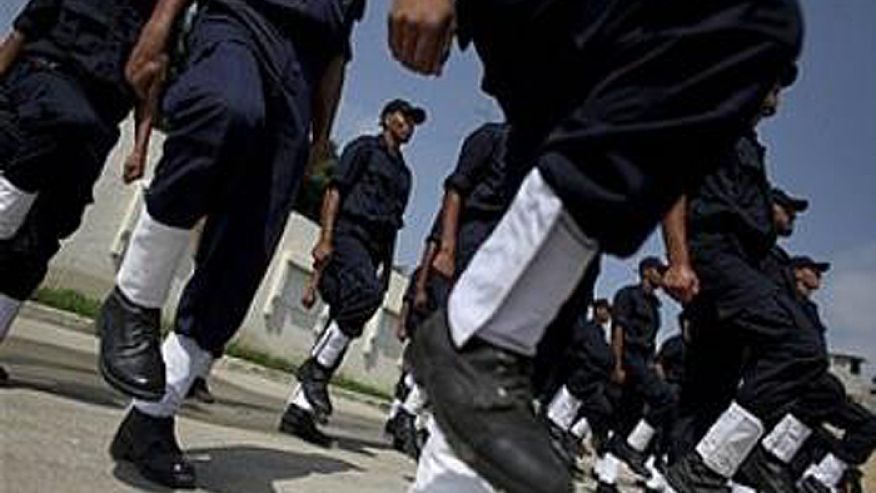
The Palestinian Authority’s announcement that it will send 3,000 police officers to Gaza as part of a unity agreement with Hamas could mean U.S. taxpayers are now at least indirectly helping an officially designated terror organization maintain law and order — and its grip on power.

“Proponents of the recent reconciliation process insist that the next step is a technocratic government that would include figures approved by Hamas and Fatah,” he said. “But they insist that this is not grounds for cutting aid — that only an elected national unity government would prompt such a cut. The integration of Hamas and PA security forces would destroy this argumentUntil the integration of these forces, U.S. funds are not used to aid Hamas. However, the moment this happens, it is grounds for a full cut in assistance.” 

hamaspoliceHamas police cadets march in Gaza. (AP

The Palestinian Authority’s announcement that it will send 3,000 police officers to Gaza as part of a unity agreement with Hamas could mean U.S. taxpayers are now at least indirectly helping an officially designated terror organization maintain law and order — and its grip on power.

The police deployment came as part of a deal between the mainly secular government of the West Bank and the radical Islamist regime of Hamas that rules in Gaza. That agreement effectively ended hopes for the Israeli-Palestinian peace process championed by U.S. Secretary of State John Kerry, but it also raises questions about U.S. foreign aid to the Palestinian Authority going forward. Since the U.S. subsidizes the PA budget to the tune of approximately $400 million per year, any effort to help Hamas indirectly spends U.S. dollars, say observers in Israel. That could be prohibited by U.S. policy, if it is read as part of a power-sharing agreement.

“No aid is permitted for a power-sharing PA government that includes Hamas as a member, or that results from an agreement with Hamas and over which Hamas exercises “undue influence,” unless the President certifies that the PA government, including all ministers, has accepted the following two principles… (1) Recognition of “the Jewish state of Israel’s right to exist” and (2) acceptance of previous Israeli-Palestinian agreements,” Jim Zanotti, a specialist in Middle Eastern Affairs, wrote in a report last September for the Congressional Research Service titled “U.S. Foreign Aid to the Palestinians.”

“ …. U.S. funds are not used to aid Hamas. However, the moment this happens, it is grounds for a full cut in assistance.”- Jonathan Schanzer, author

Those conditions have been met by the PA, but Hamas, under whose control Gaza has continued to be a launching pad for cross-border missile attacks into Israel and a safe haven for Islamic Jihad and even Al Qaeda, steadfastly refuses to acknowledge Israel’s right to exist and is reportedly pressuring the PA to cease security co-operation with Israel in the West Bank. Zanotti’s report, however, highlights a clause that might leave wiggle room for the PA to avoid losing U.S. support.

“It is unclear whether a consensus government of the type anticipated under various Fatah-Hamas agreements since 2011 would come under the legal definition of a “power-sharing PA government that includes Hamas as a member” or a government over which Hamas exercises “undue influence.” It is also unclear whether it would come under the legal definition of a “Hamas controlled” PA government, and thus trigger the additional conditions on U.S. aid cited above.”

The emerging bond between the PA and Hamas has Western diplomats concerned and Israel outraged. Today, PA President Mahmoud Abbas and Hamas leader Khaled Meshaal met face-to-face in Doha, Qatar, for the first time in 16 months, in a further sign of the warming relationship between the two parties. AFP reported a Palestinian official as saying, “The meeting was positive, with both leaders expressing a serious willingness to turn over a new leaf based on national partnership.”

In his recent interview with Fox News just a day after the new PA-Hamas rapprochement was announced, Israeli Prime Minister Benjamin Netanyahu — whose refusal to release the final batch of convicted Palestinian terrorists from Israeli custody was blamed by the Palestinians for finally derailing the peace talks — was scathing in his criticism of PA President Mahmoud Abbas.

“It’s a blow to Israel; it’s a blow to peace,” Netanyahu said. “It’s a terrible blow to the Palestinian people, because they must choose… whether they want to go forward or go backward. Yesterday, with the pact with Hamas, the Palestinian people… took a huge step backward, away from peace, away from a good future for themselves.”

Jonathan Schanzer, author of the recently published book, State of Failure: Yasser Arafat, Mahmoud Abbas and the Unmaking of the Palestinian State, told Fox News.com a power-sharing deal between the two factions, if reached, would warrant a move by the U.S. to cut aid. Kerry has not commented on whether the U.S. agrees.

“Proponents of the recent reconciliation process insist that the next step is a technocratic government that would include figures approved by Hamas and Fatah,” he said. “But they insist that this is not grounds for cutting aid — that only an elected national unity government would prompt such a cut. The integration of Hamas and PA security forces would destroy this argumentUntil the integration of these forces, U.S. funds are not used to aid Hamas. However, the moment this happens, it is grounds for a full cut in assistance.”

Abd al-Salam Siyam, secretary-general of the Hamas cabinet in Gaza, announced Sunday in a carefully worded official statement that the security officers would be deployed in Gaza for an “interim period” as a step toward the unity agreement between the two Palestinian factions. Reports suggest that many of the 3,000 PA men heading to Gaza had previously been involved in security in the territory prior to the election of Hamas in 2006 and the subsequent internal blood-letting and mass murders that followed Gaza’s lurch toward a radical Islamic regime.

“Reconciliation is positive in the sense that it would solve the problem of identifying the interlocutor on the Palestinian side” Schanzer suggests. “But it is virtually impossible to imagine peace between the Palestinians and Israelis when Hamas is involved. In other words, Fatah’s embrace of Hamas may lead to national unity, [but] it portends poorly for peace.”