Archive for May 2014

Khamenei: Iran’s Revolutionary Guards should mass produce missiles

May 11, 2014

Khamenei: Iran’s Revolutionary Guards should mass produce missiles | JPost | Israel News.

By REUTERS

05/11/2014 18:14

Supreme leader says Western expectations for Iran to limit its missile program were “stupid and idiotic”.

Khamenei

Iranian Supreme Leader Ayatollah Ali Khamenei. Photo: REUTERS

DUBAI- Iran’s Supreme Leader Ayatollah Ali Khamenei said on Sunday that Western expectations for the Islamic Republic to limit its missile program were “stupid and idiotic”.

The Supreme Leader also called on the country’s Revolutionary Guards to mass-produce missiles.

The United States and its allies have said they are worried about Iran’s missile program as they fear the weapons could carry nuclear warheads. Iran has long denied having any plans to develop atomic weapons.

“They expect us to limit our missile program while they constantly threaten Iran with military action. So this is a stupid, idiotic expectation,” Khamenei was quoted as telling the IRNA news agency while on a visit to an aeronautics fair by the Revolutionary Guards.

“The revolutionary guards should definitely carry out their program and not be satisfied with the present level. They should mass produce. This is a main duty of all military officials,” Khamenei said.

Earlier on Sunday it was revealed that the UN nuclear watchdog plans talks with Iran on Monday ahead of a May 15 deadline for the country to implement a series of measures that could allay concern about its nuclear program.

News of the meeting came after diplomatic sources told Reuters on Friday that the International Atomic Energy Agency was seeking further clarification from Iran about one of those steps, concerning information about detonators that can help set off a nuclear device and Tehran is believed to have developed.

Iran says it has already implemented the seven steps agreed by the two sides – including access to two uranium sites – but the sources suggested the IAEA still wanted more information about the so-called Explosive Bridge Wire (EBW) detonators.

How Iran responds to questions about its development and need of this type of equipment is seen as an important test of its willingness to cooperate fully with an IAEA investigation into suspected atomic bomb research by the country.

Iran says allegations of such work are baseless, but has offered to help clear up the suspicions with the UN agency.

The struggle of memory against forgetting

May 11, 2014

The struggle of memory against forgetting, Israel Hayom, Sharon N. Stern, May 11, 2014

(Islam and Israel are as they do, not as the Obama Administration says. — DM)

[I]t seems the Obama administration has omitted some very prominent facts from memory.

It was only last week that the Palestinian Authority joined together with Hamas to hold a military funeral for the terrorist Izzedine al-Masri, who murdered 15 people at the Sbarro restaurant in Jerusalem in 2001 including two Americans: a 15-year-old girl and a 31-year-old pregnant woman. The Palestinian Authority television network described the funeral as a “wedding” to the 72 virgins in Paradise, the great reward Islam promises to those who die as martyrs for Allah.

“The struggle of man against power is the struggle of memory against forgetting.”
Milan Kundera, “The Book of Laughter and Forgetting”

A week ago, Israel marked its annual Memorial Day for Fallen Soldiers and Victims of Terrorism. Traffic stood still across the country when the sirens sounded in memory of the 23,169 soldiers and victims of terror the country has lost since its establishment. The Jewish state rose out of the crematoria of Auschwitz, and like most precious metals, it continues to survive the hottest fires known to man, simply because it must continue to exist.

I look at the photos of the more than 1,500 victims of Palestinian terror murdered since the Oslo Accords were signed, among them at least 53 Americans. Why were the victims of terror murdered? For the same reason that our relatives were murdered in Europe: Simply because they were Jews.

In this context, it saddens me to say that it seems the Obama administration has omitted some very prominent facts from memory.

Last Friday, Yedioth Ahronoth reporter Nahum Barnea interviewed a U.S. State Department official who faulted Israel alone for the failure of the Israeli-Palestinian peace talks. According to the official, it was the tenders for the construction of 700 housing units on the outskirts of Jerusalem that caused the talks to collapse. Apparently he forgot the express commitment made by former U.S. President George W. Bush to former Prime Minister Ariel Sharon, as it was formulated in a letter written in April 2004, stating that “as part of a final peace settlement, Israel must have secure and recognized borders, which should emerge from negotiations between the parties in accordance with UNSC Resolutions 242 and 338. In light of new realities on the ground, including already existing major Israeli populations centers, it is unrealistic to expect that the outcome of final status negotiations will be a full and complete return to the armistice lines of 1949, and all previous efforts to negotiate a two-state solution have reached the same conclusion.”

The areas where the aforementioned 700 housing units were slated to be built are most certainly within these “already existing major Israeli population centers.” This express commitment has apparently been forgotten.

Furthermore, every agreement made with the Palestinian Authority to date has bound the Palestinians to one commitment: to settle every disagreement at the negotiating table rather than by way of incitement to violence or terrorism. That too has apparently been forgotten. Not a day goes by without some Palestinian Authority declaration hailing this or that martyr or honoring various terrorists and suicide bombers, encouraging others to join them in their glorious quest.

It was only last week that the Palestinian Authority joined together with Hamas to hold a military funeral for the terrorist Izzedine al-Masri, who murdered 15 people at the Sbarro restaurant in Jerusalem in 2001 including two Americans: a 15-year-old girl and a 31-year-old pregnant woman. The Palestinian Authority television network described the funeral as a “wedding” to the 72 virgins in Paradise, the great reward Islam promises to those who die as martyrs for Allah.

Words can kill. These words and the emotions they represent symbolize something far more destructive to the chances of sustainable peace than a few housing units. However, the Palestinian Authority’s commitment to stop the incitement to terrorism has also been forgotten from the international collective memory. This incitement inevitably ends in death.

We, the Jews, have a very long memory. It was this collective memory that bound us together during those dark days in exile. EMET, the organization I head, and I personally, will not rest until the murderers are finally tried. We are now calling for hearings to examine why no Palestinian who murdered an American citizen in disputed territories has ever been tried, charged or sued.

Boko Haram and the failure of obama’s counter-terrorism strategy

May 11, 2014

Boko Haram and the failure of obama’s counter-terrorism strategy, Breitbart,  May 10, 2014

(The same “blame exogenous contingencies,not Islam, doctrine seems also to apply to other Islamist movements, including Palestinian terrorists in the “peace process” and Iran in her substantially unimpeded march for nukes. — DM)

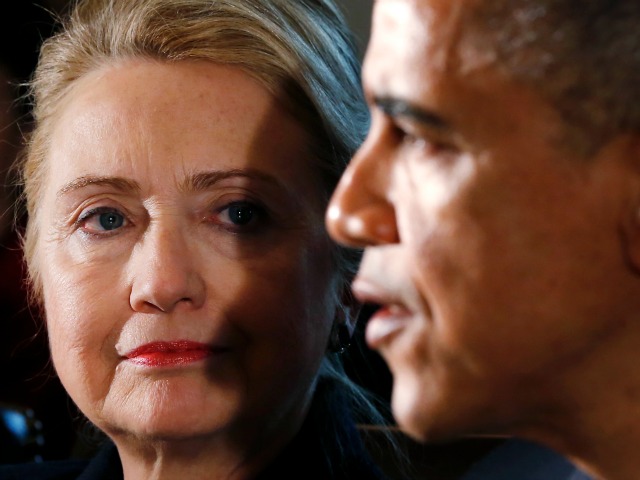
hillary_obama_glare_reuters

During Hillary Clinton’s tenure, the State Department failed to designate Boko Haram a terrorist organization, in spite of the fact that Boko Haram had become second only to the Taliban as the deadliest terrorist organization. Clinton will rightly have to bear blame for that, but the lack of a designation also reflects the much deeper problem of the Obama administration’s overall approach to Islamic extremism. It is an approach that has led to bad policies, not only with regard to Boko Haram, but also to Iran, the Syrian rebels, Egypt, the Muslim Brotherhood, and Benghazi.

[T]errorism becomes “a mode of contention,” and terrorists are not to blame for their violence; “exogenous contingencies” are at fault. Sources in the Koran, Islamic jurisprudence, or even contemporary calls to jihad are not to blame. . . .

For the Obama administration, Islamist extremism (except for Al Qaeda) is not a categorical evil which stands opposed to America’s good; it is, rather, an extreme expression—among a range of expressions—of protest against legitimate grievances. Islamic radicals such as Boko Haram are not responsible for their actions; they are forced to radicalism by their circumstances. And it definitely has nothing whatsoever to do with Islam, not even a distorted version of Islam.

The heart of the problem is that President Barack Obama and many of his top counter-terrorism advisers see Islamic extremism from the leftist perspective of social movement theory. Originating in the socialist labor movements of the 1800s and revived with the protest movements of the 1960s, social movement theory seeks to understand collective action. Academics concerned with what they saw as the relationship between “cultural imperialism” and “Islamic movements” began looking at Islamist extremism through the lens of social movement theory around 1984. It might have remained an obscure academic pursuit but for the fact that Obama elevated one of its principle proponents, Quintan Wiktorowicz, to the position of Senior Director for Global Engagement at the National Security Staff, where he became an architect of Obama’s counter-extremism strategy.

The singular impact of Wiktorowicz was to shift the focus away from the ideology driving Islamic extremism and to recast it as “Islamic activism.” He argued that Islamist violence is not a function of the call to jihad found in the Qu‘ran or in various contemporary fatwas, but is rather a calculated and rational response to state oppression:

In contrast to popular views of Islamic radicals as fanatics engaged in irrational, deviant, unpredictable violence, we argue that violent contention is the result of tactical considerations informed by the realities of repressive contexts. Islamists engage in a rational calculus about tactical efficacy and choose modes of contention they believe will facilitate objectives or protect their organizational and political gains. Violence is only one of myriad possibilities in repertoires of contention and becomes more likely where regimes attempt to crush Islamic activism through broad repressive measures that leave few alternatives. …From this perspective, violent Islamist contention is produced not by ideational factors or unstable psychological mentalities but rather by exogenous contingencies created through state policy concerning Islamists.

Thus, terrorism becomes “a mode of contention,” and terrorists are not to blame for their violence; “exogenous contingencies” are at fault. Sources in the Koran, Islamic jurisprudence, or even contemporary calls to jihad are not to blame; state policy is. Dr. Mohammed M. Hafez, an associate professor at the Naval Postgraduate School who also influenced U.S. policy, echoes this perspective in his book Why Muslims Rebel:

Muslims rebel because of an ill-fated combination of institutional exclusion, on the one hand, and on the other, reactive and indiscriminate repression that threatens the organizational resources and personal lives of Islamists. Exclusionary and repressive political environments force Islamists to undergo a near universal process of radicalization.

Radical Islamists, therefore, bear no personal responsibility for their acts of terrorism or disruption. Rather, they are forced by a political environment that excludes or represses them to undergo an inevitable process of radicalization.

For the Obama administration, Islamist extremism (except for Al Qaeda) is not a categorical evil which stands opposed to America’s good; it is, rather, an extreme expression—among a range of expressions—of protest against legitimate grievances. Islamic radicals such as Boko Haram are not responsible for their actions; they are forced to radicalism by their circumstances. And it definitely has nothing whatsoever to do with Islam, not even a distorted version of Islam.

On the very day that the U.S. announced the designation of Boko Haram as a terrorist organization, Assistant Secretary of State for African Affairs Ambassador Linda Thomas-Greenfield said that “Boko Haram’s activities call our attention not just to violence, but also to poverty and inequality in Nigeria.” The State Department’s 2012 report on human rights in Nigeria spends far more time on abuses by Nigeria’s security forces than it does on Boko Haram’s violence. The report states, “The population’s grievances regarding poverty, government and security force corruption, and police impunity and brutality created a fertile ground for recruiting Boko Haram members.” By all accounts, police brutality and incompetence in Nigeria were on an epic scale, but as Congressman Chris Smith (R-NJ) famously said at a hearing on Boko Haram, to blame terrorism on poverty is a disservice to the millions of poor people across the globe who never turn to violence.

Because of the Muslim-extremist-as-victim meme, the administration generally, and the State Department particularly, have repeatedly portrayed Muslims as the principle victims of groups such as Boko Haram, with Christians only a minor side note. The State Department has repeatedly said that Boko Haram is not religiously motivated and is more destructive to Muslims than to Christians. On the day Boko Haram was designated an FTO, Ambassador Thomas-Greenfield said that Boko Haram “had killed numerous Christians and an even greater number of Muslims,” in spite of the fact that attacks on Christians represented 46% and on Muslims only 3%, according to Jubilee Campaign.

The argument currently being put forth by the mainstream media is that the United States has been poised and ready to help Nigeria, but that Nigeria has been slow to ask, and that is a message likely coming directly from the White House. Now that the world has woken up to the evil being perpetrated by Boko Haram, President Obama is trying to portray himself as caring deeply about this issue. He told ABC News that he hoped the event would help “to mobilize the entire international community to finally do something against this horrendous organization that’s perpetrated such a terrible crime.” And Michelle Obama tweeted a photo of herself holding a sign that read: “#BringBackOurGirls.”

But members of the Obama administration—from the President himself to his National Security Staff to his Secretary of State and to his undersecretaries and their staffs—have all, until this episode, downplayed Boko Haram’s truly evil nature and prevented steps from being taken much earlier that could have prevented this tragedy, and those 276 abducted girls, instead of being held hostage, could still be sitting at their desks doing their schoolwork.

While social movement theory might provide insights into the formation and operation of Islamic activists, it cannot provide a foundation for American counter-terrorism policy. To do so is both detrimental to U.S. national security and to the security of numerous nations who are in a life-or-death struggle with the threat. The United States must stop the misguided narrative that terrorism and extremism have nothing to do with Islam. As Dr. Sebastian Gorka said in testimony to members of Congress, “We need to bankrupt transnational jihadist terrorism as its most powerful point: its narrative of global religious war.” Until the U.S. begins to acknowledge and address the ideology, we will not be able to challenge its ability to recruit, motivate, and inspire those who would abduct innocent schoolgirls.

Ehud Yaari – An Unprecedented resurgence of al-Qaeda

May 10, 2014

▶ Ehud Yaari – An Unprecedented resurgence of al-Qaeda – YouTube.

Ehud Yaari

Until recently, Israel’s Syrian and Egyptian fronts had been largely quiet since the end of the 1973 Yom Kippur War. Because of the Arab Spring uprisings, however, al-Qaeda-affiliated militias have now emerged on both fronts, in addition to their presence in Lebanon and nascent involvement with Palestinian factions. Never before has Israel faced a situation in which its border towns were in such easy range of al-Qaeda militias. Israel has always been at the core of the organization’s ideology, but not an immediate target or main focus of al-Qaeda attacks.

The question of how to handle these emerging threats has spurred a fierce but quiet debate within the Israeli defense establishment and at the highest political levels. So far, Israel has decided to go with defensive preparations. Two new territorial military divisions have been created on the Sinai and Syrian fronts; fences have been constructed along the Egyptian front; troop deployments have been increased; and new intelligence equipment and resources have been allocated for Sinai and the Golan Heights.

In Syria, Israelis may prefer the devil they do not know (the rebels) to the devil they do know (Bashar al-Assad), but they may end up with both. The portion of the country lying south of Damascus is strategic and may be the key to the war’s outcome. The Islamic State of Iraq and al-Sham (ISIS), a major jihadist group, has not yet penetrated the south, but the officially recognized Syrian branch of al-Qaeda, Jabhat al-Nusra, is already on Israel’s front line. There, JN is mainly a local organization with local characteristics. Unlike in other areas of Syria, many southern militias are headed by young leaders who accept the political authority of their elders. Israel, Jordan, and these local militias have a shared interest in preventing a full jihadist takeover or allowing the Syrian army to recapture this territory.

Against this backdrop, over 800 wounded and sick Syrians have been treated in Israel during the war, including Col. Abdullah al-Bashir, the new commander of the Free Syrian Army. One would not be incorrect in assuming that Israel has a system of coordination and cooperation with at least some rebel militias. Israel is extending significant amounts of humanitarian aid and perhaps other types of aid, but there is a quiet debate on how far to go to ensure that local rebel militias control areas close to the border. Recently, for example, a leader of a local JN group declared that his fighters were now in range of the “Zionist crusader.”

In Sinai, two organizations pose the most significant threat: Ansar Beit al-Maqdis (ABM) and Majlis Shura al-Mujahedin Fi Aknaf Bayt al-Maqdis. Both have ties to the southern Gaza Strip but are also stretching into mainland Egypt. Altogether, these groups include about three to four thousand Bedouin and foreign fighters. This is due to a transformation in Bedouin society in which younger men are abandoning their tribal traditions for a fundamentalist, Salafi jihadist version of Islam. Yet so far al-Qaeda has no official affiliation with ABM.

Meanwhile, Egyptian-Israeli military cooperation is at a level never seen before. Ten Egyptian battalions are now operating in central and eastern Sinai via the Agreed Activities Mechanism (AAM), through which Israel gives its consent for temporary Egyptian deployments in forbidden areas. In fact, Israel wants to see even more Egyptian personnel deployed, with such forces likely becoming a permanent feature in Sinai. In this manner, a de facto revision of the Military Annex to the 1979 peace treaty has been effected.

Currently, Egypt claims to have full control over Sinai, but it does not control the main militant safe havens in Jabal Halal and Wadi Amr. Until it does, militant groups will continue to pose a threat. They are already equipped with antitank and antiaircraft missiles, allowing them to easily threaten shipping in the Gulf of Aqaba and the Suez Canal, as well as commercial airline traffic and Israeli border towns. These groups also have a tacit understanding with Hamas that they can carry out any operations they wish in Sinai but not in Gaza.

Off Topic: Israel vs. al-Qaeda: Emerging Challenges on Two Fronts

May 10, 2014

▶ Israel vs. al-Qaeda: Emerging Challenges on Two Fronts – YouTube.

( Ehud Yaari knows more about Islam and the region than any other commentator I know of.  His analysis here of al Queda must NOT be missed by anyone interested in the subject. – JW )


al-Qaeda affiliates in Syria and Egypt’s Sinai Peninsula, Israel now faces the prospect of being a frontline state, as jihadist threats on its northern and southern borders compound the longstanding challenge from the Iran-Syria-Hezbollah axis.

To discuss these issues, The Washington Institute is pleased to host a Policy Forum with Ehud Yaari and Michael Morell.

Ehud Yaari, Israel’s leading interpreter of Arab politics, is a Middle East correspondent for Channel Two television and a Lafer International Fellow with The Washington Institute.

Michael Morell, a thirty-three-year veteran of the CIA, retired last year after serving since 2010 as deputy director of central intelligence, with two stints as acting director. He is currently the senior security correspondent for CBS News.

For more on this event, go to:

http://www.washingtoninstitute.org/po…

Israel assails latest allegations of brazen spying on US

May 10, 2014

Israel assails latest allegations of brazen spying on US | JPost | Israel News.

By JPOST.COM STAFF

05/10/2014 17:58

In response to Newsweek report, Strategic Affairs Minister Steinitz accused “someone of trying to maliciously harm relations between Israel and the United States.”

Yuval Steinitz

Prime Minister Binyamin Netanyahu (L) confers with Strategic Affairs Minister Yuval Steinitz in Jerusalem. Photo: REUTERS

A top government minister on Saturday angrily rejected claims of Israeli spying on the United States for the second time in a week after the American newsmagazine Newsweek once again quoted unnamed US intelligence officials as decrying what they believe to be overly aggressive espionage on the part of the Jewish state.

Strategic Affairs Minister Yuval Steinitz, who also holds the intelligence portfolio in the Netanyahu government, accused “someone of trying to maliciously and intentionally harm relations between Israel and the United States.”

Just days after Israeli officials denied a report of “unrivaled” Israeli espionage in the United States, a new report has surfaced detailing a US cover-up of Israel spying on then-Vice President Al Gore in 1998.

The report in Newsweek claimed that Secret Service agents caught an Israeli “agent” in an air duct who was in the process of bugging the vice president’s hotel room.

“The Secret Service had secured [Gore’s] room in advance and they all left except for one agent, who decided to take a long, slow time on the pot,” Newsweek quoted a senior former US intelligence operative as saying. “So the room was all quiet and he hears a noise in the vent. And he sees the vent clips being moved from the inside. And then he sees a guy starting to exit the vent into the room. He kind of coughed and the guy went back into the vents.”

Newsweek alleged that the incident “’crossed the line’ of acceptable behavior between friendly intelligence services,” and that “it was quickly hushed up by US officials” because of America’s commitment to Israel.

According to the report, US intelligence officials and congressional sources claim that Israel has been caught carrying out aggressive espionage operations against American targets for decades, but that they are rarely punished.

Steinitz said that in all his meetings with his American counterparts on intelligence matters, he has yet to hear any complaints over supposed Israeli espionage activities. On the contrary, Steinitz said that he has only heard praise from Washington over its close intelligence cooperation with Israel.

“This Tuesday, I will meet the head of the Senate intelligence committee and I will insist that false reports of this kind be repudiated,” said Steinitz.

On Wednesday, Steinitz and other senior Israeli cabinet officials dismissed claims made by Newsweek earlier in the week that “Israel’s espionage activities in America are unrivaled and unseemly.”

Chuck Hagel faces flat resistance to US regional policies in his coming Mid East trip

May 10, 2014

Chuck Hagel faces flat resistance to US regional policies in his coming Mid East trip.

DEBKAfile Exclusive Analysis May 10, 2014, 5:43 PM (IDT)

US Defense Secretary Chuck Hagel heads for Mid East

US Defense Secretary Chuck Hagel heads for Mid East

US Defense Secretary Chuck Hagel arrives in Jeddah next Monday, May 12, to attend a meeting of the Gulf Cooperation Council defense ministers, the first for an American defense chief in six years. This prolonged absence reflected the Obama administration’s military disengagement from Middle East affairs and the political estrangement that ensued between Washington and the region.

Former Israeli Prime Minister Ehud Barak commented in a lecture Thursday, May 8, at the Washington Institute for the Near East: ”The American administration changed its objective from no nuclear military Iran to no nuclear military Iran during the term of this administration.”

The impression received in Middle East capitals is that Barack Obama has adopted the old slogan of, “Apres moi, le deluge!” – intending to leave his White House successor after January 2017 an Iran that is fully capable of manufacturing a nuclear weapon.

It is this proposition that Saudi King Abdullah and Israeli Prime minister Binyamin Netanyahu are on no account ready to accept, because it allows Barack Obama to end his two-term presidency faithful to his ideal of keeping the US unburdened by military involvement.

Disengaging the US military from the Middle East and its troubles leaves Defense Secretary Chuck Hagel free to devote himself to implementing the president’s guidelines for shrinking America’s ground, air and naval forces. The White House  brooks no resistance to this goal.
On April 8, the House Armed Services Committee rejected by a vote of 61:0 the administration’s 2015 budget proposal, because of the sharp reductions in the military spending clauses. The Committee submitted its own draft proposal instead.
In a swift response, Hagel sent the Pentagon spokesman to make things clear “We stand firmly behind the president’s budget as submitted,” he said.

The region’s geopolitical climate has been radically affected in its most sensitive parts as a result of  reduced US military activity and the administration’s refusal to grapple with the most pressing Middle East anxieties.

Only last week, the Revolutionary Guards naval chief boasted that Iran could easily sink a US aircraft carrier in less than a minute. This may not be factually correct, but even this hollow taunt at the expense of the US military could only have come from the certainty that Washington will not rise to the challenge or interfere with Iran’s ascent to nuclear threshold status.
This same certainty gave Syria’s Bashar Assad the chutzpah to use chemical weapons against rebel forces at least 30 times in the nine months since President Obama backed away from his threat to destroy those poisonous weapons by force.

The UN report that 92 percent of the Syrian regime’s chemical substances have been destroyed to date has made the world body a laughing stock. No wonder, Assad had no qualms about calling a presidential election for June 3 and so assuring himself of another seven years in office, in the face of universal condemnation of the atrocities he has committed against his people.
Even the Palestinians found the cheek to put the lid on US Secretary of State John Kerry’s indefatigable effort to bring them to the table for a comprehensive peace with Israel and a state of their own, by going partners with the unrepentant Hamas terrorists.
Al Qaeda, too, after concluding that America was no longer the threat it was, in recent months pumped an estimated 100,000 fighters and terrorists into various corners of the Middle East – fanning out from Syria and Iraqi into Jordan, Sinai, Egypt, Libya and Yemen, the while absorbing increasing numbers of jihadi volunteers from the United States, Canada, Britain, France, Holland, Belgium, Italy and the Palestinians.
The US defense secretary’s mission to Jeddah next week is not to unveil an Obama administration policy reset and assure the Gulf members states that the American shield remains in place. On the contrary, he will try and persuade their leaders to dance to Washington’s tune – with little hope of success.

Hagel in fact received his answer in advance from Saudi Arabia, in the form of the largest military exercise ever seen in the Gulf region, under the title of Operation Saif Abdullah (Sword of Abdullah) with more than 130,000 soldiers.

Around the centerpiece of Chinese-made DF-3 nuclear missiles (NATO-designated CSS-2), commanding officers from all the Gulf emirates except Qatar took part in the war game for the first time, as well another first, Egypt.
This exercise gave Washington three messages: a) The Gulf nations are ready to fight Iran; b) They are prepared for this armed conflict to be nuclear; and c) They no longer rely on America for a military and nuclear shield – only on themselves.
“The Saudi military exercise was a goodbye wave to America,” wrote The National, a leading United Arab Emirates newspaper on May 6 in its story on the exercise.  Washington counts the UAE as one of its most loyal economic and military Gulf allies. Yet this story would not have seen the light of day without being sanctioned by its ruling family.
Jordan’s King Abdullah II is likewise reviewing his military cooperation with the US against Bashar Assad, in the light of al Qaeda’s recent probing raids against his borders from Iraq and Syria.
debkafile’s military sources report that Washington has begun using bases in Jordan for a belated project to train Iraqi army officers and men for future military operations against al Qaeda, which has by now overrun large areas of western and central Iraq.

Even so, the king has suspended for now the joint Jordanian-US project to create a buffer zone in southern Syria for moderate Syrian rebel units to occupy and secure the Jordanian and Israeli borders.
This has left the Israeli Golan border exposed to attacks by Syrian army and Hizballah forces, which are using this opening to gradually advance south.
Hagel, when he visits Amman next week, has little expectation of persuading King Abdullah to go back to fully supporting military operations against Assad from northern Jordan.

After Amman, the defense secretary travels to Jerusalem. He is due to arrive exactly a week after Obama’s National Security Adviser Susan Rice tiptoed out of Israel Friday, May 9. Her two day visit and talks with Prime Minister Binyamin Netanyahu – mainly on the Iranian nuclear issue – ended without any kind of press statement or even a notice of her departure.

Hagel, too, can expect to find Jerusalem’s resistance to the Washington’s regional policy on a par with that of Riyadh, the Gulf and Amman.

Report: US hushes ‘aggressive Israeli spying’

May 10, 2014

Report: US hushes ‘aggressive Israeli spying’ | i24news – See beyond.

( Interesting isn’t it?  This “report” comes out while Susan Rice is trying to convince Netanyahu not to oppose the soon to be completed Iran-scam deal.  I believe this is the opening salvo in Obama’s plan to de-legitimize Israel’s position with the US public.  I hope we’re ready for the worst… – JW )

Newsweek reports an incident of an Israeli spy lurking in Al Gore’s suite – ignored by Secret Service agents

Newsweek magazine continues reporting on aggressive Israeli espionage tactics conducted against the United States or against US officials around the world, particularly in Israel.

The magazine cites a “senior former US intelligence operative”, who recalls an incident that occurred 16 years ago, in which a Secret Service agent who was alone for a moment in a suite reserved for then-US Vice President Al Gore spotted a man – seemingly, an Israeli intelligence agent – beginning to exit from an air vent in the room.

However, instead of confronting him, the operative confides, the Secret Service agent just coughed lightly, alerting the Israeli agent to his presence – and the would-be burglar quickly disappeared back into the vent.

Additional incidents reportedly include espionage after scientists, space industry officials and senior US Navy officials on shore leave in Israel’s northern port city of Haifa.

Newsweek describes a complicated relationship between Israel and the United States. Though US-Israeli intelligence services are usually on friendly terms, at times incidents such as these may occur – but the US response is to sweep them under the carpet instead of initiating a full-blown scandal.

Also, according to the magazine, when confronted with allegations, Israeli intelligence officials were unmoved by the accusations.

“You can’t embarrass an Israeli,” Newsweek quoted another top intelligence official.

Last week the magazine reported that senior members of the United States intelligence community had told Congress that Israel continues to hold extensive espionage activities in the US, “unrivaled” by those of other closely allied countries.

Most of the alleged espionage focused on industrial and technical secrets.

According to the report, citing current and former intelligence officials, Israel’s efforts to “steal US secrets under the cover of trade missions and joint defense technology contracts have crossed red lines.”

No other country close to the United States continues to cross the line on espionage like the Israelis do,” a former congressional staffer was cited by Newsweek as saying.

Furthermore, it was stated that it is the recommendation of intelligence services that is holding back Israel’s membership from a list of countries whose citizens are exempt from being issued visas before entering the United States.

Originally, it was reported that the denial of a visa waiver is rooted in alleged mistreatment of Palestinian Americans visiting Israel.

The report was denied across the lines by Israeli officials. The Israeli embassy in Washington issued a denial, saying that “Israel does not conduct any spying activities (against the US), and condemns any attempt to tarnish Israel with false allegations.” A senior diplomatic source in Jerusalem told the Ynet web site that Israel would send the US a strong message over the report, even going so far as to argue that parts of it were “tainted with a whiff of anti-Semitism.”

Foreign Minister Avigdor Lieberman called the report a “malicious” and false accusation.

The report is “made up,” Lieberman told Army Radio. “We categorically reject such an accusation.”

Former Israeli ambassador to the US Michael Oren also slammed the report. “Israel hasn’t spied on the US since the Pollard incident, Israel doesn’t spy against the US, period,” he told Ynet referring to US Navy analyst Jonathan Pollard serving a life sentence for spying for Israel some 30 years ago.

In the newer article, Newsweek cites sources who categorically deny all accusations of anti-Semitism motivating such reports. “There is a small community of ex-CIA, FBI and military people… who are absolutely cheering on this story,” the magazine quoted a former US intelligence operative as saying, “not one of them is anti-Semitic… it has only to do with why Israel gets kid-glove treatment, when if it was (Japan or India)… it would be outrageous.”

According to former intelligence officials cited by Newsweek, the powerful “Israeli lobby” – namely, pro-Zionist, Jewish-American interest groups or powerful single donors – influence Congress decision makers, for example, by protesting security warnings issued against travel to Israel. With Congress having direct control over the budgets of the various “alphabet agencies”, members of the intelligence community reportedly found themselves often facing tough dilemmas when voicing any negative perspective on Israel.

Indyk’s Amoral Kiss-and-Tell Story

May 9, 2014

Indyk’s Amoral Kiss-and-Tell Story, Commentary Magazine, May 9, 2014

(The full text of Mr. Indyk’s platitude laden remarks is available here. — DM)

Indyk offered up a serving of platitudes and obvious statements, dressed up with a particularly provocative barb about how Israel’s settlement building is supposedly risking the future of the Jewish state. Among a whole list of predictable observations, Indyk’s remark that if only the U.S. feels a sense of urgency then “the negotiations will not succeed,” seemed particularly unworthy of having been uttered. Indeed, Indyk bemoaned how leaders on both sides “don’t feel the pressing need to make gut-wrenching compromises.” Well, it’s not as if Indyk and Kerry weren’t warned of this fact before they set out on their ill-advised venture. Neither side trusts the other to think that concessions are really warranted, and yet what does Indyk imagine Israel releasing terrorists was if not “gut-wrenching”? If Indyk can be so flippant about the pain caused by these murderers going free then he has either suspended all moral judgment or is completely indifferent to Israeli suffering; perhaps both.

The gap between reality and the picture Indyk and Kerry paint has become so wide that one wonders how it doesn’t simply swallow them both.

Since talks collapsed between Israel and the Palestinians, chief U.S. negotiator Martin Indyk has already gone to the press with at least one kiss-and-tell story, about how Israel sabotaged peace through settlement building. But it seems that Indyk intends to extract still more capital from his role in the doomed negotiations. The business of manipulation and self-promotion that now surrounds the negotiation process has virtually become an end in itself, far outstripping the importance of the always-fruitless negotiations themselves. The talks seem to take place so as to allow individuals on each side to come forward with a drip feed of snippets and revelations, promoting the good will of one side, pouring condemnation on the other.

On Thursday evening, speaking at the Washington Institute for Near East Policy’s founders conference, Indyk offered up a serving of platitudes and obvious statements, dressed up with a particularly provocative barb about how Israel’s settlement building is supposedly risking the future of the Jewish state. Among a whole list of predictable observations, Indyk’s remark that if only the U.S. feels a sense of urgency then “the negotiations will not succeed,” seemed particularly unworthy of having been uttered. Indeed, Indyk bemoaned how leaders on both sides “don’t feel the pressing need to make gut-wrenching compromises.” Well, it’s not as if Indyk and Kerry weren’t warned of this fact before they set out on their ill-advised venture. Neither side trusts the other to think that concessions are really warranted, and yet what does Indyk imagine Israel releasing terrorists was if not “gut-wrenching”? If Indyk can be so flippant about the pain caused by these murderers going free then he has either suspended all moral judgment or is completely indifferent to Israeli suffering; perhaps both.

Some recent comments that have been widely attributed to Indyk framed the Israelis for having allegedly wrecked the peace talks through settlement building. In his speech on Thursday evening it was Israeli settlements that Indyk was especially eager to condemn. Settlements, claimed Indyk, will “drive Israel into an irreversible binational reality.”

In one sense this claim is demonstrably nonsense. The limited settlement building that has taken place has been restricted to the major settlement blocs that the consensus holds would be annexed to Israel under any final-status agreement. Yet it is also true that many proponents of the settlement project see the role of the settlements as being to block the ceding of strategically important territory to a Palestinian state that might use that territory to attack Israel from—as has been the practice in territories already surrendered by Israel. Yet there is no necessary reason why Israeli annexation of the West Bank would end Israel as a Jewish state. True, if carried out right now it would likely create an almost ungovernable situation and present a severe challenge to Israeli democracy. But the claims about demography used by Indyk/Kerry/Obama to terrorize the Israelis are increasingly being called into question. Israeli birthrates have just overtaken those of Palestinians in the West Bank and with Jewish immigration into Israel up, and Palestinian emigration remaining high, the demographic catastrophe is by no means as imminent as Indyk sounds like he hopes it is.

Still the peace process has become totemic for many, and like Kerry, Indyk is among the most pious devotees to this obsession. And so, in the course of his speech, Indyk insisted that talks could be resumed, that there is still hope for an agreement between the two sides. As ever, it is always five minutes to midnight. For the last two decades the Indyks have been telling us, one more settlement expansion, one more suburban neighborhood on the outskirts of Jerusalem, and peace will be lost forever and Israel inevitably consigned to the history books. Who knows what any of this is based on? Such claims seem as fabricated as Indyk’s suggestion that since negotiations collapsed both sides have shown restraint. But since when did restraint include the Palestinians moving to bring Hamas into the government and pushing ahead with their applications to join international bodies in direct breach of the Oslo accords?

The gap between reality and the picture Indyk and Kerry paint has become so wide that one wonders how it doesn’t simply swallow them both.

Obama’s Foreign Policy: One Big Coverup

May 9, 2014

Obama’s Foreign Policy: One Big Coverup, Front Page Magazine,  , May 9, 2014

It’s easier for Obama to surrender and pretend that was his policy all along than to put up a fight. It’s easier for him to side with Israel’s enemies than with the Jewish State. It was easier for him to appease Putin before the invasion of Ukraine, now it’s easier for him to throw out a few hashtags and stay well away from the fighting and then at an opportune moment, pressure Ukraine into accepting whatever deal the Russians put forward.

Obama’s problem isn’t just that he sympathizes with terrorists and has a distaste for national power and the military, but that everything he does falls apart.
Carney

Obama will eventually adopt the Russian line on Ukraine if for no other reason than to avoid exposing his own impotence. It’s why Obama has adopted the Iranian position on its nuclear weapons program, accepted Russia’s Syrian WMD deal and why Kerry and his cronies are busy blaming Israel for the collapse of peace negotiations that were actually sabotaged by the PLO leader.

If you can’t beat them, join them. And Obama can’t beat them. Joining them is his only option.

The culture wars and media firing squads, the SEIU members who shepherd the elderly and infirm to voting booths, the illegal aliens who vote three times because voter ID is racist, are excellent tools for defeating Republicans; but they don’t impress Vladimir Putin or the Islamic militias of Benghazi.

Whatever else went down there, Benghazi had to be covered up because it was easier to join the Muslim mobs burning American flags by throwing a Coptic Christian into jail and filming an apology. It was easier than sending in the Marines or even the drones. It was easier to do nothing, prep for a debate with the real enemy, Mitt Romney, before flying off to party in Vegas.

Obama has preemptively surrendered to anyone and everyone. Even countries he opposes on an ideological basis have discovered that if they slap him around long enough, he will come around.

It just takes a little longer.

Egypt held the line, despite the threats from the State Department and the White House, until Obama decided that it was easier to give in to General Al-Sisi. The condemnations still come, but the Apaches are also on their way.

Despite Obama’s commitment to the Muslim Brotherhood, he blinked.

Obama declared a red line on Syria. Assad is still in power and the red line is crumpled up in an Oval Office desk along with a dozen candy bar wrappers and a dented Nobel Peace Prize.

It’s easier for Obama to surrender and pretend that was his policy all along than to put up a fight. It’s easier for him to side with Israel’s enemies than with the Jewish State. It was easier for him to appease Putin before the invasion of Ukraine, now it’s easier for him to throw out a few hashtags and stay well away from the fighting and then at an opportune moment, pressure Ukraine into accepting whatever deal the Russians put forward.

Putin knows it and that’s why his people are humiliating Hagel and Kerry to up the ante for the final concessions. Ukraine, like Israel, like so many other allies, will be forced to pay a high price to cover up the ego and incompetence of Barack Obama.

Obama’s foreign policy is one big cover up. From Europe to Asia to the Middle East, allies are sacrificed, positions are abandoned and credibility is set on fire to convince Americans that their leader knows what he’s doing. To avoid ever losing a fight and being seen as a loser, he preemptively surrenders.

The media’s story is that Obama meant to do these things. He meant to reverse himself on military aid to Egypt. He meant to set a worthless red line on Syria. He meant to protect Ukraine with hashtags. He meant to do nothing about Benghazi.

Some presidents cultivated a policy of strategic ambiguity to keep the country’s enemies off balance. Obama does it to keep Americans off balance about what he really did and what he really meant.

Obama makes sure to take at least two positions on every foreign policy issue. He evolves and then devolves and evolves again. He was for calling Benghazi a terrorist attack after he was against it. He was against dealing with Assad, before he was for it. He was against containing Iran before he was for it, before he jettisoned containment and skipped straight to embracing a nuclear Iran.

He issues statements that sound bold and decisive, but with just enough wriggle room to allow for a sellout. There’s enough equivocation to cover the ass of the naked emperor no matter what happens. Even while his people were pushing the lie that the Benghazi attack happened because of a YouTube protest, not terrorism, a general aside about “Acts of Terror” was inserted into the Rose Garden speech to cover him against the day when the truth could no longer be denied.

Obama’s speeches are full of double meanings and ambiguities. He came out in favor of a united Jerusalem, only to then explain that he didn’t mean it would be united by Israel. His “Red Line” comments on Syria were so ridiculously ambiguous with the outcome being, “That would change my calculus,” that they meant absolutely nothing at all.

It was the media that took the comments seriously and ended up with egg on its fedora.

Benghazi wasn’t an aberration. It was typical of his foreign policy. It was the policy of Hillary Clinton who liked to talk tough, saying of Gaddafi, “We came, we saw, he died”, while her spokesman called Assad a “dead man walking”, but when push came to shove, she abandoned her people to die without asking for military aid.

She polished her resume, they went, they died.

Democrats complain when Republicans talk about Benghazi. But why don’t we talk about Obama’s foreign policy? Why don’t we talk about the botched war in Afghanistan, his failure to stand up for the Green Movement in Iran, his push for the Islamist Arab Spring, his fumbling in Syria and his poor relations with traditional US allies in the Middle East?

Why can’t we talk about his many lies about Al Qaeda, beginning with selling the disastrous Afghan surge as a platform for defeating Al Qaeda in a place that it had mostly abandoned, only to then declare victory over an Al Qaeda that had hardly been there?

Did Obama sacrifice 1,600 Americans in Afghanistan in a phony campaign for an election talking point?

Is there any part of Obama’s universally disastrous foreign policy that we can talk about? Or is it all one big cover up?

Obama’s problem isn’t just that he sympathizes with terrorists and has a distaste for national power and the military, but that everything he does falls apart.

There is no national conversation about foreign policy or even domestic policy the way that there was during the days of Bush and Clinton. Instead we talk about Obama. Media coverage focuses on his celebrity, his political enemies and his plans for the future in purely personal terms.

The past is a foreign country. And the media doesn’t travel there. The results of his policies at home and abroad are a mystery. The media won’t tell us what happened two years ago or three years ago, so it pivots to the latest racial outrage or hashtag.

Benghazi is one of the many disasters left in his wake and his defenders insist that it go unexamined and the process of covering it up, which began while the bodies were still warm, go unnoticed.

The Obama illusion falls apart if you look at it from any angle other than the front. If you look behind it, there are flames, burning buildings, screams and political hacks who call each other “dude” making up lies about why it happened before moving on to pushing a news story about his wife’s latest hairstyle, their latest vacation or the latest celebrity they were photographed with.

Benghazi is an important part of the conversation that we need to have. But it doesn’t end there.