Archive for May 29, 2014

Israeli strike on Iran would be a ‘grave mistake’ while talks continue

May 29, 2014

Israeli strike on Iran would be a ‘grave mistake’ while talks continue – Israel News, Ynetnews.

Israeli nuclear experts warn concessions Tehran has made so far on nuclear program are easily reversible.

Michal Margalit
Published: 05.29.14, 18:44 / Israel News

An Israeli attack against Iran’s nuclear facilities is not a relevant option as long as Tehran continues negotiating with world powers over its atom program, Israeli nuclear experts said Thursday.

An International Atomic Energy Agency (IAEA) report released last week noted that Iran has been significantly reducing its most sensitive nuclear stockpile, in accordance with an interim deal signed in November with world powers.

The IAEA report showed that since January, Iran had acted to reduce its stockpile of higher-grade enriched uranium gas – a relatively short technical step away from weapons-grade material – by more than 80 percent.”It’s unlikely the military option will be used, even though it’s possible that Israel sees value in sending threats of that nature as part of a general dynamic. You have to differentiate between talking about using military force as a threat that is meant to pressure Iran during the negotiations, and actually using military force,” she concluded.

Despite Iran’s compliance with the terms of the deal, Israeli nuclear experts stress all of the moves Tehran has made in the hopes of gaining sanctions relief are reversible. So, if the Islamic Republic wanted to resume its attempts to produce a nuclear bomb, it would have no trouble doing so.

“It needs to be said that everything (the Iranians) did so far will not prevent them, if they want, to change direction. All of the concessions they’ve made so far have been made for tactical reasons,” said Prof. Meir Litvak, the director of the Center for Iranian Studies at Tel Aviv University.


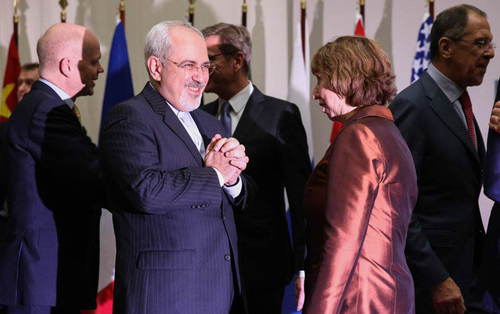
Iran and world powers sign an interim agreement (Photo: AP)

Prof. Litvak asserted the Iranians were only fulfilling their obligations because sanctions imposed on the country have yet to be removed, and Tehran is under pressure to relieve the Iranian economy.

Considering the IAEA report, is an Israeli military strike on Iran still relevant?

“Israel’s military option doesn’t exist right now because there is no chance the Americans would give Israel a green light for a military operation as long as there are negotiations with Iran on a permanent agreement.”

Prof. Litvak warned that “an Israeli military strike against Iran while international negotiations under the auspices of the United States continue would be a grave mistake. It would be an irresponsible move.”

Dr. Emily B. Landau, the head of the Arms Control and Regional Security Program at the Institute for National Security Studies (INSS), noted that while the Iranians are indeed complying with the interim agreement, their commitment is very limited.

“At first we heard a lot about the fact Iran is stopping its (nuclear) activity and in return receiving sanctions relief to give them some breathing space to negotiate a permanent agreement. But in actuality, it all comes down to their commitment to stop 20 percent uranium enrichment, and diluting the existing stockpile of 20 percent enriched uranium.”

While the IAEA report notes the Iranians now have very few kilograms of 20 percent enriched uranium left, “you have to remember these processes are reversible. Meaning, you can turn the diluted uranium back to 20 percent,” Dr. Landau said. “So while they are complying with the interim agreement, they continue 5 percent uranium enrichment.”

Iran also continues research and development of new and advanced centrifuges that can spin at very high speeds, an issue that is not addressed in the interim agreement.

“It’s very concerning, because the moment you have centrifuges that spin in much higher speeds, you can enrich the 5 percent uranium to levels higher than 90 percent, much faster,” Dr. Landau explained.

“It neutralizes the importance of limiting enrichment to 20 percent. The Iranians are not allowed to use these advanced centrifuges, and they are indeed not using them, but they’re allowed to conduct experiments. As long as they keep working on them, their nuclear program hasn’t been stopped,” she added.

Dr. Landau agreed with Prof. Litvak’s assertion that as long as the international community is negotiating with Iran on its nuclear program, a military option is not realistic.


Iranian commander says collapse of US empire is near

May 29, 2014

Iranian commander says collapse of US empire is near, Jerusalem PostAriel Ben Solomon, May 29, 2014

(Many who watched President Obama’s foreign policy “reset” address at West Point on Wednesday appear also to consider that America’s foreign policy has reached a low point, albeit for different reasons. See, e.g., Obama’s Fantasy World:

America in decline has been the operating premise of the Obama administration from Day One; “leading from behind” is is how they have sought to manage that decline. But the president, having been hammered for being both weak and inept, is now personally leading a PR campaign to twist things around. He wants you to believe that leading from behind is really leading from ahead. And if you are Barack Obama, post-modernist, facts are subordinated to “narrative.”

See also How did the world react to Obama’s outline of the US global role? — DM)

Iran’s Foreign Minister slams Israel’s attempts to set red lines on the country’s nuclear program.

The commander also said, according to the report, that Iran continued to gain military and economic power, warning the country’s enemies that their plots against it would fail.

“Any enemy formula will entail an unexpected ending for him and this is due to the Iranian nation’s reliance on religious and Islamic beliefs,” added Salami.

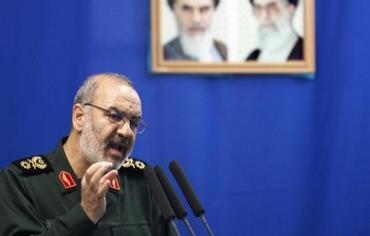
Hossein SalamiHossein Salami, deputy head of Iran’s Revolutionary Guard. Photo: REUTERS

Deputy Commander of Iran’s Revolutionary Guard, Brig.-Gen. Hossein Salami, said that the US status in the world has deteriorated and that its collapse is near.

“Today nowhere in the Muslim world” does anyone pull out “a red carpet for American officials and that’s why [US President Barack] Obama secretly” showed up at Bagram military base in Afghanistan without first letting President Hamid Karzai know, said Salami, according to a report by Iran’s Fars News Agency.

“And this shows that the US Empire in the world is coming to an end,” he said.

Obama made a surprise visit to Afghanistan on Sunday and spoke to the Afghan president, but did not meet with him.

The Afghan president rejected an invitation extended through the US embassy to meet Obama at Bagram.

“President Karzai said he would warmly welcome him if he comes to the palace but in no way he would go (to) Bagram to meet him,” Abdul Karim Khurram, Karzai’s chief of staff, told Reuters.

A US official said the White House was not surprised that the proposed visit did not work on short notice.

The commander also said, according to the report, that Iran continued to gain military and economic power, warning the country’s enemies that their plots against it would fail.

“Any enemy formula will entail an unexpected ending for him and this is due to the Iranian nation’s reliance on religious and Islamic beliefs,” added Salami.

Meanwhile, Iran’s Foreign Minister, Mohammad Javad Zarif, slammed Israel’s attempts to set red lines on the country’s nuclear program at a ministerial conference of the Non-Aligned Movement in Algeria on Wednesday.

“Is this not insolence towards the international law and the Non-Proliferation Treaty that (Israel) a non-member of NPT, which has massive nuclear arsenals and poses major existential threats to the entire Middle East region, sets redlines on Iran’s peaceful nuclear program?” said Zarif, Iran’s Tasnim News Agency reported.

He added that attempts to paint Iran as a threat to the region and the world have repeatedly turned out to be “total lies” and that the country is opposed to nuclear weapons.

Separately, Iranian and Russian officials met in Tehran on Wednesday in order to expand trade cooperation, Fars reported.

Russian ambassador to Iran, Levan Djagaryan, met the head of Iran’s Customs Administration, Massoud Karbasiyan.

“Iran and Russia are going to sign a new document on customs cooperation,” said Karbasiyan.

For his part, the Russian ambassador called for improved bilateral trade.

Current trade is worth around $5 billion a year, according to media reports.

How did the world react to Obama’s outline of the US global role?

May 29, 2014

How did the world react to Obama’s outline of the US global role? Christian Science Monitor, Ariel Zirulnick, May 29, 2014

President Barack Obama‘s long-awaited foreign policy speech Wednesday left most wanting more. Widely criticized as lacking any concrete proposals or guideposts for future foreign engagements, the speech garnered only muted reaction overseas. 

It listed some problems, outlined some principles, but did not lay out any real goals or even a hint of what America’s objectives in the world should be going forward.

A daily roundup of terrorism and security issues.

President Barack Obama‘s long-awaited foreign policy speech Wednesday left most wanting more. Widely criticized as lacking any concrete proposals or guideposts for future foreign engagements, the speech garnered only muted reaction overseas.

The key announcement was that of a $5 billion “counterterrorism partnership fund” that would be earmarked for capacity building in other countries on the “front lines” of the effort to combat global terrorism, which Obama called the paramount threat to the homeland.

As The Christian Science Monitor summed it up:

But other than the new counterterrorism partnership fund, the speech was devoid of initiatives or proposals and instead seemed aimed at refuting mounting criticism both domestically and among some worried international partners that his foreign policy is weak and rudderless.

The president asserted that by virtue of its economic power, unmatched military, values, and spirit of innovation, America will remain the world’s “exceptional” leader. The real question, he said, is not “whether America will lead, but how we will lead.”

But other than virtually ruling out American boots on the ground in foreign conflicts and emphasizing international partnerships, Obama’s speech gave few specifics on the “how” of US global leadership for the remainder of his presidency.

Foreign Policy columnist David Rothkopf echoed that take: “It provided neither reassurance to allies nor anything remotely like a foreign-policy vision. It listed some problems, outlined some principles, but did not lay out any real goals or even a hint of what America’s objectives in the world should be going forward.” News website Vox may be one of the only US outlets who found his speech a “unified, tightly focused vision of America’s role in the world.”

BBC North America editor Mark Mardell did a line-by-line analysis of the speech. He scoffed at the announcement of more assistance for Syria and the counterterrorism fund as too late in the game and found most of the speech predictable.

The problem with this speech is that it is a restatement of Mr Obama’s policy, not a re-evaluation. He’s defending a policy that has manifestly failed to produce a stable world free from crisis and turmoil. That doesn’t mean anyone else would have had better luck with a different sort of policy – but it does mean he is defending something that has not had many success. He’s avoided a world where America is up to its arms in new wars – but he has hardly brought forth a shining new dawn for peace and democracy. To some questions, there are no answers, but saying so is hardly glorious.

At the Carnegie Endowment for International Peace in Europe, Judy Dempsey, the editor-in-chief of their Strategic Europe publication,chastised European leaders for going along with US policy in the past and challenged them to come up with their own independent foreign policy. “For far too long, most European leaders were relieved to have America do their dirty work,” she wrote, citing Europe’s toothless condemnation of the Guantanamo Bay detention center.

Yet behind these words is a retreat to a special kind of soft power. Obama wants to establish new counterterrorism partnership fund designed to train and “facilitate partner countries on the front lines.” He intends to work with European allies “to train a functioning security force and border patrol in Libya and [support] French operations in Mali.” There was very little mention of the role of NATO.

European leaders should not feel vindicated by Obama’s speech. They have been wobbly over Russia and inconsistent over defending their values. If anything, they should realize that the United States is no longer going to do the running for the Europeans. Since that is the case, what about the Europeans replying to Obama with their own foreign and security policy doctrine?

Predictably, Pakistan‘s coverage on the speech focused on Obama’s comments on drone strikes there – never openly acknowledged by the US, but explicitly stated by Pakistani journalists – and US plans to scale down its military role in Afghanistan, which have significant implications for Islamabad. The Dawn headlined its story “Obama stresses need for transparency in strikes.”

In an indirect reference to the CIA, which runs the drone programme for Pakistan, President Obama noted that the US intelligence community had done outstanding work. “But, when we cannot explain our efforts clearly and publicly, we face terrorist propaganda and international suspicion; we erode legitimacy with our partners and our people; and we reduce accountability in our own government.”

Every US administration has taken a stab at the Israeli-Palestinian peace process, and Obama was no exception. Secretary of State John Kerry made frequent trips to the region to thrash out a framework for an agreement, but those efforts fizzled last month with no sign of a Plan B. The US now seems to be taking a break from its thwarted peacemaking. Indeed, the only mentions of Israel in Obama’s speech were in relation to US interests in Iran and Egypt.

Israelis noticed. From Haaretz:

To say that the Israeli-Palestinian peace process was conspicuously absent from U.S. President Barack Obama’s speech at West Point on Wednesday is an understatement. Administration officials tried to downplay the significance of the omission, but the facts speak for themselves: Obama devoted almost 5,000 words to outlining America’s foreign policy in the coming years, none of them touching on what was described until recently as one of its primary, strategic objectives. And the Palestinians? Nothing. Gurnischt. Not a peep.

“This was a speech focused primarily on security issues. It was not our intent to discuss every aspect of our foreign policy,” the officials said. That’s one explanation. The others are that Obama saw no reason to include such an abject failure in the list of successes that he detailed; that he actually has no intention of doing anything about the peace process under any circumstances; and – most importantly – that he’s truly fed up. Yes, yes, fed up with both sides, but not equally, because it is on the Israeli side that one finds most of the critics and detractors that he tried to confront in his speech.

The Times of Israel also noted the exclusion at the end of its story on the speech.

Attention will now turn to East Asia, as Japanese Prime Minister Shinzo Abe prepares to unveil his own foreign policy doctrine at a regional security conference in Singapore on Friday. He is expected to address his plans for a greater role for the Japanese military and for the ongoing face-off with China in the South and East China Seas, The Wall Street Journal reports.

Sudan says it declined Iran air defense offer after alleged Israeli attack

May 29, 2014

Sudan says it declined Iran air defense offer after alleged Israeli attack | JPost | Israel News.

By REUTERS

05/29/2014 16:15

Iran offered to set up air defense platforms on the Western coast of the Red Sea after 2012 air strike attributed to Israel.

Fire engulfs the Yarmouk ammunition factory

Fire engulfs the Yarmouk ammunition factory Photo: REUTERS/Stringer

DUBAI – Sudan turned down an Iranian offer to set up air defenses on its Red Sea coast after a 2012 air strike Khartoum blamed on Israel, fearing they would upset Iran’s regional rival Saudi Arabia, Sudan’s foreign minister was quoted as saying on Thursday.

In an interview with the Saudi-owned al-Hayat newspaper that seemed aimed at improving frosty ties with Riyadh, Ali Karti played down Khartoum’s links to Iran and to the Muslim Brotherhood, which is outlawed in Saudi Arabia.

“Iran, in truth, offered to set up air defense platforms on the Western coast of the Red Sea after the latest Israel raid, but Sudan rejected that because this would require Iranian arms experts (on the ground),” Karti said during a recent visit to Saudi Arabia, al Hayat reported.

“We rejected that because it is an Iranian presence against Saudi Arabia, something which we do not accept,” he added.

The 2012 air strike killed four people and partially destroyed an arms factory in Khartoum. Sudan blamed Israel, which did not comment at the time on the accusations.

Israeli officials have in turn accused Sudan of funneling weapons from Iran to the Islamist Palestinian group Hamas in the Gaza Strip. Iranian officials were not immediately available for a comment on Karti’s comments.

Sunni-powerhouse Saudi Arabia, a key regional ally of the United States, has been locked in a contest with non-Arab Shi’ite power Iran for influence in the Middle East.

The rivalry has effectively divided the region into two camps, with countries either allied to Saudi Arabia or to Iran.

QATAR FACTOR

Sudan has been entangled in a complex web that put it at odds with Saudi Arabia when the world’s top oil exporter tried to shore-up Egypt’s military-backed government in its struggle with the Muslim Brotherhood after the army ousted Islamist President Mohamed Morsi from power last year.

Sudanese media have said Karti traveled to Saudi Arabia two weeks ago for talks with Saudi Foreign Minister Prince Saud al-Faisal to improve ‘lukewarm’ ties between the two countries.

Karti denied that Khartoum supported the Muslim Brotherhood, which has been outlawed by Egypt as well as Saudi Arabia and the United Arab Emirates. The Brotherhood’s embrace of the ballot box challenges the principle of dynastic rule in the Gulf.

“There is a belief in the Gulf states that we have feelings towards the Muslim Brotherhood in any country in the Gulf or even in Egypt. But Sudan has refused to join the Muslim Brotherhood group,” Karti said, according to al-Hayat.

Sudan said last month after a visit by Qatar’s Emir Sheikh Tamim bin Hamad al-Thani that Doha would deposit $1 billion at Sudan’s central bank as part of an aid package to Khartoum – a move likely to be seen in the region as evidence of Sudan’s ties to Qatar, an ally of the Brotherhood.

In his interview with al-Hayat, Karti also played down Sudan’s relationship with Tehran. “Our ties with Iran are quite ordinary,” Karti said.

Israel Warns Cruz Against U.S.-Iran Deal

May 29, 2014

Israel Warns Cruz Against U.S.-Iran Deal | TheBlaze.com.

Israel Warns Cruz Against U.S. Iran Deal

Sen. Ted Cruz (R-Texas) came away from meeting with Israeli leaders struck by their unanimous opposition across political lines to the U.S. negotiations with Iran.

“I met with roughly a dozen senior officials in Israel across political parties and across political views, and every single leader with whom I met, number one viewed the prospect of Iran gaining nuclear weapons capability as the gravest national security threat facing Israel and facing the United States,” Cruz said in a conference call with reporters Wednesday.

“Number two, every single leader across the political spectrum viewed the current deal being negotiated in Geneva, as in the words of Prime Minister Netanyahu, a very, very bad deal and a historic mistake,” Cruz added.

While in Israel Tuesday, Cruz met with Prime Minister Benjamin Netanyahu, Knesset Speaker Yuli Edelstein, Defense Minister Moshe “Bogi” Ya’alon, opposition leader Bogie Herzog, Intelligence Minister Yuval Steinitz and Israeli Gen. Yossi Kuperwasser.

It was the first leg of Cruz’s international trip. The rest was in Eastern Europe where he met with government and religious leaders in Ukraine Wednesday, including recent President-elect Petro Poroshenko. He was set to fly to Poland Wednesday night before going to Estonia on Thursday. The swing through international hot spots could bolster the conservative freshman senator’s expected 2016 presidential campaign.

The Obama administration is working with Iranian President Hassan Rouhani to prevent the Islamic republic from getting nuclear weapons capabilities. But critics of the deal fear easing of sanctions on Iran could pose risks.

Cruz supports a bill sponsored by Sens. Mark Kirk (R-Ill.) and Bob Menendez (D-N.J.) to establish triggers for re-imposing sanctions on Iran. He blamed Senate Majority Leader Harry Reid (D-Nev.) for blocking the bipartisan bill. The Obama administration opposes the sanctions based on concerns it will harm the negotiations.

“With respect to Iran, I believe we are repeating the same mistakes of the Clinton administration in 1990s with respect to North Korea,” Cruz said. “In the 1990s, we relaxed our sanctions against North Korea response to vague and worthless promises just like those in Geneva now. As a consequence, billions of dollars flowed to North Korea and North Korea used those funds to develop nuclear weapons.”

In addition to meeting with Poroshenko Wednesday, he also met with Jewish and Catholic leaders in Ukraine, and talked about the “awakening of the Russian bear,” regarding Russian President Vladimir Putin’s military aggression toward the country.

The next legs of his trip were to Poland and Estonia, which he said are “on the frontlines of being next.”

“A great many of our allies in Eastern Europe are watching what’s happening in Ukraine, this renewed aggression and feeling considerable unease that they may well be next,” Cruz said.

Iran’s Strategy to Develop Nuclear Weapons

May 29, 2014

Iran’s Strategy to Develop Nuclear Weapons, Gatestone Institute Harold Rhode and Joseph Raskas, May 29, 2014

Western concessions have . . .  only bolstered the determinations of the Iranians to maintain their nuclear program until they can run out the clock on negotiations and achieve their goal of acquiring nuclear capability. But it is we in the West who are eagerly allowing them to do so.

[T]he Iranians have extracted substantial, irreversible concessions from the West in exchange for illusory, reversible limits on its nuclear program. Western concessions have therefore only bolstered the determination of the Iranians to maintain their nuclear program until they can run out the clock on negotiations and achieve their goal of acquiring nuclear capability.

Westerners seem to have a massive capacity to ignore bad news – as if dispensing with information that is either harmful or inconvenient will simply make problems go away. The Europeans and Americans seem to know perfectly well what Iran’s strategy is, but appear to have chosen to ignore how the Iranians are succeeding at pursuing their goals.

When the Iranians, then one of the most advanced and mightiest empires on earth, were conquered in 636 CE by what they deemed one of the most primitive peoples on earth – the Muslim Arabs – they felt deeply shamed. Ancient Persian descriptions reportedly refer to Arabs as “rodent eaters and lizard eaters.”[1]

At that time, Iranians, also known as Persians, who had ruled over countless ethnic and religious nationalities for more than 1,110 years, may have felt superior to the nomads inhabiting the border areas of their vast empire.

It was these desert nomads, however, the Muslim Arabs, who, within 100 years after the death of their prophet, Muhammad, in 632 CE, transformed the Middle East into today’s Arab World – except for Iran.

Although possibly devastated by the rapid spread of Arab culture and influence, the Iranians soon developed effective measures to bend this arc of Arab influence towards Iranian culture. The Iranians apparently indicated to the Arabs that it was all right to be ruled by them, but, as they, the Iranians, had more than a millennium of experience in ruling a vast empire, kept offering to show them how do it properly.[2]

Persian culture eventually defeated the culture that the victorious nomadic Arab Muslims had brought with them from Arabia. Although the rulers were Arab Muslims, pre-Islamic Persians would have had no trouble recognizing the cultural similarities between both empires.

But the indigenous Arabs may not have been willing recipients of this gift; the Iranians began smothering the Arab desert culture by deception – essentially superimposing Persian culture on the Abbasid Empire.[3] Even the name of the capital of the great Abbasid Empire, Baghdad,[4] is Persian (meaning, “God gave”).

Eventually, the Persians seem to have perfected the “art of deception” (in Persian: ketman or taqiyah). Taqiyahmeans dissimulation; ketman means paying lip service to someone in a position of authority while disagreeing with what they are saying. Both methods consist of telling someone who might harm you what you think they want to hear, as telling the truth might be dangerous.[5] The Persians also perfected ta’arof – the use of extremely polite gestures to demonstrate to others that you are superior to them.[6] As one pursues dominance and control, the enemy becomes overpowered. One rarely even grasps that he or she is being humiliated – and ultimately defeated – until it is too late. This concept is totally alien to Western culture.

Iran’s President, Hassan Rouhani, is likely wielding this strategy against President Obama and the other European leaders, with whom Iran is “negotiating” over its nuclear program. Iranian rulers have employedketman and ta’arof to lull their modern day opponents – the P5+1 – into a false sense of complacency. They have been using deception, obfuscation, and extreme outward politeness to outmaneuver their opponents. This is especially clear from the way Rouhani constantly talks about the chances of success for the negotiations, while at the same time setting demands which the West cannot tolerate. If things go as the Iranians plan, Iran will have the time it needs to acquire nuclear capability. In turn, America and its P5 +1 allies will be humiliated.

In the meantime, the Iranians have extracted substantial, irreversible concessions from the West in exchange for illusory, reversible limits on its nuclear program. Western concessions have therefore only bolstered the determination of the Iranians to maintain their nuclear program until they can run out the clock on negotiations and achieve their goal of acquiring nuclear capability.

Westerners seem to have a massive capacity to ignore bad news – as if dispensing with information that is either harmful or inconvenient will simply make problems go away. The Europeans and Americans seem to know perfectly well what Iran’s strategy is, but appear to have chosen to ignore how the Iranians are succeeding at pursuing their goals.

With patience and a deep sense of history, the Iranians apparently miss nothing. They, along with everyone else, can recall that the U.S. failed to prevent India, Pakistan, and North Korea from developing nuclear weapons. They may well have decided that they can acquire nuclear capability as well. Other countries in the Middle East seem to be deciding that, too.

The Iranians also appear to understand the nature of their opponents. They, along with everyone else, have observed President Obama, who has emphatically repeated that Iran will not be allowed to develop a nuclear weapon on his watch. Indeed, the president has said, “all options are on the table” regarding Iran, including the “military component.”[7]

But any threat of military force is credible only if the opposing party believes it is. President Obama has never displayed any credible action to back up his alleged threats.

He showed little support for the people of Syria when their government attacked them with chemical weapons, or for the people of Ukraine when Russia invaded. The latter was a clear violation of the Budapest Treaty, in which the Ukrainians gave up their nuclear program in exchange for guarantees of international of protection. They might now regret ever signing it.

The president did nothing either to protect, help, or retaliate against an attack on a U.S. Ambassador and four Americans in Benghazi, Libya on 9/11/12. The only person to spend time in jail for it was a filmmaker, scapegoated by the administration.

Indeed, the President has displayed behavior that has actually undermined his threats, not bolstered them. In 2012, President Obama was caught by a live microphone telling Russia’s then-President, Dmitri Medvedev, that he would have “more flexibility” to negotiate missile defense after the 2012 U.S. presidential election. The Iranians must have wondered on what other issues the president might be “flexible.”

Rather than project strong U.S. leadership with key American allies, President Obama’s intentions seem to be a willingness to back down in front of any opponent for supposed political gain, even though the costs of addressing these accumulating threats later are growing every day.

Obama’s policies toward Egypt, Libya, and Syria have further undermined America’s influence in the Middle East, as well as the confidence of any country to count on America to protect it. In every upheaval, instead of making strong cases for either American intervention or non-intervention, President Obama described his overall foreign policy approach as “hitting singles,”[8] a cautious, diplomacy-first approach.

The Iranians do not seem to be deterred by a president who appears unwilling to use the levers of hard power to deter his enemies. More likely, the Iranians will bring in someone who will give up a few singles – although, so far, they have not even had to do that – in favor of long-term home runs.

In supporting the candidacy of Hassan Rouhani – a so-called “moderate,” whose self-described negotiating strategy was to create “gaps in the Western front”[9] – Tehran has made its intention to accelerate its lunge toward nuclear capability unmistakably clear.

While some cultures stab their enemies in the back, the Iranians stab their enemies in the stomach. With a straight face, the Iranians have looked the West in the eye and effectively said: Hey, you don’t mind if we enrich while you talk, do you?

To reassure the West after the failure of each round of talks, Rouhani has “expressed optimism” that an agreement will be reached in the future.[10] Such statements, among others, are the Iranian way of pacifying its enemy, while the Ayatollahs quietly continue enriching uranium and building intercontinental ballistic missiles – even faster.
Happy Zarif with AshtonA visibly delighted Mohammad Javad Zarif, Foreign Minister of Iran, chats with EU foreign policy chief Catherine Ashton in Geneva on Nov. 24, 2013, after announcing the nuclear agreement with Iran. (Image source: Iranian Students News Agency).

The gap between Western and Iranian demands is evidently unbridgeable. Iran cannot accept what the West generally, and Israel especially, are prepared to allow: at a minimum, removing 15,000 centrifuges, shutting down its uranium enriching underground military bunker at Fordo, downgrading the reactor at its plutonium-production facility at Arak, and agreeing to a 20-year inspection regime. Iran would also have to export its entire stockpile of enriched uranium, which can produce approximately six bombs.[11]

A “good” deal for the West would consist of compelling Iran to comply fully with IAEA demands and six mandatory UN Security Council Resolutions, which demand that Iran suspend all enrichment, reprocessing, and heavy water activity. Parchin – a site which the IAEA believes contains “strong indicators” of having been used for explosives tests related to “possible nuclear weapon development”[12] – would be put under international scrutiny.

Many Iranians, however, have made clear they intend to expand their nuclear program – not restrict it. Ali Akbar Salehi, for instance, the head of Iran’s nuclear energy agency, said he wants to install 30,000 additional centrifuges to enrich enough uranium to fuel Iran’s Bushehr nuclear power station.[13] On May 25, 2014, Brigadier General Hossein Dehqan, Iran’s defense minister, rejected the demands of U.S. Secretary of Defense Chuck Hagel, who demanded that Iran’s missile program should come under negotiation in the talks. Dehqan described Iran’s missile capability as “defensive and not negotiable.”[14]

Meanwhile, the centrifuges keep spinning.

Should this activity continue, Iran’s Sunni neighbors fear that they will have to kowtow to the Shiites – a major goal of Shiite Iran. Humiliating the Sunnis has been a Shiite goal since their prophet Muhammad died in 632 CE.[15]

Ketman and ta’arof have effectively enabled Iran to defeat its enemies, the Sunni Arabs, yet again – as well as the West. The Iranians have, in the words of one observer, sold us the same rug twice. But it is we in the West who are eagerly allowing them to do so. [16]


[1] In Persian “Mush-Khor” and” Marmulak-Khor”
[2] For a description of how the Persians explained the methods of kingship to the Arabs, see Nizam al-Mulk. His book is called Siyasat nameh, i.e. “Book of Government”or “Rules for Kings.”
[3] Ibid.
[4] Baghdad was the capital of the Abbasid Empire from its founding in 750 until the Mongols sacked the city in 1258.
[5] For more on this concept, see Jerusalem Center for Public Affairs, The Source of Iranian Negotiating Behavior, Example #4, Ketman/Taqiyah: Masking One’s True Thoughts – Dissimulation
[6] For example, if three people are walking toward a door, one of them might rush ahead to open the door, meanwhile causing the other two to have a collision that will humiliate them.
[7] New York TimesObama Says Iran Strike Is an Option, but Warns Israel
[8] Office of the Press Secretary, Remarks by President Obama and President Benigno Aquino III of the Philippines in Joint Press Conference
[9] Times of IsraelIran’s plan: Isolate US in P5+1 talks to gain advantage
[10] Press TV, Final nuclear agreement benefits all: Rouhani
[11] Institute for Science and International Security, Defining Iranian Nuclear Programs in a Comprehensive Solution under the Joint Plan of Action
[12] International Atomic Energy Agency, Implementation of the NPT Safeguards: Agreement and relevant provisions of Security Council resolutions in the Islamic Republic of Iran
[13] Press TV, Iran must build 30,000 more centrifuges to feed Bushehr: AEOI
[14] Fars News Agency, DM: Iran’s Missile Program Not for Negotiations
[15] Khomeini himself alluded to this when he first stepped onto the tarmac, when he returned to rule Iran in February 1979. He stated that he had come to rectify a wrong that had taken place 1400 years ago.
[16] For more information on how Iranians negotiate, see: The Sources of Iranian Negotiating Behavior.