Archive for May 28, 2014

Obama: ‘Very real chance’ of agreement with Iran

May 28, 2014

Obama: ‘Very real chance’ of agreement with Iran, Times of IsraelRebecca Shimoni Ssoil, May 28, 2014

(“America should never ask permission to protect our people, our homeland, or our way of life.” Israel, on the other hand, should ask permission before doing such things? — DM)

US president pushes international partnerships in confronting Tehran, Assad, and a decentralized but still dangerous al-Qaeda

 Obama delineated the boundaries for American military action, telling the graduating cadets that “the United States will use military force, unilaterally if necessary, when our core interests demand it – when our people are threatened; when our livelihood is at stake; or when the security of our allies is in danger.”

“In these circumstances, we still need to ask tough questions about whether our action is proportional, effective and just.”

Striking an anticipated chord balancing between US engagement and internationalism, Obama told the graduates that “international opinion matters. But America should never ask permission to protect our people, our homeland, or our way of life. [Emphasis added.]


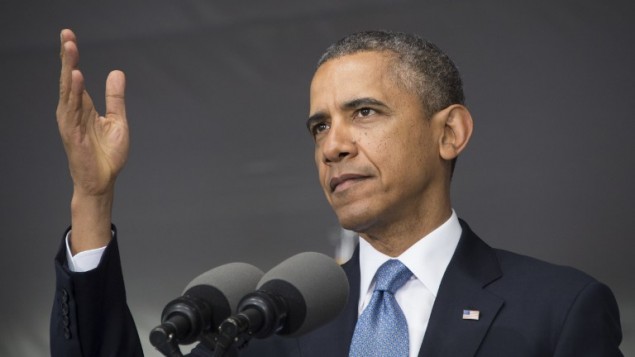
Obama at West PointUS President Barack Obama delivers the commencement address to the 2014 graduating class at the United States Military Academy at West Point, New York, Wednesday, May 28, 2014 (photo credit: AFP/ Jim WATSON)Read more: Obama: ‘Very real chance’ of agreement with Iran

WASHINGTON — In a much-anticipated speech delineating his foreign policy for the remainder of his term in office, US President Barack Obama said Wednesday that his administration’s refocus toward international cooperation provided a new opportunity to resolve tensions over Iran’s nuclear program. While warning that the odds of success are “still long” in getting Iran to give up its nuclear weapons development, he said that “for the first time in a decade, we have a very real chance of achieving a breakthrough agreement.

Despite frequent warnings from the United States, Israel, and others, the Iranian nuclear program steadily advanced for years,” Obama recalled, explaining why his new policy emphasized cooperation rather than unilateral American action. “But at the beginning of my presidency, we built a coalition that imposed sanctions on the Iranian economy, while extending the hand of diplomacy to the Iranian government.”

Obama said that the US-led international coalition has afforded “an opportunity to resolve our differences peacefully” with Iran.

“The odds of success are still long, and we reserve all options to prevent Iran from obtaining a nuclear weapon. But for the first time in a decade, we have a very real chance of achieving a breakthrough agreement – one that is more effective and durable than what would be achieved through the use of force,” he argued. “Throughout these negotiations, it has been our willingness to work through multilateral channels that kept the world on our side.”

During his speech to the 2014 graduating class at the United States Military Academy at West Point, Obama delineated the boundaries for American military action, telling the graduating cadets that “the United States will use military force, unilaterally if necessary, when our core interests demand it – when our people are threatened; when our livelihood is at stake; or when the security of our allies is in danger.”

“In these circumstances, we still need to ask tough questions about whether our action is proportional, effective and just.”

Striking an anticipated chord balancing between US engagement and internationalism, Obama told the graduates that “international opinion matters. But America should never ask permission to protect our people, our homeland, or our way of life.”

Obama said that the “threshold” for military action “must be higher” in situations that are of “global concern” but “do not pose a direct threat to the United States.” In the president’s vision, the higher threshold means that the US must seek international partnership and collective action in such cases.

“We must do so because collective action in these circumstances is more likely to succeed, more likely to be sustained, and less likely to lead to costly mistakes,” Obama explained.

Terrorism, said the president is “the most direct threat to America at home and abroad” for the foreseeable future. He warned, however, that “a strategy that involves invading every country that harbors terrorist networks is naïve and unsustainable.”

Instead, Obama said that he drew upon “the successes and shortcomings of our experience in Iraq and Afghanistan” to shift Washington’s counterterrorism strategy to one that will “more effectively partner with countries where terrorist networks seek a foothold.”

Obama described al-Qaeda as a decentralized threat with extremist affiliates, many of whom have focused their energies on targets in their host countries rather than on far-off targets on American soil.

“This lessens the possibility of large-scale 9/11-style attacks against the homeland, but heightens the danger to US personnel overseas,” he explained. “We need a strategy that matches this diffuse threat, one that expands our reach without sending forces that stretch our military thin, or stir up local resentments.”

Obama discussed successes in combating the core of al-Qaeda and “an insurgency that threatened to overrun the country” in Afghanistan, but noted that the military successes had to be reinforced by strengthening Afghan institutions.

A day after announcing that the US was moving toward what he described Wednesday as a “train and advise mission” in Afghanistan, the president emphasized that the reduced presence in the country “will allow us to more effectively address emerging threats in the Middle East and North Africa.”

Obama called on Congress to support a Counterterrorism Partnership Fund of up to $5 billion to bankroll a plan for what he termed “a network of partnerships from South Asia to the Sahel” in which the US will train, build capacity, and facilitate partner countries facing counterterror challenges.

Among those missions, he listed “training security forces in Yemen who have gone on the offensive against al-Qaeda, supporting a multinational force to keep the peace in Somalia, working with European allies to train a functioning security force and border patrol in Libya, and facilitating French operations in Mali.”

Obama said that one “critical focus” of the US’s effort would be the three-year-old crisis in Syria.

“As president, I made a decision that we should not put American troops into the middle of this increasingly sectarian civil war, and I believe that is the right decision,” he explained. “But that does not mean we shouldn’t help the Syrian people stand up against a dictator who bombs and starves his people. And in helping those who fight for the right of all Syrians to choose their own future, we also push back against the growing number of extremists who find safe-haven in the chaos.”

Obama said that the additional resources would be used to support Jordan, Lebanon, Turkey and Iraq — both in supporting refugees and battling extremists spilling over their borders.

“I will work with Congress to ramp up support for those in the Syrian opposition who offer the best alternative to terrorists and a brutal dictator,” he promised, while assuring that the US would seek to do so as part of an international partnership.

Obama spoke to his more interventionist critics, saying that his new policy did not preclude taking direct action against terrorists. He did, however, warn that “in taking direct action, we must uphold standards that reflect our values. That means taking strikes only when we face a continuing, imminent threat, and only where there is near certainty of no civilian casualties.”

US actions, he warned “must not create more enemies than we take off the battlefield.”

The president said that the US should be “more transparent about both the basis for our actions, and the manner in which they are carried out – whether it is drone strikes, or training partners.” In order to do so, Obama said, he would “increasingly turn to our military to take the lead and provide information to the public about our efforts.”

“When we cannot explain our efforts clearly and publicly, we face terrorist propaganda and international suspicion, we erode legitimacy with our partners and our people, and we reduce accountability in our own government,” he warned.

International cooperation was a major theme in Obama’s speech, with the president still seeking to dispel international images of American unilateralism that plagued the administration of his predecessor, George W. Bush.

He called for reexamining institutions such as NATO, the United Nations, the World Bank and the International Monetary Fund, in order to “evolve these institutions to meet the demands of today.” Obama said that international monitoring and cooperation on both the ongoing crisis in Ukraine and in confronting the Iranian nuclear threat had achieved positive results, if not yet resolutions to either situation.

Climate change, Obama said, was one non-military application for his redirection toward international cooperation. The president said that in 2015, America intends to present a global framework for combating climate change. At the same time, he slammed Republicans in Congress, complaining that “we can’t call on others to make commitments to combat climate change if so many of our political leaders deny that it is taking place.”

American leadership, he continued, demands that Washington conform to international norms and the rule of law. In an effort to do so, he said, he would continue to push to close the Guantanamo Bay detention facility and to “place new restrictions on how America collects and uses intelligence – because we will have fewer partners and be less effective if a perception takes hold that we are conducting surveillance against ordinary citizens.”

Obama acknowledged that the Arab Spring had challenged American policy and its commitment to reinforcing democratic values worldwide.

“In capitals around the globe – including some of America’s partners – there has been a crackdown on civil society. The cancer of corruption has enriched too many governments and their cronies, and enraged citizens from remote villages to iconic squares. Watching these trends, or the violent upheaval in parts of the Arab World, it is easy to be cynical,” he noted.

America’s fraught relationship with successive governmental successors to deposed Egyptian president Hosni Mubarak earned a special mention, with Obama emphasizing that Washington’s relationship with Cairo “is anchored in security interests – from the peace treaty with Israel, to shared efforts against violent extremism” rather than shared values. He warned, however, that US would continue to “persistently press for the reforms that the Egyptian people have demanded.”
 

Is the U.S. Willing to React Effectively?

May 28, 2014

Is the U.S. Willing to React Effectively? Gatestone InstitutePeter Huessy, May 28, 2014

Supporters of a deal with Iran assume three things, all questionable.

The clandestine production of nuclear weapons by rogue states promises to create what Yale Professor Paul Bracken terms an “exceedingly volatile poly-nuclear Middle East.”[1]

Against the backdrop of negotiations between the United States, Russia, China, France, Great Britain and Germany, (known as the P5+1), on the one hand and Iran on the other, his warning is particularly important.

In 1961, a leading defense analyst, Fred Ikle, wrote, “In entering into an arms-control agreement, we must know not only that we are technically capable of detecting a violation but also that we or the rest of the world will be… in a position to react effectively if a violation is discovered.”

At least five states have sought to build nuclear bombs clandestinely: Iraq, Iran, Syria, Libya and North Korea. All are or were signatories to the Nuclear Non-Proliferation Treaty [NPT], which prohibits all except the permanent five members of the UN Security Council from acquiring nuclear weapons.

During the past few decades they were given clean bills of health by the International Atomic Energy Administration, [IAEA], the UN organization monitoring nuclear energy programs to prevent them from being secretly transformed into parallel nuclear weapons programs.

The reason Iraq and Syria did not succeed in becoming nuclear weapons states was due to Israeli air strikes on their nuclear reactors in 1981 and 2007.

Iraq failed again in its quest for nuclear weapons because — in the immediate aftermath of the 1991 Desert Storm campaign, which ousted Iraq’s Saddam Hussein from the occupation of Kuwait — the U.S. discovered and destroyed Baghdad’s nuclear program.

As for Libya’s nuclear program — more advanced than the UN’s IAEA had assumed — the heart of it was interdicted at sea by the U.S. and Great Britain when they seized thousands of nuclear centrifuge parts destined for Libya. The centrifuge parts had been manufactured in Malaysia by the Pakistani nuclear smuggling network led by A.Q. Khan, the father of Islamabad’s nuclear weapons program.[2]

But North Korea?

In 1994 the Agreed Framework agreement between North Korea and the United States called for Japan and South Korea to fund the construction of two nuclear power plants in North Korea, in return for Pyongyang remaining in the NPT and making transparent its nuclear program. The agreement included North Korea’s ending any pursuit of nuclear weapons.[3]

What if Israel had not destroyed Iraq’s nuclear reactor in 1981? Saddam Hussein might very well have had a nuclear weapons capability when, in 1990, he invaded Kuwait. Might Saddam, armed with such weaponry, have continued south to seize the oil fields in the Kingdom of Saudi Arabia? And would a U.S.-led coalition then even have tried try to dislodge Iraq from Kuwait or even Saudi Arabia?

Today, we either naïvely or venally assume Iran is open to a simple trade. That is, the U.S. and its allies eliminate economic sanctions in return for Iran being transparent about its nuclear program.

This assumption misses why we have a problem in the first place.

Iran has been sanctioned because it is a terrorist-sponsoring state seeking nuclear weapons, not the other way around.

Iran is seeking nuclear weapons for what reason?

Most probably to fulfill its constitutional mandate to a) Destroy Israel; b) Stop America from protecting the Persian Gulf and our allies there; and c) Become the hegemonic power in the region. And, into the bargain, to control some two thirds of the world’s proven reserves of conventional oil and one third of its natural gas.

With Iran, we face either the North Korean 1994 spurious-deal option, which permits it to acquire nuclear weapons capability, or the Israeli 1981 and 2007 Iraq and Syria option of a military strike.

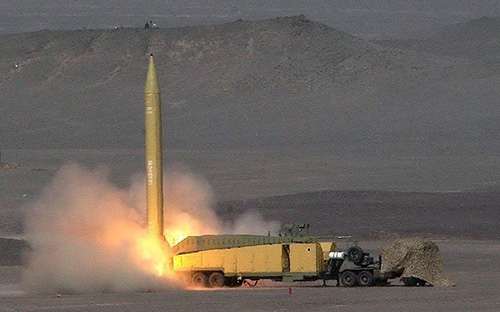
Iranian missile testAn Iranian long-range missile test in 2012. (Image source: FARS)

David Albright writes that if we choose the “deal” route, we have to ensure that any agreement with Iran totally ends its nuclear weapons capability, unlike the 1994 deal with North Korea.

Proliferation expert Professor Matthew Kroenig, of Georgetown University, alternatively argues that we should simply destroy as much of Iran’s nuclear program as possible.

However attractive a diplomatic agreement with Iran might be, its supporters assume three things, all questionable.

First, most assume we will know in a timely way of any significant Iranian breach of a new agreement.

Second, many assume that, once we find out about violations, we will muster the will to take appropriate action to end the violation. To date, however, Iran has declared the Parchin military facility off-limits, in the face of considerable evidence that suspect nuclear warhead design work has taken place there.

Third, much of conventional wisdom says “don’t worry”. For example, Spencer Ackerman of the Guardian and former CIA analyst Paul Pillar both claim that even if Iran acquires a nuclear warhead, it cannot deliver it to the U.S.

They both thus assume we have sufficient time to protect ourselves even if Iran does get a bomb.

This is wrong on two counts.

The consensus of the US intelligence community is that Iran will have an intercontinental ballistic missile [ICBM] by 2015, according to Congressional testimony on February 14, 2014 by Lt Gen Michael Flynn, director of the Defense Intelligence Agency.

Why is this?

Most Americans seem to forget that less than a year ago, North Korea showed that its missiles can now reach the U.S. if launched in a southerly direction — and demonstrated its ability to do precisely that.

Given North Korea’s extensive cooperative missile work with Iran, and that North Korea can now mate its nuclear warheads to its missiles, Iran will most likely soon learn to do likewise.

What can history tell us?

On one side, in 1981 and 2007, Israel warplanes respectively struck an Iraqi and Syrian nuclear reactor.

Great Britain and the United States in 2003 seized a Libya-bound nuclear centrifuge shipment aboard the ship BBC China after it was diverted to an Italian port.

And in 1991 the U.S. liberated Kuwait — also discovering and dismantling Iraq’s nuclear program — while using a coalition of military forces.

On the other side, in 1994 the U.S. made a “deal” with North Korea. Pyongyang cheated immediately, now has a small arsenal of nuclear weapons, and is assisting other countries in acquiring nuclear weapons.

If one is concerned about the future of the U.S. and the free world, the choice seems clear. Will politicians have the courage to make it?

[1] “The Second Nuclear Age: A Conversation with Professor Paul Bracken“, Luncheon Series, The Hudson Institute, May 6, 2014.
[2] See, for further discussion of these cases, the website of The Wisconsin Project on Arms Control, “Libyan Timeline;” “Iraq’s Real Weapons Threat” by Rolf Ekeus, Former Head of UN Inspections Effort in Iraq, The Washington Post June 29, 2003; and Micah Morrison, “New A.Q. Khan Documents Suggest Pakistan Spread Nuclear Weapon Technology“, Fox New, November 18, 2011.
[3] For an excellent chronology of these events, see “North Korean Nuclear Developments: An Updated Chronology” and “CRS Issue Brief for Congress, North Korea’s Nuclear Weapons Program“.

Israel threatened by U.S. after rejecting call to attack Syrian advance

May 28, 2014

Israel threatened by U.S. after rejecting call to attack Syrian advance – World Tribune | World Tribune.

( Not sure WHAT to make of this… – JW)

Special to WorldTribune.com

Geostrategy-Direct.com

WASHINGTON — The United States has launched a campaign against Israel in wake of its refusal to attack Syria.

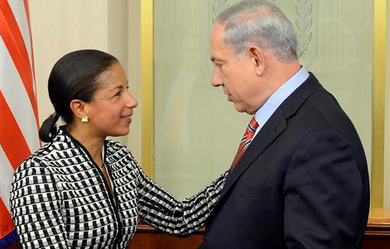
U.S. National Security Adviser Susan Rice meets with Israeli Prime Minister Benjamin Netanyahu on May 7.

Diplomatic sources said Israel rebuffed a request by President Barack Obama to attack the Syrian Army as it advanced toward rebel strongholds in the Golan Heights in May 2014. The sources said Obama’s aides, including National Security Adviser Susan Rice, warned Israeli leaders that they would regret their decision.

“The Israelis were warned that their refusal to attack [Syrian President Bashar] Assad’s forces would be very costly, and over the last few weeks there has been increasing evidence of U.S. retaliation,” a source said.

The sources said Ms. Rice and Defense Secretary Chuck Hagel rejected Israel’s explanation that an attack on the Syrian Army could spark a war that would include Iran.

Obama about-turns on Syria: US military training and weapons for moderate Syrian rebels

May 28, 2014

Obama about-turns on Syria: US military training and weapons for moderate Syrian rebels, DEBKAfile, May 27, 2014

Obama_West_Point_28.5.14President Barack Obama turns back to

Arab watchers around the Middle East are waiting agog for US President Barack Obama’s address at the US Military Academy at West Point Wednesday, May 28, as forecasts abound that he will unveil a major policy U-turn on the Syrian conflict. DEBKAfile’s military sources report that the new policy is in fact in motion ahead of the presidential disclosure. It is a program to expand US involvement in the war against the Assad regime and al Qaeda elements by providing moderate rebels with military training and a regular supply of sophisticated weapons, instead of the widely-spaced dribs and drabs hitherto. It may even include anti-air systems which Washington has withheld so far.

The Arab world sees Obama as moving to counteract Russian, Iranian and Hizballah intervention in the Syrian conflict. It is seen in some quarters as also payback for Russia’s annexation of Crimea.

At all events, a Saudi source commented in Riyadh: “For the first time in years, president Obama is ready to take direct action against Iran’s strategic interests in the Middle East.”

The West Point speech will also be watched carefully in Moscow, where expanded US input in support of the rebels is seen as a direct assault on the Russian position in Syria. DEBKAfile’s sources report that Moscow is preparing to beef up and upgrade its arms consignments to Syria so as to arm Assad for contending with the advanced American hardware incoming to the rebels.

Obama will unveil his plan for Syria the day after announcing his decision to leave 9,800 in Afghanistan – after the US combat mission is over at the end of 2014 – to train Afghan forces and support counter-terrorism operations. That decision is contingent on the next Afghan president signing a bilateral security agreement, which the incumbent Hamid Karzai refused to do. Washington appears confident that both of the candidates facing the June 14 run-off will agree to approve the accord.

The latest DEBKA Weekly 636 of May 23 disclosed President Obama’s revised approach to US military intervention in Syria, offering details of his plan. The US military training camps are already up and running, we reported. The rebel trainees arrive through Saudi Arabia, Jordan and Turkey, take the US courses and then cross into Syria.

The US army has furthermore laid out the secret routes for sending the new weapons supplies to the fighters in Syria.

By this policy reassessment, the Obama administration aims to achieve the following strategic objectives:

1. Creating a distance between the Israeli and Jordanian borders and the threats posed to those countries by the Syrian Army and its allies, Iran’s Revolutionary Guards, the Lebanese Hizballah and Iraqi Shiite militias.

2. Keeping those hostile forces at bay additionally from US military facilities in Jordan and Israel.

3. Establishing a US military intelligence foothold on the Damascus periphery to challenge Russian and Iranian exclusivity as the only major powers with operational access to the Syrian capital.

4. US military intelligence agents on the spot would seek to establish ties with high-ranking Syrian general command officers and the field commanders of units deployed in and around Damascus.

5. Creating a barrier to stave off Al Qaeda encroachments on Damascus or the Syrian-Jordanian and Syrian-Israeli borders and so preventing the jihadis from gaining jumping-off positions for attacks inside those countries.

Will Secret Diplomacy Seal Iran Appeasement?

May 28, 2014

Will Secret Diplomacy Seal Iran Appeasement? Commentary Magazine, May 27, 2014

(President Obama is the world’s greatest celebrity and therein lies his power. Rouhani and the Supreme Leader will swoon at his slightest hint of displeasure and all will be well. Right? — DM)

The Iranians’ strong negotiating position stems directly from the interim agreement that was brought about as the result of secret U.S.-Iran talks. It is difficult to imagine an international community that was reluctantly dragged into enacting sanctions in the first place, raising the pressure on Iran if no deal is reached. Nor does anyone seriously imagine President Obama ordering the use of force if the talks continue to be stalemated. As a result, there is very little reason for the ayatollahs to think they have much to worry about in the talks.

The Obama administration proved last fall that it could sell even a weak deal with Iran to the American public and brand skeptics as potential warmongers. It may be thinking that it can do the same with an even flimsier agreement negotiated in similar secrecy this year. If so, Obama may think he may have gotten himself off the hook for his many promises to stop the Iranians from getting a weapon. But such drives for appeasement that contain within them the seeds of future conflict rarely end well for the appeasers.

The latest round of nuclear talks between the West and Iran ended earlier this month without the progress toward an agreement that many had anticipated. Though the United States and its allies seem eager to sign a deal that will put a fig leaf of non-proliferation on an Iranian nuclear program that they are content to leave in place, Tehran has picked up on Washington’s zeal for a deal and is doing what its negotiators have done best for over a decade: stalling. With the international sanctions regime already starting to take on water after last November’s interim agreement that loosened the economic restrictions on Iran, the Islamist regime knows it is in a far stronger position than its Western counterparts.

But rather than reacting to this dismal situation by rethinking his approach, President Obama seems determined to double down on his determination to get a deal. As the Wall Street Journal reported on Friday, the president is revisiting the tactic he used last year to revive the moribund P5+1 talks with Iran. Rather than continuing to work with his European partners, it appears the U.S. will once again leave the multilateral negotiations and conduct bilateral talks. The assumption is that on their own, American diplomats will be able to entice the Iranians to sign on the dotted line with concessions that even the French and the British wouldn’t consider. If true, this illustrates that what the president started last year with the interim deal is a process that has one goal and one goal alone: getting a deal with Iran no matter what the price.

The Iranians’ strong negotiating position stems directly from the interim agreement that was brought about as the result of secret U.S.-Iran talks. It is difficult to imagine an international community that was reluctantly dragged into enacting sanctions in the first place, raising the pressure on Iran if no deal is reached. Nor does anyone seriously imagine President Obama ordering the use of force if the talks continue to be stalemated. As a result, there is very little reason for the ayatollahs to think they have much to worry about in the talks.

Having already won the West’s acceptance of its “right” to enrich uranium, ending the Iranian nuclear program, as President Obama pledged during his reelection campaign, is off the table. The Iranians are now only negotiating about how long it would take them to “break out” from a deal and race to a bomb. At this point the only objective of the Western negotiators appears to be to lengthen that period from a few weeks to a few months, but even this victory has not lessened Iran’s determination to drag out the talks even further.

That is why the possibility of more secret talks is such a dangerous development. Though the current multilateral negotiations have created a negotiating track that has given the Iranians much of what they wanted in the talks, the open nature of these monthly talk fests make it difficult for the Americans to sweeten the pot even further for the Iranians. Since Tehran has already openly mocked requests to include their ballistic weapons program in the talks and continue to make it hard for the International Atomic Energy Agency to monitor their facilities, including their military research sites, transparency would appear to favor at least the pretense that the purpose of the negotiations is to actually stop the Iranians from getting a bomb. But secret talks offer the possibility that Obama can go even further than his partners, who have at times balked at the open desire of Washington for an end to the confrontation with Iran at almost any price.

Iran went into this process hoping that it could achieve by Western consent what it appeared it was well on its way to achieving in spite of the push for sanctions: American approval for a nuclear program that could easily be converted to military use. If, as the Journal reported today, Iran’s weapons research scientists are still hard at work at getting closer to a bomb, the margin of error for the U.S. in this process is very small. Having conceded that Iran could amass enough nuclear fuel for a bomb, it will be harder still to craft a deal that could prevent it from taking that next inevitable state to a weapon.

The Obama administration proved last fall that it could sell even a weak deal with Iran to the American public and brand skeptics as potential warmongers. It may be thinking that it can do the same with an even flimsier agreement negotiated in similar secrecy this year. If so, Obama may think he may have gotten himself off the hook for his many promises to stop the Iranians from getting a weapon. But such drives for appeasement that contain within them the seeds of future conflict rarely end well for the appeasers.