Archive for May 27, 2014

Off Topic: ‘As of early June, IDF will begin ceasing various activities’

May 27, 2014

‘As of early June, IDF will begin ceasing various activities,’  Israel Hayom, May 27, 2014

“The significance of the emerging 2015 budgetary outline is that we will not be able to begin the year at all,” says Defense Ministry Director-General Maj. Gen. (res.) Dan Harel • “We won’t have money for the elements that produce security,” he says.

As of early June, the Israel Defense Forces will begin ceasing various activities, while certain military functions, such as vehicle repairs, are expected to dwindle one after the other, officials in the defense establishment said on Monday.

“The significance of the emerging 2015 budgetary outline is that we will not be able to begin the year at all,” Defense Ministry Director-General Maj. Gen. (res.) Dan Harel said on Monday in an interview with military correspondents at IDF headquarters in Tel Aviv, known as the Kirya.

 According to Harel, “There will be money for elements pertaining to rehabilitation and retirement, because that is the law, but we won’t have money for the elements that produce security.”

Based on the figures, the Defense Ministry’s budget for 2014 stands at 51 billion shekels ($15 billion), and the “rigid” portion of the budget, which cannot be touched, includes among other things 7.4 billion shekels ($2.1 billion) for pensions and 1.1 billion shekels ($320 million) to pay the salaries of soldiers during their mandatory service.

The areas of “flexibility” pertain to the budget for the IDF and Defense Ministry bodies. The Defense Ministry operates with a yearly budget of 1.5 billion shekels ($430 million), while the IDF operates with a budget of 26.5 billion shekels ($7.63 billion) per year. In 2015, this number is expected to drop to 22.4 billion shekels ($6.45 billion).

The defense establishment has asked that the Finance Ministry keep its promises regarding the 2014 budget, which it says were broken unilaterally. These promises, say defense officials, pertain to an agreement by the Finance Ministry to give the defense establishment parts of the amount needed to purchase new submarines and for the removal of land mines to facilitate the transfer of IDF bases to the Negev Desert. The sum of money being unilaterally withheld by the Finance Ministry stands at 2.15 billion shekels ($620 million). The defense establishment is also demanding an additional 750 million shekels ($216 million) for minimum subsistence. Regardless, according to defense officials, these funds are also not sufficient enough to reinstate training exercises for 2014.

According to Harel, “The statement that the IDF and the Defense Ministry do not know how to manage their budgets, or that there are enormous surpluses in the defense establishment that can be cut from, is blind to the facts. For years, the defense budget has gradually dropped, while instead we have seen a welcome rise in the social budget.”
State Department Apologizes for Promoting Muslim Cleric Who Backed Killing of U.S. Soldiers

May 27, 2014

State Department Apologizes for Promoting Muslim Cleric Who Backed Killing of U.S. Soldiers, Washington Free Beacon, May 27, 2014

Tweet promoting controversial cleric sparks widespread outrage

“This administration is continuing to push extremist clerics like Bin Bayyah as part of a fantasy foreign policy that somehow they are somehow a counter to al Qaeda,”

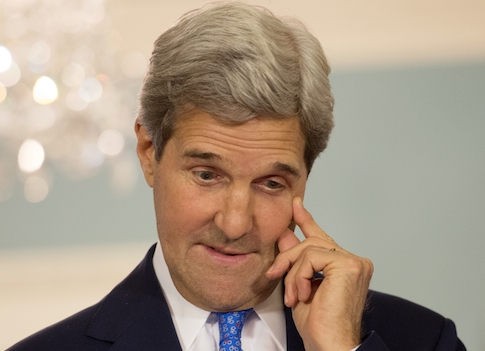
John KerrySecretary of State John Kerry / AP

The State Department’s Counter Terrorism (CT) Bureau apologized on Tuesday for promoting a controversial Muslim scholar whose organization has reportedly backed Hamas and endorsed a fatwa authorizing the murder of U.S. soldiers in Iraq.

The apology came on the heels of a Friday Washington Free Beacon report detailing the CT Bureau’s promotion of Sheik Abdallah Bin Bayyah, the vice president of a radical Muslim scholars group that was founded by a radical Muslim Brotherhood leader who has called “for the death of Jews and Americans.”

Bin Bayyah himself is one of several clerics who endorsed a 2004 fatwa, or religious order, endorsing the killing of U.S. soldiers fighting in Iraq.

The CT Bureau apologized multiple times on Tuesday for tweeting in favor of Bin Bayyah and promoting an article on his website.

“This should not have been tweeted and has since been deleted,” the CT Bureau tweeted at users who expressed anger over the original message.

“It was wrong and should not have been tweeted,” the bureau later tweeted in response to other outraged individuals.

Bin Bayyah has long been a controversial figure and his attendance at a 2013 meeting at the White House sparked a fury among critics of the Obama administration.

Bin Bayyah has served as the vice president of the International Union of Muslim Scholars (IUMS), which was founded by Muslim Brotherhood leader “who has called for the death of Jews and Americans and himself is banned from visiting the U.S.,” according to Fox News.

Bin Bayyah also has “urged the U.N. to criminalize blasphemy,” according to reports, and spoke “out in favor of Hamas,” the terror group that governs the West Bank.

The controversial cleric also took heat for issuing a fatwa in 2009  “barring ‘all forms of normalization’ with Israel,” according to Fox.

The 2004 fatwa allowing for the murder of U.S. troops in Iraq reportedly stated that “resisting occupation troops” is a “duty” for all Muslims, according to reports filed at the time.

Terrorism analyst Patrick Poole condemned the State Department’s tweet last week, stating that it must more carefully vet the Muslim leaders it promotes.

“This administration is continuing to push extremist clerics like Bin Bayyah as part of a fantasy foreign policy that somehow they are somehow a counter to al Qaeda,” Poole said. “But in Bin Bayyah’s case, it was his organization that issued the fatwa allowing for the killing of U.S. soldiers in Iraq and said it was a duty for Muslims all over the world to support the Iraqi ‘resistance’ against the United States that gave religious justification for al Qaeda’s terrorism.”

Hamas Talks to US, “Senses Change in US Position”

May 27, 2014

Hamas Talks to US, “Senses Change in US Position,” Front Page Magazine, May 27, 2014

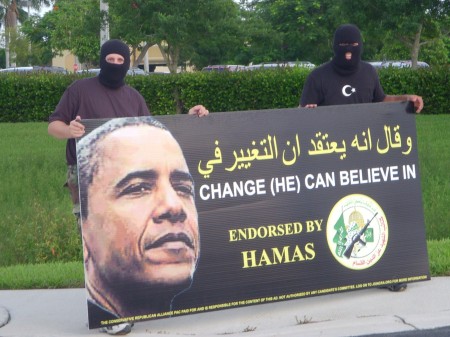
1obama-hamas-450x337

The only question is how the new Hamas-PLO government will be repackaged as Israel’s mandatory peace partners by Obama Inc.

Assuming this Frankenpalestine monster holds together, Kerry will just insist that Hamas will eventually change its position once everything has been negotiated.

I don’t know that it’s much of a change since Obama Inc. started out with backdoor contacts with Hamas and is back to backdoor contacts with Hamas.

There’s no change at all. The only question is how the new Hamas-PLO government will be repackaged as Israel’s mandatory peace partners by Obama Inc.

Hamas deputy leader Moussa Abu Marzouk, who is deeply involved in ongoing negotiations between Hamas and Fatah, said in a newspaper interview that Hamas is not opposed to the appointment of Palestinian Authority (PA) “prime minister” Rami Hamdallah as the “prime minister” of the Palestinian Arab “unity” government.

Abu Marzouk also revealed that Hamas recently held talks with the European Union (EU) and an unofficial American representative.

Hamas officials “sensed a change in the American position,” he said – hinting that the US is becoming more open to the idea of a Hamas-led “unity” Palestinian Arab government.

History suggests this unity government will fall apart, but Abbas needs it badly to sabotage negotiations with Israel, while Hamas needs to reestablish its relevance before the next conflict breaks out.

Assuming this Frankenpalestine monster holds together, Kerry will just insist that Hamas will eventually change its position once everything has been negotiated.

A Palestinian terror government

May 27, 2014

A Palestinian terror government, Israel Hayom, Zalman Shoval, May 27, 2014

The question remains as to whether Obama has internalized lessons from the mistake made by former President George W. Bush’s administration (the pressure it put on Israel to agree to Palestinian elections in which Hamas took part) or from his own mistakes regarding the Arab Spring and his support for the Muslim Brotherhood. Obama must not err again now in regard to a Palestinian government that includes Hamas.

According to unconfirmed reports from Washington, the U.S. intends to recognize the Palestinian unity government when it is established, even if Hamas does not accept the Quartet’s conditions (recognition of Israel, cessation of terror and adherence to past Israeli-Palestinian agreements). The official excuse will be that the Palestinian government will be one comprised of “technocrats,” that is to say experts, not political figures. This argument is not exactly convincing, as half of the ministers will be appointed by Hamas, a group that the U.S. itself has defined as a terrorist organization. The practical result is that the U.S. will ipso facto become a dialogue partner with a terrorist government.

We do not know yet who the experts (experts in what?) will be in the Palestinian government, but it must be assumed that they will not deviate from the line Hamas dictates to them.

In 1991, Israel demanded that the Palestinian delegation to the Madrid Conference not include official representatives of the Palestine Liberation Organization, but the U.S. chose to turn a blind eye to the fact that the members of the Palestinian delegation were receiving daily orders from the PLO headquarters in Tunis.

This time, Israel has decided not to play the game of false appearances, and it expected that the U.S. would take a similar position (Israel’s demand would have been more credible and effective had all of its government ministers stood behind it). But, as mentioned before, it appears that Jerusalem’s expectations on this matter will not be met by Washington.

“So why does Israel insist on rejecting Hamas?” some will ask. “At one time, it was also forbidden to talk with the PLO, and now it is a dialogue partner on everything.” This is indeed true, but the PLO and Fatah accepted, at least outwardly, certain rules and commitments, particularly regarding terrorism and violence, that enabled the ban on talking with them to be lifted. Hamas, on the other hand, has never forsworn terrorism. If, on occasion, Hamas has offered a “hudna” or agreed to a temporary halt of violence against Israel, this was only after the Israeli military had dealt it heavy blows or was about to. Moreover, at the Wye River Conference in 1998, Israel said that for the Palestinian commitment to peace to earn at least minimal credibility, the Palestinians would have to cancel clauses in the Palestinian National Charter that denied Israel’s right to exist and did not recognize the Jews as a people. Then-President Bill Clinton justifiably backed the Israeli demand, and the relevant clauses were annulled, at least in theory.

Israel thought President Barack Obama would follow that path and not have any contact, direct or indirect, with a Palestinian government that included Hamas unless it were to accept the Quartet’s conditions and also cancel its jihadist charter that calls for Israel’s destruction and is laced with anti-Semitic statements.

I will not go into the various theories regarding the Palestinian “reconciliation” or the doubts about the veracity or durability of this dubious move, but it is not inconceivable that this time Palestinian Authority President Mahmoud Abbas and Hamas leaders are striving for something more than just an appearance of unity.

It certainly may be that the move will set the needle in the direction of extremism, rather than moderation. Hamas officials have made it clear that they plan to follow the “Hezbollah model” from Lebanon. That is to say it will place a very limited role in civilian and administrative matters, but will reserve for itself total freedom of action as a “popular resistance organization.” The implication is clear: gaining political legitimacy while maintaining the terror option.

The question remains as to whether Obama has internalized lessons from the mistake made by former President George W. Bush’s administration (the pressure it put on Israel to agree to Palestinian elections in which Hamas took part) or from his own mistakes regarding the Arab Spring and his support for the Muslim Brotherhood. Obama must not err again now in regard to a Palestinian government that includes Hamas.


