Archive for May 26, 2014

Iran Leader: Jihad Will Continue Until America is No More

May 26, 2014

Iran Leader: Jihad Will Continue Until America is No More | The Daily Caller.

Iran’s supreme leader, Ayatollah Ali Khamenei, all but said on Sunday that negotiations over the country’s illicit nuclear program are over and that the Islamic Republic’s ideals include destroying America.

“Those [Iranians] who want to promote negotiation and surrender to the oppressors and blame the Islamic Republic as a warmonger in reality commit treason,” Khamenei told a meeting of members of parliament, according to the regime’s Fars News Agency.

Khamenei emphasized that without a combative mindset, the regime cannot reach its higher Islamic role against the “oppressors’ front.”

“The reason for continuation of this battle is not the warmongering of the Islamic Republic. Logic and reason command that for Iran, in order to pass through a region full of pirates, needs to arm itself and must have the capability to defend itself,” he said.

“Today’s world is full of thieves and plunderers of human honor, dignity and morality who are equipped with knowledge, wealth and power, and under the pretense of humanity easily commit crimes and betray human ideals and start wars in different parts of the world.”

In response to a question by a parliamentarian on how long this battle will continue, Khamenei said,“Battle and jihad are endless because evil and its front continue to exist. … This battle will only end when the society can get rid of the oppressors’ front with America at the head of it, which has expanded its claws on human mind, body and thought. … This requires a difficult and lengthy struggle and need for great strides.”

Khamenei cited the scientific advancement of the country. “The accelerated scientific advancement of the last 12 years cannot stop under any circumstances,” he said, referring to the strides the regime has made toward becoming a nuclear power.

As reported on May 19 on The Daily Caller, Iran has put up new roadblocks to reaching a deal with the P5+1 world powers over its illicit nuclear program. The powers are the permanent members of the U.N. Security Council, plus Germany.

Three days of negotiations in the fourth round of Geneva meetings ended recently without concrete results when the Iranian team presented the country’s new “red lines” — diminishing any hope by the Obama administration to claim victory in its approach to Iran’s nuclear ambitions, according to reports from Iran.

The Obama administration had hoped that with Iranian President Hassan Rouhani and Foreign Minister Javad Zarif showing an eagerness to solve the nuclear issue and address the West’s concerns, there would be a possibility for a negotiated solution. An interim agreement penned last November in Geneva was touted as an “historic nuclear deal.”

Under that agreement, Iran, in return for billions of dollars in sanctions relief, limited its enrichment activity to the 5 percent level with a current stockpile of over 10 tons (enough for six nuclear bombs), converted much of its 20 percent enriched stock to harmless oxide, and agreed to allow more intrusive inspections of its nuclear plants by the International Atomic Energy Agency, whose inspections were limited to only agreed-upon facilities.

The Iranian delegation last week presented new red lines that could not be crossed, including the expansion of the country’s research and development for its nuclear program, the need of the country to continue enrichment, and the fact that the country’s ballistic missile program — despite U.N. sanctions — is not up for negotiation.

At the same time, IAEA officials met again with their Iranian counterparts last week in Tehran to discuss information on the work on detonators and needed collaboration by the regime to clear outstanding issues on its nuclear program as part of seven transparency steps Iran had agreed to fulfill by May 15, which has yet to take place.

Reza Kahlili is a pseudonym for a former CIA operative in Iran’s Revolutionary Guards and author of the award winning book “A Time to Betray” (Simon & Schuster, 2010). He serves on the Task Force on National and Homeland Security and the advisory board of the Foundation for Democracy in Iran (FDI).
Read more: http://dailycaller.com/2014/05/25/irans-supreme-leader-jihad-will-continue-until-america-is-no-more/#ixzz32qgVMQI5

Despite nuclear probe progress, IAEA access to key Iran site elusive

May 26, 2014

Despite nuclear probe progress, IAEA access to key Iran site elusive | JPost | Israel News.

By REUTERS

05/26/2014 14:59

Iran will not be ready to address concerns about nuclear activities until the UN has access to a location at the Parchin base southeast of Tehran.

Interior of Bushehr nuclear plant

Interior of Bushehr nuclear plant Photo: REUTERS/Stringer Iran

VIENNA – The UN nuclear watchdog appears no closer to finding out what happened at a military site at the center of its investigation into suspected atom bomb research by Iran, despite signs Tehran is becoming more cooperative.

A confidential report by the International Atomic Energy Agency said Iran for the first time in years had begun engaging with a long-stymied IAEA inquiry into allegations that it may have worked on designing a nuclear weapon.

But any hope that Iran may be ready to fully address concerns about its nuclear activities will be tempered as long as it refuses to give the UN agency access to a location at the Parchin base southeast of Tehran, and information about it.

US officials say it is vital for Iran to answer IAEA questions if Washington and five other powers are to reach a broader nuclear settlement with Iran by a self-imposed deadline of July 20. However, Tehran’s repeated denials of any nuclear bomb aspirations will make it hard for it to admit to any wrongdoing in the past without losing face.

The IAEA report issued to member states late on Friday said satellite images showed “ongoing construction activities” at Parchin, a finding that could add to Western suspicions that Iran has been trying to hide any incriminating evidence of illicit nuclear-related experiments there.

“It seems clear that there is more sanitization going on,” one Western envoy said, noting indications of major alteration work at Parchin since early 2012, such as soil removal and asphalting of the specific place the IAEA wants to see.

“I can think of no other explanation for 28 months of cleanup and denied IAEA access at Parchin except an attempt to hide all traces of something from IAEA environmental sampling.”

The IAEA, which has requested Parchin access for more than two years, says it has information that Iran built a large steel chamber there for explosives tests, possibly more than a decade ago. It said back in 2011 that “such experiments would be strong indicators of possible nuclear weapon development.”

Iran denies Western suspicions that it has been seeking to develop the capability to assemble nuclear weapons. It says Parchin is a conventional military facility and has dismissed the cleansing allegations.

“The activity at Parchin gives ample reason for continued concern that Iran may be trying to remove any remaining vestiges of nuclear-related experiments,” said Mark Fitzpatrick, director of the non-proliferation program at the International Institute for Strategic Studies (IISS) think-tank in London.

But one should not leap to conclusions of guilt, he added. “The activity may also be for some entirely innocuous purpose.”

IRANIAN COOPERATION “IMPROVING”

The IAEA’s suspicions about Parchin were part of a 2011 report that included a trove of intelligence information pointing to Iranian research in the past that could be relevant for nuclear weapons, some of which it said may be continuing.

Iran says it was based on false and baseless information. But it has offered to work with the IAEA to clear up the case since pragmatist Hassan Rouhani won the presidency last year, pledging to end Tehran’s international isolation.

The IAEA-Iran talks are separate from those between Tehran and the United States, France, Germany, Britain, China and Russia. But they are complementary as both focus on fears that Iran may covertly be using a nuclear power and research program as a cover for developing a weapons capability.

Friday’s IAEA report said Iran had started engaging on one issue in the investigation, by providing explanations about the development of detonators that can, among other things, be used to set of an atomic explosive device.

It also agreed last week to provide the IAEA with information in two other areas of the inquiry, including allegations about the initiation of high explosives.

“The engagement and cooperation (shown by Iran) has been improving all the time,” a senior diplomat said.

But the IAEA report showed little progress so far regarding Parchin, saying the UN agency continues to seek answers to “detailed questions” submitted to Iran about it.

It said the activities it had noticed “appear to show the removal/replacement or refurbishment of the external wall structures of the site’s two main buildings”. The alleged test chamber was believed to have been constructed in one of them.

Nasrallah’s latest war speech is taken literally by Israeli military chiefs

May 26, 2014

Nasrallah’s latest war speech is taken literally by Israeli military chiefs.

DEBKAfile Special Report May 26, 2014, 1:14 PM (IDT)
Hassan Nasrallah on the warpath

Hassan Nasrallah on the warpath

The Hizballah leader Hassan Nasrallah’s belligerent speech Sunday night, May 25, on the 14th anniversary of the IDF’s withdrawal from south Lebanon, was taken by Israel’s top military chiefs as the precursor for operational plans to bring his forces up to the Israel border in South Syria and the Golan – not just to fight Syrian rebels, but to challenge the IDF.

This conclusion is shared by Defense Minister Moshe Ya’alon, Chief of Staff Lt. Gen. Benny Gantz and his deputy Maj. Gen. Gady Eizenkott. debkafile’s military sources say they have been watching the spate of reports Damascus and Beirut have been planting in the last fortnight, which describe Hizballah as poised for a major offensive to prevent Syrian rebels taking Quneitra opposite Israel’s Golan border.

The Israeli army is accused of backing them with firepower.

The official Saudi publication Okaz reported Saturday, May 17, that Hizballah had sent surveillance teams to the battle ground to lay the ground for an operation to keep the vitally important Golan town from falling to rebel forces.
The next day, Sunday, Damascus issued an official notice of the death of Lt. Gen. Hussein Ishaq, Syrian Air Defense Chief, of wounds he sustained Saturday in an Islamist Jabhat al-Nusra attack on the Mleia base outside Damascus.

The Syrian government is known never to report the deaths of high-ranking officers. This unusual release raised suspicions in Western intelligence sources. They wondered what an officer so senior was doing in this small base, and how he came to be caught up in a local firefight.

The answer they came up with was that the late general was sent to Mleia to prepare Syria’s air defenses as cover for a Hizballah operation. The rebels discovered this and ambushed his convoy before it reached the base.

Other Saudi sources disclosed Saturday, May 24 that the Iranian Al Qods Brigades chief, Gen. Qassem Soleimani, who is in charge of his country’s military operations in the Syria conflict, had arrived in Damascus to study the state of battle on the Golan, although no other source has confirmed this.

From the Israeli side, our sources report that no major Hizballah troop advances have been sighted heading in the direction of southern Syria and the Golan – only the advance surveillance teams which turned up briefly last week on the Syrian side of the Hermon range overlooking the Golan.

Nevertheless, Nasrallah’s speech set off alarm signals.
In all the many pugnacious speeches the Hizballah chief has delivered against Israel in his 22 years as secretary general of the Lebanese Shiite Hizballah, he has never before gone into detail on the intelligence he claims to have obtained on IDF operations. But in his latest peroration, he did just that – in reference to alleged IDF actions in southern Syria.
“When the senior strategist of Hizballah – or any military group – shows off his intelligence on enemy moves in detail, that is a declaration of war,” said one Western military source.

Nasrallah made it clear he was not talking about Israel’s medical aid to rebels wounded in battle, but the IDF fire he said was aimed at Syrian units and positions on the Golan. Its purpose, he said, was to carve out a security zone in southern Syria.

“This would not be a ‘good fence,’” he said (in reference to the friendly border between South Lebanon and Israel in the years 1978 and 2000, that was manned by the IDF-founded South Lebanese Army). It will be much more than that.”
Nasrallah accused Israel of incursions across the “land border between Hizballah and Israel,” including the shooting of farmers. “Until now we haven’t reacted, but left it to the Lebanese army and UNIFIL,” he said. “But no more: For the next violations, we will hit back at once,” he said.
This was taken by Israel’s military chiefs as a threat by Hizballah to make war on Israel from two fronts: Lebanon and Syria.

After prayer at Western Wall and Herzl’s tomb, pope heads to Yad Vashem

May 26, 2014

WATCH LIVE: After prayer at Western Wall and Herzl’s tomb, pope heads to Yad Vashem | JPost | Israel News.

By YONAH JEREMY BOB, JPOST.COM STAFF

LAST UPDATED: 05/26/2014 09:36

Pope Francis places note in Western Wall, sends message of tolerance at Temple Mount; pope calls for all religions to respect each other as “brothers and sisters” and “not to use violence in the name of God.”

pope high

Pope Francis laid a wreath at the tomb of Theodor Herzl before continuing on to the Yad Vashem Holocaust Memorial in Jerusalem on Monday. The pontiff is wrapping up his historic visit to the region with a message of peace and reconciliation between the three monotheistic faiths in the Holy Land.

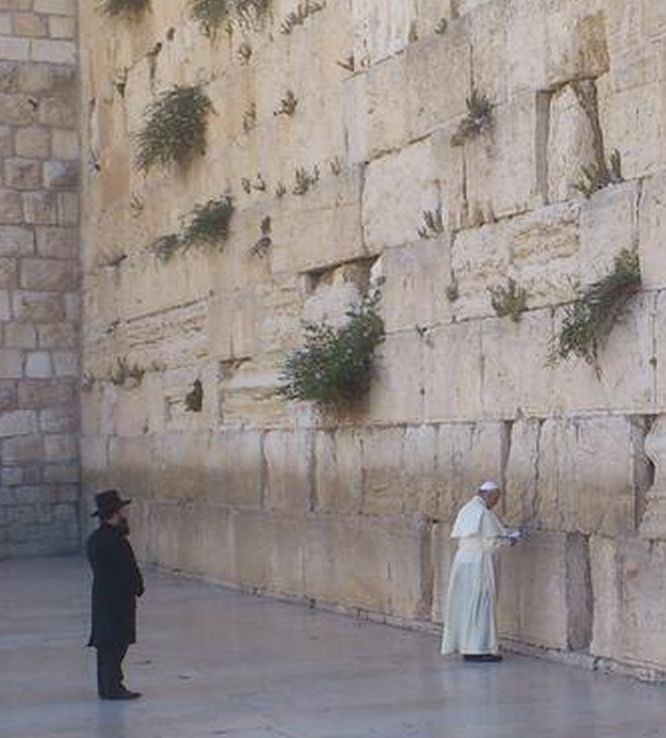
Following his visit with the Grand Mufti of Jerusalem at the Temple Mount, Pope Francis continued on to the Western Wall where he was greeted by the Rabbi of the Western Wall, Shmuel Rabinovitch.

The pope was treated to a short history lesson about the First and Second Temples, which was followed by a short speech from Rabbi Rabinovitch on the importance of Jerusalem to the Jews.

Rabinovitch also spoke about the threat of anti-Semitism, making reference to the shooting in Brussels at the Jewish Museum on Saturday. Rabinovitch stressed that Jerusalem must be a city of peace for all nations.

The pope declined to speak at this event, but he approached the Wall, where he prayed for about 90 seconds before he placing a note inside.

Rabbi Avraham Skorka, a close friend of the pontiff who is accompanying him on this trip, told Channel 10 that Francis prayed “that the [West Bank] security barrier and that genuine peace will come.”

“The last time we spoke was last night,” Skorka said. “This isn’t an easy visit for him, and it included important acts and events with special significance.”

“Nonetheless, he’s content, calm, and he knows how to balance emotions and to be level-headed.”

Security at the Wall was tight, with hundreds of policemen standing guard, and helicopters and snipers keeping watch from above.

Pope Francis set the tone for the second day of his visit to Israel with a message of tolerance at the Temple Mount.

He called upon all those who identify with Abraham – Christians, Jews and Muslims – to respect one another as brothers and sisters.

“Let us learn how to understand the pain of others and no one will use violence in the name of God,” he said.

The pope was expected to visit Yad Vashem later on Monday, where he will shake the hands of six Holocaust survivors, each with a survival story relating to Christianity.

The pontiff toured the Temple Mount complex Monday morning before paying a visit to the Western Wall.

Francis also met Muslim communal leaders, among them the mufti of Jerusalem.


