Archive for May 25, 2014

Off Topic: Pope Francis nods to Palestinian case with unscheduled visit to West Bank barrier

May 25, 2014

Pope Francis nods to Palestinian case with unscheduled visit to West Bank barrier, DEBKAfile, May 25, 2014

Abbas “forgot” to mention [to the Pope] that the barrier finally put an end to years of Palestinian suicidal terrorist outrages in Israeli towns, schools, markets and restaurants. These atrocities also targeted West Bank Christians, especially in Bethlehem, and accounted for their dwindling numbers.

Ignoring this piece of history, the pope was persuaded to visit the West Bank barrier. He was also presented with a crucifix filled with stones from the “Wall.”
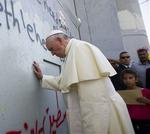
Pope_Francis_touches_the_wall_that_divides_Israel_25.5.14Pope Francis prays at West Bank security barrier in Bethlehem

Palestinian leader Mahmoud Abbas poured a litany of mostly unfounded anti-Israel grievances and propaganda in the ear of Pope Francis Sunday, May 25, taking advantage of his decision to visit Palestinian-controlled Bethlehem before spending a day in Israel. Abbas accused Israel of expelling Christians, complained about settlement construction and the plight of Palestinian prisoners and most of all, the “ugly wall” Israel had built.

Abbas “forgot” to mention that the barrier finally put an end to years of Palestinian suicidal terrorist outrages in Israeli towns, schools, markets and restaurants. These atrocities also targeted West Bank Christians, especially in Bethlehem, and accounted for their dwindling numbers.

Ignoring this piece of history, the pope was persuaded to visit the West Bank barrier. He was also presented with a crucifix filled with stones from the “Wall.”

Standing alongside Abbas, the pope delivered an even-handed statement, which called on “both sides to make sacrifices to create two states” and end the “unacceptable” Israeli-Palestinian stalemate.

He then conducted a Mass in Bethlehem’s Manger Square next to the Church of the Nativity, built over Jesus’ traditional birthplace, and was greeted by jubilant Palestinian Christians waving giant Palestinian and Vatican flags.

The Mass was superimposed by the muezzin’s call to prayer over a loudspeaker from a Bethlehem mosque. The Christian congregation reacted with whistles and stamped feet and the choir accompanying the Pope raised their voices higher.

In the official program, the Vatican referred to Abbas as the president of the State of Palestine.

Sunday afternoon, the head of the Catholic Church lands at Ben Gurion airport. Israeli President Shimon Peres will be on hand to welcome him before he is flown by helicopter to Mt Scopus for another welcoming ceremony.

His visit to Jerusalem, another religious and national minefield after the West Bank, will start Sunday evening with an ecumenical prayer service he is to conduct with the spiritual leader of the world’s Orthodox Christians at the Church of the Sepulcher, and heads of the various Christian churches and communities.

Francis has said that this encounter, marking the climax of his pilgrimage, falls on the 50th anniversary of a landmark meeting between Pope Paul VI and Ecumenical Patriarch Athenagoras, which ended nine centuries of Catholic-Orthodox estrangement.

He spends Monday in Israel, amid tight security for which thousands of police have been recruited.

The pope’s schedule includes a visit to Temple Mount and the Western Wall, Herzl’s Tomb and the Yad Vashem Holocaust Memorial Center.

It also includes a meeting on Temple Mount with the Grand Mufti of Jerusalem, Muhammad Ahmad Hussein, who is notorious for endorsing Jewish genocide.  In a Palestinian TV broadcast in 2012, Hussein declared: “The hour of [resurrection] will not come until you fight the Jews. The Jew will hide behind stones or trees. The stones or trees will call: ‘Oh Muslim, servant of Allah, there is a Jew behind me, come and kill him.’”

Not surprisingly, Muslim prayers on the mount are frequently the occasion for worshippers to hurl rocks at the Jews praying at the Western Wall below, an experience from which heavy Israeli police guards will be there to protect Pope Francis.

Israel has issued special visas for 23,000 Palestinians from the West Bank and 600 from the Gaza Strip to enter the country for the visit of Pope Francis Sunday and Monday.

The emotions inflamed by the visit were expressed early Sunday when a group of young Israelis barricaded themselves in the traditional Tomb of David on Mount Zion in Jerusalem. They were protesting reports that the building, whose upper floor is reputed to hold the Room of the Last Supper, would be presented to the Christian Church. Twenty-eight protesters were detained after attacking the police.

Netanyahu: Deadly Belgium attack result of anti-Israel incitement

May 25, 2014

Netanyahu: Deadly Belgium attack result of anti-Israel incitement | JPost | Israel News.

ADL says attack at Jewish museum in Brussels serves as reminder that anti-Semitism in Europe is still prevalent, must be taken seriously.

Brussels

Police personnel are seen at the site of a shooting in central Brussels, May 24, 2014. Photo: REUTERS

Prime Minister Benjamin Netanyahu condemned the shooting and killing of four people at the Jewish Museum in Brussels on Saturday.

He said he shares in the grief of the families of the victims. “This act of murder is the result of constant incitement against Jews and their state. Slander and lies against the State of Israel continue to be heard on European soil even as the crimes against humanity and acts of murder being perpetrated in our region are systematically ignored. Our response to this hypocrisy is to constantly state the truth, continue a relentless fight against terrorism and build up our strength,” the Prime Minister said.

Foreign Minister Avigdor Liberman blamed anti-Semitic and anti-Israeli incitement for inspiring the attack. Those who call for a boycott against Israel and those who act against Israel in international forums have contributed to this incitement, Liberman said.

“Recent anti-Semitic incidents in Kansas, Toulouse, and this evening in Brussels, should be a flashing warning signal to all those who cooperate with such incitement by rushing to condemn Israel and by comparing building a home for a Jewish family in the land of Israel with the cruel and murderous terrorist activity of anti-Semites,” Liberman said.

Justice Minister Tzipi Livni said Sunday that “every event against Jews in the world, such as the terror attack in Brussels, shocks us as Israelis – as it should.”

Writing on her Facebook page, Livni said, “The essence of Israel’s existence is to be a Jewish state in every sense of the word. But Israel is not just a safe place of refuge, we must also, in our values, represent the whole Jewish world.”

President Shimon Peres expressed his condolences on Sunday to a leader from the Jewish community of Brussels following a fatal shooting attack at a Jewish museum in the Belgian capital that left four dead on Saturday.

“We must act without hesitation against any form of anti-Semitism. The leaders of Europe should lead the struggle against anti-Semitism, which is rearing its head across the continent,” Peres in a phone conversation told told Maurice Sosnowski, president of the Coordinating Committee of Belgian Jewish Organizations.

“We are with you in this difficult time. We share your sense of shock and profound sadness,” he added.

The European Union’s foreign affairs chief Catherine Ashton condemned the attack, extending her sympathies to the families of the slain and calling for the perpetrators to be found.

“I condemn unreservedly the dreadful attack today at the Jewish Museum in Brussels. I send
my condolences to the families of the victims and express my solidarity with the Belgian
authorities and the Jewish community,” she said.

“Everything possible must be done to find those who carried out this attack. There must be no
impunity for terrorism,” Ashton added.

The Anti-Defamation League (ADL) also condemned the deadly attack, saying they were “horrified and deeply saddened” by the event.

Abraham H. Foxman, ADL National Director, said that “while violence against Jews in Belgium is extremely rare, the attack on the Brussels Jewish Museum is another tragic reminder of the frightening atmosphere for Jews in parts of Europe.”

Four people were killed at a Jewish museum in Belgium on Saturday in an attack that European Jewish leaders are already comparing to 2012’s massacre at the Ozar HaTorah school in Toulouse, France.

The attack, which took place at the Jewish Museum in central Brussels on Saturday, is being approached as racially motivated by Belgian authorities, who posited that it was motivated by anti-Semitism.

Belgium’s interior minister, Joëlle Milquet, was quoted saying by the RTBF Belgian television station that anti-Semitic motives could be behind the attack.

“It’s a shooting … at the Jewish Museum,” she was quoted as saying. “All of this can lead to suspicions of an act of anti-Semitism.”

Brussels Mayor Yvan Mayeur told the BBC that the shooting was likely a terror attack and that the choice of location “isn’t a coincidence.”

About half of Belgium’s 42,000-strong Jewish community lives in Brussels.

A spokesman for the Brussels fire brigade said the shooter drove up to the museum, went inside and fired shots.

“According to the information we have at the moment, it was a solitary shooter and it seems to have happened inside the museum,” Pierre Meys, Brussels fire brigade spokesman, told French channel BFM TV.

Security around all Jewish institutions in the country has been raised to the highest level, and Prime Minister Elio Di Rupo was meeting with police and senior officials to discuss the situation.

According to the European Jewish Congress, a crisis center organized by the Consistoire Central and the Coordinating Committee of Belgian Jewish Organizations (CCOJB) along with other communal leaders has opened and is in contact with local and national authorities.

Speaking with the Jerusalem Post, Consistoire head Baron Julien Klener said that he had met with the Prime Minister Elio Di Rupo and other senior officials and that authorities are “trying to find the suspects.”

Maurice Sosnowski, president of the CCOJB, compared the incident to the 2012 shooting of four Jews in a school in France by an Qaeda-inspired gunman, Mohamed Merah.

“This really reminds of what you experienced in France with Mr. Merah attacking a Jewish school,” he was quoted saying by BFM TV. “This is appalling. I would never have imagined something like that happening in Brussels.”

He said no threats have been issued to the Jewish community.

European and international Jewish organizations were quick to compare the two assaults.

“Two years after Toulouse, and on the eve of the European elections, this despicable attack is yet another terrible reminder of the kind of threats Europe’s Jews are currently facing,” World Jewish Congress President Ronald Lauder said in a statement shortly after the shooting. The attack was “clearly was targeted at Jews.”

“Tomorrow, we must all work together to ensure that this doesn’t happen again. If that means to improve security at Jewish sites in Europe, we have no choice. It must be done. If not, more people may be able to carry out such terrible crimes,” he added.

According to EJC President Dr. Moshe Kantor, while details of the attack are still lacking, it is clear that it is indicative of a “permanent threat to Jewish targets in Belgium and across the whole of Europe.”

“This is once again, much like the savage murders in Toulouse, a clear example of where hate and anti-Semitism leads. European government must send out a clear message of zero tolerance towards any manifestation of anti-Semitism.”

Kantor recently made waves by stating that without a significant reduction in the fear and insecurity plaguing European Jewry, normative Jewish life on the continent is “unsustainable.”

“Incidents such as this do not occur in a vacuum, and are the direct result of a systematic culture of hate and anti-Semitism against the Jewish community and the State of Israel in so many parts of Europe, including Belgium,” the Israeli Jewish Congress asserted.

A spokesman for the organization pointed out that according to a recent Anti-Defamation League Study, 27 percent of Belgians harbor anti-Semitic sentiments.

According to the ADL, Belgium comes in as the sixty third most anti-Semitic country out of one hundred territories polled around the world.

The shooting comes less than a day before polls open across Europe for elections to the European Union Parliament, with parties on the hard right expected to gain a significant plurality, though far from a majority, of mandates.

Two of the Brussels shooting victims confirmed Israeli citizens

May 25, 2014

Two of the Brussels shooting victims confirmed Israeli citizens – Israel News, Ynetnews.

The couple, tourists in their 50s from Tel Aviv, were not carrying any identifying documents; a fourth victim died of his wounds overnight.

Lior Zilberstein, Itamar Eichner

Published: 05.25.14, 08:03 / Israel News

Two of the four people killed in the shooting at the Brussels Jewish Museum Saturday were an Israeli couple in their 50s, the Foreign Ministry said overnight.

The two were not carrying any personal documents with them, so it took hours to identify them.

The other two killed were employees at the museum. One of the casualties suffered critical wounds to the face and neck and passed away from his wounds overnight.

Following the shooting, Belgium’s interior minister, Joelle Milquet, said Saturday night that anti-terror measures had immediately been heightened around all Jewish institutions in the country as a precaution.

“We decided to apply to a maximum level of protection to Jewish sites,” she said.

Ine Van Wymersch, a spokeswoman for Brussels prosecutors office, said there was no clear information about the perpetrator, although a fire brigade official said earlier that a man drew up to the museum in an Audi, exited the car and opened fire. He then reportedly reentered the car and fled the scene.

Milquet told reporters that the shooter apparently parked a car outside before entering the Jewish Museum. She added the gunman “apparently fired rather quickly, went outside and left.”

The president of one of the Jewish organizations in Belgium told Ynet that the entrance to the museum, where the shooting occurred, did not have a security guard.

“Regarding the motive, we have little information. Everything is possible,” Van Wymersch told a news conference.

“We know that the location, the Jewish Museum in Brussels, makes one think of it being an anti-Semitic attack, but we do not have enough to confirm this is the case.”

A source claimed the police will likely deem the incident anti-Semitic Sunday.

(Photo: EPA)

(Photo: EPA)

Van Wymersch said one suspect was detained after he drove away from the museum around the time of the attack.

“One person was seen leaving the scene of the crime and entering a car. We identified him and arrested him. We still don’t know if he is directly linked to the attack,” she said.

A second person being sought for questioning left the area on foot. Van Wymersch added security camera footage was being studied to try to identify the person.

Belgian Prime Minister Elio Di Rupo held a press conference on Saturday, condemning the attack: “All Belgians are united against the heinous crime at the Jewish Museum.”

Belgian Prime Minister Elio Di Rupo at the scene of the shooting (Photo: AFP)

‘Anti-Semitic attack’

The head of the Jewish community in Belgium, Julian Kllener, told Ynet: “The entire Jewish community is in shock. We did not get any special warnings from the police and the attack caught us by surprise. The Jewish community is in good standing with everyone, even the Muslim community.”

Prime Minister Benjamin Netanyahu commented on the shooting, saying it was the result of “of endless incitement against Jews and their state.”

“Slander and lies against the State of Israel continue to be heard on European soil even as the crimes against humanity and acts of murder being perpetrated in our region are systematically ignored. Our response to this hypocrisy is to constantly state the truth, continue a relentless fight against terrorism and build up our strength,” Netanyahu said.

(Photo: EPA)

(Photo: EPA)

Belgian Foreign Minister Didier Reynders, who was in the vicinity, said the scene “was terrible and left me shocked” as he saw the bodies of two of the victims lying at the entrance of the museum, located in the swanky Sablon neighborhood of Belgium’s capital.

Reynders said that “you cannot help to think that when we see a Jewish museum, you think of an anti-Semitic act. But the investigation will have to show the causes.”

European Jewish Congress President Moshe Kantor said that, even though it has yet to be established whether the attack was anti-Semitic, “we are acutely aware of the permanent threat to Jewish targets in Belgium and across the whole of Europe.”

“European governments must send out a clear message of zero tolerance toward any manifestation of anti-Semitism,” Kantor said in a statement.

(Photo: Reuters)

(Photo: Reuters)

The attack, which took place shortly before 4 pm, occurred in the Sablon area, which was hosting a three-day jazz festival and is usually clogged with tourists and shoppers on weekends. It has cobblestone streets with numerous antique shops, trendy cafes and museums, including the Jewish Museum.

Viviane Teitelbaum, a member of the Brussels legislature, said anti-Semitic attacks reached a peak in the early 1980s but had dropped off, but she noted a recent rise in anti-Jewish sentiment.

“It has been a very difficult place to live” for Jews, she said, adding that many young people are leaving the country. She said some 42,000 Jews live in Belgium, half of whom reside in Brussels.

Simone Susskind, another Brussels politician, said the museum has been at its current site for around a decade, after moving from an old synagogue in southern Brussels. She said her late husband David was a driving force behind the museum’s creation, believing that as home of the European Union and self-proclaimed “capital of Europe,” Brussels needed a museum to recount the history of Belgium’s Jewish community.

(Photo: AP)
(Photo: AP)

In neighboring France, President Francois Hollande condemned the “horrifying killings with the greatest force.” In a statement, he expressed France’s solidarity with Belgium and offered condolences to the families of the victims.

Jewish community officials drew parallels between the shooting and the 2012 killing of four Jews in a school in France by an al-Qaeda-inspired gunman, Mohamed Merah.

“This really reminds of what you experienced in France with Mr. Merah attacking a Jewish school,” Maurice Sosnowski, president of the Coordinating Committee of Belgian Jewish Organizations, was quoted saying by BFM TV.

“This is appalling. I would never have imagined something like that happening in Brussels.”

World Jewish Congress President Ronald S. Lauder urged Belgian authorities to protect Jewish sites in the country.

“Two years after Toulouse…this despicable attack is yet another terrible reminder of the kind of threats Europe’s Jews are currently facing.”

Reuters, the Associated Press, Itay Blumental, Attila Somfalvi and Moran Azulay contributed to this report.

Stung By Criticism, Obama Preps Sweeping Defense Of His Foreign Policy Approach

May 25, 2014

Stung By Criticism, Obama Preps Sweeping Defense Of His Foreign Policy Approach.

Posted: 05/24/2014 4:56 pm EDT Updated: 37 minutes ago

OBAMA


(Adds details about Syria)

By Steve Holland

WASHINGTON, May 24 (Reuters) – Stung by criticism, President Barack Obama will use a speech on Wednesday to launch a sweeping defense of his approach to foreign policy, one that he will say is reliant on multilateral diplomacy instead of military interventions.

Obama is to deliver the commencement address at the U.S. Military Academy at West Point, New York, the first in a series of speeches that he and top advisers will use to explain U.S. foreign policy in the aftermath of conflicts in Iraq and Afghanistan and lay out a broad vision for the rest of his presidency.

The president has come under withering fire in recent months for what his critics say is a passive approach to foreign policy, one that has allowed Russian President Vladimir Putin to flex his muscle in Ukraine, and left the Syrian civil war to fester and China to threaten its neighbors in the South China Sea.

Shortly after a trip to Asia late in April during which he strongly defended his incremental approach, he directed aides to frame a speech to explain his foreign policy and how he plans to handle world hot spots during his remaining two-and-a-half years in office.

“You will hear the president discuss how the United States will use all the tools in our arsenal without over-reaching,” a White House official said on Saturday. “He will lay out why the right policy is one that is both interventionist and internationalist, but not isolationist or unilateral.”

Obama, determined not to repeat what he views as the mistakes of his Republican predecessor, George W. Bush – U.S. involvement in wars in Iraq and Afghanistan – has leaned heavily on diplomatic activity instead of military force.

In the case of Ukraine, he has ordered sanctions against some of Putin’s inner circle and businesses associated with the Kremlin power structure but has made clear he will not threaten military force for Moscow’s seizure of Crimea.

The fear among some in Washington is that Obama’s handling of Russia will prompt China to flex its muscles in the South China Sea, where tensions have already been rising over such actions as the placement of a Chinese oil rig in waters claimed by Vietnam.

On Syria, Obama backed away from a threat to use military force over the use of chemical weapons against Syrian civilians by the Syrian government. While a deal struck with Russia is leading to the disarming of Syria’s chemical weapons stockpile, the three-year-old Syrian civil war rages on and President Bashar al-Assad remains in power.

Obama will emphasize that Syria remains a counter-terrorism threat as a haven for militant groups. U.S. officials have debated whether to supply heavier weapons and increase covert aid to Syrian rebels.

“We do see Syria as a counter-terrorism challenge. However, the right policy approach continues to be strengthening the moderate opposition, which offers an alternative to both the brutal Assad regime, and the more extremist elements within the opposition,” the White House official said.

The official said Obama will say the United States is the only nation capable of galvanizing global action and why “we need to put that to use in an international system that is sustainable and enduring, and that can address challenges from traditional ones, like maritime and trade issues, to emerging ones, like climate change.”

(Reporting By Steve Holland; Editing by Steve Orlofsky)


