Archive for May 21, 2014

Off Topic: System-wide damage

May 21, 2014

System-wide damage, Israel Hayom, Zvika Fogel, May 21, 2014

(Dogs and soldiers, Keep off the grass! — DM)

Unfortunately, the peace dove has yet to spread its wings over our region. Our enemies are still longing to send us back to the countries in the Diaspora from which we came. Talking about defense budget cuts simply blows a mighty wind in the sails of terror and provides motivation for the extremists creeping among our enemies.

Finance Ministry staff and other such prowlers after the defense budget are wildly irresponsible and unjust, putting a gun to the head of Defense Minister Moshe Ya’alon and the IDF Chief of Staff Lt. Gen. Benny Gantz. They alone know how easy it is to cradle the calculator pounding out budget cuts, laying off thousands of the military’s career personnel, losing tens of thousands of years of experience and transferring billions from one box to the other on the budgetary spreadsheet.

The cost of either Israel’s immediate or long-term existential threat is not theirs to bear. Translating intelligence gathered by the many agents for our security forces is not their job, and neither is procuring weapons or protecting our national borders.

When the budgetary blade is hovering over the defense establishment, its chiefs are forced to make decisions in uncertain conditions, and no man wants to have to deal with such responsibility. Should we really reduce arms purchases, weapons that defend our country at every second, systems that defend us from rockets and missiles threatening the country just beyond our borders? Should we slash our intelligence-gathering capabilities, the ones allowing us to prevent ships on sordid missions from reaching our shores, which give us an insight into the opinions of the next fanatic Muslim leader? Yes, the decision to cut back on reservists’ training was a bad one, but given the circumstances — and as there was nothing else to cut — it was the lesser of all evils, even if it will carry a heavy toll.

The burden that regular soldiers will have to shoulder will manifest itself through reduced operational success. The truth must be told. Regular units that are supposed to defend our borders, prevent terrorists from infiltrating the homefront, train for war or operations and successfully counter potential emergencies, will not be able to do so with the same quality to which we have acclimated. The impact on reserve units will not just be felt in their war readiness. Its influence will be most acutely reflected through diminished social cohesion, which essentially forms the spine of the few who remain in reserve duty.

The Israeli Air Force show on Independence Day apparently garbled Finance Ministry decision makers’ opinions as they pounded the keyboard making budget cuts. Somebody understood, perhaps, that brave IAF pilots would be there to destroy any enemy and isolate any threat. Somebody thought, perhaps, that the Iron Dome defense system would neutralize strikes against the homefront. Somebody envisioned, perhaps, the IAF commander signing a peace deal with Syria, Lebanon, Hezbollah and Hamas. I never saw a bomb that could tell the difference between terrorists and non-combatants, or a missile that knew how to take prisoners.

Some have continued fix their eyes on the retired officers’ or released soldiers’ bank accounts. What hypocrisy! Thousands of career soldiers having worked day and night on patrol, in ambush, on operations and in routine duty, are now needing to justify their contributions to the state. Those very same career soldiers who served 30 years, who were willing to sacrifice their lives while on defense and security missions, could tomorrow morning wake up to the fact that it is out of their capacity to live in dignity.

In a world of yuppies hungry for budget cuts, who will employ 50-plus-year-olds who are experts in flanking the right, clearing mines, firing in motion from tanks or prepping canons? Unfortunately, the peace dove has yet to spread its wings over our region. Our enemies are still longing to send us back to the countries in the Diaspora from which we came. Talking about defense budget cuts simply blows a mighty wind in the sails of terror and provides motivation for the extremists creeping among our enemies.

Finance Ministry staff, you have been warned!
IAEA, Iran agree on new transparency measures

May 21, 2014

IAEA, Iran agree on new transparency measures, Ynet News, May 21, 2014

(The date by which Iran’s transparency is to be displayed, August 25th, is well past the date, July 20, when the negotiations may end. Will that date be extended in hopes that the IAEA’s findings will be favorable to Iran? In any event, the IAEA will still be working. Will they wear hip boots when digging through Iran’s evidence? — DM)

Tehran to answer questions on large-scale high-explosives experimentation and research on modelling a nuclear warhead from uranium metal.

Iran says that the trove of evidence presented by the IAEA on these activities, which the Vienna agency believes took place before 2003 and possibly since, is based on faulty intelligence provided by the CIA and Israel’s Mossad.

The UN atomic watchdog said that Iran, which denies seeking or ever having sought nuclear weapons, has undertaken to provide information on the new steps “by August 25”.

Iran and the International Atomic Energy Agency (IAEA) agreed to implement five new measures to improve the transparency of the Islamic Republic’s nuclear program, the UN agency announced Wednesday.

The UN atomic watchdog said that Iran, which denies seeking or ever having sought nuclear weapons, has undertaken to provide information on the new steps “by August 25”.

The announcement comes after a fourth round of talks between Iran and six world powers in Vienna last week that both sides indicated made no progress towards a comprehensive deal over Tehran’s nuclear program.

One of the key elements in this sought-after deal would be Iran answering some of its many questions on the alleged “possible military dimensions” (PMD) of Tehran’s nuclear program – in other words efforts to design a nuclear bomb.

Iran says that the trove of evidence presented by the IAEA on these activities, which the Vienna agency believes took place before 2003 and possibly since, is based on faulty intelligence provided by the CIA and Israel’s Mossad.

These negotiations take place parallel to negotiations between Iran and the P5+1 (the United States, Russia, China, France, UK and Germany) aimed at reaching a final-status agreement guaranteeing the peaceful nature of the program.

The IAEA and Iran signed an agreement in February on transparency on seven points, which resulted in early May in the inspection of two nuclear sites in Iran.

In a potentially important step forward in the IAEA’s efforts to advance its inquiry, it said Iran would provide information “with respect to the allegations related to the initiation of high explosives, including the conduct of large-scale high-explosives experimentation in Iran,” and modelling a nuclear warhead from uranium metal.

Iran would also provide “information and explanations related to studies made and/or papers published in Iran in relation to neutron transport and associated modelling and calculations and their alleged application to compressed materials”.

Both issues were part of a landmark report issued by the IAEA in 2011 that included a trove of intelligence information pointing to past tests and experiments in Iran that could be relevant for the development of nuclear weapons. Iran denies having worked on a nuclear weapons capability in any form.

Iran must also provide information on the development of detonators for a bomb. In 2011, the IAEA had expressed concern about the “exploding bridge wire detonators” because of their “possible application in a nuclear explosive device.”

The existence of Iranian studies in this area was clearly identified in 2011 by the IAEA as an “area of ​​special concern” for the agency, which considered it unlikely that such research can be applied to any purpose other than military purposes.

IAEA investigators recently came away disappointed after Iran told them that experiments with detonators were for civilian and conventional military use only. It was a similar answer to one six years ago, when the agency first linked such tests to work on setting off a nuclear weapon.

The IAEA and Iran have also reached an agreement granting the UN agency access to research and development centrifuges – the devices that enrich uranium – as well as production workshops and centrifuges storage facilities.

How Iran responds to the IAEA’s questions is regarded as a litmus test of its readiness to start engaging with the investigation into what the UN agency calls the possible military dimensions of its nuclear program.

US officials say it is vital for Iran to resolve the IAEA’s concerns if broader diplomatic efforts by Washington and five other world powers to resolve their decade-old nuclear dispute with Iran are to succeed.

US assigns 13,000 servicemen to first ever combined US-Jordan-Israeli exercise. Hizballah heads for Golan

May 21, 2014

US assigns 13,000 servicemen to first ever combined US-Jordan-Israeli exercise. Hizballah heads for Golan, DEBKAfile, May 21, 2014

This is the first time that the US has unified two large military exercises. The Jordanian and Israeli drills will be coordinated by US command centers.

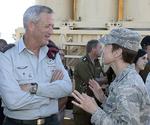
GantzHezt16.5.14Gen. Benny Gantz and US missile officer

Under cover of conjoined military exercises with Israel (Juniper Cobra) and Jordan (Eager Lion), the US has moved more than 6,000 Marines to Jordan and several thousand servicemen to Israel.. The Jordanian drill starts Sunday, May 25 and will last until June 8. The US-Israeli exercise began this week with the participation of another 6,000 combat personnel from the US European Command and 1,000 airmen to operate missile defense systems.

Sailing opposite Israel’s Mediterranean shore are two US warships carrying Aegis Combat Systems. Due to arrive in the Jordanian Red Sea port of Aqaba over the coming weekend are large US landing craft, that will drop marines on land. Gulf units are also taking part in the combined exercise.

This is the first time that the US has unified two large military exercises. The Jordanian and Israeli drills will be coordinated by US command centers.

The two war games were planned as military maneuvers plain an simple until Wednesday, May 21, when news came in of large Hizballah military forces heading toward southern Syria to help the Syrian army overcome the rebel forces fighting for more than a week to capture the Syrian Golan town of Quneitra opposite the Israeli and Jordanian borders.

In the last few days, both Israel and Jordan have beefed up their Syrian border deployments and placed them in battle stations. Hizballah’s intervention in the Golan battle may well result in the war game being switched to combat operations for real.

DEBKAfile’s first report on the escalating Golan situation appeared on May 20.

The Syrian army offensive, launched Tuesday, May 20 to break the stalemate developing with rebel forces in the tussle for the Syrian Golan town of Quneitra, has raised forebodings in Israel and Jordan lest Assad’s troops bring the fighting up to their borders. So far, the rebel offensive has failed to break through to Quneitra – or even lay it to siege. The Syrian army command, although seriously short of fighting men man, has seized the moment for a counter-offensive.

The Jordanian army has accordingly deployed its 2nd mechanized division along the entire 380 km of the kingdom’s porous border with its Syrian neighbor in battle formation, along with its 60th armored battalion. All leaves have been suspended for officers and men serving in the border sector.

Earlier, the IDF augmented its border troops opposite the Golan and the Hermon range, according DEBKAfile’s military sources.

In its counter-offensive, the Syrian army’s managed Tuesday to capture the village of Um Aswaj near the southern Syrian town of Deraa and is continuing to advance on further rebel positions in the south. It went into action after the rebels Monday captured sections of the main highway from Quneitra to Damascus. This step was supposed to have led to the encirclement of the Golan town. But this did not happen. The intense fire from Syrian 9th Division tanks forced the rebels to abandon the strategic highway.

To make up for its shortage of ground troops for the Golan, the Syrian army has brought in Grad and Scud ground-to ground missiles and conducting air strikes on the rebels with warplanes and and assault helicopters.

The deep concern over the serious security situation evolving on Israel’s northern frontier was strongly reflected in IDF Chief of Staff Gen. Benny Gantz’s explanation to the Knesset Foreign Affairs and Security Committee Monday for the urgent need to reverse defense budget cutbacks.

“The national order of priorities is changing,” he said, “and with it, unfortunately, national decisions relating to defense. “We are in the throes of a complex challenge to our resources not encountered in the past, with dramatic repercussions for the IDF. I come to you after a difficult week,” said the chief of staff in reference to the situation on the Israeli- Syrian border.

“We are obliged at this time to make painful decisions which affect all systems and all spheres of action for the reserves and the regular army – when it comes to training, the situation in the field and the home front.

“The country has clear orders of priority and on security we have already taken as many risks as are permissible.”

DEBKAfile’s military sources report that, for now, the IDF has manned all the Syrian border positions with conscripts. No reserve units have been deployed.

Iran’s Chief Negotiator Lauds China’s “Constructive” Role in Nuclear Talks

May 21, 2014

Iran’s Chief Negotiator Lauds China’s “Constructive” Role in Nuclear Talks, Tasnim News Agency  (Iranian Gov’t) May 21, 2014

China is ready to promote ties with Iran in all fields including tourism and investment, Wang Yi underlined.

Iran and China

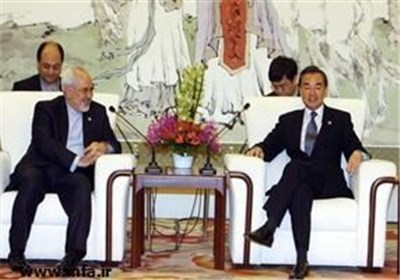
TEHRAN (Tasnim) – Iranian Foreign Minister Mohammad Javad Zarif in a meeting with his Chinese counterpart Wang Yi on Wednesday, praised China’s constructive role in talks between Iran and six world powers over Tehran’s peaceful nuclear program.

During the meeting held in Shanghai, Zarif, who is also the country’s chief negotiator, called Iran-China relations as historic and strategic.

The meeting took place on the sidelines of the 4th Summit of the Conference on Interaction and Confidence-Building Measures in Asia (CICA).

There are good grounds for expansion of cooperation between Tehran and Beijing, Zarif said, welcoming Chinese investors to invest in Iran’s economic projects.

He further appreciated Beijing’s support for Iran’s peaceful nuclear activities, official website of the Iranian foreign ministry reported.

Chinese foreign minister, for his part, expressed the hope that Iran-P5+1 nuclear talks would reach a fruitful conclusion.

China is ready to promote ties with Iran in all fields including tourism and investment, Wang Yi underlined.

Visiting Iranian foreign minister and his Chinese counterpart also discussed the latest regional and international developments.


Regenerating Leverage in Nuclear Talks with Iran

May 21, 2014

Regenerating Leverage in Nuclear Talks with Iran, JINSA Blog, Jonathan Ruhe, May 21, 2014

(Rather than try to get the P5 + 1 talks back on track, wouldn’t it be better to let them die a natural death, as now seems likely, and to focus on what to do then? We could try to look into ways to reinstitute effective sanctions, but with much of the free and non-free world anxious to make money in Iran, that won’t happen. Even at the height of the sanctions program, Iran made substantial progress in getting nukes and delivery systems.

Perhaps better, Israel, the United States and even others can find ways to scare Iran into not proceeding with its nukes for war program and, if that does not work, actually doing something about it. War is nasty, brutal but often not short. However, military action taken before, rather than after, the enemy has armed itself well can result is a less nasty, less brutal and shorter conflict. See World War II for an example of what can result from waiting too long, . — DM)

[T]here is a worrisome imbalance of leverage at the negotiating table. Iran has been building economic and military leverage against the United States. This includes a refusal to discuss its ballistic missile programs as part of a final deal, despite their potential as delivery vehicles for nuclear warheads, and despite being subject to U.N. Security Council resolutions which it agreed to address in a comprehensive settlement.

Simultaneously the United States doing nothing to address Iran’s rebounding crude oil exports.

As talks resumed last week in Vienna, significant differences remained between the United States and Iran on a comprehensive settlement over the latter’s nuclear program. This is unsurprising. First, there is minimal mutual interest on this issue. Tehran’s leaders have staked much of the regime’s credibility on their country’s self-proclaimed right to such a program. This is highly problematic for the United States, since ensuring Iran’s “right” could allow Tehran to retain the capability to develop enough fissile material for a nuclear device.

Second, productive diplomacy is severely hamstrung by the long history of distrust between the two sides. U.S. negotiators will want ironclad assurances Iran cannot cheat on a final deal, given its previous track record of deception over its nuclear activities. Meanwhile, Tehran has a tendency to view such intrusions as Trojan horses for subverting the Islamic Republic, especially on an issue as critical as the nuclear program. This calculus makes Iran unwilling to compromise if it has little to fear from the failure of negotiations.

Third, there is a worrisome imbalance of leverage at the negotiating table. Iran has been building economic and military leverage against the United States. This includes a refusal to discuss its ballistic missile programs as part of a final deal, despite their potential as delivery vehicles for nuclear warheads, and despite being subject to U.N. Security Council resolutions which it agreed to address in a comprehensive settlement.

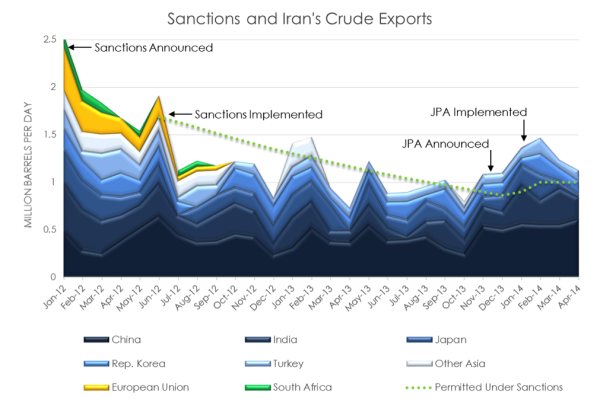
Simultaneously the United States doing nothing to address Iran’s rebounding crude oil exports. The interim deal over Iran’s nuclear program (the Joint Plan of Action [JPA], implemented January 20) paused relevant sanctions, but Iran’s exports during the interim quickly exceeded the agreed limit of 1 million barrel per day (mm b/d; chart reproduced from report by JINSA’s Gemunder Center Iran Task Force):

Sanctions and crude exports

Because oil export revenues are the lifeblood of the Iranian regime and its nuclear program, sanctions targeting these revenues helped push Tehran to the negotiating table in the run-up to the JPA. However, beyond the suspension of such measures, the Obama Administration has further tied the hands of U.S. negotiators by publicly refusing to countenance further sanctions on Iran’s oil exports, even though they would only enter into force if a final deal falls through. By reducing Iran’s fear of the failure of diplomacy, this inaction only feeds its unwillingness to compromise.

There are ways to begin rebuilding U.S. leverage heading into the final stretch of negotiations. (The JPA interim period ends July 20, though its six-month timeframe is renewable by mutual consent). While political momentum for new sanctions stalled earlier this year, American policymakers could reinvigorate the public discussion of available options. The existence of such a debate – even if the Obama Administration does not join it – could improve the prospects for an acceptable final deal, by highlighting how failure to achieve one would be more costly for Tehran than for Washington.

Specifically, the United States should explain how the world can live without Iranian oil more readily than Iran can live without an acceptable final deal. A credible argument for the feasibility of this maximal form of non-military pressure could help convince Iranian negotiators to agree to a deal which their American counterparts could sell at home, even if doing so makes it more difficult to sell back in Tehran.

There is recent precedent for driving significant Iranian exports from the global oil market, as the above chart illustrates. Oil sanctions removed roughly 1.5 mm b/d of Iranian exports from the market between their announcement in early 2012 and the JPA being agreed in November 2013. This was offset by decreasing U.S. net oil imports (driven by rising North American output) and production growth from Gulf Arab states (many of whom are even more troubled than the United States by the prospect of a nuclear-capable Iran). Over this period, the 11 largest suppliers to the United States simply shifted most of their erstwhile U.S. exports to Iran’s customers.

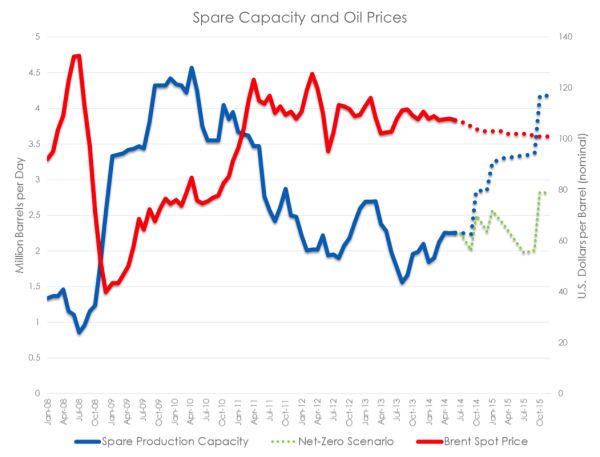
The United States could make a strong case for driving the remainder of Iranian exports from the market if it is not satisfied with a potential final deal by July 20. Thanks to forecasted further decreases in U.S. net imports and expanding Gulf capacity, the Department of Energy (DOE) projects global spare production capacity will double by the end of 2015. This is crucial, as spare production capacity influences expectations of potential future disruptions, and thus the risk premium added to the price of oil. Generally speaking, spare capacity and risk premium are inversely proportional, as evidenced in the red (price) and blue (spare capacity) lines in the chart below.

Spare capacity and oil prices

Using DOE forecasts as a baseline, removing all Iranian oil exports by July 20, 2015 (green line in chart), would merely slow the growth in projected global spare production capacity through the end of next year. All else being equal, this could be expected to have a negligible net effect on oil prices. By showing how the world can live without one thing Iran’s regime cannot, articulating an argument along these lines could help the United States regenerate crucial leverage for reaching an acceptable final deal on Iran’s nuclear program.

Off Topic: In the chief of staff’s warnings, bitter memories of 2006

May 21, 2014

In the chief of staff’s warnings, bitter memories of 2006, Times of IsraelDavid Horovitz, May 20, 2014

When the usually understated Benny Gantz sounds the alarm over budget cuts and cancels reserves training, it might be worth paying attention.

By the relative standards of a perpetually embattled state, Israel’s security situation right now could be a whole lot worse, but Israel is a security-challenged state. Gantz is not predicting the worst; but he is plainly concerned that the IDF won’t be sufficiently prepared for the worst if it happens. “We have taken all the security risks possible,” he said on Monday — by which he meant that the IDF has cut all the fat, and now is into the meat.

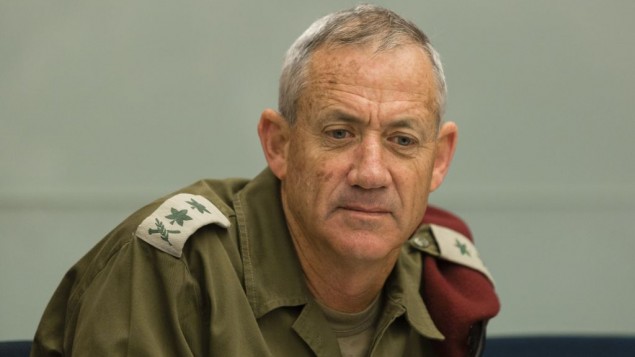
Gantz re budgetIDF Chief of Staff Benny Gantz at a meeting of the Foreign Affairs and Defense Committee in the Knesset, May 20, 2014. (Photo credit: Flash 90)

Benny Gantz’s features have long been lined and weather-beaten, reflecting the 37 years he has spent in the uniform of the IDF, most of them in the field. But the lines have grown palpably deeper in the little more than three years since he was appointed chief of the IDF General Staff.

The weight of responsibility felt by this ex-paratrooper son of a Holocaust survivor is obvious whenever you see him. Gantz is calm and far from humorless, but he doesn’t smile often when discussing the security challenges faced by Israel. He doesn’t pound on the table and he’s not an alarmist, but when he says publicly, as he has done several times this week, that he worries about skewed national priorities forcing untenable cuts in the defense budget, and when he then cancels all reserves training, it’s worth paying attention. “There’s no trick and no shtick,” he told the Knesset’s Foreign Affairs and Defense Committee on Tuesday, explaining the financial constraints under which the IDF is operating and the problems they’re causing. “There’s just the truth.”

The Treasury, unsurprisingly, is not impressed. Broadly speaking, its budgetary experts believe the IDF has long been given about 20 percent more money (in its approximately $17 billion/60 billion shekel budget) than it genuinely needs. Moreover, some analysts believe that Israel’s current defense threats are, relatively speaking, milder than in many years past: The chaos in the region means many potential enemy forces — notably, but not solely, in Lebanon and Syria — are preoccupied with their own domestic struggles.

Gantz and others in the senior IDF echelons are not as sanguine.

If the military top brass is somewhat less panicked by the P5+1 negotiations with Iran than it was a few months ago, slightly more optimistic that the US is leading a more resolute diplomatic line, there’s no similar sense as regards the northern front. Giving up hundreds of lives in the battle to save Bashar Assad, Hezbollah has graduated from a guerrilla group, capable of painful acts of terrorism, to a force with a great deal of operational experience, marshaling large numbers of fighters. Assad now owes Hezbollah a considerable debt. The fear in Israel is that this will be repaid in the form of sophisticated weaponry and greater freedom of operation, including on the Golan, where minor incidents that can prompt drastic escalation are now a near-norm.

The 100,000-rocket Hezbollah threat from the north is accompanied by a widening rocket threat from the south, where Hamas now has dozens — at least — of rockets that can hit central Israel. Fatah-Hamas reconciliation might yield relative calm, or the process might collapse — with dangerously unpredictable results for Israel. The IDF analysis is that there is no interest in an another intifada-style violent uprising against Israel, but there’s also decreasing interest in West Bank security cooperation with Israel. Bitter experience has shown that seemingly small acts of violence, given the fraught Israeli-Palestinian relationship, can explode into years of confrontation. Relations between Israeli and Palestinian security forces can transform, in an instant, from friendly to adversarial.

And then there’s the danger posed by Israel’s very own provocateurs, the race-hate “price tag” attackers.

Cooperation with Abdel-Fattah el-Sissi’s Egypt has rarely been better. Along the border with Jordan, too, things are relatively quiet. But Jordan hosts a million Syrian refugees, and the potential for instability within the kingdom and/or along its border with Israel is ever-present.

Again, by the relative standards of a perpetually embattled state, Israel’s security situation right now could be a whole lot worse, but Israel is a security-challenged state. Gantz is not predicting the worst; but he is plainly concerned that the IDF won’t be sufficiently prepared for the worst if it happens. “We have taken all the security risks possible,” he said on Monday — by which he meant that the IDF has cut all the fat, and now is into the meat.

In the aftermath of the mismanaged 2006 Second Lebanon War, the Winograd Commission castigated the IDF and its political masters for their inadequate preparation and over-confidence. A mere eight years later, Gantz will not have forgotten that the inability to overcome Hezbollah during 34 days of warfare cost the lives of 165 Israelis and more than 1,000 Lebanese. It also cost the chief of staff, Dan Halutz, his job.

It was an inability born of hubris and baseless assumptions, and also of insufficient training and the neglect of other military basics. The current chief does not want to find himself in a similar position.


Don’t blame the people for Iranian intransigence

May 21, 2014

Don’t blame the people for Iranian intransigence | JPost | Israel News.

By GARY C. GAMBILL

 05/20/2014 22:01

If Iranian leaders remain hell-bent on retaining the infrastructure to produce a bomb in short order, it is not to appease public opinion, but to suppress it; blaming the Iranian people for this state affairs just adds insult to injury.

People look for Valentine's day gifts at a shop in

People look for Valentine’s day gifts at a shop in Photo: REUTERS/Raheb Homavandi

Supporters of the Obama administration’s historic willingness to accommodate Iranian nuclear ambitions frequently contend that ruling elites in Teheran are not politically capable of eliminating or dramatically downsizing their country’s uranium enrichment infrastructure, as required by multiple United Nations Security Council resolutions. Increasing sanctions on Iran won’t change this unfortunate reality, the reasoning goes, so the only alternative to an eventual military solution is accepting a more modest rollback that leaves Iran with sufficient enrichment capacity to produce a bomb in six to 12 months, but subject to intrusive inspections.

Purveyors of the political constraint model of Iranian intransigence are often frustratingly fuzzy on cause and effect. David Patrikarakos argues that Iranian leaders have “invested too much political capital in their enrichment program to give it up unless their own survival is threatened,” while RAND Corporation analyst Alireza Nader suggests that “weakness in the face of [outside] pressure might be no less a threat” to their rule than the economic sanctions that have devastated Iran’s economy.

But autocratic regimes misallocate political capital all the time, and plenty have bowed to foreign pressure and lived to tell the tale. Is Iran’s Islamic Republic, among the most stable and enduring political systems in the region, so exceptionally feeble that its leaders cannot make a sound decision on this issue without bringing down the house? If political necessity, not odious religious extremism or hegemonic strategic ambitions, obligates Iranian leaders to enrich uranium, where’s the push coming from? The answer, implicit in most elaborations of the argument and explicit in some, is the Iranian people. Robert J.

Einhorn, formerly then-secretary of state Hillary Clinton’s special adviser on nonproliferation, finds “virtually no domestic support at present for what would be seen as gutting the nuclear program or for giving up a future nuclear weapons option.”

According to Colin Kahl, previously the Obama administration’s top Middle East policy official at the Pentagon, “demands that Iran completely dismantle its enrichment program” are viewed by “the majority of the Iranian public…as unacceptable capitulation.” Iranian elites may already be averse to dismantling the program for ideological and strategic reasons, but it is this public opinion barrier that supposedly makes pressuring them further pointless.

To be sure, there is some truth to this. Deeply rooted national identity, Shi’ite Muslim religious culture, (understandable) perceptions of historical victimization, and years of regime propaganda appear to have led most Iranians to view their country’s nuclear program favorably.

But the claim that public opinion prevents Iranian leaders from stepping back from the threshold of producing a nuclear weapon is dubious on several counts.

For starters, we don’t really know how strongly Iranians support the nuclear program, as public discussion of the matter is heavily circumscribed by the government, and there is no credible public opinion polling about it inside Iran. Survey data from outside organizations is limited and fluctuates wildly depending on who does the polling and how the questions are framed. For example, a May- June 2013 Gallup poll found that 34 percent of the public believes Iran should develop nuclear capabilities “for military use,” while a September 2013 Zogby International poll found that two-thirds believe their country should have nuclear weapons. The same Gallup poll reported that 85% of Iranians say sanctions have “personally hurt” their livelihoods, but Zogby found that only 36% “have felt an impact.”

In any case, majority public opinion isn’t always politically relevant in the Middle East. The fact that 82% of Egyptians support stoning adulterers doesn’t mean their government can’t refrain from the practice without prohibitive political costs. Whatever the breadth of public support for Iran’s nuclear program, for most Iranians it doesn’t appear to be very intense.

In the above-mentioned Zogby poll, only 6% of respondents said that continuing Iran’s enrichment program was one of their top two policy priorities. Iran’s governing elite doesn’t seem particularly inclined to do what the people want on plenty of issues they rank higher in importance.

Some advocates of compromise argue that elite divisions accentuate the costs of defying public opinion on the nuclear issue. If President Hassan Rouhani makes too many concessions, the reasoning goes, public opposition to the deal will provide “hardliners” with just enough votes to defeat “moderates” at the polls. But there’s little evidence that public opinion on the nuclear issue matters a whit even on election day. Those who self-identified as Rouhani supporters in the Zogby poll were more likely to believe Iran should have nuclear weapons (76%) than those who supported his opponents (61%).

This isn’t to say that a decisive nuclear rollback won’t be a public relations challenge for Iranian leaders. After spending tens of billions of dollars on the nuclear program, sacrificing perhaps $100b. more as a result of sanctions to keep it running, and silencing dissenting views, gutting the project is going to be hard to spin.

But the suggestion that Iran’s governing elite can’t stomach presiding over a super-charged post-sanctions economic recovery without spinning centrifuges because of public opinion is absurd, akin to arguing that the pro-Palestinian sympathies of ordinary Iranians prevent their government from ending its sponsorship of anti-Israeli terrorist groups.

If Iranian leaders remain hell-bent on retaining the infrastructure to produce a bomb in short order, it is not to appease public opinion, but to suppress it. Once they have achieved internationally recognized nuclear threshold status and normalized relations with the West, they know that the international community will be loath to punish their human rights abuses and systemic violations of political and civil liberties, for fear of provoking a nuclear breakout. Blaming the Iranian people for this state affairs just adds insult to injury.

The author is a Shillman-Ginsberg Fellow at the Middle East Forum.

Iran’s Latest Nuclear Gamble Seems Safe

May 21, 2014

Iran’s Latest Nuclear Gamble Seems Safe, Commentary Magazine, May 20, 2014

It must be understood that what the two sides have been negotiating about in Vienna is not whether the Iranians will have the capacity to build a bomb. That was already substantially conceded in the November interim deal when the West tacitly granted Iran the “right” to enrich uranium. With that point no longer in question and with the Iranians possessing the ability to reactivate their stockpile of nuclear fuel any time they like, the only variable in the bomb equation is how long such a breakout will take. The Obama administration’s goal in the talks is apparently to lengthen the current time for a breakout from a few weeks to a few months. That’s not insubstantial, but it also isn’t anything like a guarantee that Iran won’t get a bomb, especially when you realize that Western intelligence about the nuclear program is, at best, fragmentary.

The notion that after the process of loosening sanctions has begun the U.S. can cajole a reluctant Europe to tighten the noose on Iran in the event of a diplomatic breakdown is risible. It can’t and won’t be done and the Iranians know it. Just as important is that Tehran knows President Obama will not order a strike on their nuclear facilities no matter what happens in the talks.

Since President Obama has already shown that he can sell the American people on the virtues of a weak Iran deal, Tehran figures that he can be pushed harder. Rather than come away from the upcoming rounds of talks with nothing and be forced to confront a foe that he would rather engage, the Iranians are of the opinion that he will give in and give them what they want.

Last week’s nuclear talks between Western negotiators and representatives of Iran concluded on Friday with no discernable sign of progress toward an agreement that would end the standoff over Tehran’s quest for a nuclear weapon. Though sources in Vienna were predicting that the whole point of this latest session and those to follow would be to draft another agreement to follow up on the weak nuclear deal signed last November, the talks yielded no sign that a successful conclusion to the diplomatic effort was anywhere in sight, either before the July deadline or after it. Both sides spoke of large gaps between their respective positions on how much of a nuclear infrastructure Iran will be allowed in the future. With Iran demanding that it be allowed to keep 50,000 functioning centrifuges for enriching uranium—a number that would make a mockery of any safeguards to ensure against a “breakout” to a bomb after the deal is struck—the chances of an accord seem remote unless either side substantially alters their positions.

Those pondering what the next step is for both parties must understand that the interim deal fundamentally altered the dynamic of the negotiations in Iran’s favor. With the sanctions regime weakened, Iran is more confident than ever. Tehran is currently negotiating as if both the potential use of force by the West and the impact of sanctions are not major factors. By standing their ground and refusing to agree to terms that would already give them the chance to build a bomb and insisting on being granted a far larger nuclear infrastructure, the ayatollahs are gambling that the West is bluffing about both the use of force and reinstating, let alone strengthening, sanctions. Given the circumstances, that seems prudent.

It must be understood that what the two sides have been negotiating about in Vienna is not whether the Iranians will have the capacity to build a bomb. That was already substantially conceded in the November interim deal when the West tacitly granted Iran the “right” to enrich uranium. With that point no longer in question and with the Iranians possessing the ability to reactivate their stockpile of nuclear fuel any time they like, the only variable in the bomb equation is how long such a breakout will take. The Obama administration’s goal in the talks is apparently to lengthen the current time for a breakout from a few weeks to a few months. That’s not insubstantial, but it also isn’t anything like a guarantee that Iran won’t get a bomb, especially when you realize that Western intelligence about the nuclear program is, at best, fragmentary.

Any idea that the West could parlay their sanctions or a failed diplomatic initiative into justification for the kind of pressure that could really bring Iran to its knees was thrown away in the interim deal. While the talks are reportedly being conducted in a congenial manner and in English, the negotiators seem to be quite comfortable with the process. But the problem with the West’s position is that no one seriously believes they have any more leverage over Iran. The notion that after the process of loosening sanctions has begun the U.S. can cajole a reluctant Europe to tighten the noose on Iran in the event of a diplomatic breakdown is risible. It can’t and won’t be done and the Iranians know it. Just as important is that Tehran knows President Obama will not order a strike on their nuclear facilities no matter what happens in the talks.

Thus, Iran’s seemingly “unrealistic” position on the centrifuges, as one Western negotiator described it to the New York Times, is actually nothing of the sort. Iran knows the only two possible outcomes of the talks is a breakdown that will let them get to a bomb but won’t produce a devastating response from the West or an agreement that will allow them to get to their nuclear ambition a bit more slowly.

Given the possible impact of sanctions on the Iranian economy as well as the danger from an attack, either from the West or from Israel, that would appear to be quite a gamble. But Iran seems to think that the West is bluffing and that Israel is unlikely to contradict President Obama’s demand that they stand down or is too weak to achieve a military task that perhaps only the U.S. can accomplish.

Since President Obama has already shown that he can sell the American people on the virtues of a weak Iran deal, Tehran figures that he can be pushed harder. Rather than come away from the upcoming rounds of talks with nothing and be forced to confront a foe that he would rather engage, the Iranians are of the opinion that he will give in and give them what they want. That might be a miscalculation that could lead to more suffering from the Iranian people. But this is what happens when tyrants negotiate with a democracy led by a weak leader. Even if Obama comes to his senses now and refuses to provide a diplomatic fig leaf to cover an Iranian arms push, it may be too late to convince Tehran’s leaders that he means business. If Iran is gambling that it can force another weak deal, it is hard to argue with their assessment of Obama. Right now it looks like their gamble is the safest possible bet.