Archive for May 16, 2014

Blaming Israel to Preserve a Theory

May 16, 2014

Blaming Israel to Preserve a Theory, Commentary Magazine, , May 16, 2014

(In re State Department negotiator Indyk, please see Indyk Caught Bashing Israel at Hotel Bar. If the account is true (it has been officially denied), it shows that he and his colleagues oppose Israel and favor the Palestinians ideologically to an ever greater degree than public comments would suggest. — DM)

Kerry’s aides are back reinforcing their attacks on Israel this week helping to generate stories in both the New York Times and the Washington Post.

The point of the press barrage appears not, as with previous assaults on the Israelis, to pressure them to make more concessions to the Palestinians in future talks since, as theTimes noted, the president seems to have no interest in sticking his neck out further on behalf of an effort that has no chance to succeed. Rather the continued talk about settlements being the obstacle to peace seems to have two purposes. One is to defend Kerry’s reputation against accurate criticisms of his decision to waste so much time and effort on a negotiation that was always doomed to fail. The other is that the administration peace processors who largely repeated the same mistakes made by the Clinton administration during the Oslo period with regard to the Palestinians feel compelled to justify their behavior by blaming Israel.

Secretary of State John Kerry was in London yesterday trying to sweet talk Palestinian Authority leader Mahmoud Abbas into talking peace again with Israel. But the main front in the peace process appears to be in Washington where the State Department is still spinning the collapse of Kerry’s initiative and placing the primary fault for the failure of his fool’s errand on Israel. While Kerry fired the initial shots of this campaign himself when he had his “poof” moment at a Senate hearing when he claimed Israel housing construction announcements had ended the negotiations, it was then continued by an in-depth interview given by American officials (widely and credibly attributed to Kerry’s envoy Martin Indyk) to Yediot Aharonoth in which the Netanyahu government was thoroughly trashed and Abbas’s intransigence rationalized. But not satisfied with that, Kerry’s aides are back reinforcing their attacks on Israel this week helping to generate stories in both the New York Times and the Washington Post.

The point of the press barrage appears not, as with previous assaults on the Israelis, to pressure them to make more concessions to the Palestinians in future talks since, as theTimes noted, the president seems to have no interest in sticking his neck out further on behalf of an effort that has no chance to succeed. Rather the continued talk about settlements being the obstacle to peace seems to have two purposes. One is to defend Kerry’s reputation against accurate criticisms of his decision to waste so much time and effort on a negotiation that was always doomed to fail. The other is that the administration peace processors who largely repeated the same mistakes made by the Clinton administration during the Oslo period with regard to the Palestinians feel compelled to justify their behavior by blaming Israel. The problem with the focus on settlements is not just that it is both inaccurate and out of context but that railing at Israeli building is the only way to preserve belief in a theory about attaining Middle East peace that has failed again.

It cannot be emphasized enough that most of the discussion about the settlements from administration sources and their cheerleaders in the press is not only wrongheaded but also deliberately misleading. A perfect example of that comes today in David Ignatius’ column in the Post in which he writes:

The issue of Israeli settlements humiliated the Palestinian negotiators and poisoned the talks, according to statements by U.S. negotiators. When Israel announced 700 new settlements in early April, before the April 29 deadline for the talks, “Poof, that was sort of the moment,” Kerry told a Senate panel.

Phrased that way it certainly sounds egregious. But Israel didn’t announce the start up 700 new settlements. It authorized 700 new apartments in Gilo, a 40-year-old Jewish neighborhood in Jerusalem that no one, not even the Palestinians expects would be given to them in even a prospective peace treaty more to their liking than the Israelis. Israel has built almost no new “settlements,” i.e. brand new towns, villages or cities in the West Bank since the Oslo Accords were signed in 1993 and claiming anything different isn’t just wrong, it’s a deliberate attempt to poison the atmosphere against the Jewish state. Later in the day, the Post corrected that line to read “settlement apartments,” but the intent to deceive on the part of Ignatius was clear.

More to the point, both Ignatius and the latest op-ed mislabeled as a news story by Times White House correspondent Mark Landler, note their narratives of Israeli perfidy but fail to highlight that it was Netanyahu who agreed to Kerry’s framework for further peace talks and Abbas who turned the U.S. down. It was Abbas who refused to budge an inch during the talks even though Israel’s offers of territorial withdrawal constitute a fourth peace offer including independence that the Palestinians have turned down in the last 15 years. His decision to embrace Hamas in a unity pact rather than make peace with Israel sealed the end of Kerry’s effort, not announcements of new apartments in Jerusalem.

The reason for this obfuscation is not a mystery. Acknowledging the truth about the collapse of the talks would force Kerry and his State Department minions to admit that their theory about how to achieve peace has been wrong all along. It was primarily the Palestinians’ refusal to make the symbolic step of recognizing that Israel is the nation state of the Jewish people that would live in peace alongside a nation state of the Palestinian people that sunk the talks. But acknowledging that would mean they understood that the political culture of the Palestinians — in which national identity is inextricably tied to rejection of Israel’s existence — must change before peace is possible. Israel, which has already made large-scale territorial withdrawals in the hope of peace, has already dismantled settlements and would uproot more if real peace were to be had. Moreover, since most of the building that Kerry and company were blamed for the lack of peace, are located in areas that would be kept by Israel, the obsession with them is as illogical as it is mean spirited.

Just as the Clinton administration whitewashed Yasir Arafat and the PA in the 90s, so, too, did the Obama crew whitewash his successor Abbas. The result is that the Palestinians believe there will never be any serious consequences for rejecting peace. Throughout the Kerry initiative, Obama and the secretary praised Abbas while reviling Netanyahu but rather than nudging the Palestinians to make peace, it only encouraged them to refuse it. But if the U.S. is ever to help move the Middle East closer to peace, it will require honesty from the administration about the Palestinians and give up its settlement obsession. Seen from that perspective, it was Kerry and Indyk who did as much to sabotage the process as Abbas, let alone Netanyahu. But instead, Obama, Kerry, Indyk refuse to admit their faults and continue besmirching Israel to their friends in the press. Sticking to a discredited theory is always easier than facing the truth especially about your own mistakes.

Dem Senator: Boko Haram Is Not Islamist

May 16, 2014

Dem Senator: Boko Haram Is Not Islamist, Weekly StandardMichael Warren, May 16, 2014

One of the hearing’s witnesses, State Department official Robert Jackson, prompted Shaheen’s comment when he argued that “Boko Haram’s philosophy is not an Islamist philosophy.”

[Shaheen then responded], “Clearly, we need to make sure Islam is not confused with some of these horrible terrorist acts that have been and continue to be perpetrated by terrorists groups.”

New Hampshire senator Jeanne Shaheen says Boko Haram, the Islamic terrorist group that has kidnapped hundreds of Nigerian girls from their families and forced them to convert to Islam, should not be confused with Islam. The Democrat made the point in a Thursday hearing.

One of the hearing’s witnesses, State Department official Robert Jackson, prompted Shaheen’s comment when he argued that “Boko Haram’s philosophy is not an Islamist philosophy.”

“I agree and I’m glad you made that point,” said Shaheen. “Clearly, we need to make sure Islam is not confused with some of these horrible terrorist acts that have been and continue to be perpetrated by terrorists groups.”

Watch the video below:

The Boko Haram organization seeks to overthrow the government of Nigeria and install an Islamic state. As the BBC notes, the group “promotes a version of Islam which makes it ‘haram’, or forbidden, for Muslims to take part in any political or social activity associated with Western society.”

Republican Scott Brown, who is challenging Shaheen for her seat, said in a statement that it is “naive” to say Boko Haram has nothing to do with Islam. The Brown campaign has also pointed out that when he represented Massachsuetts in the Senate, Brown introduced a bill in 2012 that would have designated Boko Haram as a terrorist organization, though it died in committee. The senator also sent a letter to then-Secretary of State Hillary Clinton urging her to do the same.

US concerned at lack of headway in Iran nuclear talks

May 16, 2014

US concerned at lack of headway in Iran nuclear talks – Israel News, Ynetnews.

Main point of contention is future size of Tehran’s nuclear program – while the Islamic Republic seeks to expand, the West want strict constraints on size and scope.

News Agencies

Published: 05.16.14, 16:38 / Israel News

VIENNA – Iran and six world powers are making little progress in arduous talks on ending their dispute over Tehran’s nuclear program, a senior US official said on Friday, fanning doubt about the prospects for a breakthrough by a self-imposed July deadline.

The Islamic Republic also said the latest round of negotiations, which began in Vienna on Wednesday and were expected to end later on Friday, were difficult and slow.

After three months of comparing expectations rather than negotiating possible compromises, the sides planned at the May 13-16 meeting to start drafting the text of a final agreement that could end many years of enmity and mistrust and dispel fears of a devastating, wider Middle East war.

But the talks hit a major snag Friday over the future size of a nuclear program that Tehran says it needs to expand to fuel atomic reactors, but which the US fears could be used to make nuclear weapons.

The disagreement had been on the back burner since talks began February 18 on a comprehensive deal meant to constrain Iranian nuclear work that can make such arms in exchange for full sanctions relief on Tehran’s economy. Negotiators had concentrated on less contentious components of a final deal in previous rounds.

But both sides reported difficulties as the talks went into their third day – and Washington said it was up to the Iranians to make concessions.

Iranian Deputy Foreign Minister Abbas Araqhchi told Iran’s IRNA news agency the negotiations are moving “very slowly and with difficulty,” while a senior US official described the negotiations as “slow and difficult.”

“Significant gaps remain,” a US official, who wasn’t authorized to speak publicly about confidential information, said on condition of anonymity. “Iran still has some hard decisions to make.”

The US and Iranian statements might be designed in part to raise pressure on the other side but they also betrayed stubborn, major differences that must be overcome if intense diplomacy is to succeed in clinching a final accord.

But the atmosphere remained businesslike enough for Iranian-US bilateral talks that lasted over two hours. Such meetings, once almost unimaginable, have become more common as the two foes have sought to re-establish official communications channels closed since Iran’s 1979 Islamic Revolution.

A Western official with detailed knowledge of the negotiations was more specific, telling The Associated Press the two sides were at loggerheads over enrichment.

Iran denies any interest in nuclear weapons, saying its enrichment program is meant only to make reactor fuel. But because the technology can also create weapons-grade uranium for warheads depending on the level of enrichment, Washington and its allies want strict constraints on its size and scope.

The official declined to go into the specifics of what separated the two on the issue at the negotiating table and demanded anonymity because he wasn’t authorized to discuss the confidential talks.

But general differences have long been known. Iran’s nuclear chief, Ali Akbar Salehi, has said publicly that Tehran needs up to 100,000 centrifuges – the enriching machines – for a future nuclear network.

That’s about five times as many as the centrifuges Iran now has standing but idle, 10 times that of the machines actually enriching – and much more than the few thousand that diplomats say the US and its allies are prepared to allow.

Related differences focus on length of constraints on enrichment and other nuclear activities that could be proliferation-relevant. The diplomats say Washington and other Western countries want decade-long limits, whereas Tehran is pushing only for a few years before all restrictions are lifted.

The dispute over enrichment surfaced less than two months before the July 20 target date for a deal and follows encouraging signs of progress on less contentious issues in earlier rounds that had raised hopes that a pact could be sealed by then.

This week’s Vienna meeting was the fourth round of negotiations between Iran and the United States, France, Germany, Britain, China and Russia since February with the goal of a long-term deal by July 20.

Diplomats have disclosed that some headway was made during the previous three rounds on one of the thorniest issues – the future of Iran’s planned Arak heavy-water reactor. The West worry it could prove a source of plutonium for nuclear bombs once operational but Iran has offered to alter its configuration so that any plutonium output would be minimal and insignificant.

They also said Iran is ready in principle to sign an agreement with the UN atomic agency that would allow its experts to visit any declared nuclear site at very short notice, investigate suspicions of undeclared nuclear activity and push for deeper insight into all atomic work.

Despite slow talks, atmosphere is ‘good’

The Islamic Republic rules out closing any of its nuclear facilities. Its priority for any deal is an end of international sanctions that have severely damaged its oil-reliant economy.

Other big points of contention include the duration of any limitations of Iran’s atomic activities and the speed of lifting sanctions, as well as whether any agreement should cover the future scope of its ballistic missile program.

Shadowing the background of the talks have been threats by Israel, which sees Iran as a existential threat, to attack Iranian nuclear installations if it deems diplomacy ultimately futile in containing Tehran’s atomic abilities and potential.

Israel on Friday cited a UN Panel of Experts report obtained by Reuters that said Tehran was pressing ahead with its ballistic missile program in violation of UN sanctions, complicating the nuclear talks.

US President Barack Obama has not ruled the last-ditch option of military action either. Iran says it would hit back hard if it were attacked.

After years of increasingly hostile confrontation between Iran and the West, the landslide election last year of pragmatist Hassan Rouhani as Iranian president paved the way for a thaw in ties.

Failure to reach a deal would undermine Rouhani’s position and strengthen the position of his hardline opponents who have accused him of preparing to give up Iran’s nuclear capabilities.

Last year’s resumption of serious negotiations led to a landmark interim deal in November that saw Iran shelve higher-grade enrichment in exchange for some sanctions relief, but this arrangement expires in July.

Senior Iranian negotiator Abbas Araqchi said late on Wednesday “all the parties involved in the talks have good will” but the talks had entered a very difficult stage. Still, “despite the slow pace of the talks, the atmosphere is good,” he was quoted by semi-official Fars News Agency as saying.

Reuters and the Associated Press contributed to this report.

Round of Iran nuclear talks ends with big setbacks

May 16, 2014

Round of Iran nuclear talks ends with big setbacks | The Times of Israel.

( Surprise, surprise…  – JW )

Senior Iranian official says differences are too great to begin drafting a final agreement

May 16, 2014, 7:54 pm Updated: May 16, 2014, 8:05 pm
European foreign policy chief Catherine Ashton, left, and Iranian Foreign Minister Mohamad Javad Zarif, right, wait for the start of closed-door nuclear talks in Vienna, Austria, Wednesday, May 14, 2014. (photo credit: AP Photo/Ronald Zak)

European foreign policy chief Catherine Ashton, left, and Iranian Foreign Minister Mohamad Javad Zarif, right, wait for the start of closed-door nuclear talks in Vienna, Austria, Wednesday, May 14, 2014. (photo credit: AP Photo/Ronald Zak)

VIENNA (AP) — An ambitious round of nuclear talks between Iran and six world powers ended Friday with serious setbacks, with a senior Iranian official saying the two sides are at odds on several key issues.

Both sides were supposed to start drafting a final agreement that the six hope will constrain Iran’s nuclear program. Tehran in turn is seeking a full lifting of sanctions.

But Iranian Deputy Foreign Minister Abbas Araqchi told Iranian media Friday that differences were too big to start the drafting process. He gave no immediate details beyond saying that both sides were apart on several issues.

“There was no tangible progress in this round of the talks,” Araqchi said. “We will have one or two more rounds of talks in June. Talks will continue.”

Talks began Feb. 18 on a comprehensive deal meant to constrain Iranian nuclear work that can make such arms in exchange for full sanctions relief on Tehran’s economy. Araqchi said there was still hope a final deal can be reached before July 20, the target date for a comprehensive deal.

Iran denies any interest in nuclear weapons, saying its enrichment program is meant only to make reactor fuel. But because the technology can also create weapons-grade uranium for warheads depending on the level of enrichment, Washington and its allies want strict constraints on its size and scope.

The dispute over enrichment surfaced less than two months before the July 20 target date for a deal and follows encouraging signs of progress on less contentious issues in earlier rounds that had raised hopes that a pact could be sealed by then.

Diplomats say there is a tentative agreement to re-engineer a partially built reactor so that it would produce less waste plutonium — material that also can be used for the core of a nuclear weapon.

They also say Iran is ready in principle to sign an agreement with the UN atomic agency that would allow its experts to visit any declared nuclear site at very short notice, investigate suspicions of undeclared nuclear activity and push for deeper insight into all atomic work.

___

Copyright 2014 The Associated Press.

Follow us: @timesofisrael on Twitter | timesofisrael on Facebook

Off Topic: Arabs: We Want Democracy – Like Israel

May 16, 2014

Arabs: We Want Democracy – Like Israel, The Gatestone InstituteKhaled Abu Toameh, May 16, 2014

(See also Off Topic: Palestinian Authority: 1,700 Hamas Millionaires in Gaza. They Palestinian may not agree. — DM)

“How many Arab leaders would be left if they went on trial of similar cases of bribery and corruption?” — Zuhear al-Karim, Arabic CNN.

“If Olmert were in Kuwait, his case would have been shelved and he would have received a senior position in government.” — Yasalam, Al-Aan.

“Law is above all and this is real democracy. Israel is the only real democracy in the Middle East.” — Saad Sayad, Arabic CNN.

[W]hile they continue to hate Israel and seek its destruction, many Arabs do not hesitate to express their admiration for the independence of Israel’s judicial system.

The Tel Aviv District Court’s decision to send former Israeli Prime Minister Ehud Olmert to six years in prison for corruption has prompted calls in the Arab world for endorsing Israel’s standards of accountability, transparency and justice.

Reacting to the sentencing of Olmert, many Arabs expressed hope that the day would come when their countries would learn from Israel that no one is above the law, even if he or she is a president or prime minister.

Sufian Abu Zayda, a leading Fatah official and former Palestinian Authority minister, praised the court verdict; he said it shows that in Israel, no one is above the law.

“This verdict provides further evidence that the judicial system in Israel is fully independent in the wake of the separation between the legislative, executive and judicial authorities, as well as total freedom of the media,” said Abu Zayda, who is considered an expert on Israeli affairs.[1]

The praise for Israel’s democratic system does not mean that Abu Zayda and other Arabs have become pro-Israel and are willing to recognize Israel’s right to exist.

But while they continue to hate Israel and seek its destruction, many Arabs do not hesitate to express their admiration for the independence of Israel’s judicial system.

Comments posted by Arabs and Muslims on the Internet this week revealed how eager they are for their countries to endorse Israeli democracy. Similar reactions were also published when an Israeli court sentenced former Israeli President Moshe Katzav to seven years in prison for sex-related offenses.

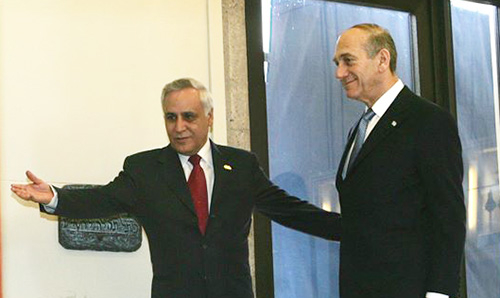
Olmert and KahzavSoon to be reunited in prison? Israel’s former President Moshe Katzav (l) and former Prime Minister Ehud Olmert (r) are pictured here during happier times

Following are some of the comments posted on Arab media and social websites in response to the Olmert verdict:

  • Ali Al-Kadi: “We salute Judge David Rosen [who sentenced Olmert to prison]. We wish the Arabs had 22 judges like David Rosen!” [Al-Quds Al-Arabi][2]
  • Mohammed Akash: “O Muslims, look at the fairness of this judge and where you are. You must learn from our enemy, Israel. Long live the fair Israeli judicial system.”[Al-Quds Al-Arabi][3]
  • Manji Dalali: “This is one of the secrets behind Israel’s victory over the Arabs. We must learn from our Jewish Zionist enemy the principles of fair justice. “[Al-Quds Al-Arabi][4]
  • Ibrahim – Libya: “We Muslims are in great need of a decent judicial system to punish our thieves and corrupt leaders. May God help us.” [Al-Quds Al-Arabi][5]
  • Hassan Jamal: “I wish Arab countries do the same for their corrupt leaders. I wish the Arab people will do the same for their countries and get rid of corrupt officials, including presidents and kings.” [Al-Quds][6]
  • Mohammed: “Of course Islam is the best religion. But the regimes that claim to endorse Islam are practicing repression and corruption. Meanwhile, Israel is among the democratic countries and is better than all the Arab and Islamic countries when it comes to respecting its people and combating theft of resources.” [Al-Wasat News][7]
  • Adel: “This is the secret to Israel’s success; it has become a symbol of justice because it has made justice one of its major bases of power. We, on the other hand, are doing the opposite. We continue to cover up cases of corruption and do not do anything about them.” [Echorouk Online][8]
  • Abu Zeid: “I live in Israel and am familiar with its laws. In this state, no one is above the law.” [Al-Arabiya][9]
  • Sami Dirani: “Israel is the enemy of the Arabs…but it practices democracy – something the Arabs do not know. That is why Israel is stronger and more advanced than the Arabs, who are busy slaughtering each other. Some [Arabs] are dying of starvation, while others are swimming in pools of dollars.” [Al-Hayat][10]
  • Hani: “The hadith [prophet’s sayings] states that we should seek education, even if it is in China. And I say to Muslims, ‘Learn justice even if it’s from Israel.’ I wish the day would come when our leaders would be brought to trial and have our money taken back from them.” [Assawsana][11]
  • Yasalam: “If Olmert were in Kuwait, his case would have been shelved and he would have received a senior position in government.” [Al-Aan][12]
  • Rahhal: “The Zionists have more justice than our thugs and so-called Muslims.” [Al-Aan][13]
  • Kabir al-Muhandiseen: “This is how states are built. This is the secret to Israel’s strength and steadfastness.” [Al-Aan][14]
  • Muhasabah: “In Israel, they hold their officials accountable and send them to prison, while we Arabs glorify the corrupt.” [Al-Aan][15]
  • Zuhear al-Karim: “How many Arab leaders would be left if they went on trial for similar cases of bribery and corruption?” [Arabic CNN][16]
  • Abdo Shehatah: “The Jews continue to prove, every day, that they have real democracy in this world.”[Arabic CNN][17]
  • Saad Sayad: “Law is above all and this is democracy. Israel is the only real democracy in the Middle East.”[Arabic CNN][18]

[1] http://samanews.com/ar/index.php?act=post&id=200106
[2] http://www.alquds.co.uk/?p=167721
[3] Ibid.
[4] Ibid.
[5] Ibid.
[6] http://www.alquds.com/news/article/view/id/503904
[7] http://www.alwasatnews.com/4266/news/read/885026/1.html
[8] http://www.echoroukonline.com/ara/articles/204210.html
[9] http://www.alarabiya.net/ar/arab-and-world/2014/05/13/-الفساد-يدخل-أولمرت-إلى-السجن-6-سنوات.html
[10] http://alhayat.com/Articles/2324750/السجن-ست-سنوات-لرئيس-الوزراء-الإسرائيلي-السابق-ايهود-أولمرت
[11] http://www.alwasatnews.com/4266/news/read/885026/1.html
[12] http://www.alaan.cc/pagedetails.asp?nid=187579&cid=46
[13] Ibid.
[14] Ibid.
[15] Ibid.
[16] http://arabic.cnn.com/middleeast/2014/05/15
[17] Ibid.
[18] Ibid.

PM to Hagel: Iran is fooling int’l community on nukes

May 16, 2014

PM to Hagel: Iran is fooling int’l community on nukes | The Times of Israel.

US defense secretary promises Netanyahu that Tehran will not be allowed to achieve nuclear weapons

May 16, 2014, 12:08 pm Prime Minister Benjamin Netanyahu (right) meets with US Secretary of Defense, Chuck Hagel, at the Prime Minister's office in Jerusalem, on Friday, May 16, 2014. (photo credit: Haim Zach/GPO/Flash 90)

Prime Minister Benjamin Netanyahu (right) meets with US Secretary of Defense, Chuck Hagel, at the Prime Minister’s office in Jerusalem, on Friday, May 16, 2014. (photo credit: Haim Zach/GPO/Flash 90)

Meeting with US Defense Secretary Chuck Hagel Friday morning in Jerusalem, Prime Minister Benjamin Netanyahu said that Iran was continuing to develop its nuclear weapons capability and intercontinental ballistic missiles.

“We’ve been saying all along that Iran is trying to pull the wool over the eyes of the international community,” Netanyahu said, “so I wasn’t surprised and I’m sure you weren’t surprised by the recent UN report on Iran’s ongoing efforts to deceive the international community, to continue to develop its ICBMs and to continually violate its commitments of Security Council stipulations on forbidding it to develop certain parts of its nuclear program.

“They continue to do that, and I think that requires very clear and firm policy on the part of the world powers, the P5+1, and I think as the talks with Iran continue, one thing must guide the international community, and that is we must not let the Ayatollahs win. We must not let the foremost terrorist state of our time, Iran, develop the capability to produce nuclear weapons.”

Turning to the Palestinians, the prime minister said that the PA cannot have peace with both Israel and Hamas.

“One of the things we have found unfortunately is that our Palestinian neighbors are moving ahead in a pact with Hamas,” Netanyahu emphasized. “The United States has designated Hamas rightly as a terrorist organization, and obviously the Palestinians cannot have a pact with Hamas and peace with Israel.

“We’re concerned too that in both Gaza and in the PA-controlled areas, there is continual incitement and propaganda against the very existence of the Jewish state. A recent ADL study, published a few days ago, talks about the fact that in both places, anti-Semitic incitement is the most troubling on the planet, and that is something that I think hinders peace. I think the Palestinians have to make a simple choice, a pact with Hamas or peace with Israel, but they can’t have both.”

Hagel responded by assuring the prime minister that America would not let Iran build a nuclear weapon.

“America’s commitment to Israel’s security is resolute, and as you noted, the military exercise that I visited yesterday with Defense Minister Ya’alon demonstrates that commitment very completely. It also demonstrates the cutting edge work our countries are doing together on rocket and missile defense, and I appreciate your comments on that point – work that has strengthened Israel’s security and saved lives, and I want to assure you, Prime Minister and the people of Israel, of the United States’ continued commitment to ensuring Iran does not get a nuclear weapon, as President Obama has said, and that America will do what we must to live up to that commitment.”

Hagel’s visit comes after stops in Saudi Arabia and Jordan, where he also promised to keep Iran from achieving nuclear weapons capability.

The stop in Saudi Arabia was designed to calm Gulf states that feel vulnerable to Iran’s influence and are frustrated at US policy on Syria, which has not yet included weapons or other lethal aid in the three-year civil war. Washington also wants to foster more effective, practical forms of defense cooperation on the Arabian Peninsula by integrating their air and missile defense systems.

Hagel addressed the Iran issue at the outset of a meeting of defense ministers from the Gulf states allied with Washington, including Kuwait, Qatar, Bahrain, Oman, Saudi Arabia and the United Arab Emirates.

Hagel promised the Gulf leaders that “under no circumstances” will the international negotiations with Iran this week in Vienna “trade away regional security for concessions on Iran’s nuclear program.”

“We will continue to hold Iran accountable for its destabilizing activities across the region,” he added. “And we will continue working closely with all of our friends and partners in the Gulf to reinforce their defenses against these destabilizing activities.”

Follow us: @timesofisrael on Twitter | timesofisrael on Facebook

Confidential UN report: Iran’s ballistic missile work complicating nuclear talks

May 16, 2014

Confidential UN report: Iran’s ballistic missile work complicating nuclear talks | JPost | Israel News.

By REUTERS

LAST UPDATED: 05/16/2014 09:04

As the talks on Iran’s nuclear program in Vienna resume, the US has brought up the missile development issue; Russia says that Iran’s missiles are not on the nuclear talks agenda.

Handout picture shows Iranian supersonic ballistic missile [file]

Handout picture shows Iranian supersonic ballistic missile [file] Photo: REUTERS/Fars News/Handout

VIENNA – Despite apparently reducing illicit purchases that breach UN sanctions, Iran is pursuing development of ballistic missiles, a confidential UN report says, posing an acute challenge to six powers negotiating with Tehran to rein in its nuclear program.

On Sunday, Iranian Supreme Leader Ayatollah Ali Khamenei described as “stupid and idiotic” Western expectations for his country to curb its missile development. He decreed mass production of ballistic weapons, striking a defiant tone just before nuclear talks resumed on Wednesday in Vienna.

The high-stakes negotiations aim for a deal by a July 20 deadline to end a long stand-off that has raised the risk of a wider Middle East war.

Tehran’s often repeated view that missiles should not be part of the nuclear talks appears to enjoy the support of Russia, one of the six global powers.

But a senior US official made clear this week that Tehran’s ballistic capabilities must be addressed in the negotiations since UN Security Council resolutions on Iran “among many other things, do say that any missile capable of delivering a nuclear weapon must be dealt with.”

A ban on developing missiles suited to carrying a nuclear warhead is included in a 2010 Security Council resolution, its fourth – and toughest – imposed on the Islamic Republic for defying council demands that it suspend uranium enrichment and other nuclear activities of potential use in bomb-making.

The new report by the UN Panel of Experts, seen by Reuters, said Iran’s overall attempts to illicitly procure materials for its banned nuclear and missile program appear to have slowed down as it pursues negotiations with world powers that it hopes will bring an end to sanctions.

But the same report makes clear that, apart from holding off on test-firing one type of rocket, Iran shows no sign of putting the brakes on the expansion of its missile program.

“Iran is continuing development of its ballistic missile and space programs,” the experts said. “A new missile launch site 40 km (25 miles) from the city of Shahrud was identified in August 2013. A larger launch complex is assessed to be close to completion at the Imam Khomeini Space Center at Semnan for ballistic missiles and satellite launch vehicles.”

The report also cited what it described as the June 2013 opening of the Imam Sadeq Observation and Monitoring Center for monitoring space objects, including satellites.

The dispute over missiles has already surfaced behind closed doors in Vienna. On Wednesday, the first day of the latest round of the nuclear talks, the US delegation made clear that it wanted to discuss both Iran’s ballistic missile program and possible military dimensions of its past nuclear research.

But in a sign of the wide divergence between the US and Iranian positions, Iranian Foreign Minister Mohammad Javad Zarif merely laughed and ignored the remarks, according to an Iranian official present. An American official declined to comment but referred to remarks from a senior US official earlier this week, who said “every issue” must be resolved.

ARMS EXPERT: LEAVE MISSILES ASIDE

Diplomats close to the talks say Britain, France and Germany agree with the US view. But Russia, which has engaged in missile-technology trade with Iran, appears to disagree. Russian Foreign Minister Sergei Lavrov was quoted by Iranian media as saying that Tehran’s missile program was not on the agenda.

The Islamic Republic denies accusations that it is seeking the capability to make nuclear weapons. It insists that its missiles are part of its conventional armed forces and rules out including them on the agenda for the nuclear discussions.

Daryl Kimball of the Arms Control Association, a Washington-based research and advocacy group, said that missiles should not become a deal-breaker.

“The best way to address Iran’s potential to exploit nuclear-capable missiles is to ensure that Iran’s nuclear program is sufficiently limited and transparent,” he said.

“To seek Iran-specific limits on conventional weapons that Iran regards as vital to its self-defense would jeopardize the negotiations’ key objective.”

An Iranian official confirmed that the ballistic missile program would not be interrupted. “Iran purchases parts from various countries, including Russia and China and then assembles missiles in Iran,” he said.

“Some Gulf countries have been involved in the missile delivery to Iran. Iran has never stopped its missile program nand has no intention to do so; it gives Iran an upper hand.”

The UN Panel of Experts, which monitors compliance with the UN sanctions regime against Iran, said in its 49-page report that monitoring Iranian missile work was not easy.

MISSILE WORK MORE HIDDEN THAN NUCLEAR ACTIVITY

“Analysis of Iran’s ballistic missile program remains a challenge. With the exception of several launches, periodic displays of hardware and one recent revelation of a new ballistic launch facility, the program is opaque and not subject to the same level of transparency that Iran’s nuclear activities are under IAEA safeguards.”

It said procurement for the missile program continues, with no apparent changes in the type of materials Iran seeks.

“Among the most important items Iran is reportedly seeking are metals as well as components for guidance systems and fuel,” the panel report said. “Similarities between Iran’s ballistic missiles and space programs can make it difficult for states to distinguish the end-uses of procured items.”

The experts said it was unclear why Iran appears not to have test-fired a Sejil, Iran’s longest-range, solid-fueled ballistic missile, since 2011. This might be due to satisfaction with its performance, an inability to procure components or ingredients for solid fuel, or a shift to other missiles considered to be of higher priority, according to the report.

“Iran may also have decided to suspend further testing which could be interpreted as inconsistent with the spirit of the (six power) negotiations,” the experts assessed.

Nevertheless, the panel said that proof Iran is continuing to develop the Sejil came from a 2013 parade of their launchers.

On Feb. 10, Iran test-fired the Barani, which the experts said the Iranian Defence Ministry had described as “a new generation of long-range ballistic missiles capable of carrying multiple re-entry vehicle (MRV) payloads.” A MRV payload deploys multiple warheads in a pattern against a single target.

Iran had announced no other ballistic test, the panel said.

According to Jane’s Defense Weekly, Iran recently unveiled an indigenous copy of the Lockheed Martin RQ-170 unmanned aerial vehicle as well as “other, potentially more significant, revelations” – including new versions of the Fateh-110 tactical ballistic missile known as the Hormuz-1 and Hormuz-2.

Military analysts say, however, that Iran has exaggerated its military achievements, including its missile capabilities.

It’s Time to End Israel’s ‘Special Relationship’ with the U.S.

May 16, 2014

It’s Time to End Israel’s ‘Special Relationship’ with the U.S., Times of Israel Blogs , May 16, 2014

(“Extreme,” perhaps, but what think ye? — DM)

With one of the strongest economies and militaries in the world, it is time that we re-establish our independence and autonomously decide our own fate. A friend who compromises our interests to further their own, is no friend at all.

The United States has reached a point in which an Arab-Israel peace treaty, under any terms, is better than the status quo where relations with Arab nations have become muddied; if this means dividing Jerusalem, what harm would it do to America? It’s surely no loss to them. No nation would ask another to negotiate on its behalf to determine borders. Why is this different for Israel?

On the surface, we describe the U.S.-Israel relationship as a special bond that cannot be broken, worth billions in trade and of supposedly high strategic value. But over the past decade, America has used this relationship, mainly through its U.N. veto and billions in military hardware grants, to bully Israel into submission and strengthen her enemies. When you peel back the rhetoric of Israel’s military and political echelons, our enemies see an image similar to that of a child constantly being scolded by his parents.

Under the Bush Administration, both governments jointly worked on Stuxnet, a computer virus that destroyed large swathes of Iran’s nuclear enrichment centrifuges at Natanz without them knowing that they were sabotaged. High ranking members of the American intelligence community leaked this program to Time Magazine and revealed a covert operation against Israel’s number one enemy. This allowed Iran not only to recover, but to implement safeguards to prevent future cyber attacks.

Hezbollah, which is deeply involved in the Syrian Civil War, has taken the opportunity to attempt to smuggle surface to air missiles into Lebanon, for future use again Israel. The Israeli Air Force in turn has carried out raids on these shipments and storage facilities with a policy of not acknowledging or announcing that they took place. This allows our enemies to, in turn, deny they took place, so as not to force their hand into retribution – which can quickly lead to an all-out war. After each raid since the war began, White House officials have leaked to the American press that these were indeed Israeli strikes. These leaks have not only put Israeli’s at risk, but Jews all over the world. Intelligence agencies, largely with the help of the Mossad, have thwarted Hezbollah/Iranian attacks in Asia & Africa. Unfortunately, Hezbollah managed to successfully carry out a bus bombing in 2012 in Bulgaria against Israeli tourists. These attacks have largely been attributed to the American leaks regarding Israel’s covert activities in Syria, Lebanon & Iran.

President Obama is widely known for his policy of disengagement, which in itself is a threat to Israel’s security. Take Ukraine for example, an American ally, was literally invaded by Russian special forces last month and had part of its territory annexed with minimal repercussions. Or Egypt under Hosni Mubarak, one of America’s strongest allies for decades, was the victim of a coup d’état with America standing idly by as the Muslim Brotherhood took power. But yet, at the same time, the Obama administration has promised Israel that they will ensure that Iran is unable to become a nuclear threshold state. How are we supposed to believe that America will protect our interests when they cannot even protect their own?

The Palestinians argue that the Americans are not an even-handed, just broker for peace and I would have to agree with them. Where we would differ is that I don’t think the Americans are biased towards Israel’s narrative. The United States has reached a point in which an Arab-Israel peace treaty, under any terms, is better than the status quo where relations with Arab nations have become muddied; if this means dividing Jerusalem, what harm would it do to America? It’s surely no loss to them. No nation would ask another to negotiate on its behalf to determine borders. Why is this different for Israel? President Abbas has refused to negotiate directly with Prime Minister Netanyahu because he knows that President Obama can extract more concessions out of Israel. Yitzhak Rabin once put it perfectly, “You don’t make peace with friends. You make it with very unsavory enemies.”

If all of this wasn’t enough to realize that Israel needs to move out of her parents house, the Pentagon recently approved a $1 billion arms package for the Iraqi military. With Fallujah, under Al Qaeda control for the past few months, the risk of American heavy arms falling in to the wrong hands in the coming years is extremely high. But this wouldn’t be the first or last time America has sold weapons to our enemies; in October 2013, they announced plans to send $10.8 billion in weapons to the United Arab Emirates and Saudi Arabia. The latter has been committed to Israel’s destruction since its inception and has recently paraded Chinese nuclear capable DF-3 missiles in a town near the Iraqi border. And let’s not forget who originally armed Saddam Hussein and the Mujahideen of Afghanistan, which transformed into Al Qaeda!

Newsweek’s claims last week about “far-reaching” Israeli spying on the United States is a concerted effort by the American intelligence community to put a full stop on the American visa-waiver program that Israel may be accepted to. Don’t be fooled, this is a symptom of the disease and not the cause. American political, military and espionage echelons attribute little value to this so called “special relationship” between the two countries. Jonathan Pollard is just another victim of this catastrophe. Every nation spies on their friends, but no spy has spent longer in an American prison than Jonathan Pollard. The Americans have described his actions as one of the greatest compromises to their national security. Surely, Pollard’s transfer of satellite imagery to an ally (in the 1980’s I might add) is much less “compromising” than Edward Snowden’s NSA leaks about entire intelligence gathering programs.

Iran continues its nuclear enrichment program, Hamas and Hezbollah are both smuggling large quantities of conflict changing weapons, Syria’s Assad is committing what no one will admit is a genocide and Palestinian President Abbas refuses to move towards a peace agreement with Israel all because Israel’s military deterrent and political power is being suppressed and compromised by our dear friend, the United States. As long as the America continues to dictate terms and conditions to Israel diplomatically, we will see no movement on the peace process as well as a vulnerable and weakened Israeli military establishment. Israel is no longer facing an existential crisis from massive Arab armies on several fronts or a devastating economic crisis, as was the case in the 1970’s. America will not remain the superpower forever and we should not put all of our eggs in one basket. With one of the strongest economies and militaries in the world, it is time that we re-establish our independence and autonomously decide our own fate. A friend who compromises our interests to further their own, is no friend at all.


