Archive for May 15, 2014

Let’s do almost nothing

May 15, 2014

Let’s do almost nothing,  Israel Hayom, Prof. Efraim Inbar, May 15, 2014

(How much is it worth to Israel to “keep America at bay?” — DM)

After the Kerry debacle, Washington is left counting an additional foreign policy failure, trying to digest what happened and pondering how to proceed. Its current instinct is to stay away from interventionist initiatives.

[I]n light of America’s great importance to Israel, uncoordinated unilateral steps by Israel on the West Bank are not advisable. Israeli statements expressing a commitment to future peace negotiations, coupled with restraint in building beyond the settlement blocs, might be enough to keep America at bay and reluctant to intervene. [Emphasis added.]

Now that the Israeli-Palestinian peace negotiations have ended in failure, many suggest taking advantage of the political limbo to advance their preferred unilateral plans. The Israeli political right wing is promoting the annexation of Area C, while the left wing is advocating a “coordinated” (whatever that means) unilateral withdrawal. Government officials have spoken about the need for Israel to “do something.” Others suggest negotiating with the Quartet, instead of the Palestinians.

Activism is unquestionably a trait that is admired in Israel. Zionist-rooted rhetoric such as “we have to determine our borders and destiny on our own” falls on receptive ears.

However, probably the wisest course of action for Israel is a patient and cautious “wait and see” approach. Resolving the conflict is impossible, but attempting to manage it — minimizing the suffering to both sides as well as the diplomatic costs to Israel — is within reach.

Kerry’s initiative has indeed ended in failure. But the sky has not fallen. There is no sense of alarm or fear of a great impending crisis in the region or elsewhere in the world.

Pressure on Israel to change the status quo is unlikely. Actually, it serves Israel’s interests to keep the status quo to hold on to its bargaining cards. The assumption that time is running against Israel is simply wrong. As a matter of fact, the Palestinian issue is likely to become less salient in the international arena over time.

After the Kerry debacle, Washington is left counting an additional foreign policy failure, trying to digest what happened and pondering how to proceed. Its current instinct is to stay away from interventionist initiatives. The U.S., drained by two wars (Afghanistan and Iraq) and blessed with new energy finds, does not want to get dragged into further conflicts in a Middle East that seems less central to its interests. So the Obama administration may be less inclined to intervene in the intractable Israeli-Palestinian conflict than ever before. Even if the U.S. obsession about Palestinian statehood persists for some reason, it is still better for Israel to wait and learn Washington’s next moves before devising an adequate response.

Moreover, in light of America’s great importance to Israel, uncoordinated unilateral steps by Israel on the West Bank are not advisable. Israeli statements expressing a commitment to future peace negotiations, coupled with restraint in building beyond the settlement blocs, might be enough to keep America at bay and reluctant to intervene.

The U.S. is also unlikely to be confronted with Arab pressure to focus on the Palestinian issue if Israel does not engage in drastic steps. The Arab world is undergoing a tremendously difficult economic and sociopolitical crisis and is busy dealing with domestic problems. Moreover, the Iranian nuclear threat continues to be the most urgent foreign policy issue, putting most Sunni states in the same strategic boat with Israel. Even the Palestinians do not take Arab lip service on their behalf seriously.

In all probability, most countries of the world can also live with an unresolved Palestinian issue. There are many simmering territorial conflicts all over the world. Nowadays, Crimea and eastern Ukraine dominate the news. In the coming months and years, many human and political tragedies will divert attention away from the Palestinian issue.

Significantly, the Palestinians have no impact on truly important strategic issue such as nuclear proliferation or energy that might galvanize powerful states into action. Once, they were an important actor in international terrorism. This is no longer true. Nowadays, Palestinians are very dependent upon international aid. Rocking the boat by using too much violence threatens the livelihood of Palestinians receiving the Palestinian Authority’s salaries and benefits, and risks Israel’s strong retaliation. Simply put, the Palestinians have only limited international leverage and are vulnerable to Israel’s potentially harmful countermeasures.

Moreover, the Palestinians have an excellent record of shooting themselves in the foot. The unity agreement between the Palestinian Authority and Hamas is the latest example of this.

Whatever some experts say, Israel is not isolated in the international community. Israel is a strong country, possessing a remarkable web of international interactions. Significantly, Israel’s relations with the world are only marginally affected by its conflict with the Palestinians.

The political actors most obsessed with the Palestinian issue, the Israeli political Left and the Europeans, are in decline. The Oslo process, with which the Israeli Left was associated, has failed, delegitimizing its initiators. Europe and the euro zone are facing acute problems, further reducing their limited ability to be true strategic actors. The ability of these weakened political actors to push the Palestinian issue to the top of the international agenda has become increasingly curtailed. Contemporary international circumstances could lead to further marginalization of the Palestinian issue.

Israelis, like many misguided Westerners, too often succumb to counterproductive hyper-activism. Doing almost nothing might bring about better results than activating unilateral plans of all kinds.

‘Very significant gaps’ remain in Iran nuclear talks

May 15, 2014

Very significant gaps’ remain in Iran nuclear talks, Israel Hayom, May 15, 2014

Optimism on potential for a final nuclear agreement with Iran has “gotten way out of control,” U.S. official says, as six world powers and Iran enter a decisive phase of talks • Deadline for deal is July 20.

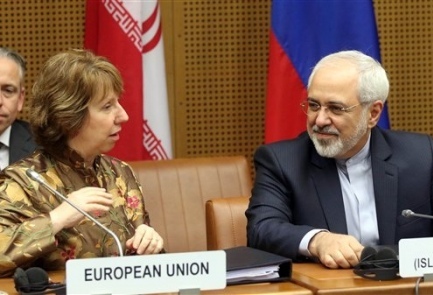
Ashton and Iranian Foreign MinisterARNEY HAS PHOTO Caption: EU foreign policy chief Catherine Ashton and Iranian Foreign Minister Mohamad Javad Zarif meet in Vienna on Wednesday | Photo credit: AP

Six world powers and Iran launched a decisive phase of diplomacy on Wednesday to draft a lasting accord that would curb Iran’s contested nuclear activity in exchange for a phased end to sanctions that have hobbled the Iranian economy.

After three months of discussing expectations rather than negotiating possible compromises, the sides are to set about devising a package meant to end years of antagonism and curtail the risk of a wider Middle East war with global repercussions.

A  Western official close to the talks said on Wednesday that “progress is being made, but all pieces have to fit together.”

“Nothing is agreed yet,” the official told Reuters on condition of anonymity.

 If a deal was reached, Washington’s decades-long estrangement from Iran could ease, improving international stability, but U.S. and other Western officials warned against unwarranted optimism given the persistent critical differences between the sides.

“We’ve spent the last couple of rounds putting all of the issues on the table, seeing where there may be points of agreement, where there may be gaps. There are some very significant gaps,” a senior U.S. official said on Tuesday.

“It’s not that there aren’t solutions to those gaps; there are. But getting to them is another matter.”

To achieve a deal, the United States, Russia, China, France, Britain and Germany will want Iran to agree to dramatically cut back its uranium enrichment program to remove any risk that it could lead to the making of atomic bombs, while Iran will want them to eliminate sanctions against its oil-based economy.

Diplomats from both sides have said they want to resolve all sticking points about issues such as Iran’s capacity to enrich uranium and the future of its nuclear facilities, as well as the timeline of sanctions relief, by a July 20 deadline.

After that, an interim deal they struck last November expires and its extension would probably complicate talks.

A spokesman for EU foreign policy chief Catherine Ashton, who coordinates diplomacy with Iran on behalf of the six, said negotiators held a “useful initial discussion” on Wednesday morning and would hold coordination meetings later in the day.

“We are now hoping to move to a new phase … in which we will start pulling together what the outline of an agreement could be. All sides are highly committed,” Michael Mann said.

Looming in the background of the talks have been warnings by Israel, which views a nuclear Iran as an existential threat, that it would attack Iranian nuclear facilities if it deems diplomacy ultimately futile in containing Iran’s atomic abilities and potential.

U.S. President Barack Obama has not ruled out the last-ditch option of military action either.

Broadly, the six powers want to ensure the Iranian program is curtailed enough so that it would take Iran a long time to assemble nuclear bomb components if it chose to do so, and would be detected with intrusive inspections before it was too late.

Iran denies accusations of having nuclear weapons aspirations, saying it wants only peaceful atomic energy.

Central to this issue will be the number of centrifuge machines, which potentially can enrich uranium to bomb-fuel quality, that Iran would be permitted to operate.

Iran has about 10,000 centrifuges running but the West will likely want that number trimmed to the low thousands, a demand that could be unacceptable to Iran.

Iran’s research and development of new nuclear technologies and the amount of stockpiled enriched uranium it may keep will also be crucial and likely difficult to negotiate. Refined uranium can be used as fuel in nuclear power plants or in weapons if purified to a high enough level.

“Halting research and development of uranium enrichment has never been up for negotiation, and we would not have accepted it either,” Iranian Deputy Foreign Minister Abbas Araqchi was quoted as saying by the ISNA news agency.

“But a wide variety of issues have been discussed … and on uranium enrichment too we have tried to reach consensus.”

Diplomats say Iran, rather than deactivating centrifuges, wants to expand its enrichment program, saying it needs to do this to fuel a planned network of nuclear power plants.

Iran entered talks with the big powers after President Hassan Rouhani was elected last June.

Diplomats have signaled that some progress may have been made during three rounds of expert-level talks since February on one of the thorniest issues — the future of Iran’s planned Arak heavy-water reactor, which Western states worry could prove a source of plutonium for nuclear bomb fuel once operational.

But the U.S. official cautioned that some media reports about progress reached up until now were going too far.

“I’ve read a lot of the optimism you’ve written,” the official told reporters. “It’s gotten way out of control.”

Other diplomats from the powers warned that progress, if any, in the coming talks will be slow. And any agreement may come only at the 11th hour. “It’s very difficult to say how it will all work in practice now. We have no agenda but that’s not different from any other meeting,” said one.

“The figures will come at the end. They will be part of the big bargaining,” he said, referring to decisions about issues such as the number of centrifuges to remain in Iran.

Much of the complexity of the final deal stems from the fact that its various elements are intertwined. A higher number of centrifuges left in Iran would mean the powers wanting Tehran to more substantially slacken the pace of enrichment, for example.

“All the parameters are interdependent,” one diplomat said.

Politically, any deal could still be torpedoed by conservative hawks in the United States or Iran, and another interfering factor could be the approaching U.S. midterm congressional elections.

Divisions in Washington are closely linked to concerns in Israel that any deal might not go far enough.

“We are not against diplomatic solutions. But on one condition, that it is a serious and comprehensive solution. A solution that can be trusted,” Yuval Steinitz, Israel’s strategic affairs, intelligence and international relations minister, told reporters in Brussels last week.

“Iran should be denied not just [the ability] to produce the bomb but also to have the capability,” he said.

What Kind of Palestinian State?

May 15, 2014

What Kind of Palestinian State? Gatestone InstituteBassam Tawil, May 15, 2014

(The last paragraph, “All that is left is to sit back and watch the establishment of Hamas’s new Islamic emirate in the West Bank, an enclave of lepers against whom the whole world will unite” seems more than slightly over-optimistic. — DM)

All that is left is to sit back and watch the establishment of Hamas’s new Islamic emirate in the West Bank.

“The shoulders of men were created only to bear rifles.” — Fatah Facebook page

The Ramallah funeral, authorized by the Palestinian Authority, was attended by masses of Palestinians waving green Hamas-affiliated flags — not yellow Fatah flags. Every child knows that if elections were held, Hamas would win in a landslide.

The Palestinian leadership understands that it will not be able to agree to the conditions for peace set out by John Kerry. These conditions do not provide a solution for the millions of grandchildren and great-grandchildren of the original 1948 refugees, who wish to “return” to Palestine.

Fatah called the “reconciliation” a union of two “military organizations.” At the end of April Fatah’s page featured two masked terrorists holding assault rifles. One wears a yellow headband of the Al-Aqsa Martyrs Brigades, Fatah’s military-terrorist wing, and the other a green headband of the Izz al-Din al-Qassam Brigades, Hamas’ military-terrorist wing. 

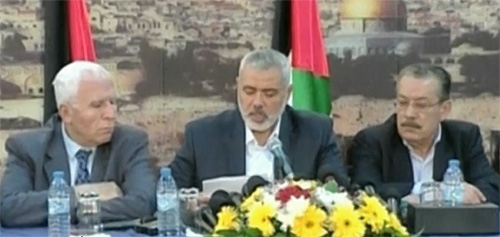
The final nail in the coffin of the Israeli-Palestinian peace was the speech given about the internal Palestinian reconciliation by the Palestinian delegate, Azzam al-Ahmed, at the home of Hamas head Ismail Haniyeh in the Shati refugee camp in Gaza.

At the end of April, the internal Palestinian reconciliation was announced, with Fatah leaders posing for the camera with Hamas leaders Ismail Haniyeh and Musa Abu Marzouk — all wreathed in smiles. Until the catastrophic pictures were published there were many Palestinians and Israelis who honestly believed there was a chance for a peace agreement that would lead to the establishment of a Palestinian state coexisting with Israel, but the speeches given by both sides made it clear that the dream of a Palestinian state would finally have to be shelved for the foreseeable future.

Hamas Fatah signingIsmail Haniyeh (center) speaks at the signing ceremony for the Hamas-Fatah unity agreement. (Image source: Screenshot of AlJazeera video)

It was no surprise when the Hamas’ Ismail Haniyeh reassured Palestinians that their future Palestinian state would stretch from the Jordan River to the Mediterranean Sea, and that the Palestinians would return to their lands in “all Palestine.”

Hamas, a branch of the Muslim Brotherhood and an extremist terrorist organization, has always held that unrealistic position and has never expressed any desire whatsoever for a peace agreement with the Jews. Its aspiration is, and has always been, to destroy Israel by force, slaughter its Jewish inhabitants and establish a Sharia-based Palestine on the ruins.

The real disappointment, however, was the speech given by Azzam al-Ahmed, who said the Palestinians would never recognize the State of Israel as the Jewish national homeland and would never waive the Palestinian “right of return” to Palestine.

Those speeches summed up the joint position agreed on by both Fatah and Hamas; it means there will not be peace. The Israelis will not agree to sign any agreement that will destroy their state through the influx of the millions of descendants of the 1948 refugees.

A few days later Mahmoud Abbas met with Hamas political bureau head, Khaled Mashaal, in Qatar. Apparently the internal Palestinian reconciliation is a done deal.

The events made it clear to one and all that this time it is not just more empty rhetoric, and that, as Palestinians, we will have to start recognizing that our lives will change, now and in the future.

The first signs came when Mahmoud Abbas and his associates threatened to dismantle the Palestinian Authority and lodged a unilateral appeal with the United Nations to have the “state of Palestine” recognized — totally in violation of the framework for the peace process set out by U.S. Secretary of State John Kerry.

The Palestinians bluntly told Kerry they would not recognize Israel as the national homeland of the Jewish people. They based their refusal on the dreamy claim that doing so would damage the historical rights of the Palestinians and the rights of Israeli Arabs.

The truth is that Mahmoud Abbas does not have either the support of the Palestinian people or a consensus to lead, and his term of office ended six years ago. He knows that no decision he makes commits either the Palestinians in the Gaza Strip or the Palestinians around the world. Many people claim that because he has no legal governmental status, his decisions are not accepted as valid even in the West Bank.

For that reason, Fatah leader Mustafa Barghouti, a member of the Fatah delegation, made a speech in which he claimed that the objective of the reconciliation had been to provide Mahmoud Abbas with a consensual status in the Gaza Strip as well as the West Bank, until the upcoming elections are held (if, in fact, they ever are held). Barghouti’s claim was made in response to Israel’s claims that Mahmoud Abbas did not actually represent anybody.

However, every West Bank child knows that Mahmoud Abbas’s regime exists only by the grace of Israeli security services and that if elections were held tomorrow, or in six months as noted in the reconciliation agreement, Hamas would win in a landslide and take over the West Bank.

Mahmoud Abbas is currently at a dead end — and why he chose to join Hamas, through the “reconciliation,” of his own free will. He can control how he hands over the keys to the West Bank to Hamas and can step into the wings without fear of a Hamas putsch or a humiliating defeat in the elections.

More importantly for him, he and his associates can ward off, at least for the time being, attempts to assassinate them and appropriate the assets they have amassed over the years, and avoid the bitter fates of their Fatah compatriots in the Gaza Strip, who were divested of their assets, often kneecapped and hurled off the roofs of high-rise buildings.

The Palestinian leadership understands that it will not be able to agree to the conditions for peace set out by John Kerry. These conditions do not provide a solution for the millions of grandchildren and great-grandchildren of the original 1948 refugees, who wish to “return” to Palestine.

They will come covertly accompanied by jihad fighters who gained their experience in the killing fields of Syria, Iraq and Lebanon, who will accuse Mahmoud Abbas of treason, and, sooner rather than later, assassinate him and his associates and hang their bodies in the main square in Ramallah.

The new mujahideen who enter “Palestine” from Jordan will immediately join Hamas, demand a redistribution of lands and resources, wage a new terrorist campaign against Israel and turn the West Bank into a Gaza-like Islamic emirate ruled according to the Shariah.

Clearly, Mahmoud Abbas and his associates cannot recognize Israel as a Jewish state because they understand it would mean the end of their demand to flood Israel with the refugees’ descendants and upset the Jewish majority. Once the political process is completed, the Palestinians would no longer have a basis for more demands and that would end the conflict once and for all.

Ever since the Palestinian leaders understood that accepting Israel’s conditions would mean their own destruction at either the hands of Hamas extremists or at the hands of the “rejection front,” they have manufactured marginal, if creative, excuses to extricate themselves from the negotiations. They have claimed that Israel refused to implement the fourth phase of a prisoner release (a promise made on condition that there was progress in the peace talks). Apparently the Palestinian leaders have come to the inevitable conclusion that their regime will be toppled one way or the other, with peace with Israel or without it.

Mahmoud Abbas’s attempt to gain time and extort Israel into unilateral concessions by enlisting the United States and the EU, while giving nothing in return, has failed. His attempt to convince Israel that he personally would waive the “right of return” to Safed, the city of his birth, has also failed. He waffled, saying that the right of return was an individual right of every refugee, so that he could not waive everyone’s “right” for them.

The Israelis immediately countered by saying that the role of a leader was to represent the collective will of all his people. They said that Mahmoud Abbas was evading taking a stand on a critical core issue, and in fact leaving the issue of the demand for the right of return without a solution.

Azzam al-Ahmed’s declarations only confirmed Israel’s evidently justified suspicions that the Palestinians did in fact want to flood their country with millions of refugee descendants and destroy their country’s demographics. This accurate conclusion was why Netanyahu insisted that the Palestinians recognize Israel as the national homeland of the Jewish people.

Another conspicuous manifestation of the upcoming change in the balance of power in the West Bank was the funeral held for the Awadallah brothers, two senior Hamas terrorists, killed by Israel, who engineered terrorist attacks that killed enormous numbers of Israeli civilians. The funeral was held near Mahmoud Abbas’s office in Ramallah after the internal Palestinian reconciliation was signed. The funeral, authorized by the Palestinian Authority, was attended by masses of Palestinians waving green Hamas-affiliated flags — not yellow Fatah flags. The crowd chanted the familiar “Khaybar, Khaybar, Jew, the army of Muhammad will return,” the call for the slaughter of the Jews, just as the army of Muhammad had expelled and slaughtered the Jews of Saudi Arabia in the seventh century.

Fatah expressed its satisfaction over the union with the Hamas terrorist organization on its official Facebook page. Fatah called the “reconciliation” a union of two “military organizations.” At the end of April Fatah’s page featured two masked terrorists holding assault rifles. One wears a yellow headband of the Al-Aqsa Martyrs Brigades, Fatah’s military-terrorist wing, and the other a green headband of the Izz al-Din al-Qassam Brigades, Hamas’ military-terrorist wing. The page also features the slogan, “Yes to unity and the end of the [internal Palestinian] rift,” and the caption reads, “The shoulders of men were created only to bear rifles.” The site is full of encouragement for attacks on Israeli soldiers and praise for the new union of the Palestinians fighting the Israeli enemy. That includes Hamas, the Palestinian Islamic Jihad and the other terrorist fronts that have spent years in a terrorist campaign trying to destroy Israel. The page also included a list of shaheeds [martyrs], role models for the future struggle.

The Israelis are also aware of declarations made by Jibril Rajoub, formerly head of the Palestinian Authority intelligence service and today a government minister, who said that if he had a nuclear weapon he would drop it on Israel.

That sort of declaration gives the Israelis an indication into what the real intentions of the Palestinian Authority for them are.

Declarations made by Tawfiq al-Tirawi in an interview with the television channel Al-Manar, Hezbollah’s mouthpiece, recently clarified the intentions of Fatah as well. Tirawi, who was a senior figure in the Palestinian preventive security force and today is a high-ranking Fatah member, said that “the homeland is all of Palestine, the Gaza Strip and the West Bank, Haifa, Jaffa, Acre, from the sea to the Jordan River, according to the principles of Fatah adopted in 1968” [the armed campaign].

All that is left is to sit back and watch the establishment of Hamas’s new Islamic emirate in the West Bank, an enclave of lepers against whom the whole world will unite. The Israelis and Jordanians will choke off Hamas, enabling Israel to take control of the West Bank for the next million years — without interference.
Hagel’s talks in Jordan and Israel to determine if Syrian rebel Golan offensive expands to Damascus

May 15, 2014

Hagel’s talks in Jordan and Israel to determine if Syrian rebel Golan offensive expands to Damascus.

DEBKAfile Exclusive Report May 15, 2014, 10:41 AM (IDT)
US and Jordanian special forces

US and Jordanian special forces

US Defense Secretary Chuck Hagel arrived in Israel Wednesday May 14 from an inspection of the US-Jordanian underground command center manned by 273 American officers and located 10 kilometers north of the Jordanian capital, Amman, debkafile’s military sources report. He arrived from attending the GCC defense ministers’ meeting in Jeddah for talks with Israel’s Defense Minister Moshe Ya’alon in Tel Aviv Thursday.
This US-Jordanian war room, known as Centcom Forward-Jordan, was established in August 2013 to direct potential US-Jordanian military action in Syria and counter any military threat posed by Syria or Hizballah to Jordan or Israel. This command center coordinates operations with the network of US air and naval forces in the Mid East. It is also connected to IDF and Israeli Air force headquarters.

Hagel was joined on his visit by the Head of the Jordanian Armed Forces Lt. Gen. Mashal Mohammad Al-Zaben and Jordanian Prince Faisal Al Hussein.

Hagel and party heard briefings from the US and Jordanian commanders directing the war room and monitoring the Syrian rebels’ assault on Golan town of Quneitra, and their evaluations of the chances of the rebels taking the town.

It was the first visit by a high-ranking US defense persona to a US military headquarters directly involved in the Syrian war.

As Hagel talked to Jordanian military and political leaders, a joint-US-Jordanian military exercise, dubbed the 8th Annual Falcon Air Meeting, took place in and around the Muwaffaq Salti Air Base in eastern Jordan. This base is considered to be the likely staging-ground for any American military intervention in Syria.

debkafile’s military sources say that Hagel’s talks in Jordan and Israel are to determine whether the rebel forces backed by the US open a new southern front against Bashar Assad.
The military aspect of the Syrian civil conflict gains ground as the political dimension recedes with the resignation of the UN-Arab League peace envoy Lakhdar Brahimi, which UN Secretary Ban Ki-Moon attributed to the failure of both sides to reach a political solution.

On Tuesday May 13, Israeli Defense Minister Moshe Ya’alon, accompanied by senior IDF commanders, toured parts of the Golan border fence to observe the fighting in the Syrian sector. He said, looking toward the town of Quneitra: “From here we can see how the rebels have pushed Assad’s army into a corner.”
Ya’alon no doubt passed this evaluation on to the Defense Secretary during his visit to the war room in Jordan, as food for the decision on whether to let the Golan battles take their course – thus far an even contest with the rebels unable to finish the Syrian forces off and capture Quneitra, the key to a wide stretch of southern Syria – or arm the rebel militias for a major push. This would demand heavy American weaponry, especially a sufficiency of TOW missiles, to tip the scales of the battle. Thus far, only a small amount has been supplied.
This decision will be important in determining how the Syrian war develops, although Secretary Hagel is rarely brought into strictly operational decisions.

If he decides to provide the rebels fighting for Quneitra with enough heavy weapons to wrest the town and parts of the South from the Syrian army, they would also be armed for the option of advancing on Damascus. They could form up into two columns – one moving out of Quneitra and the other from the southern town of Deraa. This formation would directly threaten the three Syrian army bases – Al-Kiswah, Qatana and Kanaker – defending southern Damascus, that are manned by the 9th Syrian Division.
This would be a surprise development for the Syrian commanders and Iranian military advisers, led by Al Qods Brigades chief, Gen. Qassem Soleimani, who are currently focused on the northern front up against the Turkish and Lebanese frontiers. It would catch them unprepared and lacking the strategic military reserves to defend Damascus from a new threat without exposing their other fronts.
Hagel faces another major difficulty, which is to determine which Syrian militias qualify for the receipt of heavy American weapons.
The rebel militias fighting close to Israel’s Golan border are interspersed with Jabhat al-Nusra (Al Qaeda in Syria) combatants. Al Qaeda’s ISIS (Islamic State in Iraq and the Levant) ISIS has also begun sending jihadists to the new battlefield around Quneitra. So far, the US and Jordanian officers supervising the arena from the war room near Amman have been able to keep US arms out of their hands. But what happens if those weapons are delivered in large quantities?


