Archive for May 13, 2014

Boko Haram Benefited from State Department Inaction

May 13, 2014

Boko Haram Benefited from State Department Inaction, Heritage Foundation, May 12, 2014

(Is the problem that President Obama, et al, are naive? Or might there be more? — DM)

For three years, the U.S. State Department was unwilling to acknowledge the threat and legally define Boko Haram as a terrorist organization, despite the Salafi militants’ overt and calculated efforts to terrorize Nigeria and its neighbors, including international targets such at [as?] the United Nations Headquarters.

Despite the serious implications of instability and violence in Nigeria and the region, the State Department repeatedly deferred to the Nigerian government’s request that the group not be designated so as not to discourage investment in what is now the the largest economy in Africa, rather than allowing U.S. national interests to take precedence.This continued even after  Boko Haram attacked the United Nations headquarters in Abuja, the capital of Nigeria, in 2011.

The Obama administration would be naïve to think that once the #BringBackOurGirls story leaves the media limelight, so too will the threat of Boko Haram.

NIGERIA-UNRESTPhoto: AFP PHOTO/STRINGERSTR/Getty Images

A Twitter hashtag, #BringBackOurGirls, has forced the world to pay attention to a terrorist group and conflict that have been threatening the stability of northern Nigeria for some time.

For three years, the U.S. State Department was unwilling to acknowledge the threat and legally define Boko Haram as a terrorist organization, despite the Salafi militants’ overt and calculated efforts to terrorize Nigeria and its neighbors, including international targets such at the United Nations Headquarters.

The Heritage Foundation had been warning of the group’s threat and calling for its official designation by the State Department since 2009. Timely designation would have given agencies such as the FBI, CIA and the Justice Department the resources to focus on disrupting and countering the terrorist group. If the requests for designation by Congress and experts were answered sooner by the State Department, the nearly 300 girls might have completed their high school exit exams and contributed to Nigeria’s future, instead of being kidnapped by terrorists.

As Heritage experts have previously stated, the ongoing instability in Nigeria and the region has significant implications for U.S. interests and that of our partners.” Nigeria is the United States’largest trading partner in sub-Saharan Africa, remains a top producer of oil sold in the United States and is one of the largest contributors of United Nations peacekeepers worldwide. Given the ongoing crisis in Eastern Europe with Russia, a secure and stable oil supply from Nigeria will be a critical component of European energy security.

Despite the serious implications of instability and violence in Nigeria and the region, the State Department repeatedly deferred to the Nigerian government’s request that the group not be designated so as not to discourage investment in what is now the the largest economy in Africa, rather than allowing U.S. national interests to take precedence.This continued even after  Boko Haram attacked the United Nations headquarters in Abuja, the capital of Nigeria, in 2011.

John Bolton, former U.S. Ambassador to the United Nations, recently explained why the threat of Boko Haram should be taken seriously:

The recent kidnapping of hundreds of schoolgirls in Nigeria is a dramatic and potentially tragic example of the fanaticism of Boko Haram and other Islamic militants operating along the seam between Saharan and sub-Saharan Africa … The current hostage-taking is the largest and most violent example of their growing strength, though, sadly, far from the first.

Boko Haram’s threat to regional stability will not end even if Nigerian or neighboring forces locate and secure the kidnapped girls. The Nigerian government needs to continue to focus on Boko Haram’s range of paramilitary capabilities and operational zones.  This also means working with its neighbors given the porous borders in the region and Boko Haram’s ties to terrorist groups well beyond Nigeria’s borders.  The Obama administration would be naïve to think that once the #BringBackOurGirls story leaves the media limelight, so too will the threat of Boko Haram.

Intel: Iran Sending Chlorine Bombs to Syria

May 13, 2014

Intel: Iran Sending Chlorine Bombs to Syria, Washington Free Beacon, May 13, 2014

(Sorry, but that — like Iran’s non-peaceful nuke intentions — is not on the P5 + 1 agenda. It might impede the process. — DM)

Reports that Iran is sending chlorine bombs to Syria have prompted lawmakers to criticize the Obama administration for ignoring Iran’s non-nuclear efforts to foster terrorism and discord across the Middle East.

“This Iranian regime has shown repeatedly that it feels no need to observe international agreements and only uses [nuclear] negotiations [with the West] as political cover while pursuing its own goals,” Lamborn said. “Iran’s support of Syria, potentially including chlorine bombs, has directly led to thousands of deaths.”

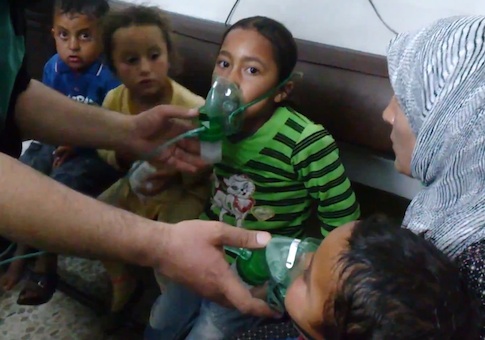
Mideast Syria Toxic GasChildren receive oxygen in rebel-held village attacked with poisonous chlorine gas / AP

Reports that Iran is sending chlorine bombs to Syria have prompted lawmakers to criticize the Obama administration for ignoring Iran’s non-nuclear efforts to foster terrorism and discord across the Middle East.

Western intelligence officials suspect that Iran has been sending Chinese-made chlorine gas to Syria in a bid to bolster President Bashar al-Assad’s war against opposition forces.

Iran reportedly has some 10,000 canisters of the deadly gas and has been shipping them by plane to Syria, according to the Telegraph.

Human rights groups and Syrian opposition leaders have said there is “strong evidence” that Assad has already used the chlorine gas to attack opposition forces in some Syrian towns.

Leading foreign policy figures on Capitol Hill told the Washington Free Beaconthat Iran’s military support for Assad highlights the need for the United States to clamp down on Iran’s non-nuclear illicit actions.

“These allegations are disturbing but sadly not surprising and serve as a timely reminder that Iran’s nefarious activities go far beyond their nuclear weapons program,” Rep. Doug Lamborn (R., Colo.), a member of the House Armed Services Committee, told the Free Beacon.

“This Iranian regime has shown repeatedly that it feels no need to observe international agreements and only uses [nuclear] negotiations [with the West] as political cover while pursuing its own goals,” Lamborn said. “Iran’s support of Syria, potentially including chlorine bombs, has directly led to thousands of deaths.”

Rep. Ileana Ros-Lehtinen (R., Fla.), a member of the House Foreign Affairs Committee, told the Free Beacon that Iran’s purported shipments of chlorine bombs is consistent with its efforts to spread terrorism and bolster rogue regimes.

“I wouldn’t be surprised if the reports alleging that Iran is supplying Assad with chlorine gas bombs are true because the regime in Tehran needs Assad to remain in power,” Ros-Lehtinen said. “Iran has a vested interest in keeping Assad in power because Syria is the lynchpin of Iran’s global terror campaign.”

Issues such as Iran’s weapons proliferation and chemical weapons stores are not even a topic of discussion in talks with Western nations, Ros-Lehtinen said.

“Iran continues to thumb its nose at the United States, and the rest of the P5+1, since Iran’s proliferation of chemical weapons and its support for terror aren’t even a factor in consideration under the current negotiations,” she said. “President Obama must not continue to view Iran’s enrichment program in a vacuum, but take into account the totality of Iran’s illicit and nefarious activities.”

In early April “Syrian planes dropped the new weapon, made of Chinese-manufactured chlorine gas canisters rigged with explosive detonators, on Kafr Zita near Hama,” according to the Debka File, which first reported on the Iran connection. “Since then, British and French intelligence sources have reported at least four such attacks against the northern towns of Idlib and Homs and the Harasta and Jobar districts outside Damascus.”

Debka claimed that “Assad is dropping these gas bombs at the rate of one every three days.”

Iran has vigorously denied sending chlorine bombs to Syria, telling state-run media outlets that it is “a lie” perpetuated by Zionist news outlets.

“This is not the first time that this Zionist news outlet spreads lies to deviate the world’s public opinion from realities,” the Iranian Foreign Ministry said last week.

However, these denials have only stoked concerns among regional experts.

“The mullahs are using Syria as a testing ground for weapons of mass destruction—pushing the boundaries of international law and taking note of the reaction—while maintaining plausible deniability by acting through their proxy, the Assad regime, in case they overstep any red lines and incur some sort of punitive response,” said Jacob Campbell, a senior fellow of the Humanitarian Intervention Centre, a foreign policy think-tank.

“What they have learnt, however, is that nobody has the willpower to enforce these red lines, which sets a very dangerous precedent for a regime with an active nuclear weapons program,” said Campbell, who has written about the issue.

Asked to comment on Iran’s reported shipments of chlorine bombs, the White House referred the Free Beacon to the U.S. intelligence community. The CIA would not comment on the record about the reports.

A recent State Department report on terrorism across the globe singled out Iran for supporting rogue actors in more than 15 countries.

“Iran remains the most active state-sponsor of terrorism and is responsible for the deaths of hundreds of Americans, both through the terrorist actions of Hezbollah and by directly supplying explosives used to kill American soldiers in Iraq,” said Lamborn.

“Even as nuclear negotiations continue, we must not be suckered into forgetting the true nature of the Iranian regime or tricked into loosening sanctions on Iran that are aimed at their support for terrorism,” he said.

Obama’s Alliance with Boko Haram

May 13, 2014

Obama’s Alliance with Boko Haram, Front Page Magazine, May 13, 2014

(See also Boko Haram and the failure of obama’s counter-terrorism strategy — DM)

This isn’t just their strategy for Nigeria. It’s their universal approach to Islamic terrorism. It’s why Kerry blamed Israel for the collapse of the peace talks with the PLO. It’s why Egypt is being pressured to free its Muslim Brotherhood detainees. And It’s why the United States is never allowed to defeat Al Qaeda.

Obama is trying to bring down governments that fight Islamic terrorism, whether in Egypt, Israel or Nigeria, and replace them with governments that appease terrorists. This shared goal creates an alliance, direct or indirect, open or covert, between Obama and the Muslim Brotherhood, Obama and the PLO and Obama and Boko Haram.

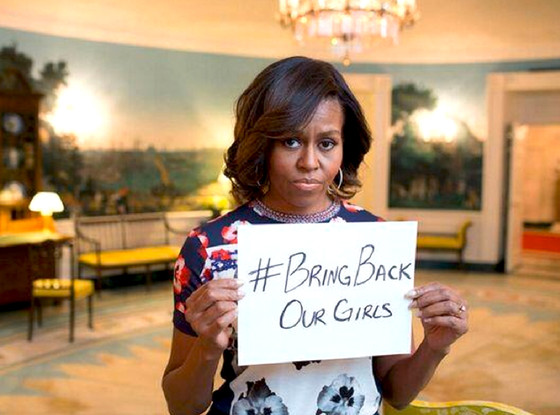
Ms Obama and girls

Leftist policy is the search for the root cause of evil. Everything from a street mugging to planes flying into the World Trade Center is reduced to a root cause of social injustice. Throw poverty, oppression and a bunch of NGO buzzwords into a pot and out come the suicide bombings, drug dealing and mass rapes.

It doesn’t matter whether it’s Boko Haram, the Islamic terrorist group that kidnapped hundreds of Nigerian schoolgirls, or a drug dealer with a record as long as his tattooed arm.

Obama and Hillary resisted doing anything about Boko Haram because they believed that its root cause was the oppression of Muslims by the Nigerian government. Across the bloody years of Boko Haram terror, the State Department matched empty condemnations of Boko Haram’s killing sprees with condemnations of the Nigerian authorities for violating Muslim rights.

Michelle Obama and Hillary Clinton haven’t championed #BringBackOurGirls because it’s a hashtag in support of the kidnapped girls, but because it undermines the Nigerian government. They aren’t trying to help the kidnapped girls. They’re trying to bring down a government that hasn’t gone along with their agenda for appeasing Boko Haram and Nigerian Muslims.

The hashtag politics aren’t aimed at the terrorists. They’re aimed at helping the terrorists.

There’s a reason why the media and so many leftists have embraced the hashtag. #BringBackOurGirls isn’t a rescue. It denounces the Nigerian government for not having already gotten the job done even as the State Department stands ready to denounce any human rights violations during a rescue attempt.

Obama and Boko Haram want to bring down the Nigerian government and replace it with a leadership that is more amenable to appeasement. It’s the same thing that is happening in Israel and Egypt.

State Department officials responded to Boko Haram attacks over the years with the same litany of statistics about unemployment in the Muslim north and the 92 percent of children there who do not attend school. When Hillary Clinton was asked about the kidnappings by ABC News, she blamed Nigeria for not “ensuring that every child has the right and opportunity to go to school.”

Clinton acted as if she were unaware that Boko Haram opposes Muslim children going to school or that it would take the very same measures that her State Department has repeatedly opposed to make it possible for them to go to school. This is a familiar Catch 22 in which the authorities are blamed for not fixing the socioeconomic problems in terrorist regions that are impossible to fix without defeating the terrorists and blamed for violating the human rights of the terrorists when they try to defeat them.

The mainstream media has been more blatant about carrying Boko Haram’s bloody water. Their stories begin with the kidnapped schoolgirls and skip over to a sympathetic reading of history in which Boko Haram only took up arms after government brutality.

Two years ago the New York Times ran an op-ed titled, “In Nigeria, Boko Haram Is Not the Problem.”

The op-ed contended that Boko Haram didn’t exist, that it was a peaceful splinter group and that the Nigerian army was worse than Boko Haram. Somehow these three claims were made on the same page.  The editorial warned the US not to give the impression that it supports Nigeria’s Christian president or it would infuriate Muslims and suggested that Christians might really be behind the Muslim terror attacks.

Last year, Secretary of State John Kerry , after a pro forma condemnation of Boko Haram terror, warned, “We are also deeply concerned by credible allegations that Nigerian security forces are committing gross human rights violations, which, in turn, only escalate the violence and fuel extremism.”

Kerry was blaming the victims of Boko Haram for the violence perpetrated against them and claiming that resistance to Boko Haram caused Boko Haram’s attacks.

The US Commission on International Religious Freedom, three of whose members had been appointed by Obama and one by Nancy Pelosi, issued a report blaming Nigeria for Boko Haram’s murderous Jihad.

The report’s findings claimed that the Nigerian government’s “violations of religious freedom” had led to “sectarian violence.” It echoed the propaganda of the Islamic terrorist group, stating that, “Boko Haram also justifies its attacks on churches by citing, among other things, state and federal government actions against Muslims.”

The report suggested that the Nigerian government was too focused on fighting Boko Haram and not focused enough on dealing with Christian violence against Muslims. “The Nigerian government’s failure to address chronic religion-related violence contrasts with its commitment to stop Boko Haram, which at times has resulted in the indiscriminate use of force against civilians and in human rights abuses.”

The solution was to scale back the fight against Boko Haram and appease Nigerian Muslims.

“In meetings with Nigerian officials, including Secretary Clinton’s meeting with Nigerian President Goodluck Jonathan in August 2012, the U.S. government consistently has urged the Nigerian government to expand its strategy against Boko Haram from solely a military solution to addressing problems of economic and political marginalization in the north, arguing that Boko Haram’s motivations are not religious but socio-economic,” the report stated.

“Additionally, senior U.S. officials frequently warn in private bilateral meetings and in public speeches that Nigerian security forces’ excessive use of force in response to Boko Haram is unacceptable and counterproductive.”

A year earlier, Deputy Secretary of State William Burns had proposed helping Nigeria develop “a comprehensive counterterrorism strategy” that includes “citizen engagement and dialogue.”  This was really a proposal to export Obama’s failed appeasement strategy in Afghanistan that had cost over 1,600 American lives to Nigeria.

Boko Haram’s kidnapping of the schoolgirls is both convenient and inconvenient for Obama and the State Department. On the one hand it has brought negative attention to their stance on Boko Haram, but on the other hand it may end up toppling the Nigerian government and empowering Muslims. And they see a more flexible Nigerian government as the only means of coming to terms with Boko Haram.

This isn’t just their strategy for Nigeria. It’s their universal approach to Islamic terrorism. It’s why Kerry blamed Israel for the collapse of the peace talks with the PLO. It’s why Egypt is being pressured to free its Muslim Brotherhood detainees. And It’s why the United States is never allowed to defeat Al Qaeda.

Obama is trying to bring down governments that fight Islamic terrorism, whether in Egypt, Israel or Nigeria, and replace them with governments that appease terrorists. This shared goal creates an alliance, direct or indirect, open or covert, between Obama and the Muslim Brotherhood, Obama and the PLO and Obama and Boko Haram.

Iran Counting on Obama’s Weakness

May 13, 2014

Iran Counting on Obama’s Weakness, Commentary Magazine, May 12, 2014

(As with the Israel – Palestine “peace process,” theP5 + 1 process is the important thing for the Obama Administration. The results do not much matter to President Obama et al so long as Iran refrains from nuking anyone important until President Obama has left office. For Iran, however, favorable results are more important than the process. — DM)

[R]rather than play ball with Obama, Iran’s leaders look to be playing hardball. As Haaretz reports, both Supreme Leader Grand Ayatollah Ali Khamenei and President Hassan Rouhani issued statements yesterday that make it clear they are in the talks to win them, not to merely acquiesce to a process that is already paving a path to nuclear capability for them.

[W]hat Obama and Kerry are really worried about is the possibility that Iran won’t even grant them a bad deal but will instead blow off the entire process and to proceed directly to nuclear capability. If so, their fatal weakness will be exposed as a reality rather than merely a conservative talking point, leaving them a choice between ramping up the conflict and complete capitulation. That’s exactly the mindset Khamenei and Rouhani are counting on to deliver them a meaningless agreement that can either be signed or ignored. Either way, Iran seems closer to its nuclear goal today than it did before Obama’s interim capitulation.

With the P5+1 nuclear talks set to resume again in Vienna tomorrow, many observers are sensing optimism that a deal with Iran is within reach. After dropping their insistence that Iran give up enriching uranium in order to gain Tehran’s acquiescence to an interim nuclear deal last November, the U.S. and its allies appear to be confident that another few meetings will produce an accord that will put an end to the confrontation with the Islamist regime over their efforts to build nuclear weapons. The best they hope to achieve is an agreement that will lengthen the time Iran needs to convert its stockpile of uranium into nuclear fuel rather than the end of the program that President Obama promised during his 2012 reelection campaign. But the administration and its supporters seem to think that rather than take the chance that the West will strengthen rather than weaken economic sanctions on it, Iran will do the smart thing and sign on the dotted line. While that won’t really end the nuclear threat, it will grant President Obama the appearance of a diplomatic victory and lead to the end of a sanctions policy that is already in danger of unraveling after the interim deal.

But rather than play ball with Obama, Iran’s leaders look to be playing hardball. As Haaretz reports, both Supreme Leader Grand Ayatollah Ali Khamenei and President Hassan Rouhani issued statements yesterday that make it clear they are in the talks to win them, not to merely acquiesce to a process that is already paving a path to nuclear capability for them. In speaking to Iran’s Revolutionary Guard Corps, Khamenei mocked the notion that the country would go along with any limits on its ability to produce and deploy ballistic missiles. Meanwhile, Rouhani, the man President Obama and other advocates of the talks have depicted as a “moderate” whose victory in a faux election last year set the stage for reform of the brutal theocracy, said the best the U.S. could hope for in the talks was “transparency” and that the Islamist regime would accept no limits on its nuclear technology.

While Washington will, no doubt, dismiss the statements as mere posturing for a domestic audience that won’t impact the talks, these declarations come at an inopportune time for the Obama administration. They raise the possibility that Iran is planning to back away from any deal, even one as weak as the interim accord signed by Secretary of State John Kerry last November, much in the same manner that it has torpedoed past agreements at the last minute. But even if that is not the case, these comments make it likely that the U.S. will have to ante up even more than Obama thought in order to get Iran to sign a deal that already amounts to appeasement.

It should be remembered that Rouhani’s credibility with the regime’s supposed hardliners rests with his exploits as a nuclear negotiator a decade ago when he took the West right up to the brink of a deal about enrichment and then backed away leaving the Bush administration and its European allies looking silly. Obama and Kerry were warned that this might happen again before they embarked on their most ambitious attempt at engagement with Iran. But while they still hope to get a deal, even if it is nothing more than a thin veil on Western approval for a robust Iranian nuclear program that could easily lead to a weapon, there’s every chance that the they’ve been led down the garden path by Khamenei and Rouhani.

Anyone wondering why Iran is acting with such confidence should look to Europe and Russia. Sanctions were already undermined by the interim deal, but with Europeans not interested in enforcing the existing restrictions, let alone tightening them to create an embargo that would give the West its only hope of spiking the nuclear threat, Iran is confident they are doomed. With Europe now facing the prospect of being forced to confront Russia after its aggression against Ukraine, there is even less appetite for squeezing Iran than even just a few months ago.

If both Khamenei and Rouhani believe Western negotiators that were already behaving as if they were desperate for a deal will be even easier to shake down than before, it’s hard to blame them for thinking so. That means that, at best, what comes out of the P5+1 process in the months leading up to the initial July deadline for an agreement (though the U.S. has already said it is prepared to keep talking beyond the summer) will be even more favorable to Iran’s nuclear quest than expected. A deal that leaves Iran’s infrastructure in place, as well as granting its right to enrich and to produce ballistic missiles, is one that will do little, if anything, to stop Tehran from getting a nuke. Rouhani’s statement that it will continue enriching uranium to 20 percent is no empty boast since it can still reconvert the stockpiles to weapons-grade material at any time.

But what Obama and Kerry are really worried about is the possibility that Iran won’t even grant them a bad deal but will instead blow off the entire process and to proceed directly to nuclear capability. If so, their fatal weakness will be exposed as a reality rather than merely a conservative talking point, leaving them a choice between ramping up the conflict and complete capitulation. That’s exactly the mindset Khamenei and Rouhani are counting on to deliver them a meaningless agreement that can either be signed or ignored. Either way, Iran seems closer to its nuclear goal today than it did before Obama’s interim capitulation.

Israel: Obstacles To Peace

May 13, 2014

Israel: Obstacles To Peace, Strategy Page, May 13, 2014

The Palestinians are finding that some of their victories have a downside. Case in point is the growing anti-Semitism and pro-Palestinian attitudes in Europe. That has caused a sharp increase in European Jews fleeing Europe. Many of them are heading for Israel.

While the Arabs have never been able to defeat Israel militarily they have achieved more success spending billions to turn Western public opinion against Jews in general and Israel in particular. Recent opinion surveys indicate that about 200 million Europeans (and a lot of Americans) consider Israelis the new Nazis for refusing to give in to the demands of the Palestinians (who want Israel destroyed in Arabic media but are more moderate in other languages). This shift in attitude has led to a dramatic increase in European anti-Semitism, most violently practiced by the rapidly growing Moslem population there against a rapidly shrinking Jewish population.

May 13, 2014: The Palestinians are finding that some of their victories have a downside. Case in point is the growing anti-Semitism and pro-Palestinian attitudes in Europe. That has caused a sharp increase in European Jews fleeing Europe. Many of them are heading for Israel. That is where most of  the Jewish population of Israel came from. Since 1948 over three million Jews moved to Israel , most of them from Europe . Some 90,000 of those were French Jews, but because there are now ten times as many Moslems as Jews in France, and a lot more violent anti-Semitic activity, over 5,000  (of 500,000) French Jews have moved to Israel in the last two years and that number is rapidly increasing. This sort of thing bothers the Palestinians. While the Arabs have never been able to defeat Israel militarily they have achieved more success spending billions to turn Western public opinion against Jews in general and Israel in particular. Recent opinion surveys indicate that about 200 million Europeans (and a lot of Americans) consider Israelis the new Nazis for refusing to give in to the demands of the Palestinians (who want Israel destroyed in Arabic media but are more moderate in other languages). This shift in attitude has led to a dramatic increase in European anti-Semitism, most violently practiced by the rapidly growing Moslem population there against a rapidly shrinking Jewish population.

Other unorthodox Palestinian tactics include not paying for goods and services bought from Israel. Currently a Palestinian firm that buys Israeli electricity for Palestinian customers in Jerusalem and the West Bank is being sued to recover over $200 million for electricity used but not paid for. Palestinians consider this sort of fraud as “legitimate resistance” against Israeli aggression.

Western efforts to obtain a peace deal between Israel and the Palestinians keep failing because of Palestinian refusal to give up demands that Israel cannot accept and continue to exist. One of these is the result of a mistake made by the Arab world over sixty years ago. Thus Palestinians insist that any peace deal depends on Israel recognizing “right of return without discrimination.” That means that the 600,000 Palestinians who fled the newly formed Israel in the late 1940s, and their millions of descendants, can return to Israel and get all their abandoned property back. Israel would also have to pay compensation. While many Palestinians would not return, enough could to change the demographic composition of Israel, turning it into a country with an Arab majority. This, for both the Palestinians and Israel, is the equivalent of  “destroying Israel.” This is something all Palestinian factions want to accomplish, and Israelis want to avoid. Getting around this obstacle would be very difficult, as the Palestinian public has endured decades of Palestinian (and Arab) media messages insisting that the right of return is an essential part of any peace deal. Westerners believe that money (a bribe) might make this problem go away. That could backfire, because the real problem is the Arab decision in the late 1940s to not offer citizenship to any Palestinian refugees. The other Arab states insisted that Palestinian refugees must remain stateless, preferably living in refugee camps (and receiving food and other aid from largely Western donors). At the time, an equal number of Jews were expelled from Arab countries. All these Jewish refugees found new homes, most of them in Israel. Thus just giving the Palestinian refugees a few hundred billion dollars would not be sufficient. They need citizenship somewhere, either in the country where they are currently refugees, or in the West. Undoing this old Arab error, which the Arabs won’t even admit was an error, is a formidable negotiating obstacle.

Another seemingly intractable problem blocking an serious negotiations is the refusal of many radical Palestinian organizations to even consider recognizing Israel’s right to exist. Fatah says that because of the recent peace deal with Hamas both groups had agreed to recognize Israel. But many Hamas leaders are not accepting that, nor do many smaller Palestinian organizations (especially Islamic terrorist ones).

In Syria the government has found Hezbollah military aid crucial because Hezbollah’s paramilitary force is one of the most effective in the region. Over the decades Hezbollah has developed effective tactics to fight Israeli troops and hostile militias and Islamic terrorist groups in Lebanon. Israel can still beat Hezbollah fighters, but with greater effort than against other Arab irregulars. In Syria this Hezbollah experience, training and professionalism has been a nasty shock to the rebels. Hezbollah fighters can operate as effectively (and often more so) than trained Syrian soldiers, but also fall back on many terrorist and commando techniques they have learned from the Iranians and decades of combat inside Lebanon and on the Israeli border. Inside Syria the Hezbollah fighters are feared by the rebels and respected by the Syrian soldiers. There are also units of Shia volunteers (mainly from Iraq) that are also trained and subsidized by Iran. Finally, the continuing civil war within the rebel movement has made the Assad government boast openly about how it believed final victory over the rebels was achievable. It’s gotten so bad that some rebel factions are calling for an alliance with Israel. After all, Israel has helped the rebels (medical care, some air strikes) while the Assad government and the Iraq based ISIL rebel factions have committed a growing list of atrocities against Syrians. This proposal is unlikely to go anywhere, but it shows you how chaotic and attitude-changing the war has been for Syrians.

In Egypt the government claims that it has regained control of the entire peninsula and that the Islamic terrorism is under control are apparently too optimistic. The increasing number of terrorist attacks by Sinai based terrorists  in 2014, at least a fifth of them outside of Sinai, indicates otherwise.

May 12, 2014:  For the third time this year an Israeli citizen has been arrested in Israel at the request of the United States and charged with illegally exporting military materials to Iran.

May 11, 2014: Israel closed several areas in the Golan Heights near the Syrian border. It was feared that increased fighting on the Syrian side might spill over into Israel, even if in the form of bullets and mortar shells landing in Israel.

In Egypt (Sinai) a clash with Islamic terrorists left one soldier dead and another wounded. The raid did capture large quantities of equipment used by the terrorists.

May 10, 2014: In Egypt 200 members of a Sinai based Islamic terrorist group are being prosecuted for participation in 51 terrorist attacks that left 55 dead. All 200 could be convicted and get the death penalty. Egyptian courts have already sentenced hundreds of Islamic terrorism suspects to death or life in prison.

May 8, 2014: In Gaza Hamas executed two Palestinians for “collaborating” with Israel. One man was shot and the other was hanged. There are three death penalty crimes in Gaza; murder, drug trafficking and collaborating with Israel. Most of the executions are for collaborating. A year ago Hamas announced a new campaign to find and arrest people providing information to Israel. Gazans who oppose Hamas (especially members of Fatah, which rules the West Bank) saw this as directed at them. Israel has always had a large network of informants in Gaza, who provide data on military, economic and political events, as well as targeting information for Israeli air attacks.

Hamas is again under pressure to drop children’s TV programs that encourage kids to attack and maim or kill Israelis. For decades both Hamas in Gaza and Fatah in the West Bank have promoted violence and terrorism against Israelis in their electronic media. Hamas is the worst offender, often putting out some pretty vile stuff. Both Hamas and Fatah ignore foreign criticism unless it involves a real threat to cut foreign aid. That rarely happens.

May 4, 2014: In southern India police arrested a Sri Lankan Moslem who, during interrogation, said he had been hired by the ISI (the Pakistani CIA) to work with a team of ISI agents to plan and carry out terror attacks on the American Consulate in Chennai and the Israeli Consulate in Bangalore.

May 2, 2014: On the Gaza security fence an Israeli patrol was fired on from the Gaza side and the Israeli troops fired back. That was the end of it. Islamic terrorists inside Gaza will often fire on Israeli troops in the hope that the Israelis will fire back and hit some nearby civilians. The Israelis know about that ploy and patrols are trained to fire back if there is no other option but otherwise to fire into the air and leave the area.

In Egypt (Cairo and Sinai) four terrorist bombs left five dead and dozens wounded. There were also several violent clashes with supporters of deposed president Morsi.

April 30, 2014:  The U.S. has allowed ten AH-64D helicopter gunships to be delivered to Egypt. The United States has held up such deliveries of military equipment because the Egyptian Army replaced the elected president of Egypt last July. Former president Morsi was sympathetic to Islamic radicals and after the coup the Islamic terrorists in Egypt went on a rampage. The 35 AH-64Ds Egypt already has proved very useful in dealing with the Islamic terrorists. So the U.S. is, out of mutual interest, letting the ten AH-64Ds Egypt had on order be delivered. Egypt had already upgraded its AH-64s to the “D” standard.

April 29, 2014: In Egypt (Sinai) soldiers raided an Islamic terrorist hideout, killing three terrorists and arresting three others. Weapons, ammo and documents were also seized.

April 27, 2014: In Sinai soldiers found five tunnels leading from a mosque across the border to Gaza. The tunnels were destroyed and five men arrested for involvement with the tunnel construction and operation.

April 26, 2014: In Libya (Benghazi) a 15 year old Egyptian girl was kidnapped, apparently for ransom. The militias and criminal gangs are increasingly turning to kidnapping for ransom for raise cash and stay in business.


Have Kerry and Indyk Pushed Abbas into the Arms of Hamas?

May 13, 2014

Have Kerry and Indyk Pushed Abbas into the Arms of Hamas? Gatestone InstituteHarold Rhode and Joseph Raskas, May 13, 2014

(Former President Carter and the Gatestone Institute authors of this piece seem not to agree. How odd. — DM)

Abbas correctly calculated that so long as he continued to negotiate with Israel, the U.S. and the Europeans would continue to prop him up with political backing and financial support in the mistaken belief that a peace deal could be reached.

Thus Kerry and Indyk have been pushing Abbas into a corner by trying to tempt him to commit suicide in the name of permanently solving the Arab-Israeli dispute.

While Israeli leaders seek peace, Palestinian leaders seek an endless peace process.

Palestinians say that for Muslims, Palestinian land reaches “from the [Jordan] river to the [Mediterranean] sea” — that is, over all of what is now Israel. In their view, Tel Aviv is illegally occupied territory just as much as any of the settlements in the West Bank. This view is based on the Muslim doctrine, deeply rooted in Islamic jurisprudence, called “waqf” (religious endowment). Any territory once under the control of Muslims, must forever be controlled by Muslims.[1] According to Islamic law, “If a person makes something waqf, it ceases to be his property and neither he nor anybody else can gift or sell it to any other person.[2]

Unfortunately, the premises on which American negotiations — led by U.S. Secretary of State John Kerry and U.S. Special Envoy for Israeli-Palestinian Negotiations, Martin Indyk[3] — are based are completely at odds with the premises on which Middle Eastern negotiations are based.

Americans seem to believe that all problems are solvable; if there is no solution, it simply means one has not tried hard enough. Americans generally are prepared to compromise on particular points to attain other points that are more important to them. When both sides reach an agreement, Americans usually are prepared to put past disagreements to bed. By making concessions, neither side has compromised its personal honor. Americans focus on the goal, which is to attain an agreement both sides can live with. We negotiate, arrive at an agreement and let bygones be bygones.

Not so in the Middle East. The mere concept is inconceivable in the winner-take-all culture of that part of the world.

Middle Easterners live with problems they know are unsolvable. For most, their immediate problems are never solved. Furthermore, any compromise is regarded solely as a backsliding that reduces personal honor and results only in indelible public shame. Far preferable is to paint a beautiful, if fictitious, patina over festering problems that cannot be solved, rather than to endure shame, dishonor and public humiliation.

For many in the Middle East, perceived wrongdoings are never in the past and the past is never over. Wrongs – such as the Christian conquest of Muslim Spain, regardless of when they occurred — must be righted.[4] Given the choice between war and shame, Middle Easterners will often choose war, even if that choice will result in both war and shame.

Because Muslims ruled Spain from 712-1492 C.E., today, over five hundred year later, Muslim organizations there are still preparing to reconquer it in the name of Islam.

Osama Bin Laden also repeatedly spoke about righting a perceived wrong he felt the West had imposed on the Muslim world more than 80 years ago: Turkey’s then-leader, Mustafa Kemal Ataturk, expelled the entire family of the Ottoman Sultan, the Caliph, leader of the world’s Sunni Muslims.

So too with much of the area the Romans conquered in 6 A.D. The Emperor Hadrian renamed it Palestina in 135 A.D, but the area was then taken from the Eastern Roman Empire by the Muslims in 637 A.D.

Today, any Palestinian Muslim leader who would sign a final peace agreement recognizing as Jewish any part of what had once been part of the Muslim World would be violating a core tenet of Islam.[5] And any Palestinian leader who agreed to surrender land held in trust by the Muslim waqf would not only be humiliated, but very likely assassinated.

Abbas’s predecessor, Yasser Arafat, faced this dilemma at Camp David in 2000, when Israel’s Prime Minister, Ehud Barak, offered Arafat all of the West Bank and East Jerusalem, with the exception of what was under the Temple Mount. Arafat, knowing that he could never accept such an agreement, rejected Barak’s offer. He then asserted that, “There never was a Jewish Temple there,”[6] and is reputed to have said, “Do you want see me up there having tea with Sadat?”[7] — a reference to the assassination by Islamists of Egypt’s President Anwar Sadat, who had signed a peace treaty with Israel.

Kerry, Indyk and their staff, even with the best intentions, seem unaware that Muslims cannot ever, under any conditions, cede territory regarded as rightfully belonging to Muslims — or, more aptly, to Allah — to non-Muslims.

So even with Kerry’s and Indyk’s — or anyone’s — best efforts, any attempt to coax Abbas into signing a permanent agreement that would undermine this Muslim requirement is futile.

Abbas undoubtedly understood the nature of his engagement with Kerry and Indyk from the outset.[8] He correctly calculated that so long as he continued to negotiate with Israel, the Americans and Europeans would continue to prop him up with political backing and financial support in the mistaken assumption that a solution can be reached.

Looking at the public record of these negotiations, it seems apparent that the more the President and Secretary of State pressured Abbas to accept a final peace agreement with Israel, the more fearful he became that if he were to sign such an agreement, he too would find himself “having tea with Sadat.”

Given that Islam cannot accept a Jewish state, the Palestinians win peace talks by “not losing.” While Israeli leaders seek peace, Palestinian leaders seek an endless peace process. Abbas simply needs to find a way to draw out the negotiations as long as possible, without ever coming to a final agreement.[9]

Abbas, in all likelihood, knows he cannot rely on the Jordanians or Saudis to back him. Leaders of both nations have publicly said that they would agree to any agreement the Palestinians accepted with Israel — the equivalent of firing blanks. The announcement was an excellent tactical move on their part: any Muslim leader who would permanently hand over Muslim territory to non-Muslims — especially to Jews — would be subject to public humiliation and almost certain assassination. Far better to let Abbas suffer the consequences rather than they, and meanwhile absolve themselves from any shame or blame in the process.

Abbas’s other out seems to have been embracing his mortal Palestinian enemy, Hamas. Abbas was doubtlessly aware that Hamas would also never consent to the conditions previously imposed on it by the Middle East Quartet: rejecting violence, recognizing Israel and accepting previous accords. Hamas could be counted on never to accept any treaty with Israel, as evidenced by the Hamas charter, which repeatedly calls not only for the destruction of Israel, but also of the Jews.

This rapprochement with Hamas, however, not only enables Abbas to continue receiving funds from the U.S. and Europe, but later to be able to blame Hamas for any subsequent failure of the talks. Abbas now does not have to choose between either possible death or certain dishonor in the eyes of his fellow Palestinians. Hamas therefore provides the perfect cover Abbas needs not to sign any permanent peace agreement that Kerry & Co. still seem so determined to deliver.

Thus, Kerry and Indyk have been pushing Abbas into a corner by trying to convince him to commit suicide in the name of permanently solving the Arab-Israeli dispute. Their inability or unwillingness to structure their framework accordingly has, in fact, enabled Abbas to entrench his negotiating positions even further.
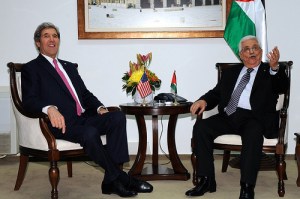
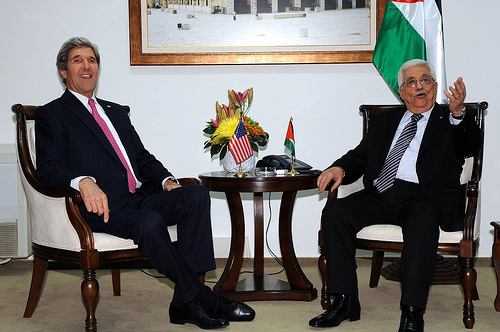
Kerry and Abbas xxxU.S. Secretary of State John Kerry and Palestinian Authority President Mahmoud Abbas in happier times, at a press conference in Ramallah on January 4, 2013. (Image source: U.S. State Department)

The problem seems again to come from a clash between Western culture and Islamic Middle Eastern culture. As one can see from Egypt, Sudan, Nigeria and Iraq, many Muslims cannot even accept the existence of a Muslim state ruled by Christians or, it often seems, a state in which more than a handful of Christians, except foreign workers, even exist.

Any agreement, such as a hudna [“truce”], is understood to be only temporary, until adequate forces can be built up with which to launch yet another attack.

Abbas, cloaking his apparent rapprochement with Hamas as an attempt to unify the Palestinian people, is meanwhile also bolstering his declining status among his West Bank constituents. Although the Palestinian Authority is popular internationally — in 2012, it achieved upgraded status as a non-member state in the United Nations — it is weak domestically, with Abbas in the ninth year of his four year term in office.

Conversely, Hamas is relatively weak internationally – designated a terrorist organization by Israel, the US, Egypt, the EU, Canada, Japan, and Australia — but strong domestically. In 2007, Hamas expelled most Fatah members in a bloody coup and consolidated its control over Gaza.

From Abbas’s position, the unity bid probably represented a win-win, permitting him to dodge Kerry diplomatically while appealing to his constituents domestically.

If anything, Kerry and Indyk should blame themselves for undermining their own well-intentioned efforts to achieve peace.


[1] For an example of this principle, see Article 11 of the Hamas Charter, which states: “The Islamic Resistance Movement believes that the land of Palestine has been an Islamic Waqf throughout the generations and until the Day of Resurrection, no one can renounce it or part of it, or abandon it or part of it.”

[2] For more on the concept of waqf, see https://www.princeton.edu/~achaney/tmve/wiki100k/docs/Waqf.html

[3] “What did Indyk contribute to peace talks?” Reuters, Newsletter 11.05.2014

[4] Notes of a Century, Bernard Lewis, p. 247-8.

[5] For more on this principle and how it is understood today, see Knowing the Enemy: Jihadist Ideology and the War on Terror, By Mary R. Habeck, p. 115, and Basic Principles of Islam, Principle #6.

[6] Camp David: An Exchange – The New York Review of Books, September 20, 2001

[7] “Do you want me to be up there having tea with Sadat?

[8] “Israel to U.S. and EU: Palestinians Deceived Kerry“, Haaretz, May 7, 2014.

[9] “Inside the talks’ failure: US officials open up“, YNet News, May 2, 2014.
United Palestinian government may provide new opportunities for peace

May 13, 2014

United Palestinian government may provide new opportunities for peace, Washington Post,  Jimmy Carter, May 12, 2014

(It’s always useful to read such profound words from the second worst President in American history. Now go thou and do otherwise. — DM)

Kerry has mentioned the need for better realities on the ground or new leadership as requisites for progress. A united Palestinian government with wider international recognition, newly elected leaders and assured financial support from the Arab world may provide an opportunity for a new round of peace talks, permitting Israel finally to live in peace with its neighbors. The international community should take advantage of these opportunities.

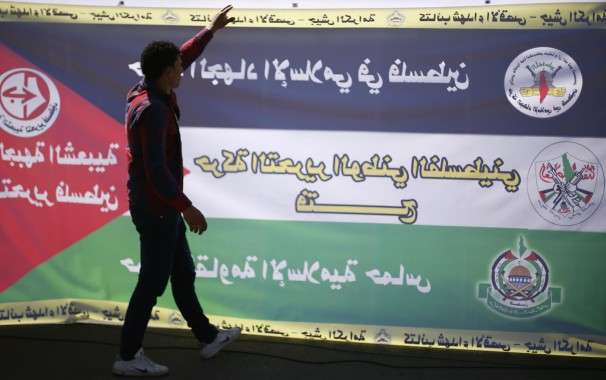
Pal factions(Suhaib Salem/Reuters) – A Palestinian man stands by a banner depicting Palestinian factions on a national flag on Monday.

Although intensive Middle East peace efforts by Secretary of State John F. Kerry have not produced an agreement, they have clarified the issues and still can produce significant dividends. His team of negotiators now is much more familiar with the complex disputes and obstacles to be overcome, as are the Israelis and Palestinians who have participated in the discussions.

It is obvious that both Israel and the Palestinians have a vital interest in a two-state solution, based on international law and U.N. resolutions approved by participating nations. President Obama has discussed some of these key factors, calling for no more settlements in the occupied territories and an adherence to the pre-1967 borders (with some mutually agreed changes). Previous U.S. presidents have made other substantive proposals on sensitive questions involving mutual security, East Jerusalem and the right of return of Palestinians.

Adhering to these commonly understood international assumptions, Kerry could issue a summary of his conclusions, as a “framework for peace.” It would be helpful to the general public, within the Holy Land and in other nations, and to anyone who makes future efforts for a comprehensive peace.

With the suspension of U.S.-sponsored peace talks on April 29, dangerous unilateral steps are likely to continue. During the previous nine months of negotiation, 14,000 new Israeli settlement units were approved, more than 3,000 Palestinians were arrestedand 50 were killed, provoking troubling examples of Palestinian retaliation, including the deaths of three Israelis.

The Palestinians’ plans for the coming months are relatively clear: to form a new unity government and expand involvement in the United Nations. Although condemned by some, the decision by the leaders of the Palestine Liberation Organization and Hamas to reconcile their differences and move toward elections can be a positive development. In the past, similar efforts have been abandoned because of strong opposition from Israel and the United States, but the resolve to succeed is now much stronger among leaders in the West Bank and Gaza. This reconciliation of Palestinian factions and formation of a national unity government is necessary because it would be impossible to implement any peace agreement between Israel and just one portion of the Palestinians.

In order for a united Palestinian Authority to remain viable with recognition of the international community, it will be necessary for all participants to accept the principle of peaceful resolution of differences and to recognize the right of Israel to exist within its pre-1967 borders as modified by mutual agreement.

The decision by Palestinian Authority President Mahmoud Abbas to have Palestine become more deeply involved in the United Nations can also be beneficial. The first 15 treaties the Palestinians decided to accept on April 1 were carefully chosen, being commitments to comply with the four Geneva Conventions of 1949, later protocols of 1977 regarding the laws of war and others related to discrimination against women and the rights of children. These are all idealistic and peaceful in nature and should cause no concern in Israel or Washington. All Palestinian factions within a unity government will have to accept these restraints.

Palestinians are poised to join other U.N. organizations that involve labor, health, tourism, agriculture, international property rights and justice. The organizations of most interest and importance are the International Court of Justice and the International Criminal Court, within which the divisive legal issues regarding activities in the West Bank, Jerusalem and Gaza might be more forcefully addressed than in the past. Joining these two courts may be the last actions to be taken by the PLO, since the United States and Israel would have strong negative reactions and Palestinians might be held to account for their violations of human rights or international law.

Kerry has mentioned the need for better realities on the ground or new leadership as requisites for progress. A united Palestinian government with wider international recognition, newly elected leaders and assured financial support from the Arab world may provide an opportunity for a new round of peace talks, permitting Israel finally to live in peace with its neighbors. The international community should take advantage of these opportunities.

Iran and IAEA end talks, unclear if progress made

May 13, 2014

Iran and IAEA end talks, unclear if progress made, Trend, May 13, 2014

Contrary to usual practice, neither side made any statement after the talks at the headquarters of the International Atomic Energy Agency (IAEA) in Vienna, held ahead of a May 15 deadline for Iran to provide information about detonators that can be used to set off an atomic explosive device.

[D]iplomats say Iran and the powers – the United States, France, Germany, Russia, China and Britain – remain far apart on what a long-term deal to resolve the dispute, and dispel fears of a new Middle East war, would look like.

iran_iaea_120113_1

The U.N. nuclear watchdog and Iran ended a three-hour meeting on Monday without announcing any new action to help allay concern about Tehran’s atomic activities, leaving it unclear whether headway was achieved, Reuters reported.

Contrary to usual practice, neither side made any statement after the talks at the headquarters of the International Atomic Energy Agency (IAEA) in Vienna, held ahead of a May 15 deadline for Iran to provide information about detonators that can be used to set off an atomic explosive device.

They also did not say when they would meet again. The lack of a clear outcome may disappoint Western diplomats, who want Iran to move much faster in addressing suspicions about past atomic bomb research. Tehran denies any such work.

The meeting took place a day before the Iran and six world powers start a new round of negotiations – also in the Austrian capital – on a broad diplomatic settlement of the decade-old nuclear dispute.

Under a transparency and cooperation pact agreed with the IAEA in November, Iran was to take seven measures by May 15 in a phased process to shed more light on a nuclear programme the West fears may be aimed at developing atomic bomb capability.

Diplomatic sources told Reuters on Friday that the IAEA was seeking further clarification from Iran about one of those steps, concerning fast-acting detonators that can have both military and civilian applications.

Iran says it has already implemented the seven steps – including access to two uranium sites – but the sources suggested the IAEA still wanted more information about the so-called Explosive Bridge Wire (EBW) detonators.

How Iran responds to questions about its development of this type of equipment is seen as an important test of its willingness to cooperate fully with a long-stalled IAEA investigation into suspected activities in the past relevant for the development of nuclear weapons.

Iran says allegations of such work are baseless, but has offered to help clear up the suspicions with the U.N. agency.

LONG-STALLED INVESTIGATION

The diplomatic sources said Iran in late April provided an explanation about the detonators, which it says are for non-nuclear uses, and that the IAEA had posed follow-up questions.

They said the IAEA also wanted to agree with Iran new measures to be taken after May 15, hoping these would tackle other sensitive issues linked to what the agency calls the possible military dimensions to Iran’s nuclear programme.

Iran’s talks with the IAEA and with big powers are closely linked as both focus on fears that Iran may be covertly seeking the capability to develop nuclear weapons. Iran says its uranium enrichment programme is a peaceful energy project only.

Western diplomats say Iran must start engaging with the IAEA’s investigation and that this is central to the success of the powers’ talks with Tehran aimed at an accord by late July.

Iran wants an end to sanctions severely hurting its oil-reliant economy. After years of confrontational standoff with the West, the election last year of pragmatist Hassan Rouhani as Iran’s president created a new atmosphere more conducive to settling disputes via diplomacy.

But diplomats say Iran and the powers – the United States, France, Germany, Russia, China and Britain – remain far apart on what a long-term deal to resolve the dispute, and dispel fears of a new Middle East war, would look like.