Archive for May 8, 2014

Netanyahu tells Rice: Iran must not be allowed to enrich uranium. They remained poles apart.

May 8, 2014

Netanyahu tells Rice: Iran must not be allowed to enrich uranium. They remained poles apart..

( Obama v Netanyahu on the question of Iran…  Who will the American people believe? – JW )

DEBKAfile Special Report May 8, 2014, 8:38 PM (IDT)
Susan Rice with Binyamin Netanyahu in Jerusalem

Susan Rice with Binyamin Netanyahu in Jerusalem

The deep divide between the Obama administration and Israeli Prime Minister Binyamin Netanyahu on the Iranian nuclear issue resurfaced during this week’s two-day (May 7-8) Jerusalem talks held by the visiting US National Security Advisor Susan Rice, who was joined by Wendy Sherman, US Under Secretary of State for Political Affairs and head of the US delegation to the nuclear talks.

Rice reiterated President Barack Obama’s contention that Iran and the P5+1 countries must reach a deal by the year’s end, before internal political conditions in Iran alter the landscape. The US urges Israel to recognize that Iran is already irreversibly a nuclear threshold state, and so it should be permitted to maintain a civilian nuclear program. This includes uranium enrichment and the construction of new nuclear reactors, with the proviso that Tehran commits not to turn its capabilities to military uses.

The Obama administration is prepared to pledge that every intelligence-gathering method at its disposal will be used to monitor Iran’s nuclear program and ensure that the threshold is not crossed. It promises Israel, as Rice repeated in her Wednesday conversation with Netanyahu, that Obama will not allow Iran to arm itself with nuclear weapons.

But debkafile’s sources in Jerusalem report that Netanyahu rejected the American position, arguing that Israel cannot leave its security in the hands of intelligence agencies whose forecasts and evaluations of the past years have often proved inaccurate.

Directly after Netanyahu and Rice met on Wednesday, a senior Israeli official said Israel continues to insist that Iran should not have the right to enrich uranium. The official, who spoke with unusual frankness, said that the Obama administration’s eagerness to seal the deal has more do with US domestic political concerns than Tehran.

“We would be happy to see July 20 pass without a deal,” the official said, referencing the target date set for a comprehensive agreement. He added that there was worry in Israel that Obama might be tempted to accommodate Iran now, in order to head off potential gains by Republicans in the November mid-term elections.

The Israeli official was emphatic about his bottom line: “Are we going to agree to [let Iran go ahead with] enrichment? No!”

On Thursday, May 8, Netanyahu echoed this outlook, saying: “Iran must not have centrifuges or enriched uranium.” Rice proposed a limit on the number of centrifuges Iran is permitted to operate, as well as a cap on the amount of uranium it can enrich.

Our sources say Netanyahu flatly rejected Rice’s argument that the quantity and sophistication of the centrifuges are not of he highest importance, compared with the real question of how many centrifuges Iran will be allowed to operate under close international scrutiny.

“The best defense against a nuclear Iran is to keep a nuclear weapon out of its hands. Tehran needs centrifuges and enriched uranium for the single purpose of building a nuclear weapon. Tehran must be deprived of this capability,” Netanyahu said Thursday.

According to debkafile’s sources in Washington, ahead of the Rice visit to Israel, administration officials conferred with several former Israeli security figures who are regularly consulted by Netanyahu on the nuclear issue. They were asked for an opinion on whether the prime minister would buy a compromise that permitted Iran to keep several thousand centrifuges and enrich a specified amount of uranium up to a low five percent grade.

Those advisers came back to Netanyahu with the impression that Obama was fixated on a fast deal regardless of Israel’s opposition. They also warned him that his rejection of the US compromise proposal would bring down on Israel’s head a propaganda campaign in both the local and international media that would impugn his credibility on the Iranian nuclear issue.

Jerusalem regards the Newsweek charge of Israeli spies crossing the red line in America as the opening shot of this campaign.

Officials in Jerusalem are also rubbishing a report on the subject that the Yediot Aharonot Hebrew tabloid is running Friday, May 9. It quotes Uzi Ilam, a long-retired former head of the Israeli Atomic Energy Committee, as arguing that Netanyahu is using the pressing Iran nuclear issue for political gain, when in fact, he says, Iran won’t be able to make a nuclear bomb for 10 years.
Knowledgeable officials say his information is years out of date. Almost all leading US, European and Israeli nuclear experts agree that Iran has reached the point of being able to manufacture a nuclear bomb in two or three or months.

Off Topic: UNHRC President replaces Falk with pro-Palestinian Indonesian diplomat

May 8, 2014

UNHRC President replaces Falk with pro-Palestinian Indonesian diplomat, Jerusalem PostTovah Lazarpff, May 8, 2014

Makarim Wibisono to serve as special investigator into Israeli actions in the West Bank and east Jerusalem after candidates put forward by a UNHRC consultative group disregarded in wake of Arab League protest.

Israel is the only country to which a rapporteur is permanently assigned.

New UNhuman rights leaderMakarim Wibisono of Indonesia Photo: REUTERS

At the request of the United Nation’s Arab Group in Geneva, a pro-Palestinian Indonesian diplomat, Makarim Wibisono, was appointed Thursday to a six-year term as a special investigator into Israeli actions in the West Bank and east Jerusalem for the Human Rights Council.

UNHRC President Ndong Ella made a sole decision to give the post to Wibisono after disregarding the three vetted candidates put forward by a UNHRC consultative group made up of five member states.

The group’s leading candidate had been American legal expert Christina Cerna of Georgetown University, because she was a neutral candidate who had not taken a public stand on the Israeli-Palestinian conflict.

The Arab League wrote a letter of protest about her and asked that a different candidate be appointed.

In March, Ella initially recommended the second candidate on the list, British legal expert Christine Chinkin, who helped author the controversial 2009 Goldstone report on Israeli military activity in Gaza in December 2008 and January 2009.

But the issue of the mandate holder for the special rapporteur on the situation of human rights in the Palestinian territories was put on hold. Member states of the UNHRC had concerns with regard to the entire list of 19 mandate holders that were due to be appointed.

On Thursday, however, when the issue of the 19 mandate holders returned to the UNHRC, Ella set aside all three vetted candidates in favor of Wibisono. According to UN procedures, the UNHRC president has the power to do this.

Wibisono had been one of the ten candidates who initially applied for the position, which for the last six-years had been held by US legal expert Richard Falk.

At Thursday’s UNHRC debate a representative of Kuwait asked Ella to explain the procedure by which the vetted candidates were set aside. “How was the name arrived at?” the Kuwaiti representative asked.

Ella responded, “You are from the Arab group, and you must know how the procedure occurred, since I carried out this procedure with your group and I did so at the request of certain members of your group.”

Ella continued, “I respected procedures by interviewing the candidates. I clarified that there were two that were not interviewed. I interviewed them. I chose the candidate who not only corresponded to the [UN] criteria but also the person who met the expectations of the concerned parties in the system.”

Ella said the issue had been gridlocked and that there were irreconcilable positions, which were erased by the Wibisono appointment.

In March, UN Executive Director Hillel Neuer had predicted that Wibisono would be appointed.

He charged that Wibisono was problematic because in the past he had “accused Israel of ‘unconscionable use of force against the Palestinians,’ ‘untenable acts of aggression,’ and of having a ‘policy of retribution against the entire Palestinian nation.’”

Neuer said that “Wibisono has referred to the ‘stark and brutal nature of the policies pursued by the occupying power,’ accused Israel of being ‘the aggressor and the perpetrator of wanton violence,’ and repeatedly minimized Israeli suffering, speaking of ‘the handful of Israelis who have died,’ and of Israel’s battle with rocket and other terrorist attacks as a ‘flimsy pretext.’”

The UNHRC has 37 rapporteurs, of which 15 are for specific countries. But Israel is the only country to which a rapporteur is permanently assigned. Its mandate focuses solely on Israeli actions with regard to the Palestinians.

More American soothing efforts

May 8, 2014

More American soothing efforts, Israel Hayom, Zalman Shoval, May 8, 2014

(Again, the process is seen as more politically important than its long term consequences. — DM)

The Obama administration is interested in presenting a deal with Iran as a lofty diplomatic success and will therefore minimize the significance of its flaws. The administration is also encouraged by the current public support for the deal as it has been presented. At the beginning of his tenure, Obama repeatedly declared his objection to a policy of “containment” in regards to Iran’s nuclear program, but it appears this could precisely be the real and negative result of the approach taken with Iran on the nuclear front.

U.S. National Security Advisor Susan Rice, the person who more than anyone has President Barack Obama’s ear on foreign policy matters, arrived in Israel on Wednesday to coordinate positions on the emerging agreement with Iran on its nuclear program. She was accompanied by Undersecretary of State Wendy Sherman, who leads the American negotiating team in the Iran talks.

This coordination is important to the United States and to Israel, which considers Iran’s nuclear efforts an existential threat. The Obama administration should also be interested in a modicum of coordination, because comprehensive Israeli objections to the deal could make it difficult to win the support of Congress. Regardless, a considerable portion of Congress already believes, in contrast to the administration, that the only way to block Iran’s race to a nuclear bomb is to increase the pressure rather than alleviate it.

The Obama administration also wants to make sure that in any case Israel will not act unilaterally against Iran. Rice, Sherman and their teams arrived in Jerusalem about a week before the next round of nuclear talks, which will likely be one of the last and is expected to focus on formulating the primary clauses of the final agreement.

Israel does not object, in principle, to a compromise, and is not thrilled at the notion of acting militarily against Iran without U.S. support. But it is far from being convinced that the deal on the table will in fact put an end to Iran’s nuclear program.

Rice and Sherman will certainly try convincing their Israeli counterparts that Washington is aware of deceptive Iranian maneuvering and that America and its Western allies will not concede even one of the tools at their disposal to act as required if need be, including the renewal and intensification of sanctions and the military option. However, not only would this probably be too little too late, but in light of America’s policies of restraint in places like Syria, Libya and Ukraine, it is hard not to doubt the veracity of these promises and soothing words.

Israel’s reservations, which the American team is sure to hear from Prime Minister Benjamin Netanyahu and his staff, primarily revolve around the following issues: The fact that despite the Americans’ sincere intentions to constrain Iran with hermetic oversight and routine inspections, experience has shown that this could be yet another instance of shutting the barn doors after the horses have already fled, or in other words, that, according to the proposed deal, Iran will perhaps be punished for violating it but not for developing the ability to acquire a nuclear bomb.

To the Iranians’ “credit,” it can be said they are not at all trying to hide their intentions. According to Iranian Deputy Foreign Minister Abbas Araqchi, the chances of the agreement preventing his country from developing a nuclear weapon is “less than 50 percent” and that Iran is within its rights to nullify any aspect of the deal it sees fit. He also added that the 20,000 centrifuges and the enriched material his country already has is already enough to make five or six nuclear bombs. While the Obama administration objects, based on its public declarations and certainly according to what the American team is telling their Israeli counterparts in Jerusalem, to Iran becoming a “threshold nuclear state,” various comments by Iran’s supreme leader Ayatollah Ali Khamenei, its “moderate” President Hassan Rouhani and by Foreign Minister Mohammad Javad Zarif make it clear that the Islamic republic has no intention of meeting the aforementioned American expectations. The only way they will be convinced, maybe, is if the economic and political price for violating the agreement is too steep.

To our great remorse, it appears that this is not where things are heading, and that the scenario of American firmness is not on the horizon. The Obama administration is interested in presenting a deal with Iran as a lofty diplomatic success and will therefore minimize the significance of its flaws. The administration is also encouraged by the current public support for the deal as it has been presented. At the beginning of his tenure, Obama repeatedly declared his objection to a policy of “containment” in regards to Iran’s nuclear program, but it appears this could precisely be the real and negative result of the approach taken with Iran on the nuclear front.

White House Escalates Secret Media War Against Israel

May 8, 2014

White House Escalates Secret Media War Against Israel, Washington Free Beacon, May 8, 2014

Obama administration continues to bash Israel over peace process.

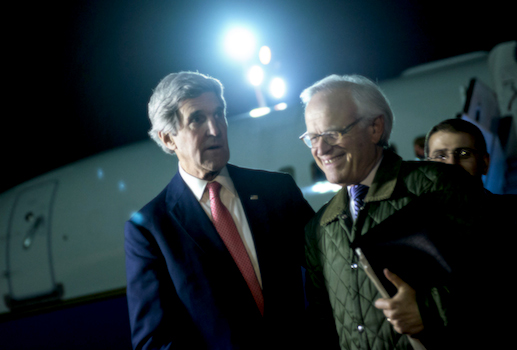
Mideast Israel Palestinian US KerrySecretary of State John Kerry and Middle East envoy Martin Indyk / AP

Senior Obama administration officials have escalated a secret media war to discredit Israel in the press, providing highly critical anonymous quotes and negative information about the Jewish state in a bid to blame it for the recent collapse of peace talks with the Palestinians.

Multiple sources in both the United States and Israel confirmed to the Washington Free Beacon that Middle East envoy Martin Indyk again served as the anonymous source for a recent interview in the Israeli press that lambasted Israel, blamed it for the failure of peace talks, and predicted that Israel needs to face another wave of Palestinian terrorism before it will make peace.

Indyk was first identified by the Free Beacon as the anonymous source for a series of anti-Israel stories planted by the Obama administration in April.

The targeted leaks have sparked anger among top officials in Jerusalem who believe that Israel is being attacked with unfair and negative press stories while the Palestinian side escapes blame from the Obama administration, according to these sources.

“There was a general ban on leaks, and it was more or less enforced,” said one senior official with a leading pro-Israel group. However, “Indyk and his team were the exception.”

“The result was that you had this constant stream of anti-Israel talking points from anonymous U.S. officials and nothing to balance them out. The Israelis would go to the Americans and ask them to correct the record, and the Americans would refuse—because of the prohibition against leaking!” the source said.

The Obama administration’s latest attempt to discredit Israel behind a facade of anonymous quotes came in a wide-ranging interview that two unnamed officials gave to Israeli reporter Nahum Barnea.

Multiple sources in the United States and Israel identified Indyk as one of Barnea’s key sources.

A State Department spokeswoman declined to speculate on who the sources of the article might be when approached by the Free Beacon and stated that both the Israelis and Palestinians deserve blame for the collapse of peace talks.

Indyk, a longtime Middle East hand and peace negotiator, has for years personally disliked Israeli Prime Minister Benjamin Netanyahu, according to these sources.

“It’s been going on for many years,” said one former Israeli diplomat, referring to Indyk’s leaks to the press. “He was defending the Palestinians. That is a long time story. His antipathy to Netanyahu is also a very long story. It’s not recent. It goes back years.”

Indyk has enjoyed a long relationship with reporter Barnea and has used those ties to leak stories critical of Israel and Netanyahu, the source said.

Barnea has been publicly close to Indyk since at least 2006, when he was selected as a top speaker on a closed-door panel sponsored by the Brookings Institution’s Saban Center, where Indyk has long served as the director when working outside of the government.

Barnea also was given a chance to interview former President Bill Clinton during a 2009 event hosted by the Saban Center.

In 2011, Barnea went to Indyk’s Saban Forum and then quoted unnamed American officials referring to Netanyahu as “the N-word.”

“Indyk has long made a practice of essentially buying the loyalty of Israeli reporters by giving them free trips and cushy speaking gigs,” said the senior official who works for a pro-Israel group. “Then he turns around and anonymously uses those journalists to attack diplomats and leaders he perceives as enemies.”

“He couldn’t do any of it without cash from Haim Saban, who endowed the Saban Center where Indyk was the director, or, more recently, from Qatar, which has been pumping huge amounts of money into the Brookings Institution.”

State Department spokeswoman Marie Harf declined to speculate on the article’s sourcing, but told the Free Beacon that both the Israelis and Palestinians share the blame for talks failing.

“As we’ve said publicly numerous times, both sides took steps that hurt the ability of the talks to move forward,” Harf said. “And it is totally inaccurate to say the secretary wanted to blame one side or the other.”

Israeli government sources in recent days have released private documents showing that the Palestinians had been planning to “thwart” the peace process long before talks officially collapsed.

Other recent stories in the U.S. press have focused on attempts by Israel to spy on America.

Newsweek published a lengthy expose earlier this week on what it claimed to be Israel’s attempts to steal technological trade secrets from the United States.

“We’ve had this pop up every few years,” said the former Israeli diplomat, explaining that U.S. officials typically leak these stories to distract from the peace process and smear Israel.

“The stuff Newsweek ran, I’ve seen this stuff repeated four of five times over the last decade,” said the source. “It’s almost as if there’s a file drawer somewhere in the basement of the State Department where someone calls a bureaucrat and says, ‘Pull out all the Israeli misdeeds.’”

The thinking in the State Department is, “If there’s a chink in Israel’s armor let’s pull this stuff out,” the source said.

Iran’s plans

May 8, 2014

Iran’s plans | JPost | Israel News.

By JPOST EDITORIAL

05/08/2014 00:45

More than Iran has managed to pull the wool over the eyes of the international coterie, the nations of the world desperately wish to be fooled.

Iran

Iran marks Islamic Revolution anniversary Photo: REUTERS

Grudgingly, we must admit that Iran is doing quite well. Tehran’s ayatollahs have effectively managed to hoodwink the US, Britain, China, France, Germany and Russia, whose representatives are now trying to reach a final deal in New York on Iran’s nuclear ambitions before the July 20 deadline.

But in actual fact, more than Iran has managed to pull the wool over the eyes of the international coterie, the nations of the world desperately wish to be fooled.

Iran’s interlocutors prefer to believe that by a miraculous happenstance the country has transformed itself overnight from a ruthless theocracy – whose agenda inter alia includes wiping Israel off the map – to an agreeable member of the international community.

Had self-bamboozlement not played a key role in the international attitude vis-à-vis Iran, there would be no difficulty seeing through the ruse and sweet talk.

Thus, while International Atomic Energy Agency inspectors visited a uranium mine and a uranium- thickening facility in the central Iranian towns of Ardakan and Yazd, Iran banned access to the WhatsApp messaging site. It explained – without embarrassment or hesitation – that the move arose from the fact that WhatsApp is owned by a “Jewish American Zionist.”

This was a reference to the acquisition of WhatsApp two months ago by Facebook, whose founder is Mark Zuckerberg. According to Abdolsamad Khorramabadi, head of the regime’s Committee on Internet Crimes, the fact that Zuckerberg is Jewish legitimizes cracking down on a particularly popular social media site.

The astounding fact isn’t so much that Tehran’s Shi’ite rulers fear social networks and incite against Jews, but that the world’s democracies are so silent on any hate propaganda so long as its targets are Jews.

Were Zuckerberg a passionately committed Zionist, it should not be held against him. Supporting Zionism, the national liberation movement of the Jewish people, ought to be a source of pride and not treated as a crime. But the fact is that while Zuckerberg is Jewish by birth, he is hardly a committed Jew. If anything, this goes to the heart of contemporary Judeophobia.

A Jew is hated not for what he does or what he espouses, but for his parentage. A Jew can be totally assimilated and fail to significantly identify with fellow Jews and Jewish causes, but to the eyes of the enemies of the Jewish people – even these days – he remains anathema for no other reason than his lineage.

We can only express dismay that the world’s most liberal governments, among them the Obama administration, have chosen to not so much as notice the non-stop stifling of elementary freedoms in Iran and the vehement anti-Jewish pretext to which Ayatollah Khamenei’s cohorts resort for outlawing applications the regime intends to repress.

Behrouz Kamalvandi, spokesman of Iran’s Atomic Department, maintains that by allowing the visit to the uranium extraction and refinement sites, “Iran will be able to say that the seven-agreed measures between Iran and the Agency [IAEA] have been fulfilled. Already six steps have been taken.”

This is the pose. Iran postures as an accommodating partner, oozing goodwill, and the international powers, seeking to strike a bargain, are only too happy to pretend right along that all is well on the Iranian front and that danger to the world can be avoided by easing the sanctions on Tehran.

It’s easier to make believe that Iran is now ruled by a moderate regime, that it will indeed – as per its promises – redesign its Arak heavy-water reactor (to greatly limit the amount of plutonium it can produce) and that it will dilute half of its 20-percent-enriched uranium.

Yet all these seeming Iranian concessions, if indeed made, are eminently reversible and will only delay the manufacture of an Iranian nuclear bomb.

The true test for Iranian intentions shouldn’t be sought in the self-serving promises of its nuclear negotiators but in other spheres – including the denial of rudimentary liberties to the Iranian population and the ongoing unmitigated expressions of hate toward all Jews, no matter where and who they are.

Israel Air Force is deadlier than ever

May 8, 2014

Israel Air Force is deadlier than ever – Israel Opinion, Ynetnews.

Analysis: IAF believes it can shorten next war on its own by striking thousands of targets a day, dropping more than 10 accurate bombs from one plane on different areas. Ron Ben-Yishai reviews revolution in aerial warfare branch perceived as ‘Israel’s insurance policy.’

Published: 05.08.14, 00:40 / Israel Opinion

At first we’ll experience a number of tough days. Rockets and missiles, directed mainly at the Tel Aviv metropolitan area. The aerial defense will mostly defend strategic facilities and bases, in the big cities buildings will collapse and there will be casualties.

But it won’t last for long. The Israel Air Force will respond immediately, and after a few days we will see a significant drop in the number of missiles fired on Israel. A ceasefire will follow, there will be some more rocket fire, and then a truce and relative calm for several years thanks to the restored deterrence.

This is the serious but reasonable scenario the IDF is preparing for, and this is the political echelon’s strategic target. It will be a “high-trajectory war.” Whether the rocket fire comes from Syria, Lebanon, Gaza or Iran – the goal will to end it quickly in order to minimize damages and losses, while causing maximum damage on the other side, so that it feels the urgency to pursue a ceasefire.

Iranian missile test. A number of tough days (Photo: AP)

Iranian missile test. A number of tough days (Photo: AP)


Israelis running into bomb shelters. Buildings will collapse (Photo: Idan Rodkin)

Israel Air Force (IAF) Commander Major-General Amir Eshel and senior IAF officers believe it is possible – and even more: With the intelligence, the arms and aircraft available at the Air Force’s disposal, they believe it could reach the described achievements on its own, without the IDF having to maneuver its way into enemy territory, and it must be allowed to do so.

If Major-General Eshel and his people are right, we are talking about a significant reduction in the number of casualties and a huge saving in resources considering the astronomic cost – about NIS 1 billion ($290 million) – of every day of fighting. What the IAF commander is suggesting is in fact a real revolution in the IDF’s combat perception, which will dramatically affect the need to equip and train the ground forces, and the budgetary list of priorities.

I already heard the claim that the Air Force can do the job on its own once before from Dan Halutz, when he served as IAF commander before being appointed chief of staff. That claim was proven wrong in the Second Lebanon War, and that’s the reason it still raises many doubts today.

Of course not all senior IDF officers agree with the IAF’s assessments. Many generals, who are aware of the Air Force’s abilities and respect them, still believe that the army must operate on the ground in order to paralyze the firing of thousands of rockets and missiles.

The short period of action is also seen as unlikely. The IAF officials respond with quite a convincing argument: If we are attacked suddenly, it will anyway take us time to gather all the ground forces and overcome attacks on emergency depots and traffic arteries. At the same time, we will have an opportunity to get the job done through aerial attacks. Simultaneously, they say, we are preparing to offer the ground forces significant help in the fighting.

Israel Air Force Commander Major-General Amir Eshel

Israel Air Force Commander Major-General Amir Eshel


The man in charge of the war in the north. IAF Commander Eshel (Photo: Air Force Media)

“We are not gambling,” Eshel explains. “We know that we are perceived both by the public and by senior state officials as the people of Israel’s insurance policy, and the expectations from us are high. Perhaps too high. But we are not confused. We remember that we’re not alone and we are building an ability to integrate.”

In Operation Pillar of Defense, he notes, the IAF prevented the need for a ground operation in Gaza, and the deterrence is more or less “working” till this very day.

I witnessed the IAF’s preparations to significantly improve its ability to aid the ground forces several weeks ago, when I joined a detention and patrol activity in the Hebron area, which was combined with preparations for a war: A drill simulating the takeover of a Lebanese village.

As we moved forward, the Paratroopers Brigade commander pointed at a fighter bending behind a terrace, and whispered in my war that his name is Lieutenant Colonel T., the F-16 squadron commander. Quite an unusual event in the IDF reality.

T., who was equipped and armed and acted like a regular fighter, explained naturally that he had joined the operation at his own initiative because he wanted to understand how the infantry forces move and operate during fighting and how he and his pilots could help them from close up – very close.

A warplane helping ground forces with gunfire and missile fire is a “natural” mission. A warplane dropping a one-ton bomb on a house and delaying the progress of a ground force – that’s an entirely different story.

 ‘Attack outputs’

But aiding the ground forces is not the IAF’s first mission. In the past two years, it has been preparing mainly for goal approved by the chief of staff, defense minister and prime minister – to be ready to shorten the fighting which could erupt at any minute, and this places immediate and even heavier responsibility on the shoulders of Eshel and his people.

Rockets launched from Gaza, sometimes from the heart of a civil population (Photo: AP)

Rockets launched from Gaza, sometimes from the heart of a civil population (Photo: AP)

Neutralizing tens of thousands of rockets and missiles in Lebanon and Gaza is a Sisyphean mission. The immobile launchers from which the missiles are fired to a larger range, with the heavy and relatively accurate warhead, are fortified and well hidden in the homes of citizens or in hidden launching holes (dug in the ground and operated by remote control); their operators move between them, rearm them and hit the IDF forces moving towards them through tunnels.

The main difficultly is using intelligence to locate them, and targeting them may also lead to the killing of uninvolved civilians and stir up the world against us.

Hunting for the portable launchers is even more difficult. It requires close surveillance of the launching areas, and if they are located – an aircraft or another instrument is needed to accurately hit the launchers’ truck while it is still exposed on the ground or while its driver is attempting to hide under the pillars of a building.

In the Second Lebanon War, the IAF was successful – facing a store of missiles which is at least six times smaller than what Hezbollah has today – but these missions proved to be tough even then. In addition ,the pilots will have to operate while bases are being fired on and defend themselves against Russian-made antiaircraft missiles which may have reached Hezbollah, or shoulder missiles which may have reached the Gazans.

In order to overcome the difficulties and climb up according to the extent of the task, the IAF has been undergoing some processes of change in the past two years. The most important process is the effort to increase the “attack outputs”: The number of sorties, but mainly the number of attacked targets and the damage inflicted on them.

 Like hail

Major-General Eshel instructed the IAF in as early as August 2012, three months after taking office, to prepare to carry out several thousand military sorties a day. The goal is increasing what he refers to as “the Air Force’s deadliness.”

In the Second Lebanon War, there were hundreds of sorties, and the number of attacked targets from the “target bank” was even smaller. Today, the bank of targets which can be destroyed has been expanded considerably, and the IAF is expected to complete the improvement of attack outputs very soon.

Locating rocket launchers from the air

Locating rocket launchers from the air

But even that is not enough. In order to reduce the launches within a short period of time, a large number of targets must be attacked at the same time. For that purpose, the defense industries have developed an accurate guided armament which the pilot can launch at different directions like hail falling on a wide area, without giving up on the accuracy of the hit, the number and variety of the targets.

For example, a single F-16 can bomb more than 10 targets in different sites simultaneously. The abilities of the F-15 (of the old models) are much higher both in quantity and in the weight of the bomb, which can destroy underground fortifications. This aircraft, says Brigadier-General Tomer Bar, commander of the Tel Nof Base, can get very far with a heavy load and without aerial fueling. Not to mention the F-15i, which is particularly adjusted for long-term attack missions and aerial supremacy. The strategic meaning is clear, even if he doesn’t mention the target country.

In order to meet Eshel’s new speed and outputs requirements, the technical and logistic systems have also been analyzed and reorganized. Colonel Dan Tortan, commander of the Hatzor Base, says the technical crew “storms” an F-16 returning from a military sortie and prepares it for an additional sortie within a short while, similar to the crew which refuels and adjusts a Formula 1 car at a pit stop during a race. With the old methods it would take several hours.

 The north is in his hands

Apart from improving the attack outputs, the IAF is investing many efforts and budgets in building the aerial defense system, which is divided into antiaircraft defense and a multi-layer missile interception system. The plan includes one command which will manage all the activity from one operation center. At the moment, however, the preference is to purchase more Iron Dome batteries in order to complete the development, get new supplies of David’s Sling (Magic Wand) interception missiles, and complete the development of the Arrow 3 for intercepting ballistic missiles in space.

David's Sling test. One command, one operational center (courtesy of the Defense Ministry)

David’s Sling test. One command, one operational center (courtesy of the Defense Ministry)

David’s Sling is the most important at the moment because of it has higher abilities than Iron Dome to intercept more serious threats. This system will operate from fixed bases which are being built, but it will be operational in only about two years at the earliest.

The truth must be told and it must be stressed that the Iron Dome batteries whose abilities have been improved in the meantime will be used at the time of a major conflict to defend Air Force bases and other vital facilities and not us much for the defense of the population, in order to improve the “functional continuity” needed for high attack outputs. The IAF base commanders have been devoting a significant part of their time and training to the functional continuity matter.

Another area the IAF has been engaging in intensively in the past few years is the “battle between wars,” which aims to prevent terrorist activities and strategic weapon supplies in Lebanon and Gaza. The activity is mostly secret. An important development took place about a year ago, when the chief of staff put the IAF commander in charge of the northern area of the “battle between wars,” at the defense minister’s approval.

As part of his responsibility, Major-General Eshel has been operating intelligence systems and operational forces not only from the IAF but from all of the IDF’s departments, arms and units. At the same time, the IAF contributes to the other efforts of the “battle between wars,” for example the takeover of Iranian weapons ship Klos-C.

 More than career soldiers 1,000 dismissed

There are more diverse tasks than before, and the IAF is also changing the staff and creating a new position – head of aerial operations, a brigadier-general who will be the IAF’s No. 3 after the head of the staff. The new structure will take effect in the summer, and the designated head of aerial operations is Brigadier-General Bar, commander of the Tel Nof Base.


Aerial fueling of F-15 planes. Improved abilities (Photo: AFP)

The organizational change is expected to help deal with the “third circle” – the name given to dealing with the Iranian nuclear program through offensive measures. Senior IAF officials don’t talk about it much, but they have created the impression that they are convinced of their ability to act if they are required to, and to reach reasonable achievements. The current abilities of the IAF and IDF to launch efficient long-range strikes, they believe, are better than they were several years ago. And yet it’s hard to compare them to the United States’ abilities.

I was very impressed by the fact that in all my conversations with senior and junior Air Force officials, I did not hear any demands to increase the aircraft fleet or the purchase budgets. The thing that bothers them is not just the deficit created this year, which is threatening the ongoing training activity, but mainly the budgetary uncertainty.

The IAF cannot make plans because the IDF still doesn’t have an approved multi-year work plan and the defense establishment still doesn’t have any approved budget for the coming year and the following year.

The IAF is in the process of closing several operational squadrons and has dismissed 1,010 career soldiers. This is a relatively huge number compared to the Air Force’s size.

“I was recently forced to dismiss, as part of the cutbacks, a 38-year-old career soldier who is an expert on the quick repair of Yasur helicopters. My heart aches over the man and his abilities which we lost, but there is no choice,” said Brigadier-General Bar.

The new Super Heron unmanned aerial vehicle (Photo: Yaron Brenner)

The new Super Heron unmanned aerial vehicle (Photo: Yaron Brenner)

The number of unmanned aerial vehicles (UAVs) which the IAF is taking in is increasing over time, and there is a rise both in the quantity and in the types and level of technology invested in them. The number of tasks the UAVs will engage in mainly in the intelligence and accurate fighting areas will grow over time, says Brigadier-General Laor, commander of the Palmachim Base, but the manned aircraft in the key tasks will not be replaced in the near future.

 Even the Americans are jealous

Another growing field is the use of flight simulators. Today there are simulators not only for warplanes but also for helicopters and UAVs.

But the highlight is the mission simulator – an Israeli invention which was co-developed by Israel’s Elbit and the American Lockheed Martin. The US Air Force commander has admitted, enviously, that even his army does not have such a thing.

So what’s the big deal? In the mission simulator a lone pilot can exercise a mission, and an entire combat squadron can even simulate a state of war. From receiving the mission from the Air Force headquarters, through planning and briefing the pilots to the sortie itself, which although it is carried out in a cockpit on the ground – the three-dimensional visions and feelings are completely realistic and relevant to the real task.

At the same time, the pilots exercise overcoming mishaps and emergency situations and flying an aircraft in extreme conditions, including a crash as a result of an antiaircraft missile hit.

These simulators not only save millions of dollars which should have been invested in hours of flight training, but also allow reserve soldiers, for example, to maintain their fitness and acquire new flight and arms operation abilities.

The pilot receives the instructions for correcting the errors in his earphones in the voice of a 19-year-old woman demonstrating amazing knowledge of the secrets of a combat flight she has never experience herself.