[T]he reporter sanitized the group by presenting it as a “political” and “militant” “faction” in Gaza, and discussing its “civic activities” — plans to build medical facilities and running of kindergartens where children alternate “between chanting Quranic verses and singing the ABC’s.” The group’s “armed wing,” which the reporter acknowledged was its priority, was described in heroic terms as “the main military expression of Palestinian nationalism.”
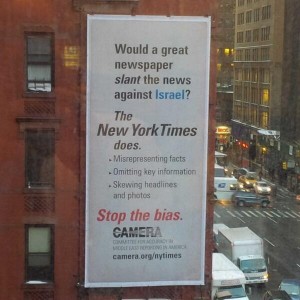
A day before Yom Hazikaron, Israel’s Memorial Day, when the country mourns its fallen soldiers and victims of terrorism, The New York Times featured a prominent article about Islamic Jihad, the notorious Palestinian terrorist organization responsible for dozens of deadly attacks on Israeli civilians.
Islamic Jihad’s claim to fame is its introduction and continued use of suicide attacks against Israelis, including gruesome attacks at Jerusalem’s Sbarro pizzeria, Haifa’s Maxim restaurant, the central bus stations in Hadera and Tel Aviv, and numerous other bombings in shopping malls, open-air markets, restaurants, buses and train stations — attacks responsible for the deaths of hundreds of Israelis and for wounding more than 1000 others. The group’s primary targets are Israeli men, women and children going about their daily lives in public areas. It therefore seemed timely to profile Islamic Jihad, responsible for so many of Israel’s terror victims, just before Yom Hazikaron.
There was just one problem. The article by The New York Times Jerusalem bureau chief included no mention whatsoever of Islamic Jihad’s terror attacks or anything at all about its victims.
Rather, the reporter euphemistically described the group’s “focus on military resistance to the Israeli occupation” – a description that adopts the terrorist group’s narrative justifying attacks against Israeli civilians, with the aim of eliminating all of Israel, as legitimate.
The reporter’s own use of such unattributed language sharply contrasts with the way the newspaper distances itself from language used by Israel, for example when it employs quotation marks when referring to “what [Israelis] call ‘incitement’ [by Palestinians].” And in contrast to the newspaper’s frequent invoking of “much of the world” viewing Israeli settlements as illegal, the article concealed the global view that Islamic Jihad is a terrorist group, noting only that “the U.S. designated Islamic Jihad” as such “in 1997,” and burying even this partial information in the 15th paragraph of the story. The fact that the European Union, the United Kingdom, and other Western countries have also listed Islamic Jihad as a terrorist organization is ignored entirely.
Instead, the reporter sanitized the group by presenting it as a “political” and “militant” “faction” in Gaza, and discussing its “civic activities” — plans to build medical facilities and running of kindergartens where children alternate “between chanting Quranic verses and singing the ABC’s.” The group’s “armed wing,” which the reporter acknowledged was its priority, was described in heroic terms as “the main military expression of Palestinian nationalism.”
Islamic Jihad is neither “militant” nor is it a “faction.” It is a terrorist group. Indeed, the group is so proud of its terrorism that it openly revels in its successes — that is, the murder of innocent civilians — every chance it gets.
But while Islamic Jihad does not make any attempt to obscure its terrorism, The New York Times does. Why would the so-called “newspaper of record” hide from its readers the most salient fact about the subject of an article?
When challenged about the article’s omissions, an editor suggested that all the context deemed relevant to the organization, its background and aims had been included in the story, with the obvious implication that there was no need to share the unpleasant facts about Islamic Jihad’s terrorist attacks against Israeli civilians– its raison d’etre.
Even though we have made the point before, it bears repeating again. News consumers beware: The New York Times deliberately deceives its readers about the facts with its advocacy journalism.
I have come here to seek a new beginning between the United States and Muslims around the world; one based upon mutual interest and mutual respect; and one based upon the truth that America and Islam are not exclusive, and need not be in competition. Instead, they overlap, and share common principles – principles of justice and progress; tolerance and the dignity of all human beings. [Emphasis added.]
. . . .
I consider it part of my responsibility as President of the United States to fight against negative stereotypes of Islam wherever they appear. [Emphasis added.]
Negative “stereotypes” of Islam? Such as this?
Does mentioning that there have been thousand or so Islamist “honor killings” in Pakistan in just one year present a vile “negative stereotype?” That video was posted almost a year ago. Would a comparable piece be aired even now on the “legitimate” media? I don’t think it would be, due to political correctness and fear of violent Islamist retribution should Islamic violence be mentioned.
Sister Raghad, the former head of the Patriarchate School in Damascus who currently resides in France, told Vatican Radio how she personally witnessed jihadi rebels terrorize Ma‘loula, including by pressuring Christians to proclaim the shehada—Islam’s credo that there is no god but Allah and Muhammad is his messenger—which, when uttered before Muslim witnesses transforms the speaker into a Muslim, with the death penalty for apostasy should the convert later “renege” by returning to Christianity.
According to the nun, those Christians who refused to embrace Islam were
killed in atrocious and violent ways that cannot be described. If you want examples, they crucified two youths in Ma‘loula for refusing to proclaim Islam’s credo, saying to them: “Perhaps you want to die like your teacher [Christ] whom you believe in? You have two choices: either proclaim the shehada or else be crucified. One of them was crucified before his father, whom they also killed.”
The post also notes,
The fact is, crucifixion is a prescribed form of punishment in the Koran (5:33) and occurs throughout the Islamic world . . . .
And in her memoir, Ravished Armenia, Aurora Mardiganian described how in the early twentieth century in the city of Malatia, she saw 16 girls crucified, vultures eating their corpses: “Each girl had been nailed alive upon her cross, spikes through her feet and hands,” wrote the Armenian survivor. “Only their hair blown by the wind covered their bodies.”
Prescribed in the Koran itself, crucifixions are as old as Islam and, with the global revival of the latter, are returning with increased frequency. And, although it is more politically correct to report on jihadis crucifying other jihadis — other terrorists or “spies” — the fact is, many more innocent Christians are being crucified again, including simply for refusing to embrace Islam and thus renounce Christ.
Why reject reality-based “negative” stereotypes and promote fantasy-based “positive” stereotypes instead? Is it a multiculturalistic effort at false moral equivalence as between Islam and Christianity/Judaism? Between evil and good?
The U.S. Commission on International Religious Freedom’s new report recommends that eight more countries be designated as Countries of Particular Concern, all but one of which are Muslim-majority populations. The panel repeatedly identified interpretations of sharia as a source for the increasing violations of religious freedom. [Emphasis added.]
The panel suggested designations for Egypt, Iraq, Nigeria, Pakistan, Syria, Tajikistan, Turkmenistan and Vietnam.
Of these, Pakistan warranted the most concern. The panel said the state of religious freedom “hit an all-time low” last year. In April 2013, the Human Rights Commission of Pakistan even said the country is “on the verge” of becoming an undemocratic society where violence is mainstream. [Emphasis added.]
“On the verge?” With “only” approximately one thousand “honor killings” in just one year? Of course, Pakistan is “democratic,” i.e, operates in accord with the desires of its Islamists. Is that the type of democracy that President Obama relishes in Islamist nations? Elsewhere?
The report suggested the retention of eight countries previously labeled as Countries of Particular Concern (CPC): Burma, China, Eritrea, Iran, North Korea, Saudi Arabia, Sudan and Uzbekistan.
The panel’s comments on Iran correspond with a United Nations report that found that Christian persecution is at unprecedented levels, even though the new President is supposedly a “moderate.” The Commission states that Sufis, Sunnis and Shiites opposed to the regime are also being victimized. [Emphasis added.]
“[Rouhani] has not delivered on his campaign promises of strengthening civil liberties for religious minorities,” the Commission report states.
One of the most important conclusions in the report is that Saudi Arabia is still promoting radical Islam and religious intolerance in the school system. The Saudi government may be confronting the Muslim Brotherhood, but that has not stopped it from indoctrinating students with a Brotherhood-type worldview.
Has President Obama found enough time (or interest) to read the report? That’s doubtful. Has His position changed? If so, I haven’t noticed it.
Hassanal Bolkiah, sultan of Brunei, began enacting the new Shariah laws this month, which call for a range of punishments, including fines and imprisonment for those who fail to show up for Friday prayers or who get pregnant outside of marriage, the Washington Post reported.
“The decision to implement the [Shariah penal code] is not for fun but is to obey Allah’s command as written in the Koran,” Bolkiah said last week.
Later this year the punishments will ramp up, with flogging and the severing of limbs becoming the punishment for those who rob or commit property crimes. And death by stoning is also scheduled to take effect next year for those who commit sodomy or who enter adulterous relationships.
Most of these punishments can also be applied to the nation’s 440,000 non-Muslims — one-third of the country’s population, as the Associated Press noted.
He continued, “Evil flourishes when good people do nothing, and that is pretty much what this is. This is not complicated. These are not crazy left-wing wacko people.”
The comedian and former “Tonight Show” host went on to say that the controversy over Los Angeles Clippers owner Donald Sterling should be considered minor when compared to what’s happening in Brunei.
Why not consider Palestinian efforts to derail the Obama- Kerry “peace process” months ago, even before Abbas visited President Obama at the White House, followed by Administration efforts to blame Israel for the collapse? Although the United States of Obama cannot lawfully continue to fund “Palestine” under a Fatah – Hamas power sharing agreement, it seems to be looking for ways to do so even as Hamas insists of having control over military aspects of the Fatah – Hamas coalition government.
The Egyptian people are astounded. They simply do not understand the Obama Administration’s efforts to bring the Muslim Brotherhood back to power.
In an effort to make some sense of the Obama Administration’s policies, Amr Adeeb, a prominent Egyptian commentator, argues that the U.S. is helping the Muslim Brotherhood to achieve power, in order to turn Egypt into a magnet for jihadist fighters. The goal, Adeeb states, is to turn Egypt into another Syria or Afghanistan and discredit Islamism as a viable political movement.
To Westerners, this may seem like a bizarre conspiracy theory, but for Egyptians it helps explain why the U.S. government is supporting an organization that has openly declared jihad against the West, engaged in threats of war with Israel and Ethiopia, demolished dozens of ancient historic churches, set hospitals on fire, and murdered Christians in the streets. The Muslim Brotherhood has no respect for the rule of law, but the Obama Administration treats the Egyptian military that removed the group from power as a threat to democracy itself. [Emphasis added.”
The Muslim Brotherhood has done its best to frustrate the Obama – Kerry “peace process.”
The link between the Muslim Brotherhood and Hamas is clear and straight, and confirmed by Article 2 of the Charter of Hamas, which reads: “The Islamic Resistance Movement is one of the wings of the Muslim Brothers in Palestine. The Muslim Brotherhood Movement is a world organization, the largest Islamic Movement in the modern era. It is characterized by a profound understanding, by precise notions and by a complete comprehensiveness of all concepts of Islam in all domains of life: views and beliefs, politics and economics, education and society, jurisprudence and rule, indoctrination and teaching, the arts and publications, the hidden and the evident, and all the other domains of life.” [Emphasis added.]
Iran, with which the United States of Obama and the rest of the P5 + 1 group have been negotiating a nuclear “peace process,” seems likely to be permitted to continue its military nuclear progress. It won’t happen transparently.
“The fear,” a former senior intelligence official told me, “is that the Iranians are going to pretend to give up their nuclear weapons program — and we’re going to pretend to believe them.” [Emphasis added]
Similarly, the chairman of the Senate Foreign Relations Committee, Robert Menendez (D-N.J.), last week told a large audience at the annual Washington Forum of the Foundation for Defense of Democracies (the think tank I head): “No one wants a diplomatic solution more than I do. But it cannot be a deal for a deal’s sake. And I am worried they [Obama and his advisers] want a deal more than they want the right deal.” [Emphasis added.]
The United States now have a “wuss” as President. He is a devious wuss, intent upon pleasing Islamists as they manage to scam an at best naive American President and others, while continuing to conduct jihad against adherents to all non-Islamist religions. President Obama ignores as best He can not only their stated but their denied and poorly concealed aspirations for world conquest, while He mocks those who disagree with His approach. Is His approach anti-American and anti-freedom in the few places where it still exists, albeit tenuously? Yes.
(Can credibility attach to President Obama’s foreign policy when it is so incredibly amorphous as hardly to exist? Or when his actions contradict his words constantly? — DM)
Perceptions of America’s credibility shape the policies of our friends — and our enemies.
[T]he sharp edge of Iranian strategy is shaped significantly by perceptions of American global resolve. Where America is seen to be resolute and determined, Iran is deterred. Where America is seen to be timid and uncertain, Iran is emboldened.
This past weekend, The Economist lambasted President Obama’s policies in Ukraine and Syria for fostering a “nagging doubt” about America’s credibility as an ally. Then, on Monday, The Atlantic’s Peter Beinart suggested that such notions are “bunk.” For Beinart, the “credibility fallacy” is an excuse to avoid complex discussions of America’s global interests.
I have some sympathy for one of Beinart’s arguments: Casual strength-vs.-weakness narratives are unhelpful. Foreign policy is too important for posturing. But ultimately, Beinart is wrong. Contrary to his assertions, American policy in Ukraine and Syria most certainly does influence America’s adversaries — especially in the Middle East.
For a start, take Dexter Filkins’s study of Qassem Suleimani, the leader of Iran’s Quds Force and an archetypal hardliner of the regime. In his meticulous analysis, Filkins shows how the sharp edge of Iranian strategy is shaped significantly by perceptions of American global resolve. Where America is seen to be resolute and determined, Iran is deterred. Where America is seen to be timid and uncertain, Iran is emboldened.
And perceptions of U.S. credibility among players who are not part of a foreign regime are also important. Take America’s adversaries in the Middle Eastern media. Opinion makers there now present Obama as the master of a rudderless agenda. These populist narratives are important — they mobilize political agendas in ways that are either favorable or problematic for the United States.
We must always remember that the Middle East is a region beset by strategic paranoia. It harbors a political environment in which perception drives policy and perception thus makes reality. Consider the Syrian civil war. In the absence of American leadership on Syria, the Sunni Arab monarchies have moved to fill the vacuum. Indeed, the Saudis warned that this would happen when, last December, they threatened to be “more assertive.” We have seen the consequences of this new assertiveness. Lacking U.S. reassurance, the Sunni kingdoms have retrenched into hypersectarian fear. Specifically, they’ve allowed their citizens to fund Salafi jihadist groups that oppose Assad (and thus also Iran). And those jihadists have been doing what they do best — most recently, going on crucifixion rampages. Tellingly, the White House is now speeding up weapons transfers to more nationalist-minded Syrian rebels. The Sunni monarchies have shamed themselves by their actions, but perception of U.S. leadership does matter.
Still, there’s another major problem with Beinart’s argument: He, like the Obama administration itself, is blind to the necessity of understood purpose in foreign policy. Again, a recent example encapsulates this truth.
Last September, serving the president’s short-lived Syria authorization-of-force request, Secretary of State John Kerry and the chairman of the Joint Chiefs, General Martin Dempsey, gave testimony to Congress. For much of the hearing, Dempsey appeared sullen. Why? Because he knew the administration’s policy represented the antithesis of basic strategy. First, the president had relinquished his authority as commander-in-chief by equivocating on his “red line.” Then, in the hearing, Kerry proudly trumpeted the administration’s intention of using strictly “limited” force. His portrayal of military strategy as a clean, simple mechanism of government was extraordinary. But don’t take my word for it, watch this video. Dempsey’s rebuke says it all — disgust. Disgust at the void between stated intention and strategic vision. And disgust at what that void did to American diplomacy. After all, barely a month before the hearing, Dempsey had been in Israeltrying to persuade a skeptical Netanyahu that America would prevent a nuclear-armed Iran. That day in Congress, Dempsey knew America’s credibility was suffering — and that a unilateral Israeli attack on Iran had become more likely.
Disgust, also, because Dempsey knew that America’s adversaries were also watching — and probably believing that America’s purposefully purpose-deficient foreign policy lacked the credibility to cause them to exercise restraint. (As a side note, it isn’t by chance that the U.S. Army’s leadership manual offers “influence” through “purpose” as its first principle.)
Today, America’s adversaries are watching the second and third acts of this spectacle of strategic vapidity. Act II: the administration’s cover-up of Assad’s continuing chemical warfare. Act III: the administration’s apparent unwillingness to respond seriously to Putin’s aggression — the Russian markets actually rallied after the latest “tough” U.S. sanctions.
Credibility matters.
So, yes, America’s foreign-policy challenges require in-depth consideration and debate. That’s especially important where military force is on the table. Nevertheless, when strength is proffered in words, those words must carry the perceived guarantee of action. Without that support, the echo of empty rhetoric finds its way into the strategic contemplations of others. The result is America’s diminished credibility and the invitation to aggression that this degradation represents.
( For readers interested in learning about the 1967 war, this 2.5 hr documentary from PBS is the most complete and least one-sided that I have encountered. HIGHLY RECOMMENDED. – JW )
This DVD is taken from the WGBM production directed by Ilan Ziv. It is admirably objective considering that Ziv was born in Israel and fought in the Yom Kippur War of 1973. He came to the US and graduated from New York University’s film school soon afterwards.
The film consists of interviews with soldiers and politicians from both the Arab and Israeli side along with footage shot during the war. I say the film is “admirably objective” but of course there is no such thing as absolute objectivity in such matters, and I am sure that Arab viewers will find the production disagreeable. This disagreement may stem largely from the fact that the Six Day War in June, 1967 was an unmitigated disaster for Syria, Egypt, Lebanon, and especially for Palestine.
However, Israel’s swift and decisive victory brought with it no lasting peace. It did however humiliate the Arabs who imagined that they should be able to defeat such a tiny nation as Israel with Allah on their side and great leadership from Egypt’s charismatic President Gamal Adbel Nassar and Jordan’s King Hussein. To save face Arab leaders have done two things. One, they have inculcated the faithful with the notion that Israel won only because the US and other allies helped them; and Two, they have refused to acknowledge defeat holding onto the notion that the war is not over and that the Arab nations will yet achieve victory.
Ziv’s film emphasizes the political nature of the conflict, revealing the thinking of leaders on both sides, showing how Moshe Dayan assumed a position of power and influence just prior to the war and how Nassar deluded himself (or was deluded by his military people) into thinking the combined forces of Egypt, Syria and Jordan could defeat the Israelis. In the United States President Lyndon Johnson was advised by his military people that if the Israelis struck first they would win in a week or so, if second, it would take them perhaps two weeks. Johnson remarked (at the time mired in Vietnam) that his generals did a great job of analyzing prospective wars in which they would not be involved, or words to that effect.
Ziv reminds the viewer that the war could have escalated into a much wider conflict, possibly bringing in the Soviet Union on the side of the Arabs and the US on the side of Israel. Some teletype messages between Soviet Premier Aleksei Kosygin and Johnson are recalled.
Some facts gleaned from the film: Israel struck first with well-timed, precision bombing of Arab airfields so that the Arab states were left with no air power. The war was, effectively speaking, over then within hours of its start. However, when the report of the air disaster reached Nassar, instead of seeking peace as fast as possible, he ordered propaganda broadcasts repeat with fictitious “victories.” Black and white film clips show the Arabs in jubilant celebration. How cruel it was when the truth came a few days later.
Israeli’s preemptive first strike was prompted by the military build up by Egypt and Nassar’s closing of the Strait of Hormuz, which most authorities consider an act of war. The film strongly suggests that if Israel had not acted first it would have suffered many more casualties, especially from Arab air power.
And then there is the famous phone call from the Arab states that never came. The Israelis were willing to trade land for peace, but the Arabs decided to pretend that the war would continue and so they did not negotiate a peace treaty. The reason the actual fighting ended is because the super powers and the United Nations demanded that Israel halt its advances.
There is some almost nostalgic footage of Moshe Dayan, Israeli’s heroic Defense Minister who led the armed forces to victory, and some of indecisive Prime Minister Levi Eshkol. Ziv recreates the story of their difference of opinion on what Israel should do and how Dayan’s position prevailed.
The real losers in the war have turned out to be the Palestinian people who have been under occupation since the war ended. The Arab states that were instrumental in bringing about this human tragedy seem content to blame Israel while doing nothing substantive to help the Palestinians. Indeed a significant portion of the terrorism directed at Israel and the West is motivated by spiteful spasms of revenge by Arabs who are desperate to somehow erase what they see as a humiliating defeat. How much wiser it would be to realize that what happened in 1967 reflects not at all on the manhood of anyone living today, or even then for that matter. Israel won because it could not lose. “Manhood” and heroic acts of valor or lack thereof have nothing to do with it.
Sadly, as many others have noted, Israel may win all the battles and all the wars and yet never achieve peace. Theirs is an unenviable position. As long as they exist in the midst of Arab nations who hate them and teach their children to hate, they will always be on a military footing. Only when the old hatreds die, some many years from now, will there be lasting peace in the Holy Lands.
Newsweek reporter Jeff Stein cites classified U.S. intelligence document on “Jerusalem’s efforts to steal U.S. secrets under the cover of trade missions and joint defense technology contracts” • Foreign Minister Avigdor Lieberman slams “malicious” report.
Eli Leon, Shlomo Cesana and Israel Hayom Staff
U.S. Congress
|
Photo credit: GettyImages
U.S. intelligence officials told Congress members that Israel has “gone too far” with its spying in the U.S., with an emphasis on seeking industrial and technical secrets, according to a Newsweek article published on Tuesday.
“Jerusalem’s efforts to steal U.S. secrets under the cover of trade missions and joint defense technology contracts have ‘crossed red lines,'” Newsweek reporter Jeff Stein wrote, citing a classified document.
According to the report, U.S. intelligence sources tasked with counterespionage, say Israel’s spying activities “go far beyond” those of other allies like Germany, France, Britain and Japan.
One congressional staffer called the testimony “alarming, terrifying.” Another was quoted calling it “damaging.”
“No other country close to the United States continues to cross the line on espionage like the Israelis do,” a congressional staffer said in the report.
While the intelligence officials did not give details in the report, a former congressional aide called Israel’s activities “industrial espionage — folks coming over here on trade missions or with Israeli companies working in collaboration with American companies, [or] intelligence operatives being run directly by the government, which I assume meant out of the [Israeli] Embassy.”
“Israel doesn’t conduct espionage operations in the United States, period. We condemn the fact that such outrageous, false allegations are being directed against Israel,” Israeli Embassy in Washington spokesman Aaron Sagui said in response.
Foreign Minister Avigdor Lieberman on Wednesday denied the claims made by Newsweek, calling them baseless and “malicious.”
Speaking to Israel Radio, Lieberman said Israel was not in any way involved in spying on the U.S., and that the story was likely put together by parties seeking to damage relations between the two countries.
“Israel is not spying on the U.S., not directly and not indirectly,” he said.
The article comes after some Congress members called for allowing Israeli citizens to join the 38 other countries allowed to visit the U.S. without a visa. Some opposed to the move have said allowing waiving the visa requirement would lead to increased Israeli spying on the U.S.
Iran’s rulers brutalize their own citizens, sponsor terrorism on several continents, and openly vow “Death to America.” They are determined to acquire the ability to develop nuclear weapons and deliver them to targets anywhere in the world.
Can U.S. President Barack Obama stop them? That’s not the question.
Or rather, that’s not the question now being asked by the keenest observers of the diplomatic dance underway between Iran and the U.S. What they are asking instead: Is Obama serious about trying to stop Tehran’s revolutionary theocrats from becoming nuclear-armed — or is that not really his goal at this point?
“The fear,” a former senior intelligence official told me, “is that the Iranians are going to pretend to give up their nuclear weapons program — and we’re going to pretend to believe them.”
Similarly, the chairman of the Senate Foreign Relations Committee, Robert Menendez (D-N.J.), last week told a large audience at the annual Washington Forum of the Foundation for Defense of Democracies (the think tank I head): “No one wants a diplomatic solution more than I do. But it cannot be a deal for a deal’s sake. And I am worried they [Obama and his advisers] want a deal more than they want the right deal.”
Michael Doran, a former senior director of the National Security Council, former Defense Department official, and now a senior fellow at the Brookings Institution’s Saban Center, considered this possibility in a penetrating article in the journal Mosaic a few months back. He recalled that in 2012, Obama reiterated his pledge to do whatever might be necessary to prevent Iran from developing nukes — even if that necessitates the use of force. “As president of the United States,” he emphasized to journalist Jeffrey Goldberg, “I don’t bluff.”
Subsequently, of course, Obama not only bluffed — he had his bluff called by Iran’s client, Syrian dictator Bashar Assad. Obama had warned Assad not to use chemical weapons against his own people — if he did, he would cross a “red line” that would bring swift and painful punishment.
But, Doran wrote, after an August 2013 chemical attack that killed some 1,500 Syrians, “instead of ordering military action, the president decided to seek congressional authorization for the use of force, knowing full well that such a bill had little chance of passing.”
Obama’s aversion to the use of military power is understandable — and shared by most Americans. But one of the clearest lessons of history is that those who project strength end up using it sparingly, while those who project weakness invite their enemies to test them.
By declaring himself “war-weary,” by insisting — against the evidence — that al-Qaida is “on the path to defeat,” and “the tide of war is receding,” by shrinking the U.S. military, punting on Syria and responding fecklessly to Russian incursions in Ukraine, Obama has diminished his own credibility. That increases the likelihood that he will be left with a binary choice: war or capitulation. And capitulation, albeit wrapped in fancy diplomatic language, looks increasingly likely in regards to Iran.
Economic warfare can be an alternative to military force but not when it’s pursued half-heartedly. A robust sanctions package carefully constructed by Congress (Republicans and Democrats alike) and signed by the president (to his credit), brought Iran to the negotiating table. But at that table, in Geneva in January, the president’s envoys concluded an interim Joint Plan of Action that eased the economic pressure — a new International Monetary Fund report finds Iran now experiencing a modest economic recovery — in return for small potatoes on the weapons side.
Specifically, under the JPOA, Iran’s rulers are not required to dismantle their nuclear program — even in part. As Doran notes: “It pauses some aspects, while others proceed apace. A ‘research’ loophole allows the Iranians to continue work on advanced centrifuges. In short, Iran gets to have it both ways: to enjoy sanctions relief (the West’s part of the deal) while continuing to build up its nuclear program (Iran’s part of the deal).”
If stopping Iran’s nuclear weapons program is not Obama’s real goal, what is? Most likely he foresees a system of deterrence and containment — akin to the strategy that the U.S. pursued against the Soviet Union during the Cold War. What’s wrong with that?
First, it misreads history: The Cold War was a time of regional and proxy wars (for example in Korea, Vietnam, Latin America, Africa and Afghanistan), as well as moments when World War III could have broken out but didn’t thanks to American presidents willing and able to make credible threats (think of President John F. Kennedy during the Cuban missile crisis of 1962). In other words: A policy of containment most emphatically does require a major military component.
Second, even the most hard-core Soviets understood that “mutually assured destruction” would not be in their interest. By contrast, Iran’s theocrats may seriously believe that “martyrs” killed fighting “infidels” reap rewards in the afterlife. In other words: Deterrence, though effective against atheist ideologues, is a dubious policy against those whose religious duty is to defeat the enemies of God.
If a deal is struck with the Iranians over the coming months, expect it to feature technical formulas comprehensible only to experts: complex rules on how many centrifuges the Iranians may spin, how much uranium may be enriched to what levels, the size of stockpiles, and what international weapons inspectors may see.
Such a deal would let Iran’s rulers continue to move toward the nuclear finish line, while lifting most of the remaining economic pressure. Both sides would claim diplomacy had succeeded. About that, one side would be telling the truth. The other side, however, would be pretending.
Clifford D. May is president of the Foundation for Defense of Democracies, a policy institute focusing on national security, and a foreign affairs columnist for The Washington Times.
Senior member of Iranian negotiating team tells ‘Guardian’ that “dark forces” are working against the conclusion of a deal: “It is clear some people don’t want to resolve this issue in a peaceful and logical way.”
Iranian FM Mohammad Javad Zarif (L) and EE foreign policy chief Catherine Ashton at nuclear talks in Vienna March 19, 2014. Photo: REUTERS
Iranian diplomats suggested that Israel is attempting to torpedo the nuclear deal between the P5 +1 group of world powers and Iran, The Guardian newspaper reported.
Seyed Abbas Araqchi, the deputy foreign minister for legal and international affairs, told Guardian reporters that “there are spoilers everywhere who don’t want an agreement, there are dark forces who don’t like this process … It is clear some people don’t want to resolve this issue in a peaceful and logical way.”
“I don’t want to use the word ‘warmongers’. But these people want continuing tension, a continuing crisis in our region. They don’t want the sanctions on Iran to end. They don’t want Iran to be a major player in this region, although in fact it already is,” he added.
Although the leader of the 3-member negotiating team from Tehran wouldn’t specifically say which country he was alluding to, the Guardian surmised he was speaking about Israel. Prime Minister Binyamin Netanyahu has been outspoken against any sort of diplomatic deal with Iran.
Araqchi, however, with a hint of optimism, said the talks were still on the right track. “Whether it gets to a conclusion is something else. Obviously we are hopeful. For our part, we are very serious and we have goodwill. If the other side reciprocates, hopefully we will come to an end. But anything can happen.”
He also said that Iranian President Hassan Rouhani has invested a lot of effort into reaching a deal and has “raised expectations.”
“But I think people understand the complexities of the situation. I don’t think it would be a big blow to Rouhani if there is no agreement. People understand he has done his best,” he said.
Top American officials will travel to Israel on Wednesday to brief Israel, their chief regional ally, on the progress of the negotiations.
US National Security Adviser Susan Rice will travel from Washington to Jerusalem, and Under Secretary of State for Political Affairs Wendy Sherman, President Barack Obama’s chief negotiator in the talks with Iran, will depart directly for Vienna after the briefings, where the fourth round of nuclear talks resume next week.
Palestinian Authority President Mahmoud Abbas, center, and negotiator Saeb Erekat, left, attend the Arab foreign ministers’ meeting at the Arab League headquarters in Cairo, on April 9, 2014. (photo credit: AFP PHOTO / MOHAMED EL-SHAHED)
A letter reportedly sent by Israel’s national security chief to the White House, the EU and numerous ambassadors blames the Palestinians for the collapse of peace talks, and claims to include hard proof that PA officials were devising measures to thwart the process even before Israel refused to release a fourth round of Palestinian prisoners at the end of March.
In the April 22 letter, Prime Minister Benjamin Netanyahu’s national security adviser, Yossi Cohen, revealed that chief Palestinian negotiator Saeb Erekat wrote a policy paper in March in preparation for a Palestinian rejection of American mediation efforts and Israeli overtures — nearly a month before Palestinian Authority President Mahmoud Abbas made a unilateral move to sign 15 international conventions, ostensibly in response to Israel’s refusal to honor its commitment to release the final round of prisoners, Haaretz reported Wednesday.
In fact, Cohen said, according to a copy of the latter published alongside the report (PDF here), Erekat had planned the maneuver weeks before Israel announced its refusal to release the prisoners — timing that, according to Cohen, demonstrates that the Palestinian leadership never intended to follow the peace talks through.
Cohen attached Erekat’s policy paper to his letter, copies of which were reportedly sent to his US counterpart Susan Rice, US Ambassador to Israel Dan Shapiro, all Israel-based EU ambassadors, and ambassadors from China, Russia and other countries. He appealed to the recipients to peruse the Erekat document and “draw conclusions” as to the Palestinians’ “bad faith” and responsibility for the failure of the latest round of peace talks.
According to Cohen, the 65-page Erekat document, which contained a “highly selective” account of the peace talks held since July and a “series of recommendations” for unilateral Palestinian actions, was presented by Erekat to Abbas on March 9, prior to Abbas’s visit to the United States and his meeting at the White House with US President Barack Obama on March 17.
The paper, Cohen said, serves as proof that Palestinian policymakers had recommended a strategy of unilateral moves “outside of the agreed negotiation framework” to Abbas as early as March, nearly two months before the April 29 deadline for the completion of the talks. Thus when Obama tried at their White House meeting to persuade Abbas to make progress at the negotiations, Cohen indicated, the PA president was already bent on torpedoing the talks and following a unilateral course.
“The document serves as damning evidence of bad faith on the part of the Palestinian side,” Cohen wrote. “It suggests that plans to reject American proposals and pursue unilateral actions were in place well in advance, despite the unwavering commitment shown by Secretary Kerry and his team in facilitating these negotiations, and the seriousness which Israel has demonstrated throughout the negotiation process.”
In the document, Erekat recommended that the Palestinian Authority apply to international treaties such as the Geneva Convention.
He also recommended reconciliation with Hamas, revealing that the push for a unity government with the terrorist organization, which does not recognize Israel, began long before negotiations with Israel reached a stalemate.
This, Cohen said, proved that the Palestinians’ unilateral moves, ostensibly direct responses to perceived Israeli intransigence, were actually “premeditated” and “calculated” steps aimed at sinking the peace process and hindering American mediation efforts.
The Palestinians have blamed Israel for the failure of the talks, saying that if Israel had released the prisoners as planned, they would not have made unilateral moves, culminating with the Fatah-Hamas pact, that saw Israel suspend the negotiations and the April 29 deadline pass with no substantive progress and no agreement for further talks.
Israel had conditioned the release of the fourth batch of prisoners, some of them Arab Israelis, on the continuation of talks past their April 29 deadline. The Palestinians refused, and made a unilateral move for international recognition.
“This document refutes the current Palestinian claim that the decision to apply for accession to the conventions – in direct violation of Palestinian obligations and of the understandings that enabled the resumption of negotiations in July 2013 – was taken strictly in response to what they considered a delay in the release of the fourth tranche of prisoners,” Cohen wrote in the letter.
“Similarly, it indicates that advancing the reconciliation process with Hamas and bringing Hamas into a new government was under active consideration at the very time intensive negotiations were meant to be under way,” he continued.
“The document points to premeditation and to Palestinians’ calculations to renege on their commitments and pursue a unilateral strategy regardless of the release of prisoners, in a manner that would gravely endanger if not destroy the negotiation process.”
American officials were quoted last weekend, in an extensive account of the negotiations published by Yedioth Ahronoth, overwhelmingly blaming Israel for the failure of the talks. It was later claimed that Kerry’s special envoy Martin Indyk was the prime source for the report, which highlighted Netanyahu’s settlement policies as “the primary sabotage.” An official was quoted in the report telling Israel, The Palestinians are tired of the status quo. They will get their state in the end — whether through violence or by turning to international organizations.”
It’s painful watching the YouTube video of President Obama in Manila last week, talking about hitting singles and doubles in foreign policy. Everything he says is measured, and most of it is correct. But he acts as if he’s talking to a rational world, as opposed to one inhabited by leaders such as Russia’s Vladimir Putin.
In the realm of power politics, U.S. presidents get points not for being right but for being (or appearing) strong. Presidents either say they’re going to knock the ball out of the park, or they say nothing. The intangible factors of strength and credibility (so easy to mock) are, in fact, the glue of a rules-based international system.
Under Obama, the United States has suffered some real reputational damage. I say that as someone who sympathizes with many of Obama’s foreign policy goals. This damage, unfortunately, has largely been self-inflicted by an administration that focuses too much on short-term messaging. At key turning points — in Egypt and Libya during the Arab Spring, in Syria, in Ukraine and, yes, in Benghazi — the administration was driven by messaging priorities rather than sound, interests-based policy.
That’s why the Benghazi “talking points” fiasco still has legs. Not because of some goofy criminal conspiracy, as imagined by conservatives, but because it shows the administration spent more time thinking about what to say than what to do.
How can Obama repair the damage? One obvious answer is to be careful: The perception of weakness can goad a president into taking rash and counterproductive actions to show he’s strong. The deeper you slide into a perceived reputational hole, the worse this dilemma.
One of Obama’s strengths is that he does indeed understand the value of caution. He can be decisive, as in the May 2011 raid to kill Osama bin Laden. But he’s usually reluctant to make large bets when the outcome is uncertain, which is commendable. The country should value a deliberative president who knows U.S. military options are limited in dealing with Putin in Ukraine, as opposed to a hothead who pretends otherwise.
You can sympathize with Obama in Manila, when he hectored those who advocate tougher policy: “What do you mean? . . . What else are you talking about?” Some of his critics’ proposals are half-baked or downright dangerous. But Obama is right only up to a point. Nearly two years ago his own advisers recommended covert support for the Syrian opposition; Obama should have said yes. His critics didn’t make him draw a “red line” on Syrian chemical weapons; that was self-inflicted. Obama didn’t need to delay so long to move more military assets to the Baltic states and Poland to signal decisive protection for NATO members.
“Say less and do more” is how one U.S. official puts it. That’s a simple recipe, and a correct one.
The key for Obama is to base policy on the fundamentals, where U.S. strength is overwhelming and the weakness of Russia (or any other potential adversary) is palpable. Just look at some numbers. The U.S. economy is growing solidly again, at an annual rate of roughtly 2.6 percent , generating jobs and reducing public and private debt. A shale oil and gas boom has analysts talking about the United States as a new Saudi Arabia. Even the screwballs in Congress can’t derail the recovery.
Russia, in contrast, is a mess and getting worse. An April 30 report by the International Monetary Fund said Russia’s growth will slow to 0.2 percent this year from an anemic 1.3 percent in 2013. Capital outflows were $51 billion in the first quarter. Russia’s economic strategy is based on energy, but “this growth framework has reached its limits,” says the IMF. “More integration with the world economy should help close the productivity gap with other countries, foster investment and diversification, and enhance growth.” But that’s precisely what Putin is forfeiting with his reckless Ukraine policy.
Ukraine, in contrast to foundering Russia, has a new $17 billion IMF loan, with plans for stabilizing its financial system, reducing corruption and ending dependence on Russian energy.
Stay the course, in other words. With sanctions, diplomatic pressure, NATO resolve. If Obama can hold the Western alliance together with these measured policies, the essential weakness of Putin’s position will be obvious in a few years. If Putin is foolish enough to invade Ukraine, he will face a protracted guerrilla war, city by city, as he moves toward Kiev.
The counter to Putin is strong, sustainable U.S. policy. To a battered Obama, three words: Suck it up.
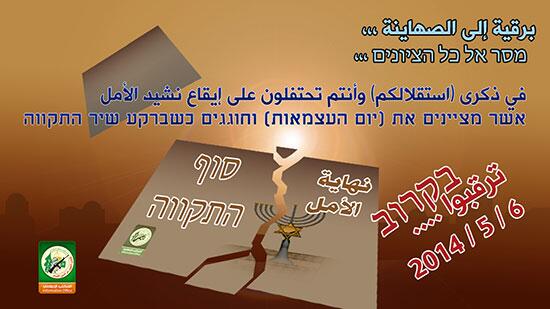
That mark Independence Day and celebrate, while Hatikva plays in the background
Soon
The end of hope
Their use of Hebrew is, apart from cheap PSYOP, the easiest way to circumvent the media. As has been shown, Hamas’ slick English online presence is a smoke-screen for their unchallenged genocidal Arabic presence.
On the light side, flashy memes are the best they can do, while Israel celebrates one Independence Day after the other.
Update: Apparently, “End of Hope” is a Hamas song and snazzy animation about how they want to deport or kill all Jews, and install a Muslim Caliphate in Israel.







 anneinpt
 artaxes
 danmillerinpanama
 davidking1530
 Peter Hofman
 Joseph Wouk
 Peter
Peter Louisiana Steve
 WarSclerotic