The Muslim Brotherhood and Terrorist Organizations, Gatestone Institute, Valentina Colombo, May 6, 2014
(Hamas united with Fatah will be a dandy “peace” process partner for Israel. — DM)
The link between the Muslim Brotherhood and Hamas is clear and straight, and confirmed by Article 2 of the Charter of Hamas, which reads: “The Islamic Resistance Movement is one of the wings of the Muslim Brothers in Palestine. The Muslim Brotherhood Movement is a world organization, the largest Islamic Movement in the modern era. It is characterized by a profound understanding, by precise notions and by a complete comprehensiveness of all concepts of Islam in all domains of life: views and beliefs, politics and economics, education and society, jurisprudence and rule, indoctrination and teaching, the arts and publications, the hidden and the evident, and all the other domains of life.”
“[T]he organization of the Muslim Brotherhood is a terrorist organization, and anyone who asks either to reconcile with them, to join them or to ally with them is himself a terrorist.” — Refaat Saïd, leader of Egypt’s Socialist party, al-Tagammu’, and previously close friend of former Muslim Brotherhood Supreme Guide, Mahdi Akef.
A new terror group, Ansar Bayt al-Maqdis [ABM], just officially entered the scene. Both the U.S. State Department and the British government included it, at the beginning of April, in their list of proscribed terrorist organizations.
The United Kingdom justified its decision as follows: “ABM is an Al Qa’ida inspired militant Islamist group based in the northern Sinai region of Egypt. The group is said to recruit within Egypt and abroad and aims to create an Egyptian state ruled by Sharia law. ABM is assessed to be responsible for a number of attacks on security forces in Egypt since 2011. The attacks appear to have increased since the overthrow of the Morsi government in July 2013. The group’s reach goes beyond the Sinai, with the group claiming responsibility for a number of attacks in Cairo and cross-border attacks against Israel. ABM has undertaken attacks using vehicle-borne improvised explosive devices and surface-to-air missiles. Examples of attacks for which the group has claimed responsibility include: an attack on the Egyptian Interior Minister in which a UK national was seriously injured (September, 2013); an attack on a police compound in Mansoura, killing at least 16 people, including 14 police officers (December 24, 2013), and an attack on a tourist bus in which three South Koreans and their Egyptian driver died (January 16, 2014).”
The decision taken by the British government against Ansar Bayt al-Maqdis came almost at the same time as the decision to start investigations on the activities of Muslim Brotherhood [MB] and its possible links with terrorism.
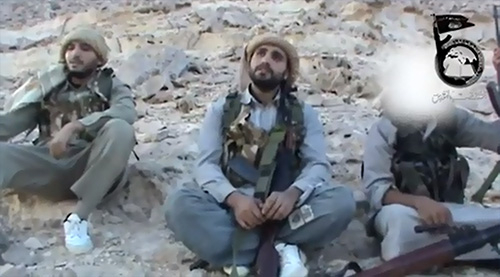
 Terrorists from the group Ansar Bayt al-Maqdis.
There is however a link between ABM and the Muslim Brotherhood: the justification of jihad, based on the Koranic text.
Although in January 2014, after the December 24 attack — linked by the British government statement to ABM — the Egyptian Muslim Brotherhood issued a declaration in which it denied any connection with ABM, Refaat Saïd, the leader of the Socialist Party, Tagammu’, said otherwise.
Saïd pointed out, during the visit of Catherine Ashton to Egypt on the eve of its presidential elections, that Ashton “wants to open channels for a reconciliation with the Muslim Brotherhood despite knowing perfectly well that Dr. Mohammed Morsi himself imported the organization of Ansar Bayt al-Maqdis and placed it in the Sinai. Morsi released many of its members from prison so they could carry out terror attacks in the Sinai region to take him back to power.”
Saïd bluntly added that “the organization of the Muslim Brotherhood is a terrorist organization, and anyone who asks either to reconcile with them, to join them or to ally with them is himself a terrorist.”[1]
Saïd, previously a close friend of Mahdi Akef, the former MB Supreme Guide, knows the Brotherhood closely.
In September 2013, after an attack on the Egyptian Minister of the Interior, Major General Ahmad ‘Abd al-Halim explained that “Ansar Bayt al-Maqdis is an organization including 15 organizations acting and working in Gaza and belonging to the sphere of al-Qaeda and Hamas.”[2]
Colonel Farouq Hamdan — an aide to former Egyptian Interior Minister — also commented that “the attack was carried out with the blessing of, and consultation between the organizations of the Muslim Brotherhood and Ansar Bayt al-Maqdis, which was funded by the Brotherhood.”[3]
The connection between Ansar Bayt al-Maqdis, al-Qaeda and Hamas — already on the official lists of proscribed terrorist organizations in the West — and the Muslim Brotherhood — which is already presently on the proscribed terror organizations of Russia (February 2003), Syria (21 October 2013), Egypt (25 December 2013), Saudi Arabia (7 March 2013) and the United Arab Emirates (9 March 2014) — is sometimes a direct one, and sometimes an ideological link.
The link between the Muslim Brotherhood and Hamas is clear and straight, and confirmed by Article 2 of the Charter of Hamas, which reads: “The Islamic Resistance Movement is one of the wings of the Muslim Brothers in Palestine. The Muslim Brotherhood Movement is a world organization, the largest Islamic Movement in the modern era. It is characterized by a profound understanding, by precise notions and by a complete comprehensiveness of all concepts of Islam in all domains of life: views and beliefs, politics and economics, education and society, jurisprudence and rule, indoctrination and teaching, the arts and publications, the hidden and the evident, and all the other domains of life.”
It would appear rather more difficult to demonstrate the link between the Muslim Brotherhood and some markedly jihadist movements such as Al Qaeda, Gamaat al-Islamiyya — also internationally recognized as a terrorist organization — and Ansar Bayt al-Maqdis.
In 2005, Sylvain Besson published, for the first time in a Western language, a document in his book, The Conquest of the West: The Secret Project of Islamists, often referred to as “The Secret Project.”
The document, “Towards a global strategy of Islamic politics (starting points, elements, essential conditions and missions),” was found in 2001 by Swiss authorities in the house of Youssef Nada, one of the leaders of the Muslim Brotherhood in the West
A similar version of the “Secret Project” was also aired in 2012 in a documentary film about the MB in the West by American journalist Glenn Beck. What is strange is that no one has given due importance to the contents of both documents.
“The Secret Project” explains the twelve starting points of the strategy of the Brotherhood in the West. For example:
“Step 5: Work to establish the Islamic state, in parallel make progressive efforts aiming at controlling the local centres of power through institutional work.
“Step 6: Work with loyalty alongside Islamic groups and institutions in various fields by agreeing on a common ground in order to cooperate on points of convergence while putting aside the points of divergence.
“Step 7: Accept the principle of temporary cooperation between Islamic movements and nationalist movements […]”
In Step 9, jihad is finally mentioned: “Build a permanent force of the Islamic preaching and support movements engaged in jihad in the Islamic world, in different ways and within the limits of the possible….Get in touch with any new movement engaged in jihad wherever in the planet, with Islamic minorities, and create walkways, according to requirements, to support and establish a partnership. Keep the jihad on alert in the umma [Muslim community] […].”
“The Secret Project” calls for a bond, a better collaboration with jihadi movements and it would seem that strategically, leaders and members of the MB consider both jihad and jihadi movements fundamental to achieve their goals.
Hasan al-Banna, the founder of the Muslim Brotherhood in 1936, issued a call to “kings and princes, members of legal organizations and Islamic societies, to those who own judgment and sense of honour in the Muslim world,” to the so-called “Fifty requests” to return to a true Islamic society.
The third request reads: “Reinforce the army, multiply sections of young people and inflame them on the grounds of Islamic jihad.”
Jihad appears always to have been part of MB ideology. Sayyid Qutb, possibly the most important MB ideologue, in his commentary of Koran, In the Shade of Qur’an, defines jihad: “Islam gives the name jihad to such cumulative efforts. This includes efforts to change people through verbal advocacy. It also includes the possible armed struggle to end an oppressive system and establish justice. […] among the radical concepts of the revolutionary party named “Muslim” the most foundational is to engage every rebellious force that comes in Islam’s way: fight them, muster everything possible to replace them.”
Sayyid Qutb’s books and his theory of jihad have been fundamental in building the foundation of Al-Qaeda ideology as Ayman al-Zawahiri clearly states in his book Knights under the Prophet’s Banner.
In 1978, a Sudanese reformist and political leader, Mahmud Muhammad Taha, who was sentenced to death for apostasy in 1985, wrote, in the first part of his reflection, These are the Muslim Brothers: “In this age when humanity was predisposed to spread Islam at the scientific level based on persuasion, on reconciliation and peace, when the world opinion was inclined to renounce violence and not to resort to war to solve problems, here came the organization of the Muslim Brotherhood calling Muslims to jihad! Here is the shaykh Hasan al- Banna, the founder of their preaching, consecrating a letter of his to jihad, ‘The Letter of jihad.’ He quotes many Koranic verses calling for jihad […] He concludes the document with the following invitation: ‘Brothers, the umma is a factory of death […] and Allah reserved you the precious life on earth and eternal bliss in the afterlife, what a fragility leads us to love this life and hate death, be ready for an important action and long for death since it will give you life.'”[4]
In a letter about “teachings” (Risalat al-ta’alim), in “Point 7,” the paragraph dedicated to action, Hasan al- Bannawrote: “We must be the masters in spreading the Islamic preaching in every place, ‘And fight them until there is nofitnah [upheaval] and [until] the religion, all of it, is for Allah’ (Surat al-Anfal, VIII:39) […] and I want jihad as an obligation of the past that will continues until the Day of Judgment and that has as its main purpose the hadith of the Messenger of Allah — upon him the greetings and blessing of Allah: whoever dies without having fought and without having any intention of fighting is as if he had died in the era of ignorance.'”
The importance of jihad in the history of MB is further underlined by the title of an essay that Yusuf al-Qaradawi, one of its main theologians: “The Muslim Brotherhood. Seventy years of preaching, education and jihad” (Beirut 2001).
Al-Qaradawi states that, “the movement engaged in real jihadi battles against the Zionists in Palestine and the British in Egypt and the movement sent the best of its sons to sacrifice.” (page 235)
It should come as no surprise, then, that the motto of Ansar Bayt al-Maqdis is also the verse singled out by Hassan al Banna: “Fight them until there is no fitnah [discord], and [until] the religion, all of it, is for Allah.” [Qur’an, Sura VIII, verse 39].
As stated in “The Secret Project” of the Muslim Brotherhood, the MB and Islamist movements are merely different but complementary ways to implement the goals of jihad.
Whereas the Muslim Brotherhood preaches jihad with pragmatism and “moderation,” the ABM, Hamas and al-Qaeda preach and practice it bluntly and with no delay. But whenever the Brotherhood enters what could be perceived as resistance, then open violence becomes permissible, as now in Egypt.
Recent statements to the Sunday Times by Ibrahim al-Mounir, whom many regard as the leader of the Brotherhood in Europe, sound as if they are a veiled threat: “If this [ban] happened, this would make a lot of people in Muslim communities think that [peaceful] Muslim Brotherhood values … didn’t work and now they are designated a terrorist group, which would make the doors open for all options.” When asked if he meant that the group was open to violence, he replied: “Any possibility.”
There can be no doubt about the ideological link between ABM and MB: both believe in jihad, in the conquest of power by Islam. The most important thing the West has to understand is the blunt pragmatism of MB, that is what Mohammed Charfi, former Tunisian minister of education, wrote in his essay, Islam et liberté: “Today the observers call a “moderate” Islamist the person who, with Westerners, uses reasonable language and who does not choose an openly violent action. However even though his style is calm and the rejection of violence seems sincere, since the movement is always linked to sharia and the sacralisation of history, his moderation remains provisional and indicates a strategy of waiting, because the ingredients of radicalization have not disappeared.”
0.000000
0.000000
 Iranian Ghadir-class mini-submarine




 anneinpt
 artaxes
 danmillerinpanama
 davidking1530
 Peter Hofman
 Joseph Wouk
 Peter
Peter Louisiana Steve
 WarSclerotic
Recent Comments