Archive for May 3, 2014

Iran denies inspectors access to suspected nuclear facility

May 3, 2014

Iran denies inspectors access to suspected nuclear facility, Times of Israel, May 3, 2014

(What a shockingly “unexpected” event! But the farce is a “process,” so it must and will continue. — DM)

Iran has stated that it has no obligation to grant the IAEA access to the site, arguing that Parchin’s designation as a military site puts it off-limits to inspections and is not included in the deal reached with world powers last year.

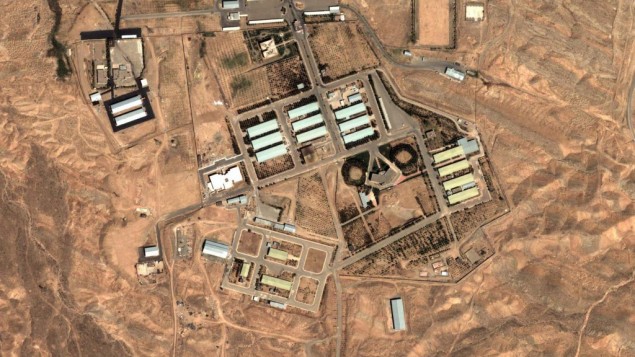
Parchin facility 20042004 satellite image of the military complex at Parchin, Iran (photo credit: AP/DigitalGlobe – Institute for Science and International Security)
 

Iran’s atomic energy organization on Saturday said it was denying international inspectors access to the suspected nuclear facility at Parchin, stating the IAEA was not entitled to visit the military complex outside the Iranian capital of Iran.

“Legally, they are not entitled to visit Parchin since we have not accepted and are not exercising the Additional Protocol (to the NPT),” the Atomic Energy Organization of Iran’s Spokesman Behrouz Kamalvandi was quoted by the semi-official Fars news agency saying.

Iran has stated that it has no obligation to grant the IAEA access to the site, arguing that Parchin’s designation as a military site puts it off-limits to inspections and is not included in the deal reached with world powers last year.

The Parchin military site has been a sticking point in long-running discussions between Iran and the IAEA; the agency suspects explosive tests took place that are “strong indicators of possible nuclear weapon development.”

Meanwhile, Ali Akbar Salehi, the head of the AEOI, told Iranian media Saturday that operations at the heavy water reactor in Arak would continue.

The Arak reactor is of international concern because it could theoretically provide Iran with a second route to a nuclear bomb — an alternative to highly enriched uranium — through extraction of weapons-grade plutonium from spent fuel if it also builds a reprocessing facility.

Iran’s enrichment activities are in defiance of repeated UN Security Council demands and resolutions, amid suspicions in the West and Israel that Tehran’s nuclear drive masks military objectives, a claim it has repeatedly denied.

Thousands of hard-liners in Iran gathered Saturday at the former US Embassy in Tehran to protest against the Islamic Republic’s recent deal with world powers over its contested nuclear program.

Hard-liners carried banners Saturday accusing moderate President Hassan Rouhani and the nation’s nuclear negotiation team of “giving up Iran’s right in return for little.”

Rouhani has faced criticism from hard-liners over the deal struck in November, which they refer to as a “poison chalice.” The temporary deal saw some sanctions lifted against Iran in exchange for it limiting uranium enrichment and allowing in international inspectors.

World powers and Iran are negotiating the terms of a final deal.


US officials: Even if Israel doesn’t like it, Palestinians will get state

May 3, 2014

US officials: Even if Israel doesn’t like it, Palestinians will get state, Times of Israel, May 3, 2014

(Obama Administration peace process postmortem spin — DM)

In anonymous briefing to top columnist, members of Kerry’s team slam Netanyahu, empathize with Abbas, warn Palestine will rise ‘whether through violence or via int’l organizations’
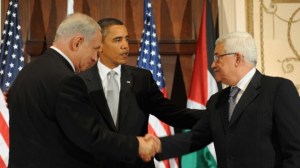
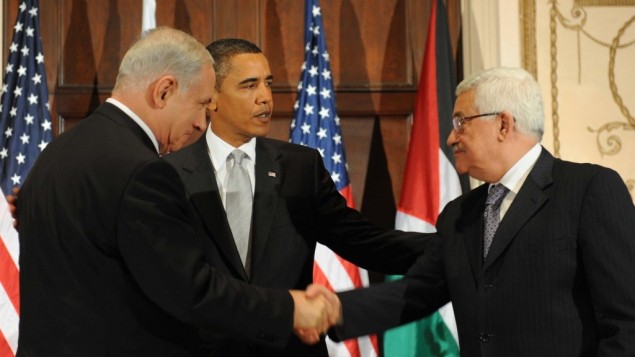
Obama Netanyahu AbbasFrom left: Prime Minister Benjamin Netanyahu, US President Barack Obama and PA President Mahmoud Abbas during a trilateral meeting in New York, Sept. 22, 2009 (photo credit: Avi Ohayon/GPO/Flash90)

American officials directly involved in the failed Israeli-Palestinian peace process over the last nine months gave a leading Israeli columnist a withering assessment of Prime Minister Benjamin Netanyahu’s handling of the negotiations, indicated that Palestinian Authority President Mahmoud Abbas has completely given up on the prospect of a negotiated solution, and warned Israel that the Palestinians will achieve statehood in any case — either via international organizations or through violence.

Speaking on condition of anonymity to Nahum Barnea, a prominent columnist from Israel’s best-selling daily Yedioth Aharonoth, the officials highlighted Netanyahu’s ongoing settlement construction as the issue “largely to blame” for the failure of Secretary of State John Kerry’s July 2013-April 2014 effort to broker a permanent peace accord.

They made plain that US President Barack Obama had been prepared to release spy-for-Israel Jonathan Pollard to salvage the talks. And they warned that “the world will not keep tolerating the Israeli occupation.”

Barnea, who described his conversations with the American officials as “the closest thing to an official American version of what happened” in the talks, said the secretary is now deciding whether to wait a few months and try to renew the negotiating effort or to publicize the US’s suggested principles of an agreement.

Detailing how the US sought to solve disputes over the core issues of a two-state solution, Barnea wrote on Friday that, “Using advanced software, the Americans drew a border outline in the West Bank that gives Israel sovereignty over some 80 percent of the settlers that live there today. The remaining 20 percent were meant to evacuate. In Jerusalem, the proposed border is based on Bill Clinton’s plan — Jewish neighborhoods to Israel, Arab neighborhoods to the Palestinians.”

He quoted the Americans saying that while the Israeli government made no response to the American plan, and also failed to draw its own border outline, Abbas agreed to the border outline so 80 percent of settlers would continue living in Israeli territory.
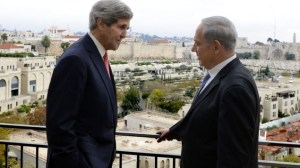
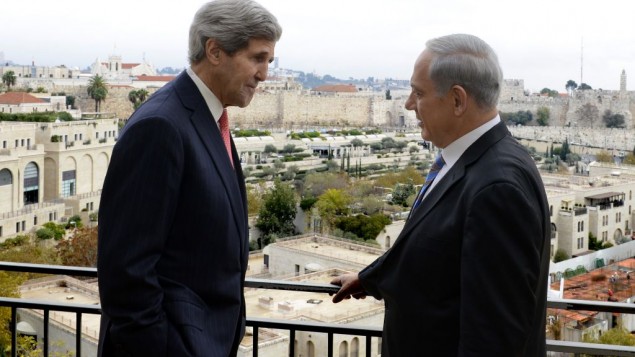
Kerry and Netanyahu on balconyUS Secretary of State John Kerry, left, and Prime Minister Benjamin Netanyahu meet in Jerusalem, December 6, 2013 (photo credit: Matty Stern/US Embassy Tel Aviv)

He quoted the Americans saying they had intended to begin the nine-month negotiating period with an Israeli announcement of a settlement freeze. But this proved impossible, an American official was quoted saying, “because of the current makeup of the Israeli government, so we gave up… We didn’t realize [that] continuing construction allowed ministers in [Netanyahu’s] government to very effectively sabotage the success of the talks. There are a lot of reasons for the peace effort’s failure, but people in Israel shouldn’t ignore the bitter truth: the primary sabotage came from the settlements. The Palestinians don’t believe that Israel really intends to let them found a state when, at the same time, it is building settlements on the territory meant for that state. We’re talking about the announcement of 14,000 housing units, no less. Only now, after talks blew up, did we learn that this is also about expropriating land on a large scale. That does not reconcile with the agreement.

“At this point, it’s very hard to see how the negotiations could be renewed, let alone lead to an agreement,” the Americans said. “Towards the end, Abbas demanded a three-month freeze on settlement construction. His working assumption was that if an accord is reached, Israel could build along the new border as it pleases. But the Israelis said no.”

1PollardJonathan Pollard (photo credit: YouTube screenshot

The Americans told Barnea that, in contrast to the hitherto unclear reports of whether the US was prepared to release American-Israeli spy Pollard to salvage the talks from collapse in recent weeks, Obama was willing “to prepare for Jonathan Pollard’s release. Such a move wouldn’t have helped his popularity in the American security system…. There was a massive effort on our part to pull the wagon out of the deep quicksand it was stuck in. But the reality here hit us hard. Neither side had a sense of urgency. Kerry was the only one who felt a sense of urgency, and that was not enough.”

One bitter American official told Barnea, “I guess we need another intifada to create the circumstances that would allow progress.”

The Americans said Kerry believed and still believes “that if the two sides can’t reach an accord, Israel is going to be in a lot worse shape than it is today.”

A third intifada, the Americans make clear, “would be a tragedy. The Jewish people are supposed to be smart; it is true that they’re also considered a stubborn nation. You’re supposed to know how to read the map: In the 21st century, the world will not keep tolerating the Israeli occupation. The occupation threatens Israel’s status in the world and threatens Israel as a Jewish state.”

Pressed by Barnea on perceived international hypocrisy over Israel’s presence in the West Bank, when the world “closes its eyes to China’s takeover of Tibet, it stutters at what Russia’s doing to Ukraine,” the Americans were quoted as responding: “Israel is not China. It was founded by a UN resolution. Its prosperity depends on the way it is viewed by the international community.”

The American officials described to Barnea what they called Abbas’s loss of trust in the talks and in Netanyahu, and how his skepticism hardened as settlement-building continued, and as Israel demanded complete security control over the territories. From Abbas’s point of view, the Americans told Barnea, the sense was “that nothing was going to change on the security front. Israel was not willing to agree to time frames; its control of the West Bank would continue forever. Abbas reached the conclusion that there was nothing for him in such an agreement. He’s 79 years old. He has reached the last chapter of his life. He’s tired. He was willing to give the process one final chance, but found, according to him, that he has no partner on the Israeli side. His legacy won’t include a peace agreement with Israel.
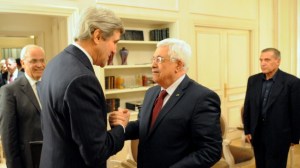
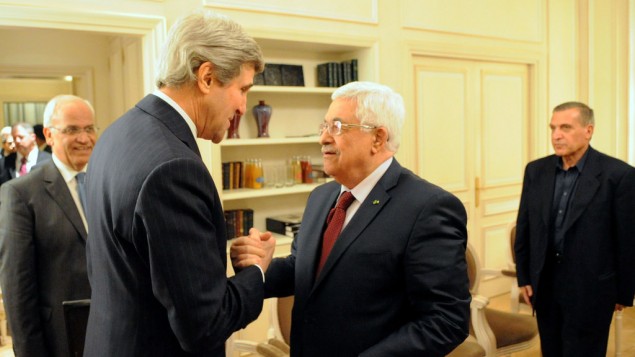
Abbas and KerryJohn Kerry, left, with Mahmoud Abbas in Paris on February 19 2014. (photo credit: US State Department)

“In February, Abbas arrived at a Paris hotel for a meeting with Kerry. He had a lingering serious cold. ‘I’m under a lot of pressure,’ he complained. ‘I’m sick of this.’ He rejected all of Kerry’s ideas. A month later, in March, he was invited to the White House. Obama presented the American-formulated principles verbally — not in writing. Abbas refused.”

Abbas, the officials told Barnea, had made concessions — in accepting that “Palestine” would be demilitarized; in agreeing to the US border outline that would see 80% of settlers coming under Israeli sovereignty, and in agreeing for Israel to retain control of sensitive security areas such as the Jordan Valley for five years.

“He also agreed that the Jewish neighborhoods in East Jerusalem would remain under Israeli sovereignty, and agreed that the return of Palestinians to Israel would depend on Israeli willingness,” the Americans said. “‘Israel won’t be flooded with refugees,’ he promised.”

In a rare attribution of some blame to Abbas, the Americans said they “couldn’t understand why it bothered him so much” to recognize Israel as a Jewish state. But here too, ultimately, the Americans were empathetic to Abbas: “The Palestinians came to the conclusion that Israel was pulling a nasty trick on them. They suspected there was an effort to get from them approval of the Zionist narrative.”
 

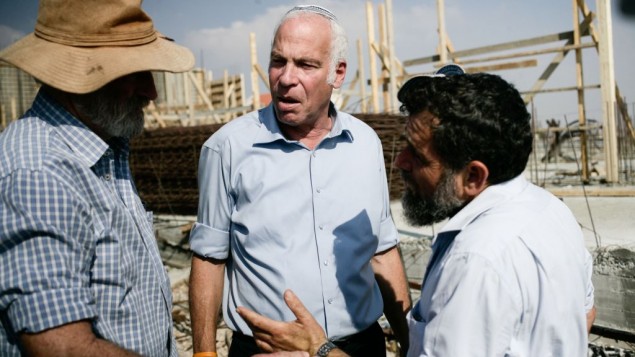
Housing ministerHousing and Construction Minister Uri Ariel (C) at a press conference promoting new housing units to be built in the Jewish settlement of Tel Tzion, near Jerusalem, on August 13, 2013 (photo credit: Flash90)

The final straw for Abbas was the late March announcement by Uri Ariel’s Housing and Construction Ministry of building tenders for more than 700 housing units in Jerusalem’s Gilo neighborhood. At that point, the Americans told Barnea, Abbas “lost interest. He turned to the reconciliation talks with Hamas and to the question of who would inherit his mantle.”

The Americans warned that, with the talks over, “Israel might be facing quite a problem. As of now, nothing is stopping the Palestinians from turning to the international community. The Palestinians are tired of the status quo. They will get their state in the end — whether through violence or by turning to international organizations.”

They also warned that if, as announced, Israel seeks “to impose economic sanctions on the Palestinians, it could boomerang. The West Bank economy will collapse, and then Abbas will say ‘I don’t want this anymore. Take this from me.’ There’s great potential for deterioration here, which could end with the dismantling of the Palestinian Authority. Israeli soldiers will have to administer the lives of 2.5 million Palestinians, to their mothers’ chagrin. The donating countries will stop paying up, and the bill of $3 billion a year will have to be paid by your Finance Ministry.”

Some of the warnings delivered by the Americans reflected a similar tone to that expressed by Obama in an interview he gave shortly before his last meeting with Netanyahu at the White House in March.

Israel can expect to face international isolation and possible sanctions from countries and companies across the world if Netanyahu fails to endorse a framework agreement with the Palestinians, Obama cautioned in an interview with Bloomberg at the time. If Netanyahu “does not believe that a peace deal with the Palestinians is the right thing to do for Israel, then he needs to articulate an alternative approach,” Obama said then. “There comes a point where you can’t manage this anymore, and then you start having to make very difficult choices,” he said.

 

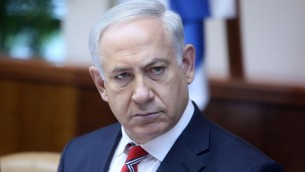
Netanyahu at cabinet meetingPrime Minister Benjamin Netanyahu speaks during the weekly cabinet meeting on February 16, 2014 (photo credit: Marc Israel Sellem/POOL/Flash90)

The president went on to condemn Israel’s settlement activities in the West Bank, and said that though his allegiance to the Jewish state was permanent, building settlements across the Green Line was counterproductive and would make it extremely difficult for the US to defend Israel from painful repercussions in the international community. “If you see no peace deal and continued aggressive settlement construction — and we have seen more aggressive settlement construction over the last couple years than we’ve seen in a very long time — if Palestinians come to believe that the possibility of a contiguous sovereign Palestinian state is no longer within reach, then our ability to manage the international fallout is going to be limited,” Obama warned.


Off Topic: PM pushes legislation enshrining Israel’s Jewish status

May 3, 2014

PM pushes legislation enshrining Israel’s Jewish status, Israel Hayom, May 2, 2014

The “Jewish state” matter emerged as one of the major gaps between the sides in recent talks that broke down. Netanyahu has made it his central demand of the Palestinians to prove they are willing to coexist peacefully with such a state. But Palestinian Authority President Mahmoud Abbas says such an endorsement would undermine the rights of Palestinian refugees and Israel’s own Arab minority.

Netanyahu, in his address, pledged that Israel will always “ensure full equality in the personal and social rights of all its citizens – Jews and non-Jews alike – in a Jewish and democratic state.”

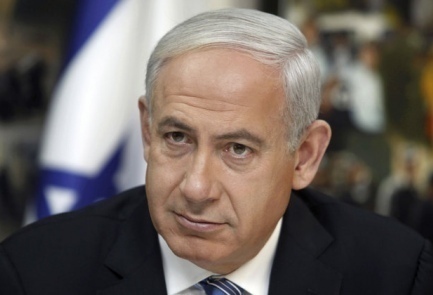
Israeli PMPrime Minister Benjamin Netanyahu | Photo credit: AP

Prime Minister Benjamin Netanyahu said Thursday that he plans to promote legislation that will enshrine the country’s status as the nation-state of the Jewish people.

“I will promote a basic law that will define Israel as the nation-state of the Jewish people. I believe that it is appropriate that the most basic ingredient of our national life will get a constitutional status, similar to other integral ingredients which our regime is founded upon that until today were defined in the Knesset’s basic laws,” Netanyahu said in a speech in Tel Aviv.

Housing Minister Uri Ariel pledges to push Jewish state legislation forward in current Knesset session • Justice Minister Tzipi Livni: “I have opposed these initiatives in the past and I will do so even if the proposal is coming from the prime minister.”

Prime Minister Benjamin Netanyahu said Thursday that he plans to promote legislation that will enshrine the country’s status as the nation-state of the Jewish people.

“I will promote a basic law that will define Israel as the nation-state of the Jewish people. I believe that it is appropriate that the most basic ingredient of our national life will get a constitutional status, similar to other integral ingredients which our regime is founded upon that until today were defined in the Knesset’s basic laws,” Netanyahu said in a speech in Tel Aviv.

Speaking at the site where Israel’s Declaration of Independence was signed, Netanyahu said legislation was necessary. Israel’s constitution is not codified in a single document, but a series of foundational “basic laws” describe central tenets of the state, define the roles of various government institutions, and protect civil rights.

“The Declaration of Independence sets, as the cornerstone in the life of the state, the national Jewish identity of the state of Israel,” he said. “To my great regret, as we have seen recently, there are those who do not recognize this natural right. They seek to undermine the historic, moral and legal justification for the existence of the state of Israel as the national state of our people.”

The “Jewish state” matter emerged as one of the major gaps between the sides in recent talks that broke down. Netanyahu has made it his central demand of the Palestinians to prove they are willing to coexist peacefully with such a state. But Palestinian Authority President Mahmoud Abbas says such an endorsement would undermine the rights of Palestinian refugees and Israel’s own Arab minority.

Netanyahu, in his address, pledged that Israel will always “ensure full equality in the personal and social rights of all its citizens – Jews and non-Jews alike – in a Jewish and democratic state.”

Addressing the peace process, Netanyahu said, “You cannot be in favor of establishing a Palestinian national state in order to preserve the Jewish character of the state of Israel and at the same time oppose recognition of Israel as a state for the Jewish people.”

Justice Minister Tzipi Livni, who has tasked law professor Ruth Gavison with drafting an alternative to the controversial Jewish state law, came out against the prime minister’s statement. “I will not allow [the state’s] democratic values to be weakened and to bow to Jewish [values] — that is the essence of the Declaration of Independence and the basis of our existence,” Livni said. “I have opposed these initiatives in the past and I will do so even if the proposal is coming from the prime minister.”

Opposition Leader Isaac Herzog (Labor) reacted to Netanyahu’s pledge as well, saying, “Labor completely supports a Jewish and democratic Israel. Unfortunately, the political destruction coming from Netanyahu’s school will cause us to lose the Jewish majority and to turn Israel into a binational state. This sad fact cannot be hidden behind any law.”

Housing Minister Uri Ariel supported Netanyahu’s initiative, saying, “We will work to move [the law] forward quickly, in the current Knesset session

“I am sorry about the justice minister’s opposition to this law,” he added. “It is inappropriate. The negotiations did not succeed, but she is not to blame.”

Coalition Chairman Yariv Levin, who presented the Jewish state bill along with MK Ayelet Shaked (Habayit Hayehudi), was pleased to hear Netanyahu’s announcement. “This is a historic decision that will return Israel to the Zionist path after years of ongoing attacks from the justice system on the basic principles upon which the sate was founded,” said Levin.

The legislation promoted by Netanyahu is similar to a bill former MK Avi Dichter (Kadima) put forward in the past, which Livni also opposed.

Former U.S. officials detect shift in Israel on Iran nuclear deal: Al-Monitor

May 3, 2014

Former U.S. officials detect shift in Israel on Iran nuclear deal: Al-Monitor, Tehran Times, May 2, 2014

(It’s from The Tehran Times, “the Voice of the Islamic Revolution.” Is the substance of the article true, false or somewhere in between? — DM)

Most Israeli officials and experts “seem to understand that ‘zero, zero, zero’ is not going to happen,” a member of a U.S. group of experts and former senior officials recently in Israel for consultations, speaking not for attribution, told Al-Monitor in an interview this week. They seem “to understand that there is a need for a domestic, indigenous civil nuclear program….for the Iranians to” deal with their domestic opposition.

The Israelis are also deeply concerned, the former U.S. diplomat said, that if there is a violation by Iran of a final nuclear accord, that the violation will be seen by Washington as too ambiguous or incremental, that there “is no smoking gun.”
 
The Israelis are “nervous that the U.S. will continuously say, ‘we are checking into it, we need more proof,’” the former diplomat described. “At what point does the cumulative effect of the small things add up to a violation?”<

Israel increasingly expects that a nuclear deal between Iran and six world powers will be reached, and has raised concerns with U.S. interlocutors about monitoring and enforcement of the deal, former U.S. officials and Iran policy experts involved in recent discussions with the Israelis tell Al-Monitor.

While Israel’s official position remains that the only acceptable Iran nuclear deal would be “zero, zero, zero,” – meaning no centrifuges, domestic uranium enrichment, or the facilities to produce them—former U.S. officials and experts involved in recent consultations with the Israelis detect that Israel’s position on the matter has shifted as the prospect of a deal being reached has increased. Israeli officials are now focusing on concerns of what happens if a deal is reached, how can monitoring and verification be sufficient to detect if there is a violation, and how would such violations of an agreement be deterred or dealt with, at a time when Israel assesses U.S. credibility as weakened on the world stage, including because of events in Ukraine and Syria.

Most Israeli officials and experts “seem to understand that ‘zero, zero, zero’ is not going to happen,” a member of a U.S. group of experts and former senior officials recently in Israel for consultations, speaking not for attribution, told Al-Monitor in an interview this week. They seem “to understand that there is a need for a domestic, indigenous civil nuclear program….for the Iranians to” deal with their domestic opposition.

“Israel is very concerned about the current discussions with Iran because all signs point to the P5+1 accepting a deal that will leave Iran’s nuclear … capability intact,” Israeli ambassador to the U.S. Ron Dermer told an Anti Defamation League conference this week.

“Our policy is simple,” Dermer said. “Let Iran have only a peaceful nuclear program and nothing more.

“On substantive issues, there is probably room for maneuver,” a senior former U.S. diplomat involved in the April consultations in Israel told Al-Monitor on condition he not be named, referring to Israel’s requirements for an Iran nuclear deal.

“But two issues are going to be very hard to persuade the Israelis on,” the former U.S. diplomat continued. “Monitoring: There is very little belief anywhere in Israel that (a comprehensive nuclear) accord can be monitored… that ensures there is not going to be clandestine activity, and the Iranians (could) not break out” at some phase.

“That is a serious concern,” the former U.S. diplomat said. “I don’t want to minimize it, because monitoring is going to be a huge problem.

The Israelis are also deeply concerned, the former U.S. diplomat said, that if there is a violation by Iran of a final nuclear accord, that the violation will be seen by Washington as too ambiguous or incremental, that there “is no smoking gun.”

The Israelis are “nervous that the U.S. will continuously say, ‘we are checking into it, we need more proof,’” the former diplomat described. “At what point does the cumulative effect of the small things add up to a violation?”

In addition, the Israelis are concerned that the United States does not have a sufficiently credible military threat to deter a future Iranian violation of a comprehensive agreement, the Iran policy expert said. “That is problematic from an Israeli perspective.”

The Iran policy expert said it was her group’s assessment that while the Iran nuclear negotiations are ongoing, there won’t be a unilateral strike by Israel. “While they are ongoing,” she repeated.

There continues to be a lot of “frustration” from the Israeli side that they will be “profoundly impacted” by a nuclear deal, even though they are not in the room for the P5+1 talks with Iran, nor do they feel the U.S. was forthcoming with them about U.S.-Iran bilateral contacts leading up to the interim nuclear deal last fall.

Israeli officials felt deeply betrayed that their U.S. counterparts were not more forthcoming with them last year about the extent of U.S.-Iranian bilateral contacts on a nuclear deal. The U.S. has said the secrecy was necessary to maintain the sensitive bilateral channel, and they did not mean to be deceptive. However, a sense of betrayal may have contributed to Israeli distrust and denunciations of the interim Iran nuclear deal reached in Geneva last November, U.S. and Israeli sources have told Al-Monitor.

If a nuclear deal is reached that allows Iran to maintain a nuclear threshold capacity, it could emerge from economic sanctions and seek European and Japanese technology to develop itself as an industrial power, while maintaining its policies on the region, Israeli sources have described official thinking in interviews this week.

Israel and Sunni powers fear Iran would be empowered by the lifting of sanctions after a prospective nuclear deal, while competing for power and influence in the region and beyond.