Archive for May 1, 2014

A Dying Little Palestinian

May 1, 2014

A Dying Little Palestinian, You Tube, Wild Bill for America, May 1, 2014

(Posted without comment because none is needed. — DM)

( “Wild Bill” gives voice to America’s “salt of the earth” support for Israel… Thank you, Bill. We love America as America loves us. –  JW )

WaPo: Middle East peace process dead, worse off than before

May 1, 2014

WaPo: Middle East peace process dead, worse off than before, Hot Air, Ed Morrissey, April 30, 2014

(The release of Palestinian “political prisoners” previously convicted of murder was the benefit resulting from the Obama – Kerry “peace process.” It was indeed a benefit, but only for the Palestinian Authority et al and their terrorist propensities. For Middle East peace? That’s different. — DM)

The Post never mentions that Hamas has been firing rockets into Israel as Fatah signed that reconciliation agreement. That might be one reason that Israel doesn’t believe Hamas to be a partner for peace, no? The problem of Palestinian demands for Israel’s destruction existed before Kerry took over from Hillary Clinton, of course, but his central conceit was that his diplomacy was going to be different. It turned out to be the same old thing, and it left the situation arguably worse.

Politically, Barack Obama can’t sustain another Cabinet change before the midterms, but diplomatically, Kerry’s turning into a walking catastrophe that Obama can’t sustain for much longer, either. The best Obama can hope is that Kerry keeps his foot out of his mouth for a few months longer, but the President may need to pick a special envoy for Israel in the meantime to bypass Kerry and his foot-in-mouth disease.

In truth, the best possible spin on the Middle East peace process before John Kerry warned Israel about becoming an “apartheid state” was that it was on life support. The Washington Post declares the project DOA, blaming intransigence on the part of the participants rather than Kerry’s gaffe-ridden approach. And wasn’t Kerry arguing that he would be the one man able to bridge that intransigence through his diplomatic brilliance?

Nine months after it began, the Obama administration’s marquee diplomatic effort to broker a peace deal between Israel and the Palestinians ended Tuesday with neither a whimper nor much of a bang.

The initiative pressed by Secretary of State John F. Kerry revived a brand of Middle East shuttle diplomacy made popular in the disco era and included a hundred closed-door meetings in a half dozen world capitals. But the talks reached their expiration date with each side blaming the other (and the United States) for the impasse and saying that neither saw a true partner for peace in the other.

That “disco era” wisecrack has to sting a bit, but it’s not far from the truth. It’s also not far from the results that shuttle diplomacy provided back in the day, mainly because the issues have little to do with the miles traveled by an American Secretary of State. The reunion between Fatah and Hamas more or less proves that, as Hamas refuses to recognize Israel nor disavow violence, despite having its own territory now in Gaza.

The Post’s William Booth and Ruth Eglash parse out the blame:

The Palestinians argue that Israel was looking for an excuse to end the talks and found cause in that reconciliation between Hamas, which controls the Gaza Strip, and Fatah, which controls politics in the West Bank. The two factions split in 2007 after Hamas seized power in Gaza.

“Israel never gave the negotiations a chance to succeed,” said Saeb Erekat, the Palestinians’ chief negotiator, on Tuesday. “If this Israeli government were sincerely interested in peace,” he said, “it would have taken Palestinian national reconciliation as an opportunity for peace rather than an opportunity for a new blame game.” …

“We’re not going to negotiate with a government backed by Hamas unless Hamas changes its position and says it’s willing to recognize Israel,” Netanyahu said Sunday on CNN’s “State of the Union.”

The Post never mentions that Hamas has been firing rockets into Israel as Fatah signed that reconciliation agreement. That might be one reason that Israel doesn’t believe Hamas to be a partner for peace, no? The problem of Palestinian demands for Israel’s destruction existed before Kerry took over from Hillary Clinton, of course, but his central conceit was that his diplomacy was going to be different. It turned out to be the same old thing, and it left the situation arguably worse.

In fact, State Department spokesperson Jen Psaki couldn’t name a single benefit for Israelis or Palestinians of Kerry’s talks when pressed by the Associated Press’ Matt Lee, except for the prisoner releases (via the Free Beacon):

Politico’s Edward-Isaac Dovere is hard pressed to come up with a single Kerry initiative that’s succeeding:

Name one high-profile issue that’s going well right now for Secretary of State John Kerry. …

Even as Kerry and Obama have brought together allied international action on Ukraine, Iran and elsewhere, his administration has been under attack at home and abroad for not being better able to showcase strength or effectiveness toward Russia and Syria.

Amid that criticism, Kerry is the face of the administration foreign policy, whether announcing the preliminary breakthrough with Iran in November — still moving forward, at least for now — or standing in Geneva again two weeks ago to cautiously accept the basic agreement with the Russians, now proven useless, to de-escalate Ukraine.

And then there’s his own decision to making a renewed Middle East peace effort a central mission, which continues to have Obama’s support and which hasn’t been affected by the “apartheid” comment or the response it’s generated.

After the “apartheid” comment, which not only put the nail in the coffin of the peace talks but may have permanently damaged Kerry’s ability to interact with Israel, Senator Ted Cruz demanded his resignation. Politically, Barack Obama can’t sustain another Cabinet change before the midterms, but diplomatically, Kerry’s turning into a walking catastrophe that Obama can’t sustain for much longer, either. The best Obama can hope is that Kerry keeps his foot out of his mouth for a few months longer, but the President may need to pick a special envoy for Israel in the meantime to bypass Kerry and his foot-in-mouth disease.

UpdateWalter Russell Mead reminds us that this is Obama’s foreign policy, even if Kerry is the incompetent in charge of it at the moment:

It’s clear that the White House is beginning to understand that even American liberals have to work hard these days to continue to believe that the President is doing a good job in foreign affairs. Unfortunately, it is less clear that the White House knows what to do about the situation.

But neither the President nor Ben Rhodes (who is cited later in the article) appear to be taking on the reason so many of the president’s sympathizers are shaking their heads over the state of American foreign policy today. It is clear to a child of ten that the President and all the people around him totally failed to understand the first thing about Vladimir Putin and his foreign policy agenda. They were caught utterly flatfooted by his move on Ukraine. To both the average layperson and the seasoned foreign policy professional, this looks like a major misreading of a major issue. Many will wonder how an administration that was listening in to Angela Merkel’s cell phone calls could have misread Russia so comprehensively.

A public failure of this magnitude, (comparable in a way to George W. Bush launching a war to stop a WMD program that he then failed to find) is profoundly damaging to public confidence in a political leader.

Via Instapundit.

Erdan: US In No Position to ‘Grade’ Us on ‘Price Tag’ Attacks

May 1, 2014

Erdan: US In No Position to ‘Grade’ Us on ‘Price Tag’ Attacks, Israel National News, Yaakov Levi, May 1, 2014

(How many have been murdered or horribly injured during price tag “terrorism” attacks? Applying an horrific label to actions that do not warrant it creates a powerful meme. Unfortunately, it has become consistent with the Obama Administration’s tendency to cast aspersions on its “friend” Israel during the now defunct “peace process.” — DM)

The State Department’s 2013 anti-terrorism report investigated terror activity across the globe in 2013, and was published on its website. The “Israel, West Bank, and Gaza” section, however, focuses intensely on “extremist Israeli settlers” and subtly calls for them to be prosecuted by the UN. “Attacks by extremist Israeli settlers against Palestinian residents, property, and places of worship in the West Bank continued and were largely unprosecuted [sic] according to UN and NGO sources,” the report claims, citing the leftist UN Office of the Coordinator for Humanitarian Affairs. 

Price tag attackPrice tag vandalism in Jerusalem (illustrative) Flash 90

The US has no business criticizing Israel for failing to rein in so-called “price tag” attacks, Communications Minister Gilad Erdan said Thursday. The criteria set in the State Department report were unrealistic and unfair, and the report ignores Israel’s attempts to deal with the problem. “They are in no position to grade us on our actions,” Erdan told Channel Ten in an interview.

The State Department’s 2013 anti-terrorism report investigated terror activity across the globe in 2013, and was published on its website. The “Israel, West Bank, and Gaza” section, however, focuses intensely on “extremist Israeli settlers” and subtly calls for them to be prosecuted by the UN. “Attacks by extremist Israeli settlers against Palestinian residents, property, and places of worship in the West Bank continued and were largely unprosecuted [sic] according to UN and NGO sources,” the report claims, citing the leftist UN Office of the Coordinator for Humanitarian Affairs.

The report also cited “399 attacks by extremist Israeli settlers that resulted in Palestinian injuries or property damage” and deemed them “violent extremists” – mostly over “price tag” attacks against Palestinian Arab homes and property.

“Price tag” is a euphemism for politically-motivated vandalism and criminal damage usually attributed to Jewish extremists, carried out either in revenge for Arab terrorist attacks, or in protest of Israeli government policies such as the destruction of Jewish homes in Judea and Samaria.

In the interview, Erdan said that the State Department was unfairly equating Israel with true terror regimes. “These price tags attacks are not against lives, but against property. It’s graffiti, not murder. I do not accept the position that attacks on property are the same as attacks against people. It’s true that these kind of attacks could get out of hand and lead to murder, but this has not happened yet,” Erdan said.

“We in the government strongly condemn these kinds of attacks and we have been taking action against them,” Erdan said. “We are very concerned. These are immoral acts and crimes that damage Israel.

Off Topic: Islamic Jihad Seeks to Join Hamas-Fatah Pact

May 1, 2014

Islamic Jihad Seeks to Join Hamas-Fatah Pact, Israel National News, May 1, 2014

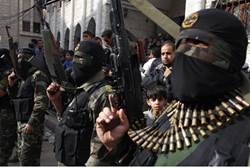
Islamic Jihad in GazaIslamic Jihad terrorists in Gaza Reuters

Despite last week predicting its failure, the Islamic Jihad terrorist group is trying to join in on the Hamas-Fatah reconciliation agreement.

Sources in the group told the Ma’an news agency that three senior leaders of the group traveled from Gaza to Egypt via the Rafiah crossing on Wednesday.

According to the sources, Muhammad al-Hindi, Nafith Azzama, and Khaled al-Batsh traveled through Egypt to convene with other faction leaders for meetings on the recent reconciliation deal.

The leaders will consider the ways Islamic Jihad could be involved in the unity government, which is due to be set into place within four weeks, the sources told Ma’an.

It is the first time the leaders have been allowed into Egypt since the military ouster of Muslim Brotherhood president Mohammed Morsi in July, the news agency noted.

According to the deal announced last Wednesday, Palestinian Authority (PA) Chairman Mahmoud Abbas is scheduled to issue a “presidential decree” announcing the dates for elections, which PA officials said would likely take place within the next six months.

Khalil al-Hayya, a senior Hamas figure and member of the Hamas parliament, told the Arab news channel Al-Khuttab on Tuesday that Hamas leadership decided to take part in the coming elections for “Palestinian president.”

The participation would be conducted either by presenting an official Hamas candidate, or by supporting a national candidate who presumably would identify with Hamas, he said.

Cracks have already appeared in the unity agreement, as senior Hamas leader Mahmoud Al-Zahar declared on Tuesday that Hamas will never recognize Israel’s right to exist or put its terrorist army under Palestinian Authority (PA) control.

Those comments are contradictory to ones made by Abbas, who declared on Saturday that the new government will “obey my policy,” and would “recognize Israel and reject violence and terrorism, and recognize international commitments.”


The Fatah-Hamas Agreement

May 1, 2014

The Fatah-Hamas Agreement, Gatestone Institute, Richard Kemp, May 1, 2014

(The perception seems to be that if everyone else (particularly Israel) will just be nice to terrorists and welcome them all will be well — for everyone else. — DM)

There is the criminal failure of the international community, as both accomplice and accessory before the fact, to make any meaningful effort to prevent endless salvoes of terrorist rocket attacks against Israeli civilians for over nine years.

As we saw with the Iranian arms shipment aboard the Klos-C last month, Iran’s sponsorship of terrorism continues unabated — even as the international community is rehabilitating its extremist regime.

But one could hope for something more forceful from Washington than State Department spokesman Jen Psaki’s weak and vacillating response in which she attempted to take the heat off Hamas and the PA by taking a gratuitous dig at Israel. “There have been unhelpful steps from both sides throughout this process,” she said.

Three hundred and thirty two drone attacks against Al Qaida and Taliban targets on Pakistani territory since 2005 demonstrate U.S. President Barack Obama’s strong resolve against terrorists that threaten the United States. Only last week, the latest wave of air strikes launched or enabled by his government against Al Qaida networks in Yemen killed 55 suspected extremists, possibly including master bomb-maker Ibrahim al-Asiri.

Of course no one expects the U.S. to send drones in reply to the news that the Palestinian Authority [PA], upon which he has lavished billions of dollars and thousands of hours of diplomacy, was going into business with Hamas, which the United States has branded a terrorist organization.

But one could hope for something more forceful from Washington than State Department spokesman Jen Psaki’s weak and vacillating response in which she attempted to take the heat off Hamas and the PA by taking a gratuitous dig at Israel. “There have been unhelpful steps from both sides throughout this process,” she said.

If the US response was feeble, the EU’s was treacherous.

Like America and several other countries, the EU designates Hamas as a terrorist organization. Yet the spokesman for Catherine Ashton, EU foreign affairs head, actually welcomed the proposal to bring Hamas into the PA.

Though shameful, this is far from surprising. It is part of a lengthy pattern of witting or unwitting EU encouragement of Middle Eastern terrorism.

The EU has contributed its taxpayers’ money to paying the salaries of convicted Palestinian terrorists via unconditional donations to the PA amounting to billions of dollars since 1994. Some of this money has also been spent on school textbooks, television programs and other PA propaganda that incite hatred and terrorism against Israel.

Ashton and the EU have called repeatedly for an end to the Israeli-Egyptian security operation on land and sea around Gaza. The operation is designed to prevent predominantly Iranian-supplied munitions and materiel for terrorism from entering the Gaza Strip, and to stop Gaza terrorists and weapons moving to attack Israeli or Egyptian targets.

At the same time, the EU, like the UN, has usually remained mute in the face of volley after volley of Iranian-supported rocket attacks from Gaza directed against the civilian population of Israel. These rockets are fired mainly by Hamas and their terrorist bedfellows, the Palestinian Islamic Jihad. Silence and inaction by such significant international bodies as the UN and the EU must, in these circumstances, add up to at least a degree of culpability.

Robert Serry, the UN Special Coordinator for the Peace Process, seems to have swallowed Abbas’s suggestion to him that reconciliation with Hamas will be on the basis of “recognition of Israel, non-violence and adherence to previous agreements.” On that “understanding,” the UN, like the EU, apparently welcomes and even supports the prospect of a terrorist group’s incorporation into the PA.

Were Hamas indeed to commit — plausibly — to such undertakings, then Israel could of course continue peace negotiations and cooperation with the PA on current terms. But other than Abbas’s words to Serry, there is no indication of this and, in the real world, Hamas is not likely even to consider such conditions.

Prime Minister Netanyahu therefore had no choice other than to suspend the peace process. This was his obligation to the Israeli people and to the international community. How could he possibly continue to negotiate with an entity that is itself negotiating with a vicious, murderous and unrelenting terrorist group hell-bent on the destruction of Israel and outlawed around the world?

Of course Abbas knew full well when he agreed to unity with Hamas that this would end the peace negotiations. But this is only the latest in a series of steps that Abbas has taken to sabotage the peace process. He rejected U.S. Secretary of State John Kerry’s framework principles last month; he has repeatedly refused to discuss PA recognition of Israel as the national homeland of the Jewish people; and at the end of March he initiated a move to join 15 international organizations, contravening an agreement to make no unilateral moves in the international arena during the period of the peace negotiations.

One of the greatest challenges in the peace process, should it be resumed at some point, is resolving Israel’s security concerns in the West Bank. Since the Israel Defense Forces left Gaza in 2005, Palestinians have fired into Israel over 8,000 rockets, killing 44 Israelis and injuring more than 1,600.

Ashod apartmentA damaged apartment building in Ashdod, following a direct hit by a rocket fired from Gaza, in November 2012. (Image source: IDF)

In addition, Gaza terrorists have seized every available opportunity for other forms of attack against Israeli soldiers and civilians including kidnappings, shootings, suicide bombs, anti-tank missiles and Improvised Explosive Devices [IEDs].

Iran, sworn to Israel’s destruction, as are its Gaza-based proxies, has funded, armed, energized and directed both Hamas and Palestinian Islamic Jihad. As we saw with the Israeli interdiction of the Iranian arms shipment aboard the Klos-C only last month, Iran’s sponsorship of terrorism continues unabated — even as the international community is rehabilitating its extremist regime.

Especially in a region and among neighbours that are becoming even more unstable, violent and unpredictable, Israel must ensure that in the event a Palestinian state should ever reach fruition, the West Bank does not become a second Gaza. The bloody consequences of that for the Israeli people would be far greater than from anything Hamas could hurl out of the Strip.

Kerry has proposed international troops to provide security against attacks on Israel from the West Bank. Few Israelis believe that they could rely on such a force to protect them. There are the historical precedents for the failure of peacekeeping forces in the region and beyond, especially when the going gets tough. And in the West Bank, the going would get very tough very soon and very often.

There is the criminal failure of the international community, as both accomplice and accessory before the fact, to make any meaningful effort to prevent endless salvoes of lethal terrorist rocket attacks against Israeli civilians for over nine years.

Worse still, when Israel has been forced to respond to protect its citizens, it has been stabbed in the back by the international community, who have accused it of war crimes.

The UN’s ill-conceived and deeply flawed 2009 Goldstone Report, for example, amounted to nothing less than incitement to terrorism.

And then there is the spectacle that we have witnessed over the past few days, of the pusillanimous and equivocating international response to plans for an active and violent terrorist group to join the PA.

Confronted by world leaders who lack the moral courage to face down terrorists whom even they themselves have designated as such, Israel is entirely right in its assumption that when it comes to security it can rely only on its own moral strength and its own armed forces.

Obama and the Inconvenience of History: Abandoning Ukraine | New Republic

May 1, 2014

Obama and the Inconvenience of History: Abandoning Ukraine | New Republic.

Obama abandons another country to its fate

 “Yeah, let’s talk about that.” The president wished to change the subject. At a press conference the other day he was being interrogated about Ukraine when a reporter asked a question about health care. Obama was delighted. As the excellent Peter Baker reported in The New York Times, “Mr. Obama seems intent on not letting Russia dominate his presidency.” This is not the first time the president has attempted to resist such intrusions upon his idea of how the world ought to be. He has been trying to escape the Middle East for years and “pivot” to Asia, as if the United States can ever not be almost everywhere, leading and influencing, supporting or opposing, in one fashion or another. On the eve of the president’s trip to Asia, Susan Rice remarked that “increasingly [we] see our top priorities as tied to Asia, whether it’s accessing new markets or promoting exports or protecting our security interests and promoting our core values.” What is this strange choice, this retiring either / or calculation? Only small powers think this way. Can the United States ever have “top priorities” only in one place, even if it is a place as big as Asia? Are our “security interests” not also broached by the failure of the Syrian state, or our “core values” not also invoked by its slaughter without end?

The tiresome futurism of Obama, his dogmatic views about what this ritualistically ballyhooed century will be like and what it will not be like, are only a part of what lowers his vision. The bigger problem is that the president feels inconvenienced by history. It refuses to follow his program for it. It regularly exasperates him and regularly disappoints him. It flows when he wants it to ebb and it ebbs when he wants it flow. Like Mr. Incredible, the president is flummoxed that the world won’t stay saved, or agree to be saved at all. After all, he came to save it. And so the world has only itself to blame if Obama is sick of it and going home.

Obama has concluded, according to Baker, that he “will never have a constructive relationship with Mr. Putin,” and so he has decided that he “will spend his final two and a half years in office trying to minimize the disruption Mr. Putin can cause, preserve whatever marginal cooperation can be saved and otherwise ignore the master of the Kremlin.” Ignoring the master, of course, has the consequence of ignoring the master’s victims: the Obama administration abandons to their fates one people after another, who pay the price for the president’s impatience with large historical struggles. The Ukrainians, the Syrians, the Iranians, the Israelis, the Palestinians, the Egyptians, the Saudis, the Moldovans, the Poles, the Czechs, the Japanese, the Taiwanese, the Baltic populations: they are all living with the jitters, and some of them on the cusp of despair, because the United States seems no longer reliable in emergencies, which it prefers to meet with meals ready to eat. No wonder that so much of our diplomacy consists in tendering reassurances. The United States now responds to oppressed and threatened peoples by making them more lonely and afraida sentimental objection, I know, and one that is unlikely to trouble Henry Kissinger’s epigone in the White House.

Obama’s impatience with history has left him patient with evil. It is not a pretty sight; but his broken foreign policy is riddled with such ironies. Here is another one: Baker reports that the president has elected to revise his Russia policy into “an updated version of the Cold War strategy of containment.” How twentieth century! Never mind that containment was a policy with many interpretations, and not quite the formula for moving on that Obama is seeking. The grim fact is that Obama’s containment is not containing Putin, whose “green men” and “peoples’ republics” and Big Lies and Russophilic incitement and covert operations and military deployments are undeterred by it. While Obama pitches the “off-ramp,” Putin revels in the on-ramp. Geneva is now the world capital of failure. The only country that American containment is containing is America.

Obama’s surprisability about history, which is why he is always (as almost everyone now recognizes) “playing catch-up,” is owed to certain sanguine and unknowledgeable expectations that he brought with him to the presidency. There was no reason to expect that the Ayatollah Khamenei would take Obama’s “extended hand,” but every reason to expect that he would crack down barbarically on stirrings of democracy in his society. There was no reason to expect that Assad would go because he “must go,” but every reason to expect him to savage his country and thereby create an ethnic-religious war and a headquarters for jihadist anti-Western terrorists. There was no reason to expect Putin to surrender his profound historical bitterness at the reduced post-Soviet realities of Russia and leave its “near abroad” alone. There was no reason to expect that the Taliban in Afghanistan would behave as anything but a murderous theocratic conspiracy aspiring to a return to power. And so on. Who, really, has been the realist here? And what sort of idealism is it that speaks of justice and democracy but denies consequential assistance (which the White House outrageously conflates with ground troops) to individuals and movements who courageously work to achieve those ideals?

But the richest of the ironies about Obama’s foreign policy is this: the world that in his view wanted to be rid of American salience now longs for it. It turns out that Obama’s Iraq-based view of America’s role in the world, according to which American preeminence is bad for the world and bad for America, is not shared by societies and movements in many regions. They need, and deserve, support in their struggles. (In Syria, for example, the tyrant enjoys the significant support of Russia, Iran, and Hezbollah, the Islamist rebels enjoy the significant support of Saudi Arabia and Qatar, and the moderate secular rebels enjoy the significant support of nobody.) There are many places in the world where we are despised not for taking action but for not taking action. Our allies do not trust us. Our enemies do not fear us. What if American preeminence is good for the world and good for America? Let’s talk about that.

Leon Wieseltier is literary editor of The New Republic.

No one defends Obama foreign policy these days

May 1, 2014

No one defends Obama foreign policy these days | Right Turn.

By Jennifer Rubin Updated: April 30 at 3:13 pm

An Obama critic these days is anyone who’s been mugged by reality in the last five years.

From the left you have Maureen Dowd, who sounds more like Charles Krauthammer:

Stop whining, Mr. President. And stop whiffing. Don’t whinge off the record with columnists and definitely don’t do it at a press conference with another world leader. It is disorienting to everybody, here at home and around the world.

I empathize with you about being thin-skinned. When you hate being criticized, it’s hard to take a giant steaming plate of “you stink” every day, coming from all sides. But you convey the sense that any difference on substance is lèse-majesté.

Also from the left, Sen. Barbara Boxer (D-Calif.) sounds like Sen. Ted Cruz (R-Tex.) when she bashes Secretary of State John Kerry’s apartheid comment: “Israel is the only democracy in the Middle East and any linkage between Israel and apartheid is nonsensical and ridiculous.”

The Obama team’s foreign policy jalopy careens around the globe, creating chaos and confusion wherever it goes. Or as centrist foreign policy guru Richard Haass put it:

American foreign policy is in troubling disarray. The result is unwelcome news for the world, which largely depends upon the United States to promote order in the absence of any other country able and willing to do so. And it is bad for the U.S., which cannot insulate itself from the world. . . . The challenge for the Obama administration is not just to ensure American strength and continued internationalism in the face of growing isolationist sentiment. It is also a case of sending the right message to others. We are witnessing an accelerated movement toward a post-American world where governments make decisions and take actions with reduced regard for U.S. preferences. Such a world promises to be even messier, and less palatable for U.S. interests, than it is today.

There are two things going on here simultaneously that have provoked this torrent of criticism from well beyond the Republicans in Congress. The confluence of the two amplify the picture of chaos and confusion combined with the Obama team’s self-pity.

The first problem here is that whatever standing Kerry had when he began his tenure is gone. The face of American foreign policy is now the subject of disdain and biting criticism. Day after day his spokeswoman is subjected to needling from the press. An excerpt from yesterday’s daily briefing:

QUESTION: If that’s his view, that Israel faces the potential – a potential future as a state that has two classes of citizens and there’s not a full-on democracy. If that’s what he believes, why doesn’t he – why does he – why is he taking back his word?

MS. PSAKI: He doesn’t disagree with the notion that many Israeli leaders have also stated – Justice Minister Livni, Prime Minister Netanyahu – many prime ministers in the past from many different political ilks have stated their concerns about a unitary state and a range of impacts that could have. He agrees with that. But he’s not naive about the games played in Washington. He – what we saw yesterday was many people use his comments and the – them out of context to distort his record and distort his viewpoints.

QUESTION: But it sounds like he’s only – and not apologizing, but saying that he regrets that the word was being used because he was caught or whatever word you want to use, or someone recorded him unbeknownst to him, using it. And isn’t it true that – first of all, isn’t it true that he has expressed this sentiment, if not the word “apartheid,” to Israeli leaders in his negotiations?

MS. PSAKI: Which he repeated in his statement, that what he was trying to describe was his belief that it’s not possible to achieve two states living side by side in peace and security without a two-state solution. And yes, that is a sentiment he has described privately, he has described publicly. . . . Again, what he – yesterday, as we were making the decision about putting this statement out, there were several interpretations of his comments that were inconsistent with his record of more than 30 years in public service, the work he’s done to – work with the negotiators to bring about a peace process. It didn’t reflect his views; it didn’t reflect his record. And that’s why we put a statement out. . . .

QUESTION: But it’s – just kind of goes to Matt’s point that if he believes that – this to be true, then instead of kind of saying I regret the statement, it cut –

MS. PSAKI: He didn’t say that. He said he –

QUESTION: Well, not that he regrets the choice of the word – of use –

MS. PSAKI: Of the specific word. Yes.

QUESTION: But –

MS. PSAKI: That’s an important point.

QUESTION: But why does he regret the choice of the word? Because it’s being interpreted by others, or because he doesn’t feel that way? Because it seems as if he clearly feels that way. He’s describing a situation which loosely is interpreted as an apartheid situation and he’s also pointing to others, and so it’s – that are saying it. And so it kind of seems as if he’s trying to distance himself from the criticism and not standing by exactly what he – how he believes it to be the case.

MS. PSAKI: No. I absolutely disagree with that. In his statement last night, he very clearly conveyed what the point he was making. He referred to other officials who have made a similar point.

QUESTION: Exactly.

MS. PSAKI: At the same time, we all know – you all work in words every single day – that certain words have – are interpreted in a certain way, have history behind them. So yes, he would have used a different word. The sentiment about the importance of reaching a two-state solution and the challenges of a unitary state – yes, he does completely agree with that.

QUESTION: So even though he put the statement out saying that perhaps he should have used another word, he still does think that Israel risks becoming an apartheid state in the future if there is no peace agreement and no two-state solution?

MS. PSAKI: I think it’s very important, as we all know, that the use of the word, the way that people interpret the word – the power of words – is a major factor here.

It goes on and on like that. The take away from the questioning and from the coverage in the mainstream media is that Kerry is a very foolish man, quite full of himself and out of his depth. One requirement (I will get to the other below) of “soft power” or “smart diplomacy” is to have smart, disciplined diplomats. This is not the Senate floor where you can talk forever, make whatever gaffes and silly remarks you like and never face criticism. With a secretary of defense who, unlike predecessors Leon Panetta and Robert Gates, is not competent to operate at a high level and a secretary of state who spends too much time explaining what he really meant to say, the administration’s message, such as it is, is muddled and unsteady.

But there is more going on here than Kerry. Those members of the Senate who have expressed trust in him on Iran, for example, look foolish to have held off on sanctions. More and more you see Democrats, scared to death that they will be dragged down by a White House circling the drain, flex their muscles. The House Foreign Affairs Committee now acts unanimously to demand new action on Syria and increased measures against Russia. Senate Democrats do not rush to the administration’s defense.

Democrats or Republicans proponents of realpolitik who once hoped President Obama would provide a course correction to the excesses of the Bush administration now are in despair.

Leon Wieseltier bemoans again and again the vacuum where America once stood and the despair of allies who crave U.S. leadership. (“He is not raising the country up, he is tutoring it in ruefulness and futility. We need to refuse this sullenness.”) Former Democratic congresswoman Jane Harman candidly admits (“it beats me”) she can’t figure out why we haven’t pursued sector-wide sanctions against Russia. And even realpolitik maven and former Obama defender Zbig Brzezinski now taunts the president’s incoherent approach to Russia.

In sum, we have a hollow foreign policy and a secretary of state incapable of improvising. The president doesn’t care to or doesn’t know how to reverse course. (Are 150,000 dead in Syria a “single” or a “double” as he defends his foreign policy in baseball terms?) And now everyone is willing to say so. With Democrats panicked they will lose the Senate and maybe even impair Hillary Clinton (who will be running on the third Obama term), the criticism is bipartisan, endless and unmerciful.