Archive for May 2014

The US President’s foreign policy leaves Ukraine’s chocolate king in a box

May 31, 2014

The US President’s foreign policy leaves Ukraine’s chocolate king in a box, DEBKAfile, May 31, 2014

(Does President Obama remind anyone else of British PM Neville Chamberlain in 1938, when he claimed to have brought “Peace in Our Time” but had helped to bring World War II instead? — DM)

Obama’s attitudes toward the Ukraine crisis and Iran’s nuclear program bear comparison: “Our ability to shape world opinion helped isolate Russia right away. Because of American leadership, the world immediately condemned Russian actions.”

But then, he went on to boast: “… at the beginning of my presidency, we built a coalition that imposed sanctions on the Iranian economy, while extending the hand of diplomacy to the Iranian government. Now we have an opportunity to resolve our differences peacefully.”

For Obama, therefore, everything is hunky dory on the Iranian nuclear scene, even though diplomacy is stalled and the six major world powers failed to turn Tehran away from its drive for a nuclear weapon.

The chocolate factory owned by Ukraine’s new President Petro Poroshenko in central Kiev is the 18th largest in the world. In the Soviet era, it called itself the Karl Marx Chocolate Works. Today, its owner has depoliticized its name to Roshen Sweets, which hasn’t done his business much good. His product is now banned in Russia on grounds of “health and safety,” while the Europeans are no kinder to its pro-EU manufacturer, having clamped a 48 percent tax on the boxes of candy, temptingly labeled “Kyev Evenings.”

Next Wednesday, June 4, President Poroshenko arrives in Warsaw for his first date with US President Barack Obama, who is coming to round off his three-part foreign policy treatise with assurances for East European leaders that America is there to defend them and their independence against the expansionist designs of Russian President Vladimir Putin.

He will find its leaders hard to convince – especially after they heard his “hammer and nail” analogy last Wednesday. Putin’s withdrawal of most of the 40,000 troops he parked on the Ukrainian border, except for a few thousand, holds no real guarantee for their security. After all, they understand that it would take the Russian army just a few hours to restore the full complement to their former positions – or even place them deep inside Ukraine, if Moscow so decided.

The East European members of NATO are seriously worried by President Obama’s policy thrust for the two-and-a-half years remaining of his term in office, as he defined it in the speech he delivered at West Point on May 28.

“US military action cannot be the only or even primary component of our leadership in every instance. Just because we have the best hammer does not mean that every problem is a nail.”

European leaders within range of Moscow are uncomfortably certain that their security is not enough of “a problem” to rate the use of the American “hammer.”

The key policy trend revealed in that speech was that Obama sees only one major threat to America in the Middle East, and that is terrorism, i.e. al Qaeda.

He did not refer to Syrian President Bashar Assad by name, despite the horrors of the unending Syrian war, or the role of Iran and the Lebanese Hizballah in fueling that war. He made it clear that Syrian rebels would be awarded US assistance as a force for pursuing the war on al Qaeda.

Obama’s attitudes toward the Ukraine crisis and Iran’s nuclear program bear comparison: “Our ability to shape world opinion helped isolate Russia right away. Because of American leadership, the world immediately condemned Russian actions.”

But then, he went on to boast: “… at the beginning of my presidency, we built a coalition that imposed sanctions on the Iranian economy, while extending the hand of diplomacy to the Iranian government. Now we have an opportunity to resolve our differences peacefully.”

For Obama, therefore, everything is hunky dory on the Iranian nuclear scene, even though diplomacy is stalled and the six major world powers failed to turn Tehran away from its drive for a nuclear weapon.

The US president sees no nails demanding the application of the American hammer – either in East Europe or in Middle East trouble spots.

Poroshenko may have had an inkling of this when he was still running for the presidency. This would explain his secret visit to Israel in April, revealed here byDEBKAfile’s intelligence sources, among other things, for secret rendezvous with Russian oligarchs close to Putin, in search of an understanding.

They didn’t turn him down, only advised him as president to refrain from aggressively provocative actions against pro-Russian rebels in East Ukraine – or face Moscow’s ire.

The future Ukraine president promised to heed this warning.

However on May 27, two days after his election, the chocolate king decided to show he had muscle and launched the Ukraine army on an offensive against the insurgents of Donetsk and Slaviansk.

Poroshenko ought to have stuck to producing candy; he clearly failed to realize that, with the Ukraine army in its current low state, he was biting off more than he could chew.

To save face, the Ukraine army Col. Gen. Koval Mykhailo claimed Friday, May 30, that large parts of East Ukraine had been brought under control and the military operation would continue. This was no more than a lame attempt to conceal the scale of this fiasco and restore a vestige of military pride, after the rebels downed a helicopter causing the death of 14 Ukraine soldiers, including a general.

Moscow responded by sending two units across into E. Ukraine – the Vostok (Chechen) Battalion and a Cossack force – while at the same time disavowing any military intervention in the fray.

But even the finest “Kyev Evenings” chocolates, if presented by Poroshonko in Warsaw Wednesday, are unlikely to change Obama’s mind about using the American hammer for the sake of Ukraine and East Europe. The words uttered at West Point will not be rewritten in Poland.

Behind the Lines: A most discreet Israeli intervention in Syria

May 31, 2014

Behind the Lines: A most discreet Israeli intervention in Syria | JPost | Israel News.

By JONATHAN SPYER

LAST UPDATED: 05/31/2014 06:33

Evidence is emerging of an increasing, though still modest, Israeli involvement in events beyond the separation of forces line with Syria on the Golan Heights.

Syria

SOLDIERS SIT atop a tank as they watch the border with Syria near Quneitra Photo: REUTERS

Since the outbreak of civil war in Syria in 2011, Israeli officials have observed events to the north with caution and concern. The concern has derived from the presence of anti-Israel paramilitary and terrorist elements on both sides of the fighting lines in Syria.

The caution, meanwhile, relates to the very deep aversion felt in the Israeli system toward the possibility of the Jewish state being sucked into the morass of the Syrian war. Israel’s Lebanon experience has left a deep institutional memory warning against overly ambitious incursions into the affairs of neighboring states.

Nevertheless, evidence is emerging of an increasing, though still modest Israeli involvement in events beyond the separation of forces line on the Golan Heights.

The least ambiguous evidence of Israeli activity related to Syria is the series of air raids against weapons convoys headed for Lebanon. These have been attributed by foreign media to Israel, and were carried out to prevent the transfer of certain weapons systems from Syria to Hezbollah.

However, the latest emerging indications relate not to activity deep within the skies above Syria. It can not be ruled out that the contacts in question are happening, discreetly, very close to the ground – and very close to the border.

Israeli officials have observed with concern the recent ebb and flow of the fighting in the Deraa and Quneitra provinces in southern Syria. The rebel fighters in this area, as elsewhere, are a varied and disparate group. The southern front is the focus of the limited Western and Arab support offered the rebels.

A Western command center at which US, Jordanian, Saudi, British and French personnel are present has been established to coordinate aid to the rebels in the south.

But the “moderate” rebels of the Supreme Military Command and the related Syrian Revolutionaries Front, who benefit from the modest flow of Western and Saudi aid, are not the only groups fighting President Bashar Assad in the south.

Jabhat al-Nusra, the official Syrian franchise of al-Qaida, is also playing a major role in the fighting in the south. The Salafi Ahrar al-Sham group is also present in force among the southern rebels.

These groups operate in coordination with the Western-supported fighters.

In recent weeks, forces led by Jabhat al-Nusra have made major territorial advances. In late April, these forces captured eastern Tel al-Ahmar (the Red Hill), situated 5 km. from the Israeli border on the Golan Heights. Western Tel al-Ahmar, which is just 2 km. from the first Israeli positions, was captured earlier in the month.

Rebel forces hope to push on to Quneitra itself. Their intention is to establish a contiguous strip of rebel-controlled territory in across western Deraa and Quneitra provinces – just 100 km. southwest of Damascus.

For Israel, the possibility that al-Qaida-linked jihadis could establish themselves along one of its borderlines represents a nightmare scenario. In a video released after the capture of the hill, a Nusra spokesman was heard to praise Osama bin Laden as the “Lion of Islam,” and to vow continued war on “Jews and crusaders.”

So the problem is clear. What is Israel doing to respond to it? In addition to increasing drone surveillance and intelligence gathering across the border, the evidence suggests that Israel has established contact with non-jihadi, Western-supported rebel elements, with the intention of ensuring the jihadis are prevented from establishing themselves along the cease-fire line on the Golan.

The medical care that the Syrian regime charges that Israel affords to wounded Syrian fighters has served to facilitate this process. One thousand or so Syrian fighters have received it, with the more lightly wounded being treated at the IDF field hospital established close to the border, and others in hospitals in northern Israel.

Col. Abdullah al-Bashir, who commands the Supreme Military Council, a prominent Western- backed rebel element, was among the military personnel to be treated in Israel.

In addition to direct contact with the rebels, Israel is also in contact with local leaders across the border, with the intention of offering them inducements to refuse shelter and medical care to the jihadi fighters.

Alleged Israeli support for Western-backed rebels in this arena is made yet more necessary by the fact that defeat for the rebellion in Deraa and Quneitra runs the risk of bringing not the status quo ante bellum, but rather Hezbollah, to the border.

Fighters from the Shi’ite Islamist movement are present among pro-regime forces battling in the south. In early March, IDF troops fired at what they said was a Hezbollah team trying to place a bomb in the border area.

So is the southern border coming to resemble south Lebanon in the 1980s? Is Israel being sucked into another commitment across a northern border? Precisely because the lesson of Lebanon is so deeply etched on the collective memory of the Israeli system, it is likely that the Israeli footprint in southern Syria will remain discernible, but light.

There are no ideal options. Nusra, according to one source, is stronger than it appears, since it has allowed pro-Western forces to take credit for a number of operations. It does this so as to keep Western support flowing into the area, from which Nusra itself will then benefit. So any strengthening of the rebels in the south carries with it the risk of assisting precisely the enemy that it is supposed to thwart.

But the alternative of passive acquiescence to either al-Qaida or Hezbollah assembling along the border is probably worse.

A complicated political and military ecosystem has emerged in southern Syria, just across the cease-fire line in the Golan Heights. Israel will do its best to preserve its vital interests, while avoiding an overt presence in this arena. Maintaining the balance is not simple.

As of now, it may be said that Israel is actively, if discreetly, engaged in southern Syria.

Netanyahu Admits to Freezing Construction

May 30, 2014

Netanyahu Admits to Freezing Construction, Israel National News, Ari Yashar, May 30, 2014

US President Barack Obama’s administration demanded “not one brick, not one house” in Judea and Samaria according to Netanyahu, a demand the prime minister said he was able to hold off.

In recent meetings with the American administration, Netanyahu reports being told to stop not only the publication of construction bids, but also the early stages of planning. While Netanyahu did not say directly, he hinted to having acceded based on his approach of maintaining a high level of cooperation with the Obama administration.

The prime minister reportedly requested that the Housing Ministry freeze new construction projects in Judea and Samaria earlier in the month, despite the collapse of peace talks, and despite the fact that he chose to release jailed terrorists instead of freezing building as a condition of the talks.

Netanyahu settlementsBinyamin Netanyahu, Flash 90

Prime Minister Binyamin Netanyau reportedly met with the heads of Judea and Samaria authorities and admitted to freezing construction in the region, due to pressure from the American administration.

In the night-time meeting at the Prime Minister’s Office, whose details were reported on Friday by journalist Ariel Kahane of Makor Rishon, nearly all the leaders of the regional councils were present, as well as Dani Dayan, Chief Foreign Envoy of the Council of Judea and Samaria, and Ze’ev Haver, the chaiman of the Amana housing organization.

Netanyahu acknowledged that American demands led to the cancellation of high planning council meetings of the IDF’s civil administration that manages the Judea and Samaria region.

The prime minister reportedly requested that the Housing Ministry freeze new construction projects in Judea and Samaria earlier in the month, despite the collapse of peace talks, and despite the fact that he chose to release jailed terrorists instead of freezing building as a condition of the talks.

In the meeting the prime minister did not deny having giving the order to freeze construction, but claimed to the representatives of Judea and Samaria residents that he wasn’t aware of the results of his actions on the region.

“Defender of the settlements”

Nevertheless, Netanyahu reportedly termed himself “the defender of thesettlements” in the meeting, claiming to have blocked strong international pressure against a Jewish presence in the region.

US President Barack Obama’s administration demanded “not one brick, not one house” in Judea and Samaria according to Netanyahu, a demand the prime minister said he was able to hold off.

In recent meetings with the American administration, Netanyahu reports being told to stop not only the publication of construction bids, but also the early stages of planning. While Netanyahu did not say directly, he hinted to having acceded based on his approach of maintaining a high level of cooperation with the Obama administration.

“Not even a lightpole can be built”

The Judea and Samaria regional leaders who met with Netanyahu leveled sharp criticism over the decision to stop the high planning council meetings, a move they said led to a de facto freeze of the region’s development given that without the council’s order, even “a lightpole for a soldier guarding at a post can’t be placed.”

They added that not even educational facilities can be built under the current status, which wasn’t the case in the freeze four years ago that Netanyahu initiated.

“Every change on the ground, even the smallest, requires the permission of the outline plan anew. If the council doesn’t meet, even the tiniest changes can’t get permission. That doesn’t allow preparation for the next school year or anything else,” one of the regional leaders said at the meeting.

Another leader added that without building, the local authorities don’t receive any construction fees, which greatly harms the budgets of the regional councils.

In response, Netanyahu claimed he wasn’t aware of the full impact of his orders to stop the council meetings, and promised to find a solution in the coming days.

The regional leaders pressed that building continue, saying that otherwise the status quo will be of construction freeze with any building becoming a deviation from the norm.

“If this will be the reality, the external pressures will be many times as strong,” the leaders stated. After the meeting they met with representatives of Netanyahu’s office to brainstorm solutions to the situation.

Silent on Syria, Obama admits his failures – Al Arabiya

May 30, 2014

Silent on Syria, Obama admits his failures – Al Arabiya News.

Brooklyn Middleton

U.S. President Barack Obama’s commencement speech at the United States Military Academy at West Point was an address that poetically decried considering major United States foreign policy dilemmas with “narrow rationale;” yet, the president then proceeded to defend U.S. inaction in Syria with narrow rationale.

Before eventually mentioning Syria, President Obama attempted to underscore the degree to which the world views America as both a beacon of hope and as a pragmatic partner who will actually act on its behalf in times of need. He pointed to several different occasions as evidence of this, including the typhoon devastated Philippines, heartbroken Nigeria when several hundred schoolgirls were kidnapped by Boko Haram militants, and Ukrainian security forces when pro-Russian rebels occupied eastern Ukrainian buildings.

There was, breathtakingly, no mention of the Syrian conflict at that moment – a situation which has caused what the U.N. referred to “the worst humanitarian crisis” in two decades. There was no mention of the implied pleas for help by thousands of children killed during indiscriminate air strikes or a madman’s detonation of his own explosives-laden body. Absent was the figure of 2.8 million refugees and 6.5 million internally displaced people (IDPs) – whose existence remains perpetually threatened by barrel bombings and radical rebel suicide car detonations.

There was no mention of repeated pleas by Syrian opposition chief Ahmad al-Jarba, asking for American-supplied arms that could dare to threaten Assad’s own arsenal.

President Obama announced that, “tough talk often draws headlines, but war rarely conforms to slogans”

Brooklyn Middleton

Perhaps this was a silent admission of his administration’s own failures regarding Syria. Regardless, it would seem, while touting America’s status as a leader to countries in time of need, it would be imperative to immediately counter those statements with at least acknowledgment that the country which has consistently sought America’s help the most in the recent term has ultimately been ignored.

Obama did, however, reiterate that he believed the U.S. should “help” Syrians “stand up against a dictator who bombs and starves his own people.“ But he failed to say what that would precisely entail. And in the same breath, President Obama reminded that he remains confident in his decision to not send troops to Syria. His administration may feel that is an accomplishment but requests for help were hardly loud cries from the Syrian opposition demanding U.S. troop deployment. In fact, only a few weeks ago, Jarba reiterated this point, telling President Obama he did not want America “to send their sons to Syria” and that the opposition sought only “effective and efficient weapons.”

Al-Qaeda militants

From a security standpoint, as al-Qaeda militants continue to flock to Syria and as Hezbollah continues setting up camp, the assertion that the former would not perhaps eventually be necessary – by President Obama’s own reasoning – cannot be ruled out.

And when he speaks of counterterrorism strategies targeting “countries where terrorist networks seek a foothold,” one cannot help but assert that the country with the second highest number of Islamist foreign fighters in modern history would seem like a solid place to kick off these efforts.

Ultimately, President Obama implores critics of his foreign policy to avoid thinking only in black and white and yet he himself relies on such thinking by blaming criticism over inaction in Syria on those who “think military intervention is the only way for America to avoid looking weak.” This tired talking point is intended to paint those who’ve long called for the U.S. to play a greater role in the Syrian conflict – predicated on the justification that it is both ethically and strategically imperative – as mere political adversaries.

Dig deeper

Asking the American public to dig deeper on complex issues of foreign policy, President Obama then does nearly the antithesis of that when discussing Syria – this speech was the latest reminder of that.

Lastly, in what was perhaps a not so veiled reference to his infamous chemical weapons are a red line for U.S.-led intervention in Syria statement, President Obama announced that, “tough talk often draws headlines, but war rarely conforms to slogans.” This is true, to be sure. But the notion that tough talk followed up by continued inertia and an orchestrated chemical weapons deal (that does nothing to eradicate the chlorine gas which Assad’s regime continually uses) is in any way representative of a new era of a more evolved foreign policy is concerning.

Perhaps President Obama did not focus more of his speech on the Syrian conflict – while making points of when U.S. military pressure should become a reality – because it would have only further etched the failures of his administration in the minds of his political adversaries and supporters alike.

_____________________________

Brooklyn Middleton is an American Political and Security Risk Analyst reporting from Israel. Her work has appeared in Turkish and Israeli publications including The Times of Israel and Hürriyet Daily News. She has previously written about U.S. President Obama’s policy in Syria as well as the emerging geopolitical threats Israel faces as it pursues its energy interests in the Eastern Mediterranean. She is currently researching Ayatollah Khomeini’s influence on Hamas and the Palestinian Islamic Jihad militant groups to complete her MA in Middle Eastern Studies. You can follow her on Twitter here: @BklynMiddleton.

NBC’s Engel: “Hard Pressed” To Find Country Where Relations Have Improved Under Obama

May 30, 2014

NBC’s Engel: “Hard Pressed” To Find Country Where Relations Have Improved Under Obama | Video | RealClearPolitics.

In a conversation with Home Depot founder Kenneth Langone on CNBC, NBC’s chief foreign correspondent Richard Engel said “you’d be hard pressed” to find a country with which relations have improved under President Obama.

“You would naturally want to say Europe, but generally the relations with a lot of European countries have gotten worse,” he continued.

KEN LANGONE, Home Depot founder: Name me one country where we have better relations–I’m sorry. I’ll ask my question after you’re done.

ENGEL: Oh no,no I’m sorry. I can’t figure out where one person is talking when I’m supposed to talk because I can’t see you. The way I kind of think about it– go ahead.

LANGONE: Name one country with whom we have better relationships today than we did when he became president of the United States almost six years ago?

ENGEL: Uh, I–you would naturally want to say Europe. But generally the relations with a lot of European countries have gotten worse because of these relationships. And this is sort of what I was about to say.

LANGONE: I can name all the countries where the relationships have gotten worse. I’m asking you to give me one country where they have gotten better.

ENGEL: Yeah. I think you would be hard pressed to find that. And I think this is the reason–

LANGONE: Isn’t that a measure of foreign policy?

ENGEL: Even our allies –yeah. And I think the reason is our allies have become confused. For eight years you had the Bush administration with a very interventionist policy, driving into world affairs, driving primarily into the Islamic world army first, or fist first. And that was very unpopular with many of our allies. But toward the end, after 8 years, people adjusted to it. Now you have a presidency that for the last six years is pulling out very rapidly. And that is creating a kind of pump action, a vortex of instability that has left allies like Saudi Arabia, like Egypt, like even some European countries very confused. Are we going in? Are we pulling out? Are we leading? Are we trying to set the agenda? That has been a lot of frustration. So in terms of the foreign policy objectives laid out in West Point, yes, he talked about ending these two unpopular wars. But I do sympathize with some of the things said in the Wall Street Journal. Right now we have a black hole in Syria. Iraq is in a state of collapse. Libya is about to go back into a civil war. And this was the one case where we intervened militarily. So I think there is a lot of problems on the horizon in the foreign policy world just because you are off-ramping in Afghanistan.

President Obama Misses a Chance on Foreign Affairs – NYTimes.com

May 30, 2014

President Obama Misses a Chance on Foreign Affairs – NYTimes.com.

( The Times continues to struggle to repair its reputation sullied by its past unconditional support of everything Obama. – JW )

President Obama and his aides heralded his commencement speech at the United States Military Academy at West Point on Wednesday as a big moment, when he would lay out his foreign policy vision for the remainder of his term and refute his critics. The address did not match the hype, was largely uninspiring, lacked strategic sweep and is unlikely to quiet his detractors, on the right or the left.

Mr. Obama did make a strong case on the use of force. Understandably frustrated by critics who “think military intervention is the only way for America to avoid looking weak,” Mr. Obama was steady and sensible on this vital issue. He endorsed military action, even unilaterally, when the country is threatened or when the security of its allies is in danger. But he stressed, correctly, that not every problem has a military solution and warned that “some of our most costly mistakes came not from our restraint but from our willingness to rush into military adventures.” (He was right, for instance to call off the threat of action after President Bashar al-Assad of Syria agreed to surrender his chemical weapons.)

In his speech, Mr. Obama tried to push back against critics who say he has ceded America’s post-World War II dominance. The question, as he correctly put it, is “not whether America will lead but how we will lead” and he reasserted that “isolationism is not an option.” Mr. Obama was right when he suggested there would be no serious negotiations over Iran’s nuclear program without his approach to American leadership.

But he provided little new insight into how he plans to lead in the next two years, and many still doubt that he fully appreciates the leverage the United States has even in a changing world. Falling back on hackneyed phrases like America is the “indispensable nation” told us little.

The president said he wanted to spend $5 billion to train and support armies in places like Libya, Mali, Yemen and Somalia to combat terrorists. The aim is to avoid having to use American troops, and, in theory, it makes sense. But the United States has a checkered history in such endeavors, and Mr. Obama made only a cursory mention of other factors crucial to success, including responsible governance and education for all. It was disturbing to hear him gloss over the return of military rule in Egypt.

Mr. Obama’s talk of the need for more transparency about drone strikes and intelligence gathering, including abusive surveillance practices, was ludicrous. His administration had to be dragged into even minimal disclosures on both topics. Just Tuesday, the administration said it wanted to make further deletions from a legal memo on drone strikes that a court ordered it to make public.

Mr. Obama’s comments on China and Russia barely touched on how he plans to manage two major countries that have turned increasingly aggressive. Pledging anew to close the jail at Guantánamo Bay, Cuba, which Congress has blocked, was, at this point, little more than a reassuring gesture.

This was far from Mr. Obama’s big moment. But since he has no office left to run for, what matters ultimately is his record in the next two and a half years.

Was the Iranian threat fabricated by Israel and the U.S.? | Haaretz

May 30, 2014

Was the Iranian threat fabricated by Israel and the U.S.? – Diplomacy and Defense Israel News | Haaretz.

( And now for something completely different… – JW )

( Gareth Porter’s writings since 2007 can be viewed HERE   It would appear he’s been active as an Iran apologist for a very long time.  No surprise then that the leftist Haaretz would take him seriously. –  JW )

In a new book and in a conversation with Haaretz, U.S. historian Gareth Porter charges that U.S. and Israeli policies on Iran have been based on fabricated evidence.

By Shemuel Meir May 29, 2014 | 3:54 PM

A narrative is a story that we tell ourselves, and not necessarily what happened in reality. For example, the “Iranian threat” narrative, which has become the common wisdom in Israeli public discourse. A new book by Gareth Porter, an American historian and researcher specializing in U.S. national security, shows how the actual state of the Iranian nuclear program does not match the Iranian threat narrative.

The book’s title, “Manufactured Crisis: The Untold Story of the Nuclear Scare” (Just World Books), already tells us that it is going against the current. Porter appears to be the only researcher who has read with an unprejudiced eye all the reports of the International Atomic Energy Agency from the past decade. He also had access to American intelligence reports on the Iranian issue from recent decades. In addition, Porter interviewed generations of American officials and analyzed the testimony of senior officials before Congress.

The result is a highly detailed and well-documented book for all interested in understanding how we arrived at the Iranian nuclear crisis, and the “attack scenarios,” and invented facts and intelligence reports whose purpose was to support the preconceptions. At the same time, the book is invaluable for those wishing to understand what is being discussed in the intensive nuclear talks that have been taking place Iran and the superpowers (or, more accurately, Iran and the U.S.) since the signing of last November’s interim agreement, which surprised many Israelis.

According to Porter, it was a hidden political agenda of U.S. decision makers (from long before Israel entered the picture) that gave rise to the Iranian nuclear crisis. This is one of the book’s main subjects, and the starting point for a discussion with which we in Israel are unfamiliar.

The story begins with U.S. support for the Iraqis during the 1980s Iraq-Iran war. The critical point comes with the collapse of the Soviet empire. According to Porter, that event and the end of the Cold War pulled out the rug from under the CIA’s raison d’être. The solution the Americans found to continue providing the organization with a tremendous budget was the invention of a new threat – the merging of weapons of mass destruction (an ambiguous term in itself) and terror. Iran, which rose to the top of the list, provided the threat that “saved” the CIA.

The empowering of the CIA’s organizational interests was reinforced by the gallant neoconservatives, led by ideologues Dick Cheney, Paul Wolfowitz and John Bolton, who had in the meantime reached senior positions in the government. They launched a campaign to delegitimize the Islamic Republic with the aim of toppling the regime (using the sanitized term “regime change”).

Running through Porter’s book is the well-substantiated claim that U.S. and Israeli policies on Iran derived from their political and organizational interests, and not necessarily from careful factual analysis of the Iranian nuclear program, which was subject to IAEA monitoring, or of the intentions of the Iranian leadership.

According to Porter, no systematic analysis was made of the goals of the Iranian nuclear program, and neither U.S. nor Israeli policy makers devoted any thought to why all of Iran’s official declarations on the subject were in line with the Treaty on the Non-Proliferation of Nuclear Weapons. Furthermore, in U.S. discussions until 2007, and in Israel until today, hovering overhead is the nuclear “axiom” that Iran is dashing toward a bomb via the route of uranium-enrichment centrifuges. Porter and the IAEA found no proof of the dash to the bomb.

Following is Haaretz’s interview with Porter, conducted via email.

You have spent years of research analyzing IAEA reports, intelligence reports and interviewing officials about the Iran nuclear issue. What motivated you to write your latest book?

“It was the realization that a narrative about the Iranian nuclear issue had gained unchallenged credence, but that I had discovered over the years a number of major ‘anomalies’ – important facts that could not be reconciled with the narrative. I also came to realize that I was the only journalist who was closely tracking the evidence surrounding the issue. And finally – and perhaps most importantly – I realized that it is was impossible to convey the truth … in an article or series of articles; I had to write a book.”

Is it fair to say that your book shows us that the whole nuclear crisis as it has unfolded over the past 10 years is about U.S. and Israeli attempts to prevent Iran from developing a non-militarized nuclear program, even though such a program is permitted under the NPT, and that this obscured the fact that Iran never intended to develop nuclear weapons?

“Yes, I put considerable emphasis on the early history of the interaction between Iran’s nuclear program and policy, and the policies of the United States and Israel toward the program. I show how the Reagan administration’s intervention, beginning as early as 1983, to pressure Germany and France to refuse to cooperate with Iran in completing the Bushehr reactor, and to refuse to provide the enriched uranium reactor fuel for Bushehr, meant that Iran had to either give up its nuclear rights under the NPT altogether or go to the black market, in defiance of U.S. policy, to get its own independent enrichment capability. And despite subsequent U.S. and Israeli charges that Iran was interested in enrichment for nuclear weapons, there was and is no evidence whatever to support that charge.”

In my Haaretz blog, I emphasize the paradigm change of the 2007 U.S. National Intelligence Estimate, and still valid today, which concluded that Iran halted its nuclear weapons program in 2003. The Israeli public is unaware of this halt. Furthermore, many commentators believe that U.S. intelligence “corrected” itself and that the 2007 estimate has been annulled. Could you enlighten our readers about the important 2007 NIE?

“The 2007 NIE broke with previous NIEs [in 2001 and 2005], which had concluded that Iran was then running a nuclear weapons program. It concluded instead, with ‘high confidence,’ that Iran had halted its work on nuclear weapons. That conclusion was of course opposed by the Bush administration and Israel, because it had been the charge that Iran was pursuing nuclear weapons that justified the threat of military force against Iran. And it did indeed make the ‘military option’ irrelevant to U.S. policy for the rest of the Bush administration and for much of the Obama administration.”

According to the 2007 NIE, however, some nuclear weapons research was carried out in Iran until 2003. Could you elaborate on what kind of research was undertaken; when, where and by whom, and what its scope was?

“Precisely who was carrying out research and what kind of research is still completely unclear, despite my effort to get any additional information on the subject from Thomas Fingar, who was in charge of the estimate. What was said by U.S. intelligence officials to be ‘snippets of conversation’ intercepted by U.S. intelligence in 2007 appears to indicate that some research related to nuclear weapons was being undertaken. But how many people were involved remains entirely unclear. And the testimony of the French ambassador to Tehran, as well as other evidence presented in my book, strongly suggests that the Supreme National Security Council had not authorized it and was not happy that it was going on.

“Not only did [Iran’s then-president] Hassan Rouhani order it halted in October 2003, when he was named the first coordinator of Iran’s nuclear policy, but Rouhani prevailed on the Supreme Leader to declare any work on nuclear weapons illicit under Islam in order to compel the researchers to give up their work on weapons. Understanding that episode correctly is clearly necessary to comprehending Iran’s nuclear policy accurately.

“Unfortunately, as I argue in my book, the evidence indicates that the team of intelligence analysts, who had been wrong about the existence of a nuclear weapons program in 2005 and again in an early draft of the 2007 estimate, got it wrong in their conclusion that the Iranian government had an actual nuclear weapons program [before] late 2003.”

In your book, you explain in great detail the sought-after “smoking gun,” i.e. the mysterious “laptop studies” and the Parchin “bomb test chamber.” The Israeli public is unfamiliar with the details of these “cases.” Could you explain the “possible military dimensions” and comment on the credibility of the “evidence”?

“I devote an entire chapter to the ‘mysterious laptop documents’ and show that they were actually fabricated by Israeli intelligence and given to the Mujahedin-e-Khalq [a militant Iranian opposition group] to pass on to German intelligence in mid-2004. The ‘giveaway’ that they were fabrications is the fundamental error in a series of studies depicting efforts to integrate a nuclear weapon into the Iranian intermediate-range missile, which shows the Shahab-3 that Iran had abandoned in 2000 in favor of a much-improved model that was first tested in August 2004 – too late to correct the mistake before the papers were passed to the MEK.

“Among the indicators that the documents originated in Israel is the fact that the MEK is not sophisticated enough to have fabricated such a large number of documents, and the well-known history of the terrorist organization’s close working relations with Israeli intelligence. Equally important is the fact that former IAEA director general ElBaradei revealed in his memoirs that Israel had passed on documents and intelligence reports to the IAEA directly in 2008 and 2009, which depicted Iran work on nuclear weapons even after 2003 – obviously prompted by the 2007 NIE.

“Those documents included information alleging that Iran had built a large metal cylinder to carry out tests of nuclear weapons designs at its Parchin military base. The IAEA made that allegation a major news theme by publishing it in its November 2011 report.  But no other evidence except the Israeli intelligence report has ever been produced to support that highly dubious charge. “

The emphasis in your book is on the centrifuges and the “enrichment track to the bomb.” Can you comment on the Arak heavy water reactor that is linked in Israel to the “plutonium track” and is behind the preemptive scenarios that have been developed in the Israeli press.

“The main weakness of the argument that Arak is an Iranian scheme for a ‘plutonium track’ to a nuclear weapon is simple: Iran has already agreed to arrangements under which it would be prevented from maintaining control of the plutonium produced by the reactor. In other words, all of the plutonium would be exported to another country. But there is a second major reason that it is not the threat that is being claimed: To build a plutonium reprocessing plant requires extensive construction as well as time, and it cannot be concealed.”

What is your assessment of the current negotiations between Iran and the P5+1? Is a final agreement to close the Iranian file on the table?

“I am pessimistic about the outcome of these talks, in the coming months at least, because the Obama administration – influenced by the false narrative surrounding the issue and overconfident about its ability to pressure an Iran it assumes has been significantly weakened by the sanctions – is planning to demand that Iran give up all but a very few thousand of its 19,000 centrifuges for many, many years. That demand, based on a notion of Iranian ‘breakout’ that is quite divorced from reality, is an obvious deal-breaker. Iran cannot and will not agree to give up its ability to provide nuclear fuel for more nuclear plants, for which it is planning. In my view, this demand will lead to a much higher level of tensions unless and until it is substantially altered.”

In your view, what is behind the Israeli-Iranian rivalry? Is there a chance for Israeli-Iranian détente following the achievement of a final agreement in the Vienna talks and the possibility of new openings in U.S.-Iran relations?

“In my view there have been political considerations on both sides of the Iran-Israel relationship that have stood in the way of a detente over the past 15 years: On the Israeli side, the first Netanyahu government in 1996 was actually willing to give detente a try, so there is no inherent reason why it could not happen again. It was the opportunity to use the U.S. to put intense pressure on Iran, if not to use force for regime change, that swayed successive Israeli governments to take the ‘existential threat’ approach to Iran. If and when the U.S. pursues a truly independent policy toward Iran, that Israeli motive will disappear.

“On the Iranian side, the main obstacle to softening of its attitude toward Israel, in my view, has been the degree to which taking a hard line toward Israel makes Iran popular in the Sunni Arab street and counterbalances, at least to some extent, the anti-Iran policy of the Sunni regimes. So Iran-Israel detente has become hostage, to a great extent, to both the pro-Israel stance of the U.S. and the Sunni-Shi’a cold war.”

A final question: Is there a possibility that you are wrong, that you have been misled by some optimistic and naïve theories?

“My operational principle as an investigative journalist is that if there is a single verifiable fact that conflicts with my general understanding of an issue, I need to look more closely to understand why that anomaly exists. In the case of Iran’s nuclear program, I have found an unbroken string of anomalies that undermine the credibility of official U.S.-Israeli narrative, but I have yet to find a single fact that would invalidate my reconstruction of the history of the issue.”

The writer, a former IDF analyst and associate researcher at the Jaffee Center for Strategic Studies at Tel Aviv University, is an independent researcher on nuclear and strategic issues, and author of Haaretz’s “Strategic Discourse” blog (in Hebrew).
Israeli strike on Iran would be a ‘grave mistake’ while talks continue

May 29, 2014

Israeli strike on Iran would be a ‘grave mistake’ while talks continue – Israel News, Ynetnews.

Israeli nuclear experts warn concessions Tehran has made so far on nuclear program are easily reversible.

Michal Margalit
Published: 05.29.14, 18:44 / Israel News

An Israeli attack against Iran’s nuclear facilities is not a relevant option as long as Tehran continues negotiating with world powers over its atom program, Israeli nuclear experts said Thursday.

An International Atomic Energy Agency (IAEA) report released last week noted that Iran has been significantly reducing its most sensitive nuclear stockpile, in accordance with an interim deal signed in November with world powers.

The IAEA report showed that since January, Iran had acted to reduce its stockpile of higher-grade enriched uranium gas – a relatively short technical step away from weapons-grade material – by more than 80 percent.”It’s unlikely the military option will be used, even though it’s possible that Israel sees value in sending threats of that nature as part of a general dynamic. You have to differentiate between talking about using military force as a threat that is meant to pressure Iran during the negotiations, and actually using military force,” she concluded.

Despite Iran’s compliance with the terms of the deal, Israeli nuclear experts stress all of the moves Tehran has made in the hopes of gaining sanctions relief are reversible. So, if the Islamic Republic wanted to resume its attempts to produce a nuclear bomb, it would have no trouble doing so.

“It needs to be said that everything (the Iranians) did so far will not prevent them, if they want, to change direction. All of the concessions they’ve made so far have been made for tactical reasons,” said Prof. Meir Litvak, the director of the Center for Iranian Studies at Tel Aviv University.


Iran and world powers sign an interim agreement (Photo: AP)

Prof. Litvak asserted the Iranians were only fulfilling their obligations because sanctions imposed on the country have yet to be removed, and Tehran is under pressure to relieve the Iranian economy.

Considering the IAEA report, is an Israeli military strike on Iran still relevant?

“Israel’s military option doesn’t exist right now because there is no chance the Americans would give Israel a green light for a military operation as long as there are negotiations with Iran on a permanent agreement.”

Prof. Litvak warned that “an Israeli military strike against Iran while international negotiations under the auspices of the United States continue would be a grave mistake. It would be an irresponsible move.”

Dr. Emily B. Landau, the head of the Arms Control and Regional Security Program at the Institute for National Security Studies (INSS), noted that while the Iranians are indeed complying with the interim agreement, their commitment is very limited.

“At first we heard a lot about the fact Iran is stopping its (nuclear) activity and in return receiving sanctions relief to give them some breathing space to negotiate a permanent agreement. But in actuality, it all comes down to their commitment to stop 20 percent uranium enrichment, and diluting the existing stockpile of 20 percent enriched uranium.”

While the IAEA report notes the Iranians now have very few kilograms of 20 percent enriched uranium left, “you have to remember these processes are reversible. Meaning, you can turn the diluted uranium back to 20 percent,” Dr. Landau said. “So while they are complying with the interim agreement, they continue 5 percent uranium enrichment.”

Iran also continues research and development of new and advanced centrifuges that can spin at very high speeds, an issue that is not addressed in the interim agreement.

“It’s very concerning, because the moment you have centrifuges that spin in much higher speeds, you can enrich the 5 percent uranium to levels higher than 90 percent, much faster,” Dr. Landau explained.

“It neutralizes the importance of limiting enrichment to 20 percent. The Iranians are not allowed to use these advanced centrifuges, and they are indeed not using them, but they’re allowed to conduct experiments. As long as they keep working on them, their nuclear program hasn’t been stopped,” she added.

Dr. Landau agreed with Prof. Litvak’s assertion that as long as the international community is negotiating with Iran on its nuclear program, a military option is not realistic.


Iranian commander says collapse of US empire is near

May 29, 2014

Iranian commander says collapse of US empire is near, Jerusalem PostAriel Ben Solomon, May 29, 2014

(Many who watched President Obama’s foreign policy “reset” address at West Point on Wednesday appear also to consider that America’s foreign policy has reached a low point, albeit for different reasons. See, e.g., Obama’s Fantasy World:

America in decline has been the operating premise of the Obama administration from Day One; “leading from behind” is is how they have sought to manage that decline. But the president, having been hammered for being both weak and inept, is now personally leading a PR campaign to twist things around. He wants you to believe that leading from behind is really leading from ahead. And if you are Barack Obama, post-modernist, facts are subordinated to “narrative.”

See also How did the world react to Obama’s outline of the US global role? — DM)

Iran’s Foreign Minister slams Israel’s attempts to set red lines on the country’s nuclear program.

The commander also said, according to the report, that Iran continued to gain military and economic power, warning the country’s enemies that their plots against it would fail.

“Any enemy formula will entail an unexpected ending for him and this is due to the Iranian nation’s reliance on religious and Islamic beliefs,” added Salami.

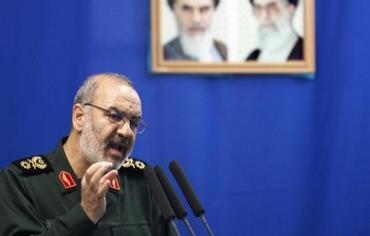
Hossein SalamiHossein Salami, deputy head of Iran’s Revolutionary Guard. Photo: REUTERS

Deputy Commander of Iran’s Revolutionary Guard, Brig.-Gen. Hossein Salami, said that the US status in the world has deteriorated and that its collapse is near.

“Today nowhere in the Muslim world” does anyone pull out “a red carpet for American officials and that’s why [US President Barack] Obama secretly” showed up at Bagram military base in Afghanistan without first letting President Hamid Karzai know, said Salami, according to a report by Iran’s Fars News Agency.

“And this shows that the US Empire in the world is coming to an end,” he said.

Obama made a surprise visit to Afghanistan on Sunday and spoke to the Afghan president, but did not meet with him.

The Afghan president rejected an invitation extended through the US embassy to meet Obama at Bagram.

“President Karzai said he would warmly welcome him if he comes to the palace but in no way he would go (to) Bagram to meet him,” Abdul Karim Khurram, Karzai’s chief of staff, told Reuters.

A US official said the White House was not surprised that the proposed visit did not work on short notice.

The commander also said, according to the report, that Iran continued to gain military and economic power, warning the country’s enemies that their plots against it would fail.

“Any enemy formula will entail an unexpected ending for him and this is due to the Iranian nation’s reliance on religious and Islamic beliefs,” added Salami.

Meanwhile, Iran’s Foreign Minister, Mohammad Javad Zarif, slammed Israel’s attempts to set red lines on the country’s nuclear program at a ministerial conference of the Non-Aligned Movement in Algeria on Wednesday.

“Is this not insolence towards the international law and the Non-Proliferation Treaty that (Israel) a non-member of NPT, which has massive nuclear arsenals and poses major existential threats to the entire Middle East region, sets redlines on Iran’s peaceful nuclear program?” said Zarif, Iran’s Tasnim News Agency reported.

He added that attempts to paint Iran as a threat to the region and the world have repeatedly turned out to be “total lies” and that the country is opposed to nuclear weapons.

Separately, Iranian and Russian officials met in Tehran on Wednesday in order to expand trade cooperation, Fars reported.

Russian ambassador to Iran, Levan Djagaryan, met the head of Iran’s Customs Administration, Massoud Karbasiyan.

“Iran and Russia are going to sign a new document on customs cooperation,” said Karbasiyan.

For his part, the Russian ambassador called for improved bilateral trade.

Current trade is worth around $5 billion a year, according to media reports.

How did the world react to Obama’s outline of the US global role?

May 29, 2014

How did the world react to Obama’s outline of the US global role? Christian Science Monitor, Ariel Zirulnick, May 29, 2014

President Barack Obama‘s long-awaited foreign policy speech Wednesday left most wanting more. Widely criticized as lacking any concrete proposals or guideposts for future foreign engagements, the speech garnered only muted reaction overseas. 

It listed some problems, outlined some principles, but did not lay out any real goals or even a hint of what America’s objectives in the world should be going forward.

A daily roundup of terrorism and security issues.

President Barack Obama‘s long-awaited foreign policy speech Wednesday left most wanting more. Widely criticized as lacking any concrete proposals or guideposts for future foreign engagements, the speech garnered only muted reaction overseas.

The key announcement was that of a $5 billion “counterterrorism partnership fund” that would be earmarked for capacity building in other countries on the “front lines” of the effort to combat global terrorism, which Obama called the paramount threat to the homeland.

As The Christian Science Monitor summed it up:

But other than the new counterterrorism partnership fund, the speech was devoid of initiatives or proposals and instead seemed aimed at refuting mounting criticism both domestically and among some worried international partners that his foreign policy is weak and rudderless.

The president asserted that by virtue of its economic power, unmatched military, values, and spirit of innovation, America will remain the world’s “exceptional” leader. The real question, he said, is not “whether America will lead, but how we will lead.”

But other than virtually ruling out American boots on the ground in foreign conflicts and emphasizing international partnerships, Obama’s speech gave few specifics on the “how” of US global leadership for the remainder of his presidency.

Foreign Policy columnist David Rothkopf echoed that take: “It provided neither reassurance to allies nor anything remotely like a foreign-policy vision. It listed some problems, outlined some principles, but did not lay out any real goals or even a hint of what America’s objectives in the world should be going forward.” News website Vox may be one of the only US outlets who found his speech a “unified, tightly focused vision of America’s role in the world.”

BBC North America editor Mark Mardell did a line-by-line analysis of the speech. He scoffed at the announcement of more assistance for Syria and the counterterrorism fund as too late in the game and found most of the speech predictable.

The problem with this speech is that it is a restatement of Mr Obama’s policy, not a re-evaluation. He’s defending a policy that has manifestly failed to produce a stable world free from crisis and turmoil. That doesn’t mean anyone else would have had better luck with a different sort of policy – but it does mean he is defending something that has not had many success. He’s avoided a world where America is up to its arms in new wars – but he has hardly brought forth a shining new dawn for peace and democracy. To some questions, there are no answers, but saying so is hardly glorious.

At the Carnegie Endowment for International Peace in Europe, Judy Dempsey, the editor-in-chief of their Strategic Europe publication,chastised European leaders for going along with US policy in the past and challenged them to come up with their own independent foreign policy. “For far too long, most European leaders were relieved to have America do their dirty work,” she wrote, citing Europe’s toothless condemnation of the Guantanamo Bay detention center.

Yet behind these words is a retreat to a special kind of soft power. Obama wants to establish new counterterrorism partnership fund designed to train and “facilitate partner countries on the front lines.” He intends to work with European allies “to train a functioning security force and border patrol in Libya and [support] French operations in Mali.” There was very little mention of the role of NATO.

European leaders should not feel vindicated by Obama’s speech. They have been wobbly over Russia and inconsistent over defending their values. If anything, they should realize that the United States is no longer going to do the running for the Europeans. Since that is the case, what about the Europeans replying to Obama with their own foreign and security policy doctrine?

Predictably, Pakistan‘s coverage on the speech focused on Obama’s comments on drone strikes there – never openly acknowledged by the US, but explicitly stated by Pakistani journalists – and US plans to scale down its military role in Afghanistan, which have significant implications for Islamabad. The Dawn headlined its story “Obama stresses need for transparency in strikes.”

In an indirect reference to the CIA, which runs the drone programme for Pakistan, President Obama noted that the US intelligence community had done outstanding work. “But, when we cannot explain our efforts clearly and publicly, we face terrorist propaganda and international suspicion; we erode legitimacy with our partners and our people; and we reduce accountability in our own government.”

Every US administration has taken a stab at the Israeli-Palestinian peace process, and Obama was no exception. Secretary of State John Kerry made frequent trips to the region to thrash out a framework for an agreement, but those efforts fizzled last month with no sign of a Plan B. The US now seems to be taking a break from its thwarted peacemaking. Indeed, the only mentions of Israel in Obama’s speech were in relation to US interests in Iran and Egypt.

Israelis noticed. From Haaretz:

To say that the Israeli-Palestinian peace process was conspicuously absent from U.S. President Barack Obama’s speech at West Point on Wednesday is an understatement. Administration officials tried to downplay the significance of the omission, but the facts speak for themselves: Obama devoted almost 5,000 words to outlining America’s foreign policy in the coming years, none of them touching on what was described until recently as one of its primary, strategic objectives. And the Palestinians? Nothing. Gurnischt. Not a peep.

“This was a speech focused primarily on security issues. It was not our intent to discuss every aspect of our foreign policy,” the officials said. That’s one explanation. The others are that Obama saw no reason to include such an abject failure in the list of successes that he detailed; that he actually has no intention of doing anything about the peace process under any circumstances; and – most importantly – that he’s truly fed up. Yes, yes, fed up with both sides, but not equally, because it is on the Israeli side that one finds most of the critics and detractors that he tried to confront in his speech.

The Times of Israel also noted the exclusion at the end of its story on the speech.

Attention will now turn to East Asia, as Japanese Prime Minister Shinzo Abe prepares to unveil his own foreign policy doctrine at a regional security conference in Singapore on Friday. He is expected to address his plans for a greater role for the Japanese military and for the ongoing face-off with China in the South and East China Seas, The Wall Street Journal reports.