Archive for April 2014

Jews Ordered to ‘Register’ in Donetsk, Ukraine

April 17, 2014

The Jewish Press » » Jews Ordered to ‘Register’ in Donetsk, Ukraine.

Flyers with instructions to “register” were handed to Jews as they left synagogue following holiday prayers.

By: Hana Levi Julian

Text of anti-Semitic flyer distributed to Jews in Donetsk, Ukraine on Passover 2014.
Photo Credit: Courtesy, Israel Matzav blog 

It is said that those who do not learn from history are doomed to repeat it.  For some Jews in Donetsk, Ukraine on this Passover holiday of “freedom,” concern and even fear is lurking in their thoughts, making them wonder about the lessons of the past.

On the first day of Passover this week, three armed men in the eastern Ukrainian province of Donetsk distributed flyers warning Jews to “register” themselves and their assets with the new pro-Russian government, according to the novosti.dn.ua website.

The flyers were handed out next to a synagogue as people were leaving following holiday prayers. They read as follows:

“Dear Ukraine citizens of Jewish nationality,

Due to the fact that the leaders of the Jewish community of Ukraine supported (Stepan) Bendery Junta, and oppose the pro-Slavic People’s Republic of Donetsk, [the interim government] has decided that all citizens of Jewish descent age 16 and older, residing within the territory of the republic, are required to report to the Commissioner for Nationalities in the Donetsk Regional Administration building and register by May 3.

(Ed. Note: Stepan Bander was a Ukrainian nationalist leader in Kiev who fought with Nazi Germany in the 1940s against Soviet troops before switching sides and taking up arms against the German occupation.)

“ID and passport are required to register your Jewish religion, religious documents of family members, as well as documents establishing the rights to all real estate property that belongs to you, including vehicles. Evasion of registration will result in citizenship revocation and you will be forced outside the country with a confiscation of property. A registration fee of $50 is required.”

Pro-Russian separatists are occupying the building where the Jews were told the register.

The flyer was written in the Russian language and bore the symbol of Mother Russia at the top of the page and that of the Donetsk People’s Republic at the bottom. It was allegedly signed by Denis Pushilin, chairman of the Donetsk interim government but no ink signature is seen on the paper.

Donetsk was recently declared an independent “people’s republic” by pro-Russian activists. In response to a query by a Ukrainian Jewish website, Pushilin confirmed the flyers were indeed distributed by his organization. However, he was quoted by the tvrain.ru news site on Wednesday as denying any connection to the content, and called the flyers a ‘provocation.’

Nevertheless, Jewish Agency Chairman Natan Sharansky told Voice of Israel government radio on Wednesday that aliyah from the Ukraine is likely to double by the end of 2014.

The flyer – authentic or not – constitutes the 17th anti-Semitic incident to have taken place in Ukraine since the beginning of 2014. Most were violent attacks. Several were aimed at Chabad-Lubavitch emissaries and a few were life-threatening. Five took place in Kiev alone, according to statistics gleaned from the Coordination Forum for Countering Antisemitism (CFCA) website.

A reader on the Israel Matzav blog warned in a number of posts that the situation in Ukraine is becoming extremely dangerous for Jews.

Wisely, a Jewish resident of Donetsk told Ynet that she does not intend to register, although she said that she had never encountered any form of anti-Semitism until she saw the flyer. “Though I take it very seriously, I am uncertain of its authenticity,” she said.

Plutonium in the Islamic Republic: Make-or-break issue or simply a decoy?

April 17, 2014

Plutonium in the Islamic Republic: Make-or-break issue or simply a decoy? | JPost | Israel News.

By YONAH JEREMY BOB

04/17/2014 02:43

Iran will sway West to allow it permanent near nuclear break-out capability, if it exchanges reduced plutonium production capacity, dilution of medium-level enriched uranium for enrichment capabilities of low-level uranium.

A general view of the Arak heavy-water project, 190 km (120 miles) southwest of Tehran

A general view of the Arak heavy-water project, 190 km (120 miles) southwest of Tehran Photo: REUTERS

The latest reports from the negotiations between the P5+1 powers and Iran over the latter’s nuclear program indicate that the Islamic Republic might be ready to make a key concession on slowing its path toward producing a nuclear weapon using plutonium.

The specific issue is what will happen with Iran’s Arak nuclear facility. If it is completed and operates as it is currently designed, it could produce enough plutonium for a nuclear weapon within eight months, according to the International Institute for Strategic Studies.

There are many other issues that could mean a longer waiting period, but Arak is considered a serious enough issue to be a deal-breaker for the US, and was the issue that almost torpedoed the interim deal.

Iran’s decision to halt construction – at least internally – of the plutonium facility as part of the interim deal, and its recent announcement that it might be willing to redesign it to greatly decrease the speed at which it produces plutonium, indeed mark a potential negotiating victory for the West and a deal-breaker in a final agreement.

The latest issue of Arms Control Today, a publication of the Arms Control Association, features some of these compromise solutions. But has Iran used the matter of Arak as a decoy to distract the West from negotiating hard on the primary issue of uranium enrichment? With all the highly complex nuclear issues to negotiate regarding the country’s multiple nuclear capabilities, the interim and final deals in many ways will come down to old-fashioned bargaining.

While there are certain issues that are deal-breakers, the West’s negotiating position has shifted much closer toward that of Iran in recent years.

This is mostly a function of Iran successfully breaching past red lines without having faced consequences.

The shift is so prominent that some of those red lines might now be less important to the West than the goals of avoiding an overt Iranian weapons capability and being able to claim victory by at least extracting some high-profile concessions from Tehran.

For example, only a short time ago the West’s demands were for no more uranium enrichment by Iran at any level, the shipment abroad of much of the country’s enriched uranium stockpile, the dismantling of its long-secret underground Fordow facility, and the dismantling of the Arak facility – in a nutshell, eliminating both the present and future paths to a bomb.

Now it appears that the red lines amount to keeping Iran at least 6-12 months away from “break-out capacity” – where it could produce a bomb – and under heavy monitoring while at least reducing the threat presented by the Arak facility (without touching the Fordow facility).

This is where the Arak concession comes into play.

It is absolutely a serious concession and a deal-breaker on its own. But if Iran successfully trades a reduction of its plutonium production capacity and the dilution of its medium-level enriched uranium for being able to permanently continue enriching low-level uranium, it will have succeeded in having the West agree to it maintaining a permanent near-break-out capability (6-12 months, maybe less if clandestinely).

At the same time, the West will be able to truthfully claim it halted Iran’s path to a plutonium bomb and froze its path to using uranium, with the plutonium halt being the biggest proof it “won” and got the Islamic Republic to back down.

Many say that had the West not raised the stakes, Iran would have undoubtedly gone down both paths. But another, more likely possibility – since several basic aspects of the plutonium path to a weapon still do not exist, and most of what does exist is half-baked – is that the plutonium path is nothing more than a decoy.

Iran may have planned from the start that it would “concede” its plutonium path to prove its intentions were not weapons-related, while using it to at least keep its uranium option open, something that a few years ago the West would not have agreed to. If this is true, any future public dispute between Iran and the US over whether to reduce the Arak facility’s plutonium production, fully convert it to a light-water reactor (not usable for weapons-grade material) or totally dismantle it could be seen from this vantage point as being somewhat staged.

Regardless of whether or not it was a grand strategy from the start, even if the final deal stops Iran’s path to a plutonium weapon but preserves both a “modest” (a term used by US President Barack Obama) Iranian “right” to uranium enrichment and lets Iran keep some of its stockpile, the outcome would likely be a permanent near break-out capacity – which Secretary of State John Kerry essentially has confirmed to Congress.

Surprise Attack on Iran: Can Israel Do It?

April 17, 2014

Surprise Attack on Iran: Can Israel Do It?.

April 16, 2014

According to a report [3] in March by the Israeli daily Haaretz, Israel continues to prepare for a strike on Iran’s nuclear facilities.

Quoting anonymous members of the Knesset who were present during hearings on the military budget, officials in the Israel Defense Force (IDF) have allegedly received instructions to continue preparing for a strike and a special budget has been allocating for that purpose. However, conducting a military operation against Iran’s key nuclear facilities would be a challenging task for the Israeli military. The distance from Israel to the Iranian nuclear sites is such that any strike using the air force would be challenging on its fuel capacity. Allocating tanker planes to the mission could alleviate part of this concern. Nonetheless, Israeli jets can’t spend too much time in Iranian airspace before the mission itself is in jeopardy. Engaging Iran’s air force in dogfights must be avoided. Therefore, surprise will be a necessary element in a successful Israeli mission.

A successful surprise attack is not easy to achieve. It rests on the ability to deceive the adversary. In general, a deception strategy might involve several elements, related to the timing of the operation, the military platforms involved, the targets, the routes chosen to the targets, the munitions used, and so on. There are several potential obstacles. First, preparations for conducting a military operation must be made without revealing the main elements of the surprise. Second, the political decision must be made covertly, that is, without revealing the timing of the operation. Could Israel pull it off?

Israel’s History of Surprise

Israel has in the past utilized both of these elements in order to succeed with conducting military operations. Both the Entebbe operation in 1976 and the attack on the Iraqi reactor in 1981 came as complete surprises to the targets due to their lack of knowledge about Israel’s military capabilities and understanding of its decision-making process and willingness to accept risk.

An example of the latter factor as an element of surprise was the 1967 attack on Egyptian airfields. At the time, Israel possessed about two hundred operational jets. 188 were used against the airfields. The costs of this strategy were obvious: only twelve planes were left to defend Israel’s territory. Egypt failed to understand the Israeli willingness to accept risk, which in part led to the mission’s success.

Another example of deception came before the 1982 invasion of south Lebanon. Prior to the formal Israeli annexation of the Golan Heights in late 1981, Israel amassed military forces in the north to deter a Syrian response. Instead of scaling back after tension had subdued, Israel kept the forces there in order to utilize them in the forthcoming Lebanese campaign. Getting used to the increased Israeli military presence in the north, the PLO and Syria failed to consider the possibility that these might be stationed there for a forthcoming invasion. Israel was itself the victim of this strategy in 1973. Egypt conducted several large training drills prior to its surprise crossing of the Suez Canal. This made it hard for the Israelis to assess whether the Egyptian actions were part of another drill or preparation for an actual attack. The Israeli failure to acknowledge this potential Egyptian deception strategy is also an example of how a state fails in incorporating the lessons of the past. Just five years earlier the Russian army had invaded Czechoslovakia in a move that begun as a training exercise and continued as a surprise attack. The head of Israeli military intelligence at the time, Aaron Yariv, issued a directive that every major training exercise by an adversary was to be regarded as a potential attack, but this directive was forgotten by the Israeli military and political leadership after Yariv quit his position in 1972.

There was an additional element to the 1973 Egyptian deception strategy. In 1968, Egyptian generals concluded that they did not have the capabilities to challenge the Israeli military. Still, the decision was to train as if it had the military capability to go through with the attack. After focusing all of its effort on covertly acquiring the necessary equipment and manpower—thereby making previous exercises more relevant—its capabilities came as a surprise to the Israelis who still assessed that the Egyptian military was in no shape to undertake the crossing. Israel learned the lesson of that experience and then utilized it in the 1981 attack on the Iraqi reactor. After having trained for months on fuel-saving maneuvers, and after just having absorbed their new U.S.-supplied F-16 fighters, the Israeli air force had acquired the necessary capabilities for the mission. It was Iraq’s turn to fail in accurately updating its assessment of Israel’s capabilities.

Surprise and Decision-Making

An element of deception must also be included in the decision-making process. The meeting of the Syrian-Egyptian Armed Forces Supreme Council in August 1973 serves as a precedent. In order to keep the meeting secret, all participants resorted to civilian means of transport and false passports. An important topic was on the agenda at that meeting—a decision on the two options for D-Day (only to be awaiting the final approval of presidents Sadat and Assad). It was deemed crucial that the Israelis did not learn of the meeting.

In Israel, it is the government as a whole—not the prime minister—that is the commander-in-chief of the military. The green light for a decision to attack Iran’s nuclear sites must thus be obtained from the cabinet ministers. Upholding secrecy after a vote in the full ministerial cabinet is a challenge. The cabinet meets every Sunday morning. However, according to the procedure requirements, the agenda items must be finalized by the preceding Wednesday. Listing the item “military attack against Iran” is not an option since the time frame from Wednesday to Sunday is a long period to keep a secret. There are three options: assure an unscheduled meeting (which may well ring some alarms), vote in advance (that is, further outsource the decision on timing to a smaller forum, but this would still risk the leak of valuable information), or announce a general or fake topic. The Begin government chose the second option prior to the attack on the Iraqi reactor in 1981. Then the ministerial cabinet approved the operation in principle and allowed the final decision to be made in the smaller security cabinet (consisting of key ministers). Former premier Ehud Olmert preferred a combination of the first and third option. The press release announcing an unscheduled cabinet meeting the day before the attack on the Syrian reactor in September 2007 said that the security cabinet was to convene to discuss “Israel’s response to Kassem rocket fire from the Gaza Strip”. Another example of Olmert’s masking of the decision-making process leading up to the attack on the reactor was related to a meeting with the U.S. administration in June 2007. The official reason given for the meeting between Olmert and George W. Bush on June 19 was Iran’s nuclear program and the peace process. However, in that meeting Olmert urged the U.S. to attack the reactor.

The Defensive Preparations Dilemma

Since the Iranians are expecting an operation, it would be impossible for Israel to achieve strategic surprise like they did with the attack on the Iraqi reactor in 1981. However, operational and tactical surprise may be achieved with regards to how the operation will be conducted and the specific date and time of the operation. One of the major problems will be how to achieve operational surprise when preparations will need to be undertaken to counter the threat of missiles from Iran, Hezbollah, and Palestinian groups in Gaza. One solution to this defensive preparations dilemma is to conduct exercises and distribute personal protective gear continuously for a long time, so as to make it impossible for Iran to determine when an attack will be launched. This has indeed been done. In recent years, Israel has conducted numerous large home-front exercises (in part also as a result of the Syrian civil war and potential fallout). It has also distributed gas masks to a large portion of the population (although it has recently been scaled back).

Mobilization of the reserves is a complex issue in Israel that also touches on the decision-making process. The mobilization would risk being delayed if it takes place under a massive missile attack from Iran and Hezbollah. A recent report from Israel’s state comptroller questioned the reserves’ ability to mobilize under fire. As such, the order needs to be given prior to the initial Israeli attack. However, mobilizing the reserves would be a signal to Iran that an attack is impending. It is possible that the Israeli leadership’s preferences for operational secrecy induce it to delay the mobilization until the day of the attack (to the risk of higher casualty numbers). According to Israeli law, mobilization of the reserves requires the approval of the Knesset Committee on Defense. Time could be saved with obtaining the committee’s approval in the months preceding the attack. Begin obtained an approval for the operation against the Iraqi reactor in the full ministerial cabinet in October 1980, which then outsourced the timing decision to the security cabinet. To protect secrecy after a series of domestic leaks, the security cabinet later decided to leave the decision on the date of the operation to Begin, Foreign Minister Yitzhak Shamir, and Chief of Staff Rafael Eitan. A similar procedure could be implemented with regards to the decision to mobilize the reserves.

Offensive Preparations

Complex military operations require lengthy preparations that cannot be concealed. However, although an adversary might know about the intention to attack, the timing and conduct of the operation are more difficult to dissect. In recent years, the Israeli military has conducted numerous offensive exercises to prepare for a potential green light from the political leadership. Two recent exercises demonstrating the capabilities of the Israeli air force took place in December 2013 and January 2014. Such exercises do not only prepare the pilots for a potential mission, it may also serve as part of a deception strategy. For several years prior to the Six Day War in 1967, Israeli aircraft could routinely be seen in the mornings hovering over the Mediterranean. As the Egyptians became familiar with the flight pattern, its air force did not pay much attention when Israeli planes followed the same route on the morning of June 5, 1967. The Israelis then launched a surprise attack. The trick used was to manipulate the adversary’s perceptions and expectations. Although Iran is not neighboring Israel and does not have significant satellite surveillance assets, it does have some intelligence capabilities that it uses to monitor Israel. For example, an Iranian radar is stationed in Syria. Iran is also known to be studying Israel’s military conduct in past campaigns. The head of the Iranian Civil Defense Organization Gholam Reza Jalali recently stated that it had sent a team to Lebanon after the 2006 war to study the effect of Israeli munitions on destroyed buildings. Apparently, Iran is also monitoring Israeli intentions and decision making. On January 26, 2013—four days prior to an Israeli attack on a convoy carrying missiles from Syria to Hezbollah in Lebanon—Supreme Leader Khamenei’s close advisor Ali Akbar Velayati stated that Iran would perceive an attack on Syria as an attack on Iran itself. Velayati might have known about the transport in advance and attempted to increase its chance of reaching its destination by creating a deterrent against an Israeli attack. This suggests that the Iranian regime have some understanding of Israeli intentions and redlines. Two Israeli signals are typical of an impending attack: deployment of Iron Dome batteries in areas of likely fallout and unscheduled meetings in the security cabinet. However, since the Israelis know there are under surveillance, they can also use it for deception. As long as the Syrian civil war continues, it would be difficult for Iran to know whether Israeli preparations are intended for the Syrian or Iranian arena. If Iran gets used to the Israeli behavioral pattern, then a surprise attack would be easier to achieve.

Operational Surprise

The need for surprise requires that Israel is the one choosing the date of the operation. This may sound as an unnecessary consideration since by definition a preemptive attack is triggered by a decision in the leadership of the attacking country. However, with regards to the timing of an attack against Iran’s nuclear facilities, there are some limits that constrain the time frame available to an attacker. Iran’s nuclear program offers two potential routes to a nuclear weapon—enrichment of uranium in centrifuge facilities or the production of plutonium in a yet-to-be-operational heavy-water reactor. Both of these routes must be considered when deciding on the date of an attack. The problem with linking the attack date to developments of the program is that Iran would have some control over the time frame available for an attack, thereby decreasing Israel’s ability to achieve surprise. Since an operational nuclear reactor is a politically difficult target and as such is off limits, the date when the Arak reactor will go “hot” serves as the outer boundary of the available time frame. Iran would have an incentive to get it operational in order to reduce the utility of an Israeli operation against the other facilities (it makes less sense to attack the enrichment facilities when Iran could subsequently move to produce plutonium using the surviving reactor). On the other hand, its operational status constitute an Israeli redline, so Israel will have a strong incentive to launch an attack before it goes “hot.” From the Iranian perspective, there is a dilemma between halting the work on the reactor—thereby reducing tension with Israel—and continuing with the work to dictate Israel’s available time frame.

The element of surprise is also related to the choice of flight route to targets in Iran. Early detection by neighboring states situated along the Israeli route is not necessarily an operational threat as long as the Israeli planes are not targeted by Arab antiaircraft systems and early warning is not passed on to the Iranian government. Given Israel’s dependence on achieving the element of surprise with regards to the operation’s timing, coordinating the operation with an external actor might be problematic and would involve considerable risk. Over the years, several such alleged partnerships have been suggested. In April 2012, a rumor emerged that Israel had been granted access to Azeri bases. Both Turkey and Saudi Arabia have been named for this purpose as well. In June 2010 news reports surfaced in Western media saying that the Saudi military had conducted a test of its antiaircraft systems and radars to ensure that it did not attack Israeli jets en route to targets in Iran. And again, in November 2013, The Sunday Times reported that Riyadh had given its consent to Israel’s use of its airspace. However, coordinating a leak-sensitive operation with another state involves huge risks. Israel recently learned the price of regional cooperation with regards to sensitive operations. According to a October 2013 report by The Washington Post columnist David Ignatius, Turkey-Israel intelligence relations experienced a severe setback after Turkish espionage chief Hakan Fidan provided Iran with a list of Iranians who had met Mossad case officers in Turkey. There is thus an inherent dilemma between coordinating with an external actor—thereby easing the operational obstacles represented by the length of the route, the number of planes necessary for destroying the targets, and the requirements for conducting rescue operations—and minimizing the risk of leaks.

In order to avoid early detection, Israel would need to reduce the external signals of the strike force. This can be done is several ways. One way is to jam or blind radars located along the route to the nuclear sites. Another option is to avoid the radars’ detection range. On June 7, 1981, Israeli jets on their way to the Iraqi reactor were flying low above the desert to avoid detection by radars. Similar low-profile flight paths could be chosen to Iranian nuclear sites. A third option is to use decoys to lure Iran into focusing its attention on the wrong targets. This was Israel’s deception strategy in the 1982 Bekaa Valley attack on Syrian anti-aircraft batteries. A fleet of Israeli UAVs was detected by Syrian radar. Subsequently, the anti-aircraft positions were exposed as the decoys were targeted. One can also try to pretend that the planes belong to the adversary. This might be the reason for Iran’s recent decision to copy Israel’s Heron design for its Fotros UAV. Iranian-made UAVs operated by Hezbollah have penetrated Israeli air space several times in the past: twice during the Second Lebanon War in 2006 and once in October 2012. Should a Fotros UAV penetrate Israeli airspace, it might take some time for Israel to identify it as hostile. The same could apply to Israeli jets or UAVs operating in Iranian air space.

As they examine the difficulties of carrying out a strike, Israeli operational analysts can take comfort in the fact that Israel has achieved surprise many times before. Iran, as the intended target of a potential attack, is faced with several problems. One is to detect the decision to attack. Another is to accurately assess the timing and conduct of the operation. And a third problem is to take measures to prevent it. Iran was caught off guard by Iraq’s invasion in September 1980. Could it get caught napping again?

Thomas Saether is a Norwegian security analyst and a post-graduate from the MA program in security studies at Tel Aviv University.


Prepare for a bad Iran deal

April 16, 2014

Prepare for a bad Iran deal – Artaxes’ brainbench.

Why the likelyhood of a bad deal with Iran has increased

By Charles Artaxes

Before I begin I want to make clear for the reader not familiar with my writings that the name Obavez refers to the US president who reminds me more of Hugo Chavez than of an US president.

We are living in a strange world. While in the recent weeks we were hearing and reading statements from the US, China and Iran expressing optimism that a deal with Iran could be struck by the deadline set for July 20, 2014 we see no indication that the positions of both sides have moved even nearly close enough to bridge the gap between them.
Far from it, the Iranians have moved further away by increasing their demands by claiming that they need substantially more centrifuges and by claiming that they have the right to enrich uranium up to 90%.

Of particular interest were the statements of Rouhani who said “We will witness the sanctions shattering in the coming months.” and the statements made in an opinion piece published in the Russian online edition of RIA Novosti claiming that “The head of the Center for Modern Iranian Studies, Radzhab Safarov, said he was “90 percent sure” that an agreement to lift sanctions against Iran will be reached during the April 7-9 meeting in Vienna, paving the way for military cooperation between Moscow and Tehran.”.
Now, all these statements could just be expressions made for politcal purposes not grounded in reality or it could be that these people know something that we don’t know.
Be it as it may. Although April 9 has passed and although such optimism seems to fly in the face of reality there are recent global developments that have increased the likelyhood of an US deal with Iran considerably.

Of these developments the two most important are the the crisis in Ukraine and the collapse of the MidEast peace process.
With the annexation of Crimea being a fait accompli Putin seems well on his way to annexing more parts of Ukraine since the recent escalation in eastern Ukraine and the massive concentration of Russian troops inidicates that a Russian invasion is just a matter of time.
This of course will have implications for the P5+1 negotiations with Iran because Russia has already indicated that it might retaliate by sabotaging the negotiations if the West tries to punish Russia for its intervention in Ukraine.
But in contrast to many commenters and op-ed writers I see Russia not sabotaging the negotiations directly but in indirect ways.
It would be bad publicity for the Russians to sabotage the negotiations directly.
It would be much smarter to undermine the sanctions regime and simultaniously encourage the Iranians in secret to be more intransigent and to increase their demands and also play for time.
If the sanctions were to be undermined there would be less economic pressure on the Iranians enabling them to drag the the negotiations for much longer.
As Reuters reported Russia and Iran are working on a oil-for-goods deal worth $20 billion. That would be precisely the way to undermine sanctions.
The other possible way for Russia to retaliate is to encourage Assad to stall the implementation of the deal on the destruction of his chemical weapons.
Assad just missed yet another deadline for handing over his vast bulk of chemical weapons which means that their removal falls further behind schedule.
From the Balkan wars in the 1990s to Syria to Iran, Russia used such crises to present itself as an important global player whose help is needed to resolve these crises thus compensating for its loss of superpower status.
But in all these crises Russia was never a part of the solution but part of the problem. In the case of Syria and Iran Russia is not interested in solving these crises (except on its terms). On the contrary, the crises ensure that Russia is needed as a ‘partner’ who ‘helps solving’ these crises and moreover they provide them a means to blackmail the West. If the West takes actions against Russia’s expansion in the Ukraine, Russia can retaliate by withdrawing its ‘cooperation’ or worsening these crises.
In the case of the former Yugoslavia the Gordian knot was cut by unilateral NATO action but absent Obavez’ willingness for military action this option is not available.
This leaves the West helpless against Russia’s moves.

So far the record of the Obavez administration has been atrocious, with disaster piling upon disaster and scandal piling upon scandal and the greatest of all disasters, ObavezCare, is assumed by many to cost the Democrats dearly in the 2014 elections.
Like many presidents before him Obavez has in his second term only one field were he could score major political points: foreign policy.
But the problem is that his foreign policy is equally disastrous and one of the two major foreign policy initiatives, the MidEast peace process, is already a total failure.
While some have declared the MidEast peace process already dead and others say that it was a stillbirth I think we can savely say that it is in a deep coma from which it’s not going to wake up anytime soon and even if it wakes up it will be so badly damaged that it can never sufficiently recover.
Therefore we don’t need to wait for the official death certificate to aknowledge that it is a total disaster for the Obavez administration.
That leaves only one field where the Obavez administration could be successful: a deal with Iran.
This increases the chances that the US administration might be so desperate for a success that it might accept any deal, a very bad deal even by their own standards.

All these developments might lead to a surprising result where Iran sides with the US and not with Russia.
If Iran were to strike a deal with the US it would achieve a tremendous result: It would be totally free from sanctions and would be treated not much differently from any other nuclear state like for example Japan.
Iran would be free to trade unhindered with the rest of the world enabling the mullah regime to end its dependence on Russia and buy military hardware and expertise from whichever country is willing to sell it.
The economic boost would not only stabilize the mullah regime but it would also provide the money to develop its nuclear program and all the military aspects of it even faster.
Of course an acceptable deal for Iran would have to be ‘an offer they can’t refuse’ giving them pretty much everything they want.
Needless to say that such a deal would bring not more freedom to the Iranian people and neither would Iran cease to see America as ‘the big satan’ and enemy number one.
There are those who see Iran as a mere pawn of Russia but I beg to differ. The Iranians have much bigger ambitions and taking their history with the mighty Persian empires of the past into account they certainly see themselves not as pawns but as a great power rising again and taking its rightful place in the world.
They are just cunningly playing their game.

Does all this sound strange to you?
Well, it might after all be not that farfetched.
I want to quote the Russian op-ed I mentioned earlier: “The expert said that the standoff over Crimea, the worst since the end of the Cold War, would contribute to the Iranian talks, because “there will be a bitter struggle between Russia and the West to win Iran round.”.
Given that Putin has tight control over the Russian media and given that RIA Novosti is run by the Russian state it is reasonable to assume that it does not contradict the views of the Russian goverment.

What does this mean for Israel?

In a very interesting interview with the New York Time’s Ethan Bronner Israel’s former military intelligence chief Amos Yadlin spoke on a wide range of topics (including Syria, Egypt and Iran).

He repeated his four conditions that are necessary for a military strike on Iran.
1. Israel can do it.
2. Bombing Iran is less dangerous than all the other alternatives.
3. Legitimacy (meaning there are no other alternatives)
4. No red light from the US

With regards to #4 he said that a red light would have to be taken very seriously into consideration.
Interestingly he mentioned also that a bad deal could be defined as a good deal.
As we have seen with the interrim deal this deal would be sold to the public as a great or at least an acceptable deal.
And that is the danger for the legitimacy of any Israeli strike.
This is why Israel must prepare for such an outcome ahead of time and plan accordingly.

Here is the full interview with Amos Yadlin.


May be Satire: Kerry Spokeswoman Protests Israeli Claim that he is a “Lapdog of the Arabs”

April 16, 2014

Kerry Spokeswoman Protests Israeli Claim that he is a “Lapdog of the Arabs,” Front Page Magazine,   , April 16, 2014

“John doesn’t even care about Arabs unless they’re Muslims. He certainly won’t be curling up in the laps of any Arab Christians. And Muslims are opposed to lapdogs for religious reasons as John found out when he tried to curl up in the lap of the Saudi monarch.”

KerryPoodle-1a

Kerry spokeswoman Jen Psaki, who has frequently taken issue with negative references by Israeli political figures to Secretary of State John Kerry denounced another claim from an Israeli political commentator that the respected diplomat was a “lapdog of the Arabs.

“I would just like to point out that it is completely false that the Secretary is a lapdog of the Arabs,” Psaki said. “That’s just the kind of extremist political rhetoric that we have come to expect from the Israeli far right which spends all of its time building settlements in the oldest city in the world instead of surrendering to terrorists like they should.”

“John doesn’t even care about Arabs unless they’re Muslims. He certainly won’t be curling up in the laps of any Arab Christians. And Muslims are opposed to lapdogs for religious reasons as John found out when he tried to curl up in the lap of the Saudi monarch.”

“Furthermore, it’s simplistic to reduce the career of a capable public servant and longtime senator to being a ‘lapdog for the Arabs’ when the Secretary has also been a lapdog for the Viet Cong, the Sandinistas, the Iranians and really anyone who would have him.”

“John Kerry is just naturally attracted to lying down in the laps of terrorists, Communists and any totalitarian movement while making a low purring sound.”

“If you’re a tyrant, John Kerry will come down and lie in your lap if you want him to. And if you don’t, he’ll wait outside your country, occasionally scratching at the door while making a high whining noise.”

It’s just who he is.”

While the preceding events did not actually take place, it was only because of the consistent refusal of Ms. Psaki to accurately and honestly comment on the Secretary of State’s attitude and behavior.

poodle-330x350

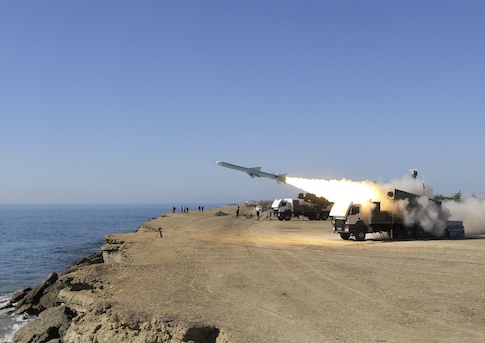
Iran Unveils New Anti-Ship Cruise Missile

April 16, 2014

Iran Unveils New Anti-Ship Cruise Missile, Washington Free Beacon, April 16, 2014

(As the United States disarm, Iran will surely follow; Iran is an Islamic, and therefore peaceful, republic. Clear now?  — DM)

U.S. to significantly cut back stock of missiles

APTOPIX Mideast Iran Naval DrillIranian naval exercises / AP

Iran announced that it has armed its warships with a new generation of cruise missiles and warned the West that its response to “any threat” will be “more deadly and heavier,” according to regional media reports.

A top Iranian naval commander revealed on Monday that Iran has armed its coastal defenses and warships with a new, domestically produced cruise missile primarily used to destroy enemy ships.

These new “Ghadir cruise missiles” have been loaded onto “both destroyers and missile-launching warships of the Navy, and they are also used as coast-to-sea missiles,” Iranian Navy Commander Rear Adm. Habibollah Sayyari wasquoted as telling the state-run Press TV.

The new weapons were unveiled just a day before a top Iranian Army Commander “downplayed the U.S. and its allies,” warning them that “in case of any threat, our response will be more deadly and heavier,” according to Iran’s Fars News Agency.

Iran’s military moves come as the United States moves to significantly cut its own cruise missile stockpiles, including the full elimination of the well-known Tomahawk and Hellfire missiles.

Iran’s new Ghadir cruise missile has been described as a “state of the art” weapon that can be fired “surface-to-surface.” Iranian officials said that they primarily aim to fire it from the coast to the sea. 

“Ghadir cruise missiles have been mounted on both Navy destroyers and missile-launching warships and they are also used as coast-to-sea missiles,” Sayyari later told Fars.

The cruise missile is reported to have “great precision and high destructive power” compared to several other types of cruise missiles that are currently being produced in Iran.

The Iranian military employs at least six other types of cruise missiles that have been domestically produced.

As Iran increases its stock of cruise missiles, the United States is currently gearing up to significantly cut a wide range of missiles that have been employed for decades.

President Barack Obama’s 2015 budget proposal aims to abolish both the Tomahawk and Hellfire missiles, as well as scale back the procurement of many others.

Obama’s proposal slashes funding for the Tomahawk by $128 million and fully eliminates procurement by 2016.

The U.S. Navy also will be forced to end its acquisition of Hellfire missiles by 2015.

The Navy has long relied heavily on both of the missiles.

Some 220 Tomahawks were fired during the 2011 military incursion into Libya. Nearly 100 Tomahawks are used on average each year, leading defense experts to warn that the stock could be completely depleted by around 2018.

Meanwhile, Iran has upped its air defense surveillance and installed a “data gathering” system onto several sites, according to Fars.

The reconnaissance tools reportedly “send the data pertaining to the direction, altitude and speed of flying targets to the control centers” several miles away, according to Iranian Brig. Gen. Farzad Esmaili, who serves as commander of the country’s Khatam ol-Anbia Air Defense Base.

These transmission systems would allow Iran to more closely track flying objects and target them.

Keeping our eye on the ball

April 16, 2014

Keeping our eye on the ball | JPost | Israel News.

By RUTHIE BLUM

04/15/2014 22:41

The Ofek 10 launch served as a reminder that the Netanyahu government is not succumbing to international inaction with regard to the Islamic Republic and its proxies.

Ofek 10 satellite

Ofek 10 satellite Photo: DEFENSE MINISTRY

After Secretary of State John Kerry’s anti-Israel “poof speech” last Tuesday before the Senate Foreign Relations Committee – and the subsequent suggestion last Thursday by his spokeswoman, Jen Psaki, that progress was being made in the negotiations between Israel and the Palestinians (a euphemism for additional, unreciprocated Israeli concessions) – it was a huge relief to be treated to some good news.

Since it is extremely demoralizing to have one’s government pressured into pandering to the Obama administration, it has become increasingly easy to sink into despair about the fate of the Jewish state. This leads to thoughts, aroused by the upcoming Passover holiday, that maybe we Israelites never really escaped Egyptian bondage, and that the only thing left of our yearning for Jerusalem is matza-induced indigestion.

Last Wednesday night, this sense of doom suddenly dissipated – poof! – with the successful launch of the Ofek 10 spy satellite into space.

The Ofek 10 is the latest in a long line of radar satellites developed in Israel. This one is equipped with even more advanced technology, which enables observation and imaging at any time of the day or night, and under any weather conditions.

It is also quicker, more durable and less expensive than its predecessors, thanks to the know-how, hard work and cooperative efforts of hundreds of experts in the Defense Ministry, Israel Aircraft Industries, Israel Military Industries and other participants in the project.

BUT IT is not merely pride in the venture that is uplifting; after all, the wonders of Israeli innovation are old hat by now, eliciting barely a yawn among the public responsible for it.

No, the reason for the surge in national spirit has to do with the purpose of this particular satellite: to monitor the activities of Iran and the rest of the terrorist organizations in the region. It is these entities that constitute the true and present danger to the state of Israel – not the hyped-up demography problem behind the “two-state solution” hysteria; not the inability of young people to purchase apartments; not the issue of foreign workers; not the fight over whether women can pray at the Western Wall as they please or how long haredim should serve in the army; not Sara Netanyahu’s alleged abuse of the staff at the Prime Minister’s Residence; and certainly not the coalition crises created by all of the above.

Indeed, contrary to what Haaretz and its ilk would have everybody believe, the most palpable existential threat to Israel is external. And it is only because of the vigilance of the IDF and resourcefulness of civil society that the world sees only the start-up nation Goliath, rather than the war-torn David, fending off rocket fire on the one hand, and boycotts, divestment and sanctions on the other.

So watching the American administration belittle Netanyahu while allowing Iran to buy time to build a nuclear bomb has had a terrible effect on the country that the regime in Tehran wishes to wipe off the map. That the Palestinian Authority, which is on board with this goal, is able to dictate its terms to Washington has made the whole farce all the more frightening.

The Ofek 10 launch served as a reminder that the Netanyahu government is not succumbing to international inaction with regard to the Islamic Republic and its proxies. Though an intelligence-gathering satellite, not a weapon, its highly publicized lift-off contained two messages. The first was for the mullahs – to let them know that their every military move is being monitored.

The second was for the citizens of Israel, frantically preparing for Passover – to let us know that someone’s got our back.

The writer is the author of To Hell in a Handbasket: Carter, Obama, and the “Arab Spring.”

Off Topic: The Kansas tragedy

April 16, 2014

The Kansas tragedy | JPost | Israel News.

By JPOST EDITORIAL

04/15/2014 22:29

Today, we stand together in solidarity with our Jewish family in the US in mourning the dead and wounded.

Jewish Community Center Kansas City

Jewish Community Center in Greater Kansas City calls for solidarity. Photo: YOUTUBE SCREENSHOT

America is no stranger to senseless shootings.

That being the sad case, it is easy to place the targeting of two Kansas City-area Jewish institutions into that “senseless” category and thereby eventually put it out of mind.

Besides, some of the shooting sprees across the US in recent years have exacted far greater tolls than the three lives taken in Overland Park, Kansas, on the eve of Passover.

But this shooting was not “senseless.” The targets were not random and the killer came to do his evil deed with a brazenly touted motive. “Heil Hitler,” he hollered This was a crime directed against Jews and committed in the name of the most unspeakable barbarity ever unleashed on the Jewish people. If this was not a hate crime, it is impossible to define what one is.

The Jewish community in Kansas and American Jews throughout the country were given bitter food for thought this Passover. One of the most meaningful passages in the Haggada holds that “in every generation, they rise upon us to destroy us.” This is an indisputable fact of Jewish existence at all times and in all places – the American Midwest included.

US Jews may not wish to acknowledge that reality.

But the ancient, noxious hate against the people of Israel still exists in some places.

It is difficult to confront such truths in places where Jews enjoy uprecedented liberty and freedom and have made their mark in every facet of the American landscape.

Perhaps because of that sense of security and well being, an increasing proportion of the American Jewish population prefers to make believe that they are immune to the Jewish lot of yesteryear and of other lands. That’s why the Kansas shooting can’t be seen as an isolated incident and why it is far from simple to compare the Kansas atrocity to the Toulouse one of two years ago. The French Jewish community is vastly different from the American and the Toulouse shooter was an Arab and a jihadist. His American counterpart was a Ku Klux Klan activist, apparently impelled by the more old-style anti-Semitism, even though he too railed against “the Zionists.”

But the bottom line is the same. In both cases the aim was to kill Jews for the crime of being Jews (although in Kansas this did not quite go to plan).

In both cases the shootings cannot be divorced from other acts of violence and most of all from words. The World Wide Web makes the most virulent anti-Semitic invective easier to disseminate and more incendiary than ever.

The Web is a scary space. The amount and degree of incitement against Jews and the Jewish state boggles the mind. Ignoring it is no answer.

There is no denying that anti-Semitism flourishes.

A teacher at the prestigious North London Collegiate School recently warned a Jewish pupil that she would send her to “one your gas chambers” for jumping the queue at the dining hall.

In that vein but immeasurably higher on the viciousness scale was an article the Ukrainian Misto Vecherniye (“Evening City”) newspaper printed in the past week. In apparent earnestness, its author warns readers to beware of the Jewish ritual of slaughtering Christian children to bake Passover matzot with their blood. The feature then rehashed the infamous 1913 Beilis blood libel in Kiev. This is not the first time this has happened in the Ukrainian media. In 2006, the Personnel Plus magazine saw fit to revive the same Beilis blood libel.

Examples abound from many countries. The tone may differ from country to country but Judeophobes seethe with hostility, irrespective of their argumentations and pretexts.

As the tragedy in Kansas demonstrates, no Jewish community is immune. Today, we stand together in solidarity with our Jewish family in the US in mourning the dead and wounded, and in outrage that the evil history of anti-Semitism is still being written.

Off Topic: Israel to land on THE MOON !! – 2015

April 16, 2014

▶ Israel to land on THE MOON !! – 2015 – YouTube.

After testing the spacecraft’s navigation sensor in a rocket experiment conducted in 2011, and after completing several preliminary design reviews over the last three years to finalize the spacecraft’s design, SpaceIL is now moving from the design stage into full scale development.

In December, 2013, SpaceIL purchased the largest and most significant part of the spacecraft: the propulsion system (the engine and the fuel tanks), which comprises 80% of the spacecraft. This is a huge milestone on the way to the moon.  A launch will be finalized in the first part of 2014.

Budget The estimated budget for the entire project, including overhead and education programs, is $36M, with $20M in cash and in-kind support already raised.

Launch Date The team is working to launch by the end of 2015, in accordance with the competition rules. However, none of the teams has finalized their launch date, and, given the project’s ambitious goal, there is speculation that the official deadline may move to mid-2016.

Will a Nuclear Japan be Obama’s Legacy?

April 15, 2014

Will a Nuclear Japan be Obama’s Legacy?  Commentary Magazine, April 15, 2014

(Japan with nukes would not be a great legacy, but it would be better than anything else President Obama has managed thus far. — DM)

When it comes to strategy, determination, or pursuit of pure national objectives, Obama is simply no match for Supreme Leader Ali Khamenei, Russian President Vladimir Putin, Chinese President Xi Jinping, or North Korean “Dear Leader” Kim Jong-un.

And so most U.S. allies now recognize that they cannot trust the United States.

Almost every recent second-term president, burdened by the record of his failures, has sought a “Hail Mary” foreign-policy success to define his legacy: Bill Clinton sought successfully to normalize ties with Vietnam, but also wanted to shake hands with Iranian President Mohammad Khatami and broker a final peace deal between Israel, the Palestinians, and the broader Arab world. And for all of George W. Bush’s talk about a war on terrorism, he effectively let North Korea off the hook, removing it from the state sponsor of terrorism list, because Condoleezza Rice thought a North Korea break through could change her boss’s legacy. Ditto the rushed 2007 Annapolis conference, which, as process for the sake of process, symbolized everything wrong with the approach of Bush’s predecessors. Like Clinton, Obama is turning to Middle East peace and Iran to reverse a legacy marred by the troubled roll-out of the Affordable Healthcare Act (“Obamacare”), the failure of the reset in Russia, and chaos in Syria. In neither case, however, will Obama see success. Neither he nor Secretary of State John Kerry recognize that their rhetoric does not sound as insightful or brilliant to outsiders as it does to their own ears or to those of their sycophantic aides. When it comes to strategy, determination, or pursuit of pure national objectives, Obama is simply no match for Supreme Leader Ali Khamenei, Russian President Vladimir Putin, Chinese President Xi Jinping, or North Korean “Dear Leader” Kim Jong-un.

And so most U.S. allies now recognize that they cannot trust the United States. In the Middle East, Eastern Europe, the Caucasus, Southeast Asia, and East Asia, traditional American allies are increasingly concluding that they need a Plan B. Those Plan B’s could actually become Obama’s greatest foreign-policy legacy.

The notion of Japan armed with nuclear weapons might seem far-fetched or bizarre given that Japan remains to this day the only country against whom nuclear weapons were used. After World War II, the new Japanese constitution declared that its military would be for self-defense only. Regional states know, however, that if pushed too far—by a resurgent and aggressive China, an unstable and unpredictable North Korea, or a Cold War-fixated Russia—Japan could resort to a nuclear deterrent in order to protect itself. A number of other analysts have written openly about Japan’s nuclear option. Given how the American pivot to Asia has evaporated, Defense Secretary Chuck Hagel’s acknowledgment that the American forces would scale back to pre-World War II levels, and the fact that the Japan-based carrier, the USS George Washington, will within a couple years need to be withdrawn for a multi-year refueling, it should become clear to Japan that any U.S. security guarantees are rhetorical and ephemeral rather than real. It should be hard for Japanese leaders not to conclude that if they want to defend their territory and people, the time is nearing when they will have to cross the nuclear weapons threshold.

How ironic it is that Obama campaigned on a nuclear zero option, but the weakness of his policies now convince states that they have little choice but to embrace nuclear weapons they once so disdained.