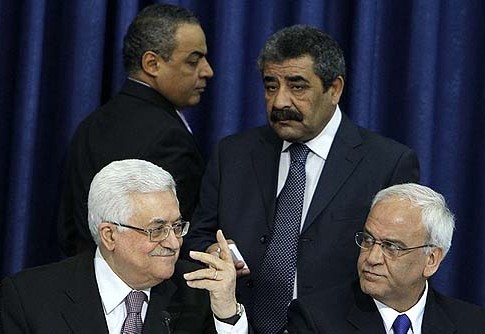
Archive for April 2014

Former Israeli Ambassador Pins Dead Peace Process on American Wishful Thinking, Says Kerry ‘Smothered in a Middle East Sandstorm’ (INTERVIEW)

April 4, 2014

Former Israeli Ambassador Pins Dead Peace Process on American Wishful Thinking, Says Kerry ‘Smothered in a Middle East Sandstorm’ (INTERVIEW), Algemeiner,  April 4, 2014

“You have a world view of [U.S. President Barack] Obama — John Kerry’s is basically Obama’s, Obama calls the shots,” he said. “They are determined to subordinate reality to that world view, irrespective of the fact that the world view has nothing to do with the reality, and that’s typical of John Kerry’s speech, which is replete with the word ‘imagine.’”

“‘Imagine what would happen if?’ And ‘imagine’, and ‘imagine’, and ‘imagine’, and ‘imagine’…”

“And you wonder, why is the supposed architect of foreign policy dealing with imagination rather than reality?

Yoram_EttingerFormer Israel Ambassador Yoram Ettinger.

Yoram Ettinger, the former Israeli Ambassador for U.S. Congressional Affairs, on Thursday had harsh words for U.S. Secretary of State John Kerry, who he said has ignored the lessons of history in favor of “wishful thinking.”

Hitting at the heart of Israel’s relationship with the U.S., and informed by his years as Israel’s Consul General in Houston, Texas, Ettinger told The Algemeiner in an interview that Kerry’s refusal to acknowledge the historical facts and realities of the Middle East left America’s top diplomat “smothered in a Middle East sandstorm.”

Ettinger said the Obama administration’s “Palestine Firster” mentality was what doomed the nine months of peace talks that collapsed this week between the internationally recognized Jewish state and a group Ettinger insists still be referred to as the PLO, with all of the connotations those initials recall of its long terrorist roots, and showing how far the world is from in its “mistaken conventional wisdom” of a ‘Palestinian Authority’ prepared to govern responsibly beside Israel.

He pointed to the common misunderstanding of the role of the United Nations, where Palestinian Authority Chairman Mahmoud Abbas has already launched his next battle, but Ettinger was confident that the powerful, though under-appreciated, role of the U.S. Congress in foreign affairs would allow Israel’s position to prevail.

“The ‘Palestine Firsters’ are those who believe that this is the center of everything,” Ettinger told The Algemeiner. “It’s part of an overall worldview – these are the same people who also believe that the UN is the quarterback of international relations. The UN assumes that the Palestinian issue is the center, so if the quarterback is telling you that the entire game plan has to be based on the Palestinian issue, you go with the quarterback.”

“They genuinely believe an Israeli concession — the establishment of a Palestinian state in Judea and Samaria — is going to do the trick, and thereby they ignore the roughly 100 years of conflict that sends a very clear message to the contrary.”

“In the 1920s and 1930s and 1940s, during the pogroms of those years, there was no independent Jewish state. There was no ‘Israeli occupation’, but still there was a war on the Jewish communities in the land of Israel,” he said. “Until 1967, Israel was not in Judea and Samaria, or Gaza.”

That begs the question: If history shows that war predated the “occupation,” how could the “occupation” be the cause of the war?

“And the same thing with the ‘settlements,’” Ettinger said.

“The lesson is very clear. The Palestinian war on Israel is not due to Israel’s policy or Israel’s size. It has to do with the existence of the Jewish state, which leads to the most fundamental misperception and error here.”

Rather than looking toward history or understanding how religion impacts decision making in the Middle East, because those concepts are too complicated to paint a simple picture, Ettinger said the U.S. sees every question through the lens of secular nationalism that can be swayed with the capitalist’s carrot of throwing money at the problem. In this case, Kerry offered $4 billion of aid to the PA to reach a deal.

If it were about money, the oil producing Arab states could come up with even more, he said; “that’s petty cash for them.”

The other tack the U.S. took in the peace talks was to insist on “Palestinian human rights,” with the notion of any group of people being able to choose their destiny through free, frequent and fair elections. But in that case, asked Ettinger, how could Kerry invite Abbas to the table, when he was elected for a four-year term, 10 years ago? Rather than nine months of fruitless negotiations, wouldn’t Kerry’s time have been better spent pursuing “Palestinian human rights” by demanding those people, too, have the chance to choose their destiny through a democratic election?

In Ettinger’s view, rather than face any of the underlying issues, the U.S. approach was to focus on multi-lateral and multi-national ways of solving problems, ultimately accepting the world view of the UN, where Israel’s enemies imagine that the Jewish state is the world’s leading tyranny against human rights.

“You have a world view of [U.S. President Barack] Obama — John Kerry’s is basically Obama’s, Obamacalls the shots,” he said. “They are determined to subordinate reality to that world view, irrespective of the fact that the world view has nothing to do with the reality, and that’s typical of John Kerry’s speech, which is replete with the word ‘imagine.’”

“‘Imagine what would happen if?’ And ‘imagine’, and ‘imagine’, and ‘imagine’, and ‘imagine’…”

“And you wonder, why is the supposed architect of foreign policy dealing with imagination rather than reality?

“He is assuming you can coerce reality to be subordinated to wishful thinking, to whims.”

“Again, it goes back to John Kerry,” he said. “This is the same John Kerry, together with [Defense Secretary] Chuck Hagel and [former Secretary of State] Hilary Clinton, who belonged to a very small club in the U.S. Senate which referred to [Syrian President] Bashar al Assad as a ‘constructive’, ‘reformist’, ‘potentially peaceful’ leader of Syria, this is before the civil war in Syria that has claimed 150,000 Syrian lives.”

“By the way, John Kerry had the same attitude toward Hafez al Assad, also, proclaimed him to be a ‘constructive leader’, and therefore one should not be surprised that he focuses on the wrong items when it comes to the Arab-Israeli conflict.”

When the U.S. declines to act against Syria for completely abrogating the human rights of Syrians, even after two generations of brutal dictatorships, Ettinger wanted to know why Kerry “imagines” that what’s happening in Israel is somehow more urgent than the hundreds of thousands of Arabs dying in various levels of civil war across the Middle East.

As he thought of the appropriate analogy to express his exasperation with the U.S. Secretary of State, Ettinger, dressed in a suit and black snakeskin cowboy boots, admitted his fondness for Texans and their sensibilities.

“I spent years in Texas, as an undergraduate and then as Consul General, and I now visit Texas sometimes four times a year, and there is a Texan colloquialism: When you drive in West Texas, and you’re smothered by a lethal West Texas sandstorm, don’t be pre-occupied by the tumbleweeds on the road.”

“So, here is John Kerry, driving in the Middle East, and he’s smothered by a Libyan sandstorm, by a Tunisian sandstorm, by an Egyptian sandstorm, by a Syrian sandstorm, a Yemenite sandstorm, an Iranian sandstorm, and an Islamic terrorist sandstorm, and what is he doing?”

“Focusing on the Palestinian tumbleweed on the road, which could face him with a very, very lethal fate. Because when you don’t focus on the sandstorm, you may be thrown off the road. And, unfortunately, this is exactly what John Kerry is doing right now in the Middle East.”

“This is Kerry’s 12th or the 13th visit to Ramallah and Jerusalem,” Ettinger said, throwing up his hands, baffled.

Rather than focus on the external forces that Israel cannot change, Ettinger’s approach is to focus on the areas where Israel, and Israelis, can make a difference, constructively, and independently of the “whims” of the world powers.

Retired from the foreign ministry for two decades, Ettinger, a former journalist, publisher and communications expert, now runs a foundation, ‘Second Thought,’ which provides lectures and material to help re-write myths about the Middle East with fresh thinking, aiming to replace the “conventional wisdom” with knowledge based on fact and history. There are two areas, specifically, where his expertise is adding tremendous value to the debate.

The first, which is the topic of his current lecture tour at Jewish organizations across the U.S. this month, is the truth behind the so-called demographic threat. Using real Israeli census data, rather than just conventional wisdom, Ettinger debunks the “myth” that Jews could become a minority within Israel.

In fact, Ettinger’s research contends that not only do the real numbers show the opposite is happening, but that all the anecdotes used to support the “conventional wisdom” are also wrong. In his presentation, Ettinger says that those “Yuppy Jews” in secular Tel Aviv now, and for more than a decade, have taken on their patriotic duty to bear more children than ever before. Meanwhile, the supposedly sky high Arab birth rate has fallen far behind, as young Arabs grapple with the common woes of entering the middle class, not bearing children.

His hard numbers (see below) have made many Israel supporters “sleep easy,” as one said, Ettinger recites many anecdotes of his own personal meetings with young Arabs he “interviews” in gas stations and cafes as he travels around Israel. Members of his audience at a presentation this week were surprised to learn that rather than spurning formal education, many live in towns with near-full high school participation, attend community colleges (mostly, the men) and universities (usually, the women, the better students in the Arab world) and how they repeat the tropes familiar in today’s America, where “maybe one child, maybe two, but definitely after my education, after I get a good job, buy a house, much later in life,” Ettinger said he is told frequently by Arabs today.

Ettinger’s other specialty is interpreting U.S. policy towards Israel. Rather than exclusively believing that what’s being said by the Executive Branch will come to pass in the Middle East, and in light of his experience on Capitol Hill, where he returns on each trip to stay current with the contacts he built when stationed at the Israeli Embassy as an Ambassador whose portfolio was, simply, all of Congress. In some ways, Ettinger’s role was to be a one-man Israel lobby.

It is with a great understanding of how the U.S. Congress functions that he feels the “PLO’s” fallback position of haranguing the UN into validating its claims against Israel will certainly backfire.

“There are some people who assume that the PLO could be granted a ‘state’ status by the UN and the international organizations would then be much more vindictive towards Israel,” Ettinger said. “This is because the vast, vast, vast majority of people, policy makers, definitely in Israel, but also in the U.S., are not familiar with the power of the U.S. Congress to set the agenda here.”

“Namely, while the President or the Secretary of State may want to punish Israel to facilitate the emergence of the Palestinian state, this is not the position of the overwhelming majority on Capitol Hill. And, I am certain that if the legislators would be approached by constituents with their requests to deny the Palestinians adequate support, and to exercise the veto at the UN Security Council, the U.S. can do it.”

“The American President cannot ignore Congress,” Ettinger said. “Congress usually is reluctant to get involved in foreign policy and national security decisions unless it’s a consensus issue, unless it’s a common denominator issue, unless it’s an issue which benefits from the support of vast majority of the population,” he said. In other words, Congress’s support of Israel is strong. In fact, all but one member of Congress voted to enhance the U.S.-Israel relationship, not work to minimize or destroy it.

“It’s time, I believe, for Israel and its supporters to realize that Congress is not a backseat driver when it comes to foreign or national security policy,” he said.

“Congress can defund foreign aid to the PLO; Congress can suspend foreign aid; Congress can suspend appropriations to the international organizations and UN agencies and that would make it extremely difficult and impossible to reward the PLO,” he said. “Because my assumption is that UN agencies and international organizations would not want to ‘cut their nose to spite their face’ knowing that once they support the PLO they’re going to be denied U.S. financial support which is the biggest chunk of their budget.”

Like his work to debunk conventional wisdom of the “demographic time-bomb,” Ettinger “absolutely” sees a UN gambit as another “false threat.”

But he also points to the power of the “false threat” as a weakness within Israel, and shared by Jews worldwide, who focus on so many “negative myths,” because it is that negativity, rather than the positivity of individual action, that limits the Jewish community’s collective strength. Just as Tel Aviv yuppies can “unilaterally” decide to have more children, as they have done, it is incumbent upon each Jew to “unilaterally” choose to do that which he can, on his own, to help the Jewish state when others speak against Israel, he said.

As Ettinger said to one eager questioner at another Manhattan event this week, “Never mind the mistake of waiting for great powers to come to our rescue, never mind what others could do, what can you do? You, yourself? How can you, on your own, contribute here? Only when each Jew does what is in his power will the Jewish people move forward,” he exhorted to a crowd unaccustomed to such direct calls for personal action.

Ettinger’s endorsement of individualism, personal responsibility, and an independent spirit draw inspiration from his time in Texas.

He said the story of Israel in the Middle East is shared by walking a mile in a Texan’s boots:

“When I served in Texas, I used to walk with a ‘Texas’ pin in my lapel. And, many times, Texas ranchers or independent oilmen, who I met, asked me very bluntly: ‘Mr. Ettinger, is there anything in common between us? Why are we meeting at all?’”

“And I said, well, here it is,” as he grabbed at his lapel pin, today the AIPAC-style Israel and American flag pin.

“‘What do you mean?” his potential contact would ask him. “This is our Texas flag.”

“I said, absolutely. You are the Lone Star State and I come from the State of the Lone Star of David.”

“And both of us are Lone Stars. I said, you’re lucky that your neighbors — New Mexico, Oklahoma, Arkansas, Louisiana — they maybe hate you, they’re envious of you, and they maybe even despise you. In our case, our neighbors want to kill us. But both of us have problems with our neighbors. Both of us have to defy the jagged, cutting edge of nature, and that has made both of us very tenacious people.”

He said, “In most cases, people were turned around completely in a positive manner, for the first time realizing that, in many respects, Israel is the Texas of the Middle East.”

But to extend the analogy, what about the people on the other side of that thousand-mile security fence that protects that border, too? What does Israel share with Texas and its relations with the Mexicans?

Ettinger said, “Those who cross from Mexico, in the vast, vast, vast majority, they want to be integrated into America, they accept the American values. Those across the border from Arab countries want to do away with Israel, to terrorize Israel, there is a big difference here.”

He had another Texan analogy he said he wanted to share with the world powers:

“When Americans, Europeans, urge us to sign an agreement, and through that agreement, to concede, and retreat, and appease,” Ettinger began,”the Texans would tell you, don’t kiss a chicken until it grows lips.”

“At this stage, the Arab chickens in the Middle East have not grown lips yet. As long as they don’t have lips, we should be vigilant, we should be on guard, and we should refrain from kissing them.”

“Once they grow lips, this hawk will gladly and enthusiastically become a dove,” former Israeli Ambassador Yoram Ettinger told The Algemeiner on Thursday.

Former Israeli Ambassador Yoram Ettinger's Comparative Analysis of Birth Rates in Israel.
Former Israeli Ambassador Yoram Ettinger’s Comparative Analysis of Birth Rates in Israel.
Netanyahu Gets It

April 4, 2014

Netanyahu Gets It, Weekly StandardAryeh Tepper, April 4, 2014

The secretary of state’s hubris is cause for wonder. 

So the Israeli-Palestinian peace talks are, predictably, collapsing. U.S. Secretary of State John Kerry responded to the frustration of his manic peacemaking efforts by quoting an ancient complaint, “There’s an old saying, you can lead a horse to water but you can’t make it drink. Now it’s time to drink and the leaders need to know that.”

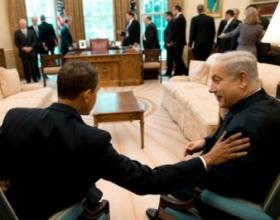
Obama_NetanyahuBarack Obama and Israeli Prime Minister Benjamin Netanyahu.

To which one might respond with the words of Psalms: “Be not like a horse or a mule, without understanding.”

The secretary of state’s hubris is cause for wonder. What is the metaphorical water to which Kerry refers? A two-state solution. In Kerry’s view, the two-state solution is clearly in the interest of both parties: the Palestinians get their state and Israel gets to preserve its democratic character. And he cannot understand why in the world Netanyahu and Abbas just don’t get it.

But Netanyahu gets it. Netanyahu gets that Palestinian violence against Jewish settlement in the land of Israel dates back to the 1920’s, well before the West Bank was “occupied” and the state of Israel even existed. Netanyahu gets that the Palestinian “right of return” is a thinly veiled attempt to reverse the results of 1948. Netanyahu gets it that the root of the conflict lies in the principled refusal to recognize the legitimacy of a Jewish nation-state in the “Arab Middle East.”

The present administration will stubbornly cling to its intellectual prejudices. One can only hope that subsequent administrations will be sufficiently tough-minded to see Palestinian rejectionism for what it is. After all, viewed in light of Palestinian rejectionism the sad history of Middle East peacemaking makes perfect sense.

Reality Check? Kerry’s Is Long Overdue

April 4, 2014

Reality Check? Kerry’s Is Long Overdue, Commentary Magazine, April 4, 2014

(If it’s time for President Obama to impose a “reality check” on the State Department, he will first need to find some reality to impose. Reality is the most endangered of all species at the White House. — DM)

The secretary has two choices. He can pull back from the talks and instead seek to manage the conflict and give the Palestinians incentives to work on developing better governance, infrastructure, and a free-market economy—things that former PA Prime Minister Salam Fayyad tried and failed to create thanks to lack of support from Abbas and Fatah. Or he can dive even deeper into the abyss and make another explosion of violence even more likely by setting up an even bigger diplomatic failure with a U.S. plan that is certain to crash and burn.

If he doesn’t understand that the first of those two is the only rational alternative for the U.S. at this point, then perhaps it is President Obama who needs to impose a “reality check” on the State Department.

Secretary of State John Kerry’s reaction to the collapse of his Middle East peace initiative was entirely predictable. Eschewing any responsibility for having personally stage-managed this fiasco, he told the Israelis and the Palestinian Authority in a statement that they needed to understand that he had better things to do if they weren’t willing to play ball. As the New York Times reported:

“There are limits to the amount of time and effort that the United States can spend if the parties themselves are unwilling to take constructive steps in order to be able to move forward,” said Mr. Kerry, who added it was “reality check time.”

He’s right about that, but if there is anyone involved with this mess that needs a reality check, it’s Kerry.

The secretary ignored the advice of wiser foreign-policy analysts who cautioned that there was no reason to believe there was a chance of forging a peace agreement between Israel and the Palestinians. He then plunged head first into the process convinced that he could succeed where all others had failed, all the while warning the Israelis that they would face violence and boycotts if they didn’t do as he asked. But while both Kerry and President Obama continued to praise PA leader Mahmoud Abbas as a peacemaker, it was he who always had his eye on the exit sign from the talks.

Abbas seized on the first pretext he could find to flee the negotiations and now Kerry is left looking foolish. But the problem here is not whether Kerry might be better employed dealing with more urgent U.S. foreign-policy issues like the Russian attack on the Ukraine, the Iran nuclear talks, or even the human-rights catastrophe in Syria than in wasting more time trying to coax the Palestinians back to the table. It’s whether Kerry’s grasp of reality is so tenuous that rather than backing away from a no-win situation, he decides to double down and try to shove a U.S. peace plan down Israel’s throat.

Kerry knows that throughout this process, it has been Israel who has been forced to pay for the talks with concessions. That was true before the talks began when it was pressured into promising to release more than 100 terrorist murderers to bribe Abbas to come back to the table. It was also true during the negotiations when Israel showed itself again to be willing to withdraw from almost all of the West Bank to create an independent Palestinian state while the Palestinians stonewalled.

It’s hard to believe Kerry is truly offended that the Israelis have been unwilling to release the last batch of murderers without some assurance from the Palestinians that they will keep talking after April or that he views this sensible decision as being somehow comparable to Abbas’s walkout and decision to go back to his quixotic effort to gain more recognition for his non-state from the United Nations. Abbas’s refusal to acknowledge Israel as a Jewish state—a measure that indicates he is willing to end the conflict rather than merely pause it—as Kerry asked should have alerted the secretary to the fact that the Palestinians simply aren’t interested in an agreement.

This is the moment for a reality check in which Kerry finally grasps that the division between Abbas’s Fatah in the West Bank and Hamas-ruled Gaza is too great to allow the former to sign a peace treaty that will recognize the legitimacy of a Jewish state no matter where its borders are drawn. But instead of pulling back from the process and realizing that all he has done is to take a stable, if unsatisfactory situation and increased the chances that it could blow up, there is now a very real possibility that he will make things even worse by trying to impose an American plan on the parties.

Such a plan would almost certainly involve territorial concessions for the Jewish state that go beyond previous offers including a more drastic (and unworkable) partition of Jerusalem. It may also leave out some of the elements that Kerry included in the peace framework that the Israelis accepted and the Palestinians rejected. These include security guarantees and the symbolic though important provisions that would commit the Palestinians to ending the conflict. But Kerry needs to realize that no matter what a U.S. plan says, Abbas hasn’t the will or the ability to sign a peace agreement.

The secretary has two choices. He can pull back from the talks and instead seek to manage the conflict and give the Palestinians incentives to work on developing better governance, infrastructure, and a free-market economy—things that former PA Prime Minister Salam Fayyad tried and failed to create thanks to lack of support from Abbas and Fatah. Or he can dive even deeper into the abyss and make another explosion of violence even more likely by setting up an even bigger diplomatic failure with a U.S. plan that is certain to crash and burn.

If he doesn’t understand that the first of those two is the only rational alternative for the U.S. at this point, then perhaps it is President Obama who needs to impose a “reality check” on the State Department.

Negotiating to the death

April 4, 2014

Negotiating to the death, Israel Hayom, Ruthie Blum, April 4, 2014

(The purpose of the Kerry “peace process” has not been to achieve peace but to achieve the process itself. It now appears that even that won’t happen.– DM)

Abbas seems to be the only player fully aware that neither Kerry’s efforts nor Netanyahu’s concessions have been part of an actual negotiation towards “two states for two peoples.” He knows it has all been for the purpose of persuading him to agree just to come to the proverbial table. Milking this for all it is worth, he keeps upping the ante.

During a nine-hour meeting Wednesday between Israeli and Palestinian chief negotiators Tzipi Livni and Saeb Erekat, the atmosphere turned so ugly that U.S. Special Envoy Martin Indyk had to intervene. Apparently, even Livni — who is almost as obsessed as U.S. Secretary of State John Kerry with the pointless process — lost her cool.

And it’s no wonder. Erekat shouted at her that he doesn’t work for the Israelis. “We’ll see you in court at The Hague,” he threatened.

This was a major slap in Livni’s face, since she has been doing her best to work for the Palestinians. So she also issued an ultimatum. Hers was that if the Palestinians did not start playing fairly, there would be a breakdown in negotiations. As though this would be some kind of penalty to a party that has no interest in peace talks, let alone in the concept of independent statehood alongside Israel. Destroying the Jewish state that it refuses to recognize is still its ultimate goal.

Oh, to have been a fly on the wall during that exchange. Watching Indyk rush in to soothe tempers and prevent Erekat from storming off and putting the final nail in the coffin of Kerry’s Nobel Peace Prize would have made for great comedy. But tragedy is never far behind, as is evident in Kerry’s attitude and Palestinian behavior.

While the secretary of state was expressing his frustration with “both sides” for not being able to reach an agreement, and calling on Prime Minister Benjamin Netanyahu and Palestinian Authority President Mahmoud Abbas to exhibit “leadership,” Abbas was busy seeking membership in U.N. bodies.

Abbas seems to be the only player fully aware that neither Kerry’s efforts nor Netanyahu’s concessions have been part of an actual negotiation towards “two states for two peoples.” He knows it has all been for the purpose of persuading him to agree just to come to the proverbial table. Milking this for all it is worth, he keeps upping the ante.

This is why Netanyahu announced that the fourth batch of prisoner releases (a euphemism for the freeing of bloodthirsty terrorists from Israeli jails) would not go through as scheduled. Since the first three releases only served to strengthen Palestinian intransigence and endanger Israeli civilians, it would have been political suicide for Netanyahu to execute another one.

In “response,” the PA released a new list of demands as a prerequisite for agreeing to resume being courted by the U.S. and Israel:

1) A written letter from Prime Minister Benjamin Netanyahu in which he acknowledges that the borders of the Palestinian state will be the 1967 borders, and that its capital will be east Jerusalem.

2) The release of 1,200 Palestinian prisoners, among them political leader and terror masters Marwan Barghouti, Ahmad Saadat and Fuad Shobaki.

3) The removal of the blockade on Gaza and the implementation of an agreement on the border crossings.

3) An agreement to return the Church of the Nativity exiles — Palestinians who laid siege to the church in 2002 and were deported to Gaza and Europe — to the West Bank.

4) A halt of Israeli construction in east Jerusalem, and the reopening of the Palestinian institutions that Israel closed (such as Orient House, PLO headquarters during the 1980s and 1990s).

5) No IDF entry into Area A to arrest or kill wanted terrorists, and authorization to the PA to control those in Area C under full Israeli control.

6) The granting of Israeli citizenship to 15,000 Palestinians, as part of a family unification framework.

This list is a precondition for war, not peace — other than one that Abbas may hope to reach with his rival terrorist brethren in Hamas. Speaking of which, on Thursday evening, four Qassam rockets landed in southern Israel, sparking an Israeli Air Force strike on terrorist bases in northern and central Gaza.

Thursday also marked the beginning of a series of “expert-level” meetings in Vienna to prepare for yet another round of negotiations between Iran and the P5+1 (the U.S., Russia, China, Britain, France and Germany).

Like the PA leadership in Ramallah, the mullahs in Tehran are being courted by the West. In an attempt to reach an agreement at all costs, the U.S. and Europe are basically begging the Islamic Republic to accept a deal, by July 20, which would enable it to develop a “peaceful” nuclear program in exchange for a lifting of the sanctions that have been dealing a blow to its economy.

This is a signal to Iran and all its Palestinian and other proxies that the best way to defeat democratic enemies with military might is to negotiate them to death, first figuratively and then literally. If the Free World continues to abet the spread of this message, it will find itself forced to replace the pen of treaties with the sword of victory, but from a perilously weakened position.

Abbas to Kerry: Please Beg Me More!

April 4, 2014

Abbas to Kerry: Please Beg Me More!, Gatestone InstituteKhaled Abu Toameh, April 4, 2014

Abbas is convinced that it is only a matter of time before U.S. Secretary of State John Kerry rushes back to the region in yet anther desperate effort to “salvage the peace process.”

In recent weeks, according to Palestinian officials, Kerry has literally been “begging” Abbas to agree to an extension of the peace talks after the end of April.

Abbas and the Palestinian Authority leadership have concluded that the Obama Administration is prepared to do almost anything to show some kind of “victory” in the peace process between Palestinians and Israelis. Palestinian demands therefore have continued to increase almost every day.

Palestinian Authority [PA] leader Mahmoud Abbas is now waiting to see what the U.S. Administration will offer him in return for refraining from pursuing his bid to join various international treaties and institutions.

In recent weeks, according to Palestinian officials, U.S. Secretary of State John Kerry has literally been “begging” Abbas to agree to the extension of the peace talks after the end of April.

Hours after Abbas signed the applications for joining a number of international bodies and treaties, he receivedan urgent phone call from Kerry asking him to refrain from further moves that could “derail” the peace process.

Abbas is convinced that it is only a matter of time before Kerry rushes back to the region in yet another desperate effort to “salvage the peace process.”

On Wednesday night, Abbas and the PA leadership received the first sign that the U.S. Administration was nervous and confused following the PA’s surprise decision to join 15 international organizations and treaties.

Kerry’s envoy, Martin Indyk, invited Chief PLO negotiator Saeb Erekat and Israeli Justice Minister Tsipi Livni to an emergency meeting in Jerusalem to find ways of preventing the “collapse” of the peace talks in the wake of Abbas’s decision to apply for the memberships.

The meeting lasted for several hours and, according to Palestinian sources in Ramallah, Indyk and Livni “reprimanded” Erekat for surprising Israel and the U.S. Administration with the new decision.

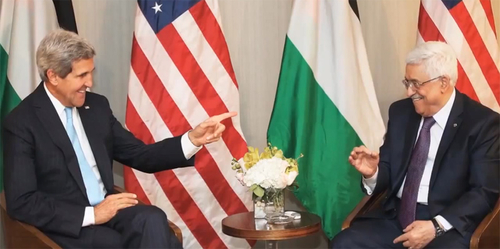
Kerry Abbas happy timesU.S. Secretary of State John Kerry and Palestinian Authority leader Mahmoud Abbas in happier times. (Image source: Nirvana News YouTube video still)

Abbas dispatched Erekat to the meeting to see what the Americans and Israelis are prepared to offer him in return for suspending this bid.

So far, however, Abbas does not seem to be satisfied with what his emissary, Erekat, heard from Indyk and Livni. Abbas is therefore expected to step up pressure on the two parties in the coming days and weeks, if he can, in the hope of extracting as many concessions as possible.

Abbas and the Palestinian Authority leadership have concluded that the Obama Administration is prepared to do almost anything to show some kind of a “victory” in the peace process between Palestinians and Israelis. Palestinian demands have therefore continued to increase almost every day.

Realizing how desperate Kerry is to achieve an extension of the talks, Abbas decided that this was the right time to set new conditions, such as the release of jailed Fatah militia leader Marwan Barghouti and Ahmed Sa’adat, Secretary-General of the Popular Front for the Liberation of Palestine. Barghouti is in prison for his role in terrorist attacks against Israelis during the second intifada. Sa’adat is serving a lengthy prison term for his role in the assassination of Israel’s Tourism Minister Rehavam Ze’evi.

As Kerry increased his pressure on the Palestinians to agree to an extension, Abbas added two more conditions: the release of hundreds of Palestinian prisoners and a complete cessation of construction in settlements and east Jerusalem neighborhoods.

Abbas has also made it clear that his decision to join international organizations and treaties does not mean that he is interested in a “clash” with the U.S. Administration.

Abbas is right. Of course he does not want a “clash” with President Barack Obama and Kerry. Rather, Abbas wants the two men to continue begging him not to walk out of the peace process and turn their entire Middle East policy into another blunder. He wants them to exert pressure on the Israeli government to accept both his old and new demands.

Abbas apparently thinks he is moving in the right direction, and that Obama and Kerry have no choice but to accept his demands and intensify U.S. pressure on Israel. Abbas does not want totally to walk out of the peace talks at this stage. He feels that he can still extract further concessions from the Israelis and Americans, and that his decision to join 15 international organizations and treaties has left the U.S. Administration in a state of panic that the peace talks might fail. Now he is waiting to see what price Obama and Kerry are willing to pay to avoid that scenario.

Commentator: Israel Behind Malaysian Plane Mystery

April 4, 2014

Commentator: Israel Behind Malaysian Plane Mystery – Middle East – News – Israel National News.

American commentator claims Israel set up the disappearance of Flight MH370 in order to blame it on Iran.

By Elad Benari

First Publish: 4/4/2014, 6:12 AM

An American commentator who appeared on state-owned Iranian Press TV suggested that Israel was responsible for the disappearance of Malaysia Airlines Flight 370, which went missing on March 8.

The comments by the commentator, Dr. Kevin Barrett, were made during an interview which aired on March 30. They were posted to YouTube by the Middle East Media Research Institute (MEMRI).

“Why are they giving us photoshopped pictures of Iranian passengers?” said Barrett, referring to the two Iranian nationals who boarded the flight with stolen passports.

“Obviously there was some kind of a set-up to try to blame this on Iran,” he continued. “Precisely what that is we don’t know, but the Israelis have been using their assets, including the head of El-Al security, who was a 9/11 suspect – he lives in New Jersey, I forget the gentleman’s name…”

“He and other Israelis have been putting out as much media propaganda as they can, trying to blame this on Iran, saying it is a waste of time to look at this as being anything other than an Iranian hijacking,” said Barrett.

“Well, Christopher Bollyn just found that there is an identical twin of this plane. It has been sitting in a hangar in Tel Aviv, Israel, for the past couple of months. There was a shell-game played with this aircraft. It was in the south of France, and then they moved it down to Israel. Speculation is that there was some sort of false-flag plan afoot, perhaps another planes-into-buildings deception like 9/11,” he claimed. “We have so many parallels between this event and 9/11.”

On Wednesday, MEMRI posted another clip from Press TV, this one featuring anti-Israel British MP George Galloway, who blamed Israel for another story that has been making headlines in the world.

Galloway claimed that “the Zionists” engineered the situation in Ukraine in order to bring “the Nazis” to power and have the Ukrainian Jews “settle in Palestine”.

Russia to back Iran in nuclear talks – Moscow’s “April surprise” for Western sanctions over Ukraine

April 4, 2014

Russia to back Iran in nuclear talks – Moscow’s “April surprise” for Western sanctions over Ukraine.

DEBKAfile Exclusive Report April 4, 2014, 10:29 AM (IST)


Arak heavy water-plutonium reactor

Arak heavy water-plutonium reactor

As the Six Power group and Iran prepared for their third round of nuclear talks in Vienna next week (Tuesday-Wednesday, April 8-9) Tehran frankly admitted to exploiting the holes in the six-month interim deal they forged in Geneva last November. 

Moscow looks like making good on its threat to back the Iranian case, in retaliation for Western penalties for its annexation of Crimea.

In a closed meeting in Tehran Wednesday, April 3, Ali Akbar Salehi, head of Iran’s Nuclear Energy Commission said: “We have 19,000 centrifuges of which 9,000 are in operation [for enriching uranium]. Our advice is not to discuss the number of centrifuges, rather to discuss the unit’s isolation power.” He explained there are different types of centrifuge.

This was a candid admission that Iran had found a way to get around its commitment under the interim deal – which US Secretary of State John Kerry held up as his greatest diplomatic achievement – not to build or activate its most advanced centrifuges for speeding up enrichment.

Salehi had no qualms about pointing to the holes in that deal, as the six foreign ministers prepared to face Iran in Vienna for the next round of negotiations on a comprehensive agreement for Iran’s nuclear program.
That forum will provide Moscow with its first opportunity to confront the West over Iran (and likely Syria too) for the sanctions and bans NATO meted out over Russia’s Ukraine policy.

The architect of Russian policy on both issues, Deputy Foreign Minister Sergey Ryabkov, gave due warning last week, when he said: “Russia wouldn’t like to use their [nuclear] talks as an element of the game of raising the stakes between Moscow and the West,” he said. “But if Russia feels forced, it would take retaliatory measures here as well.”

On the day the Iranian nuclear czar talked about Iran’s centrifuge capacity, sources in Moscow and Tehran reported that the two governments, both targets of Western sanctions, were close to a mammoth barter transaction: For 500,000 barrels of Iranian oil per day, Russia will supply goods of equivalent value including foodstuffs.

This transaction when it goes into effect will more or less scuttle the sanctions regime against Iran, including the oil embargo.
Salehi was accordingly not afraid to boast: “Enrichment activities have not ceased.”

The interim accord did not ban low-grade uranium enrichment, and that was another hole in the deal, because it allowed Iran to press forward and stockpile large quantities of the low grade material despite the fact that it can be refined to weapons grade in short order.

As for the heavy water-plutonium reactor under construction in Arak, Salehi commented: “Under normal circumstances, we would have needed at least two to three years to advance this project.” He went on to reveal: “Under the Geneva accord we undertook not to install certain major equipment for six months. So instead we worked on equipment quality.”

Referring to US President Barack Obama’s public statement last November that Iran had agreed to halt the Arak reactor project, Saleh pointed out: “The Arak reactor was never in operation for it to cease.”
However, Iran did not let the grass grow. Now that the six months of the interim accord is up, the improved equipment can be installed without further delay.

He also noted that a cessation of heavy water reactor operations was not covered in the Geneva Accord. “[The West] manipulated public opinion to persuade people that those operations must be stopped.”
This confirmed Israel’s complaint to Washington that the interim deal of last November and subsequent discussions between the big powers and Iran omitted to address the Arak project and its capacity for producing plutonium, as an alternative weapons fuel to enriched uranium.

The Iranian official made no secret of his government’s intentions. “Currently, we are not after establishing reprocessing facilities [for high grade enriched uranium and/or plutonium]. Of course, this does not mean that we renounce this right for ever.”

Israel Air Force strikes targets in Gaza after rocket fire

April 4, 2014

Israel Air Force strikes targets in Gaza after rocket fire | JPost | Israel News.

By JPOST.COM STAFF

 04/04/2014 01:50

Aircraft hits 5 terror targets in Strip; Palestinian sources say at least 2 Hamas terror outposts targeted in retaliatory strike.

IAF

Israeli F-16 fighter jet. [File] Photo: REUTERS

Israel Air Force jets struck five terror targets in the Gaza Strip overnight Thursday, the IDF confirmed.

Israel Radio cited Palestinian sources as saying the IAF had hit various terror sites in northern and central Gaza, including two outposts belonging to Hamas’s military wing.

On Thursday night, Palestinian terrorists in the coastal enclave fired four rockets toward southern Israel, activating the Code Red alert in Sderot and surrounding communities.

Israeli media reported that the projectiles had failed to reach their targets, landing in open territory near the border with Gaza.

No injuries or damage were reported on the Israeli side.

The IAF strike came after weeks of relative quite following a large-scale rocket attack on the South by Islamic Jihad terrorists in March. The Air Force struck nearly 30 Gaza targets in response to the attack.

Off Topic: Israeli-Palestinian tensions shoot up

April 4, 2014

Israeli-Palestinian tensions shoot up, DEBKAfile, April 3, 2014

(Good! — DM)

Israel hit back with penalties. . . .

Israel announced the fourth batch of 26 Palestinian prisoners was not released Saturday night, March 30, because the Palestinians had meanwhile applied to 15 UN agencies and conventions and threatened to have international courts “convict Israel’s leaders as war criminals.”The Palestinians Thursday upped their price for returning to negotiations, including recognition of the 1967 lines as borders of a future Palestinian state with east Jerusalem its capital; the release of 1,200 prisoners, including multiple murderer Marwan Barghouti and Ahmad Saadat.

Israel hit back with penalties, including the suspension of high-level bilateral communications between governments and the relegation of Palestinian affairs to the Government Coordinator Maj. Gen. Yoav Mordecai; a freeze on the release of third-generation cell phone technology to Palestinian Authority-ruled areas and an end to communications equipment exports to the Palestinian cell phone company owned by Mahoud Abbas’s sons. Finally, the 14,000 dunams of Jordan Valley land already allocated to Palestinian farmers would be held up. The Israeli government said further punitive measures were under consideration.

Off Topic: Abbas Demands Total Israeli Capitulation or I Won’t Talk to You

April 3, 2014

Abbas Demands Total Israeli Capitulation or I Won’t Talk to You, The Jewish PressTzvi Ben-Gedalyahu, April 3, 2014

Humpty Dumpty sat on the wall. Humpty Dumpty had a great fall and who even wants to put him together again?

Abbas and ArikatMahmoud Abbas (L) and PA negotiator Saeb Erekat, without straight jackets. Photo Credit: Miriam Alster/Flash9

Mahmoud Abbas lost his marbles, and the Palestinian Authority went berserk Thursday without the Peace Talks Straight Jacket as they came up with a bunch of new conditions for extending peace talks that essentially eliminates them.

That has been the aim of Mahmoud Abbas from Day One, but now that he is feeling its oats by thumbing its nose at the Oslo Accords, the Roadmap, John Kerry, President Barack Obama, Tzipi Livni and the Good Humor Man, he has removed all pretenses and acted like he has the world in his pocket.

He has the United Nations in his pocket, but has yet to learn that the world still includes non-Muslim countries and even a few nations that tolerate and sometimes actually support the existence of the State of Israel.

In response, Israel’s long-time cream puff negotiator Tzipi Livni finally showed her Israeli stuff and essentially told the Palestinian Authority not only to get lost, but she also offered to help it do so by suggesting a few sanctions on Ramallah.

U.S. Secretary of State John Kerry maintained his cool and reminded Israel and the Palestinian Authority that he has led the horses to the trough and now it is time for them to decide whether they want to drink his poison.

If Abbas drinks, he is a dead man because it means compromising, a cardinal Arab sin. If Israel drinks, it means suicide as a Jewish state.

Abbas got off his horse and jumped on a bronco, but he doesn’t know how to ride it.

Following are some of his new demands for extending talks, which really have been an illusion anyway except that make Kerry feel like he has accomplished something:

–Prime Minister Binyamin Netanyahu must sign on the dotted line that a new Arab country, once known as the Palestinian Authority, will include all of the land that was restored to Israel in the Six-Day War in 1967;

–Netanyahu must sign on the dotted line that the capital of this new insane asylum will be eastern Jerusalem, meaning its flag will fly over the Western Wall;

–Israel not only will release the terrorist that the Palestinian Authority  demanded it free last week, but it also will include a few others, 1,174 to be exact, including Marwan Barghouti, serving five life terms in prison for arranging the murders of Israelis;

– Israel will end the maritime blockade of Hamas-controlled Gaza;

–The IDF will not enter Arab-controlled cities, not even to arrest terrorists;

Israel will give the Palestinian Authority control over ‘Area C,” which includes most of the Jews who live in Judea and Samaria.

The only demand missing is for Israel to admit that the Holy Temples never existed, God forbid, and that the Elders of Zion should be the official textbook in Zionist schools.

There are a few other demands, none of them surprising since they have been Abbas’ game plan all along. His strategy has been to get what he wants with the help of Kerry. If that doesn’t work, Plan B is to rely on the hopes that the United Nations will force Israel to go belly-up.

Plan C goes back to the favorite Arab solution – war.

Israel promptly announced that the Palestinian Authority can forget about the fourth batch of terrorists leaving their jail cells, a superfluous announcement since the PA already has refused to approve the list of names of terrorists who were to be released.

Even Tzipi Livni has enough of this nonsense.

and she must be complimented for being so graceful as to giving the Palestinian Authority a chance to repent by formally asking it to withdraw its request to join 15 U.N.-related agencies, more formally known as treaties and conventions.

She added if Abbas does not step back from the edge of the cliff, Israel will slap sanctions on Ramallah.

What can Israel do?

First of all, it can withhold from Ramallah tax revenues it collects for goods flowing into the Palestinian Authority from the rest of Israel. That amounts to tens of millions of dollar a month.

Israel can also go to court to collect the millions of dollars the Palestinian Authority owes the Israel Electric Company for electricity.

Not even the European Union would be able to make up the difference. Saudi Arabia could, but it won’t.

Maybe Tehran can help Abbas.

Before that happens, the Arab League will meet next week and after counting the damage the Palestinian Authority has done to itself, it could try to put Humpty Dumpty back together again and give him back his straight jacket.

If it does, Livni will be first in line to say it was all a misunderstanding.

If it doesn’t, the road shows move to the United Nations, which gives mad men a lot more room to ride wild broncos.