Archive for March 2014

Weapons Seizure: The Photos

March 14, 2014

Weapons Seizure: The Photos.

For the first time, the IDF is releasing photos of Iran’s entire weapons shipment to Gaza terrorists. Iran attempted to hide its involvement in terror, but the evidence is clear and on display

Weapons Seizure: The Photos

“We have solid information that proves Iran’s relationship with the shipment,” a senior IDF Intelligence officer said Monday. He spoke after a combined IDF task force from various units inspected the Klos-C and unloaded the Iranian weapons shipment concealed aboard the ship. “Firstly, the containers were sealed in Iran, and they have Iranian authenticity seals on them, including seals of the Iranian postal company. The cement bags that were used to hide the weapons were clearly marked as coming from Iran,” he said.

The shipment contained 181 heavy mortars, 400,000 bullets, and dozens of M-302 rockets that have the capability to strike almost anywhere in Israel.

“In the cargo hold of the ship you can see that 100 out of 150 of the containers were transferred from Iran to Iraq,” the Intelligence officer said. “There they added additional containers, and changed the loading form in order to make it look like the entire shipment came from Iraq. This can be cross-referenced with the documents that we discovered on the ship. Generally speaking, Iran was trying to hide its involvement in any form.”

The shipment would have equipped Gaza terrorist organizations with strike capabilities far exceeding those they currently hold. “We’re talking about weapons that are out of the ordinary; different from previous smuggling attempts. These warheads are far larger than other rockets (currently present in) Gaza. Take the rocket from Operation Pillar of Defense that hit a home in Rishon Lezion. That rocket destroyed one floor. This warhead would have destroyed the entire building.”


***

U.S. Senators Tailor Ukraine Bill to Maintain Moscow’s Mideast Backing

March 14, 2014

U.S. Senators Tailor Ukraine Bill to Maintain Moscow’s Mideast Backing – Global Security Newswire.

(“… The Obama administration and U.S. legislators want to convey their disapproval of any Russian steps to undercut the new, Western-backed regime in Kiev …”
Yeah, that will impress Mr. Putin.
US foreign policy has become an utter joke. They’ve made themselves completely dependend on Russian goodwill.
– Artaxes)

March 13, 2014

A man handles a Russian military vehicle's machine gun on Thursday at a checkpoint on Ukraine's Crimean Peninsula. Republican and Democratic U.S. senators said they do not expect an advancing Ukraine-aid bill to affect Russian cooperation on anti-WMD initiatives involving Iran and Syria.

A man handles a Russian military vehicle’s machine gun on Thursday at a checkpoint on Ukraine’s Crimean Peninsula. Republican and Democratic U.S. senators said they do not expect an advancing Ukraine-aid bill to affect Russian cooperation on anti-WMD initiatives involving Iran and Syria. (Filippo Monteforte/AFP/Getty Images)

A key U.S. Senate panel passed a Ukraine aid bill designed not to interfere with Russian anti-WMD work involving Iran and Syria, al-Monitor reports.

The measure that the Senate Foreign Relations Committee approved on Wednesday would address Russia’s incursion in Ukraine’s Crimean Peninsula. However, the bill is not expected to undermine collaborative initiatives aimed at stanching the proliferation of weapons of mass destruction in Iran or Syria, or affect other matters, Democratic and Republican lawmakers told the publication. The Obama administration and U.S. legislators want to convey their disapproval of any Russian steps to undercut the new, Western-backed regime in Kiev, according to al-Monitor.

Senator Bob Corker (R-Tenn.) said the bill’s drafters “narrowed it to Ukraine involvement only.” Corker was among the authors of the legislation, which would extend $1 billion in financial assistance to Ukraine’s interim government.

According to one of Corker’s colleagues, Moscow is unlikely to respond to the tensions over Ukraine by curbing support for an international operation to remove chemical-warfare materials from Syria.

“The Russians aren’t anxious to have chemical weapons floating around, because the same people that get ahold of those could use them against us or against them in a terrorist capacity,” said Senator James Risch (Idaho), the foreign relations panel’s No. 2 Republican.

Dennis Ross, a former Obama administration Middle East adviser, said Moscow is likely to maintain its cooperation on Iran’s nuclear program based on similar reasoning.

The expert said that Russian leaders may want the United States to “pay a price” for its actions in the Ukraine crisis, “but they’re not part of the [Iran nuclear talks] as a favor to the United States.”

“The possibility of Iran becoming a nuclear weapons state … is not something that has a high degree of attractiveness to the Russians,” he said.

Elsewhere, Belarus plans to request that Russia deploy over a dozen more combat jets on its territory in response to a slight uptick in the number of fighter aircraft NATO is fielding in member countries in the Baltics, Russia Today reported on Wednesday. NATO air patrols over Estonia, Latvia and Lithuania are to increase — as are similar flights over Poland — as a counter-move to Russia’s military presence in Crimea.

Kerry angers Right by calling recognition demand ‘a mistake’

March 14, 2014

Israel Hayom | Kerry angers Right by calling recognition demand ‘a mistake’.

( It sure as hell angered me, and I’m not “Right.”  I like to think I’m sensible. – JW )

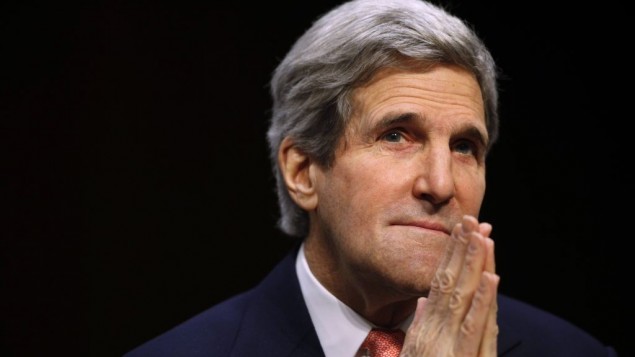
Habayit Hayehudi official: “In Washington, they do not hear the sirens going off in Ashkelon, and that is sad” • U.S. Secretary of State John Kerry says trust between Israelis and Palestinians is at an all-time low.

Mati Tuchfeld, Daniel Siryoti and Hezi Sternlicht

U.S. Secretary of State John Kerry on Thursday

|

Photo credit: Reuters

The fallacy of Iranian-American rapprochement

March 14, 2014

The fallacy of Iranian-American rapprochement, Al Arabiya net, Dr. Majid Rafizadeh, March 14, 2014

(Al Arabiya, a Saudi owned publication, was created to be a direct competitor of the Qatar-based Al Jazeera. — DM)

Iranian leaders’ recent foreign policies, particularly with regards to its nuclear program, are not strategic changes as depicted by the White House. The policies enacted by Rowhani’s government are tactical.

. . . .

The crucial issue is that the tactical policies implemented by Rowhani’s government are temporary and when the political and economic objectives of Tehran are achieved, all the agreements on the nuclear issues can be reversed, as Iranian authorities, including Iran’s Deputy Foreign Minister Abbas Araqchi, have repeatedly pointed towards.

While listening to U.S. Secretary of the State John Kerry’s speech at AIPAC’s annual policy conference in Washington, DC this year, several issues and comments reflected the White House’s underlying, fundamental, policy position regarding the Islamic Republic of Iran.

Usually, President Obama would deliver the speech at this conference, as he did in previous years, however the administration decided to send Kerry instead of the president or Vice President Joe Biden. This decision reflects the recent clashes between the U.S. administration and Israeli Prime Minister Benjamin Netanyahu, particularly on the prospects of Iranian-American rapprochement and reaching a comprehensive nuclear deal that would force the international community and United Nations Security Council members to revert all sanctions imposed over the last decade.

The bulk of Kerry and Netanyahu’s speeches concentrated on Iran, pushing for a comprehensive and final nuclear deal, recent negotiations between the P5+1 (a group of six powers constituting the permanent members of the United Nations Security Council plus Germany) and prospects of Tehran’s nuclear program.

Kerry’s comments reflect a policy position from the White House that an endgame to the Iranian nuclear crisis might involve an Iran that retains its nuclear infrastructure and continues enriching uranium.

Is diplomacy the sole avenue?

Kerry voiced support for diplomacy in Iranian nuclear negotiations and appealed for patience and trust in Iran. He emphasized that a diplomatic path is the only available avenue to reach a permanent nuclear deal and to remove the nuclear threat posed by the Islamic Republic. He pointed out that the diplomatic initiatives have been working and have yielded positive results until now, with no need to alter the ongoing negotiation and diplomatic process.

The United States believes that the Islamic Republic under Rowhani’s administration is making a strategic shift in its policies

Dr. Majid Rafizadeh

The White House has even clashed with Congress due to the bipartisan sanctions bill advocated by both Republicans and Democrats. The Obama administration has repeatedly pointed out that the sanctions bill against Iran would undermine the nuclear talks with Iranian leaders, and President Obama has threatened to veto it.

There is not doubt that reaching a permanent and comprehensive nuclear deal aimed to remove all security concerns about Iran’s nuclear ambitions is totally legitimate and desirable for all parties involved including the regional powers. Yet there is still a real security risk: if the comprehensive nuclear deal leaves Iranian leaders with some sort of path to become a nuclear armed state and if it simultaneously relieves Iran from all economic and political sanctions, then the regional security risk of reaching a final deal is much higher than the status quo.

Reaching a comprehensive nuclear deal will require the United Nations Security Council members to revert all the accumulated economic sanctions against the Islamic Republic. If the final deal is flimsy and weak and if it permits Iranian leaders to continue enriching uranium, keeping the plutonium reactors of Arak and Fordow, retaining the nuclear infrastructure, spinning centrifuges and adding to the numbers of centrifuges, the final comprehensive nuclear deal will pose more threats and make more concerns for the region.

The underlying U.S. fallacy

Kerry’s recent speech and U.S. foreign policy moves towards Tehran indicate that Washington views the current status of American-Iranian rapprochement as similar to the American-Chinese rapprochement in the early 1970s with President Nixon’s trip to Beijing.

The United States believes that the Islamic Republic under Rowhani’s administration, like Zedong’s China, is making a strategic shift in its policies with Iranian leaders searching for a fundamental policy change and a fresh era of geopolitical and strategic relationships with Washington, the West, and other regional powers.

However, the fallacy in this inaccurate analogy arises from the notion that Iranian leaders’ recent foreign policies, particularly with regards to its nuclear program, are not strategic changes as depicted by the White House. The policies enacted by Rowhani’s government are tactical.

Rowhani’s government, in addition to all the technocrats that he brought to his administration, can be characterized as the most competent Iranian administration since 1979. Rowhani’s team is made up of individuals that made incredible mistakes in the late 1980s and 1990s. They have learned from their mistakes though, and are applying new tactical policies to survive, remove sanctions, and regain their economic and geopolitical power. Tactical policies are reversible at anytime.

In one of his speeches, Khamenei gave an example of such tactical moves in recent nuclear talks by referring to wrestling (a popular sport in Iran), where sometimes, when the wrestler faces a strong rival, he must show some “heroic flexibility” in order to win the match or survive.

President Rowhani clearly wrote in his memoir that the negotiations he led during the Khatami era, and the agreement to suspend Iran’s nuclear enrichment for two years, not only did not halt the advancement of the nuclear program, but actually moved the program forward, expanding the centrifuges and nuclear infrastructure in those years. This is a prominent example of tactical policies. He added that through his policies he was capable of buying time and progressing the nuclear program to 20 percent enriched uranium with higher number of centrifuges.

The crucial issue is that the tactical policies implemented by Rowhani’s government are temporary and when the political and economic objectives of Tehran are achieved, all the agreements on the nuclear issues can be reversed, as Iranian authorities, including Iran’s Deputy Foreign Minister Abbas Araqchi, have repeatedly pointed towards.

Off Topic: A good week for Abbas

March 14, 2014

A good week for Abbas, Israel Hayom, Ruthie Blum, March 14, 2014

(Shouldn’t pacifist political commissars be hired to teach the IDF brutes how to deal tenderly and lovingly with all attempts to kill them? Surely, the Palestinian response would be proportionate. Why not simply disband the IDF and beg for immediate peace on Palestinian terms? Perhaps Secretary Kerry and President Obama will offer their wise military/diplomatic counsel. — DM)

Palestinian Authority President Mahmoud Abbas must be feeling pretty pleased with himself. In anticipation of his upcoming meeting at the White House, he needed something that would take the heat off PA rejection of U.S. Secretary of State John Kerry’s “framework for peace.”

His prayers to Allah were answered, when two events unfolded that gave him the opportunity to condemn Israel from above the fray.

The first occurred on Monday morning at the Allenby (or King Hussein) Bridge between the West Bank and Jordan. Though details of the event are not entirely clear, what has emerged so far is that 38-year-old Raed Zeiter, a Palestinian judge residing and working in Amman, was killed by Israeli soldiers at the border crossing.

According to witnesses, Zeiter charged at the soldiers with a metal pole, while shouting “Allahu akbar” (“God is great”) and attempting to grab one of their weapons. When a soldier shot him in the leg, Zeiter lunged at and started strangling him. This prompted additional shooting, which led to Zeiter’s death.

Though Prime Minister Benjamin Netanyahu’s office issued a statement of “regret” (if the incident happened the way the Israel Defense Forces recounted, there is nothing to apologize for) and “…sympathies to the people and government of Jordan” — as well as agreeing “to a Jordanian request to establish a joint Israeli-Jordanian team to complete the investigation” — both Jordanians and Palestinians went berserk.

Claiming that Zeiter was not only a judge, but a law-abiding married man with two children (one of whom is in a coma, no less), protesters in Jordan and the PA accused the IDF of committing cold-blooded murder.

The PA leadership, giddy at this turn of events, immediately demanded an international investigation. This is in spite of the fact that if any joint Israeli-Jordanian examination reveals wrongdoing on the part of the soldiers, the IDF will court-martial and hold them legally — and morally — accountable.

Jordanian Prime Minister Abdullah Ensour said, “The Israeli government’s excuses do not justify that treacherous act.”

The lower house of the Jordanian parliament announced, “What happened proved that Israel is a racist country that does not want peace.”

In addition, it not only demanded the expulsion of the Israeli ambassador in Amman and the recall of the Jordanian ambassador in Israel, but passed a unanimous resolution demanding the release of Ahmed Daqamseh from jail.

Daqamseh was a soldier in the Jordanian army who opened fire on a group of Israeli middle-school girls on a class trip to the “Island of Peace,” a joint Israeli-Jordanian tourist site in Naharayim, near the Jordanian border and under Jordanian rule.

The upshot of the massacre, which took place on March 13, 1997, was that seven girls were dead and six others seriously wounded. Daqamseh was tried by a Jordanian military court and sentenced to life in prison. Rather than expressing remorse, he maintains to this day that his actions were not criminal, but rather the fulfillment of his national and religious duty.

Many Jordanian officials and members of the public consider Daqamseh a hero and have been lobbying for his release. Monday’s killing of Zeiter is fanning the flames of this campaign. His funeral on Tuesday in Nablus allowed Abbas to gloat from the sidelines.

The second occurrence that made Abbas’ week was the flare-up in the Gaza Strip. On Tuesday, while Zeiter’s corpse was being paraded around and hailed as a martyr, the IDF killed three members of the Iranian-backed terrorist group, Islamic Jihad, in Gaza. These targeted killings were undertaken after the terrorists fired a mortar bomb at Israeli troops.

To “retaliate,” Islamic Jihad began to bombard southern Israel with dozens of Qassam and Grad rockets, sending civilians preparing for the Purim holiday into shelters.

The IDF response was quick and precise. Twenty-nine terror bases in Gaza were hit from the air, with no human casualties. Fear that Netanyahu meant business when he said, “If there is no quiet … for the residents of Israel, there will be … lots of noise in Gaza. And that’s putting it mildly,” Islamic Jihad agreed on Thursday evening to “calm things down.” Still, several missiles have been launched from Gaza since then.

Abbas couldn’t have written a better script for himself. Now he can fly to Washington with a new set of “moderate” credentials and a replenished supply of anti-Israel ammunition.

UPDATE: High Alert in the South Due to Fears of Rocket Attacks During Purim

March 14, 2014

UPDATE: High Alert in the South Due to Fears of Rocket Attacks During Purim – Jerusalem Online

This morning, educational institutions across the country celebrated Purim. Despite the recent escalation in the south, it was decided that studies would continue like normal. During the night, the IDF attacked terror groups inside the Gaza Strip. This morning, southern Israel is on high alert in case of renewed rocket fire.

Mar 14, 2014, 10:36AM | Rachel Avraham

Despite the announcement by Islamic Jihad of a lull yesterday afternoon, rockets continued to be fired on Israel in the evening hours and the Israeli Air Force attacked Gaza last night in response.

Nevertheless, classes are held as usual today in Southern Israel.

The IDF stated that last night they attacked three targets in northern Gaza and four targets in the southern part of the coastal strip. The IDF stressed that despite the fact that the Islamic Jihad was the one who fired the rockets at Israel; Hamas is responsible for all of the shooting directed at Israel from Gaza.

Local authorities in the cities surrounding Gaza—Ashdod, Ashkelon, Be’ersheva and Sderot—decided to hold school as usual this morning and not to damage the Purim celebrations held annually in schools and kindergartens.

IAF strikes 7 Gaza terror targets in response to evening rocket fire

March 14, 2014

IAF strikes 7 Gaza terror targets in response to evening rocket fire – Ynet.

Despite Islamic Jihad’s announcement of a ceasefire, ‘Code Red’ sirens were heard in the south, and rockets continue to rain down.

Latest Update:  03.14.14, 00:40 / Israel News

The Israel Air Force attacked seven Gaza terror targets on Thursday night – three targets in the north of the Strip and four in its south – after 17 rockets were fired by Gaza terror groups towards southern Israel following Islamic Jihad’s announcement on a truce with Israel.

The Iron Dome missiles-defense system was deployed in Beersheba and near Ashdod on Thursday evening to stop grad rockets from reaching the populated cities.

 ‘Code Red’ sirens were heard shortly before 7:50 pm Thursday in the Shaar HaNegev and Sdot Negev Regional Councils and in Sderot, followed by three rocket falls. Two of the rockets fell in open areas in the Shaar HaNegev Regional Council and another fell in Sderot.

 Another barrage of rockets was fired at around 8:30 pm, two of them intercepted by the Iron Dome missile-defense system. The rest fell in open areas. At around 9:05 pm, ‘Code Red’ sirens were heard for the third time in Sderot and Shaar HaNegev. Around 10:45 pm, another rocket fell in an open field in the Eshkol Regional Council. There was no ‘Code Red’ siren beforehand.  

 Earlier in the day, a rocket fell in an open area in the Ashkelon region, shortly after Islamic Jihad’s announcement of an Egyptian-brokered ceasefire with Israel. The organization denied that it was behind the attack.

 After over 60 rockets were fired at southern Israel on Wednesday evening, rocket fire from the Gaza Strip resumed Thursday morning, with sirens sounding in the towns of Yavne, Rehovot, Ashdod and Ashkelon. In light of the wake in rocket fire, Kerem Shalom Crossing has been closed, as well as Erez Crossing, which will only remain open for humanitarian emergencies.

 At least one rocket fired at Ashkelon was neutralized by the Iron Dome missile defense system, the IDF confirmed. Two rockets landed in open fields between Ashkelon and Ashdod.

The Israel Air Force struck targets in southern Gaza Strip in response to the morning rocket fire. Palestinian sources in Gaza reported that the IAF struck two targets in Rafah: A smuggling tunnel and a cached launching pad.

Mattan Tzuri and Yoav Zitun contributed to this report.

Saeed Abedini, US pastor held in Iran, denied treatment after prison beating

March 14, 2014

Saeed Abedini, US pastor held in Iran, denied treatment after prison beating – FoxNews.

(Shows us the pure EVIL and barbarism of the mullah regime. Like the Iranian weapons ship this poor man’s fate will most likely be ignored by the P5+1 in order to strike a deal. To our American readers: Please do whatever is in your power, even if that is only writing a letter or an email, to help him. – Artaxes)

By  / Published March 13, 2014 / FoxNews.com

saeed 4.jpg
Nagameh Adedini seen here in this undated photo with husband Pastor Saeed Abedini. (Courtesy of ACLJ)

An American pastor being held in one of Iran’s most brutal prisons is in serious danger, after initially being refused medical treatment following a beating at the hands of his jailers, supporters of Saeed Abedini said.

The 33-year-old Abedini, whose wife, son and daughter are at their home in Boise, Idaho, was taken to a hospital after the attack at Iran’s Rajai Shahr prison, but once there was shackled to a hospital bed and ultimately refused surgery for internal bleeding, according to his wife. On Thursday, a relative of Abedini complained to prison officials and was told a “mistake” had been made and that surgery would be performed. Although the relative was allowed to see Abedini, no procedure had taken place.

“This development is of great concern to me and our children,” Naghmeh Abedini told FoxNews.com. “Saeed needs medical care and treatment and for the Iranian government to withhold the surgery he so desperately needs is deeply troubling.”

Abedini, who has served just one year of an eight-year sentence meted out to him for allegedly evangelizing in his homeland, was taken to the hospital a little over a week ago, according to the American Center for Law and Justice, the attorneys representing the pastor and his family here in the U.S.

Abedini suffers pain in his abdomen and internal bleeding — the result of a number of prison beatings, according to his attorneys.

Abedini’s supporters say he has been beaten and tortured in the prison, and that he was only in Iran to try to start a secular orphanage. President Obama, Washington lawmakers, the European Union and a host of international humanitarian groups have called on Tehran to release Abedini, but the Iranian government has so far rebuffed them.

Abedini’s relatives in Iran told ACLJ officials prison guards told them Wednesday they had an order from the court banning visitors and stating that Abedini must remain shackled at all times. Despite spending a week at the hospital, Abedini was denied treatment and test results.

Naghmeh Abedini has been working tirelessly to keep her husband and his plight in the international spotlight. She has often left her children back home to travel around the world making her husband’s story known. She continues to pressure the Iranian government for her husband’s release.

ACLJ Executive Director Jordan Sekulow believes the temporary transfer of Abedini was due to a visit to Tehran of European Union’s High Representative Catherine Ashton. By moving him to a hospital, the regime might have been able to deny her permission to visit him while creating the impression he was getting care, Sekulow said..

“It appears the Iranian government is interested more in public relations than in human rights and providing medical treatment to a U.S. citizen who is imprisoned because of his Christian faith,” Sekulow said.

Abedini had been making one of his frequent visits to see his parents and the rest of his family in Iran, his native country, where he spent many years as a Christian leader and community organizer developing Iran’s underground home church communities for Christian converts.

On this last trip, the Iranian government pulled him off a bus in September 2012, and said he must face a penalty for his previous work as a Christian leader in Iran.

“The Iranian government is wrongfully imprisoning him and denying him needed medical care because he is a Christian,” Sekulow said.

“Just reiterates that we need to keep pressure on Iran. As soon as pressure is let up, the situation gets worse.”

Lisa Daftari is a Fox News contributor specializing in Middle Eastern affairs

Off Topic: Kerry: ‘Jewish state’ demand ‘a mistake’

March 14, 2014

Kerry: ‘Jewish state’ demand ‘a mistake,’ Times of Israel, March 14, 2014

(Yielding on the Jewish state issue would leave only a few more of Israel’s core demands. How about the “right of return?” Can’t Israel be reasonable, finally? Or something, like the Palestinians? Secretary Kerry needs an Israeli – Palestinian peace deal so that he can settle all Middle East conflicts. If not Israel, who? If not now, when? — DM)

Issue shouldn’t make or break Israel-Palestinian peace negotiations, US Secretary of State tells Congress.

Kerry March 13 2014US Secretary of State John Kerry on Capitol Hill in Washington DC on Thursday, March 13, 2014. (photo credit: AP Photo/Charles Dharapak)

Israel’s insistence that the Palestinians officially recognize Israel as a Jewish state is a mistake, US Secretary of State John Kerry said Thursday, adding that the issue should not be a critical factor in whether the current round of Israel-Palestinian peace negotiations succeed or fail.

Speaking to the House Committee on Foreign Affairs, Kerry put the kibosh on the demand, which Prime Minister Benjamin Netanyahu has made central to peace negotiations with the Palestinians.

“I think it’s a mistake for some people to be, you know, raising it again and again as the critical decider of their attitude towards the possibility of a state and peace, and we’ve obviously made that clear,” Kerry said.

Kerry noted that the “Jewish state” issue was addressed by UN Resolution 181 in 1947, which granted international recognition to the fledgling state of Israel. There are “more than 40 — 30 mentions of a ‘Jewish state’” in the resolution, Kerry said, and added that the late Palestinian leader Yasser Arafat “confirmed that he agreed it [Israel] would be a Jewish state” in 1988 and in 2004.

After bringing the two sides back to negotiating table and ending a three-year freeze, Kerry has been focused on trying to hammer out a framework deal which is due to set out the end goal of the talks plus guiding principles on each of the core issues.

On Wednesday, Kerry told lawmakers that the two sides were still far from coming to an agreement.

“The level of mistrust is as large as any level of mistrust I’ve ever seen, on both sides,” he said.

Decades of negotiations have been bedeviled by some of the toughest disputes separating the two sides, such as the fate of Palestinian refugees and the designation of Jerusalem claimed by both sides as a capital.

In recent months Prime Minister Benjamin Netanyahu has been insisting that Palestinian leader Mahmoud Abbas recognize Israel as “a Jewish state” — something Palestinians are refusing to do, believing it would irrevocably torpedo chances for the return of refugees living in exile.

Sporadic rocket fire from Gaza continues to hit South despite ‘ceasefire’

March 13, 2014

Sporadic rocket fire from Gaza continues to hit South despite ‘ceasefire’ | JPost | Israel News.

By YAAKOV LAPPIN, JPOST.COM STAFF

03/13/2014 20:18

3 rockets land in Sha’ar Hanegev and 1 in Ashkelon Coast area despite Islamic Jihad’s claims that Egypt brokered a ceasefire; Israel vows to react if provocations continue as two day rocket total nears 70.

gaza

Islamic Jihad underground rocket launcher Photo: screenshot

Sporadic rocket fire from the Gaza Strip fell in southern Israel on Thursday evening hours after the Islamic Jihad claimed that Egypt had brokered a ceasefire to end two days of hostilities that has seen nearly 70 rockets fall in the South.

A rocket fell in the Ashkelon Coast Council area around 5 p.m. Wednesday and just before 8 p.m. three rockets fell in the Sha’ar Hanegev Regional Council area.

Israel has denied that an official ceasefire is in effect, and has maintained that it will respond forcefully to rocket fire.

Defense Minister Moshe Ya’alon said earlier Thursday that “quiet would be met with quiet” but he added “if provocations continue, we will know how to pound whoever needs to be pounded.”

“We do not seek an escalation but we will not resign ourselves to any provocation from the organizations in Gaza,” Ya’alon said.

The defense minister sent “a message of strength” to the residents of southern Israel who faced a barrage of rocket fire over the past days asking them to continue their routine, saying that the IDF would continue to defend them.

Earlier in the day it appeared that Egyptian efforts to broker a ceasefire may have succeeded with an Islamic Jihad official saying that a truce had been reached.

“Following intensive Egyptian contacts and efforts, the agreement for calm has been restored in accordance with understandings reached in 2012 in Cairo,” Islamic Jihad official Khaled al-Batsh wrote on Facebook, referring to a truce that ended an eight-day Gaza war two years ago.

Batsh said Islamic Jihad, a militant group that began launching rockets into Israel on Wednesday after Israeli soldiers killed three of its fighters a day earlier, would hold its fire as long as Israel did the same.

The news came shortly after the Israel Air Force struck seven terror targets in the southern Gaza Strip in response to two rockets fired earlier in the day.

Two rockets fired on Thursday morning by Palestinian terrorists in Gaza landed in open territory near Ashkelon and Ashdod, following several hours of tense quiet after Wednesday night’s barrage of heavy fire.

Yasser Okbi and Reuters contributed to this report.