Archive for February 2014

Iran, Britain renew diplomatic ties, reopen embassies

February 20, 2014

Iran, Britain renew diplomatic ties, reopen embassies – Israel News, Ynetnews.

( The UK (which opposed the creation of the state of Israel) now has added to its karma being the first western state to normalize relations with THE rogue state of our hemisphere.  For SHAME ! – JW )

Ties were severed by London after students stormed its Tehran embassy in 2011.

AFP

Published: 02.20.14, 17:51 / Israel News

TEHRAN – Iran and Britain officially resumed diplomatic relations on Thursday, severed by London after students stormed its Tehran embassy in 2011, a senior Iranian official said.

“From today relations between Iran and Britain are resumed at the non-resident charges d’affaires level,” Deputy Foreign Minister Majid Takht-Ravanchi told ISNA, adding that the countries’ flags were raised atop their embassies in Tehran and London.

The British Foreign Office confirmed the news.

Britain had ordered the closure of Iran’s embassy in London after shuttering its own in Tehran when hundreds of Islamist students stormed the compound in November 2011.

The students – protesting against Western sanctions over Tehran’s disputed nuclear program – ransacked the building as well as the ambassador’s residence in north Tehran.

Since then, the Swedish embassy in Tehran has represented Britain’s interests there, while the Omani embassy in London has done the same for Iran.

“By ending the job of countries’ interest sections, the charges d’affaires are now responsible for the bilateral relations,” said Takht-Ravanchi.

In November, the two countries had already named non-resident charges d’affaires, and Britain’s new envoy, Ajay Sharma, visited Iran in December.

There has been a thaw in ties between the Islamic republic and the international community since the June election of President Hassan Rouhani, a reputed moderate who has reached out to the West and steered his country into a landmark nuclear deal with major powers.

US expected to keep oil embargo even if Iran nuclear deal struck

February 20, 2014

US expected to keep oil embargo even if Iran nuclear deal struck, Ynet News, February 20, 2014

(Are mixed signals been sent?  If so, why now and to whom? — DM)

American official says trade barriers erected after 1979 Islamic Revolution to remain in place, unilaterally, even if Iran achieves comprehensive deal with world powers.

A unilateral US oil embargo on Iran is expected to remain in place even if a long-term nuclear agreement between Tehran and six world powers is reached that includes an easing of international sanctions, a US official said on Thursday.

The embargo pre-dates the decade-long nuclear dispute with Iran. Washington cut off diplomatic ties with Tehran during a hostage crisis shortly following the 1979 Islamic Revolution and began imposing sanctions around the same time.

“The American domestic oil embargo is expected to remain in place even if a comprehensive agreement is reached,” the US official told Reuters on condition of anonymity.

Western diplomats say US companies would be unhappy about being left out if European Union and UN sanctions are lifted, allowing non-US firms to resume business with the Islamic Republic. Iranian officials say they would have no problem with American oil companies returning to Iran.

The US official spoke after Iran and the six powers – Britain, China, France, Germany, Russia and the United States – agreed on an agenda and schedule for talks aimed at ending the dispute over Tehran’s nuclear ambitions.

Earlier, a senior US official said the United States would like to see sanctions lifted, but that cannot happen until an agreement on Iran’s nuclear project is reached. Another US official said those remarks referred only to sanctions imposed after the dispute over the nuclear program broke out in 2002.

Iranian parliament adds $3 bln to defense budget as a respond to US military option

February 20, 2014

Iranian parliament adds $3 bln to defense budget as a respond to US military option, Trend, February 20, 2014

(Let’s remove even more sanctions on peace-loving but impoverished Iran. We can rest secure in the hope that the funds will be used only for peaceful purposes such as providing more electricity, food and medicine for the peons of Iran. Right. — DM)

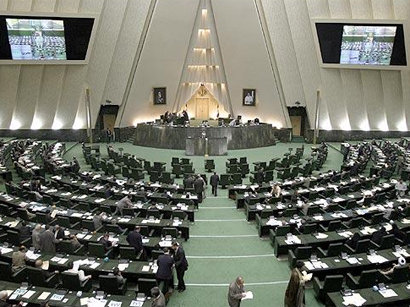
a Iranian parliament

Iranian parliament has allocated an additional $3 billion to strengthen the country’s defense capacity for the next Iranian calendar year as a response to the U.S. officials’ statements that the military option against Iran is still on the table, head of the parliamentary Budget Commission Qolam Reza Mesbahi Moghaddam said, Iran’s Fars news agency reported on Feb. 20.

“We allocated some extra $3 billion to the country’s defense budget for next year in response to them and to show that Iran will continue to boost its defense power,” the MP underlined.

On Feb. 5, Iranian parliament allocated some $3 billion of surplus oil revenues to the armed forces and related organizations for the next Iranian calendar year 1393, which starts on March 21, 2014. The Iranian parliament approved generalities of the Iran’s national budget bill on Jan. 29 and now is studying and approving details of it.

The budgets of the Iranian army and the Islamic Revolutionary Guard Corps (IRGC) have increased significantly in Iran’s next year budget bill. The army’s budget has increased by 50 percent and was set at 52 trillion rials (about $2.1 billion), and the IRGC’s budget has increased by 30 percent and was set at 44 trillion rials (about $1.8 billion), Mehr News Agency reported on Dec.10.

U.S. officials have repeatedly announced that the “military option” is still on the table, if the Islamic Republic continues to enrich uranium beyond the permitted levels.

Iranian senior commanders in recent weeks have responded to the U.S. officials` statements claiming that these statements are political bluff.

Iran’s Defense Minister Hossein Dehghan said last week that the successful test-fire of ballistic missiles which took place on Feb. 9, is a response to the U.S. officials’ statements that the military option against Iran is still on the table.

Iran says negotiation agenda agreed in nuclear talks with powers

February 20, 2014

Iran says negotiation agenda agreed in nuclear talks with powers | JPost | Israel News.

By REUTERS

02/20/2014 08:38

Negotiators have been meeting since Tuesday to hammer out an agenda for talks on a final deal to the standoff over Tehran’s atomic activities.

Khamenei

Iranian Supreme Leader Ayatollah Ali Khamenei. Photo: REUTERS

Iran and six world powers have agreed on an agenda for negotiations over Tehran’s nuclear program and will meet again next month in Vienna, a senior Iranian official said after two days of talks in the Austrian capital.

If confirmed, it would indicate an early step forward in the elusive search for a settlement of the decade-old dispute, even though the sides remain far apart on how to resolve it and both Iran and the United States have publicly stated it may not be possible to reach a final agreement.

Negotiators from Iran and the powers – the United States, France, Germany, Britain, China and Russia – have been meeting since Tuesday in Vienna to hammer out an agenda for talks on a final deal to the standoff over Tehran’s atomic activities.

Iranian Deputy Foreign Minister Abbas Araqchi told the official IRNA news agency: “The involved parties have agreed on an agenda and a framework and the next round of talks will be in the second half of March in Vienna.”

A senior US state department official earlier said about the second day of talks on Wednesday: “Today’s discussions, which covered both process and substance, were constructive and useful.”

Officials from the six powers were not immediately available for comment on Araqchi’s statement to IRNA. His statement was also carried by Iran’s English-language Press TV state television on its web site.

The meeting was due to resume on Thursday morning, expected to be followed by a news conference by European Union foreign policy chief Catherine Ashton – who is coordinating the talks on behalf of the powers – and Iranian Foreign Minister Mohammad Javad Zarif.

The six powers want a long-term deal on the permissible scope of Iran’s nuclear work to lay to rest concerns that they could be put to developing atomic bombs. Tehran’s priority is a complete removal of damaging economic sanctions against it.

The negotiations will probably extend at least over several months and could help defuse many years of hostility between energy-exporting Iran and the West, ease the danger of a new war in the Middle East, transform the regional power balance and open up major business opportunities for Western firms.

The Arms Control Association, a US-based research and advocacy group, said that if a common understanding had been reached on the issues that needed to be addressed “it is an important step forward that makes it more likely the two sides can arrive at a realistic, comprehensive deal in the next 6-12 months.”

The powers have yet to spell out their precise demands of Iran. But Western officials have signaled they want Tehran to cap enrichment of uranium at a low fissile concentration, limit research and development of new nuclear equipment, decommission a substantial portion of its centrifuges used to refine uranium, and allow more intrusive UN nuclear inspections.

Such steps, they believe, would help extend the time Iran would need to make enough fissile material for a bomb and make such a move easier to detect before it became a fait accompli. Tehran says its program is peaceful and has no military aims.

Graham Allison, director of Harvard University’s Belfer Center, said the aim should be to deny Iran an “exercisable nuclear weapons option.”

“Our essential requirement is that the timeline between an Iranian decision to seek a bomb and success in building it is long enough, and an Iranian move in that direction is clear enough, that the United States or Israel has sufficient time to intervene to prevent Iran’s succeeding,” he said.

Highlighting wide differences over expectations, Araqchi was cited by Press TV on Tuesday as saying that any dismantling of Iranian nuclear installations would not be up for negotiation.

The talks could also stumble over the future of Iran’s facilities in Arak, an unfinished heavy-water reactor that Western states worry could yield plutonium for bombs, and the Fordow uranium enrichment plant, built deep underground to ward off any threat of air strikes.

During a decade of on-and-off dialogue with world powers, Iran has rejected Western allegations that it has been seeking the means to build nuclear weapons. It says it is enriching uranium only for electricity generation and medical purposes.

As part of a final deal, Iran expects the United States, the European Union and the United Nations to lift painful economic sanctions on the oil-dependent economy. But Western governments will be wary of giving up their leverage too soon.

The six powers hope to get a deal done by late July, when an interim accord struck in November expires.
That agreement, made possible by the election of relative moderate President Hassan Rouhani on a platform of relieving Iran’s international isolation by engaging constructively with its adversaries, obliged Tehran to suspend higher-level enrichment in return for some relief from economic sanctions.

▶ Netanyahu: We must prevent Iran from having the capacity to produce nuclear weapons – YouTube

February 20, 2014

▶ Netanyahu: We must prevent Iran from having the capacity to produce nuclear weapons – YouTube.

[Transcription]

We meet on the eve of the resumption of negotiations of what is called the final settlement with Iran. They’re supposed to begin tomorrow in Vienna. What is the goal? Or what ought to be the goal of these negotiations? It’s not merely to prevent Iran from having nuclear weapons. I want to be more precise. It’s to prevent Iran from having the capability of manufacturing nuclear weapons. That is different. If Iran perches itself as a threshold state in which it has all the elements of a nuclear weapon in place, they’ll just have to do one little twist of the knob to get final enrichment of fissile material that is the core of a nuclear weapon, then all they’ll have to do is take these components from one side of a room and another side of a room, put them together and in a very short time, days or weeks or perhaps even hours, they’d have a nuclear weapon.

Our goal is to prevent Iran from having the capacity to manufacture or put together nuclear weapons. That is our goal. Now, if they claim to want only civilian nuclear energy, that they have an abundance and they certainly don’t need what it is they’re insisting on. They don’t need enrichment for peaceful nuclear energy. They don’t a heavy water reactor for that. They don’t need ICBMs, long range inter-continental ballistic missiles. They don’t need that for that. They don’t need a weaponization program that Iran of course refuses to open to inspection. They don’t need any of these things, but these are precisely the things that Iran insists on. And they’re precisely the elements that they have to be denied. Now, they haven’t been denied this, in the so-called interim deal. They’ve been allowed to maintain their ICBMs’ their long-range ballistic missiles program, they continue to develop them. By the way, the range is geared to Europe and soon to the United States. It’s not for us. And there’s only one purpose in the world to develop ICBMs. You don’t develop inter-continental ballistic missiles to deliver some hundreds of kilos of TNT. Believe me, nobody does that. You develop an ICBM in order to deliver a nuclear payload. Iran continues to develop that and continues to develop a heavy water reactor, and continues to develop latter-day models of centrifuges. Now they’re developing, as we speak, they’re developing centrifuges that are supposed to be 15 times more effective and more efficient than the centrifuges that they have today. That will enable them to leap-frog the distance and the time from low enrichment of uranium to high enrichment like that.

We’ve made a calculation. How much time has been saved by the interim deal? How much has Iran regressed by agreeing to distill or to dilute the 20% enriched uranium that they have to 3.5%? Well, given everything that they’re preparing, the 19,000 centrifuges that they have in place, and the advanced centrifuges that they continue to develop under the deal, the sub-total of what they’ve been sent back in time is four weeks. That’s what Iran has given to the world, which means it’s given practically nothing, but Iran has received a great deal. It’s received the easing of sanctions. It’s received the nations that are queuing up to ease more sanction with Iran and do more business with Iran. It’s very important to understand that. Iran has given zero, or practically zero. It’s given four weeks, but it’s receiving a new position in the world. It’s being legitimized. Everybody is embracing Iran because of a smile. But Iran’s moderation is a myth.
You should know what Iran is doing as we speak. As we speak, inside Iran innocent people are being executed. They’re executed in horrific ways. They’re executed with these cranes in the middle of cities, innocent people, hoisted up, executed by this regime. This regime continues to foster terrorism around the world. It sends the most deadly weapons to Hezbollah, to Hamas, weapons that are fired on our civilians. This regime, participates in the slaughter, the massive slaughter, the unending slaughter in Syria. That would not be possible without Iran. The Assad regime does not exist a day without Iran, without Iran’s money, without Iran’s weapons, without Iran’s commanders who were there on the site to tell what is left of the Syrian army what to do. But in addition to that, when that didn’t help, when everything else failed, Iran supplied Assad with the most important component. They actually gave them fighters. Khamenei instructed Nasrallah to go and bring his people to Lebanon, and there they do the fighting for Assad. There is no Assad regime without Iran. So as Assad perpetrates this savagery day in and day out, Iran is committing the savagery. Iran is supporting terrorists around the world. Iran is sending these weapons, deadly weapons to be fired on Israel’s cities, and Iran has not changed one iota its call to annihilate the Jewish state. And yet this regime is being embraced.
So I think what is needed are two things. One, we have to expose Iran for what it is. It smiles but it continues its deadly business every day. And secondly, it has to be stripped of the capacity to make nuclear weapons. What the deal that is being discussed today should achieve is one simple thing: zero centrifuges. Not one. Zero enrichment. They don’t need any centrifuges and they don’t have a right for enrichment. I think this is something that requires firmness and clarity. It may not be fashionable, but it’s the right thing, it’s the truthful thing, and I think that the only way that we could make Iran become a more moderate element, a more moderate nation and a more peaceful nation is by exhorting consistent pressure on it, political pressure, economic pressure and the demands of dismantling the Iranian nuclear program, which should be maintained throughout. I think any other route will actually produce the other result and make a diplomatic solution less likely. It will kick it away and force us into a reality that I think none of us want. We all want to see a peaceful solution. For a peaceful solution to succeed, you need more, not less, pressure.
The second thing that we’re discussing every day is how to achieve a secure and enduring peace with the Palestinians. By the way, the strength of Iran weakens that too, because Iran now controls one half of the Palestinian population. They control Hamas, they control Gaza through their proxies Hamas and Islamic Jihad, and of course they tell them what they say in Tehran, no peace with Israel, no reconciliation with Israel, continuous war in Israel. That’s what Hamas and the other terror proxies that Iran again, arms, funds and instructs are doing in Gaza. So one half of the Palestinian population is under the boot of Iran. And the other half, so far, has refused to confront the first half.

We’re trying to make peace with those Palestinians who at least have not engaged in terror and we say to them, if you want to achieve a real peace, then that peace has to be based on a real reconciliation with the Jewish State of Israel. I appreciate the effort, I must say ceaseless efforts, that Secretary John Kerry is engaging with me. We shall soon see if we have a partner in Abu Mazen, but I think if there is a partner there, then there is a way to move this process forward. And for it to move forward and for it to succeed ultimately, then it must address first the root cause of the conflict. The root cause of the conflict is not the settlements, it’s not the territories. This conflict predated it by at least half a century. The root cause of this conflict is the refusal to accept the right of the Jewish people to a state of their own in any boundaries. That remains a simple truth. Simple truths have a way of eluding common perception until they somehow land on you like a ton of bricks. Here is a simple truth that eluded all the experts and many of the commentators about the Middle East for decades. This was an area that was supposed to be preoccupied with one conflict and they always said the conflict, the core of the conflict in the Middle East, always in the singular. The core of the conflict was the Palestinian Israeli conflict. That’s what was said. Today if somebody repeated it, he should be at least laughed away. I think that you find that rarer and rarer. And that’s good, because when you see Syria imploding, and you see Iraq imploding, and you see Lebanon imploding and you see so many other parts of the Middle East imploding, Libya imploding, when you see all of that happening, you know that has nothing to do with the Palestinians.

I bring to your attention the fact that until two years ago people actually said this with a straight face. Professors, scholars, politicians, heads of state, they said the root cause of the conflict in the Middle East is the Palestinian Israeli conflict. Well that is as accurate as the next statement that they now say. That the root cause of the Israeli Palestinian conflict, inside the myriad conflicts of the Middle East is the settlements. Now, friends, you can take all the settlements and you can uproot them and the conflict will continue. You can have Israel continue, go back to the ’67 lines and the conflict will continue. How do we know that? Because we tried it. That’s exactly what we did in Gaza. We went back to the ’67 lines, we uprooted at terrible human cost and financial costs the 10,000 Israelis who were there. Did we get peace? What we got is a forward outpost of Iran from which they’ve so far fired about 12,000 rockets on our heads.

Now, what is going to prevent that from happening again? Well, what we need to see with the Palestinians who make a deal is that they’re resigned to the fact that they’ll have to make a genuine peace with Israel and that means finally recognizing the Jewish state. This will be a peace between two nation states. The Palestinians expect us to recognize a nation state for the Palestinian people. How do they have the temerity not to recognize the Jewish state, the nation state of the Jewish people? Do they not know that we’ve been here for the last 3,800 years? They don’t know that this is the land of the Bible? That this is where Jewish history and Jewish identity was forged? This is what defines us? This is how we define ourselves. We’ve been here a very long time, for God’s sake. They have no excuse, and they can try to distort ancient history and modern history, they can try to do that, but it doesn’t make it true. This is the land of Israel. We’ve been here on this land, associated with it for millennia, and now we say, we know that there has to be a very difficult decision to be made here. But in our ancestral homeland, we are the Jewish people. This is the Jewish land. This is the Jewish state. When we make an agreement it is an agreement between the nation state of the Jewish people and a nation state of the Palestinian people.

If they don’t accept that, you have to ask yourself why not? Why don’t they accept that? Why do they insist on not recognizing us? There is a reason.  Because once you accept the fact that Israel is the nation state of the Jewish people then you have no more claims on this land and on this country, wherever the final border will be drawn. You cannot  claim the so called right of return because that claim of Palestinian refugees or their descendants will be satisfied in the nation state of the Palestinian people. Just as Jews can come here, Palestinians if they chose can go there. That claim evaporates.
Secondly, you cannot make any territorial claims on what remains as the territory of Israel. You cannot say, well there is another people there. Perhaps a sub-group of Israel’s citizens. They’re entitled to a sub-state or to separate state or to an irredentist claim. The minute you agree to the formulation of two nation states, a Jewish state for the Jewish people and a Palestinian state for the Palestinian people, you end all claims. You end territorial claims, and you end refugee claims, you end the so-called “right of return.” That is all incorporated in ending the conflict. The fact that the Palestinian leadership and the Palestinian Authority adamantly refuses to accept this raises serious questions on whether they’re committed to a genuine peace. And unless they’re willing to accept it, they’re not committed to a genuine peace.

Now, even if they accept it, which I sincerely hope they do, that doesn’t guarantee that the decades of incitement that they’ve led to their own people, teaching them to seek this solution, an elimination of the Jewish states, that that will come to an end. We don’t know that. We cannot guarantee that. And I certainly am not coming into any of this Pollyannaish. I’m not looking at this wide eyed, from pink eyeglasses. I can understand that this will be a very difficult experience but it starts with a Palestinian leadership that accepts the Jewish state, accepts the end of claims, ends the conflict and disavows, shuts down, the whole claim of flooding Israel with refugees. That’s a necessity. It’s just not a guarantee. In fact, there is no guarantee. There is no guarantee that the incitement will stop, that the culture of hatred will end. And that’s why we need very solid security arrangements.
We hope that there will be a cultural change.  We hope that the fruits of peace will take root in the soil. We hope that the new generation of Palestinians will embrace a different path. We hope, but we can’t base the peace on hope alone. We must base it also on security. I think we have to base it also on sound economic cooperation in every way that we can to give the individual Palestinians a stake in their future. But we cannot base it merely on our wishful thinking. It just doesn’t happen that way. Look at the Middle East as a whole. The whole land is convulsing, there are earthquakes everywhere you go. And how are we to be sure that areas that we cede to the Palestinians will not be taken over by Hamas and Hezbollah and Al-Queda and Salafis. They’re all there. So we must ensure solid security arrangements that protect the peace and protect Israel in case the peace unravels. And that is the second pillar of peace.
Now what are sound security arrangements? Are they security arrangements of which we ask UNIFIL to protect us? I don’t hear a response. Maybe EUBAM? Remember EUBAM? No? EUBAM was the European force that was placed along the Gaza-Sinai border after we departed from Gaza. I have to tell you that in its favor it lasted I think seven days. Well, maybe I’m wrong, maybe a few more, maybe a few less. But that’s about it. The minute Hamas took over, EUBAM evaporated. UNIFIL has been unable to staunch or stop the arming of Hezbollah, which by now has quintupled compared to what it was when we left Lebanon in 2006. UNIFIL was charged with preventing the rearming of Hezbollah. Hezbollah is rearmed five times and in many ways with much more deadly weapons.

Now, the charge, the mandate of UNIFIL is one. It only has one mandate. To report these violations. To report these violations – not to act against them, not to intercede, not to intervene, just to report these violations. So now Hezbollah has anywhere close to 100,000 missiles. How many missiles has UNIFIL reported? Want to guess? Zero. So who are we to rely on to enforce these arrangements? Not UNIFIL, not EUBAM. Maybe UNDOF in the Golan Heights? You know what’s happening there. We have Jihad on our fences. We have attacks literally bouncing off our fences. Sometimes they cross.
We are, of course, not indifferent to the suffering of the people there and we do take, we’ve taken hundreds of these people who were bleeding to death, suffering from loss of blood or loss of limbs. We’ve taken them into our hospitals. But UNDOF? Not UNDOF, not UNIFIL, not EUBAM. And we don’t ask for Western troops. We’re the only country that is allied with the United States in distress that is not asking for American troops or for NATO troops. We’re perfectly capable of defending ourselves by ourselves against any threat, and that’s what we need to continue.

So when we speak of robust security arrangements, these are not ones that include these illusionary, illusory arrangements that don’t foster security. And by the way, if security collapses, it’s not only the peace that will collapse, it’s also the Palestinian Authority that will collapse and other important regional structures. So when we seek a peace that we can defend, that peace and that security serves not only us, but also our partners in peace. These are the twin elements, the twin pillars of the real peace.  Mutual recognition of two nation states, a Jewish state alongside a Palestinian state and it has to be a demilitarized Palestinian state that has around it and in Israel’s immediate borders the possibility of Israel defending itself with its own forces.

Now I don’t think this is a particularly complicated equation. It’s difficult, there are a lot of details in there that I haven’t discussed, as you can imagine. And I’m not saying the pursuit of peace will be easy. But I’m saying it becomes possible if you keep in mind the main items, the main elements of peace, which are mutual recognition and Israel’s capacity to defend itself by itself. I can assure you that these are not matters on which we intend to compromise. Peace always involves compromises, but I will never compromise on Israel’s security. Never. And never apologize for the fact that the Jewish people are living in their ancestral homeland. I never think of myself as an aggressor or as an outsider or some crusader kingdom. We’ve been here for so many centuries, and our attachments are so deep, that I’m always proud of the fact that the Jewish people have come home. This is our home and this is our city.

But obviously there are people who are uncomfortable with it and there is a new campaign against us, having failed to dislodge us with weapons, with armies, with terrorists, with rockets, with missiles, they now think that they’ll dislodge us with boycotts, and that’s nothing new. We’ve had that in our history as well. You know the boycotts of Jews, and I think the most eerie thing, the most disgraceful thing is to have people on the soil of Europe talking about the boycott of Jews. I think that’s an outrage, but that is something that we’re re-encountering. In the past, anti-Semites boycotted Jewish businesses and today they call for the boycott of the Jewish state. And by the way, only the Jewish state. Now, don’t take my word for it. The founders of the BDS movement make their goals perfectly clear. They want to see the end of the Jewish state. They’re quite explicit about it. And I think it’s important that the boycotters must be exposed for what they are. They’re classical anti-Semites in modern garb. And I think we have to fight them. It’s time to delegitimize the delegitimizers. And it’s time that we fight back.

I know all of you participate in this. There are two ways of fighting back. One is exposing them and the other is something that is happening and they can’t do very much about it. And I’ll tell you what it is. You know, I meet heads of state, and captains of industry, as they’re called, that is founders and leaders of big companies and some small companies and medium-sized companies. They’re all coming to Israel, including today. I had a meeting with another head of state, and they all want the same three things: Israeli technology, Israeli technology and Israeli technology. They crave it. They thirst for it, because they know that we’re in the knowledge century. They know that Israel is the repository of great genius, great creativity, entrepreneurship, innovation, scientific capability, out-of-the-box thinking. This is a tremendous capacity that we have. It’s crystalized here for a variety of reasons. It’s not always easy to explain why these things happen, but it’s very important for us to realize that we possess a great treasure – the capacity to innovate is a great treasure of profound economic value in today’s world.

And that is something that is bigger than all these boycotters could possibly address. Because people are coming here. The new powers, the old powers and the new powers. You know, the new world powers, the super-powers, Google, Yahoo. They all want to participate in this. They all understand that the world economy is being propelled forward by the internet. The internet requires cyber protection, you have to protect your bank accounts, your privacy, your communications, the power lines, the power grids, traffic lights, train schedules. All of that is run today in the digital world and all of that requires protection and we happen to have a capacity to protect it.
So for this and for many many other reasons, Israel is being sought after. And I say that the response that we have to the BDS is twofold. One, expose them, the second is outflank them. We have the economic future of the world in Israel. We have it because we support it, we develop it. And somebody said to me, you know there are only two real centers of high-tech innovation. This was said to me by a young man whose company is worth today nine billion dollars and two years ago was worth a billion dollars. And he said to me, you know, there are only two centers of high-tech innovation in the world. He said, Palo Alto and Tel Aviv. I said, correction, add Be’er Sheva. Because Be’er Sheva will be the new cyber capital of Israel. And you should see what is happening now in the south of Israel, in the Negev. This fantastic growth, this fantastic explosion. We’re putting highways and railways to the North and to the South, it makes Israel sound like an enormous country. We’re just doing what the United States did in the 19th century. But we’re doing it. We’re connecting the periphery, we’re trying to eliminate the periphery. And the most important lines that we’re paving are the fast cyber, of rather fast fiber that we’re putting from Kiryat Shmona right to Eilat. That’s the real highway. That’s the information highway. That every child, every boy, every girl in Israel, Jew, non-Jew, Christian, Muslims, Bedouins, they’re all going to be connected to it and it’s a fabulous future that we have.

I think we’re perfectly suited for the information society. We have a lot of things that we have to do, improve our education, reduce our bureaucracy, deregulate, open ourselves up and we’re consciously opening ourselves up, including to the cyber companies of the world.
We’re doing this because I believe in Israel’s future. I believe we can overcome all these challenges that we face. But we have to be clear about the challenges. We have to be clear that there’s a force against us, engine of modernism that I call, and that is the force of Medievalism that is centered in Iran, and we have to make sure that those eerie Medievalists do not get their hands on the weapons of mass death. It is perfectly possible. It is within our reach if we so wish it. And we have to achieve a durable and stable peace with our Palestinian neighbors. One that is based on mutual recognition and solid security arrangements, and we have to keep developing the State of Israel while exposing those who would rob us of the legitimacy that we so much deserve and that we have earned over centuries of suffering.

These are tasks that I know you share. We have embarked on a task to ensure the Jewish future by cooperating between ourselves and the Jewish Agency, by bringing young people here in Taglit, in Masa, and so many other efforts. I’m always delighted when I see the Birthright kids who come here. I see their eyes sparkle and glow. I see what happens to them when they touch the Kotel. I see what happens to them when they realize that this is their land. Well, this is your land as well, and I know that we have no better partners than you.
I want to thank you for everything that you’ve been doing this year and over the years on behalf of the State of Israel, on behalf of the Jewish people. It’s one and the same thing.
Thank you.

Rouhani: Iran hopes for ‘liberation’ of Jerusalem

February 20, 2014

Israel Hayom | Rouhani: Iran hopes for ‘liberation’ of Jerusalem.

Iranian president says the Muslim world is hoping for a solution to “occupation” • EU foreign policy chief Catherine Ashton says world powers and Iran made a “good start” at nuclear talks in Vienna • Gallup poll: Only 12% of Americans view Iran favorably.

Dan Lavie, Shlomo Cesana, Israel Hayom Staff and News Agencies
Iranian President Hassan Rouhani

|

Photo credit: Reuters

Obama’s Iran policy wins key point: Saudis drop its lead antagonist Prince Bandar

February 20, 2014

Obama’s Iran policy wins key point: Saudis drop its lead antagonist Prince Bandar.

DEBKAfile Special Report February 19, 2014, 10:58 PM (IST)


Prince Bandar bin Sultan -architect of Saudi Syria, Iran strategies

Prince Bandar bin Sultan -architect of Saudi Syria, Iran strategies


The live wire of the Saudi royal house’s drive against President Barack Obama’s détente with Tehran has been dropped. Prince Bandar bin Sultan, Saudi Arabia’s National Security Adviser and Intelligence Director, has not been seen for more than a month. He was reported by debkafile’s US and Saudi sources Wednesday, Feb. 19, to have been removed from the tight policy-making circle in Riyadh.
For Israel’s Binyamin Netanyahu, this counts significantly as the loss of the only other Middle East leader ready to publicly decry President Obama’s policies on Iran and Syria as promoting the negative forces in the region and damaging to America’s own interests.


As recently as Tuesday, Netanyahu declared: “I would like to tell the world today that Iran has changed neither its aggressive policy nor its brutal character… Iran continues to support the Assad regime which is slaughtering its own people.”
Prince Bandar was widely reported in the Middle East to be in secret ties with Israeli intelligence on Saudi and Israeli moves against Iran. Tehran claimed more than once that he had paid clandestine visits to Tel Aviv. Those ties, such as they were, may be presumed to have been discontinued following his removal.


There has been no official word from Riyadh disclosing any change in Bandar’s status. Our sources report that the prince, a long-serving ambassador to the United States, vanished off Saudi and Middle East radar screens in mid-January, shortly before he was scheduled to visit Washington to arrange President Obama’s forthcoming trip to Riyadh in the last week of March.
Bandar never arrived in Washington and no one in Riyadh was ready to answer questions about his whereabouts. US sources were more forthcoming – although less complimentary. In some reports he was dismissed as “hotheaded” or “erratic.”


The Saudi intelligence chief crossed the Americans by supplying weapons and money to Syrian rebels belonging to Islamist militias – though not al Qaeda. He was the driving force behind the formation of the Islamic Front coalition, which last month beat the Free Syrian Army backed by Washington into the ground.
Some Gulf sources say he is paying the price for the kingdom’s failure in Syria. Bandar promised King Abdullah thatg he would take care of getting rid of Bashar Assad. He not only fell down on this task, but he generated a clash between the Obama administration and the Saudi throne on the Syrian issue, say those sources.
The most striking evidence of his comedown came from his absence from the secret conclave held recently by Middle East intelligence chiefs to coordinate their positions on Syrian with Washington.
Instead of Prince Bandar, his seat was taken by his leading adversary on Syria, the Saudi Interior Minister, Prince Mohammed bin Nayef.


Prince Mohammed is a favorite at the White House and a close friend of Secretary of State John Kerry and CIA Director John Brennan.


The Saudi interior minister, by taking Bandar’s place at this important forum, may also be stepping into his shoes as intelligence chief – albeit without the formality of an official notice from Riyadh.

Obama enters new Iranian talks with one hand gladly tied behind his back

February 20, 2014

Obama enters new Iranian talks with one hand gladly tied behind his back Power LinePaul Mirengoff, February 19, 2014

(He put it behind his back and seems to be comfortable with it there. — DM)

The latest round of negotiations regarding Iran’s nuclear program began yesterday. Iran’s Deputy Foreign Minister Abbas Araghchi stated what has always been clear: “Dismantling [the] nuclear program is not on the agenda.”

What, then, is? As the Washington Post reports, the West seeks only “to prevent Iran fromquickly converting its nuclear program to weapons production or from hiding a parallel program.” (emphasis added) This probably means “a demand that advanced centrifuges for enriching uranium be destroyed or mothballed, and that Iran make changes to a nuclear facility under construction so it cannot produce plutonium.”

Will Iran agree to this limited package? Not likely. As the Washington Post puts it, “Iran has signaled that it would oppose any such curbs.” And a senior U.S. official acknowledged that “we have a very long way to go.”

In theory, the parties have less than six months to get there. But it’s clear that the July 20 deadline agreed to by the parties is meaningless (it always was; that’s why the parties agreed it could be extended). The New York Times reports that, in fact, the negotiations are expected to last for “up to a year.”

Iran has every incentive to drag the negotiations out for as long as possible. It has received substantial relief from crushing economic sanctions, and with every passing month its economy improves while the prospect of re-imposing the prior sanctions regime diminishes. Moreover, I expect Iran to demand, and probably receive, additional relief as a condition of continuing talks beyond the July 20 deadline.

It is also in President Obama’s interests to keep talking for as long as possible. First, an end to the talks would demonstrate that they were a failure. Second, as long as talks continue, Obama has a means of deflecting calls for serious action against Iran and can pretty much ensure that Israel will not take military action.

The one cloud on the horizon for Obama and the mullahs is a Senate bill that calls for new sanctions if no deal is reached by the July 20 deadline. If Obama had any desire to curb Iran’s nuclear program, he would permit such legislation to pass, since doing so would provide him negotiating leverage that he sorely could use.

But Obama’s desires lie elsewhere. His goals are to remove the pressure on his administration to do something meaningful in response to Iran’s emerging nuclear threat, to make sure Israel does nothing meaningful, and to make life easier for the Iranian regime, to which he hopes to sidle up.

Thus, he will combat the Senate legislation so he can continue to negotiate with one hand tied behind his back.

Will Obama Bypass Congress on Iran?

February 20, 2014

Will Obama Bypass Congress on Iran?, Commentary, February 19, 2014

(If he anticipates a domestic political advantage he seems likely to do so. — DM)

The key to any unilateral action by the president on sanctions is effective enforcement. It has long been understood by insiders that the U.S. government has only selectively enforced the existing sanctions on Iran.

Over the past several weeks, the White House has been waging an increasingly nasty fight to stop congressional action to put new Iran sanctions in place in the event that the current round of nuclear talks fail. Although 58 senators have co-sponsored the proposed legislation that would tighten the restrictions on doing business with the tyrannical Islamist regime, the Obama administration seems to have acquired the upper hand in the battle. This is largely because of specious arguments claiming those who want to give the president more leverage in the next round of negotiations are actually seeking war rather than a diplomatic solution when the reality is just the opposite. The only hope for a deal that would avert an outcome in which the U.S. would have to choose between the use of force and a nuclear Iran is the adoption of tougher sanctions that would force the ayatollahs to give up their nuclear dreams.

But the current uphill struggle by a majority of the Senate to ensure that the end of the current talks doesn’t lead to a collapse of the sanctions may be only a sideshow to the real fight over Iran that lies ahead in 2014. As the Washington Free Beacon reports, the administration is thinking ahead to the next step in the debate over Iran and exploring the possibility of lifting sanctions without congressional approval.

Congressional insiders say that the White House is worried Congress will exert oversight of the deal and demand tougher nuclear restrictions on Tehran in exchange for sanctions relief.

Top White House aides have been “talking about ways to do that [lift sanctions] without Congress and we have no idea yet what that means,” said one senior congressional aide who works on sanctions. “They’re looking for a way to lift them by fiat, overrule U.S. law, drive over the sanctions, and declare that they are lifted.”

Although only Congress has the power to revoke the sanctions it has enacted, this is not a far-fetched scenario. It is entirely possible that the president may wish to end sanctions on his own. That could come as the result of a nuclear deal that failed to satisfy those who rightly worry about the possibility of an agreement that left Iran with its nuclear infrastructure intact. Or it might be part of a further effort to appease Tehran by scaling back sanctions in order to entice it to sign a deal. And the president believes he can achieve these ends by executive action that would come dangerously close to unconstitutional behavior, but for which Congress might have no remedy.

The key to any unilateral action by the president on sanctions is effective enforcement. It has long been understood by insiders that the U.S. government has only selectively enforced the existing sanctions on Iran. In 2010, the New York Times reported that more than 10,000 exemptions had already been granted by the Treasury Department to companies wishing to transact business with Iran. Since then there have been worries that the administration has been slow to open new cases by which suspicious economic activity with Iran could be proscribed.

As the Washington Institute for Near East Policy noted in a paper published in November 2013, the president can legitimize a policy of non-enforcement by the granting of waivers that could effectively gut any and all sanctions enacted by Congress. The only effective check on such a decision would be the political firestorm that would inevitably follow a relaxation of the sanctions that would be accurately viewed as a craven offering to the ayatollahs and also an affront to both Congress and America’s Middle East allies such as Israel and Saudi Arabia that rightly fear a nuclear Iran.

The administration has already made clear on other contentious issues, such as the application of immigration law, that it will only enforce laws with which it agrees. This is clearly unconstitutional, but as we have already seen with the president’s unilateral actions on immigration, Congress cannot prevent him from doing what he likes in these matters. The same might be true on Iran sanctions, especially if he is prepared to double down on inflammatory arguments falsely labeling sanctions proponents as warmongers.

Having begun the process of loosening sanctions on Iran with the interim deal signed in November and seemingly intent on promoting a new détente with Tehran, it requires no great leap of imagination to envision the next step in this process. Unless the president produces a deal that truly ends the Iranian nuclear threat—something that would require the dismantling of Iran’s facilities and ensuring it could not possibly continue enriching uranium or building plutonium plants—a confrontation with Congress is likely. In that event, it appears probable that the president will choose to run roughshod over the will of Congress and the rule of law.

Op-Ed: Can Israel and a Nuclear Iran Coexist?

February 20, 2014

Op-Ed: Can Israel and a Nuclear Iran Coexist? Louis René Beress, February 19. 2014

(Israel has shown herself to be rational and far from mad. Iran has exhibited irrationality and a tendency toward madness. She has long expressed desires to obliterate Israel. — DM)

Two scorpions in a bottle? Inevitably, whatever the intentions of U.S. President Barack Obama, and Secretary of State John Kerry, this agreement will fail to prevent Iran from “going nuclear.”

I am become death, the destroyer of worlds. (Bhagavad-Gita)

On July 16, 1945, upon witnessing the first atomic explosion in the New Mexico desert, American physicist, J. Robert Oppenheimer, quoted somberly from the Bhagavad-Gita, the sacred book of the Hindus. “I am become death,” recited the head ofthe Manhattan Project, “the destroyer of worlds.”

At that time, quite understandably, Oppenheimer must have felt that the sheer magnitude of destruction afforded by splitting the atom would make any derivative weaponry inherently dangerous and destabilizing. Yet, subsequent history may actually have suggested otherwise, and there is now ample reason to believe that the post-War condition of superpower nuclear duopoly, or as more commonly known, nuclear bipolarity, effectively prevented a third world war. If true, this would mean, at least in principle, that two nuclear powers could conceivably live alongside each other like “two scorpions in a bottle.” This discomfiting image had been Oppenheimer’s own preferred metaphor to describe and understand U.S.-Soviet coexistence

But what if there were more than two “scorpions,” a situation that plainly already exists?  And what if there were substantial asymmetries between the “scorpions,” including assorted basic differences on the matter of “rationality?” In international relations theory, of course, rationality always means an identifiable hierarchy of preferences in which national survival is valued above all else. More technically, a rational state is one whose decision-makers always value such survival more highly than any other single preference, or combination of preferences.

What, we may ask, might Oppenheimer have predicted about a steadily nuclearizing Iran, a state which, in the past, has expressed openly annihilatory sentiments toward Israel? Would he have suggested that Israel do everything possible to somehow “live with” a nuclear Iran? Or would he have even been able to imagine any such scenario, at a time, in the late 1940s and 1950s, where foreseeable nuclear deterrence could only seem possible between two overwhelmingly dominant superpowers?

From a purely historical perspective, these questions are intriguing, but, at least in policy terms, they are essentially beside the point. For now, what really needs to be understood are the specifically expected dynamics of nuclear deterrence between an already-nuclear Israel, and a soon to be nuclear Iran. Would these two adversarial states, when both are more-or-less nuclear, be able to replicate the impressive strategic stability of the earlier Cold War?

This question still needs to be asked after the November 23, 2013 Geneva Interim Agreement between the P5+1 states, and the Islamic Republic of Iran. Inevitably, whatever the intentions of U.S. President Barack Obama, and Secretary of State John Kerry, this agreement will fail to prevent Iran from “going nuclear.”

Shortly, Israel will need to ask this critical question, and then make some very difficult eleventh-hour decisions. Either preempt against Iran’s pertinent nuclear assets and infrastructures, thereby incurring (with high probability) more-or-less substantial (non-nuclear) military reprisals, or decide against such preemption, in favor of long-term nuclear deterrence. Israel’s final decision in this matter will depend upon its antecedent answers to certain core psychological questions.

Is the Iranian adversary expectedly rational?, they will need to inquire in Jerusalem, valuing its national survival more highly than any other preference, or combination of preferences?

It is also possible, Israeli analysts will take note, that authoritative Iranian decision-makers could expectedly be neither rational nor irrational, but mad. In such unlikely, but especially daunting circumstances, deterrence would no longer serve any conceivable Israeli strategic purpose. At that point, Jerusalem’s only effectively remaining policy choice would be: (1) to hope desperately for clerical regime change in Tehran (not just a change in secular authority), but otherwise passively await Israel’s destruction, or (2) to strike first itself, preemptively, whatever the global outcry, and irrespective of the anticipated military consequences.

These are not frivolous or contrived descriptions of presumed Iranian leadership orientations. The resultant wisdom of any considered Israeli preemption will ultimately depend upon choosing correctly, and on reliably anticipating Iranian judgments over an extended period of time. For genuine safety, Israel must prepare to make decisions that are subtle, nuanced, and of protracted utility.

More than likely, Iran is not a mad or “crazy” state. Although, it is true, at least doctrinally, that Iran’s political and clerical leaders could sometime decide to welcome the Shiite apocalypse, and even its associated destructions, these enemy decision-makers might still remain subject to certain different sorts of deterrent threats. Faced with such extraordinary circumstances, conditions wherein an already-nuclear Iran could not be effectively prevented from striking first by threatening the “usual” harms of retaliatory destruction, Israel would need to identify, in advance, less-orthodox, but still promising, forms of reprisal.

Such eccentric kinds of reprisal would inevitably center upon those preeminent religious preferences, and institutions that remain most indisputably sacred to Shiite Iran.

For Israel, facing a rational adversary would undoubtedly be best. A presumably rational leadership in Tehran would make it significantly easier for Jerusalem to reasonably forego the preemption option. In these more predictable circumstances, Iran could still be more-or-less reliably deterred by some or all of the standard military threats available to states, credible warnings that are conspicuously linked to “assured destruction.”

But it is not for Israel to choose the preferred degree of enemy rationality. Moreover, there are other pertinent considerations here, factors that could portend grave hazards even from an altogether rational Iranian nuclear adversary. These noteworthy factors would bear upon certain issues of Iranian nuclear command and control; issues of stability of Iranian strategic decision-making, during periods of crisis, or mounting tensions; and issues of Iranian leadership capacity to decipher a rapidly changing and presumably more threatening strategic environment. This last issue would involve Tehran’s incremental assessments of expectedly ramped up U.S. and/or Israeli responses to an unhindered Iranian nuclearization.

Unless there is an eleventh-hour defensive first strike by Israel, a now- improbable attack that would most likely follow an authoritative determination of actual or prospective Iranian “madness,” a new nuclear adversary in the region will make its appearance. For Israel, this perilous development would then mandate a prudent and well thought out plan forcoexistence. Then, in other words, Israel would have to learn exactly how to “live with” a nuclear Iran.

There would be no reasonable alternative.

It would be a complex and problematic education. Forging such a requisite policy of nuclear deterrence would require, among other things, (1) reduced ambiguity about particular elements of Israel’s strategic forces; (2) enhanced and partially disclosed nuclear targeting options; (3) substantial and partially revealed programs for improved active defenses; (4) certain recognizable steps to ensure the perceived survivability of its nuclear retaliatory forces, including more or less explicit references to Israeli sea-basing of such forces; (5) further expansion of preparations for both cyber-defense and cyber-war; and, in order to bring together all of these complex and intersecting enhancements in a coherent mission plan, (6) a comprehensive strategic doctrine.

Additionally, because of the residual but serious prospect of Iranian irrationality, not madness, Israel’s military planners will have to identify suitable ways of ensuring that even a nuclear “suicide state” could be deterred. Such a uniquely perilous threat could actually be very small, but, if considered together with Iran’s Shiite eschatology, it might still not be negligible.

Steadily, Israel is strengthening its plans for ballistic missile defense, most visibly on the Arrow system, and also on Iron Dome, a lower-altitude interceptor that is designed to guard against shorter-range rocket attacks from Lebanon and Gaza. Iron Dome, of course, was used with considerable success in Operation Pillar of Defense. Unavoidably, however, these defensive systems, including certain others which are still in the development phase, would have leakage.

Because system penetration by even a single enemy missile carrying a nuclear warhead could be intolerable, by definition, their principal interception benefit could not reasonably lie in added physical protection for Israeli populations. Instead, any still-considerable benefit would have to lie elsewhere, that is, in potentially critical enhancements of Israeli nuclear deterrence.

If still rational, a newly-nuclear Iran would require incrementally increasing numbers of offensive missiles. This would be needed to achieve or to maintain a sufficiently destructive first-strike capability against Israel. There could come a time, however, when Iran would become able to deploy substantially more than a small number of nuclear-tipped missiles. Should that happen, all of Israel’s active defenses, already inadequate as ultimate guarantors of physical protection, could cease functioning as critically supportive adjuncts to Israeli nuclear deterrence.

In the improbable case of anticipated Iranian decisional “madness,” a still timely preemption against Iran, even if at very great cost and risk to Israel, could prove necessary. Yet, at least in itself, this plainly destabilizing scenario is insufficiently plausible to warrant defensive first-strikes. Israel would be better served by a bifurcated or two-pronged plan for successful deterrence. Here, one “prong” would be designed for an expectedly rational Iranian adversary; the other, for a presumptively irrational one.

We already know what Israel would need to do in order to maintain a stable deterrence posture vis-à-vis a newly-nuclear Iran.  But what if the leaders of such an adversary did not meet the characteristic expectations of rational behavior in world politics? In short, what if this leadership, from the very start, or perhaps more slowly, over time, chose not to consistently value Iran’s national survival as a state more highly than any other preference, or combination of preferences?

In such acutely threatening circumstances, Israel’s leaders would need to look closely at two eccentric and more-or-less untried nuclear deterrence strategies, possibly even in tandem with one another. First, these leaders would have to understand that even an irrational Iranian leadership could display distinct preferences, and associated hierarchies or rank-orderings of preferences. Their task, then, would be to determine precisely what these particular preferences might be (most likely, they would have to do with certain presumed religious goals), and, also, how these preferences are apt to be ranked in Tehran.

Second, among other things, Israel’s leaders would have to determine the likely deterrence benefits of pretended irrationality. An irrational Iranian enemy, if it felt that Israel’s decision-makers were irrational themselves, could be determinedly less likely to strike first. Years ago, General Moshe Dayan, then Israel’s Minister of Defense, urged: “Israel must be seen as a mad dog; too dangerous to bother.”With this possibly prophetic warning, Dayan had revealed an intuitive awareness of the possible long-term benefits, to Israel, of feigned irrationality.

Of course, pretending irrationality could also be a double-edged sword, frightening the Iranian side to a point where it might actually feel more compelled to strike first itself. This risk of unwittingly encouraging enemy aggression could apply as well to an Iranian adversary that had been deemed rational. In this connection, it is worth noting, Israel could apply the tactic of pretended irrationality to a presumptively rational Iranian leadership, as well as to an expectedly irrational one.

On analytic balance, it may even be more purposeful for Israel to use this tactic in those cases where Iran had first been judged to be rational.

There is, however, a relevant prior point. Before Israel’s leaders could proceed gainfully with any plans for deterring an irrational Iranian nuclear adversary, they would first need to be convinced that this adversary was, in fact, genuinely irrational, and not simply pretending irrationality.

The importance of an early sequencing for this vital judgment cannot be overstated. Because all specific Israeli deterrence policies must be founded upon the presumed rationality or irrationality of prospective nuclear enemies, accurately determining precise enemy preferences and preference-orderings will have to become the very first core phase of Iran-centered strategic planning in Tel-Aviv.

Finally, as a newly-nuclear Iran could sometime decide to share some of its fissile materials and technologies with assorted terrorist groups, Israel’s leaders will also have to deal with the prospect of irrational nuclear enemies at the sub-state level. This perilous prospect is more likely than that of encountering irrationality at the national or state level.

Soon, if it has already decided against preemption, Israel will need to select appropriately refined and workable options for dealing with two separate, but interpenetrating, levels of danger. Should Iranian leaders be judged to meet the usual tests of rationality in world politics, Israel will then have to focus upon reducing its longstanding nuclear ambiguity, or, on taking its bomb out of the “basement.”  It will also need to operationalize an adequate retaliatory force that is recognizably hardened, multiplied, and dispersed.

Recognizability is critical, because the only reality that will be real in its deterrence consequences is perceived reality. In the language of philosophy, we would call this a “phenomenological,” as opposed to a “behavioral” or “positivist,” perspective.

This visibly second-strike nuclear force should be made ready to inflict “assured destruction” against certain precisely-identifiable enemy cities. In military parlance, therefore, Israel will need to convince Iran that its strategic targeting doctrine is plainly “counter value,” not “counterforce.” It may also have to communicate to Iran certain partial and very general information about the sea-basing of selected Israeli second-strike forces.

Ironically, an Iranian perception of Israeli nuclear weapons as uniformly too large, or too powerful, could weaken Israel’s nuclear deterrence posture. For example, Iranian perceptions of exclusively mega-destructive Israeli nuclear weapons could effectively undermine the credibility of Israel’s nuclear deterrent. Although counter-intuitive, Israel’s credibility in certain confrontational circumstances could vary inversely with the perceived destructiveness of its nuclear arms

Sometimes, in complex military calculations, truth is counter-intuitive.

In essence, the persuasiveness of Israel’s nuclear deterrent vis-à-vis Iran will require prospective enemy perceptions of retaliatory destructiveness at both the low and high ends of the nuclear yield spectrum. Ending nuclear ambiguity at the optimal time could best allow Israel to foster precisely such needed perceptions. This point is very important.

Whether Israel’s leaders conclude that they will have to deter a rational or an irrational enemy leadership in Tehran, a leadership now in control of at least some nuclear weapons, they will have to consider Moshe Dayan’s injunction. What would be the expected strategic benefits to Israel of appearing to their Iranian foes as a “mad dog?” And what would be the expected costs?

Together with any such consideration, Jerusalem and Tel-Aviv, both civilian leadership and military, will need to determine: (1) what, exactly, is valued most highly by Israel’s Iranian enemies; (2) how, exactly, should Israel then leverage fully credible threats against these core enemy preferences.

Under international law, war and genocide need not be mutually exclusive. In the best of all possible worlds, Israel might still be able to stop a nuclear Iran with cost-effective and lawful preemptions; that is, with defensive first strikes that are directed against an openly-belligerent and verifiably lawless Iran. Fully permissible, as long as they were judged to conform to the Law of Armed Conflict (humanitarian international law), such discriminating and proportionate strikes, observably limited by rules of “military necessity,” could still represent authentically life-saving expressions of anticipatory self-defense.

But this is not yet the best of all possible worlds, and, soon, Israel’s Prime Minister will almost certainly have to deal with a nuclear Iran as a fait accompli. With this in mind, all early critical estimations of Iranian rationality will need to be correlated with appropriate Israeli strategies of defense and deterrence. Even in a “worst case” scenario, one in which Israeli military intelligence (Aman) would determine a compelling risk of enemy irrationality, a thoughtful dissuasion plan to protect against Iranian nuclear weapons could still be fashioned.

This binary plan would seek to deter any Iranian resort to nuclear weapons, and, simultaneously, to intercept any incoming weapons that might still be fired if deterrence should fail. While the warning is now often repeated again and again that Shiite eschatology in Iran could welcome a cleansing or apocalyptic war with “infidel” foes, such a purely abstract doctrine of End Times is ultimately apt to yield to more pragmatic calculations. In the end, high-sounding religious doctrines of “Final Battle” that were initially trumpeted in Tehran, will likely be trumped by vastly more narrowly mundane judgments of  both personal and geo-strategic advantage.

The primary goal of Israel’s nuclear forces, whether still in the “basement,” or partially disclosed, must always be deterrence ex ante, not preemption or reprisal ex post. If, however, nuclear weapons should be introduced into a conflict between Israel and Iran, some form of nuclear war fighting could ensue. This would be the case as long as: (a) Iranian first-strikes against Israel would not destroy that country’s second-strike nuclear capability; (b) Iranian retaliations for an Israeli conventional preemption would not destroy Israel’s nuclear counter-retaliatory capability; (c) Israeli preemptive strikes involving nuclear weapons would not destroy Iranian second-strike nuclear capabilities; and (d) Israeli retaliations for Iranian conventional and/or chemical/biological first strikes would not destroy Iran’s nuclear counter-retaliatory capabilities.

From the critical standpoint of protecting its security and survival, this means that Israel should now take proper steps to ensure the likelihood of (a) and (b) above, and the corresponding unlikelihood of (c) and (d). It will always be in Israel’s interests to avoid nuclear war fighting wherever possible.

An Israeli nuclear preemption against Iran is highly improbable, and effectively inconceivable. In principle, however, there are still certain residual circumstances in which such a strike could still be perfectly rational. These are circumstances wherein (1) Iran had already acquired and deployed nuclear weapons presumed capable of destroying Israel; (2) Iran had been open and forthright about its genocidal intentions toward Israel; (3) Iran was reliably believed ready to begin an actual countdown-to-launch; and (4) Israel believed that non-nuclear preemptions could not possibly achieve levels of damage-limitation consistent with its own physical survival.

Before such an argument on the logical possibility of preemption could be rejected, one would necessarily have to assume that ensuring national self-preservation was somehow not Israel’s highest priority. Such an assumption, of course, would be incorrect on its face.

What’s next for Israel in the recognizably existential matter of a steadily nuclearizing Iran? The answer will necessarily be contingent upon Jerusalem’s antecedent judgments concerning Iranian decision-making on core strategic matters. Whether Israel should choose a last-minute preemption, or opt instead for a policy of long-term nuclear deterrence and corollary active defense, will depend upon what Prime Minister Netanyahu and his senior advisors may expect from enemy leaders in Tehran – rationality; irrationality; or madness.

The Israeli side will also need to look very closely at Tehran’s expected reliability of nuclear command and control (judgments of such unreliability could heighten any Israeli incentives to preempt), but it is unlikely that such a look would prove equally determinative.

Today, more than sixty-eight years after the Manhattan Project, Israeli decision-makers should be reminded of Oppenheimer’s second relevant metaphor, the perplexing image of nuclear adversaries as “two scorpions in a bottle.”  Unless Israel can still find a way to somehow remain as the only genuine nuclear power in the Middle East, it will have to determine, as an unavoidably residual strategy, just how to coexist with an expectedly hostile “scorpion.”