Archive for February 2014

Off Topic: Kerry Tells Senators That Obama Syria Policy Is Collapsing – Bloomberg Opinion

February 4, 2014

Off Topic: Kerry Tells Senators That Obama Syria Policy Is Collapsing – Bloomberg Opinion.

By Jeffrey Goldberg Feb 3, 2014 4:00 PM GMT+0100

Photographer: Andrew Harrer/Bloomberg
Is the Churchillian John Kerry back?


Two prominent Republican senators say that U.S. Secretary of State John Kerry told them — along with 13 other members of a bipartisan congressional delegation — that President Barack Obama’s administration is in need of a new, more assertive, Syria policy; that al-Qaeda-affiliated groups in Syria pose a direct terrorist threat to the U.S. homeland; that Russia is arming the regime of Syrian President Bashar al-Assad, and is generally subverting chances for a peaceful settlement; that Assad is violating his promise to expeditiously part with his massive stores of chemical weapons; and that, in Kerry’s view, it may be time to consider more dramatic arming of moderate Syrian rebel factions.

Kerry is said to have made these blunt assertions Sunday morning behind the closed doors of a cramped meeting room in the Bayerischer Hof hotel in Munich, as the 50th annual Munich Security Conference was coming to a close in a ballroom two floors below. A day earlier, Kerry, in a joint appearance with U.S. Defense Secretary Chuck Hagel on the ballroom stage, gave an uncompromising defense of the Obama administration’s level of foreign engagement: saying that, “I can’t think of a place in the world where we’re retreating.”

Kerry’s presentation to the congressional delegation suggests that, at least in the case of Syria, he believes the U.S. could be doing much more. His enthusiasm for engagement and dissatisfaction with current policy, is in one sense no surprise: Kerry has consistently been the most prominent advocate inside the administration of a more assertive American role in Syria. Who could forget his late August speech, overflowing with Churchillian outrage, in which he promised that the U.S. would hold the Assad regime accountable for the “moral obscenity” of chemical weapons attacks? (This promise was put on hold after Obama declined to strike Syria, and after the Russians negotiated the so-far mainly theoretical surrender of the regime’s stockpile of chemical weapons.)

According to participants in the meeting, Kerry spent a good deal of time sounding out the members about their constituents’ tolerance for greater engagement in Syria. He was told, almost uniformly, that there is little appetite for deeper involvement at home. One congressman, Adam Kinzinger, a Republican from Illinois, told Kerry that his August speech on the need to confront Assad was powerful, but that the president subsequently “dropped the ball.”

Kerry’s Sunday briefing was meant to be private, but the Senate’s two most prominent Syria hawks, Republicans John McCain — the leader of the U.S. delegation to the security conference — and Lindsey Graham provided a readout of the meeting to three journalists who flew with them on a delegation plane back to Washington: Fred Hiatt, the editorial page editor of the Washington Post; Josh Rogin, the Daily Beast’s national security reporter; and me.

According to Graham, Kerry gave the clear impression that Syria is slipping out of control. He said Kerry told the delegation that, “the al-Qaeda threat is real, it is getting out of hand.” The secretary, he said, raised the threat of al-Qaeda unprompted. “He acknowledged that the chemical weapons [delivery] is being slow-rolled; the Russians continue to supply arms [and that] we are at a point now where we are going to have to change our strategy. He openly talked about supporting arming the rebels. He openly talked about forming a coalition against al-Qaeda because it’s a direct threat.”

“I would not characterize what he said as a plea for a new policy, but that, in light of recent, dramatic developments, the administration is exploring possible new directions,” said one Democratic House member who was in the meeting. “He wasn’t arguing so much that the administration needs a new policy, but that the administration is considering a range of options based on recent developments.”

The delegation, which included such senators as Republicans Roy Blunt and Kelly Ayotte and Democrat Sheldon Whitehouse, as well as such high-ranking House members as Michigan’s Mike Rogers, the Republican chairman of the House Intelligence Committee, and New York’s Eliot Engel, the ranking Democrat on the House Foreign Affairs Committee, met with Kerry for about 45 minutes, immediately before both Kerry and the delegation left on separate planes to Washington.

Late Sunday night, shortly after the delegation plane landed, Hiatt, Rogin and I asked Jen Psaki, the State Department spokeswoman, to respond to the senators’ characterization of Kerry’s remarks. She e-mailed the following response: “Like [White House chief of staff] Denis McDonough this morning on the Sunday shows, Secretary Kerry has stated publicly many times that more needs to be done rapidly by the regime to move chemical weapons to the port at Latakia, that we need to continue doing more to end the conflict, and that he has pushed the Russians to help in this effort.”

Psaki’s response continued, “No one in this Administration thinks we’re doing enough until the humanitarian crisis has been solved and the civil war ended. That is no different from the message Secretary Kerry conveyed during the private meeting. The meeting was an opportunity to hear from and engage with members of Congress and it is unfortunate that his comments are being mischaracterized by some participants.”

In a separate e-mail sent Monday morning, Psaki responded to the claim that Kerry is reintroducing the idea of supporting arming certain rebel groups. “It’s no secret that some members of Congress support this approach, but at no point during the meeting did Secretary Kerry raise lethal assistance for the opposition. He was describing a range of options that the Administration has always had at its disposal, including more work within the structure of the international community, and engaging with Congress on their ideas is an important part of that process.”

On the matter of Syria, the feeling at the Munich Security Conference, the world’s premier gathering of security experts, was that of helplessness. On the first night of the conference, Lakhdar Brahimi, the United Nations special representative for Syria, said, “We’ve just had eight days of negotiations in Geneva. … I’m sorry to report there was no progress.”

The impotence of the West, as evidenced by the failure of Geneva II talks, and by continued reports of mass murder committed by Assad’s forces, prompted former State Department official Anne-Marie Slaughter to publicly compare the situation of Syrian citizens today to that of Jews in World War II Europe. “In the United States, we often ask, ‘Why didn’t Roosevelt bomb the trains?’ We aren’t very different,” she said.

There are many reasons a secretary of state — particularly one who has been more inclined to intervene in Syria than many of his colleagues in the White House national security apparatus — might see this particular moment in the three-year-old Syria crisis as an inflection point. The utter failure of the Geneva peace talks is one reason. Reports that Syria is not complying with its promise to divest itself of its chemical weapons stockpiles is another. Add to this the recent disclosure of damning evidence that the Syria regime has tortured and starved 11,000 people to death (more than 130,000 people so far have died in the civil war), and it is understandable why Kerry would believe it is time for a new American approach.

But the main impetus for a dramatic new approach might be the claim made last week by James Clapper, the director of national intelligence, that one of the main jihadi groups fighting in Syria, the Nusra Front, “does have aspirations for attacks on the homeland.” Clapper compared parts of Syria today to the tribal areas of Pakistan, which have long been havens for jihadi terror groups.

(In her e-mail this morning, the State Department’s Psaki wrote that, “While Secretary Kerry restated what we have said many times publicly about our concern about the growing threat of extremists, he did not draw a direct connection to the threat on the homeland or reference comments made by other Administration officials. This is a case of members [of Congress] projecting what they want to hear and not stating the accurate facts of what was discussed.”)

If it is indeed true that the al-Qaeda-oriented Nusra Front is seeking targets in the U.S., then the Syria conflict must become, by necessity, a paramount national security concern for the U.S. The impact of Clapper’s testimony could be profound: If parts of Syria are becoming, in essence, al-Qaeda havens, and if jihadis are plotting attacks on American targets from those havens, then the Obama administration, which has made the fight against al-Qaeda the centerpiece of its national security strategy, will have to engage in Syria in ways it has so far tried to avoid. Such engagement would be terribly complicated, because the U.S. would essentially be facing two despicable adversaries in Syria that are battling each other: Assad’s forces (and its Hezbollah and Iranian helpers) on the one hand, and the al-Qaeda-inspired and affiliated foes of Assad, on the other.

This is why McCain argued to us, on the flight from Munich, that it is all the more important now to provide support to those rebel formations that could plausibly be designated as “moderate.” He said: “All I can do is hope that there is cumulative evidence, the failure of Geneva II, the atrocities of the 11,000, the continued regionalization of the conflict — sooner or later, the president will decide this is in America’s national security interest.”

President Obama’s position on Syrian engagement has been far-less forward-leaning than that of his secretary of state. “All along John has wanted more vigorous action,” said McCain. “I said to John on the way out, ‘Don’t make it a half measure.’ I said you’ve really got to do something to change the momentum.”

Obama has never believed the more moderate rebel factions would be capable of defeating the Assad regime (and it should be noted that these rebel groups, despite McCain’s beliefs, are particularly weak today). McCain opposed Graham’s suggestion that the administration begin using drone strikes against al-Qaeda-affiliated militants in Syria. “Eventually you’ve got to confront them, so to me, it’s a choice of, do we hit them after they hit us, or do we hit them before they hit us?” Graham said. “Because eventually we are going to engage these guys, and it seems to me there’s an appetite growing among the Arab countries and even a little bit [with] Russia quite frankly that we’ve got to change the momentum when it comes to the al-Qaeda presence.”

To contact the writer of this article: Jeffrey Goldberg at jgoldberg50@bloomberg.net.

To contact the editor responsible for this article: Zara Kessler at zkessler@bloomberg.net.
Top EU diplomat floats extending Iran talks before they begin

February 4, 2014

Top EU diplomat floats extending Iran talks before they begin  Jerusalem Post, February 4, 2014

(The longer it takes beyond the agreed upon remaining five months to reach a “deal,” the longer the sanctions relief will continue regardless of the outcome and the more difficult it will become to restore should no “deal” be reached — DM)

Ashton discussing extension, given high stakes of failure if comprehensive agreement on nuclear program not reached.

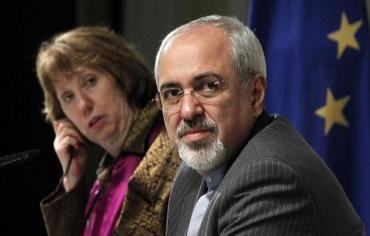
Ashton and Iran FMEU foreign policy chief Catherine Ashton (L) and Iranian FM Mohammad Javad Zarif. Photo: REUTERS

WASHINGTON – Comprehensive negotiations between world powers and Iran over its nuclear program officially begin in Vienna on February 18, at which point diplomats will have just over five months to reach an accord to end the long-standing impasse once and for all.

That cutoff was agreed upon, and is self-imposed, by the parties directly involved in the talks. Yet given the stakes of failure, Catherine Ashton, the European Union’s chief diplomat, is already discussing an extension of that deadline.

“Everyone will say to you, and rightly so, this is extremely difficult,” Ashton told The Wall Street Journal at a strategic conference in Munich on Sunday. “We have no guarantees in this and we will take the time that is necessary to get this to be the right agreement.”

Asked about Ashton’s comments on Monday, State Department spokeswoman Jen Psaki reminded reporters that the Joint Plan of Action allowed for an additional six month extension of talks “upon mutual consent.”

“The comprehensive talks have not even begun yet,” Psaki said. “So we are not at a decision-making phase, we’re not predicting, we don’t know that they would be extended, and that’s certainly not the baseline we’re going on.”

“From our standpoint, that position hasn’t been determined yet, and that simply is a statement of what’s allowed for in the JPOA,” she added.

Speaking under condition of anonymity – given the sensitivity of the negotiations – US officials told The Jerusalem Post they, too, fear the talks will require more time than has been officially acknowledged.

Iran and the P5+1– the US, United Kingdom, France, Russia, China and Germany – agreed to the six-month time frame in an interim deal that essentially capped Iran’s most strategically significant nuclear work in exchange for sanctions relief, creating an environment for the parties to negotiate in earnest.

In that first-step deal, formally known as the Joint Plan of Action, the parties gave themselves the option of extending the deadline by an additional six months – for up to a full year’s worth of negotiations.

Speaking to the Munich Security Conference over the weekend, Iranian Foreign Minister Mohammad Javad Zarif said that failure to reach a deal – or an abrupt end to negotiations – would spell “disaster.”

American officials have echoed that sentiment in recent days.

Asked by the Post on Friday whether war or additional sanctions were more likely should talks fail, State Department deputy spokeswoman Marie Harf said that US alternatives to diplomacy are limited and are “likely to involve military action.”

“I’m not predicting that we would take military action right away,” Harf said. “It’s more of a broad statement that, look, if we can’t get this done diplomatically in six months or a year or at any time, we will – we are committed to resolving it. And that involves less durable and, quite frankly, riskier actions.”

Iranian FM denies reports hinting at recognition of Israel if conflict with Palestinians settled

February 4, 2014

Iranian FM denies reports hinting at recognition of Israel if conflict with Palestinians settled | JPost | Israel News.

By ARIEL BEN SOLOMON

Zarif criticizes US attempts to pressure Iran, says sanctions are not helping solve the nuclear issue.

Iran nuclear talks  in Geneva November 24, 2013.

Iran nuclear talks in Geneva November 24, 2013. Photo: REUTERS/Carolyn Kaster/Pool

Iranian Foreign Minister Mohammad Javad Zarif “categorically denied” reports that he hinted that his country would recognize Israel if the conflict with the Palestinians was resolved.

Iran’s Fars News Agency also reported on Monday that Zarif was “misquoted” when he said at the Munich Security Conference that the “Holocaust should not happen again” and that “the extermination of Jews by the Nazi regime was tragically cruel.”

In a phone conversation with Fars, Deputy Foreign Minister Hassan Qashqavi said Zarif “completely rejected the remarks attributed to him and declared that the Islamic Republic’s stance about the (Zionist) regime is what has been repeatedly announced by the country’s diplomacy apparatus and this stance has not changed.”

In order to boost his anti-Zionist credentials, the article also pointed out that Zarif had recently visited Hezbollah leader Hassan Nasrallah in Lebanon and paid tribute to the group’s assassinated commander, Imad Mughniyeh, at his grave.

In response, a member of Iran’s parliament called for Zarif to appear for questioning regarding the reported comments about recognizing Israel.

“Zarif’s remark are inconsistent with the principles upheld by the system, since Imam [Ali] Khomeini believed that the Zionist regime was a malign tumor” and that it was a “bastard” regime, representative Ghasem Jafari told Iran’s Mehr News.

“The Islamic Republic has expended great sums so that the Zionist regime would not be recognized,” he said.

Meanwhile, Zarif criticized US attempts to put pressure on Iran and said that sanctions were not helping to solve the nuclear issue.

“The sanctions have only led to making of some 18,000 centrifuges and also added to the Iranians resentment towards the United States,” he said on Tuesday at a press conference with visiting Swedish Foreign Minister Carl Bildt, the Islamic Republic News Agency reported.

Separately, Iran’s Defense Minister Brigadier General Hossein Dehqan repeated on Tuesday that Iran is prepared to confront any enemy attack.

“Certainly, our nation will not be affected and is fully ready to confront any arrogant move of the US or its little child, Israel,” said Dehqan, according to Fars.

Off Topic: Jordan Says No to Kerry “Conspiracy”

February 4, 2014

Jordan Says No to Kerry “conspiracy.” Gatestone Institute

(Another brilliant lurch for Secretary Kerry in further destabilizing the Middle East. — DM)

Kerry has managed to escalate tensions not only between Israel and the Palestinians, but also between Jordanians and the Palestinians inside Jordan.

Kerry will now have to find a way to calm King Abdullah and his constituents before Jordan slips into civil war.

“Jordan is playing host [to Palestinians] and no agreement can pass without Jordan.” — Fatin al-Baddad, Jordanian journalist.

by Khaled Abu Toameh

Jordan’s government officials and ordinary citizens have come out against U.S. Secretary of State John Kerry’s proposals for reaching a peace agreement between Israel and the Palestinians.

The Jordanians fear that such an agreement would be concluded at their expense and undermine King Abdullah’s rule.

The Jordanians’ biggest fear is that Kerry is seeking to “resettle” Palestinian refugees in their country, effectively turning the kingdom into a Palestinian state. Palestinians constitute more than half of Jordan’s population.

More than 2,000 Jordanians from various political groups gathered in Amman on February 2 to condemn Kerry’s “malicious conspiracy.”

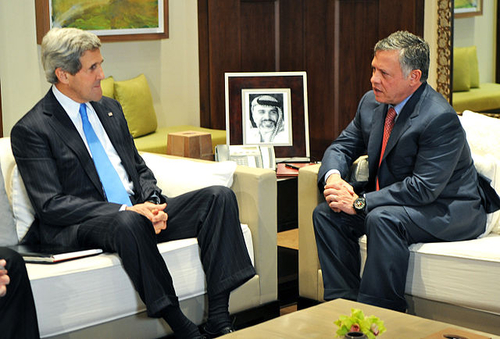
Kerry and Jordan's KingU.S. Secretary of State John Kerry meets with Jordanian King Abdullah II in Amman, Jordan, on May 22, 2013. (Image source: U.S. State Department)

Protesters claimed that Kerry’s proposals are aimed at “liquidating” the Palestinian cause and ending the Israeli-Arab conflict without granting the Palestinians their full rights, including the “right of return” to Israel.

A group of retired Jordanian army generals issued a statement warning their government against accepting Kerry’s proposals. The retired generals expressed fear that the proposals were designed to “settle” Palestinians in Jordan.

“Jordan is going through a dangerous historic moment,” the statement read. “This is an American-Zionist plot to liquidate the Palestinian cause at the expense of Jordan.”

The retired generals, headed by member of parliament Abdel Hadi Majali, vowed to use all means to block Kerry’s proposals, which are aimed at “dismantling the foundations of the kingdom and diluting the Jordanian national identity by dropping the right of return for Palestinians and granting them Jordanian citizenship.”

Jordanian columnist Fatin al-Baddad said that Jordan was extremely worried because Kerry was ignoring any role for the kingdom in his efforts to achieve peace between Israel and the Palestinians. Noting that Jordanians have declared an intifada [uprising] against Kerry and his proposed “framework agreement,” al-Baddad said that the Jordanian people are furious because they feel that the U.S. Administration has “marginalized” the kingdom.

“Jordan’s politicians and parties want to alert the world that Jordan is playing host [to Palestinians] and no agreement can pass without Jordan,” he wrote. “Jordanians believe that Kerry is offering to turn Jordan into a Palestinian state.”

Last month, dozens of prominent Jordanian figures, including former parliament members and party leaders, also expressed fear that Kerry was seeking to turn Jordan into a Palestinian state.

A petition published by the same group even called on the Jordan’s government to revoke the Jordanian citizenship granted to Palestinians after 1988, when the late King Hussein “divorced” the West Bank by cutting off administrative and legal ties with it.

“The heroic Jordanian people will struggle with all their force and means to thwart this scheme, regardless of the price,” the petition cautioned.

On February 2, Jordanian Foreign Minister Nasser Judeh appeared before parliament to voice his concern over Kerry’s ideas. In a bid to calm the parliament members, Judeh declared that Jordan would not be an alternative homeland for the Palestinians.

“This is a red line and we can not accept it,” Judeh said, stressing that Jordan would not accept any deal that comes at the kingdom’s expense.”

Judeh also hinted that Jordan would demand compensation for playing host to the Palestinians over the past few decades. “Jordan has rights as a host country for Palestinian refugees,” he added.

Following the session, the members of parliament issued a statement which also warned against Kerry’s ostensible scheme to establish a Palestinian state in Jordan.

“There is a state of fear among Jordanians and Arabs that Kerry’s plan might succeed in involving the Palestinians in a new agreement that extracts from them political concessions so as to establish a Palestinian state with no borders and sovereignty,” the statement said.

The panic in Jordan has re-ignited tensions between Jordanians and Palestinians living in the kingdom. Some top Jordanian officials have been accused of making “racist” statements about Palestinians. One of them, retired general Riad Abu Karaki, called on his government to stop granting citizenship to children born to Jordanian women who are married to Palestinians. “Why aren’t the children of Jordanian mothers granted Palestinian citizenship of their fathers?” he asked. “The Palestinians have a recognized entity called the Palestinian National Authority.”

Kerry has managed to escalate tensions not only between Israel and the Palestinians, but also between Jordanians and the Palestinians inside Jordan. The growing tensions in Jordan pose a threat to stability in the kingdom and could easily undermine the only stable regime in the region. Kerry will now have to find a way to calm King Abdullah and his constituents before Jordan slips into civil war.

IDF to deploy reservists in Gaza sector

February 4, 2014

IDF to deploy reservists in Gaza sector – israelhayom.

For the first time in years, Gaza Brigade reservists will relieve Givati Brigade soldiers departing the sector for routine, three-week training sessions • Move prompted by changes to military’s training, deployment plans following defense budget cuts.

Lilach Shoval
 

The Gaza sector is considered one of the military’s most active theaters [Illustrative]|Photo credit: Gideon

The Israel Defense Forces has announced plans to reintroduce the operational deployment of reserve units in the Gaza sector within the next few months. Reserve soldiers in the Gaza Brigade will be deployed in the sector to relieve regular soldiers from the Infantry Corps’ Givati Brigade.

The decision, made public on Monday, follows the IDF’s revision of its overall training plans as a result of cuts in the 2014 defense budget.

Because of the revision, many battalions in the Givati Brigade serve in the Gaza sector for nine months, instead of the customary three or four, raising concerns in the IDF that the troops may be exhausted.

As a result, the IDF decided that when a Givati battalion leaves the sector for a routine, three-week training session, one of the Gaza Brigade reserve battalions, which are mostly made up of former Givati soldiers, will be deployed in its place.

IDF sources said the GOC Southern Command had given much thought to the decision, given that overall reservists’ training suffered compared to the training offered to regular soldiers. The decision to introduce reservists back into the sector gradually is part of the military’s efforts to minimize the risk to them.

“These are brigade reservists, so this is their mission now and in times of emergency,” a senior Gaza Brigade officer said on Monday.

“They manned the sector during Operation Pillar of Defense [in 2012] as well, and they tackled operational incidents. Having a regular unit deployed there for only three weeks would pose the same challenges, because some of those units’ commanders have little experience in the sector.

“The regular units’ learning curve is just as complex as the reserves’ and having reservists who have served here before actually makes it easier, as proved in Operation Pillar of Defense.”

Although that operation has resulted in unprecedented calm in the Gaza sector, it is still considered one of the military’s most active theaters.

Deployment in the sector has become a badge of honor for the IDF’s infantry brigades, which, according to IDF sources, are eager to be deployed there. Most recently, the Nahal Brigade, which has never been deployed in the Gaza sector, has been campaigning for its turn.

Iran hasn’t really changed

February 4, 2014

Iran hasn’t really changed – israelhayom.

By Boaz Bismuth

The past couple of days have been particularly fascinating: The “historian” and chief Palestinian negotiator Saeb Erekat was kind enough to inform us that the Palestinians are actually the descendants of the Canaanites, and while he did not specify whether they descended from the Jebusites, Girgashites or Amorites, he insisted that, nevertheless, they were here before us.

At the same time, in Munich, U.S. Secretary of State John Kerry, in the role of political analyst, warned that the failure of the negotiations would lead to Israel suffering an international boycott, and that all our “prosperity” was nothing but a “temporary illusion.” On Monday, journalists who normally enjoy applying pressure on Israel had to admit that at hand was at most a “limited boycott.” In days such as these, in which the facts are not really important, it is possible to go on rewriting the past, the present and future — as long as it pushes Israel into a corner.

Yesterday, for example, we learned that Iranian Foreign Minister Mohammad Javad Zarif (the hero of the Geneva accords) has promised that after the Palestinian problem is resolved the conditions will be created for the recognition of Israel. Zarif, in his generosity, also honored us by delving into the “Holocaust of the Jews, which was tragically cruel.” Zarif dropped a veritable Iranian bomb, and it wasn’t even nuclear. It caused a considerable degree of excitement among the pundits. Iran truly has changed (and simultaneously, so has Israel). Prepare your passports. After stopping in Damascus for humus, get ready to enjoy some ghormeh sabzi in Tehran.

However, just a short time after the exciting news was aired in Israel — which could have certainly embarrassed Jerusalem, had it been true — Iran’s state-run news agency rushed to provide a quote from the country’s deputy foreign minister, who reportedly spoke with Zarif and denied all the comments attributed to him. The backtracking pertained not only to Israel, but to the Holocaust as well.

Moreover, as if to clarify to the world that Iran is still the same old Iran, they added a few words from Ayatollah Ali Khamenei, who said that Iran was not involved in Bahraini affairs (debatable) but admitted to its involvement in Lebanon and Palestine. Translated to Hebrew, Iran is admitting that it is an accomplice to terrorism. Iran “will support and help everyone who opposes the Zionist regime,” said the country’s supreme spiritual leader, adding that “the Zionist regime is a real cancerous tumor that should be cut and will be cut, God willing.” And by the grace of Zarif and President Hassan Rouhani as well.

Iran hasn’t really changed, and Israel will apparently survive the “limited” boycotts, and apparently Erekat’s great-grandfather was not a Jebusite. But why squander the opportunity for a juicy headline, and who needs fact checkers anyway?

Fmr. Negotiator: Iran ‘Will Never’ Dismantle Nuke Program

February 4, 2014

Fmr. Negotiator: Iran ‘Will Never’ Dismantle Nuke Program – The Washington Free Beacon.

Iran will not accept long-term limitations on program

Iranian workers stand in front of Bushehr nuclear power plant

Iranian workers stand in front of Bushehr nuclear power plant / Reuters

BY:
February 3, 2014 2:27 pm

One of Iran’s top former nuclear negotiators promised that Iran “will never” dismantle its nuclear enrichment program, and that Tehran’s current promises to curb these activates are only temporary.

“Dismantling will never occur on Iranian enrichment program,” Hossein Mousavian, Iran’s former ambassador to Germany and onetime top nuclear negotiator, told the Iranian press over the weekend.

Mousavian’s remarks have bolstered the fears of those who believe that Tehran is just buying time to advance its nuclear program, and came just days before the U.S. Treasury Department transferred $550 million directly to Iran as required under the recently signed interim nuclear agreement.

Mousavian, who currently lives in the United States where he is a research scholar at Princeton University, told the Iranian Students News Agency (ISNA), that Iran would not accept any long-term limitations on its nuclear activities under a final accord.

“If we accept limitations in the final deal to build trust on enrichment, (the limitations) should be only for the trust-building era and not forever,” Mousavian, who served as Iran’s spokesman during nuclear negotiations with the European Union, was quoted as saying. “We also define Iran’s practical needs for our nuclear program and activities and not for major powers. This issue should be always seriously focuses in final talks.”

Iranian leaders have asserted many times in recent weeks that the country would not dismantle any of its nuclear infrastructure, including the centrifuges used to enrich uranium, the key component in a nuclear weapon.

The White House, which is refusing to release the full text of the nuclear deal, has avoided commenting publicly on this claim. White House Press Secretary Jay Carney has dodged the question multiple times during his daily briefings, and White House spokesmen have declined Washington Free Beacon requests to issue a clarification on the centrifuge issue.

Mousavian went on to state that any “final” deal with Iran should last no longer than five years.

“The final agreement, if defined well, can last for three to five years, and then Iranian nuclear issue will be in its routine path,” he was quoted as saying.

Secretary of State John Kerry and his Iranian counterpart Javad Zarif briefly met over the weekend in Munich to discuss nuclear negotiations.

Zarif predicted on Monday that a final deal could be reached within the next six months and dismissed efforts by the U.S. Congress to impose new economic sanctions on Tehran.

“With good will we can reach an agreement within six months,” he was quoted as telling the German lawmakers “I don’t fear a decision in the U.S. Congress … The U.S. president has promised to veto it.”

Iran received on Monday the first installment of some $4 billion in sanctions relief. The payments are being made directly to Iran and come as the result of the United States unfreezing Iranian assets that have been locked up in foreign banks.

Iran is scheduled to receive millions more in the coming weeks.

Mousavian did not respond to a request for comment.

Iran Foreign Minister Denies He is Opposed to Second Holocaust

February 4, 2014

Iran Foreign Minister Denies He is Opposed to Second Holocaust – The Washington Free Beacon.

Makes clear that he did not condemn Holocaust

Javad Zarif

Javad Zarif / AP

BY:
February 3, 2014 12:13 pm

Iranian Foreign Minister Javad Zarif vehemently denied on Monday reports that he is opposed to a second Holocaust of Jewish people, according to Iranian media reports.

Some media outlets reported over the weekend that Zarif had stated, the “Holocaust should not happen again” and that “the extermination of Jews by the Nazi regime was tragically cruel and should not happen again.”

However, Zarif maintains that this is not the case, according to top Iranian lawmakers who have spoken to the foreign minister about his remarks.

This is just the latest example of a top Iranian political figure being forced to clarify their controversial position on the Holocaust. Many Iranian leaders have denied the Holocaust and have called for the destruction of Israel.

“Iranian Deputy Foreign Minister Hassan Qashqavi rejected the media reports about Zarif’s statements as untrue,” Iran’s state run Fars News Agency reported on Monday.

“In a phone conversation that I had with Mr. Zarif, he completely rejected the remarks attributed to him and declared that the Islamic Republic’s stance about the (Zionist) regime is what has been repeatedly announced by the country’s diplomacy apparatus and this stance has not changed,” Fars quoted Qashqavi as saying.

Iranian Supreme Leader Ali Khamenei has stated in the past that Iran will “support and help everyone who opposes the Zionist regime.”

Off Topic: Egyptian army kills, injures 41 terrorists in Sinai raid

February 3, 2014

Off Topic: Egyptian army kills, injures 41 terrorists in Sinai raid – Debka.

(UPDATE: DEBKAfile: Report of Egyptian Sinai raid is unfounded.

DEBKAfile February 3, 2014, 8:54 PM (IST)
A report Monday attributed to an “Egyptian security source” of an army raid that killed or injured 41 Islamist terrorist in northern Sinai has proved unfounded.

– Artaxes)

DEBKAfile February 3, 2014, 5:12 PM (IST)

As many as 41 militants were killed or injured in an Egyptian army raid Monday on hideouts of hard-line Islamists in North Sinai. “At least 15 dangerous jihadist elements were killed and wounded in the village of Goes Abou Raad in the Egyptian sector of Rafah city, while 26 others were killed and injured in the village of Wady Al- Akhder in Sheikh Zuweid city,” an Egyptian security source said.
Another 12 terrorists were arrested in the crackdown with sidearms, explosive materials and ammunition in their possession. 

The definition of insanity

February 3, 2014

By Charles Artaxes

I’m just amazed how anyone would see the demands for concessions on Israel’s part as anything other than insanity.
Since the ‘Arab spring’ the security situation in Egypt has deteriorated with the result that now terrorists more or less affiliated with Al Qaeda are roaming the Sinai and are threatening Israel from the south.
In addition to that Syria has attracted thousands of violent Jihadis who, while for the moment occupied with fighting Assad, have made no secret that they want to attack Israel when Assad is gone.
Another threat from the north is Hizbollah which accumulated an estimated 100,000 rockets.
Then there is the threat from Gaza and the constant threat from Iran.
In such a situation when Israel can barely manage all these threats you’ve got to be out of your mind to open up new additional security risks.
As is clear the ‘peace’ promoted by John Kerry et al involves Israel taking huge risks.
The Iranian threat is the biggest one of these threats and Israel should flatly refuse to sign any such ‘peace treaty’ while the Irananian threat exists.
While a peace agreement may or may not have positive repercussions for the Middle East, it certainly won’t change Iran’s attitude towards Israel.
On the other hand the elimination of the Iranian threat would have a positive influence on the Middle East and in any case it would reduce the threat from Hizbollah. At the least it would make the threat from Hizbollah more manageable.
For all these reasons the concessions demanded from Israel in the current situation have to be rejected as the definition of insanity.