Archive for February 2014

Obama’s World: Embrace and Appeasement, not Realism

February 7, 2014

Faster, Please! » Obama’s World: Embrace and Appeasement, not Realism.

( A must-read coherent explanation of Obama’s Iran/Middle East policy. – JW )

Posted By Michael Ledeen On February 6, 2014 @ 6:18 pm

Appeasers believe that if you keep on throwing steaks to a tiger, the tiger will become a vegetarian.
Heywood Campbell Broun [1].

I don’t think it’s hard to understand Obama’s foreign policy.  Although there’s a lot we don’t know about him, his basic impulses are clear enough.  He’s told us what they are (although, to be sure, he often misleads and obfuscates [2]), and his actions are in keeping with his announced impulses.  Furthermore, there’s nothing unique or surprising about them — you can hear them in our classrooms and our college dorms, and read them in the establishment press every day.  He’s an establishment member in high standing.

Voilá:

He believes that most of the serious problems in the world are the result of past American actions.  Call it imperialism.  Call it meddling.  Call it arrogance (as the Iranians do).  Whatever you call it, it means that pre-Obama policies were bad.  Ergo, it’s mostly Bush’s fault. (Shorthand for “before me, they didn’t understand.  Anything.”)

It follows that the single most important action to ensure good policies is to rein in the United States.  Get it out of the messes it has created.  Weaken its abilities to meddle elsewhere.  Ergo the retreats from Iraq and Afghanistan.  Ergo the often spectacular dissing of past allies and the embarrassing embrace of previous and actual enemies.  Diss Mubarak, embrace the Muslim Brotherhood.  Ergo the incredible shrinking military budget, ergo the back-of-the-hand slap to many of our greatest warriors.

It also follows that our foreign policy requires a new language, beginning with making amends for the bad policies of the past, and continuing with a dramatic realignment, aiming at creating a new alliance structure with countries we maltreated in the past.  Ergo the global apology tour.  Ergo the refusal to respond to insults from the likes of Hugo Chavez.  Ergo the Russian “reset” stratagem.  And ergo the Iran deal, pursued eagerly and relentlessly even before the 2008 election results were in, wrapped in terms of respect (the careful pronunciation of “The Islamic Republic of Iran,” for example).  And ergo the rejection of “American exceptionalism,” putting the United States on the same moral and political platform as contemporary Greece.

Those are his core principles.  It’s a highly ideological policy matrix, beginning with his conviction that WE are the root cause of most bad things.  It’s not subtle, doesn’t require mastery of nuance or even history, as his error-ridden Cairo speech demonstrated to anyone who cared to actually read it (my favorite is the claim that Muslims invented printing, when the Chinese did that, and Portuguese Jews brought it to the Middle East).  Indeed, he and his minions are so uninterested in the facts of the world that they regularly invent the world, as Secretary of State Kerry did when he falsely announced that “last year, not one Israeli was killed by a Palestinian from the West Bank.”  Actually there were several [3].

That’s what happens when an ideological vision blinds us to reality.  Obama’s ideology is a “pidgin” version of the standard  leftist view, according to which class conflict is the engine of history, with the oppressors (call them the 1%) ruling it over the impoverished and alienated poor (the 99%).  The pre-Obama United States is the incarnation of the 1%, and most of the rest of the world, especially the poor, or underdeveloped world, make up the 99%. Obama and his followers have a romantic attachment to the 99%, and his many calls for “fairness” apply to his international impulses as well as to his domestic passions.

This notion of class conflict may have explained European history for a period right after the industrial revolution, but it has little to do with the globalized world we live in.  Since it does not explain the world, people who believe it are very poorly placed to make sensible policy, either domestic or international.  Yet those who believe it continue to embrace the happy thought that they are morally and intellectually superior to the rest of us, as Fred Siegel elaborates in his wonderful new book [4] The Revolt Against the Masses.

We have been told that Obama considers himself so smart that he is bored with the problems that afflict the real world.  He evidently thinks he’s got the answers.  If you suggest that he’s failing, he lifts his chin and mentally tosses you into the “they don’t get it” pot.

Obama is actually easy to understand, although plenty of smart people keep trying to find other explanations.  Of late, Peter Foster [5], Lee Smith [6] and Mike Doran [7] have been hard at it, looking for new ways to explain Obama’s Iran policy.  Lee Smith argues that Obama’s a “realist,” and that his guru is Harvard’s Professor Walt.  He suggests that Obama views the Middle East in old-fashioned balance-of-power terms, and accepts Iran as a major player with whom we must come to terms. Mr. Doran doesn’t think Obama really cares if Iran gets the bomb, and has been bluffing all along, and Mr. Foster thinks Obama doesn’t really care if the sanctions break down, since if Iran makes lots of money via deals with the P5+1 countries, they will be very reluctant to go back into the misery of the sanctions regime, thus making a final deal more likely.  He quotes Wendy Sherman to that effect.

I agree with Doran and Foster, but I think their focus is too narrow.  Iran policy isn’t a singular effort, it’s part of a pattern.  Obama sympathizes with the regime’s ideology, he agrees that our past actions justify branding us the “Great Satan,” and he wants to make everything right with the mullahs.  He doesn’t see the regime’s enmity toward America as a fixed principle, as their raison d’etre, and he has undertaken to change it.  He has been secretly negotiating with them all along, convinced by his ideology that it will all work out.  So he doesn’t fear a nuclear Iran any more than I fear a nuclear Britain, France or Israel.

Lee Smith’s surprising suggestion that Obama’s a “realist” strikes me as too far out.  Yes, Walt and the president agree that Israel is a terrible nuisance, but Obama’s foreign policy–of which Iran is just one component–is hardly realistic.  It’s driven by passion and a false vision of the world, not by tough-minded geopolitical analysis.

If you want a good two-word description of Obama’s approach to the world, call it passionate appeasement.  And go back and read the quotation at the top.


Article printed from Faster, Please!: http://pjmedia.com/michaelledeen

URL to article: http://pjmedia.com/michaelledeen/2014/02/06/embrace-and-appeasement/

URLs in this post:

[1] Heywood Campbell Broun: http://www.giga-usa.com/quotes/authors/heywood_campbell_broun_1_a001.htm

[2] misleads and obfuscates: http://pjmedia.com/victordavishanson/obama-as-chaos/

[3] there were several: http://www.algemeiner.com/2014/02/03/kerry-says-no-deaths-from-west-bank-terror-in-2013-just-days-after-shin-bet-lists-fatalities/

[4] wonderful new book: http://pjmedia.com/eddriscoll/2014/02/02/interview-fred-siegel/

[5] Peter Foster: http://blogs.telegraph.co.uk/news/peterfoster/100258304/obamas-dangerous-game-on-iran-is-now-becoming-clear/

[6] Lee Smith: http://www.tabletmag.com/jewish-news-and-politics/161815/stephen-walt-the-new-kennan?all=1

[7] Mike Doran: http://mosaicmagazine.com/tesserae/2014/02/i-dont-bluff/
Off Topic: Fatah and the “Armed Struggle” against Israel

February 7, 2014

Fatah and the “Armed Struggle” against Israel, Gatestone InstituteKhaled Abu Toameh, February 7, 2014

While in English Abbas was voicing his opposition to an armed struggle, in Arabic Palestinian officials were issuing statements in support of “armed resistance” against Israel.

When senior figures of the Fatah urge Palestinians to be prepared for the possibility of “armed struggle”against Israel, they are actually instructing Fatah militiamen to be prepared to launch terrorist attacks.

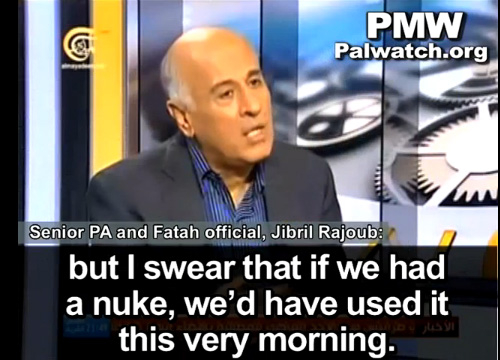
Palestinian official on nuking IsraelJibril Rajoub, a member of the Fatah Central Committee and former commander of the Palestinian security forces. (Image source: Palestinian Media Watch)

In an interview this week with the New York Times, Palestinian Authority President Mahmoud Abbas once again expressed his opposition to an armed struggle against Israel.

“In my life, and if I have any more life in the future, I will never return to the armed struggle,” Abbas declared.

But while in English Abbas was voicing his opposition to an armed struggle, in Arabic Palestinian officials were issuing statements in support of “armed resistance” against Israel. The officials who favor “armed resistance” are not low-level bureaucrats working in the Palestinian Authority [PA]. Rather, they are senior representatives of Abbas’s ruling Fatah faction. Moreover, their names are often mentioned as potential successors to Abbas, who last month entered his 10th year of his four-year term in office.

In the past, Abbas has explained his opposition to the use of violence against Israel by arguing that this has proven to be “ineffective” and could bring more “destruction” to the Palestinians.

The good news is that the Fatah leadership recently repeated its support for a “popular struggle” against Israel. The announcement was made during Fatah’s celebrations marking its 49th anniversary.

The bad news is that Fatah is not united when it comes to the issue of resorting to terrorism against Israel. Fatah has many “rebels” and armed groups that continue openly to call for an “armed struggle” against Israel as a way of achieving Palestinian goals.

In recent months, a growing number of top Fatah officials such as Jibril Rajoub, Tawfik Tirawi and Mahmoud al-Aloul – all members of the Fatah Central Committee – have publicly come out in favor of a return to an “armed struggle” against Israel. Rajoub and Tirawi are former commanders of the Palestinian security forces in the West Bank and are considered close allies of Abbas. Al-Aloul, who is also closely associated with Abbas, is a former governor of the West Bank’s largest city, Nablus.

In addition, various armed groups belonging to Fatah, such as the Aqsa Martyrs Brigades, continue to maintain a presence not only in the West Bank, but the Gaza Strip as well. The group’s militiamen never miss an opportunity to issue all kinds of threats against Israel, including turning Tel Aviv into a “mass of flame.”

Abbas has chosen not to comment on the calls by his top loyalists for an “armed struggle” against Israel. There could be three reasons for Abbas’s decision to sit on the fence. First, he may be afraid of alienating these officials and other Fatah members who are eager to resort to terrorism against Israel. Second, perhaps Abbas, deep inside, does not completely oppose the idea. Third, Abbas probably wants to use these threats as a means of extracting concessions from Israel and scaring the international community into forcing Israel to accept Palestinian demands.

The statements in favor of an “armed struggle” are aimed at preparing the Palestinian public for another round of violence with Israel if and when the US-sponsored Israeli-Palestinian negotiations fail.

Abbas may be ignoring these statements, but many Palestinians listen very carefully to the messages coming out of their top representatives.

When senior figures of the Fatah such as Rajoub and Tirawi urge Palestinians to be prepared for the possibility of an “armed struggle” against Israel, they are actually instructing Fatah militiamen and supporters to be prepared to launch terrorist attacks.

Just last week, Rajoub told the Iranian TV station Al-Alam that, “The option of resistance, including armed resistance, remains on the table.”

Tirawi, for his part, sent the following message to the Palestinians: “This who think that the negotiations [with Israel] will bring us anything are mistaken. We must return to the cycle of action. This means resistance in all forms. Fatah has not abandoned the option of armed struggle.”

Al Aloul, in a similar message, emphasized, “Fatah has not abandoned the armed struggle as a legitimate right. Fatah’s sixth conference, which was held in Bethlehem in the summer of 2009, reaffirmed this point.”

It is almost unheard-of for Hamas to say a good word about Fatah. But the increased talk about resorting to terrorism against Israel has prompted Hamas to heap praise on Fatah’s leaders. Referring to the Fatah calls for renewed violence against Israel, Hamas leader Musa Abu Marzouk commented, “These are positive statements, especially in light of the fact that the three officials are members of Fatah’s central Committee.”

Obviously, there are some in Fatah who still believe in suicide bombings and rocket attacks as a way of forcing Israel to make concessions. These Fatah officials have forgotten that Palestinians paid a heavy price for “militarizing” the Second Intifada, and are now willing to send young men and women once again to “sacrifice” themselves for the Palestinian cause.

It is nice to read Abbas’s calming and moderate statements in the New York Times. But one should also not ignore the other voices coming out of his inner circle.

A Sclerotic Goes to War Stats – Past Year

February 7, 2014
  • Since February 25, 2012
Country Views
United States FlagUnited States 561,716
Germany FlagGermany 105,595
United Kingdom FlagUnited Kingdom 102,592
Canada FlagCanada 79,415
Israel FlagIsrael 75,299
Australia FlagAustralia 46,383
France FlagFrance 27,116
Finland FlagFinland 19,994
Brazil FlagBrazil 19,419
Netherlands FlagNetherlands 18,335
Belgium FlagBelgium 17,661
Switzerland FlagSwitzerland 16,957
India FlagIndia 15,966
Poland FlagPoland 11,512
Sweden FlagSweden 11,444
Romania FlagRomania 10,943
Japan FlagJapan 10,315
Philippines FlagPhilippines 9,824
Malaysia FlagMalaysia 9,704
Italy FlagItaly 9,165
Saudi Arabia FlagSaudi Arabia 7,591
South Africa FlagSouth Africa 7,129
Panama FlagPanama 7,013
New Zealand FlagNew Zealand 6,595
Singapore FlagSingapore 6,053
Mexico FlagMexico 5,869
Lebanon FlagLebanon 5,732
Russian Federation FlagRussian Federation 5,719
Argentina FlagArgentina 5,713
Ireland FlagIreland 5,280
Thailand FlagThailand 4,886
Egypt FlagEgypt 4,571
Luxembourg FlagLuxembourg 4,566
Hungary FlagHungary 4,473
Serbia FlagSerbia 4,068
Kenya FlagKenya 3,789
Austria FlagAustria 3,694
United Arab Emirates FlagUnited Arab Emirates 3,393
Spain FlagSpain 3,116
Croatia FlagCroatia 3,080
Ukraine FlagUkraine 3,080
Portugal FlagPortugal 2,433
Greece FlagGreece 2,353
Aruba FlagAruba 2,353
Turkey FlagTurkey 2,312
Qatar FlagQatar 2,308
Korea, Republic of FlagRepublic of Korea 2,302
Slovenia FlagSlovenia 2,263
Nigeria FlagNigeria 2,245
Bahrain FlagBahrain 2,086
Papua New Guinea FlagPapua New Guinea 1,756
Uganda FlagUganda 1,703
Slovakia FlagSlovakia 1,653
Denmark FlagDenmark 1,582
Cyprus FlagCyprus 1,441
Indonesia FlagIndonesia 1,377
Pakistan FlagPakistan 1,355
Norway FlagNorway 1,344
Bulgaria FlagBulgaria 1,274
Maldives FlagMaldives 1,264
Iceland FlagIceland 1,211
Tanzania, United Republic of FlagUnited Republic of Tanzania 1,095
Angola FlagAngola 1,048
Venezuela FlagVenezuela 1,022
Dominican Republic FlagDominican Republic 1,014
Taiwan, Province of China FlagTaiwan 944
Malta FlagMalta 825
Czech Republic FlagCzech Republic 767
Latvia FlagLatvia 755
Jordan FlagJordan 640
Trinidad and Tobago FlagTrinidad and Tobago 580
Virgin Islands, British FlagBritish Virgin Islands 444
Hong Kong FlagHong Kong 438
Kuwait FlagKuwait 424
Bangladesh FlagBangladesh 397
Albania FlagAlbania 372
Viet Nam FlagViet Nam 331
Sri Lanka FlagSri Lanka 321
Morocco FlagMorocco 287
Colombia FlagColombia 262
Lithuania FlagLithuania 261
Georgia FlagGeorgia 249
Syrian Arab Republic FlagSyrian Arab Republic 241
Ghana FlagGhana 234
Palestinian Territory, Occupied FlagPalestine, State of 224
Honduras FlagHonduras 209
Bosnia and Herzegovina FlagBosnia and Herzegovina 205
Oman FlagOman 203
Estonia FlagEstonia 198
Ethiopia FlagEthiopia 188
Tunisia FlagTunisia 185
Zimbabwe FlagZimbabwe 183
Netherlands Antilles FlagNetherlands Antilles 180
Chile FlagChile 172
Algeria FlagAlgeria 170
Malawi FlagMalawi 161
Iraq FlagIraq 161
Armenia FlagArmenia 151
Azerbaijan FlagAzerbaijan 151
Jamaica FlagJamaica 147
Peru FlagPeru 144
Ecuador FlagEcuador 141
Macedonia, the former Yugoslav Republic of FlagMacedonia, the Former Yugoslav Republic 135
Uruguay FlagUruguay 133
Costa Rica FlagCosta Rica 133
Puerto Rico FlagPuerto Rico 123
Cambodia FlagCambodia 108
Iran, Islamic Republic of FlagIran, Islamic Republic of 96
Yemen FlagYemen 96
Mauritius FlagMauritius 95
Myanmar FlagMyanmar 89
Virgin Islands, U.S. FlagVirgin Islands 89
Antigua and Barbuda FlagAntigua and Barbuda 88
Bahamas FlagBahamas 87
Barbados FlagBarbados 87
Botswana FlagBotswana 79
Montenegro FlagMontenegro 77
Afghanistan FlagAfghanistan 72
Namibia FlagNamibia 70
Sudan FlagSudan 61
Brunei Darussalam FlagBrunei Darussalam 53
Moldova, Republic of FlagMoldova 52
Nepal FlagNepal 51
Fiji FlagFiji 49
Senegal FlagSenegal 47
Zambia FlagZambia 45
Guatemala FlagGuatemala 45
Libya FlagLibya 44
Lao People's Democratic Republic FlagLao People’s Democratic Republic 39
Bolivia FlagBolivia 34
China FlagChina 32
Guam FlagGuam 31
Belarus FlagBelarus 29
El Salvador FlagEl Salvador 28
Paraguay FlagParaguay 26
Réunion FlagRéunion 26
Côte d'Ivoire FlagCôte d’Ivoire 21
Comoros FlagComoros 20
Nicaragua FlagNicaragua 20
Benin FlagBenin 20
Rwanda FlagRwanda 20
Kazakhstan FlagKazakhstan 20
Cuba FlagCuba 19
Macao FlagMacao 18
Gibraltar FlagGibraltar 17
Guyana FlagGuyana 16
Djibouti FlagDjibouti 16
Suriname FlagSuriname 16
Togo FlagTogo 15
Jersey FlagJersey 15
Cameroon FlagCameroon 15
Mozambique FlagMozambique 15
Grenada FlagGrenada 14
Haiti FlagHaiti 14
Gambia FlagGambia 14
Belize FlagBelize 14
Faroe Islands FlagFaroe Islands 14
Mali FlagMali 13
Mongolia FlagMongolia 13
Guernsey FlagGuernsey 12
Isle of Man FlagIsle of Man 11
Liberia FlagLiberia 11
New Caledonia FlagNew Caledonia 10
Cayman Islands FlagCayman Islands 9
Cook Islands FlagCook Islands 9
Madagascar FlagMadagascar 9
Kyrgyzstan FlagKyrgyzstan 8
Sierra Leone FlagSierra Leone 8
Swaziland FlagSwaziland 7
Lesotho FlagLesotho 7
Gabon FlagGabon 7
Guinea-Bissau FlagGuinea-Bissau 7
Bhutan FlagBhutan 6
Tajikistan FlagTajikistan 6
Monaco FlagMonaco 6
Mauritania FlagMauritania 5
Guadeloupe FlagGuadeloupe 5
Congo FlagCongo 5
Northern Mariana Islands FlagNorthern Mariana Islands 5
Anguilla FlagAnguilla 5
French Polynesia FlagFrench Polynesia 5
Burkina Faso FlagBurkina Faso 5
Somalia FlagSomalia 4
Cape Verde FlagCape Verde 4
Saint Lucia FlagSaint Lucia 4
Dominica FlagDominica 4
Solomon Islands FlagSolomon Islands 3
Marshall Islands FlagMarshall Islands 3
French Guiana FlagFrench Guiana 3
Tonga FlagTonga 3
Bermuda FlagBermuda 3
Seychelles FlagSeychelles 3
Martinique FlagMartinique 3
Congo, the Democratic Republic of the FlagDemocratic Republic of the Congo 3
Micronesia, Federated States of FlagMicronesia, Federated States of 3
San Marino FlagSan Marino 2
Andorra FlagAndorra 2
Burundi FlagBurundi 2
Saint Vincent and the Grenadines FlagSaint Vincent and the Grenadines 2
Åland Islands FlagÅland Islands 2
Turks and Caicos Islands FlagTurks and Caicos Islands 2
Samoa FlagSamoa 2
American Samoa FlagAmerican Samoa 2
Uzbekistan FlagUzbekistan 2
Niger FlagNiger 2
Equatorial Guinea FlagEquatorial Guinea 1
Kiribati FlagKiribati 1
Central African Republic FlagCentral African Republic 1
Korea, Democratic People's Republic of FlagDemocratic People’s Republic of Korea 1
Saint Kitts and Nevis FlagSaint Kitts and Nevis 1

Off Topic: Liberman backs Kerry as ‘true friend of Israel’

February 7, 2014

Liberman backs Kerry as ‘true friend of Israel’ | JPost | Israel News.

By TOVAH LAZAROFF, JPOST.COM STAFF

02/07/2014 13:03

Foreign minister lashes out at Bennett, warns against damaging relations with Israel’s allies; Yisrael Beytenu leader criticizes government, saying “leadership with courage” is needed to make change.

Foreign Minister Avigdor Liberman.

Foreign Minister Avigdor Liberman. Photo: Marc Israel Sellem/The Jerusalem Post

Amid criticism from the Israeli Right about US diplomacy in the region, Foreign Minister Avigdor Liberman proclaimed US Secretary of State John Kerry as “a true friend of Israel,” warning that it was not wise to damage relations with allies.

Liberman took a stab a recent criticism from Economy Minister Naftali Bennett over remarks Kerry made about the possibility of boycotts on Israel if peace talks with the Palestinians break down.

While Liberman said he supported Kerry’s efforts to reach a two-state solution, he said he was not willing to pay any price for achieving such a deal and Israel’s security concerns must be addressed.

The foreign minister said he agreed that land and population swaps should be part of a peace deal.

During a speech at the Commercial and Industrial Business Club in Tel Aviv, the Yisrael Beytenu leader also addressed the management of the government, saying the splintering structure deducted from productivity.

“What is needed is leadership with courage to make changes,” he charged.

“The government needs to be managed well. With this kind of coalition of opposites, it is difficult even in the economic sphere,” he added.

Off Topic: Obama may be in two minds over Kerry’s Israeli-Palestinian peace mission

February 7, 2014

Obama may be in two minds over Kerry’s Israeli-Palestinian peace mission.

DEBKAfile Exclusive Analysis February 7, 2014, 11:51 AM (IST)
John Kerry and the boss

John Kerry and the boss

The give-and-take over an Israeli-Palestinian accord, doggedly kept afloat by US Secretary of State John Kerry, is resolving itself into a complex dynamic depending heavily on personalities and their interrelations.

Kerry needs to overcome reservations in President Barack Obama’s White House team; Israel’s A-team – Prime Minister Binyamin Netanyahu, Foreign Minister Avigdor Lieberman and Defense Minister Moshe Ya’alon – are not of one mind on the issues; Palestinian leader Mahmoud Abbas’s popular base is infamously flimsy.
The over-heated war of words between Jerusalem and Washington did not erupt in Israel’s A-Team. It came from a second-string cabinet member, Minister of the Economy Naftali Bennett, who was challenged by two fellow members, the senior negotiator, Justice Minister Tzipi Livni and Finance Minister Yair Lapid.
Yet Secretary Kerry reacted emotionally to aspersions, some of them imagined.

His warning of a boycott and international isolation threatening Israel if his initiative failed, struck a sensitive nerve and was interpreted as an attempt at intimidation. But no responsible Israeli ever accused him of anti-Semitism – as US Ambassador Dan Shapiro claimed in a radio interview Friday, Feb. 7. The words of a member of Bennett’s party may have been interpreted as such, and he quickly took them back.

The spoof parodying Kerry as scattering ridiculous concessions to the Palestinians was mild compared to the savage political satire routinely targeting Israeli politicians. It could have been laughed off. But by repeatedly rushing to the Secretary’s defense over a couple of remarks by a minister, frustrated by his exclusion from the negotiating loop, the State Department spokeswoman Jennifer Psaki made a mountain out of a molehill.
So where does the US-Israeli-Palestinian peace process go from here?

Breaking new diplomatic ground, Kerry is pressing the Israeli prime minister and Palestinian leader to submit in writing their views and reservations on the US positions he put before them in private, one-on-one conversations. He proposes to embody their comments in a non-binding paper to be the framework for further negotiations.
That paper has two-against-one support in the top Israeli threesome: Netanyahu accepts it as a basis for negotiations, but wants changes with reference to Palestinian recognition of Israel as a Jewish state and less clarity on the extent of swaps for the settlement blocs remaining on the West Bank in a Palestinian state as well as Jerusalem. These issues should be left vague, in the prime minister’s view.

Lieberman, who morphed in recent months into Washington’s most ardent fan in the Israeli cabinet, urges full acceptance of the Kerry paper.

Ya’alon is the holdout. He advocates its rejection – ruling out in particular the security plan composed by US Gen. John Allen.
Kerry and his team have marked the defense minister, rather than Bennett, as the mainspring of Israeli resistance to his effort.
The critics of the handling of his mission are to be found in Washington as well as Jerusalem. Some circles, as high as the White House level, believe Kerry erred in places and left gaps that may be hard to bridge.

His State Department team is faulted, for instance, for over-reliance on Mahmoud Abbas as the single negotiator for the Palestinians. Instead of building a broad popular foundation, they will be placing any future accord on an extremely narrow and flimsy base.

All three parties, Kerry, Israel and Abbas, are seen as missing a rare opportunity for addressing the Hamas rulers of the Gaza Strip at their lowest moment in a decade. Instead, Abbas has focused on the Palestinian refugee question. His latest demand is for each individual Palestinian refugee to be given the option of choosing where he wants to live after the conclusion of a peace accord with Israel. That was in fact the only core issue addressed last week.

It would seem that it is up to three individuals to determine the outcome of the sensitive, brittle peace process which John Kerry set in motion nearly a year ago. But that would be an over-simplification. Netanyahu must win the approval of his government and people (he has promised a national referendum for this purpose); Abbas does not speak for the Palestinian majority; and the Secretary of State will have to take the deal back to Washington for President Obama’s approval, which is far from being in his pocket.

Pentagon: ‘US Would Have No Clue If Iran Got Nuke’

February 7, 2014

Pentagon: ‘US Would Have No Clue If Iran Got Nuke’ – Israel National News.

New Pentagon report reveals US unable to detect nations acquiring nuclear bomb, expert notes India example – ‘we had no warning whatsoever.’

By Ari Yashar

First Publish: 2/7/2014, 9:00 AM
 

Bushehr nuclear reactor

Bushehr nuclear reactor
Reuters

A new report from the Pentagon warns that the US would be totally clueless if Iran were to obtain a nuclear weapon. The report reveals that America’s intelligence services are unable to detect when a nation has become nuclear armed.

Bret Stephens, a foreign affairs columnist for the Wall Street Journal, spoke about the report he recently analyzed while appearing on Fox News. There he noted the report exposes Vice President Joe Biden’s assurances, made in presidential debates with candidate Paul Ryan in 2012, as a lie.

“[Biden] said ‘for sure’ we would have ample warning before the Iranians decide to take their nuclear industrial capabilities and sprint toward a bomb,” Stephens noted. “This report tells us we probably wouldn’t have a clue.”

Proof of the American lack of early-warning capabilities come from Pakistan and India, two nations that achieved nuclear weapons with the US being none the wiser, notes Stephens.

“We had no warning whatsoever,” Stephens said about India. “And it’s not a closed society like a North Korea or Iran. …We like to imagine we have perfect intelligence, but that is just not true.”

The columnist declared that the world is entering a new phase of nuclear proliferation, in which countries from Turkey to Japan and South Korea are all expressing desires to have the option of a nuclear weapon. The number of nuclear powers are set to jump from “8 or 9 to 20 or 30,” warns Stephens.

“I think there’s a lot of doubt among our allies from Israel to Japan to South Korea about the strength of American security guarantees,” assessed Stephens, when asked about the reason a country like Japan, which has a security treaty with the US, would want the possibility of building a nuclear weapon. Tensions in Asia, particularly between Japan and China, have been reaching a boiling point over the contested Senkaku Islands lately.

Regarding Iran, Stephens added that the US is still prevented from inspecting Parchin, the military base suspecting of being used to test nuclear bomb triggering devices.

Nevertheless, the US has lifted sanctions on Iran during the 6 month interim deal, even as Iran’s Atomic Energy Organization Chief Ali Akbar Salehi said Wednesday that the deal does not limit Iran’s nuclear research and development.

Iranian lawmaker, cleric, and Majilis (council) member Mohammed Nabavian said in January that “having a nuclear bomb is necessary to put down Israel.”

The recent report confirms the warnings from a conference of security experts in the US last November, which announced the US is unprepared for an Iranian Electromagnetic Pulse (EMP) attack induced by a nuclear device. Such an attack would wreak havoc nationwide.

A Misleading Cold War Analogy

February 7, 2014

A Misleading Cold War Analogy – The Weekly Standard.

Don’t count on containing Iran.

Feb 17, 2014, Vol. 19, No. 22 • By ELLIOTT ABRAMS

Jerusalem

The Israeli debate over Iran’s nuclear program is, perhaps oddly, not yet heated. For now, the action is with the Americans: Israelis watch the negotiations nervously and without confidence, but there is little sense of impending doom—or impending war.

Gary Locke

Gary Locke

Opinion polls show that Israelis think Iran is building toward a weapon, not toward a “capability,” and they pay attention to Iran’s continuing acts of aggression (in Syria, for example), its support for terrorism, and the constant statements from Iran’s leaders about eliminating Israel from the map.

So why no panic? Perhaps Israel’s experiences with war and terror, facing Arab armies and more recently Hezbollah and Hamas, have immunized it from a panicked response. Perhaps there is faith in the Israel Defense Forces’ ability to stop Iran if the need arises. Or perhaps Israelis expect that in the end America will act to stop Iran from getting a bomb.

But during a recent visit I found another explanation as well—one that is more disturbing. Talking with members of what I’d call the “security establishment,” I found the occasional appearance of wishful thinking built around imagined Cold War analogies. That the Obama administration appears to harbor precisely the same hopes is no cause for comfort.

Here’s the theory: Once upon a time the United States and the Soviet Union almost came to war, in the Cuban Missile Crisis, and there were decades of deep and belligerent hostility. But over time, with the growing desire among Russians for economic improvement and the good things of life and the weakening of the Communist ideology among the ruling elites, that hostility eroded. Diplomatic relations were opened between Moscow and Washington, class warfare on a global scale was replaced by “peaceful coexistence,” a hot line was established, summits proliferated, and relations got into a groove of peaceful competition and occasional cooperation. The Soviet Union became a status quo power with which America could do business. So we waited, and watched while their economy rotted and their system became unreformable, the rulers lost faith in it, and finally it fell. Without a shot being fired, as Mrs. Thatcher once said.

So, the theory continues, that’s what we need to seek with Iran. Perhaps we are at an early stage; perhaps the religious elites, at any rate, haven’t lost their fervor. But they’ve lost popular support, lost the youth and the businessmen, and have realized they need a compromise. They are willing to slow down their nuclear program. Now they are led by “moderates” like Hassan Rouhani and Javad Zarif, who recognize the need for change. Time will erode their system just as it did the Soviet system, so is a war really necessary and unavoidable? Sure, if they leap toward a bomb, if they misjudge us, we’ll have to act or you Americans will. But in Cold War terms maybe it isn’t 1962 and the missile crisis and DEFCON 2; maybe it’s the 1970s or 1980s, and maybe there’s only a decade or so to go. So maybe we just wait.

That Israelis should entertain such a theory is natural, considering the price they might pay for an attack on Iran. And while rehearsing this approach they always repeat that if at some point they see Iran jumping for the bomb, they will have to bomb Iran. Still, what is striking is how this theory—whether expounded by Israelis or by Obama administration supporters—misunderstands the Cold War and its lessons.

First, it has to be said that Mrs. Thatcher’s wonderful line about Reagan winning the Cold War “without firing a shot” is false. Throughout the Cold War we fired shots. The greatest number of American casualties came in Korea and Vietnam, but on many other battlegrounds our soldiers and CIA agents, and our proxy forces, killed and died. Containment was not a series of speeches but a military strategy designed to impose costs on the Soviets and to constrain their behavior. Moreover, defeat on those foreign battlefields weakened the USSR and its alliance system—and perhaps more importantly weakened the party’s hold at home. There is no better example of this than the Soviet defeat in Afghanistan. For we understood that the way a tyranny keeps power is by tyrannizing, which defeat lessens its ability to do. It shows the populace that the rulers are not invincible, have been beaten, and may be beaten again.

From this perspective, recent American policy toward Iran is demoralizing—both to Iranians seeking freedom and to us. The American refusal to act in Syria, the unwillingness to see that the real war there is with Iran and its allies and proxies, the decision instead to permit Iranian and Hezbollah forces to fight there and keep Assad in power can only have strengthened the Islamic Republic. An Iranian elite that watched the Americans draw a red line in Syria and then back away from it can only view the red line we have drawn on their acquiring nuclear weapons as unconvincing.

In fact, if the history of the Cold War was a series of American hot wars, large and small, direct and indirect, that repeatedly confronted Soviet power, the record with Iran is the opposite. The Iranian regime has been killing Americans since the 1980s, in terrorist attacks in Lebanon and Saudi Arabia and through their very active role in Afghanistan and Iraq. For all those killings they have never paid a price, even though the U.S. government knew and spoke publicly about their supplying weapons, IEDs, training, and fighters to attack us. If vigorous American containment moved Moscow toward coexistence and weakened its ideological fervor over time, the lack of such American action should suggest that Iranian elites are far from that condition.

Second, the early Cold War was a time of nuclear proliferation. Stalin wanted the bomb, and so did Mao, and, more strikingly, so did the British and the French. Consider: We were in a tight post-World War II alliance with them in NATO, we were together in governing Germany, there were ironclad American commitments to defend Europe against the Soviets .  .  . yet the British and the French both said, “Thanks, that’s great, but we need the bomb too.” The lesson may be that if Iran gets the bomb, it is inevitable that the Saudis, Turks, and others will smile at possible American offers of defense arrangements and pledges, but see them as no substitute for their own little “force de frappe.”

Third, the comparison of Soviet and Iranian elites is itself misleading, for the Islamic Republic is still led by men motivated by religious faith. It was hard enough for the West to come, finally, to an understanding of communism as a substitute faith; books like The God That Failed taught us the nature of Communist belief. But Communist ideology was a weak reed when compared with belief in one of the great world religions. While Das Kapital was written just three years before Lenin’s birth, the ayatollahs have a real faith, not a substitute one. It is true that they have perverted Shia Islam with the state takeover of religion, and true that the older quietist school still has many adherents, but that does not suggest that the clergy running the regime are beginning to second-guess themselves and are about to produce a Gorbachev.

What produced a change in Soviet behavior was the willingness of the West, led by the United States, to fight the Cold War on the ground—and the willingness to fight it ideologically. Several Israeli officials reminded me that Reagan negotiated with the Russians just as Obama is negotiating with Iran. And the United States and the USSR had diplomatic relations, constant diplomatic contacts, and even regular summit meetings. That’s true but misleading, for while the Americans negotiated they also attacked: under Truman, Kennedy, and Reagan perhaps most forcefully. Reagan, after all, did not allow his desire for negotiations to prevent him from saying the Soviet Union was an “evil empire” that would end up on the “ash heap of history.”

The United States spent vast sums over the decades on Radio Free Europe, Radio Liberty, and similar efforts to undermine the Soviets, harnessing intellectual candle-power from the days immediately after World War II to the campaign of support for Solidarity in Poland. The missing equivalent today would be a campaign to undermine Assad in Syria, Hezbollah in Lebanon, and above all the Islamic Republic itself—not just by sabotaging centrifuges but by sabotaging its belief system, empowering dissident groups, and providing far wider Internet access just as during the Cold War we provided fax machines. The lesson of the Cold War is that any moves toward negotiation and coexistence on the military and diplomatic level must be matched by greater ideological clarity and aggressiveness on our side, or the message will be that we are giving up the struggle. That message will be received both by the regime, which will become more confident and more aggressive, and by the populace, whose hopes for freedom and whose willingness to struggle for it will be diminished.

Such clarity is entirely missing from the Obama administration’s approach to Iran, and has been since the Iranian people rose up in June 2009 and were greeted by American hesitancy and silence. Today we have instead what Ray Takeyh has called “the Rouhani narrative”: the administration’s explanation that Rouhani and his crowd are moderates whom we must strengthen by entering into agreements that lessen sanctions and make compromises on the nuclear file. Build them up, the argument goes, or the Revolutionary Guards and the supreme leader will get tired of them and throw them out.

The lessons of the Cold War teach that this is entirely wrong. First, there’s precious little evidence that people like Rouhani and Zarif are “moderates,” in the sense that they lean our way on human rights issues, Syria, or the nuclear weapons program. During Zarif’s recent visit to Beirut he laid a wreath at the grave of the terrorist Imad Mughniyeh, who was responsible for killing more Americans than any terrorists before 9/11. That’s moderation? Second, we do not strengthen such reformist voices as exist when we appear weak. The best argument such “moderates”—if they exist—could make is that aggressive actions in Syria or support for terror overseas or refusal to compromise on nukes are dangerous for Iran and threaten its security interests. When we act in ways that undermine this argument and suggest that we will do anything to avoid a confrontation, we strengthen the hardest of hardliners. When President Obama reversed himself on Syria, does anyone think Iranian “moderates” were strengthened—or instead the regime elements saying, “Press on, they are weak, they will get out of our way”? The best gifts Reagan gave those Russians who were really reformers were rising American defense budgets, support for rebels confronting Soviet-backed regimes in places like Afghanistan and Nicaragua, and the endless ideological warfare against communism.

The lesson is not that an American or Israeli attack on Iran is inevitable or preferable, only that the way to avoid it is clear thinking, a forceful diplomatic, economic, and ideological stand against the regime at home—and a military pushback against its adventurism abroad. Facing the Obama administration, Iran circa 2014 seems less like the Soviet Union of 1982 under the aging Brezhnev facing Reagan’s defense budgets and his ideological clarity than it does the Soviet Union acting in Angola, Nicaragua, and Afghanistan in 1979 and facing a Jimmy Carter who urged us to get over our inordinate fear of communism.

But after Carter came Reagan, the argument continues; doesn’t that teach us to wait, if necessary for another president and a new foreign policy? If we are confident Iran will not cross the nuclear finish line, perhaps. But 2017 is far away; from the Soviet invasion of Afghanistan to the presidential election of 1980 was only 10 months. If 2017 may be too late, if Iran will reach a nuclear capability far sooner, erroneous lessons from the Cold War offer no comfort. Reagan did not wait out the Soviets, he beat them. We have no such strategy now toward Iran.

Elliott Abrams is a senior fellow for Middle Eastern studies at the Council on Foreign Relations and author of Tested by Zion: The Bush Administration and the Israeli-Palestinian Conflict.

Off Topic: Gaza ministry denies ordering arrest of militants firing rockets

February 7, 2014

(Maan News Agency purports to be ” among the most browsed websites in the Palestinian territories, with over 3 million visits per month.” — DM)

Gaza ministry denies ordering arrest of militants firing rockets, Maan News Agency, February 6, 2014

Gaza rockets (MaanImages/file)

GAZA CITY (Ma’an) — Gaza’s ministry of interior on Wednesday denied media reports that the ministry had ordered security services to arrest militants launching rockets towards Israel, denouncing the rumors as “lies.”

“These are mere lies and falsifications and the minister’s office never released such a letter,” the minister’s office said in a statement.

The statement added that “such trivialities will never deceive our people and the ministry of interior headed by minister Fathi Hamad will continue to protect our home front and our resistance.”

Israeli news website Ynet published on Wednesday a document in Arabic that they said was a letter sent from the minister of interior’s office to the commander of Hamas’ military wing urging him to arrest those who launch rockets towards Israel.

The letter was addressed to Abu Ubayda al-Jarrah and called on him to ensure that security forces under his command monitor the areas from which rockets are being fired and to detain all “those who fire rockets even if it necessitates using force.”

The reports comes a day after the Gaza government redeployed a military force on the border tasked with preventing militants from launching rockets towards Israel, which had been withdrawn a few days earlier in protest against repeated Israeli attacks on the Gaza Strip in recent weeks.

Despite the withdrawal of the force, forces were still tasked with maintaining the ceasefire with Israel, which has been in place since Nov. 2012 despite repeated Israeli violations and Palestinian reprisals.

Israeli forces have killed six Palestinians and injured 41 in attacks on Gaza in January, Ashraf al-Qidra, spokesman for Gaza’s Ministry of Health, said last week.

Additionally, Israeli forces have opened fire on numerous Palestinian protests in border areas, which Israel maintains as a “buffer zone” that has turned 17 percent of Gaza’s total land area and 35% of its agricultural land into a no-go zone according to UNOCHA’s 2010 statistics.

Palestinian militants, meanwhile, have fired an increased number of rockets toward Israel, which have all landed in unpopulated areas with no injuries reported.

Off Topic: On the Eve of the Fourth Palestinian “No”

February 7, 2014

On the Eve of the Fourth Palestinian “No,” Commentary Magazine  February 6, 2014

(What, in far less dangerous circumstances for the U.S., should President Obama do? — DM)

Secretary of State John Kerry’s efforts to orchestrate a peace agreement between Israel and the Palestinians has breathed new life into old arguments about West Bank settlements and the need for Israel to take risks for peace. Kerry’s clear advice to the Israelis that they must give the Palestinians what they want or find themselves boycotted and isolated is widely accepted as conventional wisdom by the foreign-policy establishment. The movement to boycott, divest, and sanction (BDS) Israel assumes Israel’s foes will ultimately win because in the absence of peace, frustration about failed negotiations will cause the Jewish state to be portrayed as the new South Africa, a crumbling nation that will be brought to its knees by economic warfare.

Israel’s enemies have always underestimated its resiliency and this time is no exception. But the problem with many of the discussions about such boycotts is that they invariably ignore some basic facts about the conflict between Israel and the Palestinians. If, in fact, Israel is willing to give up almost all of the West Bank and allow the Palestinians their independence, that renders moot Kerry’s condescending advice echoed by his supporters in the media. The majority of Israelis are rightly concerned about the consequences of a West Bank withdrawal and the very real possibility that the Hamas terror state in Gaza will be replicated in any other land that the Jewish state surrenders.

But the key question that those, like Kerry, who are urging the Netanyahu government to do just that is not about the merits of a pact that would make the Jewish state more vulnerable. Rather, it is about what Kerry and his minions will do after the Palestinians once again say, “no.” After all, they’ve already done it three times. And, if news reports are correct, they may be on the verge of a fourth rejection of American-imposed terms in the wake of Israel putting an offer of 90 percent of the West Bank while being compensated for the remaining ten percent with land swaps inside Israel’s pre-1967 borders, or other exchanges.

Though most in the news media treat this information as being slightly more obscure than the details of the Peloponnesian Wars, the fact is, Israel has already offered the Palestinians an independent state in almost all of the West Bank, Gaza, and a share of Jerusalem three times. And three times they refused to take yes for an answer. The first two refusals were straightforward “no’s” from Yasir Arafat in 2000 and 2001, who answered Ehud Barak’s peace offers with a terrorist war of attrition called the second intifada. The third time, Arafat’s successor Mahmoud Abbas was so worried about being forced to also say no that he fled the U.S.-sponsored negotiations with Israel in 2008 the moment the Israelis made their offer so as to avoid giving an answer.

If Abbas finds another reason to avoid accepting a generous deal that would give the Palestinians the independence they claim is their goal, it raises the question as to how Israel’s foes will justify the BDS campaign that Kerry says is the Jewish state’s fate if an agreement is not reached. Will they dismiss Israel’s offers as insignificant or not worthy of an answer? Or will they say that the difference between 90 percent of the West Bank plus swaps and every inch of the territories that Israel won in a defensive war in 1967 is so significant that it justifies an economic war on the Jewish state, terrorism, or both?

The answer to those questions is yes to all of the above. As was the case after 2000 and each time since then, apologists for the Palestinians will find a way to justify the indefensible and to rationalize their resort to violence and an international campaign bent on Israel’s delegitimization. But for the most part they will do what they have done since 2000 and merely ignore Israel’s offers of peace and consider the absence of an agreement as proof of the Jewish state’s responsibility for the continuation of the conflict.

The first time Israel sought to give the Palestinians the West Bank, their answer befuddled the Israeli left-wingers who had staked their political lives on the transaction. The government of Ehud Barak went to Camp David in the summer of 2000 determined to give the Palestinians an offer they couldn’t refuse. But when Arafat did refuse it, they hardly knew what to think. At a press event I covered in the fall of 2000, Shlomo Ben Ami, Israel’s foreign minister at the time conveyed his shock at the way his effort to satisfy the Palestinian desire for independence had somehow led to a new and bloody conflict. Yet he said there was a silver lining to these tragic events since at least the world would now know which side wanted peace and which had chosen war. More than 13 years later, I still don’t know whether to laugh or to cry at his naive faith in international public opinion.

As we now know, rather than undermine the Palestinian narrative of victimization those events only increased international support for the position and criticism of Israel. That was repeated again after Israel’s withdrawal from Gaza in 2005 when, again, an Israeli effort to make peace was repaid in blood as the evacuated territory was transformed into a launching pad for Hamas rockets aimed at Israeli civilians.

The prime obstacle to peace remains a Palestinian political culture which still views Israel’s existence as a crime and considers Tel Aviv, let alone the blocs of communities along the old border or in Jerusalem’s suburbs, to be as much of an “illegal settlement” as the most remote hilltop holdout of Jewish extremists in the West Bank. In the absence of a change in that culture that will allow Abbas to make a peace that would be based on a denial of the “right of return” for the descendants of the 1948 refugees and recognition of the legitimacy of a Jewish state, there is little chance that the Netanyahu government’s offer of 90 percent of the West Bank will be accepted. Nor is a slightly more generous formula likely to do the trick. As they did in 2000, 2001, and 2008, the Palestinian leadership seems to be preparing their public for more conflict, not for acceptance of an accord that would force them to give up their dream of Israel’s destruction.

Rather than twisting Netanyahu’s arm to do what it his country has already tried to accomplish in the past—trade land for the promise of peace—Israel’s critics should be thinking about how they will react to the fourth Palestinian “no.” Unfortunately, the odds are most will barely notice it and simply go on blaming Israel. Indeed, that’s what the Palestinians—who know that’s what happened the first three times they turned down peace—are counting on.

Off Topic: Two rockets fired from Gaza explode in open areas in Ashkelon and surrounding area

February 7, 2014

Two rockets fired from Gaza explode in open areas in Ashkelon and surrounding area, Jerusalem Post, February 6, 2014

No injuries or damage reported in attacks; Code Red alert siren heard in area prior to landing of first rocket.

A rocket launched from the Gaza Strip.
Gaza rocket at sunset Photo: REUTERS/ Darren Whiteside

Two rockets were fired from the Gaza Strip into Israel on Thursday evening. The first rocket exploded in the Ashkelonarea in an open area and the second one also landed in an open area Eshkol Regional Council later in the evening.

No injury or damage was reported.

Prior to first the rocket’s landing, a Code Red missile alert siren went off in Ashkelon and surrounding areas.

Contrary to reports in a number of Israeli media outlets, the IDF confirmed that there was no interception of the rocket by the Iron Dome rocket defense system.

Last week the Iron Dome rocket defense system intercepted a rocket over the southern city of Eilat. There were no reports of injuries or damage in that attack.

The Sinai-based jihadist organization Ansar Beit al-Maqdis has claimed credit for the Eilat attack.