Archive for February 2014

Off Topic: Terrorist Planned Attack to Save for Wedding

February 16, 2014

Terrorist Planned Attack to Save for Wedding, Israel National News, February 16, 2014

Arab terrorist tells police he will use his prisoner’s salary from the PA to pay his debts and get married.

TerroristTerrorist Thinkstock

Hosni Najar, a Palestinian Authority (PA) terrorist who is serving time in an Israeli jail, told police that he planned a terror attack in order to be caught and arrested by Israel, and thus gain a monthly salary from the PA, which rewards terrorists jailed by Israel.

Palestinian Media Watch (PMW) obtained a copy of Najar’s testimony to police. In it, he explains that the sums he received as salary from his first stint in jail – for planningshooting attacks and suicide bombings that were eventually foiled – was only 45,000 shekels. However, he calculated that his second period in jail will leave him with 135,000 shekels. “This way I will pay my debts,” he explained.

The testimony confirms PMW’s claim, that the PA policy of paying high salaries to terrorists during their incarceration in Israeli jails and after their release, not only rewards terror activity, but is also an incentive for carrying out terror.

The terrorist was well versed in the way the PA pays jailed terrorists. He explained to police that according to PA law, terrorists who served more than five years in jail receive a 4,000 shekel monthly salary for three years after their release, on top of the salary that they receive during their jail time. Najar said that his first incarceration did not last five years, and so he was not eligible for the three years of payments. His goal in planning the second attack was to reach an accumulative incarceration of at least five years, and thus be eligible for the added sums.

“After my release… I had a bank account with 45,000 shekels, the salary from the Palestinian Ministry of Prisoners… and I was 30,000 short for the wedding costs… I decided to set up some imaginary plan with the Israeli Shin Bet so that I would get arrested… after I have five years [jail time] I will receive about 4,000 shekels’ salary [after the release] and this sum will last for three years. In other words, there will be an amount of 135,000 shekels and so I will cover my debts.”

PMW’s Itamar Marcus and Nan Jacques Zilberdik note that the actual sum Najar can expect to receive is 144,000 shekels, and that he is already receiving a monthly salary, since PA law determines that the salary is paid to a prisoner from the day he is arrested.

Off Topic: ‘Netanyahu, Obama to agree on extension of peace talks’

February 16, 2014

‘Netanyahu, Obama to agree on extension of peace talks,’ Israel Hayom, February 16, 2014

(Extending the “peace process” well beyond the November 2014 U.S. congressional elections. What’s in it for PM Netanyahu? — DM)

Deputy Minister Ofir Akunis (Likud) says one-year extension expected • Israeli withdrawal to the 1967 borders would be suicidal, Akunis says • Foreign Minister Avigdor Lieberman: Perhaps my tone has changed, but the essence is the same.

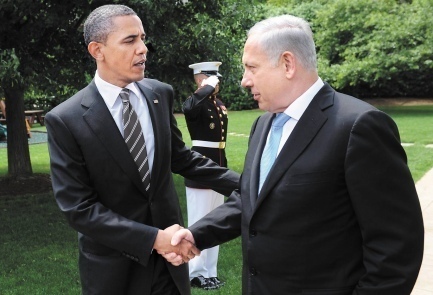
Netanyahu and ObamaPrime Minister Benjamin Netanyahu and U.S. President Barack Obama are set to agree on a one-year extension of the peace talks, according to Deputy Minister Ofir Akunis (Likud) | Photo credit: Avi Ohayon / GPO

Prime Minister Benjamin Netanyahu and U.S. President Barack Obama are expected to agree on a one-year extension of the current Israeli-Palestinian peace negotiations at their White House meeting in early March, Deputy Minister Ofir Akunis (Likud) said at a cultural event in Ramat Gan on Saturday.

Speaking of the peace process, Akunis said: “There is no confrontation with the U.S., but there are certainly some fundamental differences of opinion. An Israeli withdrawal to the June 4, 1967, borders would be like a suicidal person jumping off the roof of the Azrieli Towers [a trio of Tel Aviv skyscrapers]. This was never Likud policy — and will never be.”

The possibility of a an extension of the peace negotiations was first reported in Israel Hayom two months ago.

Meanwhile, Foreign Minister Avigdor Lieberman met with his French counterpart Laurent Fabius on Friday in Paris. Later that day, Israel’s Channel 2 aired an interview with Lieberman in which the Yisrael Beytenu leader said that Israel would not compromise on its opposition to the right of return for Palestinian refugees and its demand for Palestinian recognition of Israel as a Jewish state.

In the Channel 2 interview, Lieberman denied that he has undergone any sort of political metamorphosis.

“At my advanced age, perhaps my tone has changed somewhat,” Lieberman said. “I used to have more energy, when I was younger and more vigorous, but I think that the essence is the same essence.”

Lieberman recently publicly defended U.S. Secretary of State John Kerry, who was widely criticized in Israel for saying that Israel may face boycotts and further delegitimization if the current peace talks with the Palestinians fail.

“I’ve always had excellent relations with Kerry, even during the previous term when he was in the Senate,” Lieberman told Channel 2.

At a cultural event in Nes Ziona on Saturday, Kadima leader Shaul Mofaz talked about the peace talks with the Palestinians, saying that the “status quo can’t go on forever.”

“It’s just a matter of time before there will be a violent Palestinian ‘tsunami’ here, on a scale we have never seen before,” Mofaz said.

Strategic Affairs Minister Yuval Steinitz (Likud) referred on Saturday to the uproar caused by European Parliament President Martin Schulz’s Knesset speech earlier in the week.

“What happened in the Knesset was a tragicomedy,” Steinitz said at a cultural event in Tel Aviv on Saturday. “[Schulz] slightly stumbled on the data and facts, but the response of the [Habayit Hayehudi] ministers and MKs who walked out was unfortunate and disproportionate, in my opinion.”

Off Topic: Israel uneasy over Russian arms flooding into Syria in the north, Egypt to the south

February 16, 2014

Israel uneasy over Russian arms flooding into Syria in the north, Egypt to the south, DEBKAfile, February 16, 2016

The Iran-Syrian-Hizballah alignment is making diplomatic gains. Tehran is stiffening its bargaining position and begrudging nuclear concessions in the current negotiations with the Six Powers. The knock-on effect on the Syrian crisis was clearly visible in Geneva on Saturday, Feb. 15, when the talks on a political settlement crashed before ending their third round.

A new concern is preoccupying Israel’s strategists in recent weeks. On top of the al Qaeda fighting strength gathering around its borders, they are beginning to worry about the high momentum with which Russian President Vladimir Putin is capitalizing on America’s withdrawal from the Middle East. Moscow is working through military pacts with Syrian President Bashar Assad and Egyptian strongman and future president, Gen. Abdel-Fattah El-Sisi to dramatically deepen its regional foothold. This and Putin’s powerful personal backing for the two figures already have serious repercussions.

The Iran-Syrian-Hizballah alignment is making diplomatic gains. Tehran is stiffening its bargaining position and begrudging nuclear concessions in the current negotiations with the Six Powers. The knock-on effect on the Syrian crisis was clearly visible in Geneva on Saturday, Feb. 15, when the talks on a political settlement crashed before ending their third round.

In Beijing meanwhile, US Secretary of State John Kerry told reporters Friday that Obama was concerned about the deterioration in the humanitarian situation in Syria and also by the fact that peace talks between the opposition and government had not produced a discussion of a transitional government as planned. President Barack Obama has asked “all of us to think about various options that may or may not exist [for the Syrian crisis,]” Kerry said. Have they been presented? He was asked. “No, they have not,” he said.

The top US diplomat was perfectly aware, like everyone else, that Obama has no intention of conducting even the most minor US intervention in Syria war and has opted to leave a clear field in that doomed country to President Putin.

This hands-off policy has not only given the Russian president free rein to advance his interests, but further empowered Syrian ruler Bashar Assad to exercise his will on his suffering people undisturbed.

One of Assad’s most prominent characteristics is his ability to be beholden to no one – even Moscow, which supplies all his war needs even more generously than Iran. Assad goes along with Putin only when it suits his agenda, but is never in his pocket.

This was demonstrated in the breakdown of the Geneva conference – for which UN Mediator Lakhdar Brahimi was forced to apologize Saturday.  Assad flatly refused to accept a transitional government in Damascus in defiance of the advice pressed on him by the Russian president.

That fiasco also bankrupted the policies John Kerry managed for the Obama administration, which hinged heavily on Putin’s success in extracting from Assad enough flexibility to satisfy minimal US requirements.

So Putin failed to deliver the goods and Assad continued to wage his hideous war – a double setback for Washington, because White House policy-makers failed to appreciate that Assad and Putin each had their own agendas which were not uniformly in sync.

A similar relationship may be evolving between Cairo and Damascus.

This week, Egypt’s future president Defense Minister Gen. El-Sisi was in Moscow to sign a large transaction for the purchase of Russian arms. According to some estimates it is worth $2 billion; others put the figure as high as $3 billion.

Advanced Russian missiles and warplanes – and most likely S-300 anti-missile batteries – will flow into the Egyptian army’s arsenals for its two interlinked wars on the Muslim Brotherhood, which was outlawed as a terrorist organization after its overthrow from power, and on the al Qaeda jihadists entrenched in Sinai.

These terrorists are hand in glove with the Brotherhood for striking Egyptian military and government targets and also in close coordination with Al Qaeda elements in Libya.

Gen. El-Sisi currently treats Israel as a welcome ally, mainly because the Netanyahu government has agreed to overlook key clauses of the 1979 Israeli-Egyptian peace treaty in order to give him a free hand in Sinai and supports his campaigns with deep intelligence cooperation.

But the Egyptian strongman’s is trip to Moscow last week took him a long step away from Washington and an important step closer to Moscow, with incalculable consequences.

DEBKAfile’s military and intelligence sources draw certain disquieting parallels:

1. Although widely different in personality and leadership style, El-Sisis and Assad share the same lone rider instinct. They prepare their steps with meticulous care and advance planning for the sake of preserving their independence of action.

Assad’s maneuvers net him all the hardware he needs to fight his war from Russia. El-Sisi has designed his first arms transaction with Moscow to put him on the road to the independent path he seeks on the world and Middle East stages.

2. The Egyptian ruler and his following hold to the political orientation briefly summed up as Nasserist. He knows that Egypt’s fundamental economic woes are incurable, and so he is investing effort in building a strong regime that will promote the Nasserist form of pan-Arab nationalism, with Egypt in the forefront.

This policy may well bring Egypt into collision with the state of Israel, the national manifestation of the Jewish people.

Therefore, in many ways, the Egyptian strongman is an enigma. Neither Washington nor Jerusalem can foresee exactly where he is heading. The Syrian ruler for his part has confounded the most extreme predictions of how far he is willing to go in his pitiless determination to survive.

Netanyahu Warns World Over Iran Aggression

February 16, 2014

Netanyahu Warns World Over Iran Aggression, Israel National News, Tova Dvorin, February 16, 2014

Prime Minister begins weekly Cabinet meeting with warning to the West over Iranian political and nuclear policy

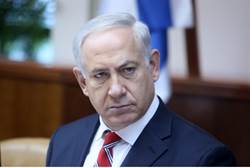
NetanyahuPrime Minister Binyamin Netanyahu Flash90

Prime Minister Binyamin Netanyahu opened his weeklyCabinet meeting Sunday with more words of warning to the West over Iran.

“The major powers’ talks with Iran will resume this week. Until now, it must be said, it is Iran which has gained without giving anything significant,” he began. “It has received a major easing of sanctions and the Iranian economy is already responding appropriately. Iran is also continuing its aggressive policy both inside Iran and outside Iran.”

“Inside Iran, it is executing innocent people,” Netanyahu continued. “Outside Iran, it supports the continued killings by the Syrian regime, which would be unable to act without it, without its support.”

“Iran is also continuing to arm terrorist organizations with advanced, deadly weapons and, of course, it is continuing to call for the destruction of the State of Israel. At the same time, Iran is continuing with advanced research and development of centrifuges. Iran is not prepared to concede even one centrifuge.”

“Israel’s policy is clear and is active on two tracks: First, to expose Iran’s unchanging aggressive policy. Second, to demand the dismantling of Iran’s enrichment capacity,” the Prime Minister reiterated. “Iran does not need any centrifuges for nuclear power for civilian purposes.”

On Tuesday, Iran’s atomic chief Ali Akbar Salehi announced that new centrifuges were being developed that are 15 times more powerful than what Iran currently uses for its uranium enrichment.

Salehi insisted that the development was not in violation of a November 24 agreement between Iran and six world powers that has imposed curbs on Tehran’s nuclear drive and states that Iran cannot increase its number ofcentrifuges.

Iran currently has nearly 19,000 centrifuges, including 10,000 of the so-called first generation being used to enrich uranium. Some 1,000 second generation machines, three to five times more powerful, have been installed but are not in service.

Iranian Multi-Warhead Missile Seen as ‘Extremely Unlikely’

February 16, 2014

Iranian Multi-Warhead Missile Seen as ‘Extremely Unlikely’- Global Security Newswire.

(More hot air coming from Tehran … – Artaxes)

Feb. 14, 2014

An woman walks past an Iranian Shahab 2 ballistic missile in 2012. A new analysis plays down the possibility that Iran recently tested a missile designed to accommodate multiple warheads.

An woman walks past an Iranian Shahab 2 ballistic missile in 2012. A new analysis plays down the possibility that Iran recently tested a missile designed to accommodate multiple warheads. (Atta Kenare/AFP/Getty Images)

A newly described Iranian weapon is likely designed to hold cluster munitions, not multiple warheads, as initially reported, says IHS Jane’s Defense Weekly.

Iran would face substantial difficulties in equipping the “Barani” ballistic missile to protect dozens of reentry vehicles during their return into the atmosphere, the defense publication said in a Thursday analysis. The Persian Gulf power earlier this week said the missile performed as intended in a recent trial flight, and state television paired the announcement with a mock-up image of two ballistic missiles each firing roughly 30 reentry vehicles outside the earth’s atmosphere.

Iranian media described the Barani as a “new generation of long-range ballistic missiles carrying multiple reentry vehicle payloads.”

Jane’s, though, said it is “extremely unlikely” that the missile can accommodate multiple warheads, a capacity commonly tied to nuclear arms. Rather, Iran probably built the Barani payload to drop numerous smaller bomblets after returning into the atmosphere, the analysis says.

U.S. intelligence analysts referenced Iranian work on cluster munitions in a 2012 assessment for lawmakers, the defense publication noted.

“Iran has boosted the lethality and effectiveness of existing systems with accuracy improvements and new submunition payloads,” the 2012 U.S. findings state.

Still, the Middle Eastern nation may be developing a capacity to release bomblets higher than Patriot antimissile systems — fielded in neighboring Arab countries — could intercept them, according to the analysis. Earlier this week, Iranian Defense Minister Hossein Dehqan was reported to assert that the Barani missile is capable of “evading [the] enemy’s antimissile defense systems.”

Jane’s noted, though, that possible cluster-munition payloads could be intercepted by Aegis-equipped U.S. antimissile warships, as well as the Terminal High-Altitude Area Defense system.

Iran: We’ve Developed a Missile ‘Better than S-300’

February 16, 2014

Iran: We’ve Developed a Missile ‘Better than S-300’ – Israel National News.

(Hey, that’s great. So you don’t need the S-300 anymore. Right? – Artaxes)

Advanced missile would be used against aircraft and cruise missiles, says Tehran.

By Dalit Halevy

First Publish: 2/15/2014, 11:18 PM

Illustration: S-300 missile defense batteries

Illustration: S-300 missile defense batteries
Reuters

Iran continues to present technological achievements in the field of military industry. The Commander of the country’s Air Defense Forces, Farzad Ismail, said that the missile “Bawer ” (Faith) made ​​in Iran, has reached the operational phase of development and that it features more advanced capabilities than the S-300 Russian-made missile.

The S-300 is a long range surface-to-air missile – manufactured by the Russian firm Almaz – designed to intercept aircraft and cruise missiles, and its most advanced models can also target ballistic missiles.

The corresponding missile in the West is the MIM-104 Patriot made ​​in the United States.

At the end of the previous decade there was talk about Rusia’s intention to sell the S-300 to Iran, but in 2010 a senior Russian source said that the transaction had been frozen.

Ismail noted that in response to the delay in the transfer of missiles from Russia to Iran, the Supreme Leader of Iran, Ali Khamenei, instructed the Iranian Ministry of Defense to develop its own missile. The matter was handed over to the Air Defense Command, Khatam al Anbia, and a number of scientific and academic centers.

The second phase of the project, which has been going on for five years, focuses on radar, launchers and the missile itself. A model of the missile was presented in military parades in Tehran.

‘Time is of the Essence’ to Halt Iran Proliferation

February 16, 2014

‘Time is of the Essence’ to Halt Iran Proliferation – Israel National News.

Founder of EMPact America tells Arutz Sheva why he believes the threat to American security from Iran could be closer than you think.

By Uzi Baruch, Washington
First Publish: 2/15/2014, 11:19 PM

A group of academics and American politicians came together at week’s end in Washington D.C., to discuss what they say is the greatest threat to US security: a nuclear Iran capable of obtaining an EMP, or Electromagnetic Pulse weapon.

Henry Schwartz, a prominent New York-based entrepreneur and founder of EMPact America, which organized the conference, spoke exclusively to Arutz Sheva and shared his thoughts on his group’s effort to lobby for greater awareness of the threat of an EMP attack against the US.

Schwartz said that the despite having served in the military, the event – which was the culmination of five years of hard work and drew in such influential figures as the former Director of the CIA James Woolsey and Republican Senator and rising GOP star Ted Cruz – had made him feel that “for the first time in 80 years …I am serving my country.”

He explained that his efforts had required patience, and would need further resolve in order to build a “critical mass” of awareness – and he warned that time was of the essence.

Off Topic: Terrorists Caught Infiltrating into Itamar

February 16, 2014

Terrorists Caught Infiltrating into Itamar, The Jewish Press, February 15, 2014

Approaching the anniversary of the Fogel family massacre, the IDF caught 4 armed Arabs trying to infiltrate into the town of Itamar on Friday night.

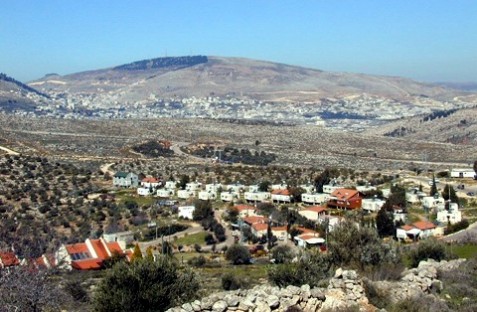
Itmar Itamar: In March 2011, residents of nearby Awarta infiltrated into the town and massacred the Fogel family. Photo Credit: Wikipedia

On Friday night four terrorists were caught trying to infiltrate into the town of Itamar, in the Shomron.

An IDF lookout saw four suspicious figures approaching the town and sent out a unit to search for the suspects.

The IDF caught three of the infiltrators who immediately surrendered, while a fourth tried to run away and was also caught. The terrorists were armed with knives, and equipment for breaking into homes. They were brought in for interrogation.

In another month it is the anniversary of the 2011 Fogel family massacre, when residents of Awarta infiltrated into Itamar with knives, and killed most of the family members on a Friday night.

Off Topic: Judea-Samaria Gas Stations Refuse to Serve PA Vehicles

February 15, 2014

Judea-Samaria Gas Stations Refuse to Serve PA Vehicles, Israel National News, February 15, 2014

Fuel stations in Palestinian Authority-controlled areas of Judea and Samaria are refusing to serve PA officials due to a row over unpaid bills.

The fiasco is the latest chapter in ongoing allegations of PA corruption and mismanagement of funds.

Gas pumpsGas pump (illustration) Thinkstock

Fuel stations in Palestinian Authority-controlled areas of Judea and Samaria are refusing to serve PA officials due to a row over unpaid bills.

According to the Bethlehem-based Maan news, the West Bank Union of Gas Station Owners said the PA has not paid its fuel bills for half a year, ratcheting up a debt of $15.7 million.

The Union’s deputy spokesperson,  Nizar al-Jaabari, said officials had been given an ultimatum of February 15th to pay their bills. Both PA security forces and the Finance Ministry were notified, but Saturday came and went without the bills being paid.

He said the debts had left many gas stations in a desperate situation, unable to purchase new stocks of fuel.

The fiasco is the latest chapter in ongoing allegations of PA corruption and mismanagement of funds.

Despite complaining of a lack of money, the Palestinian Authority recently announced multimillion-dollar plans to build two new airports – one of which would be located in a part of Judea-Samaria controlled by Israel, known as Area C.

The PA, which relies heavily on foreign donors, has been begging the world to step up financial aid in order to save it from collapsing. At the same time it has continued to provide huge monthly salaries to terrorists serving time in Israeli prisons while blaming Israel for the financial crisis.

Off Topic: Egyptian army launches campaign to create buffer zone on Gaza border

February 15, 2014

Egyptian army launches campaign to create buffer zone on Gaza border, Ma’an News Agency, February 15, 2014

(Ma’an News Agency claims to have many readers in Palestinian areas. — DM)

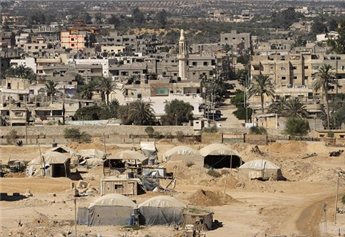
Gaza tunnels and Egypt(MaanImages/file)

Since the coup against Egyptian president Morsi in July. . . . Egypt has strictly enforced the blockade and targeted the tunnels.

CAIRO (Ma’an) — Egyptian border forces destroyed 10 tunnels and seven homes in the Sinai on Saturday as part of new campaign to create a buffer zone along the border with the Gaza Strip that would extend 500 meters in some places.

The campaign began with a military operation in the border town of Rafah, where tunnels leading into the Gaza Strip were targeted in the neighborhoods of al-Brahma, al-Sarsuriya, Salahudeen, al-Helwat, and Zoraba, an Egyptian security source said.

The security source added that the tunnels were destroyed and the homes they were located in were subsequently blown up.

He explained that the move was part of a wider campaign to set up a buffer zone along the border with Gaza in Rafah that would extend 300 meters in populated areas and 500 meters in open areas.

The zone would potentially threaten dozens of homes in the city, which has been divided by the international border since the 1982 Camp David peace accord. Thousands were displaced in the early 2000s when Israel demolished homes to build a buffer zone on the Palestinian side.

The Egyptian security source also told Ma’an that Egyptian army forces on Saturday successfully foiled three explosive devices placed in military vehicles and armored cars in Sheikh Zuwaid, including two that were placed near the Sheikh Zuweid Hospital and a third on the road to a nearby village south of Sheikh Zuewid.

He added that army forces raided “militant strongholds” in the village of al-Kharuba south of Sheikh Zuweid and destroyed three homes and five “hideouts.”

They also destroyed an olive grove that was reportedly used to hide militants following attacks taking place on the nearby road to Rafah International crossing.

Egyptian armed forces launched large scale military action against militants in the Sinai Peninsula earlier in September, in what officials described as the largest mobilization of force in the area since the 1973 war with Israel. The military action comes in the wake of rising instability and almost daily attacks in the region, following a July 3 coup by the Egyptian military which unseated President Mohammad Morsi.

Until July of this year, tunnels connecting Gaza to Egypt provided a vital lifeline for the territory amidst the otherwise crippling Israeli blockade. The blockade has been in place since 2006, and it has limited imports and exports and led to a major economic decline and wide-reaching humanitarian crisis.

Since the coup against Egyptian president Morsi in July, however, Egypt has strictly enforced the blockade and targeted the tunnels.

Egyptian Maj. Gen. Ahmad Ibrahim said in October that nearly 800 tunnels had been destroyed since the beginning of the year at that time, while Rafah officials estimated in September that these operations had demolished 95% of previously existing tunnels.