Archive for February 2014

Iran FM: Political resolve, goodwill vital for nuclear talks

February 17, 2014

Iran FM: Political resolve, goodwill vital for nuclear talks, Trend, February 17, 2014

(How about broadcasting more video simulations of Iranian missiles showering Israel and U.S. naval resources with goodwill? Iran compensates for her goodwill deficits through ample political resolve to achieve, without significant compromise, her ultimate goals of nuclear weaponry and as much relief from sanctions as she desires. She appears to be winning on both counts. — DM)
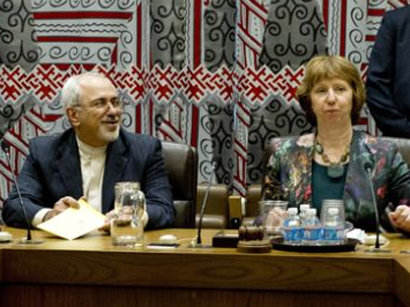
Iranian FM on good will

Iran’s Foreign Minister Mohammad Javad Zarif says ‘political resolve and goodwill’ are essential for talks between Iran and the six major world powers to reach a final agreement, Press TV reported.

“The Geneva Joint Plan of Action has almost clarified the frameworks and issues but it is necessary to discuss them with more precision and also [to discuss] follow-up methods,” the top Iranian nuclear negotiator said upon his arrival in the Austrian capital, Vienna, on Monday.

Iran and the five permanent members of the UN Security Council – China, Russia, Britain, France and the United States — plus Germany are scheduled to hold the next round of nuclear talks in Vienna on Tuesday.

The negotiations between Iran and the Sextet of world powers are aimed at reaching a comprehensive accord on the Islamic Republic’s nuclear energy program after the two sides clinched a landmark interim deal last November.

Zarif further said he would meet EU foreign policy chief Catherine Ashton, who heads the Sextet of powers during the nuclear talks, on Monday.

“Tomorrow (Tuesday) our official session with the P5+1 will begin after a meeting with the Austrian president and foreign minister,” the Iranian minister added.

He pointed to the measures carried out by both sides over the past weeks and said, “It seems that [the measures] are a good beginning to reach a solution.”

“What is important to us is reaching a final agreement based on the preservation of the Iranian nation’s rights and interests and we hope we will achieve results in this regard,” Zarif pointed out.

On Sunday, an Iranian nuclear negotiator Hamid Ba’eedinejad said the upcoming talks in Vienna would focus on new and advanced centrifuges and Arak heavy water reactor.

Under the Geneva deal, the six countries agreed to provide Iran with some sanctions relief in exchange for Iran agreeing to limit certain aspects of its nuclear activities during a six-month period. It was also agreed that no nuclear-related sanctions will be imposed on Iran within the same timeframe.

Egypt says suicide bomber caused deadly bus blast

February 17, 2014

Egypt says suicide bomber caused deadly bus blast | The Times of Israel.

( Egypt’s “unofficial” version.  Debka claims it was a bomb timed to go off in Eilat.  As usual, there’s no version that can be trusted. – JW )

Terrorist boarded bus full of South Korean tourists and detonated, killing four, officials say; group of survivors crosses into Israel

February 17, 2014, 4:06 pm
The wreckage of the bus blown up near the Taba crossing on the Egypt-Israel border, February 16, 2014 (photo credit: AFP)

The wreckage of the bus blown up near the Taba crossing on the Egypt-Israel border, February 16, 2014 (photo credit: AFP)

CAIRO — A  suicide bomber was behind the deadly blast that tore through a bus carrying South Korean tourists, Egyptian security officials said.

The officials said the bomber boarded the bus while it waited near the Egypt-Israel border crossing at Taba in the Sinai Peninsula. The Egyptian driver and the South Korean guide had disembarked but were close to the bus when Sunday’s blast took place, according to the officials.

The Egyptian officials spoke on condition of anonymity Monday because they were not authorized to speak to the media.

South Korean officials said the bombing killed three South Koreans and an Egyptian driver. The tourists were Korean Christians who had saved for years to visit Biblical sites on their church’s 60th anniversary.

“The preliminary investigation shows some tourists disembarked to get their bags. A man walked to the bus. There was an explosion when he reached the third step,” interior ministry spokesman Hany Abdel Latif told AFP.

The tourists were all members of the same church group from the central South Korean county of Jincheon and were on a 12-day trip through Turkey, Egypt and Israel. They were about to cross into Israel when the attack occurred.

The South Korean ambassador to Egypt, Kim Young-So, told Seoul’s MBN TV station that the bus bombing appeared to be a “suicide bombing by a terrorist.”

An al-Qaeda-linked Islamist group, Ansar Bayt al-Maqdis, took responsibility for the bombing. On its Twitter account, the organization promised to continue to attack Egypt’s economy, tourism, and military.

The group, based in the Sinai Peninsula, has deployed several suicide bombers in attacks on police, as well as in a failed attempt to assassinate interior minister Mohamed Ibrahim in September.

Fifteen survivors from the blast crossed into Israel on Monday and are staying at a hotel in the resort city of Eilat, Israel’s Channel 2 news reported. Other tourists who had been on the bus carrying 33 were still hospitalized in the Sinai.

Egypt had reportedly refused offers of Israeli help after the blast, transporting at least 12 injured people to hospitals in the Sinai peninsula instead of the closer Yoseftal Hospital in Eilat.

Militants have killed dozens of tourists in sporadic attacks over the past several decades, mostly recently in a 2009 bombing that killed a French tourist in Cairo.

Maj. (res.) Aviv Oreg, formerly the head of Al Qaeda and Global Jihad desk at the Israel Defense Force’s military intelligence directorate, said the bombing was likely intended to send a message to Jerusalem and Cairo.

For jihadist organizations in the Sinai Peninsula, this sort of attack is ”very sufficient in order to pinpoint that Israel is their target in their aspirations,” he told The Times of Israel.

Police under now deposed president Hosni Mubarak had all but stamped out Islamist militancy after a spate of Sinai resort bombings between 2004 and 2006.

But the three-year period of lawlessness and unrest after Mubarak’s overthrow in 2011 has allowed the militants to regroup in the restive Sinai peninsula and to branch out to the Nile Delta.

“A continuation in attacks on tourists would mean a shift in strategy by jihadist groups that until now targeted the military and police,” said Issandr El Amrani of the International Crisis Group.

“But that cannot be judged after one attack,” he added.

The head of Egypt’s Chamber of Tourism said the attack could have been aimed at hitting the tourism industry, one of Egypt’s top revenue generators.

“The attack aimed at harming tourism in general,” said Elhami al-Zayat.

Sunday’s bombing came as a court in Cairo began trying Morsi and 35 co-defendants on charges of espionage and collusion with militants to launch attacks in Egypt.

Morsi, Egypt’s first democratically elected and civilian president, was ousted after a year in power amid massive protests demanding his resignation.

The military-installed government has since accused Morsi’s Muslim Brotherhood of masterminding the attacks that have also targeted police headquarters in Cairo.

The Brotherhood, now designated as a terrorist group, publicly renounced violence decades ago and denies involvement in the attacks.

The deadliest attacks have been claimed by the Sinai-based Ansar Beit al-Maqdis group, whose leadership is drawn from militant Bedouin who want an Islamist state in the peninsula.

In recent months, ever since Morsi’s ouster, cooperation between Israeli and Egyptian authorities “has been largely enhanced,” Oreg said, moving from the tactical and operational level to the intelligence realm. The Shin Bet, too, has been forced, over the course of the past two years, to realign itself in order to address the growing threats from the Sinai.

Netanyahu: Iran engaged in ‘subversive activities’ in Latin America, world

February 17, 2014

Netanyahu: Iran engaged in ‘subversive activities’ in Latin America, world, Jerusalem Post, February 17, 2014

In meeting with Peruvian president, prime minister warns of Islamic Republic’s global reach; claims that nuclear talks have already allowed Iran to escape from sanctions.

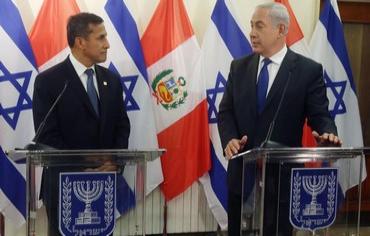
Netanyahu in PeruPrime Minister Binyamin Netanyahu meets with Peruvian President Ollanta Humala, February 17, 2014 Photo: MARC ISRAEL SELLEM/THE JERUSALEM POST

Prime Minister Binyamin Netanyahu met with Peruvian President on Monday in Jerusalem, where the two discussed relations between Israel and Peru and spoke of recent developments with regards to the Iranian nuclear program.

Speaking about Iran’s global influence, especially in Latin America, Netanyahu accused Iran of inflammatory behavior, saying  that “Iran is engaged subversive activities around the world, including in Latin America.”

The two leaders met on the eve of nuclear talks between world powers and Iran due to re-start Tuesday in Vienna, and Netanyahu told the Peruvian president that a different policy is required than what is currently in place.

“A policy that requires Iran to stop its aggression, to stop its nuclear military program, and to become a nation among the nations, not a rogue state that arms itself with nuclear weapons.” he said.

The prime minister continued: “I think it is important for Israel, I think its important for Peru and I think its important for world peace.”

Iran is believed to have bases in Cuba, Venezuela, Bolivia and Nicaragua.

Humala, in his comments, spoke warmly about increasing economic and global cooperation with Israel, but steered clear of Iranian issue.

Netanyahu rebuffed comments Iran’s Supreme LeaderAyatollah Ali Khamenei made Monday.

Khamenei said he was not against nuclear talks with western powers but he didn’t think they would lead anywhere.

In response, Netanyahu jested that the nuclear talks had indeed already gone somewhere, allowing Iran to escape from sanctions.

Netanyahu thanked the Peruvian president for supporting Israel’s recent inclusion as an observer in the Pacific Alliance, a Latin American trade bloc comprised of  Chile, Colombia,Mexico, and Peru. Netanyahu said its beneficial for both Israel and Peru.

Netanyahu recalled the meaningful relationship between the two allies. “We remember that Peru supported Israel’s bid for statehood is 1947. This is a relationship with roots, and I believe it will have big branches in coming years.”

Op-Ed: The Nuclear Option is on the Table

February 17, 2014

Op-Ed: The Nuclear Option is on the Table, Israel National News, Dr. Joseph Frager, February 17, 2014

(Wouldn’t EMP attacks,  nuclear,  non-nuclear or a combination of both, be better? — DM)

The Obama administration’s soft approach to Iran’s nuclear program may have done more than simply making a conventional strike more likely.

President Obama has had a constant refrain when it comes to Iran – “I’m keeping all options on the table”.

The likelihood of President Obama using any kind of military force against Iran is extremely slim. It has become even less likely now that an “interim agreement” which many consider on both sides of the aisle to be a sham has been signed.

Israeli leaders, however, have made it perfectly clear that they will not allow Iran to obtain a nuclear bomb. The Israeli efforts have been stymied byPresident Obama who has refused to send Israel vital Bunker Buster Bombs. The Iranians have hardened their nuclear facilities anticipating a military strike making the situation more complex and challenging.

In military circles both inside an outside of Israel the price of a military strike on Iran has been debated. Some have warned that the retaliation by Iran’s proxies in Hezbollah and Hamas will be too high a price to pay. Hezbollah now has more sophisticated missiles than heretofore that can reach Tel Aviv. These factors have delayed an Israeli attack thus far.

Israel’s back is, however, soon to be against the proverbial “wall”. No nation has the patience of Israel. No nation wants Peace more than Israel. And no nation when it comes to its back being pushed against the wall will more likely strike than Israel. This is how it has been able to survive.

The President by signing an interim agreement that is at best a “bad agreement” and at worst a total capitulation to the Mullahs has boxed Israel into a tight corner.

Senator Ted Cruz of Texas said point blank on Feb. 6th at the EMPact America Conference held at the Reserve Officers Association in Washington D.C. that this agreement has increased the chances of a military strike against Iran. Now comes the big question. If a conventional military strike cannot destroy the embedded Iranian Nuclear reactors and stockpile, especially since Israel does not have the necessary Bunker Busters to do the job, will Israel then go to the nuclear option?

Had the President given Israel the Bunker Busters and the necessary assurances that it needs to defend itself against a prolonged conflict and retaliation by Hezbollah, I would not be raising the dreaded spectre of a nuclear attack against Iran. However, given the current existential nature to the Iranian threat, the likelihood of a nuclear strike by Israel on Iran’s nuclear facilities has increased immensely.

Let us all hope that the President will reverse course and provide Israel with everything it needs for a conventional strike on Iran. Otherwise, barring a revolution in Iran, Israel will have no other option but to use its nuclear arsenal.

Bomb which blew up South Korean bus in Sinai was rigged to detonate in Eilat

February 17, 2014

Bomb which blew up South Korean bus in Sinai was rigged to detonate in Eilat.

DEBKAfile Exclusive Analysis February 17, 2014, 10:23 AM (IST)
The tourist bus blown up by terrorists in Sinai

The tourist bus blown up by terrorists in Sinai

The bus carrying South Korean tourists from Egypt to Israel was rigged as a time bomb for Eilat, debkafile’s counter-terror sources reveal. It blew up prematurely in Egyptian Sinai and killed three South Korean tourists – two men and a woman – and the Egyptian driver, Sunday, Feb. 16, shortly before the bus crossed the Taba terminal just north of Eilat. Fourteen tourists were injured.

An explosion in downtown Eilat a few minutes later would have magnified the death toll and afforded the al Qaeda-linked Ansar Bayt al-Maqdis embedded in Sinai its first terrorist hit in the heart of an Israeli town.
The timing mechanism was apparently faulty and detonated the bomb while the bus was still on the Egyptian side of the border.

Even then, the tragedy could have been averted had Egyptian security measures been in force on the tourist routes through Sinai. In an area ridden with terrorists, the bus should have been escorted by a police van with four armed officers. Before reaching the terminal, it should have been stopped and thoroughly searched by security officers with sniffer dogs trained to detect explosives.

Until now, debkafile’s military sources report, Israel relied on Egyptian security to monitor the tourist buses entering through the Taba crossing, and merely carried out routine checks of the visitors’ papers.

Following the bus attack, Israel will need to tighten security for Taba and nearby Eilat and carry out its own stringent inspections for visitors entering from Egypt.

South Korea issued a statement Monday voicing shock and outrage at the terrorist bombing of the bus and strongly condemning it as an act of terror. The victims were all members of a church group from the central South Korean county of Jincheon, who were on a 12-day trip through Turkey, Egypt and Israel.

Seoul issued a high-level travel warning for the Sinai region and the Gulf of Aqaba, and urged its nationals living elsewhere in Egypt to take extra precautions.

“We believe that terrorism can never be justified under any circumstances and such inhumane and unethical acts should be weeded out by all means,” the foreign ministry said. UN Secretary Ban Ki-moon added his voice to the condemnation.

The Israel Airports Authority, which is responsible for border security, said the Taba crossing had been closed in the wake of the blast and Israeli trippers in Sinai urged to leave.
Immediately after the attack on the bus, debkafile reported Sunday on the inadequacies of the Egyptian-Israeli war on al Qaeda.:

The bombing of a tourist bus carrying 33 South Korean tourists in Sinai just 250 meters from the Taba crossing to Israel, killing at least 4 tourists and the Egyptian driver, represents a major failure of the joint war Egypt and Israel are waging against Al Qaeda and its partners-in-terror, the Muslim Brotherhood and the Palestinian Hamas. At least 14 South Korean tourists were injured, although some sources put the figure at 20.

The South Korean group, coming from St. Catherine’s monastery near Mount Sinai, was hit just before entering Israel for a 24-hour tour of the Holy Places.

Exactly how the attack was engineered is still unclear, debkafile’s counterterrorism sources report. According to one theory, the tourist bus was attacked in three stages:

1. An explosive device was planted inside the base on a timer – either when the visitors were out touring or at one of the rest stops between the monastery and Taba.

2. At the moment that the bomb was timed to detonate, the terrorists fired a rocket at the bus.
3. At the same moment, a bomb car rammed the right wall of the bus and exploded.
Given the clockwork precision of the three actions and the quantity of explosives expended, the low number of casualties is surprising.
The operation bore the signature of Ansar Bayt Al-Maqdis, the al Qaeda-led Islamist coalition which has been carrying out terrorist and rocket attacks on both sides of the border, and whose membership includes a number of seasoned and highly trained terror operatives from Libya, Egypt, Yemen and Saudi Arabia. They are fed a steady stream of intelligence by Egyptian Muslim Brotherhood figures hiding in the Gaza Strip as well as locals of the Palestinian Hamas and the Jihad Islami.
They succeeded in breaking new ground in Sinai with their attack on a tourist target – and deal a body blow to a major Egyptian industry – only because key events caught the anti-terror forces wanting:

a)  One of the four trials against deposed Egyptian president Mohamed Morsi opened in Cairo Sunday morning, in which he was charged with espionage and conspiring to commit acts of terror.
This date should have been accompanied by an elevated terror alert not only in Egypt proper but in Sinai as well. The trial was adjourned to Feb. 23 when his lawyers walked out in protest against Morsi  being confined in a soundproofed cage.
That date too could be a red-letter day for terror.

b) The fact that Egyptian-Israeli border forces went on high alert only after the bombing of the tourist bus – not before – points to lax foresight by both forces.
c)  Despite intensive intelligence-sharing between Egypt and Israel in Sinai and the Gaza Strip, neither agency picked up on the plans in the making for the coming attack.

d)  It is the declared policy of Ansar Bayt Al-Maqdis to punish Israel for Egyptian assaults on its members and bases with rocket strikes on Eilat. The last such strike took place on Jan. 31. Israeli authorities have chosen to play these threats down, except for posting an Iron Dome anti-missile battery at Israel’s southernmost town.
e)  The Sinai jihadists spotted the hole in this defensive screen. Iron Dome is set to intercept rockets aimed at Eilat, but not to gather intelligence outside its radius, such as Taba, just a few kilometers to the north. Intelligence there depended on other sources.

The fact is that Ansar Bayt Al-Magdis was able to rig a bomb to blow up just a few meters from the Taba terminal and the Israeli border bespeaks a large hole in IDF defenses.
f)  Israel permitted the Egyptian army to deploy military units, tanks and assault helicopters in Sinai, a major concession in support of the war on terror. But those forces have failed to curb the operational capabilities of the terrorists who are making free of Sinai.
The whisper going around Israeli official and high military circles is that the government’s policy of relying on the Egyptian army to handle the Islamist terrorists has run aground. There are quiet calls for an urgent revision. It is time for Israel’s security and military chiefs to stop pretending that they can afford to turn their backs on the mounting menace posed by Al Qaeda groups closing in on its borders from south and north.

Iran: Nuclear talks to focus on centrifuges, reactors

February 16, 2014

Iran: Nuclear talks to focus on centrifuges, reactors, Al Arabiya News, February 16, 2014

“[W]e will definitely not accept to be deprived from having the right to replace the existing centrifuges with the new and advanced ones,” Hamid Baeedinejad, an Iranian nuclear negotiator, told IRNA.

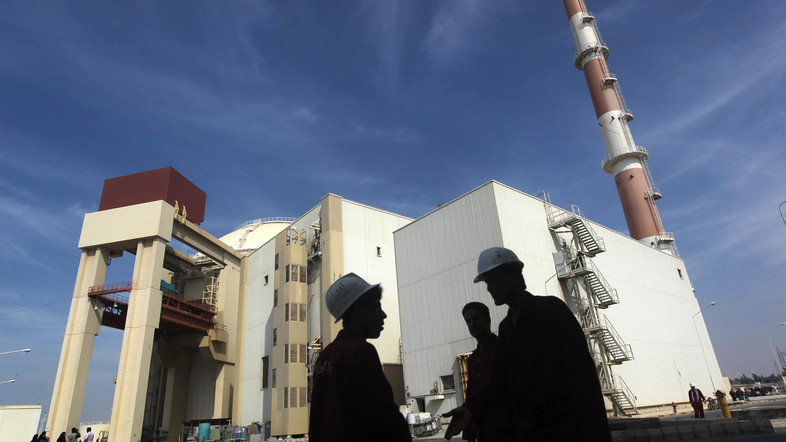
Iranian workers stand in front of Bushehr nuclear power plant, 1,200 km south of TehranIranian workers stand in front of the Bushehr nuclear power plant, about 1,200 km (746 miles) south of Tehran. (File photo: Reuters)

An Iranian negotiator said nuclear talks with world powers this week would focus on advanced centrifuges and the unfinished Arak heavy water reactor, the official IRNA news agency reported Sunday.

Iran is due to resume talks Tuesday in Vienna with the P5+1 — Britain, France, the United States, Russia and China plus Germany — aimed at reaching a comprehensive accord on its controversial nuclear program following November’s landmark interim deal.

“Using advanced and new centrifuges is one of the focal points which should be examined and solved for the long term and comprehensive deal, since we will definitely not accept to be deprived from having the right to replace the existing centrifuges with the new and advanced ones,” Hamid Baeedinejad, an Iranian nuclear negotiator, told IRNA.

“The Arak heavy water reactor is also one of the most important and difficult subjects to be examined and discussed in the negotiations, and we certainly want to keep this reactor.”

Western powers and Israel have long suspected Iran is pursuing a nuclear weapons capability alongside its civilian program, charges denied by Tehran.

Under the interim deal, Iran agreed to roll back or freeze some nuclear activities for six months in exchange for modest sanctions relief and a promise by Western powers not to impose new restrictions on its hard-hit economy.

The unfinished Arak reactor is of concern to the West because Tehran could theoretically extract weapons-grade plutonium from its spent fuel if it also builds a reprocessing facility, giving it a second possible route to a nuclear bomb.

Baeedinejad said any proposal which would allay such concerns “without changing the essence of the reactor” would be examined.

Iran agreed not to build a reprocessing facility as part of last month’s nuclear deal. It also committed not to make further advances at its Arak, Fordo and Natanz facilities.

Mehr news agency said Iranian Foreign Minister Mohammad Javad Zarif, who is leading the negotiating team, would meet on Monday evening with EU foreign policy chief Catherine Ashton for a working dinner.

It said the negotiations would officially begin at 0830 GMT on Tuesday.

Egypt refused Israeli medical help for Taba bus blast

February 16, 2014

Egypt refused Israeli medical help for Taba bus blast | The Times of Israel.

Israeli ambulances were at the border minutes after bombing killed 4 and injured 8, but Egyptian authorities spurned offers of aid

February 16, 2014, 8:46 pm

Although Israeli-Egyptian security cooperation has never been closer, Egypt refused Israeli offers of medical assistance for the tourists wounded when their bus was blown up by Islamic extremists Sunday afternoon, just inside Egyptian territory at the Taba border crossing.

Three Korean tourists and the Egyptian bus driver were killed in the bombing, and at least eight passengers were seriously injured. The bomb was placed under the driver’s seat and detonated by remote control as the vehicle neared the crossing into Israel.

More than two dozen Israeli ambulances were despatched to the crossing immediately after the bombing — which took place just across the border and was audible inside Israel — but the Egyptian authorities refused Israel’s offers of assistance. Israeli “emergency forces were ready within minutes,” the local Israeli Magen David Adom emergency chief said.

Some reports said the injured were eventually brought to a hospital at the Egyptian resort of Sharm e-Sheikh a full three hours after the blast. Other reports said not all of the injured had been evacuated by evening. Eilat’s Yoseftal Medical Center is a few minutes’ drive from the Taba crossing.

No Israelis were among the casualties, an Israeli police spokesman said.

Israel also offered assistance in investigating the bombing but that offer was not immediately accepted either, Israeli sources said on Sunday night. This, despite the fact that security cooperation between Israel and the Egyptian leadership under military strongman Abdel-Fattah el-Sissi “has never been closer,” according to Israeli military sources.

Initial investigation indicated that the bomb was planted under the driver’s seat of the tourist bus when it made a stop en route to Taba at the resort town of Nuweiba. The bomb was detonated by remote control, as the bus waited near the Taba Hilton hotel to obtain permission to cross into Israel.

Security arrangements at the crossing are such that the terrorists would not have been able to carry out the attack at the Israeli side of the border or inside Israel, security sources said Sunday night without elaboration.

The IDF’s Southern Command’s former chief of staff, Brig. Gen. (res.) Tzvika Fogel, warned that Sinai terror was likely to continue, and was a response to the perception among terror groups that their opponents were growing in strength. “The terror initiatives won’t stop surprising us as long as the Egyptians and the Palestinian Authority will continue to grow stronger in the eyes of those who are carrying out the terror,” said Fogel.

Israel’s Channel 2 news reported that dozens of Israelis were vacationing at the Taba Hilton at the time of the blast. Several of them, and other Israeli tourists in Egypt, immediately sought to return to Israel. By evening, Israel had reopened its facilities at the Taba crossing to enable them to cross back into Israel. Egypt later reopened the crossing as well.

In 2004, a bomb blast at the Hilton killed 31 people. The hotel, which houses a casino, is about 100 meters from the border.

Officials said the tourist bus had arrived at Taba from the ancient Greek Orthodox monastery of St. Catherine in central Sinai. The bus, filled with 32 Korean Christian pilgrims, had started its journey in Cairo, passed through St. Catherine, stopped briefly at Nuweiba and was on its way to Eilat when the bomb exploded shortly before it reached the border.

Ansar Bayt al-Maqdis, an al-Qaeda affiliated terrorist organization, reportedly claimed responsibility for the attack, various Arabic-language media outlets reported.

The group said on Twitter that it would continue to attack Egypt’s economy, tourism and its military commanders, Israel Radio reported.

The Sinai-based al-Qaeda-linked group was also responsible for a handful of terror attacks throughout Egypt and for several Grad rockets launched at Eilat over the past month from across the border.

Ansar Bayt al-Maqdis is reportedly holed up in the mountainous center of the arid peninsula, an area the Egyptian military has been loath to approach in its ongoing battle with terror groups in the increasingly turbulent Strip.

Some Egyptian media reports, nonetheless, blamed Hamas, the Islamist organization that rules the Gaza Strip. El-Sissi has been relentlessly closing smuggling routes between the Sinai and Gaza, in part because he blames Hamas for direct involvement in terrorism in the Sinai. Egyptian officials in recent weeks have vowed to take on Hamas once they have defeated Sinai-based terrorism.israeli-medical-help-for-taba-bus-blast/#ixzz2tW2GSUza
Follow us: @timesofisrael on Twitter | timesofisrael on Facebook

Sinai tourist bus blast killing at least 5 people points up Egyptian-Israeli inadequacy against al Qaeda

February 16, 2014

Sinai tourist bus blast killing at least 5 people points up Egyptian-Israeli inadequacy against al Qaeda.

( The explosion was heard here in Eilat. – JW )

DEBKAfile Exclusive Analysis February 16, 2014, 7:58 PM (IST)
The tourist bus blown up by terrorists in Sinai

The tourist bus blown up by terrorists in Sinai

The bombing of a tourist bus carrying 33 South Korean tourists in Sinai just 250 meters from the Taba crossing to Israel, killing at least 4 tourists and the Egyptian driver, represents a major failure of the joint war Egypt and Israel are waging against Al Qaeda and its partners-in-terror, the Muslim Brotherhood and the Palestinian Hamas. At least 14 South Korean tourists were injured, although some sources put the figure at 20.

The South Korean group, coming from St. Catherine’s monastery near Mount Sinai, was hit just before entering Israel for a 24-hour tour of the Holy Places.

debkafile’s counterterrorism sources report that the tourist bus was attacked in three stages:

1. An explosive device was planted inside the base on a timer – either when the visitors were out touring or at one of the rest stops between the monastery and Taba.
2. At the moment that the bomb was timed to detonate, the terrorists fired a rocket at the bus.
3. At the same moment, a bomb car rammed the right wall of the bus and exploded.
Given the clockwork precision of the three actions and the quantity of explosives expended, the low number of casualties is surprising.
The operaton bore the signature of Ansar Bayt Al-Maqdis, the al Qaeda-led Islamist coalition which has been carrying out terrorist and rocket attacks on both sides of the border, and whose membership includes a number of seasoned and highly trained terror operatives from Libya, Egypt, Yemen and Saudi Arabia. They are fed a steady stream of intelligence by Egyptian Muslim Brotherhood figures hiding in the Gaza Strip as well as locals of the Palestinian Hamas and the Jihad Islami.
They succeeded in breaking new ground in Sinai with their attack on a tourist target – and deal a body blow to a major Egyptian industry – only because key events caught the anti-terror forces wanting:

a)  One of the four trials against deposed Egyptian president Mohamed Morsi opened in Cairo Sunday morning, in which he was charged with espionage and conspiring to commit acts of terror.
This date should have been accompanied by an elevated terror alert not only in Egypt proper but in Sinai as well. The trial was adjourned to Feb. 23 when his lawyers walked out in protest against Morsi  being confined in a soundproofed cage.
That date too could be a red-letter day for terror.

b) The fact that Egyptian-Israeli border forces went on high alert only after the bombing of the tourist bus – not before – points to lax foresight by both forces.
c)  Despite intensive intelligence-sharing between Egypt and Israel in Sinai and the Gaza Strip, neither agency picked up on the plans in the making for the coming attack.

d)  It is the declared policy of Ansar Bayt Al-Maqdis to punish Israel for Egyptian assaults on its members and bases with rocket strikes on Eilat. The last such strike took place on Jan. 31. Israeli authorities have chosen to play these threats down, except for posting an Iron Dome anti-missile battery at Israel’s southernmost town.
e)  The Sinai jihadists spotted the hole in this defensive screen. Iron Dome is set to intercept rockets aimed at Eilat, but not to gather intelligence outside its radius, such as Taba, just a few kilometers to the north. Intelligence there depended on other sources.

The fact is that Ansar Bayt Al-Magdis was able to deploy unnoticed just a few meters from the Taba terminal and the Israeli border a rocket trap and a bomb car bespeaks a large hole in IDF defenses.
f)  Israel permitted the Egyptian army to deploy military units, tanks and assault helicopters in Sinai, a major concession in support of the war on terror. But those forces have failed to curb the operational capabilities of the terrorists who are making free of Sinai.
The whisper going around Israeli official and high military circles is that the government’s policy of relying on the Egyptian army to handle the Islamist terrorists has run aground. There are quiet calls for an urgent revision. It is time for Israel’s security and military chiefs to stop pretending that they can afford to turn their backs on the mounting menace posed by Al Qaeda groups closing in on its borders from south and north.

‘Iran got something for nothing,’ prime minister says

February 16, 2014

‘Iran got something for nothing,’ prime minister says – Israel News, Ynetnews.

Talks on long-term accord start in Geneva this week amid lukewarm expectations on both sides.

AFP, Ynetnews

Latest Update: 02.16.14, 13:07 / Israel News

Iran has so far gained without having to give anything significant in return, Prime Minister Benjamin Netanyahu said Sunday.

Iran and world powers embark Tuesday on the Herculean task of transforming an interim nuclear deal into a long-term accord satisfying all sides and silencing talk of war for good.

“It has received a major easing of sanctions and the Iranian economy is already responding appropriately,” Prime Minister Netanyahu said.

Meanwhile, Netanyahu said, Iran is continuing with advanced research and development of centrifuges.

“Iran is not prepared to concede even one centrifuge,” the prime minister asserted, adding that “Iran does not need any centrifuges for nuclear power for civilian purposes.”

He noted that Israel’s policy “is clear and is active on two tracks: First, to expose Iran’s unchanging aggressive policy. Second, to demand the dismantling of Iran’s enrichment capacity.”

The prime minister also decried the continuation of Tehran’s aggressive policies both inside and outside of the country.

“Inside Iran, it is executing innocent people. Outside Iran, it supports the continued killings by the Syrian regime, which would be unable to act without it, without its support,” the premier elaborated.

“Iran is also continuing to arm terrorist organizations with advanced, deadly weapons and, of course, it is continuing to call for the destruction of the State of Israel,” he continued.

After a decade of failure and rising tensions, US President Barack Obama has put the chances of reaching a final status agreement at not more than “50-50”, while Iranian Foreign Minister Mohammad Javad Zarif has predicted “difficult” discussions.

The scheduled three-day meeting in Vienna between senior diplomats from Iran and the United States, China, Russia, Britain, France and Germany – the P5+1 – is the first in what is expected to be a series of tricky encounters in the coming months.

It comes after foreign ministers struck a deal in Geneva on November 24 that saw Iran agree to curb – for six months – some of its nuclear activities in exchange for minor relief from painful sanctions.

That agreement, which came into force on January 20, extends the theoretical “break-out time” needed by Iran – which denies seeking the bomb – to produce enough highly-enriched uranium for a nuclear weapon.

In return Iran is due to get over the six months some US $6-7 billion in sanctions relief, including US $4.2 billion in assets frozen in overseas bank accounts.

But Iran’s nuclear freeze is only temporary – although it can be extended – and the bulk of UN and Western sanctions remain, continuing to deprive Iran of billions of dollars in oil revenues every week.

Under the “comprehensive” deal now being sought, which the parties aim to conclude and commence implementing by November, the powers will want Iran to scale back its activities permanently.

In exchange, Iran would see all UN Security Council, US and EU sanctions lifted.

The deal might include the closure of Iran’s Fordow facility, slashing the number of centrifuges enriching uranium, cutting its stockpile of fissile material and altering a new reactor being built at Arak, diplomats say.

This, plus tighter UN inspections, would not remove entirely Iran’s capability to get the bomb but would make it substantially more difficult. According to Obama, it would be “impossible”.

“Your enrichment capacities are incompatible with your civilian nuclear program, we are saying to them … They don’t fit with your statement that you have no military objectives,” one Western envoy involved in the Vienna talks said.

Hard sell

But how such a deal goes down with hardliners in the United States and in Israel, as well as with Sunni Arab monarchies in the Gulf, remains to be seen.

“I think both sides would be willing to make compromises to meet the bottom lines of the other side,” Richard Dalton, the former British ambassador to Tehran now at think-tank Chatham House, told AFP.

“The trouble is that both sides have hard men outside the negotiating room who have to be satisfied.”

Iranian President Hassan Rouhani, a relative moderate whose election last year has helped thaw relations with the West, for now retains the backing of supreme leader Ayatollah Ali Khamenei.

Rouhani called last week for the talks to be “fair and constructive”, while Tehran has laid out a series of “red lines” including refusing to close down any nuclear facilities or to stop medium-level enrichment.

“I am not fully sure whether Khamenei himself is fully committed to this process yet,” Siavush Randjbar-Daemi, Iran and Middle East lecturer at Manchester University, told AFP.

“Geneva really was a stop gap, a band-aid solution that didn’t really heal the wounds.”

Iran general says US is heading for collapse

February 16, 2014

Iran general says US is heading for collapse, Times of Israel, February 16, 2014

(“We are ready for the decisive battle with America and the Zionist regime (Israel).” The Supreme Leader does not bluff and neither do I. So there!  — DM)

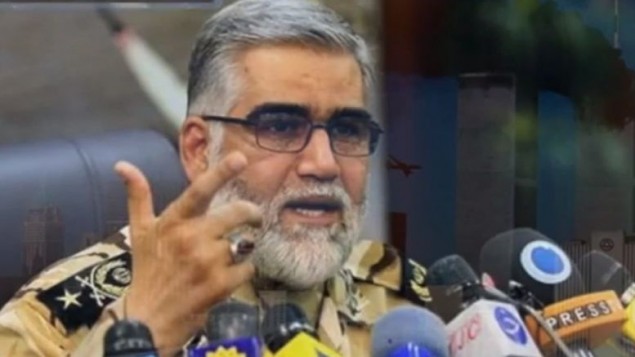
Iranian ground forces commanderAhmad-Reza Pourdastan, Iran’s ground forces commander (photo credit: YouTube screenshot)

The commander of Iran’s Army ground forces on Sunday declared that the US is heading for collapse.

Brigadier General Ahmad Reza Pourdastan was quoted by the Iranian Fars news agency warning Washington against any military action against Iran, and predicting that US was moving toward a final collapse.

“Based on the remarks of the Supreme Leader of the Islamic Revolution (Ayatollah Ali Khamenei), the ‘world arrogance’ is moving on a historical twist,” he said in an address, referring to the US. “And if it repeats its wrong method against Iran, it will no doubt have no destiny, but decomposition like the Soviet Union.”

The remarks, the latest in a series of belligerent comments by prominent Iranian figures, came two days before Iran and world powers begin talks aimed at transforming an interim deal into a long-term accord on Iran’s rogue nuclear program.

Last week, Iran’s chief of staff Hassan Firouzabadi warned the Islamic republic’s foes that Iran was prepared for a “decisive battle” if attacked.

“We are ready for the decisive battle with America and the Zionist regime (Israel),” Fars news agency quoted Firouzabadi as saying.

He also warned neighboring nations not to allow any attack to be launched on Iran from their soil. “We do not have any hostility toward regional states, but if we are ever attacked from the American bases in the region we will strike that area back,” he said.

Washington has many military bases in the region, including in Bahrain, Kuwait, the United Arab Emirates, Saudi Arabia and Turkey.

US Secretary of State John Kerry said late last month that if diplomacy with Iran fails, “the military option of the United States is ready and prepared to do what it would have to do.”

But Firouzabadi accused the US of bluffing.

“Over the past decade, they brought their forces but came to the conclusion that they can’t attack us, and left,” he said, dismissing the US military threat as nothing but a “political bluff.”

Iranian President Hassan Rouhani said on Tuesday that the West should not have any delusions about using a military option. “I say explicitly, if some have delusions of having any threats against Iran on their tables, they need to wear new glasses. There is no military option against Iran on any table in the world,” he said.

And last Sunday, Iranian Revolutionary Guards Corps Navy Commander Ali Fadavi said the US knows that its aircraft carriers in the Persian Gulf would be sunk if it launched a military strike on Iran. “The Americans can sense by all means how their warships will be sunk with 5,000 crews and forces in combat against Iran and how they should find its hulk in the depths of the sea,” said Fadavi, according to Fars.

“They cannot hide themselves in the sea since the entire Middle East region, Western Europe, the Persian Gulf, the Sea of Oman and the Strait of Hormuz are monitored by us and there is no place for them to hide.”

Also Sunday, Defense Minister Hossein Dehqan touted the Iranian military’s ability to respond to an American attack, Fars reported. “The Iranian Armed Forces are an intertwined and coherent complex that can give a decisive response to any threat at any level and any place under the command of the commander-in-chief,” Dehqan said in a ceremony marking the 35th anniversary of the revolution that brought the current Islamic regime to power. “The enemy can never assess and think of the range of the response given by the powerful and mighty Armed Forces of the Islamic Iran,” he added.

On February 7, Iranian state TV ran a documentary featuring a computerized video of Iran’s drones and missiles bombing Tel Aviv, Haifa, Ben-Gurion Airport and the Dimona nuclear reactor in a simulated retaliation for a hypothetical Israeli or American strike on the Islamic Republic. The clip also showed simulated attacks on American targets in the region, including an aircraft-carrier.