Archive for February 2014

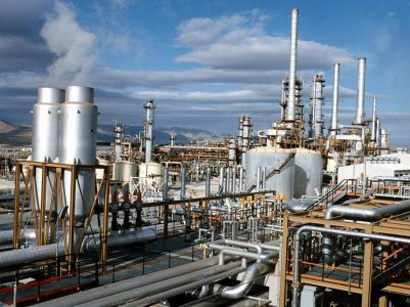
Iran building four petrochemical plants in Arvand free zone

February 19, 2014

Iran building four petrochemical plants in Arvand free zone, Trend, February 20, 2014

(See earlier report on el Supremo’s desire for more petrochemical exports. — DM)

Petrochemical_Iran_240213

The construction of four petrochemical plants has begun in Iran’s Arvand free zone in the southwest of the country, IRIB quoted zone Director Esmaeil Zamani as saying on February 18.

Some 622 billion rials, about $25 million, will be invested in the projects, he added. The plants will produce various types of thinner, paint, glue, anti-freeze and solvent.

The four plants have a total capacity of producing 78,000 tons of chemical compounds and petrochemicals per year, he noted.

Iran’s petrochemical exports surpassed $9.19 billion during the first 10 months of the current solar year (started on March 21, 2013), the country’s customs administration reported on Jan. 25.

The country’s petrochemical exports stood at $8.116 billion during the first nine months of the current solar year which indicates a 2.3 percent decrease compared to the same period of the preceding year.

Western countries suspended certain sanctions against Iran as the Geneva nuclear deal came into force on Jan. 20.

The prohibition on the import, purchase or transport of Iranian petrochemical products and related services was suspended as a result of the nuclear deal implementation.

Exports of Iran’s gas condensates stood at $8.520 billion for the first 10 months of the current Iranian calendar year, according to the country’s custom administration’s report.

Same truth, different speaker

February 19, 2014

Same truth, different speaker, Israel Hayom, February 19, 2014

(Buying time, but for whom and what? As failure of the deal is delayed, Iran can prosper while rendering attempts to restore sanctions innocuous. — DM)

Perhaps today people will understand why Prime Minister Benjamin Netanyahu, back in September, refused to fall for Iranian President Hassan Rouhani’s charming smiles at the U.N. General Assembly

In December, U.S. President Barack Obama put the odds of reaching a nuclear deal with Iran at 50 percent, despite the euphoria around the world and within his administration after the interim deal was sealed in Geneva.

In Vienna on Tuesday, negotiations between Iran and the superpowers resumed, and this time the talks are focusing on a final status agreement. The 50% Obama gave in December is high in comparison with the 0% chance of success given by his former adviser on weapons of mass destruction and Iran’s nuclear arsenal, Gary Samore, who has also participated in the negotiations. While officials in Jerusalem have already said it, they have been treated like a bunch of naysayers. Perhaps today people will understand why Prime Minister Benjamin Netanyahu, back in September, refused to fall for Iranian President Hassan Rouhani’s charming smiles at the U.N. General Assembly.

Samore’s interview with Bloomberg merely proves that the world understands perfectly what Iran wants (a bomb), but, just like Iran, the world (including the Obama administration) also wants to buy time. Samore calls this a “classic truce.” The idea is not to solve the problem, rather postpone it until a later date. Iran and the superpowers pushed the “pause” button together. This suits the West and is excellent for the Iranians.

At this rate, the Iranians are liable to reap such fruits as exploring other avenues of cooperation with the Americans, improving their country’s economy and continuing to extract themselves from international isolation, all while not dismantling one single centrifuge.

Samore’s comments on Tuesday did not teach us anything new here in Israel, but the fact that he is saying it certainly makes it important and extremely troubling. The problem is that Samore, today, no longer works at the White House. He is now at Harvard.

It is precisely for this reason that on the eve of negotiations, Iran’s supreme leader, Ayatollah Ali Khamenei, can continue taking verbal jabs at the West by saying, “They will lead nowhere regardless,” and why Ali Larijani, the head of Iran’s parliament, can tell the superpowers not to make any more demands and to refrain from seeking supervision over the country’s ballistic missile program.

After Obama’s and Samore’s assessments, it is interesting that officials in London have yet to wager on the chances for a successful final status deal with the Iranians. It is possible that, in light of events, they would actually prefer betting on the date of Iran’s first nuclear test.

Supreme leader: Iran to create ‘economy of resistance’

February 19, 2014

Supreme leader: Iran to create ‘economy of resistance’, Times of Israel, February 19, 2014

(Khamenei, along with many in the West, expects the P5+1 negotiations eventually to end in failure. Putting Iran’s export mechanisms in good order while sanctions relief persists will continue to be an obvious strategy for Iran for as long as P5+1 try to negotiate. — DM)

Ayatollah Ali Khamenei called Western sanctions “a full-fledged economic war” and said Iran is determined to force the West to retreat.

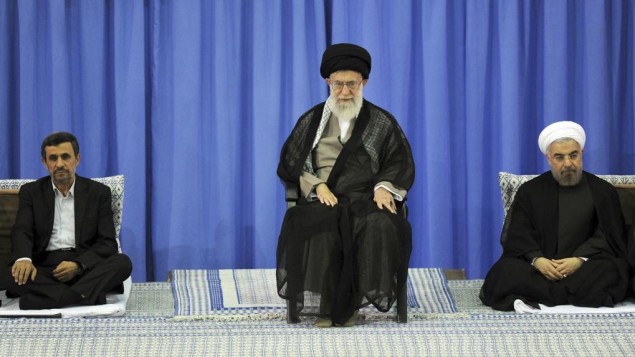
Iranian trifectaIn this picture released by the official website of the Iranian supreme leader’s office, Supreme Leader Ayatollah Ali Khamenei, center, President Hasan Rouhani, right, and outgoing president Mahmoud Ahmadinejad, sit, in an official endorsement ceremony for Rouhani, in Tehran, Iran on Saturday, August 3. (photo credit: AP Photo/Office of the Iranian Supreme Leader)

TEHRAN (AP) — Iran’s top leader ordered the government Wednesday to create an “economy of resistance” to counter sanctions imposed over Tehran’s nuclear program.

Ayatollah Ali Khamenei called Western sanctions “a full-fledged economic war” and said Iran is determined to force the West to retreat.

Iran has been hit hard by sanctions that have hit, among other targets, its vital oil sector. The program requires the government to diversify Iran’s exports, reduce dependence on sales of raw materials and promote knowledge-based high-tech industries.

“If (Iran) pursues … an economy of resistance, we will overcome economic problems and will defeat the enemy … that has imposed a full-fledged economic war against this great nation,” he said in his order which was posted on his website leader.ir.

Under the program, the government must take action to expand production and export of knowledge-based products, increase domestic production of strategic goods and develop markets in neighboring countries. It also encourages greater privatization and increased exports of electricity, gas, petrochemical and oil by-products instead of crude oil and other raw materials.

Iranian officials say it will be harder to target oil byproducts with sanctions that it will be to target crude.

Western sanctions over Iran’s nuclear program also shut Iran out of the international banking system, making it hard for its remaining customers in Asia and elsewhere to pay.

An interim nuclear deal reached in November with world powers has eased some sanctions but the core remains in place — including measures targeting Iran’s oil exports, the pillar of its economy.

Crude oil exports account for nearly 80 percent of Iran’s foreign revenue but have been reduced by half in the past two years due to stepped up sanctions. It currently exports about 1 million barrels a day — compared to 2.2 million in 2011.

Iran says its non-oil exports have increased to about $40 billion a year, showing an annual 20 percent increase.

Iran and the six-nation group — the five permanent members of the UN Security Council plus Germany — began talks for a final deal in Vienna Tuesday.

Khamenei, who has the final say on all state matters in Iran, has said he had accepted the talks but doubts they will succeed, saying Washington is using the nuclear issue as an “excuse” to pressure the country.

In his order, Khamenei has asked the government to closely monitor sanctions and impose costs on the “enemy,” a reference to the US

The West suspects that some Iranian nuclear activities are intended to give it the ability to build a weapon. Iran denies this, saying its program is for peaceful purposes.

Large explosion rocks southern Beirut, killing four and wounding 19

February 19, 2014

Large explosion rocks southern Beirut, killing four and wounding 19 | JPost | Israel News.

By REUTERS

02/19/2014 10:22

Security sources said the explosion near an Iranian cultural center appeared to have been caused by a car bomb and a motorcycle laden with explosives.

The scene of the explosion in southern Beirut

The scene of the explosion in southern Beirut Photo: COURTESY LEBANESE MEDIA

A large explosion near an Iranian cultural center in the southern suburbs of Lebanon’s capital Beirut on Wednesday killed at least four people and wounded 19, security sources said.

Security sources said the explosion appeared to have been caused by a car bomb and a motorcycle laden with explosives.

The area is controlled by the Shi’ite political and militant movement Hezbollah. Iran’s embassy in the same area was targeted by a bomb attack in November, one a series of car bombs in southern Beirut since July.

The Kuwaiti embassy is also located in the same area.

Lebanese television footage showed fire trucks and Lebanese soldiers standing in the streets. A wounded man was carried away on a stretcher and a young girl was being evacuated by two men. Glass covered the road and nearby buildings were damaged.

Radical Sunni Islamists have pledged to attack Hezbollah on Lebanese soil for its intervention in Syria to help Syrian President Bashar Assad, a member of the Alawite offshoot of Shi’ite Islam, in his war against majority Sunni rebels.

Washington critics sound alarm as Iran talks resume

February 19, 2014

Washington critics sound alarm as Iran talks resume | The Times of Israel.

White House defends negotiations in Vienna amid warnings by conservative groups; ballistic technology tops agenda

February 19, 2014, 9:47 am

Catherine Ashton and Javad Zarif before talks began in Vienna Tuesday. (Screen capture)

Catherine Ashton and Javad Zarif before talks began in Vienna Tuesday. (Screen capture)

WASHINGTON — As a first round of talks toward a long-term comprehensive nuclear agreement between the P5+1 states and Iran began Tuesday, critics warned that the Vienna negotiations could end in a deal – or a stalemate — that would leave Iran dangerously close to a nuclear weapon.

Mark Dubowitz, the executive director of the conservative think tank Foundation for the Defense of Democracies, warned that during the months of comprehensive negotiations, Iran would still have the capacity to hone technologies that would advance its ability to weaponize its stockpiles of enriched uranium. Research on delivery systems, warhead designs, nuclear triggers and ballistic missiles, he cautioned, could continue apace, unfettered, for months.

“Iran is gaining itself a minimum of six months to work on those elements, maybe longer,” he told The Times of Israel. “Iran has shown a willingness to compromise on the parts of its nuclear program that it has already perfected.”

In addition to weapons delivery systems, Dubowitz warned, Iran would be able to continue research and development on advanced centrifuges, although it is forbidden from installing any new centrifuges under the terms of an interim nuclear deal it reached with world powers in November 2013. Advanced centrifuges would enable Iran to use fewer centrifuges to enrich its uranium to near-weapons-grade levels.

In the face of the criticism, Obama administration officials expressed guarded optimism. Asked about the chances for a long-term deal with Iran, White House spokesman Jay Carney said Tuesday night that “because there is at least some prospect that Tehran might be willing to — in a verifiable, transparent way — convince the international community that it has forsaken pursuit of a nuclear weapon, we ought to do that through diplomatic means.”

While acknowledging that the threat of military force against Iran must remain “on the table,” he asserted that it “can’t be a first option.”

Carney told reporters that the administration is “obviously mindful of the fact that [the negotiations] may not result in an agreement, but because they present the opportunity, we have to take it.”

“Our view hasn’t changed in that we think that it is absolutely the right thing to do to test whether or not Tehran is serious about resolving this conflict diplomatically,” he explained.

Carney responded to critics who, like Dubowitz, have been complaining that the interim agreement didn’t curtail in a meaningful way Tehran’s ability to break out to a bomb.

The White House spokesman said that according to the terms of the interim agreement, Iran must address the UN Security Council resolutions related to its nuclear program before a comprehensive resolution can be reached. Referencing a 2010 Security Council resolution to that effect, Carney argued that the agreement obliged Iran to “deal with matters related to their ballistic missile program.” He said fulfillment by Iran of the obligations set down in the interim deal was a prerequisite to a comprehensive agreement.

A senior administration official speaking to reporters in Vienna in advance of the talks noted that the number of centrifuges allowed Tehran will be a major point of discussion in the negotiations toward a comprehensive solution. The official did not, however, discuss the trajectory of talks regarding new centrifuge technology in the comprehensive framework.

A Senate bill that would increase sanctions against Iran should the talks prove unsuccessful has been languishing in Congressional deep freeze, scant votes short of a veto-proof majority. Supporters of the bill say that it would have been one of Iran’s few incentives to reach an agreement rather than dissemble while continuing to build up the still-permissible aspects of its nuclear program.

AIPAC, which lobbied heavily for the bill, released a memo Tuesday in which it said that the final agreement with Iran must include the dismantlement – and not merely suspension – of Iran’s existing nuclear capabilities.

“Tehran must dramatically alter its position if the Vienna talks are to have any chance for success,” warned the pro-Israel lobbying group. It cited past quotes by US President Barack Obama, Secretary of State John Kerry and other top administration officials insisting that Iran must dismantle key aspects of its nuclear program, including the fortified underground uranium enrichment facility at Fordo and the Arak heavy water reactor, whose future plutonium byproduct could furnish a second route to the bomb.

While cynicism toward Iran’s intents has been running high in some circles, others in Washington were more optimistic about the renewed talks. On Friday, a bipartisan group of 104 members of the House of Representatives signed on to a letter congratulating the Obama administration for its efforts.

The members of Congress emphasized that the ongoing implementation of the interim agreement “increases the possibility of a comprehensive and verifiable international agreement.”

The letter reiterated the administration’s complaints regarding the new sanctions legislation, noting that although Congress “may be compelled to act” toward additional sanctions should talks break down, the representatives believe that while talks are ongoing “a bill or resolution that risks fracturing our international coalition or, worse yet, undermining our credibility in future negotiations and jeopardizing hard-won progress toward a verifiable final agreement, must be avoided.”

Islamic world must attain its rightful position: Rouhani

February 18, 2014

Islamic world must attain its rightful position: Rouhani, Tehran Times, February 18, 2014

President Rouhani called for measures to improve security and boost the economy in the Islamic world in order to bring about “lasting peace and sustainable development” and to promote the Islamic culture.
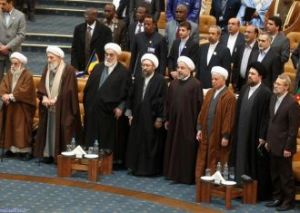
Organization of Islamic Action

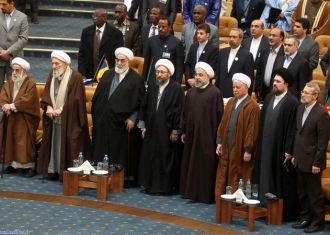
TEHRAN – The ninth session of the Parliamentary Union of the Organization of Islamic Cooperation (PUIC) kicked off in Tehran on Tuesday, with the attendance of representatives from 47 OIC member states.

Iranian Parliament Speaker Ali Larijani took over the rotating presidency of the conference from Sudanese National Assembly Speaker Al-Fateh Ezzedin for one year.

Iranian President Hassan Rouhani, Larijani, and Ezzedin delivered speeches during the opening ceremony of the conference.

Twenty-eight parliament speakers and 14 deputy speakers of OIC member states are attending the conference, which is being held on the theme of “Islamic parliaments: Solidarity, Progress, and Justice”.

In his speech, President Rouhani called for measures to improve security and boost the economy in the Islamic world in order to bring about “lasting peace and sustainable development” and to promote the Islamic culture.

He added that the Islamic Republic of Iran “wishes the best” for all Muslim countries and regards their “progress” and “glory” as its own.

Rouhani also expressed hope that the conference would find tangible solutions for the problems facing Muslims.

He also said that he was optimistic that the conference would increase cooperation and common understanding between Iran and all other Islamic countries.

Elsewhere in his remarks, Rouhani said that today, Muslims are facing various challenges, including security problems, economic crises, the Syria crisis, and the Palestine question.

However, in light of Muslims’ enormous economic wealth and their countries’ critical geopolitical position, they should have a more proper role in the world, he added.

Rouhani asked if it is fair that the Islamic world is torn by “extremism and terrorism” and sectarian and tribal conflicts that lead to the death of Muslims, and that Islam, which is the religion of mercy and kindness, is being presented to the world through the prism of Islamophobia.

He also said that Muslim nations, by virtue of their possession of abundant natural resources and their control of sensitive geostrategic locations in the world, should be enjoying a much better situation in the world in comparison to other nations.

‘Arrogant powers use terrorism to threaten Muslims’

In his speech to the conference, Larijani said that the arrogant powers make “tactical” use of “terrorism” in order to threaten various Muslim nations, such as Syria, Iraq, Afghanistan, and Pakistan.

But if Islamic countries utilize their vast potential in various areas, they will acquire an honorable position vis-à-vis the arrogant powers, he noted.

The Iranian Majlis speaker also hailed the recent wave of Islamic Awakening in regional Muslim countries, underlining that such democratic movements will strengthen unity in the Islamic ummah (community).

‘Extremism a major challenge for Islamic world’

The Sudanese parliament speaker, who is the former rotating president of the union, also delivered a speech in which he described “extremism” as one of the biggest challenges facing the Islamic world.

Ezzedin called for more unity among Muslims and said the PUIC should convey the message of Islam to the world.

Elsewhere in his remarks, he touched on the union’s objectives and said that the PUIC should take measures to promote scientific research and bridge scientific gaps in Muslim countries.

The PUIC was established in 1999 and consists of 53 members and 22 regional, international, and parliaments observers. Its permanent headquarters is in Tehran.

It seeks to strengthen parliamentary cooperation among Islamic countries in order to solve challenges facing the Islamic world.

According to the PUIC website, one of the objectives of the union is to provide a framework for comprehensive and fruitful cooperation and coordination among parliaments of OIC members.

The eighth meeting of the PUIC was held in the Sudanese capital Khartoum in January, 2013.

▶ Netanyahu: The Syrian butchery shows the true face of Iran. – YouTube

February 18, 2014

▶ Netanyahu: The Syrian butchery shows the true face of Iran. – YouTube.

The Syrian victims being cared for by IDF doctors shows the true heart of Israel and the Jewish people.

Rouhani: Zionist regime benefits most from upheaval in Muslim world

February 18, 2014

Rouhani: Zionist regime benefits most from upheaval in Muslim world, Jerusalem Post, February 18, 2014

(The bases for his thesis that “the “Zionist regime” gains the most benefit from the current upheaval in the Muslim world” must be self-evident. Peaceful, highly intelligent charmer that he is, might he have referred to reduced attacks on Israel as those in the Muslim world kill each other?– DM)

In meeting with Arab MPs, Iranian president calls on Muslim countries to show unity with Iran against Western threats.

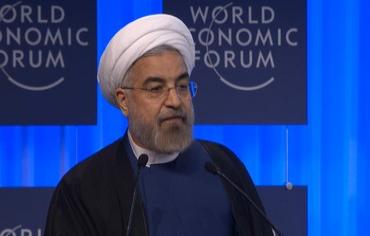
Rouhani 1Iranian President Hassan Rouhani Photo: SCREENSHOT DAVOS WORLD ECONOMIC FORUM

Iranian President Hassan Rouhani on Tuesday called on Arab parliamentarians to show Muslim unity and support Iran against threats from the West.

Addressing visiting MPs from Arab countries at the Inter-Parliamentary Union in Tehran, Iran’s Press TV quoted Rouhani as saying that the “multifaceted” threats against Iran would eventually have a negative impact on all Muslim nations.

Rouhani attacked Israel, saying that the “Zionist regime” gains the most benefit from the current upheaval in the Muslim world.

The Iranian president condemned using violence against Muslims in the name of anti-terror activities.

Netanyahu: Iran remains ‘brutal’ and ‘aggressive’

February 18, 2014

Netanyahu: Iran remains ‘brutal’ and ‘aggressive’ | The Times of Israel.

February 18, 2014, 6:36 pm

PM says field hospital treating Syrians shows ‘true face of Israel’ while casualties are proof of ‘true face’ of Tehran

Prime Minister Benjamin Netanyahu visits an IDF field hospital for treatment of wounded from the civil war in Syria, in Ramat ha Golan, Northern Israel. February 18, 2014. (photo credit: Kobi Gideon /GPO/FLASH90)

Prime Minister Benjamin Netanyahu visits an IDF field hospital for treatment of wounded from the civil war in Syria, in Ramat ha Golan, Northern Israel. February 18, 2014. (photo credit: Kobi Gideon /GPO/FLASH90)
 

As nuclear talks resumed between Iran and the world powers known as the P5+1, Prime Minister Benjamin Netanyahu said that the Islamic Republic remains aggressive and brutal, and is complicit in the Syrian regime’s murder of its citizens.

“I would like to tell the world, today,” Netanyahu said Tuesday morning during a tour of the Golan Heights, “as the talks between the major powers and Iran are being resumed, that Iran has changed neither its aggressive policy nor its brutal character. Iran is continuing to support the Assad regime which is slaughtering its own people. This is the true face of Iran. The world cannot forget this.”

Netanyahu made his comments at an IDF base where injured Syrians are receiving medical care. Defense Minister Moshe Ya’alon and IDF Chief of Staff Maj. Gen. Benny Gantz were on hand as well.

“On the day when talks between the major powers and Iran are being opened in Vienna, it is important that the world sees the pictures from this place, which divides the good that is in the world from the bad,” Netanyahu was quoted in a press release as saying. “The good part is that Israel is saving the lives of those who have been wounded in the daily slaughter that is being perpetrated in Syria. This is the true face of Israel.

“The bad part is that Iran is arming those who are carrying out the slaughter,” he continued. “This is the true face of Iran. All of the children who have been injured, to say nothing of those who have been killed, were injured as a result of Iran’s arming, financing and training the Assad regime in the massacres that it is perpetrating.”

In Early February, Channel 2 News aired footage of a secret Israeli field hospital in the Golan Heights that has treated over 700 Syrians since the war began.

The army hospital, staffed by soldiers in uniform, includes an emergency room, an intensive care unit, an operating room, a mobile laboratory, a pharmacy and an x-ray facility. It treats Syrian patients who cross the border regardless of creed, ethnicity – or with which faction their loyalties lie.

The once-sporadic treatment of Syrian nationals in Israel has, by now, become routine, the report made clear: The wounded cross the border and IDF medical teams deployed in the Golan Heights give them preliminary treatment. Those who are well enough are sent back across the border, and those who require further treatment are evacuated to the military hospital, a field commander at the facility told Channel 2. In this way, the hospital treats about a hundred Syrians per month.

“I would like to tell the world, today,” Netanyahu said Tuesday morning during a tour of the Golan Heights, “as the talks between the major powers and Iran are being resumed, that Iran has changed neither its aggressive policy nor its brutal character. Iran is continuing to support the Assad regime which is slaughtering its own people. This is the true face of Iran. The world cannot forget this.”

Netanyahu made his comments at an IDF base where injured Syrians are receiving medical care. Defense Minister Moshe Ya’alon and IDF Chief of Staff Maj. Gen. Benny Gantz were on hand as well.

“On the day when talks between the major powers and Iran are being opened in Vienna, it is important that the world sees the pictures from this place, which divides the good that is in the world from the bad,” Netanyahu was quoted in a press release as saying. “The good part is that Israel is saving the lives of those who have been wounded in the daily slaughter that is being perpetrated in Syria. This is the true face of Israel.

“The bad part is that Iran is arming those who are carrying out the slaughter,” he continued. “This is the true face of Iran. All of the children who have been injured, to say nothing of those who have been killed, were injured as a result of Iran’s arming, financing and training the Assad regime in the massacres that it is perpetrating.”

In Early February, Channel 2 News aired footage of a secret Israeli field hospital in the Golan Heights that has treated over 700 Syrians since the war began.

The army hospital, staffed by soldiers in uniform, includes an emergency room, an intensive care unit, an operating room, a mobile laboratory, a pharmacy and an x-ray facility. It treats Syrian patients who cross the border regardless of creed, ethnicity – or with which faction their loyalties lie.

The once-sporadic treatment of Syrian nationals in Israel has, by now, become routine, the report made clear: The wounded cross the border and IDF medical teams deployed in the Golan Heights give them preliminary treatment. Those who are well enough are sent back across the border, and those who require further treatment are evacuated to the military hospital, a field commander at the facility told Channel 2. In this way, the hospital treats about a hundred

WATCH: Iranian Film Shows ‘Nuclear Attack’ on Israel

February 18, 2014

WATCH: Iranian Film Shows ‘Nuclear Attack’ on Israel – Israel National News.

(Could they make their intentions any clearer? You see an atomic blast and someone trampling on the word ‘Holocaust’ on the floor. – Artaxes)

Latest in a series of digital saber-rattling illustrates aggressive Iranian response to theoretical military strike on nuclear program.

By Ari Soffer

First Publish: 2/18/2014, 12:32 PM
 

IAF F-4 Phantom (illustration)

IAF F-4 Phantom (illustration)
Flash 90

A new animated film posted on Iranian websites in recent days graphically portrays an Iranian counterattack against a theoretical joint Israeli-American strike on the Islamic Republic’s military facilities, culminating in the destruction of the Jewish state.

The clip was posted together with messages decrying attempts to tighten sanctions on Iran due to its nuclear program, according to Israel Hayom, and begins with an airstrike by Israeli and American forces on Iran. 

Iranian air defenses kick in and destroy the bombers, and subsequent scenes show Iranian aircraft flying over Jerusalem, and strikes on Israel’s soil.

Chillingly, the film ends with what appears to be an Iranian-launched nuclear missile destroying the Jewish state.

The film is not the first such Iranian simulation of an attack against Israeli or western targets. Similar clips, including one earlier this month, have previously been released by official Iranian state organs as crude warnings to Israel and western states not to target its nuclear facilities.

But the graphic illustration of a nuclear attack against Israel will hardly allay fears in Jerusalem and elsewhere that Tehran’s nuclear program is far from peaceful.