Archive for February 27, 2014

Arak Heavy Water Reactor 85 percent completed, Iranian MP says

February 27, 2014

Arak Heavy Water Reactor 85 percent completed, Iranian MP says, Trend, Umid Niayesh, February 27, 2014

(Since it has been only 85 percent completed, centrifuge installation is said to have been suspended and Iran’s intentions are said to be peaceful, what could go wrong if when the P5+1 talks end in failure and Iran remains “open for business?” — DM)

The U.S. and the EU are concerned that the facility could be used to produce plutonium which can be used to fuel a nuclear weapon as an alternative to highly enriched uranium. Iran says its atomic programme is peaceful and the Arak reactor is intended to produce isotopes for cancer patients.

1 Arak nearly completed

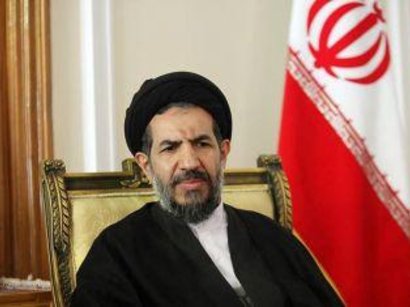
Iran’s Arak Heavy Water Reactor is now 85 percent complete, Vice-Speaker of the Parliament Mohammad Hassan Aboutorabi Fard said, Iranian Donya-e-eqtesad newspaper reported on Feb. 27.

The MP went on to say that in the past the western powers wanted Iran’s nuclear sites to be closed. Meanwhile today they have accepted their loss negotiating with Iran on the issue.

“Some 19,000 Iranian centrifuges are spinning and the Arak heavy water reactor is 85 percent complete,’ he remarked.

Iran’s heavy water production plant and reactor which remains under construction is located near the city of Arak.

The U.S. and the EU are concerned that the facility could be used to produce plutonium which can be used to fuel a nuclear weapon as an alternative to highly enriched uranium. Iran says its atomic programme is peaceful and the Arak reactor is intended to produce isotopes for cancer patients.

Iran has agreed to suspend the installation activity at the reactor based on the Geneva nuclear deal.

Iran and the P5+1 reached a nuclear agreement on November 24, 2013. Iran has agreed to curb some of its nuclear activities for six months in return for sanctions relief. Iran and the P5+1 group have agreed to implement the agreement starting from Jan. 20.

Under the agreement, six major powers agreed to give Iran access to $4.2 billion in revenue blocked overseas if it carries out the deal which offers sanctions relief in exchange for steps to curb the Iranian nuclear programme.

The incomplete Arak heavy water nuclear reactor was a stumbling block that almost derailed nuclear talks between Iran and other nations last November, when France’s Foreign Minister Laurent Fabius insisted that Iran should agree to halt work there before world powers would consider signing the nuclear deal.

The reactor if operating optimally would produce about nine kilogrammes of plutonium annually or enough for two nuclear weapons each year.

On January 16, the White House released details of implementing the nuclear deal signed by Iran and the world’s six major powers. According to the statement Iran is committed to not fuelling the Arak reactor or install the remaining components.

On Feb. 6, Iranian media outlets quoted head of the Atomic Energy Organisation of Iran, Ali Akbar Salehi as saying Iran can make some design changes to the Arak Heavy Water Reactor in order to produce less plutonium and in this way allay the concerns.

Salehi also went on to say that the plutonium which will be produced in the reactor is not weapons grade plutonium.

Kerry, we hear you loud and clear

February 27, 2014

Kerry, we hear you loud and clear, Israel Hayom, Dr. Gabi Avital, February 27, 2014

(General Robert E. Lee wrote to his son “Never do a wrong thing to make a friend or keep one; the man who requires you to do so is dearly purchased at a sacrifice.” That’s good advice for nations as well as people. — DM)

Night and day we are taught that the United States is Israel’s best friend. It is quite possible that this is historically true. It is quite possible that when the gains and losses are weighed up, Israel has benefited from its special relationship with the U.S.

A deeper examination, however, shows the State Department has been directly tied to every diplomatic and even economic initiative that has turned out to be a grave mistake. Is Kerry acting on his own accord? Is there a large conceptual gap between him and U.S. President Barack Obama? The answer to both questions is a resounding no.

Toward the end of the previous century, during a visit to the U.S. by Ariel Sharon, a disagreement emerged between him and several members of Congress over U.S. obligations toward Israel. The minimalists felt the U.S. owed Israel — for being an ally, a strategic asset, an intelligence provider and military testing ground — some $50 billion. The maximalists sought around $80 billion for these services. No gift is free.

Years passed, and Israel has taken giant strides away from being a strategic asset, primarily because of, as many predicted, the failure of the Oslo Accords. While some of Israel’s deterrent capabilities have vastly improved and pre-emptive strikes are occasionally carried out behind enemy lines — at least according to foreign reports — the actions of influential elements at home create the perception that Israel is more of a patron than an ally.

We recently learned that U.S. Secretary of State John Kerry is very much an American patriot, both as a citizen concerned for the welfare of his country and as a politician mainly concerned for his chair. A signed weapons deal between Israeli arms company Rafael Advanced Defense Systems and India, estimated at billions of dollars, is now liable to be terminated due to pressure from Kerry and his cohorts. It is accepted practice to leverage connections, apply pressure and persuasion, even to offer monetary enticements, but this matter essentially runs deeper.

Night and day we are taught that the United States is Israel’s best friend. It is quite possible that this is historically true. It is quite possible that when the gains and losses are weighed up, Israel has benefited from its special relationship with the U.S.

A deeper examination, however, shows the State Department has been directly tied to every diplomatic and even economic initiative that has turned out to be a grave mistake. Is Kerry acting on his own accord? Is there a large conceptual gap between him and U.S. President Barack Obama? The answer to both questions is a resounding no.

Kerry’s conduct is merely an extension of the policy which clearly disregards the notion of a “brotherhood between nations” and instead revolves around clear egotistical interests. Obama’s conduct has lead the U.S. to major outside debt, as well as a regression from the principle of being the “world’s policeman,” which has in turn lead to a dramatic decrease in domestic weapons manufacturing. This is the root of Kerry’s concern. As far as we know, no connection has been made between the pressure on India and a diplomatic price Israel would have to pay in negotiations with the Palestinians. From another perspective, however, there is a clear connection.

Kerry is essentially saying loud and clear that America’s economic interests are more important than the natural partnership between friends. Therefore, this is an opportunity to put on the table what should already be clear: America’s aid to Israel in nothing more than a clause in the national budget under the foreign relations section, earmarked for purchasing precious real-time intelligence information, testing its military hardware in battlefield conditions and primarily to promote its sales of fighter jets, all of which Israel facilitates. The dependence on military aid handcuffs Israel in many areas, first and foremost in the fight for a foothold in various global markets. In these areas the U.S. meddles in every deal, in most cases providing a half-empty threat to develop and mass-produce the Javelin self-guided surface-to-surface anti-tank missile, the main competitor for Rafael’s Spike missile.

The day in which the aid, rather the payment owed to Israel, is paid in shekels and not another round of shopping in the U.S., Israeli industry in general and its military industry in particular will breathe a very large sigh of relief.

Obama: The lion that chirped

February 27, 2014

Obama: The lion that chirped, Israel Hayom, Prof. Abraham Ben-Zvi, February 27, 2014

(Why would President Obama pay close attention to foreign affairs not immediately affecting the U.S. (except perhaps to provide a welcome and perhaps contagious distraction) when few in the U.S. do so?  He would gain little if any domestic political advantage.– DM)

[I]n the negotiations for a permanent deal with Iran — a major test for American policy overall — Washington has taken a notably conciliatory line with Tehran, supporting continued uranium enrichment. 

Recent weeks have been marked by a flood of events and statements by U.S. representatives that, at least at first glance, showed intent to stop the ongoing decline in the U.S.’s superpower status and offer credibility and relevance in a number of contexts.

But it is doubtful whether any of these declarations will be fulfilled.

It began with U.S. President Barack Obama insisting that his planned meeting with Beijing’s mortal enemy, the Dalai Lama, take place as planned, despite the demonstrations in China. It continued with the U.S. bolstering its forces in South Korea in light of the constant provocations by their irritating northern neighbor (even though there were hesitations about the extent of the move). Finally, of course, there was the explicit warning by U.S. National Security Adviser Susan Rice to Russian President Vladimir Putin about the severe ramifications that could result from Russian interference in Ukraine after the serious events there and the clashes between protesters and security forces loyal to former president Viktor Yanukovych, who has managed to flee.

These were all supposedly key expressions of a new firm, energetic conduct that might indicate a new direction. But on closer inspection it becomes clear that the American sword-polishing does not indicate any significant change to the Obama administration’s basic approach to the international arena.

When it comes to Ukraine, European powers — Germany and France, along with Poland, not the U.S. — were the ones who led most of the diplomatic gambits to bring about a deal with Russia. Not only that, the U.S. warnings to Moscow were general and banal and did not carry any hint of a real intent to take specific steps against Putin in a region that for Russia is part of its traditional zone of influence, directly and indirectly.

Moreover, as with other crises, Obama himself exuded indifference toward what was happening in Kiev, even though the question of democratization and human rights, which stood at the heart of the crisis, is supposed to be close to his heart and at the top of his priorities.

In the other areas that have been foci of international interest these past few days, it also appeared that the steps taken were symbolic (such as the meeting with the Dalai Lama) or mainly tactical (as with North Korea), incapable of changing the global strategic picture. What’s more, in the negotiations for a permanent deal with Iran — a major test for American policy overall — Washington has taken a notably conciliatory line with Tehran, supporting continued uranium enrichment. Meanwhile, the Pentagon’s plans to make dramatic cuts to the defense budget, unveiled this week, could blunt any attempt to show strength and deter enemies and insurgent forces.

Indeed, when the U.S. Army is about to downsize to the numbers of 1940 (before the U.S. entered World War II), the lion’s roar will echo in the international jungle as nothing more than a bird’s chirp, unable to scare off predators. When assertive speech is not backed up and not supported by appropriate military action, it looks hollow and empty.

Obama’s government will be judged, not by its declarations or tactical steps of little meaning, but by its basic policy and plans. These already show a clear goal of unilateral withdrawal from war zones, crises, and tensions. The looming budget cut is a red light, proof that it is yet to be determined whether the American eagle will morph into a white dove. The only thing left to do is to wait and see what global price will be paid when the process is complete.

Off Topic: Report: Obama to pressure Netanyahu into accepting Kerry framework proposal

February 27, 2014

Obama to pressure Netanyahu into accepting Kerry framework proposal, Jerusalem Post, February 27, 2014

(President Obama “wouldn’t want to run any risk that it was the lack of his involvement that would make the difference between success and failure,” an official told the Times” — but he probably won’t let PM Netanyahu see the text of the “framework” before meeting wth Abbas. — DM)

According to ‘The New York Times,’ US president expected to appeal to Netanyahu and Abbas to adopt framework plan.

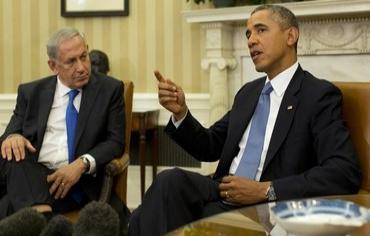
Obama Netanyahu 2013US President Obama and Prime Minister Netanyahu in the Oval Office, September 30, 2013. Photo: REUTERS/Jason Reed

Undeterred by the failed efforts of his predecessors to clinch an Israeli-Palestinian peace treaty, US President Barack Obama is planning on getting more involved directly in the negotiations.

According to The New York Times, the president is expected to appeal to Prime Minister Binyamin Netanyahu and Palestinian Authority President Mahmoud Abbas to adopt a framework plan for final-status peace negotiations.

According to the report published Thursday, administration officials said this week the US president was gearing to take more of an active role in the process when he first meets Netanyahu on Monday, and later in March with Abbas.

During the respective meetings, Obama was reportedly expected to press the leaders of the two sides to agree to the framework document that is being drafted by US Secretary of State John Kerry.

“Now is a very timely opportunity for him to get involved,” a senior US official said on condition of anonymity.

Officials said now was the time for Obama to directly involve himself in talks as the April deadline is nearing for the current round of negotiations and major hurdles apparently remain between the sides.

“The president wouldn’t want to run any risk that it was the lack of his involvement that would make the difference between success and failure,” an official told the Times.

However, Israeli official on Wednesday said Obama was not expected to present Netanyahu with the much-discussed framework document.

The comments come despite some speculation that Obama would unveil the document during his scheduled meeting with Netanyahu in the White House on Monday. The officials said it was unlikely Washington would roll out the paper before Obama also meets with Abbas.

The Palestinians announced earlier this week that Obama had invited Abbas to visit Washington next month, though no final date was reported. Abbas met twice last week in Paris with US Secretary of State John Kerry. Kerry has been working with the sides since November on the document that would serve as the basis for continuing the talks that began in July.

Netanyahu may meet with Kerry in Washington as well. Both men are to address the annual policy conference of the America Israel Public Affairs Committee in Washington next week.

Sources: UN nuclear agency opted against sensitive Iran report

February 27, 2014

Sources: UN nuclear agency opted against sensitive Iran report, Jerusalem Post, February 27, 2014

(What difference does it make now? New information (said by Iran to be baseless) about Iran’s “alleged detonator development, computer modelling to calculate nuclear explosive yields, and preparatory experimentation that could be useful for any atomic test” must not matter because Iran has accommodated us by not using nukes yet and is “open for business.” Can’t we all be as cooperative as Iran?– DM)
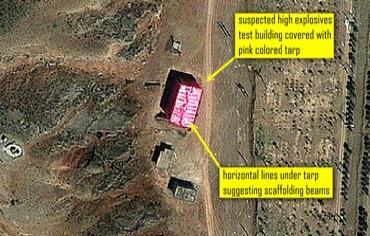
Parchin sat imageSatellite image of Parchin Photo: GeoEye-ISIS

Report – to have been prepared last year – would almost certainly have angered Iran and complicated efforts to reach nuclear deal.

VIENNA/UNITED NATIONS – The UN nuclear watchdog planned a major report on Iran that might have revealed more of its suspected atomic bomb research, but held off asTehran’s relations with the outside world thawed, sources familiar with the matter said.

Such a report – to have been prepared last year – would almost certainly have angered Iran and complicated efforts to settle a decade-old dispute over its atomic aspirations, moves which accelerated after pragmatic President Hassan Rouhanitook office in August.

According to the sources, the International Atomic Energy Agency (IAEA) has apparently dropped the idea of a new report, at least for the time being.

There was no immediate comment from the IAEA. The sources said there was no way of knowing what information collected by the agency since it issued a landmark report on Iran in 2011 might have been incorporated in the new document, although one said it could have added to worries about Tehran’s activities.

As relations rapidly improved, Iran struck an interim nuclear deal with six world powers in November which Israel denounced as an “historic mistake” as it did not require Tehran to dismantle its uranium enrichment sites.

One source said probably only Israel, which is believed to be the Middle East’s sole nuclear-armed state, would criticize the IAEA for not issuing a new report in the present circumstances. Iran and the world powers hope to reach a final settlement by July, when the interim accord expires, although they acknowledge this will be an uphill task.

A decision not to go ahead with the new document may raise questions about information that the United Nations agency has gathered in the last two years on what it calls the “possible military dimensions” (PMD) to Iran’s nuclear program. Tehran says the program is peaceful and denies Western allegations that it is seeking to develop the capability to make bombs.

The sources, who declined to be identified due to the sensitivity of the issue, suggested the more recent material concerned extra detail about alleged research and experiments that were covered in the November 2011 report. A new report would probably have included “updated information on PMD” which could have “reinforced the concern” about Iran, one said.

The IAEA’s dossier in November 2011 contained a trove of intelligence indicating past activity in Iran which could be used for developing nuclear weapons, some of which it said might still be continuing. Iran rejected the allegations.

It helped Western powers to step up the sanctions pressure on Iran, including a European Union oil embargo imposed in 2012, showing the potential significance of a decision on whether to publish the IAEA’s findings.

Since then the agency has said it obtained more information that backs up its analysis in the 2011 document, which detailed allegations ranging from explosives testing to research on what experts describe as an atomic bomb trigger.

Other issues it wants Iran to address are alleged detonator development, computer modelling to calculate nuclear explosive yields, and preparatory experimentation that could be useful for any atomic test.

It says the “overall credible” information in the 2011 dossier – contained in an annex to a wider quarterly report – came from member states, believed to include Western powers and Israel, as well as its own efforts.

One source said it was believed that the Vienna-based IAEA had received more information on suspicions of nuclear yield calculations, but it was not known to what extent this would have made it into a new report on Iran.

IRAN SAYS CLAIMS BASELESS

“The agency has obtained more information since November 2011 that has further corroborated the analysis contained in that annex,” it said on Feb. 20 in a regular quarterly report on Iran’s nuclear program.

It has been investigating accusations for several years that Iran may have coordinated efforts to process uranium, test explosives and revamp a missile cone in a way suitable for a nuclear warhead. Iran says such claims are baseless and forged.

The sources said that last year’s planned report would probably have amounted to a wider review of the Iranian nuclear file, including PMD and other outstanding issues.

They said the idea was raised internally when the IAEA’s long-running efforts to get Iran to cooperate with its investigation appeared completely deadlock in mid-2013.

But with a new leadership in Tehran trying to end its international isolation, Iran and the IAEA agreed last November a step-by-step transparency pact to help allay concerns about the atomic activities. This was sealed shortly before the breakthrough deal between Tehran and the six powers – the United States, Russia, France, Germany, Britainand China.

In follow-up talks on Feb 8-9, Iran agreed for the first time to address one of many PMD issues in the 2011 report, regarding so-called exploding bridge wire detonators, which can have both civilian and military applications.

“While other experiments with possible military dimensions must be addressed and soon, progress on the bridge wire detonators issue would be an important first step toward resolving these issues,” said the Arms Control Association, a US research and advocacy group, in a Feb. 26 analysis.

But it remains uncertain when and how the IAEA will be able to look into more sensitive areas, including long-sought access to the Parchin military base southeast of Tehran, where it suspects explosives tests that could be used for nuclear bomb development took place a decade ago, a charge Tehran denies.

The IAEA inquiry is separate from, but still closely linked to, the wider diplomacy to end the years of standoff over the nuclear program that has raised fears of a Middle East war.

THE IAEA’S “JOB”

The interim agreement focused mainly on preventing Tehran obtaining nuclear fissile material to assemble a future bomb, rather than on whether Iran sought atom weapons technology in the past, which the IAEA is investigating.

The 2011 report portrayed a concerted weapons program that was halted in 2003 – when Iran came under increased Western pressure – but it also indicated that some activities may later have resumed.

Western diplomats and nuclear experts say the IAEA needs to complete its inquiry to establish what happened and to be able to provide assurances that any “weaponization” work – expertise to turn fissile material into a functioning bomb – has ceased.

They say clarifying this is also important in being able to quantify the time Iran would need to dash for a nuclear weapon, if it ever decided to do so.

But it is unclear to what extent it will form part of any final settlement between Iran and the powers – which unlike the IAEA can lift crippling sanctions on the major oil producer and therefore have more leverage in dealing with Tehran.

“Some analysts have argued incorrectly that issues like Parchin and alleged military dimensions do not matter. According to their reasoning, these issues are in the past and should be overlooked,” the Institute for Science and International Security, a US think-tank, said this week.

However, Peter Jenkins, a former British ambassador to the IAEA, said Iran now appeared to be in full compliance with its obligations under the nuclear Non-Proliferation Treaty, and had “started to resolve residual … questions about past nuclear-related activities and to shed light on future intentions”.

A senior U.S. official said that clearing up the issue of possible military dimensions to Iran’s nuclear program was “in the first instance” the IAEA’s task.

“The more that Iran can do to meet their obligations with the IAEA, the better for the nuclear negotiating process around a comprehensive agreement,” the US official said on Feb. 17. But, “We don’t want to do the job that belongs to the IAEA.”

Off Topic: Pro-Moscow coup in Crimea. Russian fighter jets on W. border on combat alert. Kiev deploys security forces

February 27, 2014

Pro-Moscow coup in Crimea. Russian fighter jets on W. border on combat alert. Kiev deploys security forces.

DEBKAfile Special Report February 27, 2014, 10:41 AM (IST)
Russian fighter jets on combat alert

Russian fighter jets on combat alert

The Russian defense ministry announced Thursday, Feb. 27 that fighter jets stood on combat alert along its western borders with Ukraine. Moscow repeated its commitment to protect Russian-speaking elements in the Crimean Peninsula. Earlier, armed men carried out a pro-Russian coup in the Crimean capital, by seizing government and parliamentary buildings and hoisting Russian flags – in response to the pro-European coup in Kiev. Forces loyal to the provisional government in Kiev meanwhile surround the area which they say was occupied by “criminals in army fatigues.”

The pro-Russian coup came on the heels of a day of violent clashes between pro-Russian and pro-European protesters in the Crimean capital, prompting a Russian military alert. debkafile: Witnesses in Crimea Wednesday night saw Russian military equipment moving into the peninsula. We reported earlier that Vladimir Putin would never relinquish Russian control of the Crimean peninsula and its military bases there – or more particularly the big Black Sea naval base at Sevastopol.

Read debkafile’s report of Wednesday, Feb. 26.

There is no way that President Vladimir Putin will relinquish Russian control of the Crimean peninsula and its military bases there – or more particularly the big Black Sea naval base at Sevastopol. This military stronghold is the key to Russia’s Middle East policy. If it is imperiled, so too are Russia’s military posture in Syria and its strategic understandings with Iran.

This peril raised its head Wednesday, Feb. 26, when pro-Russian and pro-European protesters clashed violently in the Crimean town of Simferopol, the Peninsula’s financial and highway hub.

Most of the protesters against Moscow were members of the minority Tatar community, who had gathered from around the region to demand that Crimea accept Kiev rule.

The majority population is Russian speaking and fought the Tatar demonstrators. However,  rival historic claims to this strategic peninsula were in full flight, sparking red lights in Moscow to danger.

The Tatars ruled Crimea in the 18th century. If they manage to expel Russian influence from Simferopol and then the rest of the region, it would be the signal for dozens of the small peoples who make up the Russian Federation to go into separatist mode and raise the flags of mutiny. The Kremlin is therefore bound to nip the Tatar outbreak in the bud to save Russia.

And so, Putin ordered Defense Minister Sergei Shoigu to stage an urgent four-day drill to test the combat readiness of Russian military forces in central and western Russia, starting with a high alert for the military and the deployment of some units to shooting ranges.
The exercise will involve Russia’s Baltic and Northern Fleets and its air force.

In a televised statement after a meeting of top military officials in Moscow, defense minister Gen. Shoigu said the forces “must be ready to bomb unfamiliar testing grounds” and be “ready for action in crisis situations that threaten the nation’s military security.”

A senior Russian lawmaker on Tuesday told pro-Russia activists in Ukraine’s Crimean Peninsula that Moscow will protect them if their lives are in danger.

The Russian president’s military move Wednesday signaled his readiness to send his army into Ukraine and divide the country, if Moscow’s national interests and the Russian-speaking population of Ukraine are at stake. Having broadcast that message, Putin will now wait to see if it picked up by Washington and Brussels for action to restrain the new authorities in Kiev.

But it is no longer certain how much control Western powers have over the former protesters of Kiev, who appear to have taken the bit between their teeth.

Off Topic: The eyes of Vladimir Putin

February 27, 2014

Israel Hayom | The eyes of Vladimir Putin.

Clifford D. May

Russian President Vladimir Putin is not happy. The government he backed in Ukraine has collapsed. The Ukrainian leader he favored, Viktor Yanukovych, is on the run, accused of the “mass murder” of protestors.

I am not so bold as to predict what Putin will do next. But that he will take action — perhaps very bold action — should be the working assumption of American policy planners.

On one level, Putin is a simple man: He likes to hunt, fish and ride horses bareback (and I’m talking about his back, not the horses’). Those who cross him end up in cages in Siberia — or worse. Employing Machiavellian principles, he has become, over the past 15 years, a neo-czar.

He also has demonstrated a remarkable ability to befuddle American leaders. In 2001, President George W. Bush looked into Putin’s eyes and came away with “a sense of his soul” — suggesting it resembled Thomas Jefferson rather than Ivan the Terrible.

Nevertheless, U.S. President Barack Obama and Secretary of State Hillary Clinton convinced themselves that it was Bush’s cowboy swagger — not conflicting geopolitical interests — that were the root cause of Russo-American tensions. Their solution: “Reset” relations with the Kremlin. That this was a misguided policy became evident when Clinton, with elaborate fanfare, presented Russian Foreign Minister Sergey Lavrov with a button inscribed with the Russian word peregruzka. She believed it meant “reset.” In fact, it means “overcharge.” (Reset is perezagruzka. True, that’s only a two-letter mistake. But just one letter separates Obama from Osama.)

Two things to keep in mind about Putin: (1) Just as a U.S. Marine is always a U.S. Marine, so a KGB colonel is always a KGB colonel. (2) He believes — and in 2005 stated clearly — that the “demise of the Soviet Union was the greatest geopolitical catastrophe” of the 20th century.

That does not imply that he is a communist. Ideologies — indeed, ideas — are of little apparent interest to him. What he does care about is power — for himself, yes, but also for the Russian nation and people. Under both czars and commissars, Russia commanded an empire. If Putin does not restore Russian hegemony over a vast swath of Eurasia it won’t be for lack of effort.

No territory is more central to this mission than Ukraine, which Putin sees as a Russian territory. Not entirely without reason: Rus’, the first eastern Slavic state, was founded around what is now the Ukrainian capital of Kiev in the 9th century. “Ukraine” derives from a Slavic root meaning “borderland.” You’ve been reading news stories about “Russian-speaking eastern Ukraine” and “Ukrainian-speakers in the west,” but the two Slavic tongues are actually more mutually intelligible than, say, the versions of Arabic spoken in Morocco and Egypt.

Don’t misunderstand me: Historic, ethnic and linguistic ties are no reason to deny a people self-determination. A few years back, Czechoslovakians decided they’d rather be Czechs and Slovaks. There are no longer Yugoslavs — just Serbians, Croatians, Bosnians, etc.

If Ukrainians (most of them in the western part of the country) want to distance themselves from Russia, to become more like their freer, richer, less corrupt (though increasingly effete) neighbors in the European Union, should they not have that right?

On the other hand, if some Ukrainians (mostly in the east and on the Crimean Peninsula, home of Russia’s Black Sea Fleet) prefer to remain joined at the hip with Putin’s autocratic and unproductive Russia, are they not entitled to make a bad decision?

Most of the media have characterized the Ukrainian crisis as has The Wall Street Journal: “a nationwide movement for wholesale democratic change.” I suspect it’s more about Ukraine’s crumbling economy and conflicted identity than democracy, though the available data leave room for uncertainty.

Perhaps the turmoil is best understood as a belated aftershock of the Cold War. In 1989, the Berlin Wall fell (actually it was dismantled by hand; I have a chunk here in my office) and two years later the Soviet Union crumbled.

The Baltic States — Estonia, Latvia and Lithuania — had remained essentially Western despite years of Soviet and Russian occupation. They quickly became parliamentary democracies and members of the European Union. Muslim-majority (and not Islamist) Azerbaijan has benefited from petroleum resources and political stability. But other former Soviet republics have been sinking into authoritarianism, poverty or chaos.

Twenty years ago, Ukraine’s major foreign policy objective was integration with the EU. Among the reasons little progress was made: Ukrainians failed to meet the EU’s economic and other standards, the EU was nervous about expanding into the heart of what had been Soviet space, and the U.S., under both Democratic and Republican administrations, has been reluctant to get deeply involved. (Recall George H. W. Bush’s “chicken Kiev” speech of 1991.)

Last fall, just as Ukraine was about to sign an “association agreement” with the EU, Putin offered Yanukovych’s government a $15 billion bailout — if he’d put his pen back in his pocket. That was the spark that ignited the recent explosions.

I’d wager that Putin is willing to spend a lot more to keep Ukraine within Russia’s orbit. He may be willing to commit troops as well — as he did in Chechnya and Georgia.

Ukraine could descend into civil war. Or Ukrainians could choose, in a referendum, whether to integrate into Europe, reinforce their ties with Russia, split into separate eastern and western states, or attempt to sort out their differences in some other way.

But expect Putin to set “red lines” and do whatever is necessary to enforce them. He won’t ask permission of Obama, the EU, or the U.N. You shouldn’t need to look into his eyes to see that.

Clifford D. May is president of the Foundation for Defense of Democracies, a policy institute focusing on national security, and a foreign affairs columnist for The Washington Times.

Kerry: US must pursue Iran nuke talks before considering war

February 27, 2014

Kerry: US must pursue Iran nuke talks before considering war | JPost | Israel News.

By REUTERS

02/27/2014 00:53

Washington has to “exhaust all remedies” before contemplating military action to force Tehran to cease nuclear activities, Kerry says.

John Kerry in Davos, January 24, 2014

John Kerry in Davos, January 24, 2014 Photo: REUTERS

WASHINGTON – The United States has an obligation to pursue nuclear negotiations with Iran before it considers going to war with Tehran to force it to give up its nuclear activities, US Secretary of State John Kerry said on Wednesday.

“We took the initiative and led the effort to try to figure out if before we go to war there actually might be a peaceful solution,” Kerry told a group of reporters.

Iran reached a landmark preliminary agreement with six world powers, including the United States, in November to halt its most sensitive nuclear operations, winning some relief from economic sanctions in return.

US President Barack Obama, like his predecessors, has said that all options are on the table with regard to Iran’s nuclear program, using diplomatic code for the possibility of military action. While US officials have long held out that threat, Kerry’s comments appeared to indicate that the Obama administration would seriously consider a strike on Iran if the diplomatic talks fail.

“I happen to believe as a matter of leadership, and I learnt this pretty hard from Vietnam, before you send young people to war you ought to find out if there is a better alternative,” said Kerry, who served in the Vietnam War as a young US naval officer.

“That is an obligation we have as leaders to exhaust all the remedies available to you before you ask people to give up their lives and that is what we are doing” with Iran, he added.

The Obama administration is under pressure from Republican lawmakers threatening to revive a bill that would impose new sanctions on Iran, a move the White House is warning could interfere with delicate nuclear talks to find a lasting agreement. Iran denies allegations by the United States and some of its allies that it is seeking to develop the capacity to build nuclear weapons.

Pressure from lawmakers may increase with signs that easing of sanctions pressure on Tehran has boosted oil export.

Sources who track tanker movements told Reuters Iran’s oil exports rose further in February for a fourth consecutive month. In addition extra cargoes had headed to

Off Topic: Inside the Ring: All eyes on Moscow’s military moves in Ukraine

February 27, 2014

Inside the Ring: All eyes on Moscow’s military moves in Ukraine – Washington Times.

U.S. intelligence agencies are stepping up their spying on Russia’s military amid concerns that Moscow is preparing to use force against Ukraine in the wake of the pro-democracy revolution in Kiev.

Earlier this week, intelligence agencies reported that two Ural-4320 trucks full of armed Russian troops were observed arriving in the Black Sea port of Yalta. Photographs made by a Ukrainian civilian were posted online as the troop transports entered a Russian military facility in Yalta, on the Crimean peninsula in Ukraine.

Other activities in recent days have included the movement of armored personnel carriers observed at Russia’s Black Sea Fleet headquarters in nearby Sevastopol.

U.S. officials said the purpose of the troops is not known, but speculation centers on the possibility of the troops being used as part of an advance force for a future Russian military operation.

U.S. intelligence agencies also are tracking possible covert infiltration of Russian Spetsnaz commandos. One concern is that Moscow will provoke a conflict by using the undercover commandos to attack ethnic Russians and then launch an invasion under the guise of protecting those Russians.

A part of debris from a rocket North Korea launched on Dec. 12, 2012 is pulled up by South Korean navy in the Yellow Sea, South Korea. U.S. officials confirmed that the long-range rocket program benefited from parts made in China, Europe and America. (South Korea Defense Ministry via Associated Press)

Enlarge Photo

A part of debris from a rocket North Korea launched on Dec. … more >

Some 8 million Russians reside in Ukraine, making up about 17 percent of the population.

Tensions remain high between Moscow and Kiev over the recent ouster of Ukraine’s pro-Russia president, Viktor Yanukovych, who now is being sought on murder charges.

In a sign of Moscow’s concern over losing what it regards as a strategic neighbor, President Vladimir Putin ordered Russian forces on a higher state of alert Tuesday. The mobilization includes forces some 200 miles from Russia’s southern border with Ukraine.

The mobilization could indicate a future military operation, although Moscow’s Defense Ministry said the troop movements are not related to the unrest in Ukraine.

The Obama administration has issued indirect warnings to Russia not to intervene militarily, the latest signal made by Deputy Secretary of State William Burns during a visit Tuesday to Kiev.

“We strongly support Ukraine’s territorial integrity and its unity,” Mr. Burns told reporters at the U.S. Embassy in Kiev.

Asked about the Russian military activities in the Crimea, and how far the United States is prepared to go to prevent military intervention, Mr. Burns said: “All that I would stress is what I said before, and that is that the United States strongly supports the unity and the territorial integrity of Ukraine.”

Mr. Burns said speculation over splitting Ukraine into pro-Russian and pro-European regions “is not in Ukraine’s interest.”

“And the United States will continue to reinforce that very firm position,” he said.