Archive for February 23, 2014

Off Topic: Time to get tough on Turkey’s Erdogan, US foreign policy experts tell Obama

February 23, 2014

Time to get tough on Turkey’s Erdogan, US foreign policy experts tell Obama, Jerusalem Post, February 23, 2014

Bipartisan group of wonks, lawmakers urge US president to publicly chide Turkish PM for “undermining democracy.”

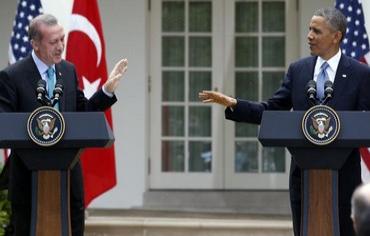
Obama, Turkish PMUS President Barack Obama and Turkish PM Recep Tayyip Erdogan in Washington. Photo: REUTERS

A group of over 80 bipartisan lawmakers and foreign policy wonks are appealing to US President Barack Obama to take a more forceful, public stand against Turkish Prime Minister Recep Tayyip Erdogan’s efforts to “diminish the rule of law” and “undermine democracy.”

The letter, whose existence was first reported on by The Daily Beast online news site, comes during tense times in Turkey, with Erdogan conducting a shake-up of the law enforcement and judicial establishments in order to shore up his hold on power.

Erdogan has purged thousands of police and sought tighter control of the courts since a corruption inquiry burst into the open in December, a scandal he has cast as an attempted “judicial coup” meant to undermine him ahead of elections.

“Prime Minister Recep Tayyip Erdoğan is increasingly undermining a central pillar of the decades-long, strategic US-Turkish partnership:  Turkey’s growing democracy,” the letter, which was initiated jointly by the right-leaning Foreign Policy Initiative, the left-leaning Center for American Progress, theBipartisan Policy Center, and Freedom House, reads.

“We are writing because of our deep dismay at this development and to urge you to make clear to the Turkish public America’s concern about Turkey’s current path. Silence will only encourage Prime Minister Erdoğan to diminish the rule of law in the country even further.”

Among the signatories to the letter are former Obama administration officials Dennis Ross, who served as an envoy to the Middle East peace process; and Julianne Smith, a former advisor to Vice President Joe Biden. John Bolton, the former ambassador to the UN during the George W. Bush administration; Republican Sen. Norm Coleman; Republican Gov. Tim Pawlenty; and Weekly Standard editor Bill Kristolwere among the Republicans who endorsed the letter.

Obama and Erdogan spoke via telephone last week. According to the State Department, the two leaders discussed a range of bilateral and regional issues.

Obama and Erdogan spoke about the importance of quickly concluding the normalization agreement between Turkey and Israel.

The two leaders also addressed their shared interest in continuing efforts to advance a political solution to the Syria conflict.

During a news conference held earlier this month, Erdogan, reiterated his government’s position that any reconciliation between Ankara and Jerusalem would be contingent upon an Israeli commitment to remove the siege on the Hamas-ruled Gaza Strip.

Gantz: Iran ‘handing out torches to pyromaniacs’

February 23, 2014

Gantz: Iran ‘handing out torches to pyromaniacs,’ Times of Israel, February 23, 2014

IDF chief of staff says Islamic Republic is directly involved in fostering instability across all of Israel’s borders.

Gantz in Golan Heights

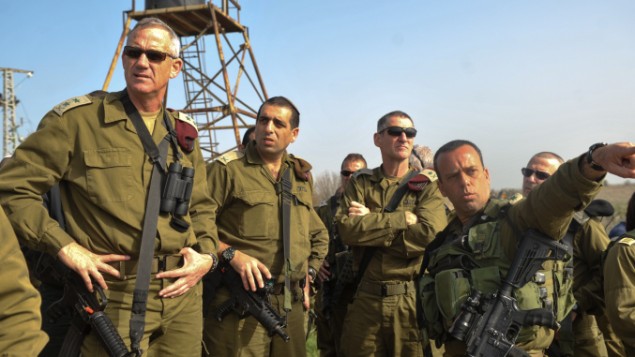
IDF Chief of Staff Benny Gantz (L) seen during a tour in the Golan Heights, February 23, 2014 (photo credit: IDF Spokesperson/Flash90)

Iran and its surrogates are ceaselessly attempting to destabilize and compromise Israel’s borders, with the Islamic Republic directly involved in each and every one of the regional conflicts in countries surrounding the Jewish state, IDF Chief of Staff Benny Gantz said Sunday.

During a visit to the Golan Heights, Gantz stated that Israel’s army was tirelessly working to ensure that its borders remain safe, but added that regional unrest was providing fertile ground for a highly explosive situation.

Iran “is handing out torches to pyromaniacs,” the IDF chief of staff said. “[It is providing its surrogates with] ammunition, rockets, and is heavily involving itself in the fighting.”

Gantz added that the relative quiet along Israel’s borders was misleading, and that hostile forces were constantly attempting to find and take advantage of Israeli security vulnerabilities.

“Each and every one of our fronts is in a tense state right now,” he said. “Quiet, I would say, yet tense, everyday.”

Also Sunday, US Undersecretary of State Wendy Sherman and Intelligence Minister Yuval Steinitz held a nearly five-hour meeting in Jerusalem to discuss the technological, political and intelligence aspects of the Iranian nuclear program, as well as the interim agreement signed between the Islamic Republic and the P5+1 world powers in Geneva last November and the ongoing talks on a permanent accord.

During the Meeting, Steinitz reiterated Israel’s stance that any final agreement with Iran must ensure that the Tehran dismantles its capacity to develop nuclear weapons.

Undersecretary of State Wendy Sherman speaks to the press in Jerusalem on February 22, 2014. (screen capture: YouTube)

On Saturday, Sherman stated that the US is committed to reaching a final deal with Iran by July. Sherman added that the US would never allow Tehran to produce nuclear arms.

The undersecretary said the US had begun “tough negotiations” that will continue through July, by which time she hopes the sides will reach a comprehensive agreement.

The P5+1 and Iran are set to reconvene in Vienna on March 17, having met in the Austrian capital last week.

The talks are designed to build on a first-step deal reached in November that commits Iran to initial nuclear curbs in return for some easing The deal can be extended by mutual consent after six months.

Sanctioning Iranians’ health

February 23, 2014

Sanctioning Iranians’ health, Al Jazeera English, Sammy Almashat, MD, MPH, Maziar Shirazi, MD, February 23, 2014

(Her jihadists suffer from shortages of weapons for peace, horrid illness go untreated and multiple privations are forced daily — even upon Iran’s impoverished children — by external forces of greed, envy, fear and hatred. Yet she broadcasts frequent video simulations of her own scarce radioactive isotopes and other medical supplies being air-dropped even to her enemies. Her love of and compassion for all of humanity are unquenchable.  — DM)

The recent interim deal will do little to alleviate these underlying causes of the country’s humanitarian crisis. For all the bipartisan hysteria on Capitol Hill about the easing of the sanctions, the “vast bulk” of the sanctions regime against Iran still remains in place, with the total relief over the six months of the interim deal pegged at $7 bn, or just 1 percent of Iran’s GDP.
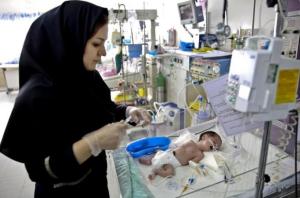
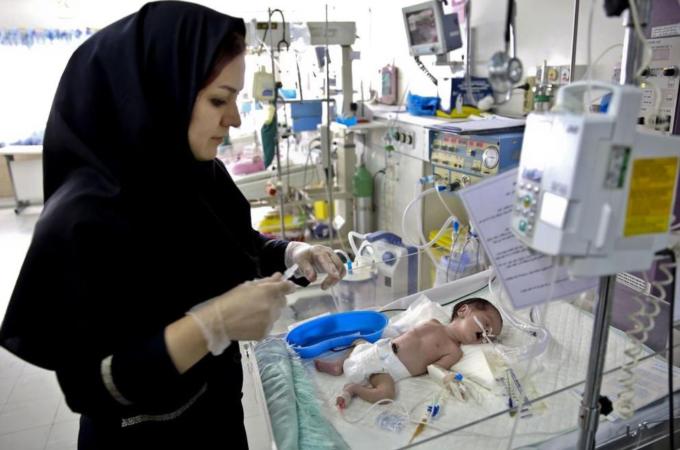
Iranian healthSanctions have affected severely the health care system in Iran [AP]

The recent interim deal reached between the P5+1 powers and Iran over the country’s nuclear energy programme has become the latest political football for President Barack Obama and Congressional leaders, many of whom seem aghast at even the minimal relief in economic sanctions it promises. The suffering of the Iranian people, far from being a point of concern, has been upheld by Senators John McCain and Chuck Schumer as evidence of the sanctions’ success in “bringing Iran to the negotiating table”.

The cumulative effect of the policy is often proudly referred to, among politicians of all stripes, as “crippling”. Though one wouldn’t know it from the sterile coverage of the sanctions by US news outlets, nowhere can the crippling effect be more clearly observed than in the daily lives of average Iranians.

The cumulative effect of the policy is often proudly referred to, among politicians of all stripes, as “crippling”. Though one wouldn’t know it from the sterile coverage of the sanctions by US news outlets, nowhere can the crippling effect be more clearly observed than in the daily lives of average Iranians.

Iran’s economy has been plunged into a recession, with GDP contracting by 5.4 percent over the past year. Rising unemployment coupled with an inflation rate of 40 percent (the real figure is reportedly double this) has eaten away at the country’s middle class, with 40 percent of Iranian families now living under the poverty line. In a recent Gallup poll, 85 percent of Iranians reported that their livelihoods have been hurt “a great deal” or “somewhat” by the sanctions.

As is usually the case in economic crises, the healthcare sector has been especially hard-hit.

‘The price is worth it’

Before the sanctions reached their full impact over the past two years, the Iranian healthcare system was long considered one of the most advanced in the Middle East, with health standards among the highest in the developing world. Beginning in the 1980s, the country implemented a nationwide primary care network, based around community health workers that brought health care to 23 million rural dwellers, many of whom had never before seen a doctor, while reducing rural infant mortality by 75 percent.

In recent decades, Iran also realised “the largest and fastest drop in fertility ever recorded” through, among other measures, the dissemination of free contraception to the population. Many of these birth control pills were manufactured by the country’s domestic pharmaceutical industry, which was nurtured over a period of decades and had made the country self-sufficient for 90-97 percent of its medicinal needs.

Following the tightening of the US-led sanctions over the past two years, that industry, like many others, has faced severe shortages of the raw materials necessary for manufacture. Imports of newer, more advanced medicines from US and European drug manufacturers decreased 30 percent in 2012. Shortages of modern anesthetics are forcing surgeons to turn to outmoded, riskier drugs while operating, while hemophilia medicines were at one point reduced to a third of their previous availability.

The Obama administration has long claimed that the sanctions are not intended to hurt the civilian population, citing provisions that exempt humanitarian items, such as medical supplies and agricultural goods, as evidence of a “smart sanctions” policy as opposed to one of collective punishment. In July 2013, it expanded a list of exempted medical products that companies can export without prior approval under a standing authorisation.

In reality, these pronouncements amount to little more than public relations gestures that function to cloak the sanctions with a veneer of humanitarian concern while they inflict enormous damage on the lives of ordinary Iranians. Illustrating the toothless nature of the exemptions, the administration’s list of permitted medical supplies is largely restricted to rudimentary medical devices, such as tongue depressors and medical shoe covers that Iran could easily make itself.

Based on interviews with US Treasury officials, the International Crisis Group observed that the notable absence of any pharmaceuticals on the list is due to concerns that these so-called “dual-use” products could theoretically be converted to military use.

This disturbingly echoes the rationale invoked during the era of UN sanctions against Iraq less than two decades ago, in which Washington and London’s routine blocking of what they similarly dubbed dual-use items, such as childhood vaccines and water treatment equipment under the Oil for Food programme, led to the deaths of up to 500,000 children under 5 by 2003. Then-Secretary of State Madeleine Albright’s infamous proclamation that these deaths were a “price…worth” paying for US goals has been reprised in Rep Brad Sherman’s (D-CA) open (albeit refreshingly honest) callto “hurt the Iranian people”.

More fundamentally, the alleged humanitarian exemptions have been rendered meaningless by a sanctions regime that has functioned – as intended – as a blunt instrument against Iranian economic activity.

As highlighted in a report released last year by the Wilson Center, the blacklisting of Iran’s Central Bank and “draconian” penalties for sanctions violations have made private banks exceedingly reluctant to finance any imports, medical or otherwise. A lack of hard currency has made Iran increasingly dependent on a barter system to obtain potentially poorer quality drugs from China and India, while for the newest medicines still under patent, there is no alternative source. Prohibitions on shipping have further choked off vital trade routes.

In an implicit acknowledgement that the sanctions regime has hindered the import of humanitarian supplies, the P5+1 pledged, as part of the recent nuclear deal, to “facilitate” the import of exempted humanitarian items, such as medicines and medical devices through the creation of a separate financial channel to handle these transactions.

Sanctioning helath [sic] care

However, the Obama administration has as yet provided no specifics on how it would implement this provision and address the root causes within the financial and shipping systems inhibiting the import of humanitarian items. Indeed, since the deal, the administration has stepped up its crackdown on alleged sanctions violators, further intimidating would-be business partners from engaging in permitted trade with Iran.

Leading authorities within industries impacted by the sanctions are, to say the least, sceptical of this new pledge, labeling the Obama administration’s past handling of humanitarian trade a “disaster”.

Ultimately, talk of humanitarian exemptions misses the broader point about the underlying logic of Western sanctions policies against the developing world over the past half-century. As in other cases (eg Iraq, Cuba, Gaza), the inconvenient truth of President Obama’s sanctions policy is that its effectiveness is measured directly by the level of economic suffering inflicted on the civilian population – suffering that invariably extends to the health sector his administration purportedly spares.

To take just one obvious example, rising unemployment inevitably reduces access to healthcare in a country largely reliant on employer-based health insurance, with newly uninsured Iranians among those forced into a now-thriving black market to obtain medicines and other basic care.

The recent interim deal will do little to alleviate these underlying causes of the country’s humanitarian crisis. For all the bipartisan hysteria on Capitol Hill about the easing of the sanctions, the “vast bulk” of the sanctions regime against Iran still remains in place, with the total relief over the six months of the interim deal pegged at $7 bn, or just 1 percent of Iran’s GDP.

In the coming months, the Obama administration and European authorities must be held accountable for implementing their promise to ease trade in humanitarian items, especially by US media that has thus far rendered the Iranian people all but invisible in its reporting on the sanctions.

However, absent a rollback of the sanctions’ most draconian provisions, promises of humanitarian relief within a policy of collective punishment designed solely to cripple their nation’s economy are, for average Iranians, empty and self-serving gestures.


Satire: Malice through the looking glass: What if Israel behaved like other Mid-East nations

February 23, 2014

Malice through the looking glass: What if Israel behaved like other Mid-East nations, CiF Watch, Joe Geary, February 23, 2014

We are hearing reports of several dead and dozens injured as five Christian churches have been attacked and set on fire by a Jewish mob in central Jerusalem after allegations that an Israeli Christian claimed to be the Prophet Moses.

NEWS: Middle East

Good evening.

In the usual weekly display of anti-Iranian feeling, thousands of Israelis poured into the streets of Tel Aviv after Saturday prayers, chanting “Death to Iran, Death to Islam” and burning effigies of President Rouhani and John Kerry.

We are hearing reports of several dead and dozens injured as five Christian churches have been attacked and set on fire by a Jewish mob in central Jerusalem after allegations that an Israeli Christian claimed to be the Prophet Moses. The man was arrested before he could be lynched. Doctors say he suffers from severe mental problems but could still face stoning if found guilty under Israel’s strict blasphemy laws.

Scenes of jubilation, music mingling with gunshots,  were witnessed all over the Israeli town of Ashdod as Mr Avi Sand returned there after serving four years in prison for murdering an entire Arab family, including two young children and a three-month old baby. The town’s Mayor declared a Day of Celebration for his return. Flowers and sweets were distributed among the children in his honour. His poster could be seen on walls alongside other celebrated Israeli militants who had killed Arab civilians in recent years.

The Israeli Prime Minister has reiterated yet again his firm line on the fate of Muslims in the future state of Israel, following any successfully negotiated two-State peace talks. “Muslims have no right to live on this side of the border” he told the collected journalists. “We will not tolerate a single Arab on the Holy soil of Israel. Israel must be Muslim-frei.”

An Education Ministry inspection of a number of Jewish schools has revealed that Jewish children as young as five are routinely being taught not only that the whole of Palestine belongs to the Jews, but also that the Arabs who live there are descended from pigs and apes. A spokesman for the Ministry told the press: “They are only innocent animal stories for children, a bit like Aesop’s Fables”.

A group of Arab NGOs, the Red Crescent and UNWRA issued a joint statement today condemning the continued firing of rockets from Gaza into Israeli civilian centres, which they described as “war crimes”. “We deplore not only the loss of life but the terrible psychological trauma inflicted in particular on the children by these constant acts of barbarity”, a spokesman told us.  Along with a number of sympathetic Western NGOs such as War on Want and Save the Children, they are documenting crimes against civilians which will help bring a case against Hamas at The Hague of preaching genocide.

In other news, the UN is expected later today to pass a motion condemning fifteen Arab states for human rights abuses including the enslavement of foreign workers, religious and gender apartheid and the widespread, indiscriminate use of torture and the death penalty.  The Head of the Arab League was heard earlier to remark: “They have us bang to rights. All this has being going on for far too long. Well, forever, actually. It has to stop.”

And finally, on a lighter note, several witnesses are claiming to have seen what they describe as a pig slowly flapping its wings over the offices of the BBC and the Guardian newspaper in central London.

Well, some people will believe anything, won’t they?

Good night.

China calls Iran nuclear talks positive

February 23, 2014

China calls Iran nuclear talks positive, Tehran Times, February 23, 2014

(They seem positive indeed for China, which on Saturday signed a far-reaching joint cooperation agreement with Iran giving both additional and potentially lucrative markets. China has little if any reason to worry about Iran’s nuke program, but establishing strong commercial and other ties with Iran should assuage any lingering, albeit slight, Chinese concerns. — DM)

China will join all parties, in the spirit of the five principles, to continue to promote the negotiations and play a constructive role in the search of a comprehensive, long-term and appropriate solution of the Iran nuclear standoff

China FM spokeswoman

TEHRAN – China on Friday called Iran’s nuclear talks with the world powers in Vienna positive and constructive, saying it will be a good start for negotiations on a comprehensive agreement, Xinhua reported.

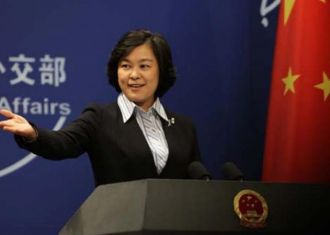
“This round of talks will help maintain the momentum of dialogue. It also laid a good foundation for negotiation on a comprehensive agreement,” said Chinese Foreign Ministry spokeswoman Hua Chunying.

During the three-day talks, Iran and the 5+1 group (the five permanent members of the UN Security Council plus Germany) agreed on a framework and a preliminary timetable for the nuclear negotiations over Tehran’s nuclear program.

Hua told a regular press briefing that all parties showed willingness to allay each other’s concerns, conducted substantive discussions on the specific elements a comprehensive agreement requires, and made a timetable for the next round of talks.

She briefed the press on the five principles China has put forward, including sticking to the process of 5+1 dialogue with Iran, seeking a comprehensive, fair and appropriate long-term solution, following the principle of step-by-step and reciprocal process, creating a favorable atmosphere for negotiations, and pursuing a holistic approach addressing both symptoms and root causes of the issue.

“The five principles aim to help all parties bridge their differences and build a consensus. All sides recognized these principles as positive for promoting the dialogue process,” Hua said.

She added that more complicated and sensitive problems will come out as the talks enter a new phase of comprehensive agreement negotiation.

China will join all parties, in the spirit of the five principles, to continue to promote the negotiations and play a constructive role in the search of a comprehensive, long-term and appropriate solution of the Iran nuclear standoff, the spokeswoman added.

Obama’s foreign policy objectives

February 23, 2014

Israel Hayom | Obama’s foreign policy objectives.

Richard Baehr

In his first year in office, U.S. president Barack Obama was asked about his belief in the concept of “American exceptionalism.” The president’s response was a sharp break from the concept as understood by his predecessor in the Oval Office, George W. Bush, and many Americans. The more generally accepted concept was summarized by writer James Kirchik as the notion “that our history as the world’s oldest democracy, our immigrant founding and our devotion to liberty endow the United States with a unique, providential role in world affairs.”

The concept, in other words, supports an outlook on America’s role in world affairs that includes our active involvement in these matters, and argues that America has had a positive involvement in world affairs.

Obama’s response as the leader of his country, a country that for decades was the self-proclaimed leader of the free world, was unusual to say the least: “I believe in American exceptionalism, just as I suspect that the Brits believe in British exceptionalism and the Greeks believe in Greek exceptionalism.”

Comparing the United States role in the world to Britain’s, a former great power, now one with one-fifth the population of the United States, or to that of Greece, a country with less than one-thirtieth the population of the United States, and a collapsing economy to boot, suggested that for the new president, neither America nor its history were all that special.

This is, after all, a president who has been seemingly obsessed with “difference” and inequality at home. So it was probably not that surprising that he viewed America’s recent outsized and costly role (both in men and treasure) in military interventions overseas, as something to be scaled back. Greece could not afford to send, and was not sending troops around the world, so why should America? Why should America be the big dog? Was our prominent role in world matters (as compared to the role of other nations) fair?

The president campaigned on a platform that emphasized multilateralism in activities abroad, with a greater emphasis on diplomacy over the use of force. To a large extent, war fatigue was something the president shared with many Americans. The United States has suffered about 7,000 fatalities, and several times that number of injured in the conflicts in Afghanistan and Iraq. The Vietnam war, a very long conflict that also caused a long post-conflict American war fatigue, had eight times the number of Americans killed in combat, and left a similar less-than-satisfactory state of affairs in the country where we had been engaged.

One great difference between the Vietnam War and the more recent conflicts related to the size of the American armed forces, and the greater shared sacrifices that occurred in the earlier conflict. In a nation of 180 million, 3.5 million served in the military during the Vietnam period, and a large number of those who served had been drafted rather than volunteering for duty. Now the United States has an all-volunteer military, with about 1.4 million members in a nation of well over 310 million people. The share of the American population in the armed forces has dropped from 2% to less than 0.5%, a greater than ¾ decline. Many fewer American families are “military families” with a real personal stake in what happens to their sons and daughters overseas, and the division between military families and the rest of America has widened.

Obama’s shift from a presidency concentrating on foreign affairs, including wars abroad, to one that focuses the president and the government on domestic matters, is therefore a popular course, though there are obvious wide splits within the nation on the critical domestic issues that should be the focus of government, and on the appropriate domestic policies to pursue.

The past few years have witnessed many American policy statements on troubling matters abroad, but much less of an active role in resolving them. The Syrian civil war, which has continued for several years and has produced well over a 100,000 deaths, seems to have barely bothered the critics of America’s invasion of Iraq (which of course at the time included then Illinois State Senator and later U.S. Senator Barack Obama) and produced similar large casualty figures in the civil war that followed the overthrow of Saddam Hussein’s regime. While good policy options for ending the conflict in Syria have not been obvious, the Obama White House seemed to have set policy in part not to offend the Iranians (with whom it was negotiating on a nuclear deal), and Russia, both of which had important stakes in preserving the Bashar Assad government. The human rights choir in the United States, which seems to care so deeply about what happens to innocent refugees in the Sudan, seemed not to value as much the lives of murdered Syrian civilians. Maybe if Mia Farrow and Nicholas Kristof had ventured off to Syria, the Left would have cared more.

There might have been a time during the Syrian conflict when a more active American role might have enabled a non-al-Qaida dominated Sunni resistance to have emerged to fight the Assad regime. But that does not appear to be an option today, and the killing continues. In Libya, the United States was happy to “lead from behind” in the overthrow of the Gadhafi regime, supporting a limited military intervention by our allies, in order to respond to identical crimes that have occurred in Syria on a much larger scale. Clearly, even with a policy of avoiding direct U.S. military involvement, consistency has been a hard thing to find with this administration in responding to overseas hot spots or human rights catastrophes.

One area where the administration has been steadier has been in its public pronouncements and more recently in its stepped-up efforts to resolve the Israeli-Palestinian conflict. But there is zero evidence to date that U.S. Secretary of State John Kerry can move the parties to a deal within the designated or any time frame. While the American negotiators always talk of windows of opportunity about to close without a deal this very moment (suggesting the atmospherics are better now than at other times), it is hard to see why that is the case. The Palestinians seem as uninterested in resolving the conflict as they always have been. They have demanded maximalist concessions from Israel (a complete transfer of sovereignty in Jerusalem’s Old City), never relaxed any of their demands (a right of return for between 5 and 8 million descendants of refugees), and never promised to agree to an end of the conflict if a satisfactory agreement could be negotiated to create a Palestinian state.

The Palestinians are rejectionist for several reasons: They never pay a price for saying no to American negotiators or those from other countries, they have no interest in actually having to run a state (given the Hamas/Fatah split and the chaos, corruption and failed governance and economies in both Hamas- and PA-dominated areas), and they have never reconciled to the permanence of a Jewish majority State of Israel. It is always easier to blame Israeli stubbornness about settlements as the reason why talks collapse, and that is likely to be the case again.

The passion with which Kerry has undertaken his peace negotiations is matched only by his zeal for alarming people at home and abroad of the catastrophe that he warns will soon be upon us due to global warming caused by rising carbon dioxide levels in the atmosphere. While in Indonesia this week, a developing country with a gross domestic product less than $3,500 per capita, Kerry argued that global warming should be the No. 1. concern of this nation of over 200 million people. As the evidence of the extent of global warming becomes increasingly scant, the voices warning of its dangers have become more strident.

Many have tried to make some sense and find a common thread in the new internationalism of the Obama administration. If you review the evidence, you get this — fight no more wars abroad, reduce the size and cost of the military, expand the welfare state, fight global warming (renamed as climate change since it goes down easier and can be applied to all changes up or down in the number of storms, or temperatures), pressure Israel for a peace deal with the Palestinians (since solving that problem is so essential and ripe for resolution, and Israeli intransigence explains why a deal has never been reached to date), allow the Iranians to talk their way out of sanctions with promises they don’t really commit to on scaling back their nuclear program, work more closely with international bodies and groups of nations on particular problems, and never unilaterally advance specifically national (American) objectives. This laundry list well describes the foreign policy objectives of the major European nations and the European Union itself over the past decades.

If you want to manage a nation in decline, Barack Obama has chosen a good model.

Netanyahu: Iran still getting everything, giving nothing

February 23, 2014

Netanyahu: Iran still getting everything, giving nothing | JPost | Israel News.

By HERB KEINON

02/23/2014 11:34

As top US negotiator with Iran visits Israel, PM warns at weekly cabinet meeting that granting Iran new uranium enrichment capabilities will help Tehran to “practically realize its plan to become a nuclear threshold state.”

bibi

PM Binyamin Netanyahu at Cabinet meeting. Photo: MARC ISRAEL SELLEM

Even as the US top Iran negotiator is in the country saying Iran could be allowed a small peaceful nuclear program, Prime Minster Binyamin Netanyahu continued to warn Sunday against granting Iran any uranium enrichment capabilities

“Iran will practically realize its plan to become a nuclear threshold state, with enrichment [capability] and the ability to develop intercontinental missiles. This combination of enrichment, weapons, and the ability to launch missiles creates a situation where Iran gets everything and gives nothing,” he said at the opening of the weekly cabinet meeting.

On Saturday night, US Under Secretary of State Wendy Sherman, who participated in the talks between Iran and the world powers in Vienna last week, said in Jerusalem that “I would like there to be zero enrichment. I would like there to be no facilities, I would like there not to be an indigenous program. I would like many things in life. But that does not mean I will get them.”

Sherman is in the country briefing top officials on the talks, and from here will travel to Saudi Arabia, which is as concerned as Israel at the prospect of Iran gaining nuclear capabilities.

Over the last two weeks Netanyahu has once again stepped up the rhetoric against Iran’s nuclear program, saying that the country has not altered any of its aggressive policies.  This is expected to be one the key issues he discusses next Monday when he is scheduled to meet US President Barack Obama in Washington.

US: Iran might be allowed ‘limited’ nuclear program

February 23, 2014

US: Iran might be allowed ‘limited’ nuclear program | JPost | Israel News.

By TOVAH LAZAROFF

02/22/2014 22:58

Iran could possibly have a small nuclear program for “practical needs” as part of a final deal, says US undersecretary of state Wendy Sherman.

Iran could be allowed a small peaceful nuclear program, should an agreement be reached in diplomatic talks, US Under Secretary of State for Political Affairs Wendy Sherman said on Saturday night in Jerusalem.

“At the end of the day, if they [Iran] do want to have a small, discreet, limited program that addresses practical needs, it is envisioned as a possibility in the joint plan of action,” Sherman said.

“It would have to be highly constrained, monitored, and verified on a regular basis,” Sherman said.

She spoke both publicly and privately with Israeli journalists as part of a drive to solicit support for the diplomatic process, which she said is the best way to prevent Iran from acquiring nuclear weapons.

Sherman arrived in Israel on Friday to update officials on the talks held this week in Vienna between Iran and the P5+1 countries (US, Russia, China, the United Kingdom, France, and Germany). The EU was also party to the talks.

Last week, the sides set a framework for negotiations toward a final agreement that is expected to be hammered out by July 20.

Israel has said that Iran will continue to be a nuclear threat as long as it has the ability to enrich uranium, and that a peaceful nuclear power program does not require that ability. It has warned that Iran is using the talks to play for time to develop nuclear weapons.

“I would like there to be zero enrichment,” said Sherman.

“I would like there to be no facilities, I would like there not to be an indigenous program.

I would like many things in life. But that does not mean I will get them.”

The key words when monitoring a potential peaceful nuclear program, she said, would be “verify, verify, verify.”

Sherman noted that in the first month of the process, Iran appeared to have met its commitment, although she noted that it is just the start of a very long road. The talks are progressing, said Sherman, who heads the US team. She urged critics of the process to give the six powers time to allow diplomacy to work. It would be a mistake, she said, for the US Congress to pass legislation for new sanctions at this time, even if the start date for those sanctions were after July 20.

“It would send the wrong signal” and could “create real problems,” she said.

“Our view is that if an action risks the negotiation and risks the diplomacy, then the onus comes on the person who has created that risk,” she said.

“This is a very difficult negotiation and the consequences are enormous. We are asking everyone to be thoughtful about the steps that they take, so that we have the time and space to get to a comprehensive agreement,” Sherman said.

She said she had explained the need for patience when she met with the American Israel Public Affairs Committee, which favors additional sanctions. Sherman said she imagines it will be a topic of debate when AIPAC holds its policy meeting at the start of March in Washington.

“I would urge AIPAC to create this space [for diplomacy],” she said.

In response to a question by The Jerusalem Post, Sherman said, “I understand that sanctions with tremendous leadership by the US Congress helped bring Iran to the table.” However, she said that with the diplomatic process under way, additional sanctions would only place international cooperation for the process at risk.

The US and Israel are joined in the goal of ensuring that Iran does not have nuclear weapons, but do not agree on every tactical approach, she said.

She promised that a comprehensive agreement would address all concerns and that the US would maintain its veto power until it is certain that the nuclear danger had been thwarted.

Sherman said progress had been made in Vienna and that a framework had been reached to guide negotiations for the next five months.

“Unless we are satisfied, there will be no agreement. Nothing is agreed until everything is agreed,” Sherman said.

She heads from here to Saudi Arabia.

Iran-China joint cooperation document signed

February 23, 2014

Iran-China joint cooperation document signed, Trend, February 23, 2014

(Sanctions? Please don’t use that naughty word from the past. — DM)

Iran_China_flags_041212

The Iranian minister underlined that Iran’s government is always interested in developing ties with important and effective countries.

Iran-China joint comprehensive cooperation document was signed by Iran’s Economics and Finance Minister Ali Tayebnia and Chinese Commerce Minister Gao Hucheng here on Saturday, IRNA reported.

In the 15th economic cooperation commission meeting of Iran and China here on Saturday evening, Tayebnia said that according to the agreement, the final document for bilateral economic cooperation in different fields of industry, mine, energy, credit, finance, banking, health, transportation, shipping, agriculture, housing and urban planning, trade, communication and technology, labour and social welfare, urban and rural development and technological and technical cooperation will be arranged and executed.

He proposed that a permanent committee be formed to supervise and coordinate issues concerning execution of agreements and by holding monthly meetings to have a full control on fulfillment of agreements and reporting the result to heads of the both countries commissions.

The Iranian minister underlined that Iran’s government is always interested in developing ties with important and effective countries.

ˈConsidering past good cooperation, I believe there are plenty of grounds for expansion of bilateral cooperation between the two countries,ˈ said the minister.

He called Iran’s stock exchange as one of the most stabilized regional and world markets, adding that the market had played its role in privatization process in the country and with around 160 billion dollars has prepared necessary preparation to attract foreign investment.

Tayebnia, by referring to non-oil trade exchange level between the two countries, said that the exchange level between Iran and China in the past two years was more than 25 billion dollars.

In the meeting, in addition to signing the final document of the joint commission, a Memorandum of Understanding (MoU) on cooperation in the field of e-trade, arbitration and judgment to settle and remove disputes between businessmen, Iran-China industrial park cooperation and increasing economic and trade ties and exchanges were signed, too.

Final nuclear deal with Iran by July, top US negotiator says

February 23, 2014

Final nuclear deal with Iran by July, top US negotiator says, Times of Israel, February 22, 2014

(Substantively more of the same, but what about the July procedural deadline? Is it as unrealistic as the rest of the P5+1 arrangements about preventing Iran from having and using nukes?  Since Parchin and other “undisclosed” military sites as well as missile and warhead developments appear to be off-limits for inspection, what credible assurances can be given? “We don’t have a car, so don’t look in the garage.” — DM)

Wendy Sherman tells Israeli press that the only measure of success is an agreement that keeps Iran from ever getting nuclear arms.

Undersecretary of State Wendy Sherman speaks to the press in Jerusalem on February 22, 2014. (screen capture: YouTube)

The United States is committed to reaching a final deal with Iran by July which would ensure Tehran would never be able to produce nuclear weapons, Undersecretary of State Wendy Sherman said Saturday.

Speaking in Jerusalem, the top US negotiator in the ongoing negotiations between Iran and the P5+1 world powers said there was only one measure of success, “and that is if an agreement means that Iran will never obtain a nuclear weapon and that the international community will have assurance in the exclusively peaceful nature of a nuclear program in Iran.”

The US, she said, was looking for “concrete actions” by Iran, and she intended to tell Israeli leaders that a comprehensive agreement would not be “about what we believe, it is about what we see, what can be verified, what can be monitored.”

Sherman arrived in Israel from the latest round of talks between world powers and Iran in Vienna and spoke to reporters in Jerusalem.

The undersecretary said the US had begun “tough negotiations” that will continue through July, by which time she hopes the sides will reach a comprehensive agreement.

“We have set a framework and a timetable for the negotiations, but this is a very complex negotiation and I very much look forward to the talks I will have here in Israel,” she said.

Sherman expressed appreciation for the “input, ideas, points of view” she has received from Israeli leaders during her visits between summits.

“Sometimes we agree, sometimes we don’t agree, but what is critical is to have that input as we move forward to ensure the security of Israel and the security of the United States and the security of the world,” Sherman said.

The sides are set to reconvene in Vienna on March 17, after having met in the Austrian capital earlier this week.

The talks are designed to build on a first-step deal reached in November that commits Iran to initial nuclear curbs in return for some easing of sanctions. The deal can be extended by mutual consent after six months.

Under terms of that accord, Iran has already begun to carry out a series of steps. These include diluting or converting its stockpile of higher enriched uranium and not to make any more for the next six months.

Iran also agreed not to increase its stockpile of lower-enriched uranium and not to set up new centrifuges at its enrichment plants, as well as to allow rigorous oversight by the UN nuclear agency.

Sanctions being suspended during this interim agreement include those on Iran’s petrochemical exports, its trade in gold and precious metals, its car industry and the supply of parts for Iran’s civil aviation industry. No new sanctions will be imposed while the first-step deal remains in effect.