Archive for February 20, 2014

UN nuclear watchdog: Iran’s uranium stockpile has declined for first time in 4 years

February 20, 2014

UN nuclear watchdog: Iran’s uranium stockpile has declined for first time in 4 years | JPost | Israel News.

By REUTERS

02/20/2014 17:47

IAEA report indicates that Iran meeting its commitments under the Geneva nuclear agreement with western powers, has stopped uranium enrichment activity.

A bank of centrifuges at nuclear facility in Iran

A bank of centrifuges at nuclear facility in Iran Photo: REUTERS

VIENNA – Iran’s stockpile of higher-enriched uranium has declined significantly for the first time in four years after it stopped such enrichment activity under a landmark nuclear deal with world powers, the UN atomic agency reported on Thursday.

The report by the International Atomic Energy Agency (IAEA) also indicated that Iran was meeting its commitments under the Nov. 24 pact with the powers to curb its most proliferation-prone nuclear work in exchange for some easing of sanctions.

It was issued to member states just hours after Iran and the six big powers – the United States, France, Germany, Britain, China and Russia – wound up a first round of negotiations in Vienna aimed at a final settlement of the decade-old dispute over Tehran’s nuclear program. The next round is slated for March 17.

UN nuclear inspectors are playing a critical role in monitoring that Iran is living up to its side of last year’s six-month accord, designed to buy time for the negotiations on a comprehensive agreement over atomic activity Tehran says is entirely peaceful but the West fears may have military aims.

Iran’s reserve of uranium refined to a 20 percent fissile concentration fell to 161 kg in February from about 196 kg in November, the IAEA report said. Iran suspended higher-grade enrichment under the November deal and has since converted some of the material into oxide and diluted some to a lower purity.

However, the stock of low-enriched – or 5 percent purity – uranium rose to 7,609 kg from 7,154 kg in November. This apparently resulted from a delay in constructing a plant to convert some of the material into a form less suitable for processing into high-enriched bomb material.

Iran’s holding of uranium – which Tehran says it needs to fuel a planned network of nuclear power plants – is closely watched in the West as it could provide weapons-suitable material if refined much further. Iran denies any such goal.

(Reporting by Fredrik Dahl; Editing by Mark Heinrich)

Obama’s Foreign Policy: Enemy Action

February 20, 2014

Obama’s Foreign Policy: Enemy Action | FrontPage Magazine.

US-POLITICS-ECONOMY

It’s often hard to determine whether a series of bad policies results from stupidity or malicious intent.

Occam’s razor suggests that the former is the more likely explanation, as conspiracies assume a high degree of intelligence, complex organization, and secrecy among a large number of people, qualities that usually are much less frequent than the simple stupidity, disorganization, and inability to keep a secret more typical of our species. Yet surveying the nearly 6 years of Obama’s disastrous foreign policy blunders, I’m starting to lean towards Goldfinger’s Chicago mob-wisdom: “Once is happenstance. Twice is coincidence. Three times, it’s enemy action.”

Obama’s ineptitude started with his general foreign policy philosophy. George Bush, so the narrative went, was a trigger-happy, unilateralist, blundering, “dead or alive” cowboy who rushed into an unnecessary war in Iraq after alienating our allies and insulting the Muslim world. Obama pledged to be different. As a Los Angeles Times editorial advised him in January 2009, “The Bush years, defined by ultimatums and unilateral actions around the world, must be brought to a swift close with a renewed emphasis on diplomacy, consultation and the forging of broad international coalitions.” Obama eagerly took this advice, reaching out not just to our allies, but also to sworn enemies like Syria, Venezuela, and Iran, and serially bowing to various potentates around the globe. He went on the apology tour, in which he confessed America’s “arrogant, dismissive, derisive” behavior and the “darker periods in our history.” And he followed up by initiating America’s retreat from international affairs, “leading from behind,” appeasing our enemies, and using rhetorical bluster as a substitute for coherent, forceful action. Here follow 3 of the many mistakes that suggest something other than inexperience and a lack of knowledge is driving Obama’s policies.

Russia

Remember the “reset” button Obama offered to Russia? In September 2009 he made a down payment on this policy by reversing George Bush’s plan to station a radar facility in the Czech Republic and 10 ground-based missile interceptors in Poland. Russia had complained about these defensive installations, even though they didn’t threaten Russian territory. So to appease the Russians, Obama abandoned Poland and the Czech Republic, who still live in the dark shadow of their more powerful former oppressors, while Russia’s Iranian clients were emboldened by their patron’s ability to make the superpower Americans back down. As George Marshall Fund fellow David J. Kramer prophesized at the time, Obama’s caving “to Russian pressure . . . will encourage leaders in Moscow to engage in more loud complaining and bully tactics (such as threatening Iskander missiles against the Poles and Czechs) because such behavior gets desired results.”

Obama followed up this blunder with the New START arms reduction treaty with Russia signed in 2010. This agreement didn’t include tactical nuclear weapons, leaving the Russians with a 10-1 advantage. Multiple warheads deployed on a missile were counted as one for purposes of the treaty, which meant that the Russians could exceed the 1550 limit. Numerous other problems plague this treaty, but the worst is the dependence on Russian honesty to comply with its terms. Yet as Keith B. Payne and Mark B. Schneider have written recently, for years Russia has serially violated the terms of every arms-control treaty it has signed, for obvious reasons: “These Russian actions demonstrate the importance the Kremlin attaches to its new nuclear-strike capabilities. They also show how little importance the Putin regime attaches to complying with agreements that interfere with those capabilities. Russia not only seems intent on creating new nuclear- and conventional-strike capabilities against U.S. allies and friends. It has made explicit threats against some of them in recent years.” Busy pushing the reset button, Obama has ignored all this cheating. Nor did Obama’s 2012 appeasing pledge to outgoing Russian President Dmitri Medvedev–– that after the election he would “have more flexibility” about the proposed European-based anti-missile defense system angering Russia––could convince Vladimir Putin to play ball with the U.S. on Iran and Syria. Obama’s groveling “reset” outreach has merely emboldened Russia to expand its influence and that of its satellites like Iran and Syria, at the expense of the interests and security of America and its allies.

Syria

Syria is another American enemy Obama thought his charm offensive could win over. To do so he had to ignore Syria’s long history of supporting terrorists outfits like Hezbollah, murdering its sectarian and political rivals, assassinating Lebanon’s anti-Syrian Prime Minister Rafiq Hariri in 2005, and facilitating the transit of jihadists–– during one period over 90% of foreign fighters–– into Iraq to kill Americans. Yet Obama sent diplomatic officials on 6 trips to Syria in an attempt to make strongman Bashar al Assad play nice. In return, in 2010 Assad hosted a cozy conference with Hezbollah terrorist leader Hassan Nasrallah and the genocidal Iranian president Mahmoud Ahmadinejad, where they discussed “a Middle East without Zionists and without colonialists.” Despite such rhetoric, even as the uprising against Assad was unfolding in March 2011, Secretary of State Clinton said, “There’s a different leader in Syria now. Many of the members of Congress of both parties who have gone to Syria in recent months have said they believe he’s a reformer.”

In response to the growing resistance against the “reformer” Assad, Obama once again relied on blustering rhetoric rather than timely action to bring down an enemy of the U.S. Sanctions and Executive Orders flew thick and fast, but no military aid was provided to Assad’s opponents, the moderates soon to be marginalized by foreign terrorists armed by Iran. As time passed, more Syrians died and more terrorists filtered into Syria, while Obama responded with toothless tough rhetoric, proclaiming, “For the sake of the Syrian people, the time has come for President Assad to step aside.” Equally ineffective was Obama’s talk in 2012 of a “red line” and “game-changer” if Assad used chemical weapons. Assad, obviously undeterred by threats from the world’s greatest military power, proceeded to use chemical weapons. Obama threatened military action, only to back down on the excuse that he needed the permission of Congress. Instead, partnering with the Russian wolf his own weakness had empowered, he brokered a deal that in effect gave Assad a free hand to bomb cities and kill civilians at the price of promising to surrender his chemical stockpiles. The butcher Assad magically changed from a pariah who had to go, into a legitimate partner of the United States, one whose cooperation we depend on for implementing the agreement. Given such cover, he has continued to slaughter his enemies and provide invaluable battlefield experience to tens of thousands of terrorist fighters.

Of course, without the threat of military punishment for violating the terms of the agreement­­––punishment vetoed by new regional player Russia––the treaty is worthless. Sure enough, this month we learned that Assad is dragging his feet, missing a deadline for turning over his weapons, while surrendering so far just 5% of his stockpiles. And those are just the weapons he has acknowledged possessing. In response, Secretary of State John Kerry has blustered, “Bashar al-Assad is not, in our judgment, fully in compliance because of the timing and the delays that have taken place contrary to the [Organization for the Prohibition of Chemical Weapons]’s judgment that this could move faster. So the options are all the options that originally existed. No option has been taken off the table.” You can hear Assad, Rouhani, Nasrallah, and Putin rolling on the ground laughing their you-know-what’s off over that empty threat.

Iran

Now we come to the biggest piece of evidence for divining Obama’s motives, Iran. The Islamic Republic has been an inveterate enemy of this country since the revolution in 1979, with 35 years of American blood on its hands to prove it. Even today Iranian agents are facilitating with training and materiel the killing of Americans in Afghanistan. The regime is the biggest and most lethal state sponsor of terrorism, and proclaims proudly a genocidal, anti-Semitic ideology against Israel, our most loyal ally in the region. And it regularly reminds us that we are its enemy against whom it has repeatedly declared war, most recently in February when demonstrations celebrated the anniversary of the revolution with signs reading, “Hey, America!! Be angry with us and die due to your anger! Down with U.S.A.” At the same time, two Iranian warships crowded our maritime borders in the Atlantic, and state television broadcast a documentary simulating attacks on U.S. aircraft carriers.

Despite that long record of murder and hatred, when he first came into office, Obama made Iran a particular object of his diplomatic “outreach.” He “bent over backwards,” as he put it, “extending his hand” to the mullahs “without preconditions,” going so far as to keep silent in June 2009 as they brutally suppressed protests against the stolen presidential election. But the mullahs contemptuously dismissed all these overtures. In response, Obama issued a series of “deadlines” for Iran to come clean on its weapons programs, more bluster the regime ignored, while Obama assured them that “We remain committed to serious, meaningful engagement with Iran.” Just as with Russia and Syria, still more big talk about “all options are on the table” for preventing the mullahs from acquiring nuclear weapons has been scorned by the regime.

Doubling down on this failed policy, Obama along with the Europeans gambled that sanctions would bring Iran to its knees before it reached breakout capability for producing a weapon. Odds of success were questionable, but just as the sanctions appeared to be pushing the Iranian economy, and perhaps the regime, to collapse, in November of last year Obama entered into negotiations that resulted in a disastrous agreement that trades sanction relief for empty promises. This deal ensures that Iran will become a nuclear power, since the agreement allows Iran to continue to enrich uranium in violation of numerous U.N. Security Council Resolutions. Finally, in an act of criminal incoherence, Obama threatened to veto any Congressional legislation imposing meaningful economic punishment for future Iranian cheating and intransigence.

Given this “abject surrender,” as former U.N. Ambassador John Bolton called it, it’s no surprise that the Iranians are trumpeting the agreement as a victory: “In this agreement, the right of Iranian nation to enrich uranium was accepted by world powers,” the “moderate reformer” Iranian president Hassan Rouhani bragged. “With this agreement … the architecture of sanctions will begin to break down.” Iranian foreign minister Mohammed Javad Zarif, agreed: “None of the enrichment centers will be closed and Fordow and Natanz will continue their work and the Arak heavy water program will continue in its present form and no material (enriched uranium stockpiles) will be taken out of the country and all the enriched materials will remain inside the country. The current sanctions will move towards decrease, no sanctions will be imposed and Iran’s financial resources will return.” Memo to Mr. Obama: when the adversary loudly brags that the agreement benefits him, you’d better reexamine the terms of the deal.

As it stands today, the sanction regime is unraveling even as we speak, while the Iranians are within months of nuclear breakout capacity. Meanwhile the economic pain that was starting to change Iranian behavior is receding. According to the International Monetary Fund, Iran’s economy is projected to grow 2% in fiscal year 2014-15, compared to a 2% contraction this year. Inflation has dropped over 10 points since last year. Global businesses are flocking to Tehran to cut deals, while Obama blusters that “we will come down on [sanctions violators] like a ton of bricks.” Add that dull cliché to “red line,” “game-changer,” and the other empty threats that comprise the whole of Obama’s foreign policy.

These foreign policy blunders and numerous others––especially the loss of critical ally Egypt–– reflect ideological delusions that go beyond Obama. The notion that aggressors can be tamed and managed with diplomatic engagement has long been a convenient cover for a political unwillingness to take military action with all its dangers and risks. Crypto-pacifist Democrats are particularly fond of the magical thinking that international organizations, summits, “shuttle diplomacy,” conferences, and other photogenic confabs can substitute for force.

But progressive talk of “multilateralism” and “diplomatic engagement” hides something else: the Oliver Stone/Howard Zinn/Noam Chomsky/Richard Falk self-loathing narrative that the United States is a force of evil in the world, a neo-colonialist, neo-imperialist, predatory capitalist oppressor responsible for the misery and tyranny afflicting the globe. Given that America’s power is corrupt, we need a foreign policy of withdrawal, retreat, and apologetic humility, with our national sovereignty subjected to transnational institutions like the U.N., the International Court of Justice, and the European Court of Human Rights ––exactly the program that Obama has been working on for the last 5 years. Given the damage such policies are serially inflicting on our security and interests, it starts to make sense that inexperience or stupidity is not as cogent an explanation as enemy action.

Bruce Thornton is a Shillman Journalism Fellow at the Freedom Center, a Research Fellow at Stanford’s Hoover Institution, and a Professor of Classics and Humanities at the California State University. He is the author of nine books and numerous essays on classical culture and its influence on Western Civilization.


Iran Has the Bomb

February 20, 2014

Articles: Iran Has the Bomb.

American Thinker

By Peter Vincent Pry

For several years now, myself and others have been warning that Iran probably already has the bomb. Contrary to Obama Administration promises that they will know when Iran crosses “the red line” to build the bomb, we have warned that such claims are false.

U.S. intelligence is not good enough to so precisely and with such high confidence monitor and verify the status of Iran’s nuclear weapons program.

Defense Science Board Report

A recently published Defense Department study “Assessment of Nuclear Monitoring and Verification Technologies” (January 2014), by the blue ribbon Defense Science Board, concludes the following:

“Closing the nation’s global nuclear monitoring gaps should be a national priority. It will require, however, a level of commitment and sustainment we don’t normally do well without a crisis. …monitoring for proliferation… presents challenges for which current solutions are either inadequate, or more often, do not exist. Among these challenges are… Small inventories of weapons and materials…. Small nuclear enterprises designed to produce, store, and deploy only a small number of weapons…Undeclared facilities and/or covert operations, such as testing below detection thresholds, or acquisition of materials or weapons through theft or purchase… Use of non‐traditional technologies…”

These intelligence blind-spots align perfectly with U.S. monitoring gaps against Iran’s nuclear weapons program. The Defense Science Board Report is tantamount to an admission that Iran probably already has the bomb.

Clandestine Nuclear Weapons Program

Like the North Korean nuclear weapons program, Iran’s nuclear weapons program is clandestine, mostly underground, mostly inaccessible to international inspections, and impenetrable to U.S. national technical means. Most of what we know about Iran’s nuclear program has been disclosed voluntarily by Tehran to the International Atomic Energy Agency.

The U.S. did not even suspect Iran was working on the bomb until 2002, after the program was in operation for some 15 years.

We should know from our own experience that Iran probably already has the bomb. During its World War II Manhattan Project, when nuclear weapons were only a theoretical possibility, and working with 1940s era technology, the U.S. built two atomic bombs of radically different design that both worked perfectly — in a mere three years.

Iran, with access to copious unclassified information on nuclear weapon designs, working with 21st Century technology, helped by the A.Q. Khan network, North Korea, Russia, and China, supposedly has been unable to build the bomb — after thirty years of trying. This is an implausibly optimistic assessment.

North Korea developed its first nuclear weapons in no more than 8 years.

Unreported by the mainstream media are warnings that Iran might already have the bomb by such experts as former Director of Central Intelligence R. James Woolsey; former Chairman of the National Intelligence Council Fritz Ermarth; President Reagan’s Science Advisor Dr. William R. Graham; former Director of the Defense Nuclear Agency Vice Admiral Robert Monroe; former Director of the Strategic Defense Initiative Ambassador Henry Cooper; and Israeli intelligence officers, the latter going public in the Israeli newspaper Maariv in September 2013.

Historically, the U.S. intelligence community has underestimated and been surprised by foreign nuclear weapon programs. They were surprised by the first Soviet A-bomb test in 1949, by the Soviet H-bomb test in 1955, by China’s first nuclear test in 1964, by discovery after the 1991 Persian Gulf War that Iraq under Saddam Hussein was within 6 months of developing an atomic bomb, by Pakistan and India’s nuclear tests in 1998, and by North Korea’s nuclear test in 2006.

Nuclear Testing Not Necessary

Nuclear testing is not necessary to develop a nuclear weapon deliverable by aircraft or missile. The U.S. Hiroshima bomb (a “gun-type” uranium bomb) was not tested before use — Hiroshima was the test. Israel, South Africa, and North Korea all developed nuclear weapons without nuclear testing.

North Korea developed its first nuclear weapon by 1993, according to a declassified CIA report and Senate testimony by then Director of Central Intelligence R. James Woolsey. North Korea’s first nuclear test years later, in 2006, was probably for political purposes — nuclear blackmail of the U.S. and its allies — and to develop more sophisticated nuclear weapons.

Iran and North Korea are strategic partners and by treaty and in practice share science and technology. North Korean scientists are present in Iran helping its missile and nuclear programs. Iranian scientists reportedly have been present at all three North Korean nuclear tests.

A prudent U.S. foreign and defense policy would assume that Iran’s nuclear weapons program is probably on a par with North Korea’s.

See No Evil

America has a bigger problem with its intelligence community than the inadequacy of national technical means to monitor rogue state and terrorist nuclear weapon programs.

Intelligence community leaders General James Clapper, Director of National Intelligence, and Michael Morrell, until recently the Deputy Director of CIA, are proven liars, willing to lie to Congress and the American people to cover up the failures and transgressions of the Obama Administration.

Clapper lied about National Security Agency spying on the American people. He lied again in covering for President Obama’s false assertion that North Korea does not have nuclear missiles — during the crisis over North Korea’s threatened nuclear missile strikes in 2013 — belittling the Defense Intelligence Agency’s accurate assessment that Pyongyang does, in fact, have nuclear armed missiles.

Morrell lied when he altered CIA talking points on Benghazi to protect then Secretary of State Hillary Clinton and the Obama Administration.

Clapper and Morrell are clear indicators that the Obama Administration has corrupted — the technical word is “politicized” — the intelligence community. How can Congress and the American people trust their intelligence leaders to tell the truth about anything that reflects badly on this White House? The fish rots from the head down.

The biggest liar is in the White House.

The Obama Administration’s Geneva interim agreement with Iran is probably calculated to kick the can down the road so some future administration will get blamed if Iran eventually does a nuclear test. The model is the Clinton Administration’s Agreed Framework with North Korea, which never had any realistic chance of denuclearizing North Korea, but kicked the can to the Bush Administration, so they got blamed for the North Korean bomb when Pyongyang tested in 2006.

Nuclear Surprise

If Iran already has the bomb, why have they not yet tested?

Fritz Ermarth thinks Iran is following the example of North Korea, and probably wants to clandestinely build such robust capabilities so that its nuclear status will become irreversible.

Israel and South Africa never tested because they elected to pursue a policy of deliberate ambiguity, to reap the deterrence benefits of being known nuclear weapon states while avoiding the international opprobrium of making their nuclear status official by testing.

However, most of my colleagues and I conclude from analysis of Iranian and Jihadi statements and writings that Tehran is not interested in the bomb for status or deterrence. The word “deterrence” does not even appear in their military writings about the bomb. It is all about nuclear use, in particular a nuclear electromagnetic pulse (EMP) attack that would cause a protracted national blackout, potentially killing millions of Americans through starvation and societal collapse.

For example: “If the world’s industrial countries fail to devise effective ways to defend themselves against dangerous electronic assaults, then they will disintegrate within a few years…. American soldiers would not be able to find food to eat nor would they be able to fire a single shot.” (Tehran, Nashriyeh-e Siasi Nezami)

The mullahs who run Iran want the bomb for reasons of religious eschatology having to do with the Shiite version of Apocalypse, the return of their 12th Imam, and the ultimate triumph of Islam in the secular and spiritual universe. In this vision, the Jews and Infidels (that’s us) must convert or die.

The Islamic Bomb has nothing to do with deterrence theory or geostrategic calculations familiar to Western nuclear strategists. The Mullahs have their own timetable for the Apocalypse. They hold a “12th Imam Conference” in Tehran every year to study signs and portents. Their development of nuclear weapons, and the failure of the West to stop them, is itself interpreted as one of the “miracles” indicating the Apocalypse is nigh.

The possibility of nuclear EMP attack is another “miracle” as it destroys the high-tech society and weaponry that is the source of U.S. strength. In this view, Western materialism and worship of the False God that is Technology becomes our downfall.

A Nuclear EMP attack would cause us to destroy ourselves by means of the corrupt lifestyles of an anti-spiritual civilization wholly focused and dependent upon high-tech materialism. We would die for our sins in the perfect act of divine retribution:

“In the context of the final battle… all of the planes and satellites will fall, computers will fail, other equipment will be made useless and… the Earth will be shaken … by nuclear war,” prophesy Abdallah and Shayk Muhammed an-Naqshbandi, “Technology will stop or turn against the Americans.”

The Congressional EMP Commission warned that Iran has several times detonated its Shahab III missile at high altitudes, apparently simulating a nuclear EMP attack. Iran has also demonstrated the capability to launch a ballistic missile from a freighter and make a nuclear EMP strike anonymously, and so perhaps escape retaliation. Iran has also orbited several satellites on trajectories consistent with practicing a surprise nuclear EMP attack against the United States.

Iran has not conducted a nuclear test because its theocracy is not interested in diplomatic “signaling” or Western theories of nuclear deterrence and arms control bargaining. When the mullahs are ready, they will make a surprise nuclear attack. The vaporization of New York City and an EMP attack that crashes American society will be their nuclear tests.

The bottom line is that Iran is a nuclear truck bomb headed our way.

Dr. Peter Vincent Pry served in the CIA, the House Armed Services Committee, the Congressional Strategic Posture Commission, the Congressional EMP Commission, and is the author of Electric Armageddon and Apocalypse Unknown both books available through CreateSpace.com and Amazon.com.Facebook

Iran, Britain renew diplomatic ties, reopen embassies

February 20, 2014

Iran, Britain renew diplomatic ties, reopen embassies – Israel News, Ynetnews.

( The UK (which opposed the creation of the state of Israel) now has added to its karma being the first western state to normalize relations with THE rogue state of our hemisphere.  For SHAME ! – JW )

Ties were severed by London after students stormed its Tehran embassy in 2011.

AFP

Published: 02.20.14, 17:51 / Israel News

TEHRAN – Iran and Britain officially resumed diplomatic relations on Thursday, severed by London after students stormed its Tehran embassy in 2011, a senior Iranian official said.

“From today relations between Iran and Britain are resumed at the non-resident charges d’affaires level,” Deputy Foreign Minister Majid Takht-Ravanchi told ISNA, adding that the countries’ flags were raised atop their embassies in Tehran and London.

The British Foreign Office confirmed the news.

Britain had ordered the closure of Iran’s embassy in London after shuttering its own in Tehran when hundreds of Islamist students stormed the compound in November 2011.

The students – protesting against Western sanctions over Tehran’s disputed nuclear program – ransacked the building as well as the ambassador’s residence in north Tehran.

Since then, the Swedish embassy in Tehran has represented Britain’s interests there, while the Omani embassy in London has done the same for Iran.

“By ending the job of countries’ interest sections, the charges d’affaires are now responsible for the bilateral relations,” said Takht-Ravanchi.

In November, the two countries had already named non-resident charges d’affaires, and Britain’s new envoy, Ajay Sharma, visited Iran in December.

There has been a thaw in ties between the Islamic republic and the international community since the June election of President Hassan Rouhani, a reputed moderate who has reached out to the West and steered his country into a landmark nuclear deal with major powers.

US expected to keep oil embargo even if Iran nuclear deal struck

February 20, 2014

US expected to keep oil embargo even if Iran nuclear deal struck, Ynet News, February 20, 2014

(Are mixed signals been sent?  If so, why now and to whom? — DM)

American official says trade barriers erected after 1979 Islamic Revolution to remain in place, unilaterally, even if Iran achieves comprehensive deal with world powers.

A unilateral US oil embargo on Iran is expected to remain in place even if a long-term nuclear agreement between Tehran and six world powers is reached that includes an easing of international sanctions, a US official said on Thursday.

The embargo pre-dates the decade-long nuclear dispute with Iran. Washington cut off diplomatic ties with Tehran during a hostage crisis shortly following the 1979 Islamic Revolution and began imposing sanctions around the same time.

“The American domestic oil embargo is expected to remain in place even if a comprehensive agreement is reached,” the US official told Reuters on condition of anonymity.

Western diplomats say US companies would be unhappy about being left out if European Union and UN sanctions are lifted, allowing non-US firms to resume business with the Islamic Republic. Iranian officials say they would have no problem with American oil companies returning to Iran.

The US official spoke after Iran and the six powers – Britain, China, France, Germany, Russia and the United States – agreed on an agenda and schedule for talks aimed at ending the dispute over Tehran’s nuclear ambitions.

Earlier, a senior US official said the United States would like to see sanctions lifted, but that cannot happen until an agreement on Iran’s nuclear project is reached. Another US official said those remarks referred only to sanctions imposed after the dispute over the nuclear program broke out in 2002.

Iranian parliament adds $3 bln to defense budget as a respond to US military option

February 20, 2014

Iranian parliament adds $3 bln to defense budget as a respond to US military option, Trend, February 20, 2014

(Let’s remove even more sanctions on peace-loving but impoverished Iran. We can rest secure in the hope that the funds will be used only for peaceful purposes such as providing more electricity, food and medicine for the peons of Iran. Right. — DM)

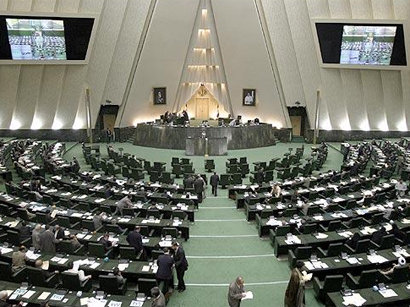
a Iranian parliament

Iranian parliament has allocated an additional $3 billion to strengthen the country’s defense capacity for the next Iranian calendar year as a response to the U.S. officials’ statements that the military option against Iran is still on the table, head of the parliamentary Budget Commission Qolam Reza Mesbahi Moghaddam said, Iran’s Fars news agency reported on Feb. 20.

“We allocated some extra $3 billion to the country’s defense budget for next year in response to them and to show that Iran will continue to boost its defense power,” the MP underlined.

On Feb. 5, Iranian parliament allocated some $3 billion of surplus oil revenues to the armed forces and related organizations for the next Iranian calendar year 1393, which starts on March 21, 2014. The Iranian parliament approved generalities of the Iran’s national budget bill on Jan. 29 and now is studying and approving details of it.

The budgets of the Iranian army and the Islamic Revolutionary Guard Corps (IRGC) have increased significantly in Iran’s next year budget bill. The army’s budget has increased by 50 percent and was set at 52 trillion rials (about $2.1 billion), and the IRGC’s budget has increased by 30 percent and was set at 44 trillion rials (about $1.8 billion), Mehr News Agency reported on Dec.10.

U.S. officials have repeatedly announced that the “military option” is still on the table, if the Islamic Republic continues to enrich uranium beyond the permitted levels.

Iranian senior commanders in recent weeks have responded to the U.S. officials` statements claiming that these statements are political bluff.

Iran’s Defense Minister Hossein Dehghan said last week that the successful test-fire of ballistic missiles which took place on Feb. 9, is a response to the U.S. officials’ statements that the military option against Iran is still on the table.

Iran says negotiation agenda agreed in nuclear talks with powers

February 20, 2014

Iran says negotiation agenda agreed in nuclear talks with powers | JPost | Israel News.

By REUTERS

02/20/2014 08:38

Negotiators have been meeting since Tuesday to hammer out an agenda for talks on a final deal to the standoff over Tehran’s atomic activities.

Khamenei

Iranian Supreme Leader Ayatollah Ali Khamenei. Photo: REUTERS

Iran and six world powers have agreed on an agenda for negotiations over Tehran’s nuclear program and will meet again next month in Vienna, a senior Iranian official said after two days of talks in the Austrian capital.

If confirmed, it would indicate an early step forward in the elusive search for a settlement of the decade-old dispute, even though the sides remain far apart on how to resolve it and both Iran and the United States have publicly stated it may not be possible to reach a final agreement.

Negotiators from Iran and the powers – the United States, France, Germany, Britain, China and Russia – have been meeting since Tuesday in Vienna to hammer out an agenda for talks on a final deal to the standoff over Tehran’s atomic activities.

Iranian Deputy Foreign Minister Abbas Araqchi told the official IRNA news agency: “The involved parties have agreed on an agenda and a framework and the next round of talks will be in the second half of March in Vienna.”

A senior US state department official earlier said about the second day of talks on Wednesday: “Today’s discussions, which covered both process and substance, were constructive and useful.”

Officials from the six powers were not immediately available for comment on Araqchi’s statement to IRNA. His statement was also carried by Iran’s English-language Press TV state television on its web site.

The meeting was due to resume on Thursday morning, expected to be followed by a news conference by European Union foreign policy chief Catherine Ashton – who is coordinating the talks on behalf of the powers – and Iranian Foreign Minister Mohammad Javad Zarif.

The six powers want a long-term deal on the permissible scope of Iran’s nuclear work to lay to rest concerns that they could be put to developing atomic bombs. Tehran’s priority is a complete removal of damaging economic sanctions against it.

The negotiations will probably extend at least over several months and could help defuse many years of hostility between energy-exporting Iran and the West, ease the danger of a new war in the Middle East, transform the regional power balance and open up major business opportunities for Western firms.

The Arms Control Association, a US-based research and advocacy group, said that if a common understanding had been reached on the issues that needed to be addressed “it is an important step forward that makes it more likely the two sides can arrive at a realistic, comprehensive deal in the next 6-12 months.”

The powers have yet to spell out their precise demands of Iran. But Western officials have signaled they want Tehran to cap enrichment of uranium at a low fissile concentration, limit research and development of new nuclear equipment, decommission a substantial portion of its centrifuges used to refine uranium, and allow more intrusive UN nuclear inspections.

Such steps, they believe, would help extend the time Iran would need to make enough fissile material for a bomb and make such a move easier to detect before it became a fait accompli. Tehran says its program is peaceful and has no military aims.

Graham Allison, director of Harvard University’s Belfer Center, said the aim should be to deny Iran an “exercisable nuclear weapons option.”

“Our essential requirement is that the timeline between an Iranian decision to seek a bomb and success in building it is long enough, and an Iranian move in that direction is clear enough, that the United States or Israel has sufficient time to intervene to prevent Iran’s succeeding,” he said.

Highlighting wide differences over expectations, Araqchi was cited by Press TV on Tuesday as saying that any dismantling of Iranian nuclear installations would not be up for negotiation.

The talks could also stumble over the future of Iran’s facilities in Arak, an unfinished heavy-water reactor that Western states worry could yield plutonium for bombs, and the Fordow uranium enrichment plant, built deep underground to ward off any threat of air strikes.

During a decade of on-and-off dialogue with world powers, Iran has rejected Western allegations that it has been seeking the means to build nuclear weapons. It says it is enriching uranium only for electricity generation and medical purposes.

As part of a final deal, Iran expects the United States, the European Union and the United Nations to lift painful economic sanctions on the oil-dependent economy. But Western governments will be wary of giving up their leverage too soon.

The six powers hope to get a deal done by late July, when an interim accord struck in November expires.
That agreement, made possible by the election of relative moderate President Hassan Rouhani on a platform of relieving Iran’s international isolation by engaging constructively with its adversaries, obliged Tehran to suspend higher-level enrichment in return for some relief from economic sanctions.

▶ Netanyahu: We must prevent Iran from having the capacity to produce nuclear weapons – YouTube

February 20, 2014

▶ Netanyahu: We must prevent Iran from having the capacity to produce nuclear weapons – YouTube.

[Transcription]

We meet on the eve of the resumption of negotiations of what is called the final settlement with Iran. They’re supposed to begin tomorrow in Vienna. What is the goal? Or what ought to be the goal of these negotiations? It’s not merely to prevent Iran from having nuclear weapons. I want to be more precise. It’s to prevent Iran from having the capability of manufacturing nuclear weapons. That is different. If Iran perches itself as a threshold state in which it has all the elements of a nuclear weapon in place, they’ll just have to do one little twist of the knob to get final enrichment of fissile material that is the core of a nuclear weapon, then all they’ll have to do is take these components from one side of a room and another side of a room, put them together and in a very short time, days or weeks or perhaps even hours, they’d have a nuclear weapon.

Our goal is to prevent Iran from having the capacity to manufacture or put together nuclear weapons. That is our goal. Now, if they claim to want only civilian nuclear energy, that they have an abundance and they certainly don’t need what it is they’re insisting on. They don’t need enrichment for peaceful nuclear energy. They don’t a heavy water reactor for that. They don’t need ICBMs, long range inter-continental ballistic missiles. They don’t need that for that. They don’t need a weaponization program that Iran of course refuses to open to inspection. They don’t need any of these things, but these are precisely the things that Iran insists on. And they’re precisely the elements that they have to be denied. Now, they haven’t been denied this, in the so-called interim deal. They’ve been allowed to maintain their ICBMs’ their long-range ballistic missiles program, they continue to develop them. By the way, the range is geared to Europe and soon to the United States. It’s not for us. And there’s only one purpose in the world to develop ICBMs. You don’t develop inter-continental ballistic missiles to deliver some hundreds of kilos of TNT. Believe me, nobody does that. You develop an ICBM in order to deliver a nuclear payload. Iran continues to develop that and continues to develop a heavy water reactor, and continues to develop latter-day models of centrifuges. Now they’re developing, as we speak, they’re developing centrifuges that are supposed to be 15 times more effective and more efficient than the centrifuges that they have today. That will enable them to leap-frog the distance and the time from low enrichment of uranium to high enrichment like that.

We’ve made a calculation. How much time has been saved by the interim deal? How much has Iran regressed by agreeing to distill or to dilute the 20% enriched uranium that they have to 3.5%? Well, given everything that they’re preparing, the 19,000 centrifuges that they have in place, and the advanced centrifuges that they continue to develop under the deal, the sub-total of what they’ve been sent back in time is four weeks. That’s what Iran has given to the world, which means it’s given practically nothing, but Iran has received a great deal. It’s received the easing of sanctions. It’s received the nations that are queuing up to ease more sanction with Iran and do more business with Iran. It’s very important to understand that. Iran has given zero, or practically zero. It’s given four weeks, but it’s receiving a new position in the world. It’s being legitimized. Everybody is embracing Iran because of a smile. But Iran’s moderation is a myth.
You should know what Iran is doing as we speak. As we speak, inside Iran innocent people are being executed. They’re executed in horrific ways. They’re executed with these cranes in the middle of cities, innocent people, hoisted up, executed by this regime. This regime continues to foster terrorism around the world. It sends the most deadly weapons to Hezbollah, to Hamas, weapons that are fired on our civilians. This regime, participates in the slaughter, the massive slaughter, the unending slaughter in Syria. That would not be possible without Iran. The Assad regime does not exist a day without Iran, without Iran’s money, without Iran’s weapons, without Iran’s commanders who were there on the site to tell what is left of the Syrian army what to do. But in addition to that, when that didn’t help, when everything else failed, Iran supplied Assad with the most important component. They actually gave them fighters. Khamenei instructed Nasrallah to go and bring his people to Lebanon, and there they do the fighting for Assad. There is no Assad regime without Iran. So as Assad perpetrates this savagery day in and day out, Iran is committing the savagery. Iran is supporting terrorists around the world. Iran is sending these weapons, deadly weapons to be fired on Israel’s cities, and Iran has not changed one iota its call to annihilate the Jewish state. And yet this regime is being embraced.
So I think what is needed are two things. One, we have to expose Iran for what it is. It smiles but it continues its deadly business every day. And secondly, it has to be stripped of the capacity to make nuclear weapons. What the deal that is being discussed today should achieve is one simple thing: zero centrifuges. Not one. Zero enrichment. They don’t need any centrifuges and they don’t have a right for enrichment. I think this is something that requires firmness and clarity. It may not be fashionable, but it’s the right thing, it’s the truthful thing, and I think that the only way that we could make Iran become a more moderate element, a more moderate nation and a more peaceful nation is by exhorting consistent pressure on it, political pressure, economic pressure and the demands of dismantling the Iranian nuclear program, which should be maintained throughout. I think any other route will actually produce the other result and make a diplomatic solution less likely. It will kick it away and force us into a reality that I think none of us want. We all want to see a peaceful solution. For a peaceful solution to succeed, you need more, not less, pressure.
The second thing that we’re discussing every day is how to achieve a secure and enduring peace with the Palestinians. By the way, the strength of Iran weakens that too, because Iran now controls one half of the Palestinian population. They control Hamas, they control Gaza through their proxies Hamas and Islamic Jihad, and of course they tell them what they say in Tehran, no peace with Israel, no reconciliation with Israel, continuous war in Israel. That’s what Hamas and the other terror proxies that Iran again, arms, funds and instructs are doing in Gaza. So one half of the Palestinian population is under the boot of Iran. And the other half, so far, has refused to confront the first half.

We’re trying to make peace with those Palestinians who at least have not engaged in terror and we say to them, if you want to achieve a real peace, then that peace has to be based on a real reconciliation with the Jewish State of Israel. I appreciate the effort, I must say ceaseless efforts, that Secretary John Kerry is engaging with me. We shall soon see if we have a partner in Abu Mazen, but I think if there is a partner there, then there is a way to move this process forward. And for it to move forward and for it to succeed ultimately, then it must address first the root cause of the conflict. The root cause of the conflict is not the settlements, it’s not the territories. This conflict predated it by at least half a century. The root cause of this conflict is the refusal to accept the right of the Jewish people to a state of their own in any boundaries. That remains a simple truth. Simple truths have a way of eluding common perception until they somehow land on you like a ton of bricks. Here is a simple truth that eluded all the experts and many of the commentators about the Middle East for decades. This was an area that was supposed to be preoccupied with one conflict and they always said the conflict, the core of the conflict in the Middle East, always in the singular. The core of the conflict was the Palestinian Israeli conflict. That’s what was said. Today if somebody repeated it, he should be at least laughed away. I think that you find that rarer and rarer. And that’s good, because when you see Syria imploding, and you see Iraq imploding, and you see Lebanon imploding and you see so many other parts of the Middle East imploding, Libya imploding, when you see all of that happening, you know that has nothing to do with the Palestinians.

I bring to your attention the fact that until two years ago people actually said this with a straight face. Professors, scholars, politicians, heads of state, they said the root cause of the conflict in the Middle East is the Palestinian Israeli conflict. Well that is as accurate as the next statement that they now say. That the root cause of the Israeli Palestinian conflict, inside the myriad conflicts of the Middle East is the settlements. Now, friends, you can take all the settlements and you can uproot them and the conflict will continue. You can have Israel continue, go back to the ’67 lines and the conflict will continue. How do we know that? Because we tried it. That’s exactly what we did in Gaza. We went back to the ’67 lines, we uprooted at terrible human cost and financial costs the 10,000 Israelis who were there. Did we get peace? What we got is a forward outpost of Iran from which they’ve so far fired about 12,000 rockets on our heads.

Now, what is going to prevent that from happening again? Well, what we need to see with the Palestinians who make a deal is that they’re resigned to the fact that they’ll have to make a genuine peace with Israel and that means finally recognizing the Jewish state. This will be a peace between two nation states. The Palestinians expect us to recognize a nation state for the Palestinian people. How do they have the temerity not to recognize the Jewish state, the nation state of the Jewish people? Do they not know that we’ve been here for the last 3,800 years? They don’t know that this is the land of the Bible? That this is where Jewish history and Jewish identity was forged? This is what defines us? This is how we define ourselves. We’ve been here a very long time, for God’s sake. They have no excuse, and they can try to distort ancient history and modern history, they can try to do that, but it doesn’t make it true. This is the land of Israel. We’ve been here on this land, associated with it for millennia, and now we say, we know that there has to be a very difficult decision to be made here. But in our ancestral homeland, we are the Jewish people. This is the Jewish land. This is the Jewish state. When we make an agreement it is an agreement between the nation state of the Jewish people and a nation state of the Palestinian people.

If they don’t accept that, you have to ask yourself why not? Why don’t they accept that? Why do they insist on not recognizing us? There is a reason.  Because once you accept the fact that Israel is the nation state of the Jewish people then you have no more claims on this land and on this country, wherever the final border will be drawn. You cannot  claim the so called right of return because that claim of Palestinian refugees or their descendants will be satisfied in the nation state of the Palestinian people. Just as Jews can come here, Palestinians if they chose can go there. That claim evaporates.
Secondly, you cannot make any territorial claims on what remains as the territory of Israel. You cannot say, well there is another people there. Perhaps a sub-group of Israel’s citizens. They’re entitled to a sub-state or to separate state or to an irredentist claim. The minute you agree to the formulation of two nation states, a Jewish state for the Jewish people and a Palestinian state for the Palestinian people, you end all claims. You end territorial claims, and you end refugee claims, you end the so-called “right of return.” That is all incorporated in ending the conflict. The fact that the Palestinian leadership and the Palestinian Authority adamantly refuses to accept this raises serious questions on whether they’re committed to a genuine peace. And unless they’re willing to accept it, they’re not committed to a genuine peace.

Now, even if they accept it, which I sincerely hope they do, that doesn’t guarantee that the decades of incitement that they’ve led to their own people, teaching them to seek this solution, an elimination of the Jewish states, that that will come to an end. We don’t know that. We cannot guarantee that. And I certainly am not coming into any of this Pollyannaish. I’m not looking at this wide eyed, from pink eyeglasses. I can understand that this will be a very difficult experience but it starts with a Palestinian leadership that accepts the Jewish state, accepts the end of claims, ends the conflict and disavows, shuts down, the whole claim of flooding Israel with refugees. That’s a necessity. It’s just not a guarantee. In fact, there is no guarantee. There is no guarantee that the incitement will stop, that the culture of hatred will end. And that’s why we need very solid security arrangements.
We hope that there will be a cultural change.  We hope that the fruits of peace will take root in the soil. We hope that the new generation of Palestinians will embrace a different path. We hope, but we can’t base the peace on hope alone. We must base it also on security. I think we have to base it also on sound economic cooperation in every way that we can to give the individual Palestinians a stake in their future. But we cannot base it merely on our wishful thinking. It just doesn’t happen that way. Look at the Middle East as a whole. The whole land is convulsing, there are earthquakes everywhere you go. And how are we to be sure that areas that we cede to the Palestinians will not be taken over by Hamas and Hezbollah and Al-Queda and Salafis. They’re all there. So we must ensure solid security arrangements that protect the peace and protect Israel in case the peace unravels. And that is the second pillar of peace.
Now what are sound security arrangements? Are they security arrangements of which we ask UNIFIL to protect us? I don’t hear a response. Maybe EUBAM? Remember EUBAM? No? EUBAM was the European force that was placed along the Gaza-Sinai border after we departed from Gaza. I have to tell you that in its favor it lasted I think seven days. Well, maybe I’m wrong, maybe a few more, maybe a few less. But that’s about it. The minute Hamas took over, EUBAM evaporated. UNIFIL has been unable to staunch or stop the arming of Hezbollah, which by now has quintupled compared to what it was when we left Lebanon in 2006. UNIFIL was charged with preventing the rearming of Hezbollah. Hezbollah is rearmed five times and in many ways with much more deadly weapons.

Now, the charge, the mandate of UNIFIL is one. It only has one mandate. To report these violations. To report these violations – not to act against them, not to intercede, not to intervene, just to report these violations. So now Hezbollah has anywhere close to 100,000 missiles. How many missiles has UNIFIL reported? Want to guess? Zero. So who are we to rely on to enforce these arrangements? Not UNIFIL, not EUBAM. Maybe UNDOF in the Golan Heights? You know what’s happening there. We have Jihad on our fences. We have attacks literally bouncing off our fences. Sometimes they cross.
We are, of course, not indifferent to the suffering of the people there and we do take, we’ve taken hundreds of these people who were bleeding to death, suffering from loss of blood or loss of limbs. We’ve taken them into our hospitals. But UNDOF? Not UNDOF, not UNIFIL, not EUBAM. And we don’t ask for Western troops. We’re the only country that is allied with the United States in distress that is not asking for American troops or for NATO troops. We’re perfectly capable of defending ourselves by ourselves against any threat, and that’s what we need to continue.

So when we speak of robust security arrangements, these are not ones that include these illusionary, illusory arrangements that don’t foster security. And by the way, if security collapses, it’s not only the peace that will collapse, it’s also the Palestinian Authority that will collapse and other important regional structures. So when we seek a peace that we can defend, that peace and that security serves not only us, but also our partners in peace. These are the twin elements, the twin pillars of the real peace.  Mutual recognition of two nation states, a Jewish state alongside a Palestinian state and it has to be a demilitarized Palestinian state that has around it and in Israel’s immediate borders the possibility of Israel defending itself with its own forces.

Now I don’t think this is a particularly complicated equation. It’s difficult, there are a lot of details in there that I haven’t discussed, as you can imagine. And I’m not saying the pursuit of peace will be easy. But I’m saying it becomes possible if you keep in mind the main items, the main elements of peace, which are mutual recognition and Israel’s capacity to defend itself by itself. I can assure you that these are not matters on which we intend to compromise. Peace always involves compromises, but I will never compromise on Israel’s security. Never. And never apologize for the fact that the Jewish people are living in their ancestral homeland. I never think of myself as an aggressor or as an outsider or some crusader kingdom. We’ve been here for so many centuries, and our attachments are so deep, that I’m always proud of the fact that the Jewish people have come home. This is our home and this is our city.

But obviously there are people who are uncomfortable with it and there is a new campaign against us, having failed to dislodge us with weapons, with armies, with terrorists, with rockets, with missiles, they now think that they’ll dislodge us with boycotts, and that’s nothing new. We’ve had that in our history as well. You know the boycotts of Jews, and I think the most eerie thing, the most disgraceful thing is to have people on the soil of Europe talking about the boycott of Jews. I think that’s an outrage, but that is something that we’re re-encountering. In the past, anti-Semites boycotted Jewish businesses and today they call for the boycott of the Jewish state. And by the way, only the Jewish state. Now, don’t take my word for it. The founders of the BDS movement make their goals perfectly clear. They want to see the end of the Jewish state. They’re quite explicit about it. And I think it’s important that the boycotters must be exposed for what they are. They’re classical anti-Semites in modern garb. And I think we have to fight them. It’s time to delegitimize the delegitimizers. And it’s time that we fight back.

I know all of you participate in this. There are two ways of fighting back. One is exposing them and the other is something that is happening and they can’t do very much about it. And I’ll tell you what it is. You know, I meet heads of state, and captains of industry, as they’re called, that is founders and leaders of big companies and some small companies and medium-sized companies. They’re all coming to Israel, including today. I had a meeting with another head of state, and they all want the same three things: Israeli technology, Israeli technology and Israeli technology. They crave it. They thirst for it, because they know that we’re in the knowledge century. They know that Israel is the repository of great genius, great creativity, entrepreneurship, innovation, scientific capability, out-of-the-box thinking. This is a tremendous capacity that we have. It’s crystalized here for a variety of reasons. It’s not always easy to explain why these things happen, but it’s very important for us to realize that we possess a great treasure – the capacity to innovate is a great treasure of profound economic value in today’s world.

And that is something that is bigger than all these boycotters could possibly address. Because people are coming here. The new powers, the old powers and the new powers. You know, the new world powers, the super-powers, Google, Yahoo. They all want to participate in this. They all understand that the world economy is being propelled forward by the internet. The internet requires cyber protection, you have to protect your bank accounts, your privacy, your communications, the power lines, the power grids, traffic lights, train schedules. All of that is run today in the digital world and all of that requires protection and we happen to have a capacity to protect it.
So for this and for many many other reasons, Israel is being sought after. And I say that the response that we have to the BDS is twofold. One, expose them, the second is outflank them. We have the economic future of the world in Israel. We have it because we support it, we develop it. And somebody said to me, you know there are only two real centers of high-tech innovation. This was said to me by a young man whose company is worth today nine billion dollars and two years ago was worth a billion dollars. And he said to me, you know, there are only two centers of high-tech innovation in the world. He said, Palo Alto and Tel Aviv. I said, correction, add Be’er Sheva. Because Be’er Sheva will be the new cyber capital of Israel. And you should see what is happening now in the south of Israel, in the Negev. This fantastic growth, this fantastic explosion. We’re putting highways and railways to the North and to the South, it makes Israel sound like an enormous country. We’re just doing what the United States did in the 19th century. But we’re doing it. We’re connecting the periphery, we’re trying to eliminate the periphery. And the most important lines that we’re paving are the fast cyber, of rather fast fiber that we’re putting from Kiryat Shmona right to Eilat. That’s the real highway. That’s the information highway. That every child, every boy, every girl in Israel, Jew, non-Jew, Christian, Muslims, Bedouins, they’re all going to be connected to it and it’s a fabulous future that we have.

I think we’re perfectly suited for the information society. We have a lot of things that we have to do, improve our education, reduce our bureaucracy, deregulate, open ourselves up and we’re consciously opening ourselves up, including to the cyber companies of the world.
We’re doing this because I believe in Israel’s future. I believe we can overcome all these challenges that we face. But we have to be clear about the challenges. We have to be clear that there’s a force against us, engine of modernism that I call, and that is the force of Medievalism that is centered in Iran, and we have to make sure that those eerie Medievalists do not get their hands on the weapons of mass death. It is perfectly possible. It is within our reach if we so wish it. And we have to achieve a durable and stable peace with our Palestinian neighbors. One that is based on mutual recognition and solid security arrangements, and we have to keep developing the State of Israel while exposing those who would rob us of the legitimacy that we so much deserve and that we have earned over centuries of suffering.

These are tasks that I know you share. We have embarked on a task to ensure the Jewish future by cooperating between ourselves and the Jewish Agency, by bringing young people here in Taglit, in Masa, and so many other efforts. I’m always delighted when I see the Birthright kids who come here. I see their eyes sparkle and glow. I see what happens to them when they touch the Kotel. I see what happens to them when they realize that this is their land. Well, this is your land as well, and I know that we have no better partners than you.
I want to thank you for everything that you’ve been doing this year and over the years on behalf of the State of Israel, on behalf of the Jewish people. It’s one and the same thing.
Thank you.

Rouhani: Iran hopes for ‘liberation’ of Jerusalem

February 20, 2014

Israel Hayom | Rouhani: Iran hopes for ‘liberation’ of Jerusalem.

Iranian president says the Muslim world is hoping for a solution to “occupation” • EU foreign policy chief Catherine Ashton says world powers and Iran made a “good start” at nuclear talks in Vienna • Gallup poll: Only 12% of Americans view Iran favorably.

Dan Lavie, Shlomo Cesana, Israel Hayom Staff and News Agencies
Iranian President Hassan Rouhani

|

Photo credit: Reuters

Obama’s Iran policy wins key point: Saudis drop its lead antagonist Prince Bandar

February 20, 2014

Obama’s Iran policy wins key point: Saudis drop its lead antagonist Prince Bandar.

DEBKAfile Special Report February 19, 2014, 10:58 PM (IST)


Prince Bandar bin Sultan -architect of Saudi Syria, Iran strategies

Prince Bandar bin Sultan -architect of Saudi Syria, Iran strategies


The live wire of the Saudi royal house’s drive against President Barack Obama’s détente with Tehran has been dropped. Prince Bandar bin Sultan, Saudi Arabia’s National Security Adviser and Intelligence Director, has not been seen for more than a month. He was reported by debkafile’s US and Saudi sources Wednesday, Feb. 19, to have been removed from the tight policy-making circle in Riyadh.
For Israel’s Binyamin Netanyahu, this counts significantly as the loss of the only other Middle East leader ready to publicly decry President Obama’s policies on Iran and Syria as promoting the negative forces in the region and damaging to America’s own interests.


As recently as Tuesday, Netanyahu declared: “I would like to tell the world today that Iran has changed neither its aggressive policy nor its brutal character… Iran continues to support the Assad regime which is slaughtering its own people.”
Prince Bandar was widely reported in the Middle East to be in secret ties with Israeli intelligence on Saudi and Israeli moves against Iran. Tehran claimed more than once that he had paid clandestine visits to Tel Aviv. Those ties, such as they were, may be presumed to have been discontinued following his removal.


There has been no official word from Riyadh disclosing any change in Bandar’s status. Our sources report that the prince, a long-serving ambassador to the United States, vanished off Saudi and Middle East radar screens in mid-January, shortly before he was scheduled to visit Washington to arrange President Obama’s forthcoming trip to Riyadh in the last week of March.
Bandar never arrived in Washington and no one in Riyadh was ready to answer questions about his whereabouts. US sources were more forthcoming – although less complimentary. In some reports he was dismissed as “hotheaded” or “erratic.”


The Saudi intelligence chief crossed the Americans by supplying weapons and money to Syrian rebels belonging to Islamist militias – though not al Qaeda. He was the driving force behind the formation of the Islamic Front coalition, which last month beat the Free Syrian Army backed by Washington into the ground.
Some Gulf sources say he is paying the price for the kingdom’s failure in Syria. Bandar promised King Abdullah thatg he would take care of getting rid of Bashar Assad. He not only fell down on this task, but he generated a clash between the Obama administration and the Saudi throne on the Syrian issue, say those sources.
The most striking evidence of his comedown came from his absence from the secret conclave held recently by Middle East intelligence chiefs to coordinate their positions on Syrian with Washington.
Instead of Prince Bandar, his seat was taken by his leading adversary on Syria, the Saudi Interior Minister, Prince Mohammed bin Nayef.


Prince Mohammed is a favorite at the White House and a close friend of Secretary of State John Kerry and CIA Director John Brennan.


The Saudi interior minister, by taking Bandar’s place at this important forum, may also be stepping into his shoes as intelligence chief – albeit without the formality of an official notice from Riyadh.


