Archive for February 18, 2014

Islamic world must attain its rightful position: Rouhani

February 18, 2014

Islamic world must attain its rightful position: Rouhani, Tehran Times, February 18, 2014

President Rouhani called for measures to improve security and boost the economy in the Islamic world in order to bring about “lasting peace and sustainable development” and to promote the Islamic culture.
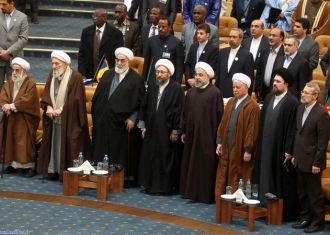
Organization of Islamic Action

TEHRAN – The ninth session of the Parliamentary Union of the Organization of Islamic Cooperation (PUIC) kicked off in Tehran on Tuesday, with the attendance of representatives from 47 OIC member states.

Iranian Parliament Speaker Ali Larijani took over the rotating presidency of the conference from Sudanese National Assembly Speaker Al-Fateh Ezzedin for one year.

Iranian President Hassan Rouhani, Larijani, and Ezzedin delivered speeches during the opening ceremony of the conference.

Twenty-eight parliament speakers and 14 deputy speakers of OIC member states are attending the conference, which is being held on the theme of “Islamic parliaments: Solidarity, Progress, and Justice”.

In his speech, President Rouhani called for measures to improve security and boost the economy in the Islamic world in order to bring about “lasting peace and sustainable development” and to promote the Islamic culture.

He added that the Islamic Republic of Iran “wishes the best” for all Muslim countries and regards their “progress” and “glory” as its own.

Rouhani also expressed hope that the conference would find tangible solutions for the problems facing Muslims.

He also said that he was optimistic that the conference would increase cooperation and common understanding between Iran and all other Islamic countries.

Elsewhere in his remarks, Rouhani said that today, Muslims are facing various challenges, including security problems, economic crises, the Syria crisis, and the Palestine question.

However, in light of Muslims’ enormous economic wealth and their countries’ critical geopolitical position, they should have a more proper role in the world, he added.

Rouhani asked if it is fair that the Islamic world is torn by “extremism and terrorism” and sectarian and tribal conflicts that lead to the death of Muslims, and that Islam, which is the religion of mercy and kindness, is being presented to the world through the prism of Islamophobia.

He also said that Muslim nations, by virtue of their possession of abundant natural resources and their control of sensitive geostrategic locations in the world, should be enjoying a much better situation in the world in comparison to other nations.

‘Arrogant powers use terrorism to threaten Muslims’

In his speech to the conference, Larijani said that the arrogant powers make “tactical” use of “terrorism” in order to threaten various Muslim nations, such as Syria, Iraq, Afghanistan, and Pakistan.

But if Islamic countries utilize their vast potential in various areas, they will acquire an honorable position vis-à-vis the arrogant powers, he noted.

The Iranian Majlis speaker also hailed the recent wave of Islamic Awakening in regional Muslim countries, underlining that such democratic movements will strengthen unity in the Islamic ummah (community).

‘Extremism a major challenge for Islamic world’

The Sudanese parliament speaker, who is the former rotating president of the union, also delivered a speech in which he described “extremism” as one of the biggest challenges facing the Islamic world.

Ezzedin called for more unity among Muslims and said the PUIC should convey the message of Islam to the world.

Elsewhere in his remarks, he touched on the union’s objectives and said that the PUIC should take measures to promote scientific research and bridge scientific gaps in Muslim countries.

The PUIC was established in 1999 and consists of 53 members and 22 regional, international, and parliaments observers. Its permanent headquarters is in Tehran.

It seeks to strengthen parliamentary cooperation among Islamic countries in order to solve challenges facing the Islamic world.

According to the PUIC website, one of the objectives of the union is to provide a framework for comprehensive and fruitful cooperation and coordination among parliaments of OIC members.

The eighth meeting of the PUIC was held in the Sudanese capital Khartoum in January, 2013.
▶ Netanyahu: The Syrian butchery shows the true face of Iran. – YouTube

February 18, 2014

▶ Netanyahu: The Syrian butchery shows the true face of Iran. – YouTube.

The Syrian victims being cared for by IDF doctors shows the true heart of Israel and the Jewish people.

Rouhani: Zionist regime benefits most from upheaval in Muslim world

February 18, 2014

Rouhani: Zionist regime benefits most from upheaval in Muslim world, Jerusalem Post, February 18, 2014

(The bases for his thesis that “the “Zionist regime” gains the most benefit from the current upheaval in the Muslim world” must be self-evident. Peaceful, highly intelligent charmer that he is, might he have referred to reduced attacks on Israel as those in the Muslim world kill each other?– DM)

In meeting with Arab MPs, Iranian president calls on Muslim countries to show unity with Iran against Western threats.

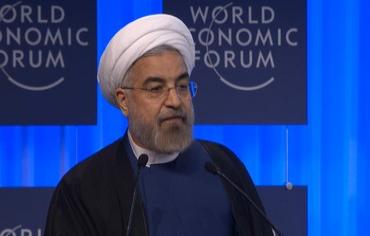
Rouhani 1Iranian President Hassan Rouhani Photo: SCREENSHOT DAVOS WORLD ECONOMIC FORUM

Iranian President Hassan Rouhani on Tuesday called on Arab parliamentarians to show Muslim unity and support Iran against threats from the West.

Addressing visiting MPs from Arab countries at the Inter-Parliamentary Union in Tehran, Iran’s Press TV quoted Rouhani as saying that the “multifaceted” threats against Iran would eventually have a negative impact on all Muslim nations.

Rouhani attacked Israel, saying that the “Zionist regime” gains the most benefit from the current upheaval in the Muslim world.

The Iranian president condemned using violence against Muslims in the name of anti-terror activities.

Netanyahu: Iran remains ‘brutal’ and ‘aggressive’

February 18, 2014

Netanyahu: Iran remains ‘brutal’ and ‘aggressive’ | The Times of Israel.

February 18, 2014, 6:36 pm

PM says field hospital treating Syrians shows ‘true face of Israel’ while casualties are proof of ‘true face’ of Tehran

Prime Minister Benjamin Netanyahu visits an IDF field hospital for treatment of wounded from the civil war in Syria, in Ramat ha Golan, Northern Israel. February 18, 2014. (photo credit: Kobi Gideon /GPO/FLASH90)

Prime Minister Benjamin Netanyahu visits an IDF field hospital for treatment of wounded from the civil war in Syria, in Ramat ha Golan, Northern Israel. February 18, 2014. (photo credit: Kobi Gideon /GPO/FLASH90)
 

As nuclear talks resumed between Iran and the world powers known as the P5+1, Prime Minister Benjamin Netanyahu said that the Islamic Republic remains aggressive and brutal, and is complicit in the Syrian regime’s murder of its citizens.

“I would like to tell the world, today,” Netanyahu said Tuesday morning during a tour of the Golan Heights, “as the talks between the major powers and Iran are being resumed, that Iran has changed neither its aggressive policy nor its brutal character. Iran is continuing to support the Assad regime which is slaughtering its own people. This is the true face of Iran. The world cannot forget this.”

Netanyahu made his comments at an IDF base where injured Syrians are receiving medical care. Defense Minister Moshe Ya’alon and IDF Chief of Staff Maj. Gen. Benny Gantz were on hand as well.

“On the day when talks between the major powers and Iran are being opened in Vienna, it is important that the world sees the pictures from this place, which divides the good that is in the world from the bad,” Netanyahu was quoted in a press release as saying. “The good part is that Israel is saving the lives of those who have been wounded in the daily slaughter that is being perpetrated in Syria. This is the true face of Israel.

“The bad part is that Iran is arming those who are carrying out the slaughter,” he continued. “This is the true face of Iran. All of the children who have been injured, to say nothing of those who have been killed, were injured as a result of Iran’s arming, financing and training the Assad regime in the massacres that it is perpetrating.”

In Early February, Channel 2 News aired footage of a secret Israeli field hospital in the Golan Heights that has treated over 700 Syrians since the war began.

The army hospital, staffed by soldiers in uniform, includes an emergency room, an intensive care unit, an operating room, a mobile laboratory, a pharmacy and an x-ray facility. It treats Syrian patients who cross the border regardless of creed, ethnicity – or with which faction their loyalties lie.

The once-sporadic treatment of Syrian nationals in Israel has, by now, become routine, the report made clear: The wounded cross the border and IDF medical teams deployed in the Golan Heights give them preliminary treatment. Those who are well enough are sent back across the border, and those who require further treatment are evacuated to the military hospital, a field commander at the facility told Channel 2. In this way, the hospital treats about a hundred Syrians per month.

“I would like to tell the world, today,” Netanyahu said Tuesday morning during a tour of the Golan Heights, “as the talks between the major powers and Iran are being resumed, that Iran has changed neither its aggressive policy nor its brutal character. Iran is continuing to support the Assad regime which is slaughtering its own people. This is the true face of Iran. The world cannot forget this.”

Netanyahu made his comments at an IDF base where injured Syrians are receiving medical care. Defense Minister Moshe Ya’alon and IDF Chief of Staff Maj. Gen. Benny Gantz were on hand as well.

“On the day when talks between the major powers and Iran are being opened in Vienna, it is important that the world sees the pictures from this place, which divides the good that is in the world from the bad,” Netanyahu was quoted in a press release as saying. “The good part is that Israel is saving the lives of those who have been wounded in the daily slaughter that is being perpetrated in Syria. This is the true face of Israel.

“The bad part is that Iran is arming those who are carrying out the slaughter,” he continued. “This is the true face of Iran. All of the children who have been injured, to say nothing of those who have been killed, were injured as a result of Iran’s arming, financing and training the Assad regime in the massacres that it is perpetrating.”

In Early February, Channel 2 News aired footage of a secret Israeli field hospital in the Golan Heights that has treated over 700 Syrians since the war began.

The army hospital, staffed by soldiers in uniform, includes an emergency room, an intensive care unit, an operating room, a mobile laboratory, a pharmacy and an x-ray facility. It treats Syrian patients who cross the border regardless of creed, ethnicity – or with which faction their loyalties lie.

The once-sporadic treatment of Syrian nationals in Israel has, by now, become routine, the report made clear: The wounded cross the border and IDF medical teams deployed in the Golan Heights give them preliminary treatment. Those who are well enough are sent back across the border, and those who require further treatment are evacuated to the military hospital, a field commander at the facility told Channel 2. In this way, the hospital treats about a hundred

WATCH: Iranian Film Shows ‘Nuclear Attack’ on Israel

February 18, 2014

WATCH: Iranian Film Shows ‘Nuclear Attack’ on Israel – Israel National News.

(Could they make their intentions any clearer? You see an atomic blast and someone trampling on the word ‘Holocaust’ on the floor. – Artaxes)

Latest in a series of digital saber-rattling illustrates aggressive Iranian response to theoretical military strike on nuclear program.

By Ari Soffer

First Publish: 2/18/2014, 12:32 PM
 

IAF F-4 Phantom (illustration)

IAF F-4 Phantom (illustration)
Flash 90

A new animated film posted on Iranian websites in recent days graphically portrays an Iranian counterattack against a theoretical joint Israeli-American strike on the Islamic Republic’s military facilities, culminating in the destruction of the Jewish state.

The clip was posted together with messages decrying attempts to tighten sanctions on Iran due to its nuclear program, according to Israel Hayom, and begins with an airstrike by Israeli and American forces on Iran. 

Iranian air defenses kick in and destroy the bombers, and subsequent scenes show Iranian aircraft flying over Jerusalem, and strikes on Israel’s soil.

Chillingly, the film ends with what appears to be an Iranian-launched nuclear missile destroying the Jewish state.

The film is not the first such Iranian simulation of an attack against Israeli or western targets. Similar clips, including one earlier this month, have previously been released by official Iranian state organs as crude warnings to Israel and western states not to target its nuclear facilities.

But the graphic illustration of a nuclear attack against Israel will hardly allay fears in Jerusalem and elsewhere that Tehran’s nuclear program is far from peaceful.

U.S. House majority leader links Holocaust, Iran sanctions

February 18, 2014

U.S. House majority leader links Holocaust, Iran sanctions – Haaretz.

Representative Eric Cantor says U.S. must counter Iran’s ‘determined march’ to produce nuclear weapons.

By |Feb. 18, 2014 | 2:10 PM

Eric Cantor

Congressman Eric Cantor Photo by AP

Representative Eric Cantor, the Republican House majority leader, cited the lateness of American actions against the Nazis in critiquing President Obama’s foreign policy.

In a speech Monday to the Virginia Military Institute, Cantor (R-Va.), who is Jewish, described leading a congressional delegation recently to Auschwitz to mark the 69th anniversary of the Nazi death camp’s liberation.

“Standing there as the frigid wind swept through the eerily quiet ruins of the camp, I could not help but regret that American action in World War II came too late to save countless millions of innocent lives,” he said.

“Hitler’s rise and conquest of Europe did not come as a surprise. We must not repeat the same mistake by reducing our preparedness, accepting the notion that we are one of many or ceding global leadership to others.”

Cantor said that “evil and hateful ideologies still exist in the world,” citing as perhaps the most evident Iran’s “determined march” to produce nuclear weapons.
“I can imagine few more destabilizing moments in world history than Iran on the threshold of being a nuclear power,” he said.

Cantor called on the United States to prepare for additional sanctions to counter what he said was the erosion of Iran’s isolation through its participation in international talks aimed at keeping it from obtaining a nuclear weapon.

“An America that leads is an America that must work to restore the badly eroded international pressure on Tehran,” he said. “We should lay the groundwork now for additional sanctions in the event Iran violates the terms of the interim agreement.”

The Obama administration has said that the removal of a number of sanctions ahead of the talks has not diminished a tough sanctions regime. It has opposed new sanctions while talks are underway, saying that unilateral U.S. sanctions could fracture the international alliance that has nudged Iran to the talks.

Iranian hacking of Navy computers reportedly more extensive than first thought

February 18, 2014

Iranian hacking of Navy computers reportedly more extensive than first thought – FoxNews.

Published February 18, 2014
FoxNews.com

NSA New Boss_Cham640.jpg

This Oct. 5, 2011, photo, provided by the U.S. Navy, shows Vice Adm. Michael Rogers. Rogers, nominated to be the next head of the NSA, led the Navy’s response to its largest unclassified network being hacked by Iran last year. (AP)

An Iranian hack of the Navy’s largest unclassified computer network reportedly took more than four months to resolve, raising concern among some lawmakers about security gaps exposed by the attack. 

The Wall Street Journal, citing current and former U.S. officials, reported late Monday that the cyberattack targeted the Navy Marine Corps Internet, which is used by the Navy Department to host websites, store nonsensitive information, and handle voice, video, and data communications. 

The paper reported that the hackers were able to remain in the network until this past November. That contradicts what officials told the Journal when the attack was first publicly reported this past September. At the time, officials told the paper that the intruders had been removed.

“It was a real big deal,” a senior U.S. official told the Journal. “It was a significant penetration that showed a weakness in the system.”

The quoted official said that the Iranians were able to conduct surveillance and compromise communications over the unclassified computer networks of the Navy and Marine Corps. However, another senior official told the Journal that no e-mail accounts were hacked and no data was stolen. There is also no evidence that Iran was able to penetrate classified U.S. computer networks. 

The cyberattack is one of the one of the most serious infiltrations of government computer systems by the Iranians. The Journal reported that U.S. defense officials were surprised at the skill of the hackers, who were able to enter the network through a security gap in a public-facing website. 

The military response to the hack was over seen by Vice Adm. Mike Rogers, President Obama’s pick to be the next head the National Security Agency. Congressional aides told the Journal that Rogers would likely face questions on plans to fix security issues that have surfaced as a result of the attack. A confirmation hearing for Rogers has not yet been scheduled. 

Despite the length of the operation to remove the hackers, officials who spoke to the Journal praised Rogers for his leadership of the cybersecurity response. The issue is not expected to prevent Rogers from being confirmed as NSA director.

Iran not expecting immediate results of nuclear talks: spokesperson

February 18, 2014

Iran not expecting immediate results of nuclear talks: spokesperson, Xinhua Net, February 18, 2014

(Another confirmation that military aspects of Iran’s nuclear plans will not be discussed and hence will not be part of any “comprehensive agreement.” — DM)

Iran’s military and defensive program has nothing to do with the nuclear talks and “a new round of talks will merely focus on Iran’s nuclear issue, and the Iranian negotiating team will insist on that . . . .”

TEHRAN, Feb. 18 (Xinhua) — Iran does not expect immediate results from a new round of nuclear talks with world powers that started in the Austrian capital of Vienna on Tuesday, Iranian Foreign Ministry spokeswoman said Tuesday.

Marzieh Afkham said Iran and the P5+1 group, which consists of the United StatesRussia, China,France and Britain plus Germany, would mainly talk about the framework of their future negotiations in Vienna.

The course of talks is “long, difficult and complicated which should be paced carefully and vigilantly,” she said.

Iran’s military and defensive program has nothing to do with the nuclear talks and “a new round of talks will merely focus on Iran’s nuclear issue, and the Iranian negotiating team will insist on that,” she added.

Referring to Monday’s remarks by Iran’s Supreme Leader Ayatollah Ali Khamenei about the talks, she said the leader was urging the Iranian negotiators to heed “predetermined principles” of Iran’s nuclear rights.

Khamenei said Monday that he was not optimistic about Iran’s nuclear negotiations with the world powers. “(Some Iranian officials believe) if we negotiate with the United States on the nuclear issue, the problem will be solved… I’m not opposed to the talks, but I’m not optimistic.”

In November, Iran and the P5+1 group reached an interim deal on Iran’s nuclear program in Geneva and started its implementing on Jan. 20. Under the deal, Iran suspended the most sensitive parts of its nuclear activities in exchange for partial relief of the sanctions slapped on it.

The two sides started a fresh round of talks in Vienna on Tuesday toward reaching a comprehensive nuclear agreement.

Iran tells talks it won’t scrap any nuclear facilities, rejecting a central demand by six world powers

February 18, 2014

Iran tells talks it won’t scrap any nuclear facilities, rejecting a central demand by six world powers – National Post.

George Jahn, Associated Press | February 18, 2014 9:43 AM ET

Iran's deputy Foreign Minister Abbas Araghchi attends the nuclear talks between world powers and Iran, in Vienna, Austria, 18 February 2014. Negotiators from Iran and six world powers were gathered in Vienna to start talks on ending the stand-off over Tehran's nuclear programme through a comprehensive agreement
Iran’s deputy Foreign Minister Abbas Araghchi attends the nuclear talks between world powers and Iran, in Vienna, Austria, 18 February 2014. Negotiators from Iran and six world powers were gathered in Vienna to start talks on ending the stand-off over Tehran’s nuclear programme through a comprehensive agreement.
EPA / Hans Punz

Iran said Tuesday it would not scrap any of its nuclear facilities, drawing a red line in negotiations with six world powers seeking deep cutbacks in Tehran’s atomic program in exchange for an end to crippling economic sanctions.

The statement by Deputy Foreign Minister Abbas Araghchi suggested tough talks ahead, constituting a rejection of a central demand by the six countries.

The talks are designed to build on a first-step deal that came into effect last month and commits Iran to initial curbs on its nuclear program in return for some easing of sanctions.

Iran insists it is not interested in producing nuclear weapons but the six powers want Tehran to back its words with concessions. They seek an agreement that will leave Iran with little capacity to quickly ramp up its nuclear program into weapons-making mode with enriched uranium or plutonium, which can used for the fissile core of a missile.

For that, they say Iran needs to dismantle or store most of its 20,000 uranium enriching centrifuges, including some of those not yet working. They also demand that an Iranian reactor now being built be either scrapped or converted from a heavy-water setup to a light-water facility that makes less plutonium.

Iran is desperate to shed nearly a decade of increasingly strict sanctions on its oil industry and its financial sector but is fiercely opposed to any major scaling back of its nuclear infrastructure.

“Dismantling (the) nuclear program is not on the agenda,” Deputy Foreign Minister Abbas Araghchi told reporters in Vienna.

The talks are formally led by Catherine Ashton, the EU’s top foreign policy official, and Iranian Foreign Minister Mohammad Javad Zarif. The United States, Russia, China, Britain, France and Germany are also at the table.

Ashton spokesman Michael Mann warned of the “intensive and difficult work lying ahead of us.”

Despite his colleague’s comments, Iranian Deputy Foreign Minister Abbas Araghchi said the talks got off to a “very good beginning.” He said even if they end later this week with nothing more than a future agenda “we’ve accomplished a lot.”

Iran’s the Problem

February 18, 2014

Iran’s the Problem – The Weekly Standard.

Feb 24, 2014, Vol. 19, No. 23 • By LEE SMITH

Two weeks ago the Treasury Department sanctioned a senior al Qaeda official, Olimzhon Adkhamovich Sadikov, also known as Jafar al-Uzbeki, for facilitating the flow of foreign fighters into Syria. The Levant appears to be ground zero in a struggle between al Qaeda and an Iranian-led axis of terror in a conflict now spreading from the Iraqi desert to the Lebanese coast. The Obama administration believes that in this contest for regional dominance, there are two clear sides and that it is al Qaeda, and not Iran, that constitutes the greatest threat to U.S. national security. Thus the Obama administration’s  reluctance to act against Bashar al-Assad’s regime in Damascus, lest this give al Qaeda sway in Syria. However, here’s a fact that should give the administration cause to rethink its assessment: Al Qaeda’s Uzbeki is operating out of Iran, with the approval of Iranian authorities.

Newscom 

Newscom

From Iran’s perspective, backing Uzbeki and his al Qaeda fighters against Assad and Hezbollah and even against its own Revolutionary Guard puts another piece into play on the chessboard. It’s an additional weapon in Tehran’s arsenal. As the 9/11 Commission Report made clear, the Islamic Republic has frequently worked with al Qaeda when it suits Iranian interests. Similarly, Assad, whose forces now battle a resistance that includes al Qaeda fighters, turned Damascus international airport into a transit hub for al Qaeda fighters entering Iraq in the mid-2000s to kill American troops. He also has a long history of using and manipulating Sunni jihadists. 

This latest designation comes at a pivotal time for the administration’s regional policy. The White House’s chief strategic goal in the Middle East is to protect the interim nuclear weapons agreement with Tehran in the hope of creating, as Obama told the New Yorker last month, a new geopolitical equilibrium that balances Iran against Saudi Arabia. To get there, Obama needs to keep the Iranians at the negotiating table, not an easy trick given the regime’s volatile, even paranoid, nature.

Obama’s judgment of the clerical regime’s psychology has dictated policy since he first came to the White House. The administration refused to support the Green movement that took to the streets in the wake of Iran’s likely fraudulent June 2009 elections for fear of driving the regime from the negotiating table. Obama ignored the advice of officials who wanted to arm the Syrian rebels and avoided any serious efforts to topple Assad because he believed that this, too, would alienate the Iranians. He resisted Congress’s push to impose sanctions on Iran and has now provided sanctions relief for the same reason—he doesn’t want to get the mullahs mad and risk losing his negotiating partner.

Iran, the White House insists, is not the problem. It can be managed through regular diplomatic and political means—engagement, deterrence, etc. But al Qaeda, a non-state actor, making war from Lebanon, Syria, and Iraq, is another animal altogether. As Director of National Intelligence James Clapper explained in his Senate testimony last month, the administration believes that al Qaeda represents the greatest threat to U.S. national security. According to Clapper, one al Qaeda affiliate in Syria that the administration has designated, Jabhat al-Nusra, even has plans to attack the United States. Unfortunately for the White House, it turns out that Nusra is funded and manned by the Iranian-based al Qaeda network. That is, Obama has tied America’s position in the Middle East to partnering with Iran, which itself has partnered with actors the White House deems the main threat to U.S. national security.

Nonetheless, the White House continues to see the regional conflict simplistically. As Obama puts it, what we’re watching unfold is a sectarian war between Sunnis and Shiites in which the United States should avoid taking sides. This is also Iran’s version of the war, promulgated in part to keep the White House on the sidelines. It’s a multipurpose public diplomacy campaign intended also to galvanize Iran’s Shia base across the region and destabilize Sunni-majority regimes. Sectarianism is a significant factor in Middle East conflicts, but the fundamental fact is that Iran is a -revolutionary regime. It means to overturn the regional status quo, the American-backed order of the Middle East, and sideline the United States once and for all. In this effort, al Qaeda, along with Hezbollah and various other Iranian-backed terrorist organizations, can all be useful to Tehran.

For five years now, traditional American allies like Israel and Saudi Arabia have told the White House that Iran is the problem. You might think, with its latest terror designation, the administration might come to that same view. But the administration is reluctant to see the implications of what it has just done. The fact is, it’s long past time to move against Tehran on all fronts. Our key struggle in the Middle East is with the Iranian revolutionary regime that supports Sunni as well as Shiite terrorism.


