Archive for February 11, 2014

Off Topic: Netanyahu accepts Kerry’s “framework” in principle, seeks publication delayed to Knesset recess

February 11, 2014

Netanyahu accepts Kerry’s “framework” in principle, seeks publication delayed to Knesset recess.

DEBKAfile Exclusive Report February 11, 2014, 9:23 AM (IST)
Binyamin Netanyahu and Ambassador Ron Dermer

Binyamin Netanyahu and Ambassador Ron Dermer

Prime Minister Binyamin Netanyahu has informed the White House in Washington and US Secretary of State John Kerry of his acceptance in principle of the US framework document – subject to the reservations he has raised with US Special Envoy Martin Indyk, debkafile’s exclusive Washington sources report.

This step was followed by news that the prime minister would call on President Barack Obama in the first week of March during his next visit to Washington.
It was also the background to Israeli Ambassador Ron Dermer’s defense of the US Secretary in an interview published in TIME Magazine Tuesday, Feb. 11.
Kerry’s comment about boycott and international isolation hanging over Israel if his peace mission failed was denounced in Jerusalem as attempted intimidation. However, Dermer let him off the hook by saying: “I think he was making a descriptive statement. I don’t think he was doing it in order to pressure Israel.”
By overstating the ambassador’s role as “Bibi’s brain,” TIME was hinting that Dermer’s comment represented the prime minister’s current thinking on the incident.

In the exchanges leading up to the Obama-Netanyahu meeting, the prime minister’s office and Israel embassy have asked the White House and State Department to delay publication of the Kerry document to mid-April during the Knesset’s Passover recess. This will help Netanyahu to stay clear of the rowdy debates and heated special sessions he expects to erupt over his acceptance of the paper.

The Secretary of State may therefore add a few weeks to the three-way negotiating time table and release his framework accord at the end of April or early May.

A high-ranking US official told debkafile: “We all know that the die is cast in Jerusalem and that Netanyahu has accepted Kerry’s guidelines. They are now working on the reservations he needs to submit for his government coalition to survive the expected storm of protest and resistance and for the talks with the Palestinians to carry on.

Netanyahu will also try presenting the Kerry paper to the public as an American proposal which is not binding either on Israel or the Palestinians, except for the attached reservations.
US officials au fait with such processes predict that those reservations will eventually find their way to the dustbin. In 2004, Prime Minister Ariel Sharon appended 16 reservations to President George W. Bush’s letter defining the American position on the Israeli-Palestinian dispute.

In that letter, Bush omitted recognition of the “right of return” for the 1948 Palestinian refugees, and tangentially acknowledged Israel’s right to establish large settlement blocs in the West Bank in consideration of demographic changes.
The Bush letter did not refer to the 1967 borders, but instead determined that future negotiations should be based on the 1949 Armistice Lines.

Sharon’s reservations had dropped by the wayside by the time Congress came to approve the Bush letter in its original form.

Informed sources in Washington forecast a similar fate for the Kerry framework document.

For now, the US Secretary has made his own request of Netanyahu and the Palestinian leader Mahmoud Abbas: He asks them to draw out the negotiations on his framework after its release over two years – that is up until late 2016 when the Obama administration ends. Abbas is against any prolongation of the process. He has so far agreed to an extension of no more than a year.

Off Topic: Fatah-Hamas reconciliation almost final, reports say

February 11, 2014

Fatah-Hamas reconciliation almost final, reports say, Times of Israel, February 11, 2014

(Will Hamas pretend to be nice to help push the delusional “peace process,” or will Fatah unite with Hamas to continue giving terrorism a chance? — DM)

Fatah and Hamas have made significant progress in reconciliation talks held in Gaza and are now on the verge of implementing previously signed agreements, Palestinian media reported on Tuesday.

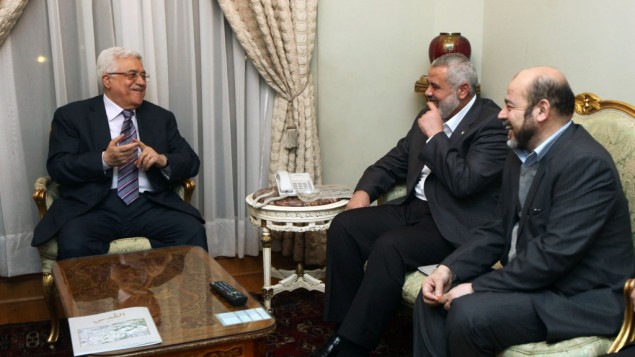
Hamas and Fatah meet in Cairo 2012Palestinian President Mahmoud Abbas, and prime minister in gaza strip, Ismael Hanyah, during a meeting between Fatah and Hamas in Cairo, Egypt, 23 February 2012 (photo credit: Mohammed Al-Hums/Flash90)

Fatah and Hamas have made significant progress in reconciliation talks held in Gaza and are now on the verge of implementing previously signed agreements, Palestinian media reported on Tuesday.

“Things are completely ready for ending the divide, and [PA] President [Mahmoud] Abbas is very optimistic that the reconciliation will soon be implemented,” said Nabil Shaath, a senior Fatah member sent by Abbas to Gaza late last week at the head of a delegation from Fatah’s Central Committee to hold talks with Hamas.

The two rival movements have been at loggerheads since Hamas’s violent takeover of the Gaza Strip in June 2007, a year after winning a landslide victory in national elections. A series of signed reconciliation agreements have not been implemented amid ongoing persecution of opposition members both by Hamas in Gaza and by Fatah in the West Bank.

Speaking to journalists in Gaza Monday evening, Shaath said that Hamas has agreed to the immediate formation of a “national consensus” government headed by Abbas, followed by legislative and presidential elections in six months. Elections are also to be held for the Palestinian National Council, the legislative body of the PLO, in which Palestinian refugees living in the diaspora will take part.

Nabil ShaathNabil Shaath in his Ramallah office (photo credit: Miriam Alster/Flash90)

Abbas is expected to send Azzam Al-Ahmad, the Fatah official responsible for talks with Hamas, to Gaza to discuss the implementation of the agreement, Shaath said.

Hamas, for its part, is concerned that some 55,000 of its civil servants working in Gaza will remain jobless following reconciliation with Fatah, the PA official daily Al-Ayyam reported, quoting “knowledgeable political sources.” Hamas would like to see these employees integrated into the PA’s bureaucracy, though Fatah has given no guarantee to that effect, the sources told the paper.

Referring to rumors regarding the content of a framework peace agreement to be presented by US Secretary of State John Kerry in the coming weeks, Shaath said that Abbas would not be able to accept a number of American conditions, including recognition of Israel as a Jewish state, leaving a certain number of settlers in the West Bank, and extending the Israeli military presence in the Jordan Valley.

“Negotiations will not be extended [beyond their original nine-month time-frame] if these conditions persist,” Shaath was quoted by the London-based daily Al-Quds Al-Arabi as saying. He warned, however, that Palestinians should be prepared for the eventuality that refusal to accept the American conditions would bring about a “cutting of the foreign aid which the PA relies on to fulfill its needs.”

Fatah attempts to block Dahlan

Talks with Hamas were not the only purpose of the high-profile Fatah visit to Gaza, however. The Ramallah-based movement is concerned over the growing influence of Mohammad Dahlan, a former Fatah member and once the head of Palestinian security in the Gaza Strip.

An Arafat loyalist, Dahlan was expelled from the movement in 2011 after his public criticism of Abbas for corruption led to accusations that he was plotting a coup against the Palestinian president. He fled to Dubai, but continues to enjoy a following among the rank and file of Fatah both in Gaza and in the West Bank.

Dahlan Mohammed Dahlan in 2006. (photo credit: Michal Fattal/Flash90)

According to Jerusalem-based Palestinian daily Al-Quds, the Fatah delegation headed by Shaath sent a harsh message to Fatah members in Gaza and the West Bank, warning them against cooperating with Dahlan. The movement summoned prominent supporters of Dahlan living in Ramallah, such as Sufian Abu Zaida and Majed Abu Shamala, and told them they must choose between working with Dahlan and remaining in the movement.

“Mohammed Dahlan is no longer a member of Fatah. He now works from an office in Dubai in the UAE under orders of UAE sheikhs, and moves as an Emirates citizen, receiving a budget from the UAE,” Shaath said.

Fatah’s leadership has also accused Dahlan of encouraging cooperation with Hamas in Gaza, a claim that Hamas’s deputy political bureau chief, Mousa Abu Marzouq, rushed to dismiss.

“Hamas denies the rumors regarding reconciliation with Dahlan,” Abu Marzouq wrote in a statement posted to Facebook on Sunday. “In truth, the demands which we obliged in Gaza came from the reconciliation delegation headed by Azzam Al-Ahmad.”

Hamas remained largely mum on Tuesday on the prospect of imminent reconciliation with Fatah.

BY ELHANAN MILLER

White House Draws Red Line on Iranian Ballistic Missile Program

February 11, 2014

White House Draws Red Line on Iranian Ballistic Missile Program, Washington Free Beacon, February 10, 2014

(The Obama Administration is pretty good at drawing red lines. Doing something when they are crossed is different. — DM)

Obama Iran AnalysisIranian army members prepare missiles to be launched / AP

The White House on Monday pushed back against Iran’s efforts to set a “red line” preventing negotiations over its contested ballistic missile program, which has been permitted to continue undeterred under the recently signed interim nuclear accord.

One of Iran’s top nuclear negotiators stated early Monday that Iran would under no circumstances negotiate with the West on its ballistic missile program. These remarks were accompanied by the announcement that Tehran had successfully test fired two ballistic missiles, which are the preferred delivery system for nuclear arms.

“The defense-related issues are a red line for Iran,” Abbas Araqchi, Iran’s senior negotiator and its deputy foreign minister, was quoted as saying on Monday, just a week before talks are set to resume. “We will not allow such issues to be discussed in future talks.”

However, the White House quickly pushed back against the comments, vowing to force the issue during upcoming negotiations and demand that it be resolved under a final deal.

“Per the Joint Plan of Action, Iran must address the [United Nations] Security Council resolutions related to its nuclear program before a comprehensive resolution can be reached,” Bernadette Meehan, National Security Council spokesperson, told theWashington Free Beacon.

“Among other things, UN Security Council Resolution 1929 prohibits all activities involving ballistic missiles capable of delivering nuclear weapons, including launches,” Meehan said. “So this issue will need to be addressed during the comprehensive discussions.”

This is one of the first instances of the White House publicly pushing back against Iran’s demands, which have grown increasingly bellicose as the talks proceed.

Iran is on course to develop more advanced ballistic missiles, the country’s defense minister was quoted as saying following Monday’s test.

“The new generation of ballistic missile with a fragmentation warhead, and a Bina laser-guided surface-to-surface and air-to-surface missile, have been successfully tested,” Defense Minister Hossein Dehgan was quoted as saying in numerous reports.

Under new Iran sanctions legislation currently stalled in Congress, Iran would have been subject to immediate and harsh economic penalties for launching a ballistic missile.

Wendy Sherman, the U.S.’s top negotiator, admitted during a congressional hearing last week that Iran can continue its ballistic missile work under the interim nuclear deal, which will last for around six months.

“It is true that in these first six months we’ve not shut down all of their production of any ballistic missile that could have anything to do with delivery of a nuclear weapon,” Sherman told lawmakers during a hearing on the nuclear deal. “But that is indeed something that has to be addressed as part of a comprehensive agreement.”

Sherman’s admission elicited concern from several senators.

“Why did you all not in this agreement in any way address the delivery mechanisms, the militarizing of nuclear arms, why was that left off since they [Iran] breached a threshold everyone acknowledges. They can build a bomb. We know that,” said Sen. Bob Corker (R., Tenn.), the committee’s ranking member. “They know that. They have advanced centrifuges. We have a major loophole in the research and development area that everyone acknowledges.”

By: 

US energy delegation to visit Tehran next month

February 11, 2014

US energy delegation to visit Tehran next month, Trend, February 10, 2014

(French, British,  Japanese and German too, even before Iran is “open for business.”  — DM)

A senior US official said Secretary of State John Kerry had telephoned his French counterpart Laurent Fabius to tell him that the visit, whilst from the private sector, was ‘not helpful’ in sending the message that ‘it is not business as usual’ with Iran.

A delegation consisted of American oil experts will visit Tehran in the next Iranian calendar month (to start of February 20), Iran’s Mehr News Agency reported on February 8.

Also 12 renowned oil and energy experts from the United States, UK, and Japan will attend an international oil, gas, and petrochemical industries conference in Tehran.

Also it is expected that representatives from 3 major German oil companies including Siemens, Linde, and BASF travel to Tehran in near future.

Tehran has already started negotiations with French oil and gas companies.

Iran’s Tasnim News agency reported on February 5 that French gas firm Gaz de France, has announced its readiness to work with Iran.

The company made the announcement during the visit of a French business delegation to Iran on Tuesday.

The cooperation will be apart from that of Total and Technip in this field.

A delegation of more than 100 French companies arrived in Tehran on Monday in the biggest demonstration of western business interest in Iran for more than a decade, Financial Times reported.

The three-day visit which includes top French companies such as major oil firm Total, engineering company Alstom, telecoms group Orange and car manufacturer Renault, has raised hopes in Iran that an interim deal on its nuclear programme could lead to a return of foreign investment.

The victory of centrist President Hassan Rouhani last summer paved the way for the country to strike an interim nuclear deal with six major powers, the U.S., UK, France, Russia, China and Germany in November 2013 which took effect in January.

A visit to Iran by such a large French business delegation drew a stern warning from Washington that most US sanctions remain in place and will be enforced even against allies, AFP reported.

The 116-strong French delegation with representatives from major companies like Total, Lafarge and Peugeot, was the largest of its kind from Europe since a landmark nuclear deal reached with the major powers in November gave Iran limited relief from crippling US and EU sanctions.

French employers’ union Vice President Thierry Courtaigne said the delegation which arrived in Tehran on Monday, wanted to assess the commercial opportunities opened up by the easing of Western sanctions.

However a senior US official said Secretary of State John Kerry had telephoned his French counterpart Laurent Fabius to tell him that the visit, whilst from the private sector, was ‘not helpful’ in sending the message that ‘it is not business as usual’ with Iran.

Israeli PM accuses Iran of increasing “int’l aggression”

February 11, 2014

Israeli PM accuses Iran of increasing “int’l aggression, Xinhuanet, February 10, 2014

(How dare Prime Minister Netanuahu speak such blasphemy while Iran’s Charmin Offensive continues? Shouldn’t Israel simply lie back, relax and enjoy it? Does PM Netanyahu even want a benign Iran and the peace it would surely bring to the Middle East? —  DM)

Netanyahu has vocally protested the easing of economic sanctions while Iran and the P5+1 world powers are negotiating a deal on the Iran’s long-disputed nuclear program, which Israel believes is geared to produce atomic bombs.

JERUSALEM, Feb. 9 (Xinhua) — Israeli Prime Minister Benjamin Netanyahu said Sunday the recent easing of sanctions on Iran has not only failed to moderate its policies, but is fuelling its aggression, according to a statement by the prime minister’s office.

“What is happening here is that the international community is reducing the sanctions, and Iran is increasing its aggression,” Netanyahu said at the start of the weekly cabinet meeting in Jerusalem, adding that “the Iranian foreign minister recently met with the head of Islamic Jihad. Iran continues to supply terrorist organizations with deadly weapons, continues aiding the massacre in Syria, and is sending warships to the Atlantic Ocean.”

These remarks came following reports that Iranian warships were sailing toward U.S. maritime borders on Saturday, which “was meant to counter U.S. naval presence in the Persian Gulf,” Iranian Navy chief R.-Adm. Habibollah Sayyari was quoted as saying by the Fars news agency.

Netanyahu has vocally protested the easing of economic sanctions while Iran and the P5+1 world powers are negotiating a deal on the Iran’s long-disputed nuclear program, which Israel believes is geared to produce atomic bombs.

On the other side, Iran’s Supreme Leader Ayatollah Ali Khamenei gave a speech Saturday in which he criticized Washington’s “controlling and meddlesome” policy toward his country.