Archive for February 11, 2014

Off Topic: The B.D.S. Threat – NYTimes.com

February 11, 2014

The B.D.S. Threat – NYTimes.com.

( Roger Cohen has historically been the most stridently anti-Israel columnist at the NY Times.  That’s saying a lot.  Reading this piece gave me severe cognitive dissonance.  – JW )

LONDON — Secretary of State John Kerry caused outrage in Israel recently when he declared: “For Israel there’s an increasing delegitimization campaign that has been building up. People are very sensitive to it. There is talk of boycotts and other kinds of things. Today’s status quo absolutely, to a certainty, I promise you 100 percent, cannot be maintained. It’s not sustainable. It’s illusionary.”

Members of the Israeli government were indignant. Israel, they declared, will not negotiate under pressure. Advice givers, stay away! But Kerry was only repeating what Israel’s own finance minister, Yair Lapid, had already said: The Boycott, Divestment and Sanctions (B.D.S.) movement is beginning to bite.

I am a strong supporter of a two-state peace. The messianic idea of Greater Israel, occupying all the land between the Mediterranean and the Jordan River, must wither. Jews, having suffered for most of their history as a minority, cannot, as a majority now in their state, keep their boots on the heads of the Palestinians in the occupied West Bank any longer.

Palestinians must accept the permanence of the state of Israel within the 1967 lines with equitable land swaps. Competitive victimhood should cede to collaborative viability for the nation states of the Jewish and Palestinian peoples. Narratives and revealed truth do not a future make. They perpetuate the imprisoning past.

So, in theory, B.D.S. might be a positive factor. When the largest Dutch pension fund and the largest Danish bank withdraw investments from, or cease business with, Israeli banks because of their operations in the settlements, they send a powerful signal to Israel to get out of the West Bank.

Yet these developments make me uneasy for a simple reason: I do not trust the B.D.S. movement. Its stated aim is to end the occupation, secure “full equality” for Arab-Palestinian citizens of Israel, and fight for the right of return of all Palestinian refugees. The first objective is essential to Israel’s future. The second is laudable. The third, combined with the second, equals the end of Israel as a Jewish state. This is the hidden agenda of B.D.S., its unacceptable subterfuge: beguile, disguise and suffocate.

The anti-Apartheid movement in South Africa contained no such ambiguity. As Diana Shaw Clark, an activist on behalf of a two-state solution, wrote to me in an email, “People affiliated with divestment in South Africa had no agenda other than the liberation and enfranchisement of an oppressed majority.”

This is not the case in Israel, where the triple objective of B.D.S. would, in Clark’s words, “doom Israel as a national home for the Jews.” Mellifluous talk of democracy and rights and justice masks the B.D.S. objective that is nothing other than the end of the Jewish state for which the United Nations gave an unambiguous mandate in 1947. The movement’s anti-Zionism can easily be a cover for anti-Semitism.

It would be gratifying if Israelis and Palestinians could learn overnight to live together as equal citizens in some United States of the Holy Land between the Mediterranean and the Jordan River, a binational and democratic secular state that resolves their differences. But it is an illusion to think this could ever happen, the one-state pipe dream. The fault lines are too deep. A single state cannot mark its Day of Independence and Day of Catastrophe on the same date.

One state, however conceived, equals the end of Israel as a Jewish state, the core of the Zionist idea. Jews must not allow this to happen. Trust your neighbor? Been there, tried that.

The so-called right of return of the hundreds of thousands of Palestinians driven out in the 1948 war (whose descendants now number in the millions) cannot be exercised, any more than the Jews of Baghdad and Cairo have deeds to return home. There can, and should be, agreed compensation for the dispossessed, but there cannot be a reversal of history. The “right” is in fact a claim.

A Jewish national home is needed. History demonstrated that. It must now be reinvented. For that, the corrosive occupation has to end and with it the settlement industry.

B.D.S. is a wake-up call. I oppose it because I do not trust it. That does not mean, as Lapid intimated, that Israel can ignore its message.

Israel can only be a state of laws again when the lawless enterprise beyond the Green Line ends. West of that line, Israel is a democracy affording greater minority rights than other regional states (Omar Barghouti, a B.D.S. leader, has a master’s degree from Tel Aviv University). But that is not enough. All citizens should enjoy equality in the Jews’ national home, a state where civil marriage becomes possible, state and synagogue are divorced, and Israelis are permitted to identify themselves as Israelis if they so wish, rather than as Jews or Arabs or Druze — that is as undifferentiated citizens.
North Korea Doing Iran’s Nuclear Dirty Work

February 11, 2014

North Korea Doing Iran’s Nuclear Dirty Work, Clarion Project, February 11, 2014

(This has long been one of my primary concerns. Due to the amelioration of sanctions, Iran will be able to pay North Korea more than previously and increase their cooperation. North Korea needs the money and will be pleased to oblige. — DM)

Measure Iran’s nuclear weapons progress by looking at North Korea. History has shown that when one advances, so does the other.

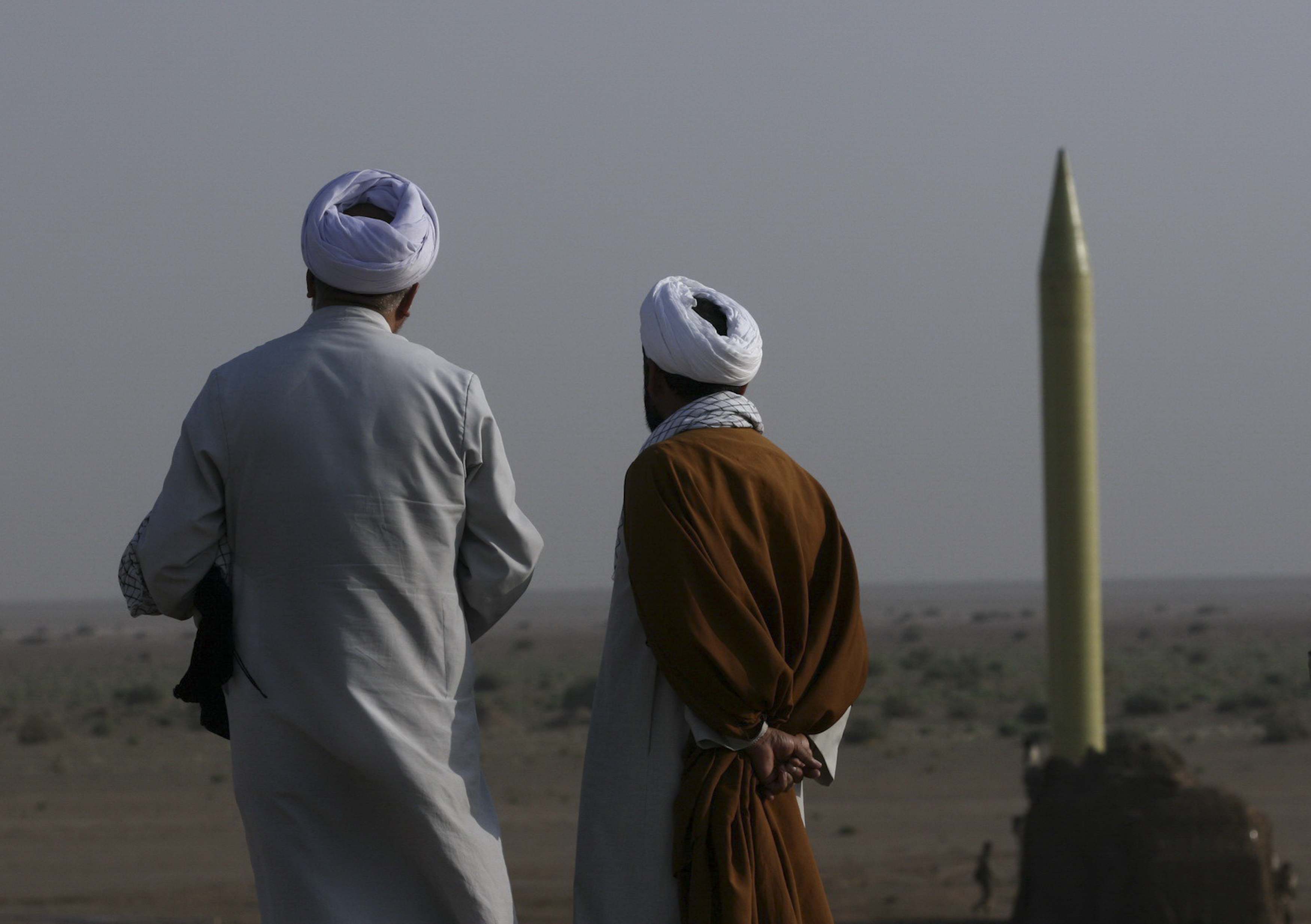
Iranian clerics stand near surface to surface missile which is ready to be launched during war game near city of Qom Iranians view a test of a surface-surface missile. (Photo: © Reuters)

The West is expecting North Korea to soon conduct its fourth nuclear test and to launch a long-range ballistic missile in retaliation for joint U.S.-South Korean military exercises.

How does Iran fit into this equation?

The two rogue states share their technology and Iranian scientists have been reported at every single North Korean nuclear test. The Iranian Shahab-3 ballistic missile is modelled after North Korea’s No-Dong missile. It is not a coincidence that, according to Director of National Intelligence Clapper, North Korea is increasing its nuclear program at the exact same time as Iran is slowing its nuclear program down.

As Iran limits its uranium enrichment, North Korea is adding to its uranium enrichment site at Nyongbyon. As Iran halts work on its Arak plutonium-producing plant, North Korea is restarting its own plutonium-producing plant that it closed in 2007.

Intelligence analyst Ilana Freedman reports that her sources say that Iran began moving its nuclear bomb production capabilities to North Korea at the end of 2012. This was around the same time that Iran was cleansing its Parchin base after U.N. inspectors found strong evidence that they had carried out tests for developing nuclear missiles there. Iran still refuses to grant inspectors access to the site.

Freedman’s sources say that Iran has outsourced its nuclear weapons research to two sites in North Korea near Nyongbyon, which is where U.S. intelligence confirms a uranium enrichment facility is being expanded. They say that Iran has been providing the raw uranium for the site. A second site about 15 miles north is where work on nuclear warheads is progressing. According to her sources, there are 250-300 Iranian scientists in North Korea protected by a group of Revolutionary Guards personnel and 14 warheads have already been produced there.

We shouldn’t be confident that the U.S. government would detect secret work like this, because the U.S. government itself isn’t confident: A three-year study by the Defense Department concludedearlier this year that U.S. intelligence capabilities against secret nuclear activities is “either inadequate, or, more often, do not exist.”

If Iran has outsourced its work to North Korea, it wouldn’t be an anomaly. In fact, the dual nature of North Korea and Iran’s programs has long been reported on. A former senior official in Germany’s Defense Ministry says that some intelligence officials believe that at least one North Korean nuclear test was done on behalf of Iran.

Iranian scientists were reportedly on the scene for North Korea’s most recent nuclear test last year. There is evidence that Iran sponsored the test with millions of dollars in Chinese currency. Iran’s top nuclear scientist, Dr. Mohsen Fakhrizadeh, was present. He is believed to be the manager of Iran’s efforts to develop nuclear triggers and warheads.

In 2012, Iran’s company that produces ballistic missiles and satellitessent a delegation of a dozen representatives to North Korea to watch its long-range ballistic missile test. The test failed.

If Iran is willing to pay, North Korea is willing to sell. It has no moral qualms about selling deadly technology to a radical Islamic regime, and the cash-strapped regime wouldn’t have much of a choice if it did.

The Iranians spend an estimated $2 billion on North Korean arms every year. The actual number may be even higher.  A top Iranian defector revealed that Iran paid North Korea $1-2 billion to build a nuclear reactor in Syria that was ultimately bombed by Israel in 2007. North Korean defectors say that 40% of the country’s exports are arms sales.

Western analysts mistakenly view the Iranian and North Korean weapons of mass destruction programs as separate. Yet, history has shown that when one advances, so does the other.

If you want to measure Iran’s nuclear weapons progress, look at North Korea.

By RYAN MAURO

Washington’s Strange Silence on Iran

February 11, 2014

Washington’s Strange Silence on Iran – Commentary Magazine.

02.11.2014 – 12:20 PM
 

If you only got your news by following the statements put out by the Obama administration, you would currently be blithely unaware of the disturbing moves taken by Iran in recent days. That is because it would appear that the latest strategy of the Obama administration is to simply ignore those statements coming from the Iranians that they don’t wish to hear. Nuclear centrifuges can spin, ballistic missiles can be tested, bellicose speeches can be delivered by the Islamic Republic’s most senior figures–but if no one in the White House chooses to hear it, does it really make a sound? 

In the lead-up to Tehran’s no doubt charming celebrations marking the 35th anniversary of the country’s violent Islamic revolution, the regime’s warlike moves have been going into overdrive. As part of the festivities Iranian state television has aired simulated footage of its military bombarding Israel’s cities and attacking an American aircraft carrier. Senior military figures have spoken of dispatching warships to the North Atlantic and of their ability to strike the U.S. military. Supreme Leader Ayatollah Khamenei has taunted America, expressing his amusement at the naivete of Americans for believing Iran would actually scale down its military. Indeed, they haven’t and Iran’s Defense Ministry has been celebrating the testing of new long-range ballistic missiles and laser guided surface-to-surface and air-to-surface missiles.

And while Obama may have used his State of the Union address to showcase his achievements in holding back the Iranian nuclear program, yesterday Iran’s nuclear experts announced the unveiling of a new generation of centrifuges 15 times more powerful than the ones they currently have. This will allow them to resume uranium enrichment at 60 percent, somewhat higher than the less than 5 percent permitted under the U.S. brokered interim agreement.

How many emergency statements has the administration made in the face of these threats? How many press conferences called regarding Iran’s moves to breach the interim agreement? Cue tumbleweed. With the exception of some quotes that CNN managed to extract from the Pentagon, in which officials noted they were monitoring the ballistic missile tests and denied that there was evidence warships had been sailed into the North Atlantic, we have heard nothing from the U.S. government. Seemingly these matters are of little concern to the administration. On the one hand perhaps this speaks of a certain fatigue among the press who have grown tired of pursuing this matter in State Department press briefings. Yet it is also noteworthy that the administration has offered no statements of its own on these developments.

Given that National Security Advisor Susan Rice has a tendency to take to Twitter to slam Israeli ministers for unkind words about Secretary Kerry, one would have thought that she would also have no qualms about treating the Iranians to some of the same. Yet apparently the testing of ballistic missiles, Iran’s head of state calling the U.S. government liars, or the threat to sail warships up to American waters is of little interest to anyone in Washington.

But then, it is probably hardly surprising that the Obama administration isn’t exactly eager to highlight the fact that its Iran policy lies in tatters. The administration is in no rush to draw attention to the matter of Iran’s new centrifuges and thus confirm that the interim agreement they staked everything on was in fact never fit for purpose in the first place. Perhaps they are hoping that if they don’t make too much fuss about any of this then no one will notice. Or is the strategy now simply to ignore the Iranians and eventually they’ll shut up and go away? They won’t, of course. 

Obama: US will come down ‘like a ton of bricks’ on violators of Iran sanctions

February 11, 2014

Obama: US will come down ‘like a ton of bricks’ on violators of Iran sanctions | JPost | Israel News.

( “Think I’m bluffing?  Cross that line… ” –  JW )

By MICHAEL WILNER

LAST UPDATED: 02/11/2014 20:29

US president, French president Hollande meet at White House; leaders address Israeli-Palestinian peace process, Iran nuclear issue, Syrian conflict; Obama: New Iran sanctions would “endanger” diplomatic efforts.

white house

US President Barack Obama and French President Francois Hollande address a joint news conference in Washington, February 11, 2014. Photo: REUTERS

WASHINGTON — Private firms conducting business in Iran before international sanctions are lifted “do so at their own peril,” US President Barack Obama said on Tuesday during a joint press conference with French President Francois Hollande.

Should businesses proceed with contracts in violation of sanctions imposed by the United States, the European Union and the United Nations Security Council, “we will come down on them like a ton of bricks,” Obama said from the East Room of the White House.

The US president said world powers were “firm” in their commitment to their sanctions regime, which has led to a dramatic contraction of the Iranian economy. But all are in agreement, Obama said, that new sanctions legislation during the current negotiations period could “endanger” prospects for a diplomatic solution to the nuclear crisis.

Republicans in the US Congress have threatened to use partisan procedural tactics to force a vote in the Senate on new sanctions against Iran, skeptical that an interim deal reached in November has truly halted Iran’s march toward nuclear weapons capacity.

Eluding to criticisms in Congress, and to the standard Israel’s government has set for any comprehensive accord between world powers and Iran, Obama said he would maintain a “very high threshold” for proof from Iran that its nuclear ambitions are limited to civilian power.

Responding to reports that a large French trade delegation plans on visiting Tehran this month, Hollande said he cannot control the travel of business executives as president of the republic.

“Companies just make their decisions when it comes to travel,” he said, adding that he had made “clear” to French businessmen what sanctions entail.

“Sanctions will only be lifted if and when there is definite agreement,” Hollande said. “During this period of the interim agreement, they remain in force.”

“Toughness” forced Iran to agree to an interim deal, freezing much of their nuclear work in exchange for $7 billion in sanctions relief, Hollande said. But there is and will remain an “Iranian problem” until the Islamic Republic renounces its nuclear program, he added.

France has become a key ally to the US on matters of foreign policy in the Middle East. Hollande pointed out that, on the precipice of US military action against Syria last September in response to President Bashar Assad’s use of chemical weapons against civilians, France was prepared to act in concert— where other allies, such as Great Britain, were not.

But France now supports the diplomatic path that opened in response to the threat of military force, he said. Hollande promised to exert “pressure” on Assad to remove all chemical weapons from Syria with haste.

Obama, who has been criticized for not using force against Assad after threatening to do so, proudly lauded the policy and said that Assad’s chemical arms stockpile had now been “completely chronicled.”

Hollande was honored at the White House in the first official state visit by a French president in nearly twenty years.

The French premier was welcomed with pomp, as French and American flags draped nearly a mile of Pennsylvania Avenue. Hollande arrived to cannon fire off the Potomac River and to a full display of the American guard.

Vice President Joseph Biden, US Secretary of State John Kerry and National Security Advisor Susan Rice were in attendance at the ceremony on the South Lawn.

In his opening remarks during their joint press conference, Hollande briefly mentioned US efforts at forging peace between Israel and the Palestinians, urging the parties to sign a framework for negotiations “now.”

Obama, too, briefly mentioned the effort, noting that the EU would play a key role in the implementation of a final-status peace accord.

Mullahs Ahoy

February 11, 2014

Mullahs Ahoy – The Washington Free Beacon.

Pentagon to Iran: Sail wherever you like

(“White House spokesman Jay Carney also said on Monday that the United States has “no evidence” Iranian warships are on the way to the United States.”
Well, there is also no evidence for intelligent life in the White House.
– Artaxes)

Iranian navy personnel  / AP
Iranian navy personnel

BY:
February 11, 2014 4:59 am

The U.S. Defense Department said on Monday that Iranian warships are allowed to sail into the Atlantic Ocean so long as “they understand the responsibilities” of cruising so close to the U.S. border.

The Pentagon’s pronouncement comes just days after Iran announced that warships were approaching the U.S. maritime border in response to America’s naval presence in the Persian Gulf.

Asked to respond to Iran’s pointed military rhetoric, Pentagon spokesman Bill Speaks told the Washington Free Beacon that it would not be an issue for Iranian ships to enter the Atlantic.

“Freedom of the seas applies to all maritime nations, all navies, everywhere—so long as they understand the responsibilities, which come with that freedom,” Speaks said. “So, if they are able to send their ships to the Atlantic, I’m sure they won’t be surprised to find many, many others already there.”

Speaks added that there is no solid evidence that Iranian ships are sailing towards the United States.

“On the Iranian claim, at this point, this is merely an announcement, not an actual deployment,” he said.

Iranian naval commanders struck a much less conciliatory tone, threatening to sink U.S. warships and kill American soldiers.

“The Americans can sense by all means how their warships will be sunk with 5,000 crews and forces in combat against Iran and how they should find its hulk in the depths of the sea,” Rear Adm. Ali Fadavi, the commander of the elite Islamic Revolution Guards Corps (IRGC) Navy, was quoted as saying Sunday in the regional press.

Another Iranian general said that the dispatch of warships to the United States “has a message.”

“Iran’s military fleet is approaching the United States’ maritime borders, and this move has a message,” Iranian Adm. Afshin Rezayee Haddad said according to the semi-official Fars News Agency.

Iran dispatched the war fleet in “response to Washington’s beefed up naval presence in the Persian Gulf,” where American ships are stationed to help keep international shipping lanes safe, according to the report.

U.S. officials with knowledge of Iran’s movements said they were not particularly worried about Iran, which has a history of embellishing its military strength.

“These statements are probably more reflective of Iranian naval propaganda rather than any strategic intent,” one U.S. official told the Free Beacon. “Iranian officials have made similar statements since at least 2011, all of which turned out to be rhetorical posturing.”

Iran would also have a difficult time making it to America, the official said.

“Even if Tehran were serious about sending naval assets to the U.S. maritime border, it would be hard pressed to do so,” the source said. “Traversing thousands of miles would pose logistical challenges even for the world’s most advanced naval forces.”

White House spokesman Jay Carney also said on Monday that the United States has “no evidence” Iranian warships are on the way to the United States.

“Well, first of all, there was an Iranian announcement that they are moving ships close to the United States, and we have no evidence that Iran is in fact sending ships close to the U.S. border,” he told reporters during his daily briefing.

Iran’s amped up military threats against the United States come just one week before Western negotiators are set to meet with Tehran for another round of nuclear negotiations.

The talks could hit speed bumps given a recent series of statements by Iranian leaders who have vowed to keep the nuclear program running at full steam.

One of Iran’s senior negotiators said on Monday that the issue of Tehran’s ballistic missile program would be off the table. The statement prompted quick pushback from the White House.

“Per the Joint Plan of Action, Iran must address the [United Nations] Security Council resolutions related to its nuclear program before a comprehensive resolution can be reached,” Bernadette Meehan, National Security Council spokesperson, told the Free Beacon.

“Among other things, UN Security Council Resolution 1929 prohibits all activities involving ballistic missiles capable of delivering nuclear weapons, including launches,” Meehan said. “So this issue will need to be addressed during the comprehensive discussions.”

Huge Anti-American Crowds Mark Iran Revolution

February 11, 2014

Huge Anti-American Crowds Mark Iran Revolution – NBC.

(Do they lie when they say they want peace or do they lie when they say “Death to Israel” and “Down with America”? Take your pick. – Artaxes)

ABEDIN TAHERKENAREH
 
By Ali Arouzi

TEHRAN — Anti-American and anti-Israel sentiment ran high on the streets of Tehran on Tuesday as hundreds of thousands celebrated the 35th anniversary of the Islamic Revolution.

Chants of “Death to Israel” and “Down with the U.S.” reverberated and groups of young people approached NBC News’ crew to deliver their message of anger and distrust.

“I have a message for Mr. Obama: My option on the table is the destruction of Israel, be sure of that,” 22-year-old student Jamshid said during the events marking the 1979 toppling of Shah Reza Pahlavi, a close U.S. ally.

 “I have a message from the people of Iran to Mr. Obama and [Israeli Prime Minister Benjamin] Netanyahu — we are ready for big war,” another young man told NBC News.

The virulent anti-Western and anti-Israeli statements come as the government of President Hassan Rouhani steers the country towards a rapprochement with the West. In November, the regime agreed to cap its nuclear enrichment program in exchange for an easing of Western sanctions.

Also on Tuesday, Rouhani said that Iran would pursue peaceful atomic research “forever,” and lashed out at Western statements that a military solution to a nuclear dispute with Tehran remained an option.

“I say explicitly to those delusional people who say the military option is on the table, that they should change their glasses … Our nation regards the language of threat as rude and offensive,” Rouhani told the crowds.

Despite the political message, the anniversary events also had a carnival feeling. Posters of Supreme Leader Ali Hosseini Khamenei stood next to stalls selling food, T-shirts and balloons in the shape of Spider-Man and Miley Cyrus.

On Saturday, Khamenei said the United States was trying to undermine the country’s government.

“The Iranian nation should pay attention to the recent negotiations and the rude remarks of the Americans so that everyone gets to know the enemy well,” state news agency Fars quoted him as saying.

The statements are markedly different to more conciliatory language some officials have used during negotiations.

On Feb. 2, the country’s foreign minister said it would be a “disaster” if Tehran did not turn an interim agreement to defuse a decade-old dispute over its nuclear program into a permanent deal.

“What I can promise is that we will go to those negotiations with the political will and good faith to reach an agreement because it would be foolish for us to only bargain for six months,” Mohammad Javad Zarif said. “That would be a disaster for everybody – to start a process and then to abruptly end it within six months,” he said.

Reuters contributed to this report.

Is Obama seeking an opening to Iran the way Richard Nixon did with China?

February 11, 2014

Is Obama seeking an opening to Iran the way Richard Nixon did with China? – Human Events.

Is Obama seeking an opening to Iran the way Richard Nixon did with China?


By: Michael Barone
2/11/2014 06:00 AM

Is Barack Obama trying to shift alliances in the Middle East away from traditional allies and toward Iran? Robert Kaplan, author and geopolitical analyst for the Stratford consulting firm, thinks so.

In a realclearworld.com article, Kaplan argues that the Obama administration sees the recently elected Iranian President Hassan Rouhani “as a potential Deng Xiaoping, someone from within the ideological solidarity system who can, measure-by-stealthy-measure, lead his country away from ideology and toward internal reform.”

Such a development, he goes on, is “something that could, in turn, result in an understanding with the West.”

That of course is not what the president and Secretary of State John Kerry say they’re up to. They say they’re trying to get Iran to agree to stop its nuclear weapons development. No talk of a new alliance.

But Kaplan’s view provides a more convincing explanation of what they’ve actually been doing. It helps explain why Obama and Kerry remain equable in the face of Iranian officials’ public statements that they have not given up their nuclear program.

It also helps explain their adamant opposition to the sanctions bill supported by 59 senators and a large majority in the House. That bill would apply enhanced sanctions if and only if the administration did not achieve its stated goals at the end of the six-month negotiating period agreed to in November and that took effect, after resolution of “technical” issues, in January.

Obama spokesmen say the sanctions legislation might torpedo the negotiations and even lead to war. The Iranians, brought to the table by sanctions, will walk out if more sanctions are threatened.

That makes little sense. Particularly because in his State of the Union message Obama said that he would be the first to insist on more sanctions if negotiations failed. Why oppose legislation that would make his own threat more credible?

It would make sense, however, if Obama is trying to construct, in Kaplan’s words, “a concert of powers that would include America, Iran, Russia and Europe,” all opposed to Sunni al-Qaida terrorists.

Kaplan compares Obama and Kerry on Iran with Richard Nixon and Henry Kissinger on China, attempting to reconcile with a long-shunned adversary based on shared common interests.

But there are significant differences between Nixon and Kissinger’s opening to China and what Kaplan says Obama and Kerry are doing today.

The first is that Nixon and Kissinger waited until they had strong concrete evidence that China’s leaders had interests consistent with America’s.

As a candidate, Nixon wrote a 1967 Foreign Affairs article saying “we cannot simply afford to leave China forever outside the family of nations.” But he called that a long-run goal, dependent on China “accepting the basic rules of international civility.”

In office, Nixon and Kissinger listened to Chinese officials’ denunciations of the Soviets and Soviet diplomats’ alarm over China. But only after they observed a Soviet arms buildup and armed clashes on the China-Soviet border did they actively pursue communications with China through intermediaries.

Iran’s mullah regime has been sponsoring armed attacks on Americans for 35 years. Its assaults on al-Qaida-type terrorists have been limited, so far as the record shows, to a bit of help in Afghanistan a decade ago.

The second difference between Iran now and China then is that Obama and Kerry, in Kaplan’s account, place much stock in Rouhani as a change agent who will modify the character of a regime hostile to the U.S. for 35 years.

Previous administrations have seen earlier Iranian presidents as change agents too. Former Defense Secretary Robert Gates in his book “Duty” notes that every president since Jimmy Carter has tried to reach out to Iranian leaders “and every one of them has failed to elicit any meaningful response.”

The reason is that the firmly anti-American supreme leaders, Ayatollahs Khomeini and Khamenei, hold the real power, not the occasional smiling front-man president.

Nixon and Kissinger did not rely on some internal reformer to turn China around. Deng Xiaoping’s economic reforms started four years after Nixon resigned, and his name does not appear in Kissinger’s memoir “The White House Years.”

The Nixon-Kissinger opening did not rely on regime change — Kissinger’s account portrays them as puzzled by internal Chinese politics — but on a demonstrated common interest in cabining in the Soviet Union.

Do Obama and Kerry really believe that we share such a common interest with the mullahs’ Iran?

Michael Barone, senior political analyst for The Washington Examiner, is a resident fellow at the American Enterprise Institute, a Fox News Channel contributor and a co-author of The Almanac of American Politics. 

Lieberman heads to Paris for talks on Iran

February 11, 2014

Lieberman heads to Paris for talks on Iran – Israel News, Ynetnews.

In first trip to France in five years, the foreign minister will also meet with French interior minister, head of OECD and members of French Jewish groups

AFP

Published: 02.11.14, 16:36 / Israel News

Foreign Minister Avigdor Lieberman will visit Paris on Wednesday for talks with his counterpart Laurent Fabius that will include the Iranian nuclear program, his ministry said Tuesday.

“France plays an important role on the international stage to prevent further nuclear program of Iran,” said Lieberman’s spokesman in a statement ahead of the minister’s first official visit to France since 2009.

“The new ballistic missile test conducted Monday by Iran proves once again that its intentions have not changed, and that the Iranians do not want to hide their aggressive intentions,” he added, referring to Iran’s test of two new missiles.

“The threat is always the same, but (now it is) hidden behind smiles. This is the only change,” the spokesman said.

The Foreign Ministry said that while in Paris, Lieberman will also meet with the Interior Minister of Manuel Valls, Secretary-General

of the Organization of Economic Cooperation and Development (OECD) Angel Gurria, members of the France-Israel inter-parliamentary friendship group, and representatives of Jewish organizations.

Lieberman, leader of the right-wing Yisrael Beiteinu party, has long been considered a “hawk” in Israeli politics. But since his return to the Foreign Ministry in November, following his acquittal in a trial for corruption, he has worked to shed his image of the “pariah” of the international diplomatic scene.

The foreign minister recently backed US Secretary of State John Kerry after he came under fire from fellow members of the government, who accused him of exploiting the threat of international boycott to pressure Israel into negotiations with the Palestinians.

On Sunday, Prime Minister Benjamin Netanyahu said that easing sanctions against Iran was counterproductive, and had pushed Tehran to redouble its “aggression on the international scene.”

This tone contrasts with that adopted by the United States and the European Union, who have decided to partially lift sanctions against Iran in the hope of reaching an agreement on Tehran’s nuclear program.

Negotiations with the P5+1 (the United States, China, Russia, France, the UK and Germany) on a comprehensive agreement with Iran are set to begin in Vienna on February 18.

Experts Discuss Iran ‘EMP Threat’

February 11, 2014

Experts Discuss Iran ‘EMP Threat’ – Defense/Security – News – Israel National News.

We have the technology to avert catastrophe, say experts. So why aren’t we?

By Daniel Perez

First Publish: 2/10/2014, 6:25 PM
Ballistic missile fired during Iranian war games (illustrative)

Ballistic missile fired during Iranian war games (illustrative)
Reuters

WASHINGTON, D.C. – It would have been the 103rd birthday of Ronald Reagan, an American president known for his frankness, and for possessing the courage to confront those countries who would threaten the freedom and security of the United States and her allies.

Thursday (Feb. 6) was an auspicious occasion, then, for EMPact America’s latest symposium, entitled “American Security and the Iranian Bomb: Analyzing Threats at Home and Abroad.”

Political leaders and persons of influence from the Beltway and beyond gathered at the Reserve Officers’ Association – a mere stone’s throw from the Capitol building—to hear a public conversation with former CIA Director James Woolsey and rising GOP star Senator Ted Cruz (R-TX), moderated by Frank Gaffney, president of the Center for Security Policy. Following the dialogue with Woolsey and Cruz, Congressman Trent Franks (R-AZ) delivered his own remarks, and was honored with EMPact America’s “Guardian of the Grid” award, for his efforts to raise awareness of the looming EMP threat.

Gaffney, an renowned expert on national security affairs, kicked off the gathering by briefing those in attendance on the nature of the threat. In a grim but poignant assessment, he explained the various ways in which an Electromagnetic Pulse weapon (or even a naturally-occurring solar storm) would most likely devastate our nation’s energy infrastructure, leading to death tolls projected in the millions – as many as 9 out of every 10 Americans.

“This is a catastrophe that we can not fix after it happens,” said Gaffney, “…the good news is that we can prevent it.”

He went on to explain the various ways in which the United States could “harden” its electrical grids against attack or natural disaster. Indeed, Henry Schwartz, prominent New York-based entrepreneur and founder of EMPact America, raised this very issue, maintaining that EMP countermeasures are neither a recent development, nor are they out of America’s financial reach.

Referring to such technologies as “affordable,” he announced that “our government has been using EMP protection within the military and its continuity plan since the Cold War. The President and his men are well protected against EMP, including when traveling in Air Force One … however, you, and your loved ones, and the things you depend on to live, are not protected.”

“But you could be protected!” Schwartz exclaimed.

During the dialogue, former Director of Central Intelligence Jim Woolsey (who also served as an ambassador in nuclear disarmament talks between the United States and the Soviet Union), confirmed Schwartz’s claims. Having crunched the numbers himself, Mr. Woolsey said, he estimated that a tax equivalent to $3 on every U.S. citizen would provide sufficient funds to retrofit electrical grids across the country, shielding them from an EMP event.

Spending several minutes discussing the various “flavors” of EMP, Mr. Woolsey explained in detail the havoc that would be left in their wake. Of 18 key infrastructures that keep American life running, says Woolsey, 17 are run on electricity. He therefore referred to the type of EMP weapon that would run along our electrical grids, knocking out transformers, as a “real carrier of death.”

He stressed the urgency of the matter, saying: “We rarely, if ever, have an opportunity to make a huge contribution to our security – and that’s security not just from enemies, but security from the sun (and that latter one is inevitable no matter what we do with our foreign policy) – and we have an opportunity to do some of these things quickly. But the system is not working in such a way as to make it happen.”

Soliciting the support and suggestions of those in attendance, Woolsey added that “this is one of those things that comes along perhaps once in a century or so that we just have to do. We are toying with the real possibility of the complete destruction of our society.”

Whereas Mr. Woolsey was able to provide an analytical intelligence-oriented perspective on the EMP threat, Sen. Ted Cruz was able to offer a more political point of view. He didn’t mince words. Senator Cruz decried what he saw as the popular misconception that Iran’s new president represents a more progressive government.

“The press has described Rouhani as a ‘moderate’ because, I guess, he uses Twitter, so he can’t be all bad,” the senator wryly observed. “If you look at just what they say in their own words… [Supreme Leader Ayatollah] Khamanei on November 20th, 2013, said ‘the Zionist regime is a regime whose pillars are extremely shaky, and is doomed to collapse. Israelis ‘should not be called humans.’”

“This isn’t a decade ago,” Cruz emphasized, “this is November of 2013.”

Cruz also went on to quote social media posts by the Iranian cleric describing Israel as the “sinister, unclean, rabid dog of the region,” as well as quotes by President Rouhani and other sources in the Iranian administration and military, each alluding or directly referring to the annihilation of the Jewish state.

The senator from Texas expressed an implied interdependency between the safety and security of the United States, and that of Israel, as did several other speakers in attendance. He expressed the concern that the moment Iran obtains a nuclear arsenal, it could be turned on Tel Aviv, New York, Los Angeles, or indeed, major cities throughout the western world.

Yet rather than viewing Israel as a liability, Cruz declared that he takes comfort in the fact that “if Iran gets too close to acquiring nuclear weapons capability, I have an enormous degree of confidence that Israel will act to protect her right to exist as a Jewish state. And if Israel acts and launches a military attack to take out Iran’s nuclear weapons capability, it is difficult to think of an action that would perform a greater service for U.S. national security interests.”

Concluding the morning’s proceedings was Congressman Trent Franks (R-AZ-8), who was presented by war hero and EMPact America President David Bellavia with the organization’s Guardian of the Grid Award. Franks expressed an unwaveringly pro-Israel stance similar to that espoused by Sen. Cruz. He also took the opportunity to criticize U.S. President Barack Obama for focusing more attention on condemning Israel for building houses “in their own capital city,” than on preventing a hostile regime from obtaining nuclear weapons.

The congressman recounted his efforts to bring greater attention to the danger posed by Iran, and how his warnings until recently had fallen on deaf ears.

Rep. Franks did conclude, however, on an optimistic note. Speaking directly to the audience, he declared that “all the efforts that you make are going to be worthwhile.”

“There is a moment in the life of every problem where it is big enough to be seen and understood, but still small enough to be addressed. And you and I are living in that moment.” Rep. Franks went on to express the pride he felt for those at the conference, and encouraged them to “keep storming the gates.”

While Iran’s nuclear agenda, and the threat of an EMP attack do not appear to be at the top of the Obama administration’s list of priorities, the EMPact America conference nonetheless demonstrated that there are those in the House, the Senate, and the intelligence community, who recognize these as top priority issues, and will continue to sound the alarm until the U.S. commits to a decisive and meaningful response.

Left to right: Senator Ted Cruz (Re-TX), Frank Gaffney, Former CIA Director James Woolsey Daniel Perez

Former CIA Director James Woolsey (L) with prominent pro-Israel activist Dr. Joseph Frager Daniel Perez

To learn more about EMPact America and their work, and to view footage from the conference, visit www.HomelandThreats.com

AIPAC and Iran’s war against America

February 11, 2014

Our world: AIPAC and Iran’s war against America | JPost | Israel News.

By CAROLINE B. GLICK

02/10/2014 21:32

AIPAC did not cut and run from the Iran sanctions fight because it consecrates two-party initiatives. It walked away because it lost.

AIPAC

AIPAC Photo: REUTERS

For its decision to pull anchor last Friday on its bid to pass new sanctions on Iran, AIPAC has been accused of slavish devotion to bipartisanship. Although the criticism is not without foundation, it is probably undeserved in this case.

AIPAC did not cut and run from the Iran sanctions fight because it consecrates two-party initiatives. It walked away because it lost.

If the Republicans controlled the Senate, it’s possible that AIPAC would have maintained its support for the bill’s immediate passage even in the face of President Barack Obama’s pledge to veto any sanctions law. But since the Democrats control the Senate, the bill was dead without Democratic support.

Once President Obama coerced Senate Democrats into ending their support for the bill’s passage, he killed the bill. And he didn’t kill it by making it a partisan bill per se. He killed it by making it impossible to pass the bill through the Senate.

In truth, AIPAC’s retreat from the Iran sanctions bill is probably a good thing. The pro-Israel advocacy group’s high-profile role in the US debate about Iran’s nuclear weapons program has caused US policymakers to confuse the issue.

Due in part to AIPAC’s leadership role over the past decade in getting anti-Iran sanctions passed through Congress, most Americans perceive Iran’s nuclear weapons program as an Israeli security problem, not an American problem. Since AIPAC is a lightning rod for isolationists in both parties, and for anti-Israel forces in the Democratic Party, its leadership role in the debate reinforced that perception.

Certainly it is true that Iran’s nuclear weapons program is the most acute threat that Israel faces to its long term survival.

But it is also the most acute national security threat facing the United States.

The Obama administration exploits AIPAC’s high-profile role in the Iran sanctions debate to accomplish two goals. With the American public’s interest and patience for foreign affairs at a low point, the White House has used AIPAC’s central role in the Iranian nuclear issue to discredit AIPAC.

The administration views AIPA C, and the American Jewish community more generally as an adversary in its bid to reposition the US on the world stage, by among other things, downgrading the US relationship with Israel to the level of EU-Israel ties.

Since last November, when the administration forged the deal with Iran that clears the path for Tehran to complete its nuclear weapons development in peace, the White House has actively endorsed the claim that AIPAC, or “the Israel lobby,” is using its supernatural powers on Capitol Hill to pass legislation that will force the US into war, for Israel.

This message was so incendiary that it became the focal point of news coverage of the Iranian nuclear weapons story.

And that in turn advanced the administration’s second goal.

That goal is to obfuscate the fact that Iran is working to acquire nuclear weapons, both as a means to become a regional hegemon, and to carry out its goal of destroying its enemies, including the United States.

Until Friday, the administration faced two obstacles toward achieving that goal: the Congressional sanctions bid, and Iranian behavior.

The sanctions bill wasn’t important as a sanctions bill per se. The sanctions placed on Iran’s economy over the past decade had either no impact or a marginal impact on Iran’s nuclear weapons program.

The sanctions bill was important because it demonstrated that it was the will of the American people, through their Congressional representatives, to prevent Iran from becoming a nuclear power. In other words, it said that Obama’s diplomatic fetish is not the be all and end all of American power.

By killing the bill, Obama did far more than weaken AIPAC. Indeed, the real impact so dwarfs whatever harm was caused to the hated Jewish group that it exposes the entire debate on AIPAC’s power or lack thereof as completely ridiculous.

By defeating the sanctions bill, Obama showed the mullahs that the domestic constituencies in the US that oppose Iran’s nuclear program are powerless to stop it. In other words, Obama told the Iranians that they have no reason to maintain even a pretense of good will or faith.

In truth, since Iran’s phony moderate Hassan Rohani was elected to the presidency last summer, Iran’s positive signals to the West have been so weak, that in a previous era, when reality played a greater role in US foreign policy, they would have been laughed off as pathetic feints.

But at least they were there.

No more.

Just hours after the Democrats withdrew support for sanctions, (and AIPAC declared defeat), Iranian television broadcast a documentary of a simulated military attack on Israel and on US military targets, replete with drone and missile strikes on the USS Abraham Lincoln, downing US aircraft, and striking US military installations in the Persian Gulf.

One of the interesting aspects of Friday’s broadcast of “The Nightmare of Vultures,” is that it follows a much shorter computer-simulated clip of Iranian attacks televised in early November.

That clip was broadcast a week before the conclusion of the interim deal, which enables Iran to complete it nuclear weapons program. Notably, the earlier clips only showcased Iranian strikes on Israeli cities.

The computer-simulated attacks on US targets were not included.

Friday’s dramatization of Iran’s war against America was followed on Saturday first with a verbal assault on the US by Iranian dictator Ali Khamenei.

In a speech before military officers, Khamenei referred to the US as Iran’s “enemy,” and he said that Americans are “controlling and meddlesome,” and that US officials are “lying” when they express friendship with the Iranian people and when they “tell our authorities that they are not after regime change in Iran.”

Hours after Khamenei rallied his military forces with his stirring “hate America” screed, Iranian Admiral Afshin Rezayee Haddad of Iran’s Northern Naval Fleet announced that the fleet was on its way across the Atlantic Ocean, headed for America.

In his words, “Iran’s military fleet is approaching the United States’ maritime borders, and this move has a message.”

Then on Sunday, Iran dropped the bombshell.

Speaking to Iran’s ISNA news agency, Behrouz Kamalvandi, a spokesman for Iran’s atomic energy agency, said that Iran will not allow International Atomic Energy Agency inspectors to visit the Parchin military nuclear complex.

Parchin is believed to be the site where Iran is combining the enriched uranium and other components of its nuclear program and building its actual arsenal.

Most recently, in August 2013, the private satellite imaging company Digital Globe published new photos of the Parchin facility. According to the Associated Press, those images indicated that Iran may be building nuclear bombs at the site.

One of the many flaws of the interim deal with Iran was that the US and EU did not insist on inspecting Parchin. Given that Parchin wasn’t included, there was no apparent reason for the Iranians to restate the known fact that Parchin was not part of the deal. And consequently, Kamalvandi’s statement cannot be viewed as posturing.

It has to be seen as a threat.

AIPAC’s withdrawal from the sanctions debate may or may not be good for AIPAC. But lawmakers – from both parties – would do their country a great service if they use the occasion of AIPAC’s departure to place the domestic US debate where it should have always been – on the dire threat Iran’s nuclear weapons program constitutes for the security of the United States of America.


