Archive for February 10, 2014

The P5+1 “No Nukes for Iran” Scam is becoming even clearer: an update

February 10, 2014

The P5+1 “No Nukes for Iran” Scam is becoming even clearer: an update, Dan Miller’s Blog, February 10, 2014

It’s domestic politics, ideology and rejection of reality all the way down.

a1  Obama and Kahameni -building a toaster

As I attempted to demonstrate in January, the English language text of the P5+1 “deal” with Iran has a comforting preface expressing a general intention to keep Iran from getting nuclear weapons. However, neither the preface nor the rest of the text even mentions Iran’s continuing efforts to improve her ballistic missile capabilities, nuclear warhead development or her “undisclosed” military sites such as Parchin, where work on those projects evidently continues.

No significant reductions in either Iran’s nuke development or ability to produce nukes can reasonably be expected. Nor are we likely to know when she gets them.

new report from the Pentagon warns that the US would be totally clueless if Iran were to obtain a nuclear weapon. The report reveals that America’s intelligence services are unable to detect when a nation has become nuclear armed.

Bret Stephens, a foreign affairs columnist for the Wall Street Journal, spoke about the report he recently analyzed while appearing on Fox News. There he noted the report exposes Vice President Joe Biden’s assurances, made in presidential debates with candidate Paul Ryan in 2012, as a lie.

“[Biden] said ‘for sure’ we would have ample warning before the Iranians decide to take their nuclear industrial capabilities and sprint toward a bomb,” Stephens noted. “This report tells us we probably wouldn’t have a clue.”

Although we have received nothing worth having from the November 24th deal and are not likely to, Iran is already benefiting from reduced sanctions and increased respect from the “international community” — as respect for the United States drops.

Under the terms of the November 24th “deal,” the process can continue for five months after it officially begins on February 18th. There has already been talk of extensions.

WASHINGTON – Comprehensive negotiations between world powers and Iran over its nuclear program officially begin in Vienna on February 18, at which point diplomats will have just over five months to reach an accord to end the long-standing impasse once and for all.

That cutoff was agreed upon, and is self-imposed, by the parties directly involved in the talks. Yet given the stakes of failure, Catherine Ashton, the European Union’s chief diplomat, is already discussing an extension of that deadline.

“Everyone will say to you, and rightly so, this is extremely difficult,” Ashton told The Wall Street Journal at a strategic conference in Munich on Sunday. “We have no guarantees in this and we will take the time that is necessary to get this to be the right agreement.” [Emphasis added.]

Getting the “right agreement” would take far more than additional time.

Asked about Ashton’s comments on Monday, State Department spokeswoman Jen Psaki reminded reporters that the Joint Plan of Action allowed for an additional six month extension of talks “upon mutual consent.”

“The comprehensive talks have not even begun yet,” Psaki said. “So we are not at a decision-making phase, we’re not predicting, we don’t know that they would be extended, and that’s certainly not the baseline we’re going on.”

“From our standpoint, that position hasn’t been determined yet, and that simply is a statement of what’s allowed for in the JPOA,” she added.

Speaking under condition of anonymity – given the sensitivity of the negotiations – US officials told The Jerusalem Post they, too, fear the talks will require more time than has been officially acknowledged. [Emphasis added.]

A further six month extension will permit the farce to continue well past the November U.S. elections, draining the Obama Administration’s foreign policy debacles of any juice they might otherwise provide for Republicans in the congressional elections.

Is that among President Obama’s goals? Probably, along with continued implementation of the ideology which is at least one of the bases for His policies. According to an article by Michael Ledeen at PJ Media titled Obama’s World: Embrace and Appeasement, not Realism,

I don’t think it’s hard to understand Obama’s foreign policy.  Although there’s a lot we don’t know about him, his basic impulses are clear enough.  He’s told us what they are (although, to be sure, he often misleads and obfuscates), and his actions are in keeping with his announced impulses.  Furthermore, there’s nothing unique or surprising about them — you can hear them in our classrooms and our college dorms, and read them in the establishment press every day.  He’s an establishment member in high standing.

Voilá:

He believes that most of the serious problems in the world are the result of past American actions.  Call it imperialism.  Call it meddling.  Call it arrogance (as the Iranians do).  Whatever you call it, it means that pre-Obama policies were bad.  Ergo, it’s mostly Bush’s fault. (Shorthand for “before me, they didn’t understand. Anything.”) [Emphasis added]

It follows that the single most important action to ensure good policies is to rein in the United States.  Get it out of the messes it has created.  Weaken its abilities to meddle elsewhere.  Ergo the retreats from Iraq and Afghanistan.  Ergo the often spectacular dissing of past allies and the embarrassing embrace of previous and actual enemies Diss Mubarak, embrace the Muslim Brotherhood.  Ergo the incredible shrinking military budget, ergo the back-of-the-hand slap to many of our greatest warriors. [Emphasis added.]

It also follows that our foreign policy requires a new language, beginning with making amends for the bad policies of the past, and continuing with a dramatic realignment, aiming at creating a new alliance structure with countries we maltreated in the past.  Ergo the global apology tour.  Ergo the refusal to respond to insults from the likes of Hugo Chavez.  Ergo the Russian “reset” stratagem.  And ergo the Iran deal, pursued eagerly and relentlessly even before the 2008 election results were in, wrapped in terms of respect (the careful pronunciation of “The Islamic Republic of Iran,” for example).  And ergo the rejection of “American exceptionalism,” putting the United States on the same moral and political platform as contemporary Greece. [Emphasis added.]

Those are his core principles.  It’s a highly ideological policy matrix, beginning with his conviction that WE are the root cause of most bad things.  It’s not subtle, doesn’t require mastery of nuance or even history, as his error-ridden Cairo speech demonstrated to anyone who cared to actually read it (my favorite is the claim that Muslims invented printing, when the Chinese did that, and Portuguese Jews brought it to the Middle East).  Indeed, he and his minions are so uninterested in the facts of the world that they regularly invent the world, as Secretary of State Kerry did when he falsely announced that “last year, not one Israeli was killed by a Palestinian from the West Bank.”  Actually there were several. [Emphasis added.]

The Iranian “deal” is a scam and a farce for at least the following additional reasons:

Missile development

Wendy Sherman, the lead U.S. negotiator with Iran, has stated that “we’ve not shut down” Iran’s nuke program.

The U.S.’s top nuclear negotiator admitted on Tuesday that Iran could continue developing ballistic missiles under the recently inked nuclear accord meant to scale back Tehran’s nuclear program. [Emphasis added.]

Under pressure from the Senate Foreign Relations Committee (SFRC), U.S. negotiator Wendy Sherman conceded that the U.S. failed to “shut down” Iran’s ongoing development of ballistic missiles, which have long range capabilities and are the preferred weapon for delivering a nuclear payload. [Emphasis added.]

“It is true that in these first six months we’ve not shut down all of their production of any ballistic missile that could have anything to do with delivery of a nuclear weapon,” Sherman told lawmakers during a hearing on the nuclear deal. “But that is indeed something that has to be addressed as part of a comprehensive agreement.” [Emphasis added.]

This comprehensive agreement will not be agreed upon for at least six months, Sherman admitted, giving Tehran a lengthy window in which to perfect its weapons systems.

However, Iran’s deputy foreign minister/head negotiator disagrees with Sherman and denies that Missiles will even be discussed:

TEHRAN: Iran’s ballistic missile program will not be discussed in nuclear negotiations with world powers, the deputy foreign minister said in statements published Monday.

The remarks by Abbas Araqchi, who is also Iran’s lead negotiator in talks with world powers, came a week before negotiations were to resume on a comprehensive accord over Tehran’s nuclear ambitions.

“Iran’s defence-related issues are not up for negotiations,” Araqchi said, according to media reports.

We will not discuss any issue other than the nuclear dossier in the negotiations,” he added. [Emphasis added.]

US lead negotiator in the talks, Wendy Sherman, last week told a Senate hearing that Iran’s ballistic missile program would be addressed in the comprehensive deal.

Ms. Sherman can, of course, say whatever she (or her boss) desires for domestic consumption, where at least minimal impact seems likely. Her words will, however, change neither the views of Iran nor what happens, beyond further acquiescence in Iran’s demands.

Parchin and other military facilities and developments

Iran announced on Sunday it has not granted the U.N. atomic watchdog access to the Parchin military site, where the agency suspects experiments relating to nuclear weapons development may have occurred.

Iran cited that the visit would not fall under seven steps the Islamic Repubilc and the International Atomic Energy Agency (IAEA) had agreed on.

“Visiting Parchin is not included in the seven steps,” Behrouz Kamalvandi, the spokesman for Iran’s atomic energy organization, told the ISNA news agency, referring to elements of an agreement reached Sunday.

The Islamic Republic agreed on seven “practical steps” with the IAEA in talks seeking further safeguards to enhance transparency on Tehran’s nuclear drive, an Iranian nuclear official said.

The steps are meant to be implemented by May 15, Iran’s envoy to the Vienna-based body, Reza Najafi, told the ISNA news agency.

Iran elaborated upon her position when she denied U.S. State Department claims that further protocols would be considered.

The U.S. State Department’s spokesman Alan Eyre’s statements on Iran`s obligation to ratify and implement additional protocol on its nuclear program is completely baseless, press service of Iranian embassy in Azerbaijan told Trend news agency on Feb. 9. [Emphasis added.]

On Feb. 3, Eyre told Trend that the Geneva agreement reads that: Islamic Republic should ratify and implement additional protocol on the nuclear program within the authorities of the Iranian president and the parliament as well.

It should be noted that Iran and the P5+1 reached a nuclear agreement on Nov. 24, 2013. Iran has agreed to curb some of its nuclear activities for six months in return for sanctions relief. Iran and the P5+1 group agreed to implement the agreement starting January 20, 2014.

Meanwhile, Iranian bellicosity toward the U.S. and Israel increases

In November, Iranian state television broadcast a short video animation of an Iranian response to an hypothetical Israeli attack on Iran. On February 7th, Iranian state television broadcast a longer and more “interesting” video:

Iranian state TV on Friday ran a documentary featuring a computerized video of Iran’s drones and missiles bombing Tel Aviv, Haifa, Ben Gurion Airport and the Dimona nuclear reactor in a hypothetical retaliation for an Israeli or American strike on the Islamic Republic.

Iranian drones and missiles are also shown carrying out simulated strikes on the American aircraft carrier USS Abraham Lincoln, downing American aircraft and striking American military targets in the Persian Gulf. [Emphasis added.]

The clip was broadcast amid a clear escalation of anti-American rhetoric and even action by Iran: On Saturday, an Iranian admiral announced that Iran had despatched warships to the North Atlantic, while Iran’s spiritual leader Ayatollah Ali Khamenei denounced the Americans as liars who, while professing to be friends of Iran, would bring down his regime if they could. He also said it was “amusing” that the US thought Iran would reduce its “defensive capabilities.” [Emphasis added.]

The film, entitled “The Nightmare of Vultures,” opens with Supreme Leader Khamenei addressing military academy graduates in 2011, warning: “Anybody who thinks of attacking the Islamic Republic of Iran should be prepared to receive strong slaps and iron fists from the Armed Forces.”

“And America, its regional puppets and its guard dog – the Zionist regime – should know that the response of the Iranian nation to any kind of aggression, attacks or even threats will be a response that will make them collapse from within,” the film shows him saying. [Emphasis added.]

Set to dramatic music, the video shows Iranian drones and missiles carrying out strikes against Tel Aviv’s Kikar Hamedina square, the Azrieli Towers skyscrapers, and the IDF’s Kirya central command complex, as well as Ben Gurion International Airport, Haifa’s Technion, several army and air force bases, and the nuclear reactor in Dimona.

The strike on the Israel’s central command building is shown taking place while former prime minister Ehud Olmert and former defense minister Amir Peretz — who served in that capacity during the 2006 Second Lebanon War — are inside convening a meeting.

Regardless of whether Iran is now or soon will be capable of such attacks, the videos display a less than sincere Iranian interest in peaceful resolution of western problems with her current nuke development and her later use of the results. Iran’s evident attitude is in dramatic contrast to the U.S., P5+1 et al desire for peaceful resolution at any cost. What would the Iranian reaction be if either a U.S. or Israeli television network were to broadcast a comparable video animation of her response to a hypothetical attack by Iran? Iran probably would not be amused.

Iran’s assertions of military prowess are not limited to video animations. She claims to have the “biggest army in the region,” with long range missiles and drones.

Iranian army

To mark 35 years since the 1979 Islamic Revolution in Iran, the regime held a special display of the nation’s domestic military industry advances in the last decade, bragging that it has the “biggest army in the region.”

The pinnacle of Iranian warfare was presented in the Shihab 1, 2 and 3 missiles, which feature a range of up to 2,000 kilometers(1,243 miles), enabling them to strike Israel. The missiles are fired from subterranean launchers, making them difficult to detect by satellite.

According to the Iranian army, the Shihab missiles can be fired rapidly in response to an attack.

In addition, the army boasted its Khalij Fars rocket, a supersonic ballistic missile developed for strikes on naval targets. The current version of the rocket has a 300 kilometer (186 mile) range, and is being developed to upgrade that range. The rocket features a 650 kilogram (1,433 pound) warhead.

Iran has developed several drones, the most advanced being the Fotros whose 2,000 kilometer radius allows it to strike Israel. The drone can stay airborne for 30 hours, and aside from intelligence gathering is armed to attack.

The army took the opportunity to showcase its domestically produced Saeqeh fighter jet as well, which is modeled after the F-18, along with the Qaher 313 stealth plane and combat helicopters based on the Cobra.

Iran hasn’t neglected its navy either; the Islamic regime showed off its battleships which include a 94 meter (308 feet) long ship weighing 1,500 tons, submarines including miniature submarines, as well as speedy patrol ships.

Additionally, an advanced radar was displayed called Dhu al-Fiqar, after the name of the sword given by Mohammed, the founder of Islam, to his son-in-law Ali, who is considered the inheritor of Islam by the Shia Muslims who rule Iran. The radar is built to locate low-flying rockets and tanks.

The flexing of military muscle follows threats by Iran on Saturday to the US, warning that it could strike American warships in the Persian Gulf. The same day, the country sent a naval fleet towards American maritime borders, a move the US downplayed.

Iran also

said Monday it has “successfully tested” two missiles on the eve of the 35th anniversary of its Islamic revolution, the official IRNA news agency reported.

Iran’s ballistic missile programme has long been a source of concern for Western nations because it is capable of striking its arch-foe Israel.

“The new generation of ballistic missile with a fragmentation warhead, and a Bina laser-guided surface-to-surface and air-to-surface missile, have been successfully tested,” Defence Minister Hossein Dehgan said.

He said the new ballistic missile could “evade anti-missile systems” and was capable of “great destruction.” [Emphasis added.]

The other missile can be fired from a plane or a boat to strike military targets with “great precision,” he added. [Emphasis added.]

Peace-loving, humanitarian underdog Iran! Sanctions, lacking any rational basis and perversely imposed by the West out of sheer hatred for her suffering people, have reduced her to a state of abject poverty. The sanctions caused her beloved people to starve and to forego needed medical treatment with home-made radioactive isotopes.

Hang them high

They will just have to hang tough until the contemplated further lifting of sanctions. Perhaps Iran may then be able to do a little better for her beloved people and even build a purely defensive — but suitably modest — military. Right

Conclusions

The United States of Obama has blessed us with many problems, domestic and foreign. The Iranian scam is one of the latter and likely the most dangerous. Like all of the others, it probably will be impossible to deal with it effectively until after President Obama is relaxing comfortably in His new presidential library, glorying in the wonders He hath wrought for world peace and hoping for his next Nobel Peace Prize. If we are still around then, perhaps the United States may be able to undo some of His most dangerous blunders and revert to a path toward at least a semblance of sanity.

Obama’s Precarious Iran Policy

February 10, 2014

Obama’s Precarious Iran Policy – Commentary Magazine.


02.10.2014 – 11:50 AM

As American peace efforts toward Iran have meandered along, Western diplomats have been eagerly pointing to the moderate and supposedly promising statements coming from Iranian president Rouhani and Foreign Minister Mohammed Zarif. Amidst the Geneva negotiations between the Iranians and the P5+1 nations, not only has the Obama administration been backing away from using force to halt Iran’s nuclear program, but the president has spoken firmly about his will to stop Congress from implementing further sanctions against Iran. Yet, just as Obama’s clamor for peace with Iran is becoming most frantic, Iran is once again giving every indication that it is clamoring for war.

Writing at Mosaic, Michael Doran, a former security advisor in the Bush administration, makes the case that President Obama is essentially so allergic to the prospect of intervention in the Middle East that it may well have always been his strategy to acquiesce in the face of the Iranian bomb. Doran’s case is as disturbing as it is compelling, for as he points out, if containment rather than prevention had been Obama’s strategy from the outset then he hardly could have expressed this openly. Rather, he would have been at least compelled to publicly adopt the appearance of staunch opposition to a nuclear Iran. Yet, consistently, both in the case of Iran and Syria, Obama has expressed tough words, backed up by the kind of inaction that gives every reason to doubt the sincerity with which those words were offered.

One might have thought that the Iranians would have seized the opportunity that Obama was presenting them with–to pay lip service to reciprocating his own platitudes for peace, and in return they could rest assured that America would never get serious about intervention. Iran’s previous president, Ahmadinejad, never quite caught on and a series of crippling sanctions were the result of his fierce rhetoric and his refusal to even feign cooperation. It seemed that Rouhani was different in this respect and that he had learned that mild words could easily purchase sanctions relief and enthusiastic engagement from Western governments eager to renew trade relations.

It is, then, a sign of just how unpredictable Iran can be that over the last few days Iran has abruptly resumed the rhetoric of war. On Friday, as has now been widely publicized, Iranian state television ran a documentary featuring simulated footage of an Iranian bombardment of Israel’s cities as well as an air strike on a U.S. naval carrier. This appears to have been coordinated with a series of aggressive statements made by the regime over the weekend. These included an Iranian admiral announcing that Iran has dispatched warships to the north Atlantic, while both Iran’s defense minister and the Iranian Revolutionary Guards’ naval commander spoke of Iran’s ability to strike American forces. And perhaps most significantly of all, the nation’s Supreme Leader Ayatollah Khamenei accused the Americans of being liars in their peace efforts with Iran. Khamenei also mockingly spoke of how he found it “amusing” that the U.S. thought Iran would reduce its military capabilities.

As Doran points out, the so called interim agreement between Iran and the West is designed in such a way so that negotiations can in fact run on indefinitely without reaching the end goal of forcing Iran to relinquish its nuclear capabilities. It is in Iran’s interest to try and keep this interim period open for as long as possible. The next round of talks are due to commence on February 18 and to run for five months. Iran may have decided that with part of the sanctions already lifted, it would be advantageous to delay the start of these negotiations by causing a minor diplomatic crisis. By pursuing a stop-start strategy on these talks, Iran can drag out the period in which it is still permitted to enrich, while sanctions have been scaled down and the threat of further sanctions are being held off, giving it time to cross the threshold of full weapons capabilities.

As the recent statements from the Iranian leaders demonstrate, the Obama administration can talk peace all it likes; the Iranians, however, may still have no interest in reciprocation. What they know full well is that by even threatening war, with a White House that is clearly intimidated by the prospect of military intervention, Tehran can keep America running scared.

Iran says it has tested fragmentation missile

February 10, 2014

Iran says it has tested fragmentation missile – THE TIMES OF ISRAEL.

(More peaceful stuff coming … – Artaxes)

Defense minister claims successful trials of ballistic missile and laser-guided plane- or ship-fired missile

By Times of Israel staff and AFPFebruary 10, 2014, 7:05 pm

A missile displayed during a military parade outside Tehran.  (photo credit: AP/Vahid Salemi)

A missile displayed during a military parade outside Tehran. (photo credit: AP/Vahid Salemi)

TEHRAN — Iran said Monday it has “successfully tested” two missiles on the eve of the 35th anniversary of its Islamic revolution, the official IRNA news agency reported.

Iran’s ballistic missile programme has long been a source of concern for Western nations because it is capable of striking its arch-foe Israel.

“The new generation of ballistic missile with a fragmentation warhead, and a Bina laser-guided surface-to-surface and air-to-surface missile, have been successfully tested,” Defence Minister Hossein Dehgan said.

He said the new ballistic missile could “evade anti-missile systems” and was capable of “great destruction.”

The other missile can be fired from a plane or a boat to strike military targets with “great precision,” he added.

President Hassan Rouhani, elected last year on promises to engage the West diplomatically, congratulated the Iranian people and Supreme Guide Ayatollah Ali Khamenei over the tests, IRNA reported.

The UN Security Council, the United States and the European Union have long imposed sanctions on Iran’s ballistic missile programme.

Iranian officials have said they will not discuss the missile programme at talks with world powers later this month on Tehran’s controversial nuclear activities.

Western nations and Israel suspect Iran is covertly pursuing nuclear weapons alongside its civilian program, allegations denied by Tehran.

Iran claims new generation of 15-times-faster centrifuges

February 10, 2014

Iran claims new generation of 15-times-faster centrifuges – THE TIMES OF ISRAEL.

(“We have the ability to enrich uranium at 60 percent grade if one day we need it for peaceful works”… Like peaceful nuclear bombs? – Artaxes)


Tehran nuclear chief reserves right to resume enrichment to 60% if needed; Israeli team to meet US negotiators ahead of next week’s nuclear talks

By Times of Israel staff and AFP |February 10, 2014, 6:28 pm

International Atomic Energy Agency inspectors (2nd and 3rd left) and Iranian technicians at Natanz nuclear power plant south of Tehran on January, 20, 2014 (Photo credit: Kazem Ghane/IRNA/AFP)

International Atomic Energy Agency inspectors (2nd and 3rd left) and Iranian technicians at Natanz nuclear power plant south of Tehran on January, 20, 2014 (Photo credit: Kazem Ghane/IRNA/AFP)

Iran’s nuclear chief declared that his country has developed a new generation of centrifuges 15 times more powerful than those currently being used to enrich uranium, and said it might resume enrichment to 60% if necessary.

“We unveiled a new generation of centrifuges that surprised the Westerners,” said Ali Akbar Salehi on Monday. “This new machine is 15 times more powerful than the previous generation,” he claimed, according to Iran’s state broadcaster IRIB.

Salehi added that the development did not violate the November 24 Geneva interim agreement between Iran and six world powers that has imposed curbs on Tehran’s nuclear drive. “We successfully argued that this was allowed within the research and development article in the agreement,” Salehi said.

Talks between Iran and the six powers — the United States, Russia, China, Britain, France and Germany — on a long-term, “comprehensive” accord are due to start in Vienna on February 18. Ahead of them, Israel’s Minister for Strategic Affairs is to lead a delegation for talks with the chief US negotiator with Iran, Under Secretary of State for Political Affairs Wendy Sherman.

Sherman last week told a Senate hearing that Iran’s ballistic missile program would be addressed in the comprehensive deal.

But on Monday Iran’s deputy foreign minister Abbas Araqchi, who is also a senior Iranian nuclear negotiator, said “the defense-related issues are a red line for Iran.”

“We will not allow such issues to be discussed in future talks,” he said.

Sherman also argued that Iran does not require an unfinished heavy water reactor in Arak – which could one day produce plutonium as a by-product – nor the underground Fordo uranium enrichment site for its civilian nuclear program.

But another Iranian nuclear negotiator, Majid Takhte Ravanchi, on Monday reiterated that Iran would not accept the closure of “any of its nuclear sites.”

Last week, Salehi said Iran could make changes to Arak’s design to produce less plutonium and “allay the worries.”

Prime Minister Benjamin Netanyahu lambasted the US and the international community for the Geneva deal, which he called a “historic mistake,” and he is demanding that Iran’s entire “military nuclear” capability be dismantled under a permanent accord. US President Barack Obama, by contrast, has said he could envisage Iran being left with a heavily supervised enrichment capability under a permanent deal.

Iran currently has nearly 19,000 centrifuges, including 10,000 of the so-called first generation being used to enrich uranium. Some 1,000 second generation machines, three to five times more powerful, have been installed but are not in service. Under the November deal, Iran cannot increase the number of its centrifuges.

Iran's Foreign Minister Ali Akbar Salehi, center, arrives for the Security Conference in Munich, Germany, on Sunday. (photo credit: AP Photo/Matthias Schrader)

Iran’s Foreign Minister Ali Akbar Salehi, center, arrives for the Security Conference in Munich, Germany, on Sunday. (photo credit: AP Photo/Matthias Schrader)

Salehi did not say when the new centrifuges would become operational, but said a first machine was to be delivered to a medical centre in Karaj, west of Tehran, “within two or three months.”

In a recent interview with The Times of Israel, former Israeli Ambassador to the US Michael Oren warned that Iran was continuing to develop its centrifuges, and that more sophisticated models would enable it to speed more quickly to nuclear weapons if it chose to try to break out to the bomb. “If the talks break down,” he warned, “and you [the Iranians] quickly install your additional 9,000 centrifuges, among them the IR2s, which really give you [the equivalent of] about 24,000 centrifuges. And you have a stockpile [of enriched uranium]. And maybe you’ve done some research and development, that actually gives you some [centrifuges] closer to an IR3, which has an even higher rate of accumulation than the IR2s, how long is it going to take you [to break out]?”

In his remarks Monday, Salehi also said that despite the current halt in Iran’s uranium enrichment above the 5% grade, as agreed in the Geneva interim deal which took effect in late January, Iran has not and will not give up its right to enrich uranium to the 20% grade and may even resume enrichment to 60% if needed.

“We have met our needs to the 20-percent-enriched fuel (for the Tehran research reactor and medical purposes) and we have enough fuel, but we have not lost our right to produce 20 percent fuel,” he said, according to the Fars news agency.

He claimed Iran was entitled to enrich uranium to any level it wanted, and said, “We have the ability to enrich uranium at 60 percent grade if one day we need it for peaceful works.”

Iranians reject US claims of additional protocol

February 10, 2014

Iranians reject US claims of additional protocol, Trend, February 10, 2014

(The Iranian Parliament seems quite unlikely to agree to anything beyond Iranian perceptions of the P5+1 “deal.”–  DM)

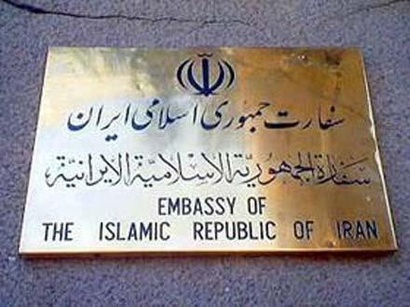
Iranian embassy sign

If the Parliament rejects the Additional Protocol, the administration will not be able to sign any agreement on the issue.

The U.S. State Department’s spokesman Alan Eyre’s statements on Iran`s obligation to ratify and implement additional protocol on its nuclear program is completely baseless, press service of Iranian embassy in Azerbaijan told Trend news agency on Feb. 9.

On Feb. 3, Eyre told Trend that the Geneva agreement reads that: Islamic Republic should ratify and implement additional protocol on the nuclear program within the authorities of the Iranian president and the parliament as well.

It should be noted that Iran and the P5+1 reached a nuclear agreement on Nov. 24, 2013. Iran has agreed to curb some of its nuclear activities for six months in return for sanctions relief. Iran and the P5+1 group agreed to implement the agreement starting January 20, 2014.

Under the agreement, six major powers agreed to give Iran access to $4.2 billion in revenues blocked overseas if it carries out the deal, which offers sanctions relief in exchange for steps to curb the Iranian nuclear program.

Additional protocol should pass the legal processes in Iran before implementation, the embassy statement reads, adding that Iranian parliament has the major role in the process.

The Additional Protocol allows unannounced inspections outside of declared nuclear sites and it is seen as a vital tool at the IAEA’s disposal to make sure that a country does not have any hidden nuclear work.

On October 16, 2013, Tasnim news agency quoted member of the Iranian Parliament’s National Security and Foreign Policy Commission, Hussein Naghavi Husseini as saying implementation of the Additional Protocol by the Islamic Republic should be ratified in the Islamic Consultative Assembly (parliament).

“If the Parliament rejects the Additional Protocol, the administration will not be able to sign any agreement on the issue,” Naghavi Husseini added.

Additional Protocol was endorsed earlier by Iran in 2003, but wasn’t officially ratified by the country’s parliament.

The U.S. and its Western allies suspect Iran of developing a nuclear weapon – something that Iran denies. The Islamic Republic has on numerous occasions stated that it does not seek to develop nuclear weapons, using nuclear energy for medical researches instead.

Off Topic: Palestinian official: Israel may attack Gaza to undermine peace plan

February 10, 2014

Palestinian official: Israel may attack Gaza to undermine peace plan, Xinhua Net, February 10, 2014

(Israel’s attempts to defend herself against attacks by Hamas seem to upset them. — DM)

Israeli Prime Minister Benjamin Netanyahu would attack Gaza if Kerry is going to propose a practical peace plan that is based on international law, Erikat told Xinhua.

GAZA, Feb. 10 (Xinhua) — Chief Palestinian negotiator Saeb Erikat said on Monday that Israel may wage a war on the Hamas- ruled Gaza Strip to foil an expected peace plan of U.S. Secretary of State John Kerry.

Israeli Prime Minister Benjamin Netanyahu would attack Gaza if Kerry is going to propose a practical peace plan that is based on international law, Erikat told Xinhua.

“This is a possible reaction to avoid signing a peace deal,” Erikat said.

He added Israel’s recent threats against Gaza are very dangerous, urging the international community to take what Israel is preparing for into consideration.

On Kerry’s peace plan that is expected to be proposed soon, Erikat said the Palestinian side has not received anything from the Americans so far.

The U.S.-sponsored peace negotiations between the Palestinians and Israelis resumed last July and are set to end in April.

However, Israeli and Palestinian negotiators have said on various occasions that no tangible progress had been achieved in the process.

Cross-border violence between Israel and Gaza militants has escalated recently, raising fears of a possible collapse of a one- year shaky cease-fire brokered by Egypt.


Iran Claims ‘Biggest Army In Region’ on Revolution Anniversary

February 10, 2014

Iran Claims ‘Biggest Army In Region’ on Revolution Anniversary, Israel National News, February 10, 2014

(Lots of missiles with a range of up to 2,000 KM are stored in underground launchers and available to strike Israel. Drones too. It sure is good that they are a peace-loving bunch of guys.– DM)

In time for 35th anniversary of Islamic Revolution, Iran showcases domestic military industry in latest threatening posturing.

Iranian armyIranian Armed Forces march in Tehran (file) Reuters

To mark 35 years since the 1979 Islamic Revolution in Iran, the regime held a special display of the nation’s domestic military industry advances in the last decade, bragging that it has the “biggest army in the region.”

The pinnacle of Iranian warfare was presented in the Shihab 1, 2 and 3 missiles, which feature a range of up to 2,000 kilometers(1,243 miles), enabling them to strike Israel. The missiles are fired from subterranean launchers, making them difficult to detect by satellite.

According to the Iranian army, the Shihab missiles can be fired rapidly in response to an attack.

In addition, the army boasted its Khalij Fars rocket, a supersonic ballistic missile developed for strikes on naval targets. The current version of the rocket has a 300 kilometer (186 mile) range, and is being developed to upgrade that range. The rocket features a 650 kilogram (1,433 pound) warhead.

Iran has developed several drones, the most advanced being the Fotros whose 2,000 kilometer radius allows it to strike Israel. The drone can stay airborne for 30 hours, and aside from intelligence gathering is armed to attack.

The army took the opportunity to showcase its domestically produced Saeqeh fighter jet as well, which is modeled after the F-18, along with the Qaher 313 stealth plane and combat helicopters based on the Cobra.

Iran hasn’t neglected its navy either; the Islamic regime showed off its battleships which include a 94 meter (308 feet) long ship weighing 1,500 tons, submarines including miniature submarines, as well as speedy patrol ships.

Additionally, an advanced radar was displayed called Dhu al-Fiqar, after the name of the sword given by Mohammed, the founder of Islam, to his son-in-law Ali, who is considered the inheritor of Islam by the Shia Muslims who rule Iran. The radar is built to locate low-flying rockets and tanks.

The flexing of military muscle follows threats by Iran on Saturday to the US, warning that it could strike American warships in the Persian Gulf. The same day, the country sent a naval fleet towards American maritime borders, a move the US downplayed.

America has lifted sanctions on Iran as part of an interim agreement, even as Iran reiterated on Sunday that International Atomic Energy Agency (IAEA) inspectors are forbidden from visiting the Parchin military base, long suspected as a site of nuclear bomb detonator tests.

Last Friday, Iranian TV aired a documentary simulating attacks on the US and Israel.

By Dalit Halevi, Ari Yashar

Iran says will not negotiate missile programme

February 10, 2014

Iran says will not negotiate missile programme – The Daily Star.

Febuary 10, 2014 10:59 AM (Last updated: February 10, 2014 02:21 PM)
Iran's Deputy Foreign Minister Abbas Araqchi speaks during United Nations day in Tehran, on October 22, 2013. AFP PHOTO/ATTA KENARE
Iran’s Deputy Foreign Minister Abbas Araqchi speaks during United Nations day in Tehran, on October 22, 2013. AFP PHOTO/ATTA KENARE

TEHRAN: Iran’s ballistic missile program will not be discussed in nuclear negotiations with world powers, the deputy foreign minister said in statements published Monday.

The remarks by Abbas Araqchi, who is also Iran’s lead negotiator in talks with world powers, came a week before negotiations were to resume on a comprehensive accord over Tehran’s nuclear ambitions.

“Iran’s defence-related issues are not up for negotiations,” Araqchi said, according to media reports.

“We will not discuss any issue other than the nuclear dossier in the negotiations,” he added.

US lead negotiator in the talks, Wendy Sherman, last week told a Senate hearing that Iran’s ballistic missile program would be addressed in the comprehensive deal.

“The defence-related issues are a red line for Iran. We will not allow such issues to be discussed in future talks,” said Araqchi.

Western nations and Israel have long suspected Iran of covertly pursuing nuclear weapons alongside its civilian program, allegations denied by Tehran.

Tehran insists its program — boasting long-range missiles with a maximum range of 2,000 kilometres (1,200 miles), enough to reach Israel — is an integral part of its defence doctrine.

It also denies ever seeking atomic weapons, saying its nuclear activities are for peaceful medical and energy purposes.

Iran struck an interim nuclear deal with world powers in November under which it agreed to roll back parts of its nuclear work in exchange for the release of billions of dollars in frozen assets and limited relief from crippling sanctions.

Talks on a comprehensive nuclear agreement are due to resume on February 18 in Vienna.

Iranian poet executed for ‘waging war on God’

February 10, 2014

Iranian poet executed for ‘waging war on God’ – Al Jazeera.

(These are the kind of reforms you can expect from the “moderate Iranian regime” ™.
And the world wants to allow nukes in the hands of these stone age barbarians? – Artaxes)

Death sentence carried out on ethnic Arab Hashem Shaabani, accused of being an “enemy of God” and a threat to security.

Last updated: 10 Feb 2014 04:37

A human rights groups says more than 300 people have been executed since Rouhani came to power [EPA]

An Arab-Iranian poet and human rights activist, Hashem Shaabani, has been executed for being an “enemy of God” and threatening national security, according to local human rights groups.

Shaabani and a man named Hadi Rashedi were hanged in unidentified prison on January 27, rights groups have said.

Shaabani, who spoke out against the treatment of ethnic Arabs in the province of Khuzestan, had been in prison since February or March 2011 after being arrested for being a Mohareb, or “enemy of God”.

Last July, the Islamic Revolutionary Tribunal found Shaabani and 13 other people guilty of “waging war on God” and spreading “corruption on earth”.

The 32-year-old was the founder of Dialogue Institute and was popular for his Arabic and Persian poems. In 2012, he appeared on Iran’s state-owned Press TV, where human rights groups say he was forced to confess to “separatist terrorism”.

According to BBC Persian, officials from the Ministry of Information informed the condemned men’s families that they had been hanged, and they would be subsequently informed on the location of the men’s burial site.

Shaabani was moved from the area to an unspecified prison before his death, it was reported.

Iran executed 40 people over two weeks of that month, according to Amnesty International. According to the Iran Human Rights Documentation Centre (IHRDC) more than 300 people have been executed since Hasan Rouhani became president in August.

In the past, Tehran has said the death penalty was essential to maintain law and order, and that it was applied only after exhaustive judicial proceedings. Most of the executions in January were for drug related offences, according to Amnesty.

Iran admits: May have worked on designing nuclear weapon

February 10, 2014

Iran admits: May have worked on designing nuclear weapon | JPost | Israel News.

( In addition, they acknowledged for the first time that the sky may have been blue. – JW )

By REUTERS

02/10/2014 10:46

Iran moves to cooperate in UN nuclear bomb probe, UN says progress has been made but: “There are still a lot of outstanding issues.”

Bushehr nuclear Iranian

Iranian security official at Bushehr nuclear plant. Photo: REUTERS

VIENNA –  Tero Varjoranta, the UN nuclear agency’s chief inspector, spoke to reporters on Monday, after Iran agreed to start addressing suspicions that it may have worked on designing an atomic weapon, a potential breakthrough in a long-stalled investigation into Tehran’s atomic activities.

Iran and the U.N. nuclear agency have made progress in talks on the country’s disputed nuclear program but there are still many outstanding issues, the watchdog’s chief inspector. Varjoranta said progress had been “good” but added: “There are still a lot of outstanding issues.”

The UN nuclear agency said on Sunday that Iran had agreed to start addressing suspicions that it may have worked on designing an atomic weapon. The development – although limited for now – marked a step forward in an international push to settle a decade-old dispute over Iran’s nuclear program. Tehran says this is peaceful, while the West fears that Iran wants to develop atomic arms.

The deal could also send a positive signal to separate, high-stakes negotiations between Iran and six world powers which are due to start on Feb. 18 in Vienna, aimed at reaching a broader diplomatic settlement with the Islamic state.

Efforts to end years of hostile rhetoric and confrontation that could otherwise trigger a new war in the Middle East gained momentum with last year’s election of a relative moderate, Hassan Rouhani, as new Iranian president on a platform to ease Iran’s international isolation.

The International Atomic Energy Agency said Iran had agreed during talks in Tehran to take seven new practical measures within three months under a November transparency deal with the IAEA meant to help allay concern about the nuclear program.

For the first time, one of them specifically dealt with an issue that is part of the U.N. nuclear agency’s inquiry into what it calls the possible military dimensions to Iran’s atomic activities. Iran has repeatedly denied any such ambitions.

It said Iran would provide “information and explanations for the agency to assess Iran’s stated need or application for the development of Exploding Bridge Wire detonators”.

Although such fast-functioning detonators have some non-nuclear uses, they can also help set off an atomic device.

“It is an important issue and it is good that the agency can now tackle it,” former chief IAEA inspector Herman Nackaerts said. But he made clear that much work remained in order to fully clarify the IAEA’s concerns: “It is a first step in a long process.”

Faced with deadlock last year in its attempts to get Iran to cooperate with its investigation, the IAEA changed tactics and now seeks to gradually build mutual trust by starting with some of the less sensitive issues, diplomats say.

Suggesting that more difficult matters would have to wait a while longer, there was no mention in the IAEA’s statement of its long-sought access to the Parchin military site, where it suspects explosives tests relevant for nuclear bombs may have been conducted a decade ago. Iran denies this.

DETONATOR DEVELOPMENT

The IAEA has been investigating accusations for years that Iran may have coordinated efforts to process uranium, test explosives and revamp a missile cone in a way suitable for a nuclear warhead. Iran says such claims are baseless and forged.

Other steps to be taken by Iran by May 15 include inspector access to the Saghand uranium mine and the Ardakan uranium ore milling plant as well as updated design information about a planned reactor the West fears could yield weapons material.

Iran will also give information on the extraction of uranium from phosphates. Uranium can fuel nuclear power plants but also provide the fissile core of a bomb if refined more.

The IAEA, tasked with preventing the spread of nuclear weapons in the world, says it needs such access and information to gain a more complete picture about Iran’s nuclear program.

It wants “to have a complete understanding of Iran’s uranium holdings”, said Olli Heinonen, another former chief IAEA inspector, now at Harvard University’s Belfer Center.

The Iran-IAEA talks are separate from, though still closely linked to, the wider diplomacy between Iran and the United States, France, Germany, Britain, China and Russia.

Shortly after Tehran and the IAEA signed their cooperation accord on Nov. 11, Iran and the six powers clinched an interim deal to curb its nuclear work in exchange for some sanctions easing, designed to buy time for the talks on a long-term deal.

The IAEA’s investigation is focused on the question of whether Iran sought atomic bomb technology in the past and, if it did, to determine whether such work has since stopped.

A joint Iran-IAEA statement issued after the Feb. 8-9 discussions said the two sides held “constructive technical meetings” and that Iran had implemented six previous, initial steps including access to two nuclear-related sites.

The IAEA had hoped to persuade Iran in the talks finally to start addressing its suspicions. While denying them, Iran has said it will work with the IAEA to clear up any “ambiguities”.

The issue of detonator development was mentioned in a report that the IAEA prepared in 2011 containing a trove of intelligence information about alleged activities by Iran that could be used in developing atomic arms.

“Given their possible application in a nuclear explosive device, and the fact that there are limited civilian and conventional military applications for such technology, Iran’s development of such detonators and equipment is a matter of concern,” the IAEA said in the 2011 document.

It said Iran had told the U.N. agency in 2008 that it had developed such detonators for civil and conventional military applications. “However, Iran has not explained to the agency its own need or application for such detonators,” it said.

(Editing by Stephen Powell)