Archive for February 7, 2014

Pentagon: ‘US Would Have No Clue If Iran Got Nuke’

February 7, 2014

Pentagon: ‘US Would Have No Clue If Iran Got Nuke’ – Israel National News.

New Pentagon report reveals US unable to detect nations acquiring nuclear bomb, expert notes India example – ‘we had no warning whatsoever.’

By Ari Yashar

First Publish: 2/7/2014, 9:00 AM
 

Bushehr nuclear reactor

Bushehr nuclear reactor
Reuters

A new report from the Pentagon warns that the US would be totally clueless if Iran were to obtain a nuclear weapon. The report reveals that America’s intelligence services are unable to detect when a nation has become nuclear armed.

Bret Stephens, a foreign affairs columnist for the Wall Street Journal, spoke about the report he recently analyzed while appearing on Fox News. There he noted the report exposes Vice President Joe Biden’s assurances, made in presidential debates with candidate Paul Ryan in 2012, as a lie.

“[Biden] said ‘for sure’ we would have ample warning before the Iranians decide to take their nuclear industrial capabilities and sprint toward a bomb,” Stephens noted. “This report tells us we probably wouldn’t have a clue.”

Proof of the American lack of early-warning capabilities come from Pakistan and India, two nations that achieved nuclear weapons with the US being none the wiser, notes Stephens.

“We had no warning whatsoever,” Stephens said about India. “And it’s not a closed society like a North Korea or Iran. …We like to imagine we have perfect intelligence, but that is just not true.”

The columnist declared that the world is entering a new phase of nuclear proliferation, in which countries from Turkey to Japan and South Korea are all expressing desires to have the option of a nuclear weapon. The number of nuclear powers are set to jump from “8 or 9 to 20 or 30,” warns Stephens.

“I think there’s a lot of doubt among our allies from Israel to Japan to South Korea about the strength of American security guarantees,” assessed Stephens, when asked about the reason a country like Japan, which has a security treaty with the US, would want the possibility of building a nuclear weapon. Tensions in Asia, particularly between Japan and China, have been reaching a boiling point over the contested Senkaku Islands lately.

Regarding Iran, Stephens added that the US is still prevented from inspecting Parchin, the military base suspecting of being used to test nuclear bomb triggering devices.

Nevertheless, the US has lifted sanctions on Iran during the 6 month interim deal, even as Iran’s Atomic Energy Organization Chief Ali Akbar Salehi said Wednesday that the deal does not limit Iran’s nuclear research and development.

Iranian lawmaker, cleric, and Majilis (council) member Mohammed Nabavian said in January that “having a nuclear bomb is necessary to put down Israel.”

The recent report confirms the warnings from a conference of security experts in the US last November, which announced the US is unprepared for an Iranian Electromagnetic Pulse (EMP) attack induced by a nuclear device. Such an attack would wreak havoc nationwide.

A Misleading Cold War Analogy

February 7, 2014

A Misleading Cold War Analogy – The Weekly Standard.

Don’t count on containing Iran.

Feb 17, 2014, Vol. 19, No. 22 • By ELLIOTT ABRAMS

Jerusalem

The Israeli debate over Iran’s nuclear program is, perhaps oddly, not yet heated. For now, the action is with the Americans: Israelis watch the negotiations nervously and without confidence, but there is little sense of impending doom—or impending war.

Gary Locke

Gary Locke

Opinion polls show that Israelis think Iran is building toward a weapon, not toward a “capability,” and they pay attention to Iran’s continuing acts of aggression (in Syria, for example), its support for terrorism, and the constant statements from Iran’s leaders about eliminating Israel from the map.

So why no panic? Perhaps Israel’s experiences with war and terror, facing Arab armies and more recently Hezbollah and Hamas, have immunized it from a panicked response. Perhaps there is faith in the Israel Defense Forces’ ability to stop Iran if the need arises. Or perhaps Israelis expect that in the end America will act to stop Iran from getting a bomb.

But during a recent visit I found another explanation as well—one that is more disturbing. Talking with members of what I’d call the “security establishment,” I found the occasional appearance of wishful thinking built around imagined Cold War analogies. That the Obama administration appears to harbor precisely the same hopes is no cause for comfort.

Here’s the theory: Once upon a time the United States and the Soviet Union almost came to war, in the Cuban Missile Crisis, and there were decades of deep and belligerent hostility. But over time, with the growing desire among Russians for economic improvement and the good things of life and the weakening of the Communist ideology among the ruling elites, that hostility eroded. Diplomatic relations were opened between Moscow and Washington, class warfare on a global scale was replaced by “peaceful coexistence,” a hot line was established, summits proliferated, and relations got into a groove of peaceful competition and occasional cooperation. The Soviet Union became a status quo power with which America could do business. So we waited, and watched while their economy rotted and their system became unreformable, the rulers lost faith in it, and finally it fell. Without a shot being fired, as Mrs. Thatcher once said.

So, the theory continues, that’s what we need to seek with Iran. Perhaps we are at an early stage; perhaps the religious elites, at any rate, haven’t lost their fervor. But they’ve lost popular support, lost the youth and the businessmen, and have realized they need a compromise. They are willing to slow down their nuclear program. Now they are led by “moderates” like Hassan Rouhani and Javad Zarif, who recognize the need for change. Time will erode their system just as it did the Soviet system, so is a war really necessary and unavoidable? Sure, if they leap toward a bomb, if they misjudge us, we’ll have to act or you Americans will. But in Cold War terms maybe it isn’t 1962 and the missile crisis and DEFCON 2; maybe it’s the 1970s or 1980s, and maybe there’s only a decade or so to go. So maybe we just wait.

That Israelis should entertain such a theory is natural, considering the price they might pay for an attack on Iran. And while rehearsing this approach they always repeat that if at some point they see Iran jumping for the bomb, they will have to bomb Iran. Still, what is striking is how this theory—whether expounded by Israelis or by Obama administration supporters—misunderstands the Cold War and its lessons.

First, it has to be said that Mrs. Thatcher’s wonderful line about Reagan winning the Cold War “without firing a shot” is false. Throughout the Cold War we fired shots. The greatest number of American casualties came in Korea and Vietnam, but on many other battlegrounds our soldiers and CIA agents, and our proxy forces, killed and died. Containment was not a series of speeches but a military strategy designed to impose costs on the Soviets and to constrain their behavior. Moreover, defeat on those foreign battlefields weakened the USSR and its alliance system—and perhaps more importantly weakened the party’s hold at home. There is no better example of this than the Soviet defeat in Afghanistan. For we understood that the way a tyranny keeps power is by tyrannizing, which defeat lessens its ability to do. It shows the populace that the rulers are not invincible, have been beaten, and may be beaten again.

From this perspective, recent American policy toward Iran is demoralizing—both to Iranians seeking freedom and to us. The American refusal to act in Syria, the unwillingness to see that the real war there is with Iran and its allies and proxies, the decision instead to permit Iranian and Hezbollah forces to fight there and keep Assad in power can only have strengthened the Islamic Republic. An Iranian elite that watched the Americans draw a red line in Syria and then back away from it can only view the red line we have drawn on their acquiring nuclear weapons as unconvincing.

In fact, if the history of the Cold War was a series of American hot wars, large and small, direct and indirect, that repeatedly confronted Soviet power, the record with Iran is the opposite. The Iranian regime has been killing Americans since the 1980s, in terrorist attacks in Lebanon and Saudi Arabia and through their very active role in Afghanistan and Iraq. For all those killings they have never paid a price, even though the U.S. government knew and spoke publicly about their supplying weapons, IEDs, training, and fighters to attack us. If vigorous American containment moved Moscow toward coexistence and weakened its ideological fervor over time, the lack of such American action should suggest that Iranian elites are far from that condition.

Second, the early Cold War was a time of nuclear proliferation. Stalin wanted the bomb, and so did Mao, and, more strikingly, so did the British and the French. Consider: We were in a tight post-World War II alliance with them in NATO, we were together in governing Germany, there were ironclad American commitments to defend Europe against the Soviets .  .  . yet the British and the French both said, “Thanks, that’s great, but we need the bomb too.” The lesson may be that if Iran gets the bomb, it is inevitable that the Saudis, Turks, and others will smile at possible American offers of defense arrangements and pledges, but see them as no substitute for their own little “force de frappe.”

Third, the comparison of Soviet and Iranian elites is itself misleading, for the Islamic Republic is still led by men motivated by religious faith. It was hard enough for the West to come, finally, to an understanding of communism as a substitute faith; books like The God That Failed taught us the nature of Communist belief. But Communist ideology was a weak reed when compared with belief in one of the great world religions. While Das Kapital was written just three years before Lenin’s birth, the ayatollahs have a real faith, not a substitute one. It is true that they have perverted Shia Islam with the state takeover of religion, and true that the older quietist school still has many adherents, but that does not suggest that the clergy running the regime are beginning to second-guess themselves and are about to produce a Gorbachev.

What produced a change in Soviet behavior was the willingness of the West, led by the United States, to fight the Cold War on the ground—and the willingness to fight it ideologically. Several Israeli officials reminded me that Reagan negotiated with the Russians just as Obama is negotiating with Iran. And the United States and the USSR had diplomatic relations, constant diplomatic contacts, and even regular summit meetings. That’s true but misleading, for while the Americans negotiated they also attacked: under Truman, Kennedy, and Reagan perhaps most forcefully. Reagan, after all, did not allow his desire for negotiations to prevent him from saying the Soviet Union was an “evil empire” that would end up on the “ash heap of history.”

The United States spent vast sums over the decades on Radio Free Europe, Radio Liberty, and similar efforts to undermine the Soviets, harnessing intellectual candle-power from the days immediately after World War II to the campaign of support for Solidarity in Poland. The missing equivalent today would be a campaign to undermine Assad in Syria, Hezbollah in Lebanon, and above all the Islamic Republic itself—not just by sabotaging centrifuges but by sabotaging its belief system, empowering dissident groups, and providing far wider Internet access just as during the Cold War we provided fax machines. The lesson of the Cold War is that any moves toward negotiation and coexistence on the military and diplomatic level must be matched by greater ideological clarity and aggressiveness on our side, or the message will be that we are giving up the struggle. That message will be received both by the regime, which will become more confident and more aggressive, and by the populace, whose hopes for freedom and whose willingness to struggle for it will be diminished.

Such clarity is entirely missing from the Obama administration’s approach to Iran, and has been since the Iranian people rose up in June 2009 and were greeted by American hesitancy and silence. Today we have instead what Ray Takeyh has called “the Rouhani narrative”: the administration’s explanation that Rouhani and his crowd are moderates whom we must strengthen by entering into agreements that lessen sanctions and make compromises on the nuclear file. Build them up, the argument goes, or the Revolutionary Guards and the supreme leader will get tired of them and throw them out.

The lessons of the Cold War teach that this is entirely wrong. First, there’s precious little evidence that people like Rouhani and Zarif are “moderates,” in the sense that they lean our way on human rights issues, Syria, or the nuclear weapons program. During Zarif’s recent visit to Beirut he laid a wreath at the grave of the terrorist Imad Mughniyeh, who was responsible for killing more Americans than any terrorists before 9/11. That’s moderation? Second, we do not strengthen such reformist voices as exist when we appear weak. The best argument such “moderates”—if they exist—could make is that aggressive actions in Syria or support for terror overseas or refusal to compromise on nukes are dangerous for Iran and threaten its security interests. When we act in ways that undermine this argument and suggest that we will do anything to avoid a confrontation, we strengthen the hardest of hardliners. When President Obama reversed himself on Syria, does anyone think Iranian “moderates” were strengthened—or instead the regime elements saying, “Press on, they are weak, they will get out of our way”? The best gifts Reagan gave those Russians who were really reformers were rising American defense budgets, support for rebels confronting Soviet-backed regimes in places like Afghanistan and Nicaragua, and the endless ideological warfare against communism.

The lesson is not that an American or Israeli attack on Iran is inevitable or preferable, only that the way to avoid it is clear thinking, a forceful diplomatic, economic, and ideological stand against the regime at home—and a military pushback against its adventurism abroad. Facing the Obama administration, Iran circa 2014 seems less like the Soviet Union of 1982 under the aging Brezhnev facing Reagan’s defense budgets and his ideological clarity than it does the Soviet Union acting in Angola, Nicaragua, and Afghanistan in 1979 and facing a Jimmy Carter who urged us to get over our inordinate fear of communism.

But after Carter came Reagan, the argument continues; doesn’t that teach us to wait, if necessary for another president and a new foreign policy? If we are confident Iran will not cross the nuclear finish line, perhaps. But 2017 is far away; from the Soviet invasion of Afghanistan to the presidential election of 1980 was only 10 months. If 2017 may be too late, if Iran will reach a nuclear capability far sooner, erroneous lessons from the Cold War offer no comfort. Reagan did not wait out the Soviets, he beat them. We have no such strategy now toward Iran.

Elliott Abrams is a senior fellow for Middle Eastern studies at the Council on Foreign Relations and author of Tested by Zion: The Bush Administration and the Israeli-Palestinian Conflict.

Off Topic: Gaza ministry denies ordering arrest of militants firing rockets

February 7, 2014

(Maan News Agency purports to be ” among the most browsed websites in the Palestinian territories, with over 3 million visits per month.” — DM)

Gaza ministry denies ordering arrest of militants firing rockets, Maan News Agency, February 6, 2014

Gaza rockets (MaanImages/file)

GAZA CITY (Ma’an) — Gaza’s ministry of interior on Wednesday denied media reports that the ministry had ordered security services to arrest militants launching rockets towards Israel, denouncing the rumors as “lies.”

“These are mere lies and falsifications and the minister’s office never released such a letter,” the minister’s office said in a statement.

The statement added that “such trivialities will never deceive our people and the ministry of interior headed by minister Fathi Hamad will continue to protect our home front and our resistance.”

Israeli news website Ynet published on Wednesday a document in Arabic that they said was a letter sent from the minister of interior’s office to the commander of Hamas’ military wing urging him to arrest those who launch rockets towards Israel.

The letter was addressed to Abu Ubayda al-Jarrah and called on him to ensure that security forces under his command monitor the areas from which rockets are being fired and to detain all “those who fire rockets even if it necessitates using force.”

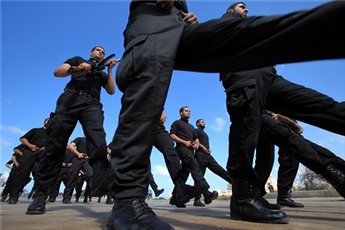
The reports comes a day after the Gaza government redeployed a military force on the border tasked with preventing militants from launching rockets towards Israel, which had been withdrawn a few days earlier in protest against repeated Israeli attacks on the Gaza Strip in recent weeks.

Despite the withdrawal of the force, forces were still tasked with maintaining the ceasefire with Israel, which has been in place since Nov. 2012 despite repeated Israeli violations and Palestinian reprisals.

Israeli forces have killed six Palestinians and injured 41 in attacks on Gaza in January, Ashraf al-Qidra, spokesman for Gaza’s Ministry of Health, said last week.

Additionally, Israeli forces have opened fire on numerous Palestinian protests in border areas, which Israel maintains as a “buffer zone” that has turned 17 percent of Gaza’s total land area and 35% of its agricultural land into a no-go zone according to UNOCHA’s 2010 statistics.

Palestinian militants, meanwhile, have fired an increased number of rockets toward Israel, which have all landed in unpopulated areas with no injuries reported.

Off Topic: On the Eve of the Fourth Palestinian “No”

February 7, 2014

On the Eve of the Fourth Palestinian “No,” Commentary Magazine  February 6, 2014

(What, in far less dangerous circumstances for the U.S., should President Obama do? — DM)

Secretary of State John Kerry’s efforts to orchestrate a peace agreement between Israel and the Palestinians has breathed new life into old arguments about West Bank settlements and the need for Israel to take risks for peace. Kerry’s clear advice to the Israelis that they must give the Palestinians what they want or find themselves boycotted and isolated is widely accepted as conventional wisdom by the foreign-policy establishment. The movement to boycott, divest, and sanction (BDS) Israel assumes Israel’s foes will ultimately win because in the absence of peace, frustration about failed negotiations will cause the Jewish state to be portrayed as the new South Africa, a crumbling nation that will be brought to its knees by economic warfare.

Israel’s enemies have always underestimated its resiliency and this time is no exception. But the problem with many of the discussions about such boycotts is that they invariably ignore some basic facts about the conflict between Israel and the Palestinians. If, in fact, Israel is willing to give up almost all of the West Bank and allow the Palestinians their independence, that renders moot Kerry’s condescending advice echoed by his supporters in the media. The majority of Israelis are rightly concerned about the consequences of a West Bank withdrawal and the very real possibility that the Hamas terror state in Gaza will be replicated in any other land that the Jewish state surrenders.

But the key question that those, like Kerry, who are urging the Netanyahu government to do just that is not about the merits of a pact that would make the Jewish state more vulnerable. Rather, it is about what Kerry and his minions will do after the Palestinians once again say, “no.” After all, they’ve already done it three times. And, if news reports are correct, they may be on the verge of a fourth rejection of American-imposed terms in the wake of Israel putting an offer of 90 percent of the West Bank while being compensated for the remaining ten percent with land swaps inside Israel’s pre-1967 borders, or other exchanges.

Though most in the news media treat this information as being slightly more obscure than the details of the Peloponnesian Wars, the fact is, Israel has already offered the Palestinians an independent state in almost all of the West Bank, Gaza, and a share of Jerusalem three times. And three times they refused to take yes for an answer. The first two refusals were straightforward “no’s” from Yasir Arafat in 2000 and 2001, who answered Ehud Barak’s peace offers with a terrorist war of attrition called the second intifada. The third time, Arafat’s successor Mahmoud Abbas was so worried about being forced to also say no that he fled the U.S.-sponsored negotiations with Israel in 2008 the moment the Israelis made their offer so as to avoid giving an answer.

If Abbas finds another reason to avoid accepting a generous deal that would give the Palestinians the independence they claim is their goal, it raises the question as to how Israel’s foes will justify the BDS campaign that Kerry says is the Jewish state’s fate if an agreement is not reached. Will they dismiss Israel’s offers as insignificant or not worthy of an answer? Or will they say that the difference between 90 percent of the West Bank plus swaps and every inch of the territories that Israel won in a defensive war in 1967 is so significant that it justifies an economic war on the Jewish state, terrorism, or both?

The answer to those questions is yes to all of the above. As was the case after 2000 and each time since then, apologists for the Palestinians will find a way to justify the indefensible and to rationalize their resort to violence and an international campaign bent on Israel’s delegitimization. But for the most part they will do what they have done since 2000 and merely ignore Israel’s offers of peace and consider the absence of an agreement as proof of the Jewish state’s responsibility for the continuation of the conflict.

The first time Israel sought to give the Palestinians the West Bank, their answer befuddled the Israeli left-wingers who had staked their political lives on the transaction. The government of Ehud Barak went to Camp David in the summer of 2000 determined to give the Palestinians an offer they couldn’t refuse. But when Arafat did refuse it, they hardly knew what to think. At a press event I covered in the fall of 2000, Shlomo Ben Ami, Israel’s foreign minister at the time conveyed his shock at the way his effort to satisfy the Palestinian desire for independence had somehow led to a new and bloody conflict. Yet he said there was a silver lining to these tragic events since at least the world would now know which side wanted peace and which had chosen war. More than 13 years later, I still don’t know whether to laugh or to cry at his naive faith in international public opinion.

As we now know, rather than undermine the Palestinian narrative of victimization those events only increased international support for the position and criticism of Israel. That was repeated again after Israel’s withdrawal from Gaza in 2005 when, again, an Israeli effort to make peace was repaid in blood as the evacuated territory was transformed into a launching pad for Hamas rockets aimed at Israeli civilians.

The prime obstacle to peace remains a Palestinian political culture which still views Israel’s existence as a crime and considers Tel Aviv, let alone the blocs of communities along the old border or in Jerusalem’s suburbs, to be as much of an “illegal settlement” as the most remote hilltop holdout of Jewish extremists in the West Bank. In the absence of a change in that culture that will allow Abbas to make a peace that would be based on a denial of the “right of return” for the descendants of the 1948 refugees and recognition of the legitimacy of a Jewish state, there is little chance that the Netanyahu government’s offer of 90 percent of the West Bank will be accepted. Nor is a slightly more generous formula likely to do the trick. As they did in 2000, 2001, and 2008, the Palestinian leadership seems to be preparing their public for more conflict, not for acceptance of an accord that would force them to give up their dream of Israel’s destruction.

Rather than twisting Netanyahu’s arm to do what it his country has already tried to accomplish in the past—trade land for the promise of peace—Israel’s critics should be thinking about how they will react to the fourth Palestinian “no.” Unfortunately, the odds are most will barely notice it and simply go on blaming Israel. Indeed, that’s what the Palestinians—who know that’s what happened the first three times they turned down peace—are counting on.

Off Topic: Two rockets fired from Gaza explode in open areas in Ashkelon and surrounding area

February 7, 2014

Two rockets fired from Gaza explode in open areas in Ashkelon and surrounding area, Jerusalem Post, February 6, 2014

No injuries or damage reported in attacks; Code Red alert siren heard in area prior to landing of first rocket.

A rocket launched from the Gaza Strip.
Gaza rocket at sunset Photo: REUTERS/ Darren Whiteside

Two rockets were fired from the Gaza Strip into Israel on Thursday evening. The first rocket exploded in the Ashkelonarea in an open area and the second one also landed in an open area Eshkol Regional Council later in the evening.

No injury or damage was reported.

Prior to first the rocket’s landing, a Code Red missile alert siren went off in Ashkelon and surrounding areas.

Contrary to reports in a number of Israeli media outlets, the IDF confirmed that there was no interception of the rocket by the Iron Dome rocket defense system.

Last week the Iron Dome rocket defense system intercepted a rocket over the southern city of Eilat. There were no reports of injuries or damage in that attack.

The Sinai-based jihadist organization Ansar Beit al-Maqdis has claimed credit for the Eilat attack.