Archive for February 6, 2014

Iran’s bomb in the basement

February 6, 2014

Column one: Iran’s bomb in the basement, Jerusalem Post,  Caroline B. Glick, February 6, 2014

Iran either has a bomb already or is about to get one. And, having been abandoned by the White House, we face this threat alone.
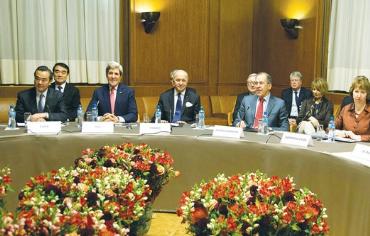
Nuke talks, Nov 2013 Iran nuclear talks at the Palais des Nations in Geneva, November 24, 2013. Photo: REUTERS

It is happening in slow motion, to be sure.

But we are witnessing how a nuclear armed Iran is changing the face of the Middle East.

For years, US leaders, including President Barack Obama, warned that a nuclear armed Iran would spark a regional arms race.

And this is happening.

As the Wall Street Journal’s Bret Stephens (a former Jerusalem Post editor in chief) noted this week, Turkey signed a nuclear cooperation agreement with Japan that includes “a provision allowing Turkey to enrich uranium and extract polonium, a potential material for nuclear weapons.”

Saudi Arabia has long had a nuclear cooperation deal withPakistan, whose nuclear weapons program the Saudis financed.

Jordan and Egypt have both raised the prospect of developing nuclear programs.

And in 2007, Israel bombed a Syrian nuclear installation built for it by North Korea and paid for by Iran.

In his article, Stephens cited a recent report by the Pentagon’s Defense Science Board stating that the world is entering into “a new nuclear age” that, as we see is characterized by everyone, including non-state actors, seeking to develop and proliferating nuclear capabilities.

Iran’s nuclear status has opened the floodgates to this era of nuclear chaos.

Also in response to Iran’s nuclear progress, Gulf states and others are treating Iran with newfound deference. Kuwait,Qatar and Oman all seem to be breaking ranks with Saudi Arabia by expressing support and indeed obedience to Iran.

Shortly after word broke in late November that the US and its partners had reached an interim nuclear deal with Iran, Iranian Foreign Minister Muhammed Javad Zarif took a victory lap in Kuwait and Oman.

In his press conference with his Kuwaiti counterpart, Zarif said, “We believe that a new era has begun in ties between Iran and regional states which should turn into a new chapter of amicable relations through efforts by all regional countries.”

Zarif also visited Lebanon, Jordan and Iraq. In Beirut, he took on the role previously held by the US and France when he mediated between Hezbollah and the March 14 movement to form a new government.

The fact that Hezbollah has since reneged on its agreement to the deal doesn’t mean that Iran is weaker than it thought. Hezbollah is Iran’s proxy. Its refusal to join the government means that Iran is now demanding better terms than it previously accepted. Its new terms require total Hezbollah domination of the country.

As Michael Rubin reported in Commentary this week, the Iraqi Kurds, who have been US allies for decades, have now accepted Iranian mediation of their leadership crisis.

All of this newfound deference toward Iran owes entirely to Iran’s new nuclear status.

In Washington, the Obama administration placed the full weight and prestige of the White House on its campaign to derail a widely supported bill in Congress to install additional sanctions against Iran in six months if Iran fails to comply with its obligations in the interim Joint Plan of Action. Over the past week, due to administration pressure, the Senate buried the sanctions bill.

Far from feeling the need to protect its agreement with the mullocracy, it appears that the administration’s main goal in that campaign was to weaken and discredit AIPAC, which supported the sanctions bill.

As Lee Smith noted this week in Tablet, weakening the pro-Israel advocacy group has become one of the administration’s major second-term goals.

AIPAC was the target of the administration’s campaign rather than the sanctions themselves because the sanctions regime against Iran – painstakingly cobbled together over a decade – disintegrated last November. When word of the interim deal got out, the stampede of European businessmen to Tehranbegan.

This week’s delegation of a hundred French businessmen to Iran in search of deals that could bring as much as $20 billion into the country was just the latest demonstration that the entire debate about sanctions is an irrelevant sideshow.

Just as its leaders have always believed, Iran’s new nuclear status is its economic salvation.

Most observers are missing Iran’s rise to the stature of regional hegemon because the Iranian regime has yet to try out its new power against Israel. With Iran and its Syrian and Hezbollah proxies tied up in their jihads in Iraq and Syria, they haven’t yet been able to turn their guns on Israel. But when the fighting in those theaters abates, there can be little doubt that Israel will move to the top of their target list.

And as Jonathan Schanzer pointed out in Foreign Policy this week, the Middle East is being flooded with advanced weapons that erode Israel’s qualitative military edge over its adversaries.

Hezbollah and Hamas have 60,000 missiles in their arsenals – three times the number they possessed at the end of the 2006 Second Lebanon War. And as Schanzer noted, these missiles are far more powerful and precise than the ones they fielded eight years ago. Hezbollah’s Yakhont missiles can strike naval vessels within 120 kilometers of Lebanon’s coast. Hamas has advanced anti-aircraft missiles that threaten the air force.

As for the air force, its fleet of F-15s and F-16s is already a decade old.

Syria, of course has retained more than 95 percent of its chemical weapons arsenal. And its forces are more battled hardened than ever before.

Iraq, now largely an Iranian satellite, is receiving advanced drones from the US. There is no reason to trust that those drones will not be shared with Iran and Hezbollah.

In his interview last month with CNN’s Fareed Zakaria, President Hassan Rouhani stated unequivocally that contrary to claims by Obama administration officials, Iran will never “under any circumstances” destroy any of its centrifuges.

Zakaria said that means the negotiations for a final nuclear deal with Iran will end in “a train wreck,” since the sides’ conceptions of what was agreed to “look like they are miles apart.”

But Zakaria is wrong. The talks won’t end in a train wreck. Indeed, they may never end at all.

Catherine Ashton, the EU’ foreign policy chief, said Sunday that negotiations with Iran may well go on after their six-month deadline in July.

Moreover, whether the negotiations go on forever or end at a certain point, the result won’t be a train wreck. It will be Iran with a nuclear bomb or nuclear arsenal in its basement, waiting for a propitious moment to conduct a nuclear weapons test or attack.

Last spring, Rouhani gave a television interview explaining how he used his position as Iran’s chief nuclear negotiator in 2003 to facilitate Iran’s nuclear weapons program. Rouhani boasted that they massively expanded uranium enrichment at Natanz, and constructed the nuclear reactor at Bushehr and the heavy water plant at Arak under the cover of the negotiations.

In testimony last month before the US Senate Select Committee on Intelligence, Director of National Intelligence James Clapper said that Iran has already reached the breakout point where it can assemble nuclear weapons at will. In his words, Iran’s “technical advancements strengthen our assessment that Iran has the scientific, technical and industrial capacity to eventually produce nuclear weapons.”

Obama and his advisers claim that the US has the intelligence capability to know if and when the Iranians move from breakout capacity to actual bomb making.

But as Stephens reported, the Defense Science Board report rejects that conclusion. According to the board, the US does not have the capability to know when a country moves from breakout capacity to an actual arsenal.

So given Rouhani’s previous subterfuge, there is every reason to assume that Iran is using its current negotiations to move from breakout capacity to a nuclear arsenal.

This state of affairs has grave implications for Israel.

Today it is no longer self-evident that Israel has the capacity to effectively strike Iran’s nuclear installations.

Through deed and word, the White House has made clear repeatedly that it prefers a nuclear- armed Iran to an Israeli strike to prevent Iran from becoming a nuclear power.

As it has done several times over the past six years, the Obama administration can be expected to continue to use the many means it has at its disposal to prevent Israel from launching such an attack.

Moreover, with each passing day Iran’s nuclear sites become more and more difficult to attack successfully. And Iran’s technological capabilities have vastly expanded over the past decade.

Today Iran can replace damaged or destroyed centrifuges much faster than it could in the past.

Iran’s ally North Korea has also expanded its nuclear capabilities and its arsenal. Pyongyang is ready and willing to sell Iran replacements for any nuclear components that might be destroyed in a military strike.

Finally, Iran recognizes the implications of growing European and US hostility toward the Jewish state. It knows that if Israel openly attacks Iran and sets back its nuclear weapons program, the EU and the US will punish Israel, and express sympathy with Iran, and so give the Iranians cover to rapidly rebuild any lost capabilities.

Iran’s achievement of breakout capacity and seemingly unfettered path to a bomb in the basement, and its consequent rise to the position of regional hegemony, is the greatest Israeli foreign policy failure since the 1993 Oslo Accord with the PLO.

Our leaders on the Right failed us. They were too weak to pay the diplomatic price for attacking Iran’s nuclear installations when Israel could have easily set the program back for a decade or more.

Our leaders on the Left failed us. Their messianic faith that America will protect us from Iran if we just surrender to Palestinian terrorists lulled us to sleep at the watch when we needed to be most vigilant.

Today, due to the administration’s full-bore assault on Israel’s right to defensible borders and to our historic heartland, we have devoted ourselves to a fruitless and irrelevant discussion of how much of our land and our security we need to give up to appease the Palestinians who will never, ever be appeased.

Our leaders continue to hope that a proper mix of concessions to the PLO will convince Obama to stand by his empty pledge to prevent Iran from becoming a nuclear power.

Obama will do no such thing. Concessions to the Palestinians will weaken us militarily and politically. And they will give us no advantage over Iran. While it is important to deal with the administration’ hostile insistence on unreciprocated Israeli concessions to the PLO, we cannot ignore Iran.

Iran either has a bomb already or is about to get one. And, having been abandoned by the White House, we face this threat alone.

We must now, immediately and consistently, do whatever we can still do to diminish the Iranian threat.

“I Don’t Bluff”

February 6, 2014

“I Don’t Bluff – MOSAIC Magazine”.

(At long last, the right questions are asked and the logical conclusions are drawn. What took you so long, guys? I am amazed. Anyone with half a brain could arrive at these conclusions long ago.
And just to prove my point I refer to a little article I wrote more then a month ago : The Deal Matrix
But still I’m happy that finally someone did it. – Artaxes)

Suppose the president never intended to roll back Iran’s nuclear program. How then would he proceed?

By Michael Doran | February 6, 2014 at 5:00am

Photo courtesy Flickr/pennstatenews.
 
President Obama has repeatedly promised to do whatever it takes to prevent Iran from acquiring a nuclear bomb. If there is no other choice, he says, he will resort to force. In a March 2012 interview with Jeffrey Goldberg, the president famously rejected the alternative policy, namely, allowing Iran to go nuclear and then trying to contain it. He emphasized the point dramatically: “[A]s president of the United States,” he said, “I don’t bluff.”

Really? Suppose this statement was just a show of toughness, timed to keep supporters of Israel on his side during the 2012 campaign season. Suppose that, when it came to Iran, in his heart of hearts, the president actually preferred a strategy of containment to a strategy of prevention. Suppose that was actually his policy aim from the outset—but, for obvious reasons, he couldn’t say so. How would he proceed?

He would proceed exactly as he has been proceeding—trumpeting his intention to roll back the Iranian nuclear program while actually avoiding confrontation at all costs.

To gain a sense of the president’s methods, consider first the saga of Syria’s use of chemical weapons that developed in 2013. Each time the situation called for a tough response, Obama telegraphed a punch—his famous “red line”—but then never actually delivered the blow. 

The White House first realized that Bashar al-Assad had employed chemical weapons in the spring of last year. Its immediate reaction, however, was anything but a rush to enforce the president’s announced red line. On the contrary, it stalled for time. When the political pressure to respond became unbearable, the White House announced, in June, an intention to increase aid to the Syrian opposition. The president, it now seemed clear, was going to force Assad to pay a price for his barbarity. But the announcement soon revealed itself as a ploy to buy still further time, the diplomatic equivalent of “the check is in the mail.” The aid never arrived.

Then came the August 21, 2013 chemical attack that killed around 1,500 Syrian civilians. This time, the administration reacted quickly. Within days it appeared absolutely determined to punish Assad. Any doubts about its resolve were dispelled on August 30, when Secretary of State John Kerry stood before the television cameras and delivered a Churchillian speech justifying immediate missile strikes against the regime. But then, instead of ordering military action, the president decided to seek congressional authorization for the use of force, knowing full well that such a bill had little chance of passing. In short, he punted.

Call it the case of the vanishing reprisal. It is a pattern that reflects the president’s deep aversion toward U.S. involvement in open-ended conflict in the Middle East. His legacy, he has made abundantly clear, is to end such involvement. And just as that dictated doing nothing to stop Assad, it has dictated a posture of complacency toward Iran.

Indeed, the failure—or, better, the refusal—to stand up to Assad in Syria was also a failure to contain the Iranian Revolutionary Guards and their proxy, Hizballah. After all, these two actors did the most to turn the tide of the Syrian civil war. It was their direct intervention that broke the momentum of the insurgency and rescued the Assad regime from destruction. 

Here, too, the same pattern is at work. Few have noticed the degree to which, in dealing with Iran’s aggressive behavior in the Middle East, Obama has broken ranks with his predecessors in the White House. For the last 35 years, every other American president has defined countering Iran’s malign influence as a vital American interest. To be sure, Obama still pays lip service to this traditional policy. “We are clear-eyed about Iran’s support for terrorist organizations like Hizballah, which threaten our allies,” he assured us again in this year’s State of the Union address. But the gap between word and deed has been glaring.

Recently, Obama went so far as to envision Iran as a constructive force in regional security. “[I]f we were able to get Iran to operate in a responsible fashion,” he told David Remnick, the editor of the New Yorker, “you could see an equilibrium developing between . . . [Sunni] Gulf states and [Shiite] Iran in which there’s competition, perhaps suspicion, but not an active or proxy warfare.”

In poker terms, this would be known as a “tell,” a behavioral tic that inadvertently reveals a player’s bluff. In the case of Iran, as in the case of Syria, the president is looking for an exit.

Nowhere is this more evident than in the nuclear negotiations with Tehran that resulted in the interim deal reached in Geneva in November. Even strong supporters of the president’s policy are now publicly expressing doubts about that deal. Thus, Fareed Zakaria, the former managing editor of Foreign Affairs and former editor of Newsweek International, came away flabbergasted from an interview that he conducted for CNN with Iranian President Hassan Rouhani at the recent World Economic Forum in Davos. So impressed was Zakaria by the yawning gulf between the American and the Iranian positions that he called the interim deal “a train wreck.” 

Even more startling is the skepticism of Dennis Ross, who, until late 2011, was a senior official in the Obama White House with responsibility for the greater Middle East. A study group recently chaired by Ross assessed the interim deal as so “deeply flawed” as to “undermine the effort to prevent a nuclear Iran.” 

Obama himself has let it be known that he is not optimistic about the prospects of the next round of negotiations. In his interview with Remnick, he put the chance of success “at less than even.” These are low odds. But does that mean that the president has already worked up a tough Plan B? Is he preparing a response that will leave the Iranians in no doubt that they will be worse off if they fail to satisfy the minimum requirements of the United States and its partners? Or will we witness yet another instance of the vanishing reprisal?

The questions have already answered themselves. The outline of the real Plan B is fully visible in the Joint Plan of Action (JPOA) that emerged from Geneva. Technically, that deal lasts six months, but it can be extended indefinitely by mutual consent. While the parties to the agreement express the “aim” of reaching a comprehensive agreement within a year, they are also careful not to commit themselves in any way. The deal, in other words, is less interim than interminable.

Obama’s surrogates are already telling us to expect a very long negotiation. “I think it’s extremely unlikely that it will be possible to reach a comprehensive agreement in the next six months,” says Gary Samore. He ought to know; until last year, he served as the top arms control official in the White House. Samore thus spoke with authority when he concluded: “We’re in for a rolling series of extensions.” In short: endless process, no endpoint.

And consider where we’re already at in this process. Despite claims to the contrary, the JPOA does not “dismantle” any part of the Iranian nuclear program. It pauses some aspects, while others proceed apace. A “research” loophole allows the Iranians to continue work on advanced centrifuges. In short, Iran gets to have it both ways: to enjoy sanctions relief (the West’s part of the deal) while continuing to build up its nuclear program (Iran’s part of the deal).

Much energy on the part of the White House has been invested in painting a contrary picture. We are assured that real progress has been made; we are even told that Iran has embarked on a historic reconciliation with the West. The president, even as he admits to doubts about the prospects of success, deftly encourages exaggerated hopes for the ongoing negotiations in order to seize the moral high ground from skeptics. The White House has even taken to branding its critics as warmongers seeking to sabotage the chances for peace. “If certain members of Congress want the United States to take military action, they should be upfront with the American public and say so,” warned Bernadette Meehan, a White House staffer.

Thus the interim deal allows the president, too, to have it both ways. He makes concrete concessions to Iran in the present while promising get-tough policies in the future—at, that is, some very distant point in the future, which, as it draws nearer, will assuredly vanish in turn like a mirage in the desert.

“As I sat there,” writes former Defense Secretary Robert Gates in his new memoir, “I thought: The president doesn’t trust his commander [on the ground] . . . , doesn’t believe in his own strategy, and doesn’t consider the war to be his. For him, it’s all about getting out.” Gates is describing a White House discussion about Afghanistan. But it might just as well have been about Iran—or, for that matter, Syria. The president doesn’t trust those who have traditionally managed the conflict with Iran, doesn’t believe in his own strategy, and doesn’t consider the struggle to be his. He wants out.

Continuing to profess an unshakable resolve to roll back the Iranian nuclear program, the president has blunted every argument for a tougher policy and found plausible-sounding excuses to resist all calls for increased pressure on Tehran. While denying it vehemently, he has put the United States on a glide path to accepting a nuclear Iran—bluffing all the way.

_________________

Michael Doran, a senior fellow of the Saban Center for Middle East Policy at the Brookings Institution, is a former deputy assistant secretary of defense and a former senior director of the National Security Council in the George W. Bush administration. He is finishing a book on Eisenhower and the Middle East. He tweets @doranimated.

Ayatollahs Celebrate 35 Years of Terror

February 6, 2014

(The new moderate Iran with President Rouhani and his Charmin offensive looks different depending on the eyes through which, and where, one looks. Perhaps that minor problem that can be solved with blindfolds, so that Islamophobes and Zionists don’t deny humanitarian Iran her “rightful place” as a peaceful nuclear power. — DM)

Ayatollahs Celebrate 35 Years of Terror, Front Page Magazine, February 6, 2014

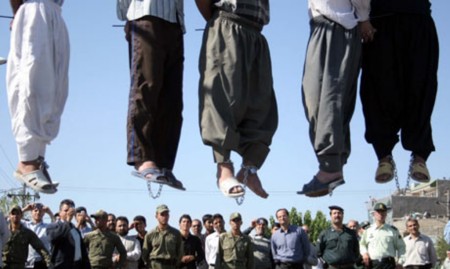
Hang them high

I was born after the Islamic Revolution of Iran, at the beginning of the eight-year-long Iran-Iraq war and lived most of my life in the post-revolutionary era under the Ayatollah and Shiite Islamic Sharia law. I remember many people that underestimated the power of the Islamist movement, of Ayatollah and Imam Ruhollah Khomeini and his followers. Yet, here we are at the 35thanniversary of the establishment of the Islamic Republic of Iran, with a much stronger, centralized regime that has been successful at promoting its ideology across the region, creating proxies such as Hezbollah, funding other Islamist movements, and thwarting America’s (and its allies’) security interests, as well as the U.S.’s foreign policy, geopolitical, geostrategic and geo-economic objectives in the region.

The Ayatollah, Mullahs, and Iranian leaders are celebrating the 35th anniversary of the establishment of Islamic Republic of Iran by Ayatollah and Imam Ruhollah Khomeini and his extremist followers.

It is also worth noting that due to the Carter administration’s foreign policies, the United States stood by and watched one of our (and Israel’s) staunchest allies in the Middle East be controlled by Shiite Islamic Ayatollahs and clerics; Iran was turned into one of the U.S.’s most robust and determined geopolitical, geostrategic, and geo-economic enemies.

This considerably shifted the balance of power in the Middle East, as the Islamic Republic built a firmer alliance with Russia and China, to counter American and Israeli foreign policy objectives in the region.

Ceremonies began in Iran on Saturday, marking the 35th anniversary of the victory of the 1979 Islamic Revolution, which deposed pro-US Muhammad Reza Shah and brought in the Islamic Republic.

The beginning of the 10 days of celebration, called the 10-Day Dawn (Fajr) festivities across Iran, marks the day when the late founder of the Islamic Republic, Imam Ayatollah Ruhollah Khomeini, arrived back home from exile on February 1, 1979, after having spent more than 14 years away, mostly in the Iraqi holy city of Najaf, with some time in Turkey and France.

These 10 days will culminate in one of largest nationwide rallies on February 11th, to celebrate the anniversary of the triumph of the Islamic Revolution.

After overthrowing the secular and pro-Western state, the Ayatollahs instituted a new social order based primarily on Islamist thoughts, Shari’a law, and Shiite ideals like the introduction of Jurisprudent Leadership (Vilayat-e Faqih) and giving divine power to the Supreme Leader (Vali)—whose legitimacy lies in his piety and his supposedly unmatched knowledge of Islam.

Article 57 was added to the constitution to emphasize this shift: “The powers of government in the Islamic Republic are vested in the legislature, the judiciary, and the executive powers, functioning under the supervision of the absolute religious leader and the Leadership of the Ummah, in accordance with the forthcoming articles of this Constitution…”

This gave the Supreme leader the absolute power to veto, enact, or suspend any law that was deemed to be un-Islamic based on his interpretations. All articles of the constitutions became subject to approval of Islamic laws. This created an artificial façade of democracy. For example, while the constitution gives rights to writers, journalists, and bloggers to write freely, everything should still comply with Islamic and Shiite laws.

To be precise, the arrest, torture and execution of writers were legitimized by the ruling leaders and clerics because of the enforcement of Article 24 which states, “Publications and the press have freedom of expression, except when it is detrimental to the fundamental principles of Islam or the rights of the public. The details of this exception will be specified by law.”

In other words, every article in the constitution became subject to Article 4: “All civil, penal financial, economic, administrative, cultural, military, political, and other laws and regulations must be based on Islamic criteria.  This principle applies absolutely and generally to all articles of the Constitution as well as to all other laws and regulations, and the wise persons of the Guardian Council are judges in this matter.” This law gave the ruling Ayatollah and Iranian leaders the sovereign power and institutional mechanisms to implement and ensure compliance with Islam, as defined by the ruling clerics.

Is the establishment of the Islamic Republic of Iran getting weaker?

The answer is mixed. Regarding regional and international realms, the Islamic Republic has definitely become a much more centralized state compared to its 1979 condition. The nation is also on the verge of becoming a nuclear power and nuclear-armed state.  The Islamic Republic has also grown to be more self-sufficient in some industries, particularly in military capabilities, including multiple ballistic and cruise missile systems— such as Shahab-3, the Shahab-3D— investment in nuclear technologies, missile-equipped drones with a range of 2,000 kilometers like the Fotros drone (copying the US drone captured by Iranian forces), automobiles such as Sepehr, and air-to-air missiles such as Fatter (a copy of U.S. AIM-9 Sidewinder). This partial self-sufficiency has mostly concentrated on military programs since the 1980s, as also seen in the frequent announcements by Iranian leaders on various technological breakthroughs including the building of jet fighters, submarines, tanks, and torpedoes.

When it comes to domestic policies, the Iranian government has definitely become more masterful in cracking down, suppressing, and implementing the discriminatory laws against religious minorities, segregating the society based on gender, executing dissidents, imposing dress code, stifling the potential of both society and economic opportunity.  But this has also created a large section of the society (primarily the youth population under 30 years of age who comprise approximately more than 50% of the Iranian population) to become disaffected and disenchanted with the Islamic regime. Finally, if there is going to be any real threat to the Ayatollahs and Iranian leaders, it will most likely be from this young section of the population, rather than any action from external forces.

by 

Rocket hits in open area south of Ashkelon

February 6, 2014

Rocket hits in open area south of Ashkelon – Israel News, Ynetnews.

Red alert siren sounds in Ashkelon region as residents hear explosion

Matan Tzuri

Published: 02.06.14, 20:44 / Israel News

A red alert siren sounded in the Ashkelon region for the second time Thursday

No injuries or damage were reported. The rocket was most likely launched from the Gaza Strip.

Earlier on Thursday, a color red alert sounded in the Hof Ashkelon Regional Council. Shortly after the sirens heard, a rocket hit was detected near the Gaza Strip border fence. No injuries or damage were reported.

Despite assurances by Hamas that it will operate with determination to prevent rocket launches on Israel by the various Palestinian factions in the Gaza Strip, Israel has yet to feel any relief.

In the last week, rockets have fallen on open areas in the Negev, Eilat, and in the coastal council of Ashkelon. Islamic Jihad had taken responsibility for the launches on Eilat, and – according to reports by Palestinian sources in the Strip – Hamas had called in all factions involved in terror activities to clarify its wishes for showing restraint in an attempt to maintain the relative calm.

At a security conference on January 29, Military Intelligence Chief Brigadier General Aviv Kochavi said that despite a drop in the number of missiles and rockets threatening Israel, their level of precision has drastically risen.

“Some 170,000 rockets and missiles are threatening the State of Israel from all regions. Up until recently, the number was much greater and it has decreased, but it will go up again.

“They are much more precise and a lot more lethal. The most significant thing we would like to point out is the fact that the enemy has the capability to land mass amounts of arms on Israeli cities,” he said.

Iran Hosts Palestinian Islamic Jihad Leaders

February 6, 2014

Iran Hosts Palestinian Islamic Jihad Leaders – Washington Free Beacon.

(Feel the love …
Of course, this story will be ignored by the fools who only hear the wonderful, soothing words from those smiling butchers who represent a regime that is not content with killing, raping and oppressing its own citizens but wants to murder the citizens of another country too.
– Artaxes)

Top Iranian officials praise anti-Israel terror group

Javad Zarif / AP

Javad Zarif / AP

BY:
February 6, 2014 12:25 pm

Senior Iranian leaders on Wednesday hosted a delegation of top officials from Palestinian Islamic Jihad (PIJ), a deadly anti-Israel terror group that is sanctioned by the U.S. State Department.

The PIJ delegation arrived in Tehran on Wednesday to hold high-level meetings with leading Iranian lawmakers, as well as with Iranian Foreign Minister Javad Zarif, who also is leading nuclear negotiations with the West, according to regional reports and photographs.

Zarif expressed his support for PIJ’s “resistance” against Israel, which includes terror attacks, suicide bombings, and the murder of Jewish citizens.

“The resistance will undoubtedly succeed in defending the rights of Palestinians,” Zarif was quoted as saying by Iran’s state-run PressTV following a meeting with PIJ’s deputy secretary general Ziyad al Nakhalah.

Zarif was also photographed smiling and clasping hands with al Nakhalah, who the State Department officially recognized this year as a “Specially Designated Global Terrorist.”

Terrorism experts warned that Iran’s nuclear diplomacy continues to be coupled with support for terror groups across the globe.

“This underscores the fact that despite the ongoing diplomacy between Iran and the U.S. over its nuclear program, Iran continues to sponsor terrorism around the world,” said Jonathan Schanzer, a former terrorism finance analyst at the U.S. Treasury Department. “PIJ is now perhaps the most dangerous actor in the Gaza Strip in light of the support it receives from the Iranian regime.”

Iranian lawmakers who met with the PIJ delegation praised the group’s efforts to destroy Israel.

“Resistance and campaign against the Zionist regime is the only way to liberate Palestine and securing the rights of its oppressed people,” Iranian Parliament Speaker Ali Larijani was quoted as saying during a meeting with PIJ leaders.

PIJ member Ramazan Abdullah responded by saying that “Iran has always been the main supporter of the Palestinian nation’s cause and goals,” according to Iran’s Fars News Agency.

PIJ, with support from Iran, has grown close to Hamas.

It has been sanctioned by the State Department for conducting “numerous attacks, including large-scale suicide bombings against Israeli civilian and military targets,” among them terror attacks that have killed Americans. The State Department has additionally noted that PIJ “receives financial assistance and training primarily from Iran.”

The very public and high-level meetings between Iran and the PIJ are a sign that this relationship has not waned as Tehran attempts to court the West. Iran’s ties to the terror group Hezbollah have also grown stronger in recent months.

Iranian Supreme Leader Ali Khamenei’s has noted in the past that Iran has “direct involvement in the Palestinian and Lebanese confrontation against Israel.”

PIJ’s Abdullah noted during his meeting with Iranian leaders that “the only way for Palestinians to move forward is to follow the path of resistance,” according to PressTV.

Obama’s dangerous game on Iran is now becoming clear

February 6, 2014

Obama’s dangerous game on Iran is now becoming clear – The Telegraph.

By World Last updated: February 5th, 2014

Photo: AFP/REUTERS

One of the most unfortunate pieces of White House spinning over the Iran nuclear negotiations is that those who supported new sanctions legislation – including several Democrat senators – were effectively “voting for war”.

They weren’t. What they were voting for was an alternative way of dealing with Iran. A more results-driven and fact-based approach, that clashes with several of the premises that underpin the current Kerry-Obama approach to the negotiations.

The new Senate sanctions bill (now successfully stalled, it seems) didn’t call for new sanctions straight away. What it did was seek to put a hard floor under the negotiations process: if no deal was reached within 12 months – the six months of the “interim deal” plus six months grace – then the sanctions would kick in.

There was good reason for this approach. Sceptics – or perhaps better, pragmatists – didn’t want Tehran to keep endlessly rebooting the negotiations. Their fear was that Iran would simply wait while their economy picked up as sanctions started to unravel under the weight of market expectations and then cut a deal from a position of strength.

Mr Obama always vigorously refuted this analysis as scaremongering, saying sanctions were “limited” and “reversible”, and that Iran’s feet would held to the fire to ensure they did actually cut a meaningful deal.

Already, however, there are signs that the pragmatist’s analysis has turned out to be correct. First it emerged last month that Russia was engaged in negotiating a $1.5 billion-a-month backdoor trade/barter deal.

Then, this week, a group 116 of France’s top businessmen, including representatives from companies like Renault, Total and Airbus, visited Tehran on a trade mission offering further evidence that market expectation is picking up: when German CEO’s see their French counterparts racing to Tehran to get first dibs on any deals, you can bet they won’t be far behind.

In both of these cases the White House and State Department has officially cried foul, describing the French delegations and Russian deals as “unhelpful” and of “serious concern”.

Perhaps they really are concerned, fearing that their negotiating leverage is visibly ebbing away, since it’s hard to drive a bargain with Tehran to give up its nuclear programme when Iran is getting what they want (economic relief) anyway.

But there is another theory – that this is precisely what the White House wants. Look at this quotation from Wendy Sherman, the US’s top Iran negotiator, giving evidence to a senate committee this week in response to the French trade gambit.

We hope people don’t go to Tehran. That is our preference. But those who go raise hopes that the Rouhani administration’s going to have to deliver on. And the only way they can deliver on those hopes is a comprehensive agreement that we will agree to, and that means a verifiable assurance that they are not developing, creating, will have – obtaining a nuclear weapon.

And so although we don’t want people to go, because we think it does send the wrong message, if they do go, it puts pressure, perversely, on the Rouhani administration. Because as far as we have seen to date, there are not deals getting done, but rather people getting first in line in the hope that someday there will be a deal.

It does make you wonder if the White House is perfectly happy with what is happening. The strategy would seem to be to try and buy Tehran off with the promise of trade/money even before the deal is done.

Is this really wise? We should be careful of dangling too juicy a carrot, too close to the horse’s mouth, or we might find that the horse just gobbles the carrot, and then – belly full – cannot be coaxed in the right direction?

At that point, to stretch the horse analogy, you have to resort to wielding a big stick. But in the Obama administration’s case, the debacle over Syria has already taken that option off the table. The public won’t wear it, and it probably wouldn’t work anyway.

It is – genuinely, no cop out here – too early to say if the White House strategy will work, but make no mistake, it is highly risky.

In a good negotiation, you start by advertising your top line and then negotiation downwards to a compromise.

The P5+1 have started these negotiations by constantly advertising their bottom line, to the point that people like Jack Straw are sent to Tehran to warn sceptics on the his own side about the risk of Tehran walking away if we drive too hard a bargain.

This is like playing poker and warning your fellow players in advance just how big a bet they need to make in order to bluff you into folding your hand.

Iran wants economic relief – it’s why they came to the table – and the best time to have asked for something substantial in return was when they were at their most needy, probably when the Omani back-channel was open last year.

Since then leverage – which is what actually gets results in negotiations – has been seeping away. With the threat of military action so remote, the onus on sanctions as a real driver of change has never been heavier.

But to listen to Wendy Sherman, the White House is already constructing rationales for the benefit of weakening that lever too, as officials from both sides privately soften the ground for the talks running over the initial six months.

At the time of the interim agreement negotiations in Geneva, senior diplomats selling the deal hard behind closed doors to journalists and senators in Washington, were adamant that a deal could be done in that time.

Now people like David Ignatius, the Washington Post columnist who – it is often said – you should read if you want to know what Obama really thinks, writes that:

Both Iranians and Americans privately doubt a final pact can be reached in that time frame, but if good-faith bargaining continues, Iran and the P5+1 group of world powers may agree to extend the interim freeze another six months. The United States has officially been mum on any such extension.

It is pretty clear the game that is being played here. On sanctions, on time frames the goalposts are shifting as many sceptics predicted they would.

Let’s hope their predictions don’t keep coming true.

Off Topic: Bennett: Why Should Israel Pay for US Policy Mistakes?

February 6, 2014

Why Should Israel Pay for US Policy Mistakes? Israel National News, February 6, 2014

Economics Minister insists Israel focus on looking out for its own interests, says Kerry’s plan ‘would bring tragedy to Israel’.

Bennett, Israel Naftali Bennett, Flash90

The United States has made many mistakes in its Middle East Policy, and it is Israel that has paid for those mistakes, Economics Minister Naftali Bennett said Thursday. Speaking to Israel Radio, Bennett pointed out to a range of what he said were errors and miscalculations by the U.S., vowing that he would not allow Washington to impose yet another tragic mistake on Israel.

“Washington insisted on instituting elections for the Palestinians, and they elected Hamas,” Bennett said. “Washington insisted that Israel withdraw from Gaza, and in return we got tens of thousands of rockets on southern Israel, after democratically elected Hamas took over Gaza.”

Now, a new idea has cropped up – having NATO troops defend Israel in the Jordan Valley and other areas that Israel withdraws from in Judea and Samaria as part of a final-status agreement with the Palestinian Authority. Like the other ideas the U.S. has had, this one would bring tragedy to Israel, and Israelis must make sure this does not happen, Bennett said.

“We will never let anyone else be responsible for our security,” said Bennett. “Only the IDF will defend Israelis. In recent weeks we have been told that if we make a deal with the Palestinians then prices will go down, but if we don’t Israel will be isolated and forsaken. I would suggest that all these people making these threats think twice. Israelis are stronger than these threats, and no one will persuade us to destroy our national home with these threats.”

Bennett added that he had nothing against U.S. Secretary of State John Kerry, and he was very appreciative of Israel’s special relationship with the United States. Neither Kerry nor the Obama administration were “anti-Semites,” as some were saying, he said, but it was up to Israel to look out for its own interests, and to make the decisions it needed to make to defend itself.

If a framework for an agreement is presented, he added, it would be brought to Israelis for a referendum.

By David Lev

Iran says it may modify Arak reactor to allay Western concerns

February 6, 2014

Iran says it may modify Arak reactor to allay Western concerns | JPost | Israel News.

By REUTERS

02/06/2014 13:20

First official statement by Iranian nuclear energy chief to show flexibility; West believes plant could produce plutonium for nuclear weapons.

Arak

Iran’s heavy-water production plant in Arak, southwest of Tehran. Photo: REUTERS

DUBAI – Iran is prepared to modify its planned Arak heavy water reactor to help allay Western concerns, its nuclear energy chief said in published remarks that could be the first such suggestion by a senior Iranian official.

Western powers, preparing for negotiations with Iran on a long-term deal defining the scope of its disputed nuclear program, fear Arak could provide a supply of plutonium – one of two materials, along with highly enriched uranium, that can be used for the core of a nuclear weapon – once operational.

The Islamic Republic has said the reactor is designed to produce isotopes for medical treatments, and has denied that any of its nuclear activity is geared to developing a bomb.

In an interview with Iran’s state-run Press TV, Ali Akbar Salehi, head of the Atomic Energy Organization of Iran, did not spell out how any changes could be made to the Arak plant.

Press TV reported Salehi as saying he did not believe Western concerns over Arak were genuine, calling them a “fabricated fire” used to put Iran under political pressure.

But he added: “We can do some design change, in other words make some change in the design, in order to produce less plutonium in this reactor, and in this way allay the worries and mitigate the concerns.”

Heavy water reactors, fueled by natural uranium, are seen as especially suitable for yielding plutonium. To do so, however, a nuclear reprocessing plant would also be needed to extract the plutonium.

Iran is not known to have any such reprocessing facility.

The fate of Arak was a big sticking point in talks last year that led to a landmark agreement to curb Iran’s nuclear program in exchange for some easing of sanctions.

Under the Nov. 24 agreement Iran pledged to not install any additional reactor components or produce fuel for the plant during the six-month period of the deal.

US officials have made clear the reactor must be dealt with under any final settlement. “They do not need a heavy-water reactor at Arak in order to have a peaceful nuclear program,” Wendy Sherman, the US Undersecretary of State for Political Affairs, told lawmakers in Washington on Tuesday.

Iran already has built a heavy-water production plant that is to be linked to the still unfinished reactor.

The future of the Arak site is expected to be one of the most thorny issues to resolve in the negotiations on a long-term nuclear deal with Iran due to begin on Feb. 18.

Some Western experts have suggested a possible way forward might be to reconfigure the heavy water reactor into a light water reactor, which experts say would be much less amenable to any attempt at nuclear proliferation.

(Reporting by Mehrdad Balali in Dubai and Fredrik Dahl in Vienna; Writing by William Maclean; Editing by Mark Heinrich)

Iran’s Rouhani: Nuclear deal has made ‘Zionist regime very angry’

February 6, 2014

Iran’s Rouhani: Nuclear deal has made ‘Zionist regime very angry’ – ynetnews.

(The irony. The moderate nazi talking about radicals. – Artaxes)

In interview to state television in Iran, Rouhani said the interim nuclear accord reached between Iran and world power has angered the ‘Zionist regieme’ and ‘radicals in the US’ because of their ‘Iranophobia’

Reuters

Published:  02.06.14, 10:46 / Israel News
 
Iranian President Hassan Rouhani appeared on state television to talk about a landmark deal made with six world powers aimed at curbing the Iranian nuclear program on Wednesday (February 5).

He was speaking in an interview with the state television station Islamic Republic of Iran Broadcasting (IRIB). “This move (the nuclear deal) has caused much anger among our enemies,” Rouhani said.

“You can see that the radicals in America are saying something new every day. The Zionist regime is very angry and our dear people witness how upset they are with this agreement. I want to state that this is the first success of the great nation of Iran in cooperating with the world,” Rouhani added, referencing US legislators bent on imposing new sanctions on the Islamic Republic, as well as Israeli objection to the interim agreement reached in Geneva.

Hassan Rouhani (Photo: MCT)

Hassan Rouhani (Photo: MCT)

Asked why he thought Iran was being portrayed as a threat in the west, Rouhani replied that the country’s ‘enemies’ wanted what he called ‘Iranophobia’ to spread across the world.

“We wanted to stamp out this Iranophobia conspiracy, to tell the world that this is a lie. Iran is not a threat to anyone. Iran’s activities are completely peaceful and its doors are open to international supervision based on law and within the frameworks of law. In my opinion, before dealing a blow to the sanctions, we must first deal with the Iranophobia conspiracy,” he said.

Asked about the apparent lack of response by Iran to what he called a ‘tale of lies’ by American officials, he said the government did not feel the need to justify themselves to the Iranian people.

“We have no need for interviews. Our people understand completely,” he said.

Aimed at easing a long festering stand-off, the interim pact was made between Iran and the five permanent members of the UN Security Council (the United States, France, Britain, China and Russia) plus Germany.

The deal was reached in November in Geneva, designed to persuade Iran to curb parts of its nuclear work, in return for an an estimated $7 billion in sanctions relief. Easing of sanctions began in late January.

“Good relations with neighbors is one of our main principles: it is an important priority for us. Of course, all the countries in the region are among our foreign policy priorities as well as relations with other world powers.

“Regarding the issue of the joint action plan or what is known as the Geneva agreement, our people witnessed that in the first step we were able to reach an agreement with the great powers while keeping the dignity and preserving the rights of our nation. Today we are seeing that many of these oppressive chains that were unrightfully bound on the economic movements of our society, are being torn apart,” he said.

However, members of the US Congress have argued that it was unwise to ease sanctions before Iran took aggressive action to rein in its nuclear program, which the United States, Israel and others suspect may be aimed at building bombs. Iran has denied this.

US lawmakers have some influence over Iran policy because of their ability to pass legislation imposing fresh sanctions on Iran, something US President Barack Obama has opposed during the current negotiations and threatened to veto.

Hard-line clerics close to Iranian Supreme Leader Ali Khamenei, Revolutionary Guards commanders and the intelligence services have attacked the temporary concessions Rouhani has made, although Khamenei has so far backed the president.

Rouhani, whose election led to a thaw in ties with the West after years of confrontation and hostile rhetoric, has promised to pursue a consistent foreig policy of “prudence and moderation” to revive the economy.

Off Topic: The petulant Secretary Kerry

February 6, 2014

The petulant Secretary Kerry, Times of Israel,  By David Horovitz, February 5, 2014

How dare those stubborn Israelis deny him his nine-month peace treaty

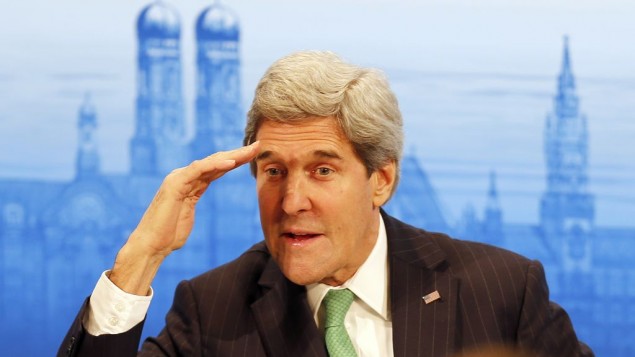
Kerry Salutes US Secretary of Foreign Affairs John Kerry salutes as he attends the 50th Security Conference in Munich, Germany, Saturday, Feb. 1, 2014. The conference on security policy takes place from Jan. 31, 2014 until Feb. 2, 2014. (photo credit: AP/Frank Augstein)

US Secretary of State John Kerry may feel heartfelt concern about the growing campaign to delegitimize Israel and to boycott it. One of the least smart and least constructive ways to tackle the danger, however, is by issuing an anguished public prediction that this is what awaits Israel if his peace effort fails.

But then the indefatigable secretary has consistently displayed a grievous absence of smarts when it comes to Israel, and the wider Middle East.

It remains inexplicable how Kerry, on taking office, could decide that he was capable of bridging the gulfs between a weak-willed Palestinian Authority President Mahmoud Abbas and a profoundly skeptical Israeli Prime Minister Benjamin Netanyahu, in an era of utter instability in the Middle East. Did his hubris obliterate the recollection that less than five years earlier, a far more flexible Israeli prime minister, Ehud Olmert, operating at a time when extremists were not filling every possible territorial vacuum in Israel’s immediate neighborhood, was rebuffed by Abbas with a peace offer Netanyahu would never come close to replicating?

Undeterred by two decades of incontrovertible evidence that setting deadlines and trying to turn the screws on the Israeli and Palestinian leaderships to force a deal simply doesn’t work, Kerry publicly professed his confidence not only that he would soar where all predecessors had failed, but that he could achieve the hitherto impossible in a mere nine months.

When reality first bit, he withdrew to nurse his wounds, and returned with a fallback position: A full peace deal? Well, perhaps not. But how about a “framework” covering the big issues, so that we can at least keep talking beyond the unfeasible deadline.

In the last few weeks, though, it has become clear that even a binding framework agreement is beyond reach. No, Mr. Netanyahu does not trust the Palestinian Authority to keep Israel secure from the east. No, Mr. Netanyahu does not believe Abbas’s regime would long survive without the IDF in the area, and is not prepared to risk a Hamas takeover of the West Bank. No, Mr. Netanyahu does not intend to drag tens of thousands of settlers out of their homes. No, Mr. Abbas will not belatedly decide to confront the narrative permeated deep in the Palestinian psyche by Yasser Arafat and suddenly declare that the Jewish state is legitimate. No, Mr. Abbas will not publicly abandon the demand for a “right of return,” even though that demand amounts to a call for the demographic destruction of Israel and therefore prevents the establishment of Palestine.

So the secretary has fallen back again; seeking now to broker a non-binding framework agreement, as a vehicle to keep the talks going. Well, if you set the bar low enough — as the P5+1 countries proved so dismally in Geneva in November — even the most recalcitrant players may be persuaded to clear it.

Kerry’s public musing in Munich at the weekend about Israel’s “illusionary” thinking on peace and prosperity sounded like the moaning of a petulant child: I want my nine-month peace treaty, and I want it now!

(Let me stress that I have no time for those on the rejectionist right who waded in to publicly assail the secretary. The Naftali Bennetts, Ofir Akunises and Danny Danons of this world dismally seize every opportunity to advance their one-state non-solution.)

Israel, Mr. Secretary, has no illusions about the hostility all around it and the anti-Semitism painted as anti-Zionism further afield. It has no illusions, either, about the fragility of its current economic well-being. It has a prime minister who finds it unconscionably hard to defy the extremists who would subvert its democracy by populating remote areas of Judea and Samaria that Israel has no intention of permanently retaining, and who wish to see us ruling over another people for the foreseeable future. But this is a prime minister, too, who has freed 78 largely unreformed terrorists in the cause of these peace talks (unfortunately so; he should, rather, have instituted a settlement freeze), who has publicly embraced the two-state solution, who is plainly prepared to contemplate territorial compromise even with the region in such dangerous flux.

The true path to Israeli-Palestinian peace lies not in attempting to strong-arm reluctant, mistrustful leaders to sign up to this or that latest lawyerly draft of an accord. It runs, rather, via the gradual marginalization of extremists and the encouragement of moderates. It requires ending the vicious incitement against all things Israeli, not just in Gaza but also in the West Bank, and the promotion of hierarchies that advocate reconciliation.

This takes work — gradual, painstaking work, from the sides themselves, helped by the outside would-be peacemakers. That doesn’t mean a dozen more two-day attempts at coercive top-down shuttle diplomacy. It means real engagement, led by the US, involving the wider international community, identifying educators and investors and journalists and every other potential grassroots advocate of reconciliation, gradually achieving change from the bottom up, which in turn will impact leaderships. There is no quick fix. But there are slower fixes. It’s not that we need less outside help; we need more, but properly directed, strategically directed.

Good diplomacy also involves reading the riot act, privately, to Netanyahu — telling him that while Israel will always be portrayed as the key obstacle to peace because it has a state and the underdog Palestinians don’t, the prime minister would help his cause if he seized the initiative as a credible force for moderation by, for instance, announcing that there will be no further investment in isolated settlements and that the residents of those settlements can seek financial compensation at any time to relocate to consensus areas.

And good diplomacy requires telling Mr. Abbas that there will no Palestinian state so long as he insists upon the “right of return,” because Israel, the only place on earth where the Jews get to determine their own fate, is not about to commit demographic suicide. It requires telling Mr. Abbas to change the tone of what’s taught in his schools, broadcast on his TV channels, and published in his newspapers, to reflect the reality that there are competing claims to this narrow strip of land and that neither of the competing peoples is going anywhere.

Good diplomacy, Mr. Secretary, means that you most certainly should address the boycott and delegimitization issue in public — to make plain that it is unconscionable to misrepresent Israel as some kind of illegal entity; to explain that the notion that the Jews, uniquely, have no right to a state is an apartheid argument; to underline that historic Jewish Israel was revived by international mandate and that it was those who spoke for mandatory Palestine’s Arab residents who prevented the simultaneous establishment of a first-ever Palestinian state 66 years ago, and to urge that those who purport to support the Palestinian interest use their influence to encourage both sides toward viable positions that can enable long-term co-existence.

And good diplomacy, centrally, involves taking practical steps to marginalize those outside powers that relentlessly foster extremism and terrorism and violence — those enemies of peaceful co-existence — led by Iran. The Obama administration failed the people of Iran when they tried to rise up against their regime. It has failed to protect the people of Syria from slaughter. It has offered no coherent guidance to would-be democrats in Egypt.

And its latest diplomatic “achievement” has set Iran more firmly than ever on its path to nuclear threshold status — allowed to enrich uranium, allowed to improve its technology for enrichment, allowed to continue its weaponization and missile development programs. The Iranians came to the table desperate, and you, Mr. Secretary, sent them home crowing — failing to use your authority and influence to force their admission that they were working toward the bomb and to ensure they were halted.

In short, the most profound concerns that Israelis have about the fragility of their security and prosperity stem somewhat less from their failures, Mr. Secretary, than from yours.