Archive for February 4, 2014

Pay Day for the Mullahs

February 4, 2014

Pay Day for the Mullahs, Front Page Magazine, February 4, 2014
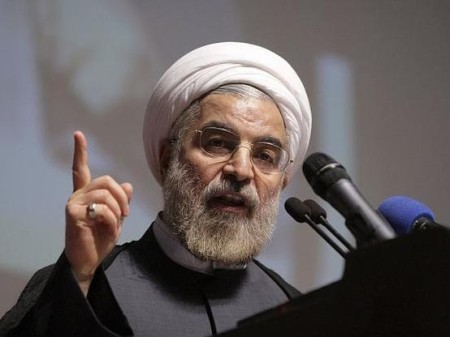
Hassan-Rouhani-450x337

Iran is receiving $550 million of its frozen oil revenues under the interim nuclear deal the Obama administration has pushed forward with Iran. The United States “helped facilitate the transfer” of the funds to Iran through unnamed foreign banks according to Reuters, citing a U.S. Treasury spokeswoman.  Iran’s official IRNA news agency has reported that the $550 million already has been transferred to Iran’s Central Bank account in Switzerland. This transfer is just the first installment of the $4.2 billion of blocked Iranian oil revenues held abroad that the U.S. has committed to help unfreeze.

“The Capitalists will sell us the rope with which we will hang them,” Vladimir Lenin once famously said. The Obama administration is going one step further. It is involved in handing the mullahs money with no strings attached, which they will undoubtedly use for a further military build-up with which to threaten the United States and its allies.

Consider the following chilling words from a top Iran military official, Brig. Gen. Hossein Salami, as quoted by the Daily Caller on February 1st.  He made these remarks during a televised interview:

America, with its strategic ignorance, does not have a full understanding of the power of the Islamic Republic.  We have recognized America’s military strategy, and have arranged our abilities, and have identified centers in America [for attack] that will create a shock. We will conduct such a blow in which they [America] will be destroyed from within.

Another top Iranian military official said last month: “Know that a direct conflict with America is the strongest dream of the faithful and revolutionary men around the world.”

Consider that nothing in the interim agreement stops Iran from continuing its research and development of a nuclear triggering device.  The money flowing to Iran, as the Obama administration opens the spigot wider and wider, will help pay for it.

Consider too that nothing in the interim agreement stops Iran from continuing to develop or acquire long-range intercontinental ballistic missiles which can reach the United States and Europe, as well as Israel. Indeed, the latest annual “Worldwide Threat Assessment of the US Intelligence Community” states that Iran “wants to improve its nuclear and missile capabilities” on which it has already “made technical progress.”

This same intelligence assessment warned of the continued danger that North Korea will remain an exporter of ballistic missiles and nuclear technology to Iran. Nothing in the interim nuclear agreement would hamper Iran’s ability to use the money we are letting loose to purchase nuclear materials or weapons from its buddies in Pyongyang. Instead of oil-for-food, as the fault-ridden program in Iraq was known, the Obama administration is enabling an unfrozen-oil-revenues-for-weapons program.

Among the non-nuclear-related weapons that a senior Iranian Air Force commander just announced Iran is planning to build are semi-heavy and training jets. The announcement was made on February 3rd – the very day the first installment of Iran’s frozen oil revenues was released.  The plan to build the jets was sent to senior officials to receive their approval, and “once approved, the Defense Industries will start building them,” the senior Air Force commander, Islamic Republic Air Force Chief Liaison Officer General Aziz Nasirzadeh, said. “We have taken very good measures in producing aircraft ammunition, long-range ammunition and smart missiles,” he added. Now Iran will have more money in its hands to continue to do so.

Iran will also be able to obtain insurance, previously subject to sanctions, for the tankers carrying its crude oil to its remaining major customers in China, India, Japan, Korea, Turkey and Taiwan. This will mean “Iran’s crude oil exports will not decline and our customers will be able to purchase oil from Iran without any anxiety and they will not have to look for alternatives to Iran crude oil,” Ali Majedi, a deputy minister for international affairs and trading explained.  And with the lifting of sanctions on Iran’s petrochemical industry as part of the interim agreement, Iran will be able to increase its hard currency revenues from that source as well. Again, Iran will get its hands on more money to pay for further militarization and to fund its mischief in the Middle East and beyond, thanks to the current lifting of sanctions under the interim agreement.

The Intelligence Assessment referenced above describes just some of the mischief that Iran and its proxy Hezbollah are pursuing, in addition to Iran’s continued work on developing a nuclear arms capacity:

Outside of the Syrian theater, Iran and Lebanese Hizballah [Hezbollah] continue to directly threaten the interests of US allies. Hizballah has increased its global terrorist activity in recent years to a level that we have not seen since the 1990s…Iran will continue to act assertively abroad in ways that run counter to US interests and worsen regional conflicts. Iranian officials almost certainly believe that their support has been instrumental in sustaining Assad’s regime in Syria and will probably continue support during 2014 to bolster the regime. In the broader Middle East, Iran will continue to provide arms and other aid to Palestinian groups, Huthi rebels in Yemen, and Shia militants in Bahrain to expand Iranian influence and to counter perceived foreign threats.

In short, the Obama administration and its fellow negotiators of the interim agreement with Iran have sent Iran the first installment of money, with more to come, that Iran will turn around and cheerfully use against us.

by 

Off Topic: Israeli settlers mock Kerry’s peacemaking with spoof video

February 4, 2014

Israeli settlers mock Kerry’s peacemaking with spoof video, U.K. Telegraph, February 4, 2014

(Ridicule can, occasionally, be the most effective form of protest —  DM)

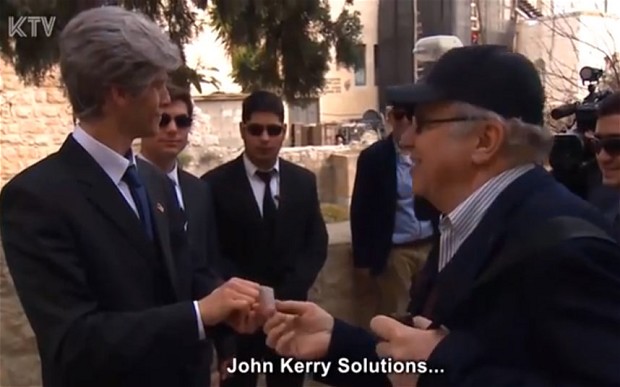
The main settlers’ lobby has released a video ridiculing John Kerry’s Middle East peace efforts, undermining a plea from the White House for Israeli politicians to desist from personal attacks on the US secretary of state.

The main settlers’ lobby has released a video ridiculing John Kerry’s Middle East peace efforts, undermining a plea from the White House for Israeli politicians to desist from personal attacks on the US secretary of state.

Kerry Israeli solutionsAt one point, the Mr Kerry character is seen down-playing the importance of the Western Wall, one of the holiest sites in Judaism, in Jerusalem’s old city Photo: YOUTUBE

Israel’s Yesha [settlers] Council has posted online a deliberately disrespectful spoof depicting America’s top diplomat – played by an actor resembling John Kerry – riding a camel and making a series of preposterous statements that belittle his understanding of the region’s complexities.

At one point, the Mr Kerry character is seen down-playing the importance of the Western Wall, one of the holiest sites in Judaism, in Jerusalem’s old city.

“Dividing Jerusalem is not an easy thing,” the actor says. “We must realise it is holy to all religions – Jews, Christians, Muslims, Buddhists, Klingons and Hobbits. But what I’m saying is: ‘why fight over an old wall?’

I’ll build you a brand new wall, close to the beach.”

A woman with an American accent is then seen telling him: “I think you should go home, where you belong, and stay there.”

Dani Dayan, the Yesha Council’s international envoy, said the video aimed to “highlight the infeasibility of John Kerry’s proposals, which are at best unrealistic and at worst a danger to the State of Israel.”

It was released after several high-ranking Israeli politicians launched apparently coordinated attacks on Mr Kerry for warning at a security conference in Munich last weekend that the Jewish state faced the risk of an economic boycott if no peace deal was reached with the Palestinians.

Naftali Bennett, the industry minister and leader of the far-Right Jewish Home party, accused Mr Kerry of acting as a “mouthpiece for anti-Semitic boycott threats”.

In response, Susan Rice, the US national security adviser, issued a series of tweets on Tuesday denouncing the criticism.

“Personal attacks in Israel directed at Sec Kerry totally unfounded and unacceptable,” Ms Rice wrote in one tweet. Another said: “U.S. Govt has been clear and consistent that we reject efforts to boycott or delegitimize Israel.”

Earlier this month, Moshe Yaalon, a hawkish Israeli cabinet minister, triggered the diplomatic row by dismissing Kerry’s frenetic peacemaking efforts as meddling motivated by “an incomprehensible obsession and a sense of messianism”. “The only thing that might save us is if John Kerry wins the Nobel Prize and leaves us be,” he was reported to have said by an Israeli newspaper.

Benjamin Netanyahu, the Israeli prime minister, who had earlier labelled calls for a boycott “immoral and unjust”, told members of his Likud party on Monday that attacking Mr Kerry personally was wrong. “We are in the midst of a complex, sensitive and difficult process, and there may be misunderstandings down the line,” he said. “The way to clear up misunderstandings must be professional, to the point, and not about the person.”

Iran Nuclear Substance Could Face New U.N. Scrutiny

February 4, 2014

Iran Nuclear Substance Could Face New U.N. Scrutiny – Global Security Newswire.

Feb. 4, 2014

International Atomic Energy Agency Director General Yukiya Amano, left, attends a panel discussion with Iranian Foreign Minister Mohammad Javad Zarif on Saturday at the Munich Security Conference. Amano suggested his agency could further question Iran over past work involving a key nuclear substance.

International Atomic Energy Agency Director General Yukiya Amano, left, attends a panel discussion with Iranian Foreign Minister Mohammad Javad Zarif on Saturday at the Munich Security Conference. Amano suggested his agency could further question Iran over past work involving a key nuclear substance. (Christof Stache/AFP/Getty Images)

Iran could face new international scrutiny over previous activities tied to a potential ingredient for initiating nuclear detonations, Reuters reports.

The International Atomic Energy Agency might discuss Iran’s past work with polonium 210 at a Saturday meeting with Iranian delegates, the news agency reported on Monday, citing recent comments by IAEA Director General Yukiya Amano. The U.N. organization is seeking to shed light on Iran’s atomic ambitions by investigating allegations that the Middle Eastern nation may once have conducted experiments relevant to nuclear-bomb development. Tehran insists its atomic activities are nonmilitary in nature.

“Polonium can be used for civil purposes like nuclear batteries, but can also be used for a neutron source for nuclear weapons. We would like to clarify this issue,” Amano said at the Munich Security Conference this past weekend.

The U.N. agency in 2008 said it was satisfied with prior Iranian disclosures tied to polonium, and the IAEA chief’s reason for calling new attention to the rare substance was uncertain. A number of Iranian researchers in the 1980s had suggested pursuing an investigation on generating the material, but the effort ended prematurely following the departure of a key scientist, according to past disclosures reported by the agency.

The 2008 statement said the agency would also continue its probe on the matter with the intention of verifying its initial conclusions. Mark Hibbs, a nuclear expert with the Carnegie Endowment for International Peace, said Amano’s organization might have obtained new data pertaining to Iran’s work with the substance.

IAEA spokeswoman Gill Tudor, though, said the polonium issue was not new.

“The agency is keeping an eye” on the matter, and its understanding would “benefit from further clarification,” she said.

Meanwhile, Iran has gained access to $550 million in previously restricted funds under a six-month accord with the five permanent U.N. Security Council member nations and Germany, Reuters reported on Monday.

Tehran agreed in November to restrict some of its nuclear activities in exchange for curbs on international economic pressure. The United States and other nations hope the interim arrangement will pave the way for long-term restrictions aimed at preventing any Iranian actions to develop nuclear arms.

Iranian Ballistic Missile Program Can Continue Under Deal

February 4, 2014

Iranian Ballistic Missile Program Can Continue Under Deal – The Washington Free Beacon.

U.S. Negotiator Wendy Sherman: ‘We’ve not shut down’ Iran’s nuke delivery program 

Wendy Sherman / AP

Wendy Sherman / AP

BY:
February 4, 2014 12:47 pm

The U.S.’s top nuclear negotiator admitted on Tuesday that Iran could continue developing ballistic missiles under the recently inked nuclear accord meant to scale back Tehran’s nuclear program.

Under pressure from the Senate Foreign Relations Committee (SFRC), U.S. negotiator Wendy Sherman conceded that the U.S. failed to “shut down” Iran’s ongoing development of ballistic missiles, which have long range capabilities and are the preferred weapon for delivering a nuclear payload.

“It is true that in these first six months we’ve not shut down all of their production of any ballistic missile that could have anything to do with delivery of a nuclear weapon,” Sherman told lawmakers during a hearing on the nuclear deal. “But that is indeed something that has to be addressed as part of a comprehensive agreement.”

This comprehensive agreement will not be agreed upon for at least six months, Sherman admitted, giving Tehran a lengthy window in which to perfect its weapons systems.

Iran plans to launch three new satellites into space in the coming weeks, according to regional reports. The technology used to conduct such a launch is similar to those used for ballistic missiles, leading experts to label Iran’s space program a cover for its ballistic missile work.

The “satellites are ready for launch and it is anticipated that one of them will be sent into orbit by the end of the current Iranian year,” which ends of March 20, the deputy head of Iran’s Space Agency was quoted as saying on Monday by the semi-official Fars News Agency.

Senators on the SFRC criticized Sherman, the State Department’s under secretary of state for political affairs, for inking a deal that they said leaves gaping “loopholes” on which Iran can capitalize.

“Why did you all not in this agreement in any way address the delivery mechanisms, the militarizing of nuclear arms, why was that left off since they [Iran] breached a threshold everyone acknowledges. They can build a bomb. We know that,” said Sen. Bob Corker (R., Tenn.), the committee’s ranking member. “They know that. They have advanced centrifuges. We have a major loophole in the research and development area that everyone acknowledges.”

“We are going to allow them over this next year to continue to perfect the other piece of this, which is the [nuclear] delivery mechanism,” Corker added. “Why did we do that?”

Sen. Marco Rubio (R., Fla.) pointed out that “few countries” in the world possess both the ability to enrich uranium to high levels and an advanced ballistic missile program.

If Iran is awarded right to continue its enrichment, and continue its missile program, all it would have to do is ramp up uranium production “and now they’re a nuclear power,” Rubio warned.

Sherman responded by stating that the ballistic missile program is secondary to its bomb-making capabilities.

“If we can get—and I don’t know whether yet if we will be successful—but if we can get to the verifiable assurance that they cannot obtain a nuclear weapon, if we know they cannot have a nuke weapon, then a delivery mechanism, as important as it is, is less important,” she said.

Sen. James Risch (R., Idaho) said he has been “disgusted” by the interim deal.

“I do not support what has been done,” he told Sherman. “I think this thing’s a disaster. I was stunned when I saw what the agreement was. I’ve been disgusted as we’ve gone forward.”

Sherman promised that Iran’s ballistic missile work would be addressed at a later time in a final agreement.

“We see this as a first step,” she said. “We don’t consider the gaps that exist loopholes because this is not a final agreement. This is a first step.”

Sherman said that the ballistic missile program would be rendered ineffective if the U.S. can successfully convince Iran to give up its nuclear program.

“If we are successful in assuring ourselves and the world community that Iran cannot obtain a nuclear weapon, then them not having a nuclear weapon makes delivery systems almost, not entirely, but almost irrelevant,” she said.

Sherman went on during the hearing to explicitly lay out some of the concessions that the U.S. hopes to win in a final deal.

Iran, she said, does not need to continue its work at the highly fortified Fordow facility. It also has no need for the partially constructed heavy water reactor at Arak.

She also said there is “no doubt” that Iran will have to scale back the number of nuclear centrifuges it is operating.

Kerry tells Iran that existing sanctions will stay in place as nuclear negotiations continue – Washington Post

February 4, 2014

Kerry tells Iran that existing sanctions will stay in place as nuclear negotiations continue – Washington Post.

By , Published: February 2

 Secretary of State John F. Kerry told Iran’s foreign minister Sunday that the United States will continue to enforce existing sanctions on Iran while bargaining over a deal to rein in Iran’s disputed nuclear program.The top U.S. and Iranian diplomats held a rare face-to-face meeting Sunday in Germany, the State Department said. The private meeting furthers a tentative warming between the two nations that began with the election last year of Iranian President Hassan Rouhani.
Kerry’s discussion with Iranian Foreign Minister Mohammad Javad Zarif was their first since the United States and Iran struck a temporary agreement that caps the most worrisome elements of Iran’s nuclear program in exchange for limited easing of global financial restrictions on Iran’s oil business. They also met in September at the United Nations to begin talks that Iran has sought as a way to end crushing economic sanctions.

“Secretary Kerry reiterated the importance of both sides negotiating in good faith and Iran abiding by its commitments” under that initial agreement, a senior State Department official said Sunday. “He also made clear that the United States will continue to enforce existing sanctions.”

The official spoke on the condition of anonymity to describe the closed-door meeting on the sidelines of an international security conference. The meeting lasted slightly longer than an hour, the official said.

The nuclear negotiations with Iran are politically sensitive at home, where many in Congress oppose the Obama administration’s strategy of limited easing of sanctions imposed in protest of a secretive nuclear program that Iran says has no military purpose.

Israeli Prime Minister Benjamin Netanyahu also opposed the interim, six-month deal as a giveaway to Iran. The United States and Israel have accused Iran of trying to build a nuclear weapon.

European Union foreign policy chief Catherine Ashton, who is leading negotiations with Iran on behalf of six world powers, called the one-on-one meeting “incredibly important” to build confidence for the larger negotiations set to begin Feb. 18 in Vienna.

The goal is a comprehensive agreement that ends a 10-year diplomatic impasse and ensures that Iran cannot quickly redirect its advanced nuclear development work to build a bomb. Kerry has repeatedly said negotiations will be extremely difficult.

Kerry and Zarif have portrayed the interim deal reached in November very differently for their respective publics. Kerry stresses that the deal forces Iran to stop uranium enrichment work considered the most likely to lead to a bomb and degrade its existing stocks of the most potent uranium. Zarif stresses the economic benefit to Iran and what he calls a recognition of Iran’s right to a continued homegrown uranium enrichment program.

Zarif said in an interview Saturday that Iran was not prepared to give up research on centrifuges used to purify uranium as part of a final nuclear deal.

“We are ready because we believe it is in our interests and we have no other intention. So theoretically it shouldn’t be that difficult,” Zarif told Reuters and International Media Associates, a television production company.

In Iran, Mehdi Karroubi, the 76-year-old former speaker of Iran’s parliament, was released from custody. The move is the first sign that Karroubi and former prime minister Mir Hossein Mousavi may be exonerated for leading the 2009 “Green Movement.”

Both men were accused of inciting massive street protests after the disputed reelection of President Mahmoud Ahmadinejad in 2009. Since the election of Rouhani as Iran’s president in June, there have been growing calls from reformists for the release of Mousavi and Karroubi.

Karroubi has been held under arrest in a heavily guarded state-controlled residence since 2011.

But in an interview Sunday with the official Iranian Student News Agency, Karroubi’s son, Hossein Karroubi, said that though his father returned home Saturday night, the elder Karroubi’s fate is still unclear.

“The groundwork for this transfer was done 10 days ago, and now he is living on the second floor and the security team are in a separate suite on the first floor. The security situation has not changed, just the location,” Hossein Karroubi said.

Jason Rezaian in Tehran contributed to this report.

Key senator: Sanctions after Iran talks fail might be too late

February 4, 2014

Key senator: Sanctions after Iran talks fail might be too late – The Jerusalem Post.

Pushback against White House during Senate hearing on Iran as senators say Tehran still conducting nuclear research during negotiations; chief negotiator Sherman says coming months will be test for the Islamic Republic

By MICHAEL WILNER
02/04/2014 19:00

US Congress
US Congress Photo: REUTERS

WASHINGTON — In a Senate hearing on negotiations with Iran on Tuesday, Foreign Relations Committee chairman Robert Menendez challenged US President Barack Obama on the weight of his vow to seek new sanctions against Iran should talks over its nuclear program fail.

Questioning Wendy Sherman, the chief US negotiator with Iran, Menendez (D-NJ) noted that Iran’s continued nuclear-related research and development would shorten the window of time required by the Islamic Republic to produce a nuclear weapon— even as negotiations take place.

“In reality, the only effect we have is over time,” Menendez said. “To enforce sanctions then would be far beyond the scope or the window.”

“It’s not simply about passing sanctions,” Menendez added. “It’s about the timeframe necessary to have them be effective.”

In his fifth State of the Union address, the president said he would be the first man in Washington to call for new sanctions if Iran fails to agree to a comprehensive nuclear accord satisfactory to the US and its allies.

In the same speech, he promised to veto any new sanctions legislation that might compromise the diplomatic process. Menendez introduced just such a bill in December that he described as an “insurance policy” for Congress. That bill has earned 59 cosponsors across party lines.

Midway through the hearing, Menendez pushed back against the Obama administration for referring to his strategy as tantamount to a “march to war,” a phrase stated multiple times by Jay Carney, the White House press secretary, after the bill’s rollout.

“I don’t believe any of you, any senator, any member of the House are warmongers. I don’t believe anyone prefers war,” Sherman agreed. “Tactical considerations may lead us to that choice. But that is an issue of tactics, not an issue of intent.”

Sherman conditioned her testimony by noting that she would not negotiate with Iran in public. But she noted that Iran’s scientists “cannot unlearn what they know” about nuclear weaponry, and that the US delegation was focused instead on preventing Iran from being physically able to build such a weapon.

“The coming months will be a test of Iran’s intentions,” she said.

Sherman defended a short-term nuclear agreement reached in Geneva in November between Iran and world powers, a negotiation she led personally.

“This is not perfect,” she said, referring to the six-month pause known formally as the Joint Plan of Action. “But we agreed on a six-month program that freezes where they are, and rolls back their program in significant ways.” The US would be willing to tolerate a “small, limited enrichment program,” Sherman added— a position vehemently opposed by Prime Minister Benyamin Netanyahu.

Menendez asked the lead diplomat to comment on recent statements by Iranian leaders, including Iranian President Hassan Rouhani and Iranian Foreign Minister Mohammad Javad Zarif, that the Islamic Republic would never dismantle its expansive centrifuge program.

“It is their maximalist negotiating position,” Sherman said, chalking up the comments to political talk for domestic consumption. “I wouldn’t expect any less.”

Also testifying was David Cohen, under secretary for terror and financial intelligence at the Treasury Department, who repeated the administration’s assertions that most sanctions against Iran would be vigorously enforced.

But Senator Jeanne Shaheen (D-NH) asked Cohen whether European allies would comply just as well, noting that “expansive EU trade delegations” were preparing to travel to Tehran to explore newfound business opportunities.

“If these talks turn into deals that violate the elaborate sanctions we have in place, then we’ll take action,” Cohen said, repeating that Iran “is not open for business.”

Ranking member of the committee, Senator Bob Corker (R-TN), said he was concerned that the interim agreement would gel into a new status quo.

“Somehow, because Congress wants to ensure that we end up with a proper end state, there’s been a lot of unfortunate things that have been said,” Corker said, calling for continued pressure from his colleagues.

Corker is a strong supporter of Menendez’s sanctions bill, the Nuclear Weapon Free Iran Act of 2013, which would trigger new sanctions tools against Iran if a deal is not reached in one year.

In his opening remarks, Menendez tacitly ceded that Iran is already a nuclear-threshold state.

“If all we achieve is the essence of an early-warning system in Iran’s future break-out ability, and the sanctions regime has collapsed, and the only options for this or any future President is to accept a nuclear-armed Iran or a military option, in my view,” Menendez said, “that is not in the national security interests of the United States.”

“I know that is not anyone’s goal or plan, but I also think we need to guard against wanting a deal so much that we concede more than we gain,” he added.

US: Iran ‘not open for business’

February 4, 2014

US: Iran ‘not open for business’ – The Straits Times.

WASHINGTON (AFP) – United States officials declared on Tuesday that Iran is “not open for business” and vowed to scrutinize the companies heading to the Islamic republic since it entered a temporary nuclear agreement.

Testifying before skeptical lawmakers, President Barack Obama’s administration detailed initial sanctions relief to Iran, including the transfer of US$550 million (S$697.9 million) in frozen oil revenues as part of a six-month nuclear agreement.

But Ms Wendy Sherman, who is spearheading the diplomacy with Tehran, said that the United States was warning the growing number of business delegations heading to Iran that sweeping sanctions remained in place.

“Tehran is not open for business because our sanctions relief is quite temporary, quite limited and quite targeted,” Ms Sherman, the under secretary of state for political affairs, told the Senate Foreign Relations Committee.

Islamic Jihad threatens to torpedo peace talks

February 4, 2014

Islamic Jihad threatens to torpedo peace talks – The Times of Israel.

Gaza-based terror group promises to ‘destroy any accord that legitimizes the Zionist occupation’

By Times of Israel staffFebruary 4, 2014, 12:38 pm
 

Islamic Jihad members firing rockets into Israel from the Gaza Strip. (photo credit: CC BY-SA Amir Farshad Ebrahimi, Flickr)

Islamic Jihad members firing rockets into Israel from the Gaza Strip. (photo credit: CC BY-SA Amir Farshad Ebrahimi, Flickr)

The Islamic Jihad terror group threatened this week to work to scuttle any peace agreement between Israel and the Palestinian Authority.

“Just as we have fought against the Oslo process in the past, so will we destroy any accord that legitimizes the Zionist occupation of Palestine,” a senior official for the group, Ahmad al-Medlal, told French daily Le Figaro on Sunday.

He added that his organization was capable of reaching all of Israel, a reference to the group’s recent attempts to carry out terror operations in Israeli cities and civilian centers and its efforts at launching rockets at Israeli towns from the Gaza Strip.

The threat is not hypothetical. In early January, four Islamic Jihad activists from Bethlehem were arrested for the December 22 bombing of a bus in the coastal city of Bat Yam, a suburb of Tel Aviv. Disaster was averted when a passenger noticed a suspicious unclaimed bag on the bus and the bus driver evacuated the passengers before the bomb exploded.

Meanwhile, IDF figures show the rate of rocket attacks from Gaza tripled in January in comparison with the monthly rate in 2013, a spike partly blamed on Islamic Jihad, which has moved into the rocket-launching areas of the Strip in recent weeks as Hamas has withdrawn its 900-strong anti-rocket force.

The US designated the organization’s deputy secretary-general, Ziyad al-Nakhalah, a terrorist following the Bat Yam bombing.

“Ziyad has repeatedly taken credit for attacks against Israel,” a State Department statement said. “For example, Ziyad took credit for PIJ’s [Palestinian Islamic Jihad’s] indiscriminate missile attacks into Israel in 2011, 2009, and 2008.”

The Monday statement from Medlal was not the first time Islamic Jihad has called for a return to terror attacks.

In September, while Palestinian Authority President Mahmoud Abbas attended the UN General Assembly in New York, Medlal and Hamas armed wing spokesman Abu Obeida exhorted Palestinians in the West Bank to declare a “Third Intifada” against Israel.

“The intifada needs to break out anew at every point of conflict,” Medlal said at the time, at a conference in the Gaza Strip’s Jabaliya refugee camp. “Resistance is the best response to the occupation’s crimes against the al-Aqsa Mosque.”

Abbas recently rejected a return to armed conflict. “In my life, and if I have any more life in the future,” he told The New York Times in an interview published Monday, “I will never return to the armed struggle.”

Off Topic: Israel grateful for Kerry’s peace efforts, Peres says

February 4, 2014

Israel grateful for Kerry’s peace efforts, Peres says  The Times of Israel

(“Please, Sir, may I have another bowl of soup?” — DM)

In effort to counter criticism, president insists US secretary of state ‘hasn’t come to fight with us, but to bring reconciliation’

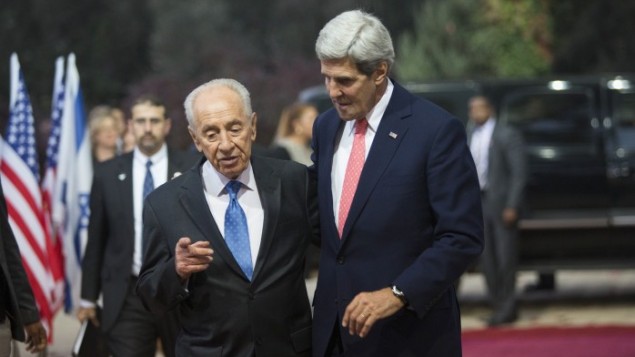
Kerry, PeresPresident Shimon Peres meets with US Secretary of State John Kerry at the President’s Residence in Jerusalem on November 6, 2013. (Photo credit: Yonatan Sindel/Flash90)

President Shimon Peres on Tuesday praised US Secretary of State John Kerry’s peace efforts, defending the top American diplomat from recent criticism leveled at him from local right-wing politicians.

Kerry’s peace effort “comes at the behest of both sides – we, the Palestinians, the whole world,” Peres said at a ceremony at the President’s Residence honoring Israeli exporters.

“We thank him for his efforts,” the president continued, “and we’re strengthening his hand and looking forward to positive results.”

Peres’s comments come amid a flood of fierce criticism against the American diplomat from Israeli right-wing politicians in recent days following a speech in which Kerry warned that boycotts and delegitimization of Israel would only expand without a peace deal.

Speaking at the Munich Security Conference on Saturday, Kerry said that Israel faces an “increasing delegitimization campaign that has been building up. People are very sensitive to it. There are talk of boycotts and other kinds of things.”

Kerry said he was utterly certain that the current status quo was “not sustainable… It’s illusionary. There’s a momentary prosperity. There’s a momentary peace.”

Intelligence and Strategic Affairs Minister Yuval Steinitz called the comments “offensive and intolerable,” and Economy Minister Naftali Bennett accused Kerry of incitement and of serving as a “mouthpiece” for anti-Semitic elements attempting to boycott Israel.

“Only security will bring economic stability, not a terrorist state close to Ben-Gurion Airport. We expect our friends around the world to stand by our side to face the anti-Semitic attempts to boycott Israel, not to be their mouthpiece,” Bennett said on Saturday.

But Peres seemed to reject the criticism on Tuesday.

“[Kerry] himself has emphasized that the result [of peace talks] must be acceptable to both sides,” he said. “He hasn’t come to fight with us, but to bring reconciliation between us,” said Peres.

Within two hours of Peres’s comments, Housing Minister Uri Ariel of the Jewish Home party once again railed against the American administration, albeit in more veiled terms. Speaking at the Jerusalem Conference underway Tuesday in the capital, he criticized those “who are repeating to the public again and again the same slogan of ‘two states for two peoples.’ So let me say again, in a loud and clear voice, to them and to friends across the ocean” – a reference to the Obama administration – “between the Jordan and the sea there will be just one state – the State of Israel.

“These pressures from outside are unfair and won’t bring peace. And I say to our friends across the ocean, don’t threaten us with boycotts and sanctions. The Jewish people won’t surrender its land and won’t surrender its home…. This pressure will not succeed.”

That theme, the accusation that Kerry himself had threatened Israel with boycotts, has been vociferously denied by Justice Minister Tzipi Livni, Israel’s chief peace envoy, and the US administration itself.

“Secretary Kerry has a proud record of over three decades of steadfast support for Israel’s security and well-being, including staunch opposition to boycotts,” State Department spokesperson Jen Psaki said Sunday. “Secretary Kerry has always expected opposition and difficult moments in the process, but he also expects all parties to accurately portray his record and statements.”

Livni was even harsher in her condemnation of the critics.

“Some of those who speak harshly against the US secretary of state would lower their eyes in embarrassment if they knew what Kerry has done to prevent these threats and these boycotts,” she said Sunday.

Netanyahu, after speaking to Kerry on Sunday night, said in comments apparently targeted at the right-wing critics that Kerry had unambiguously clarified he opposed such boycotts.

“The peace process is delicate. There may be periods of misunderstandings and disagreements,” Netanyahu said in a statement. “The best way to clarify misunderstandings or express differences of opinion is by substantively discussing the issues and not by engaging in personal attacks.”

On Monday night, US National Security Advisor Susan Rice continued the American response, lashing out at the criticism of Kerry and calling the attacks “totally unfounded and unacceptable.”

In a series of tweets, Rice wrote that “John Kerry’s record of support for Israel’s security and prosperity [is] rock solid.” She also said the US government “has been clear and consistent that we reject efforts to boycott or delegitimize Israel.”

Off Topic: Kerry Tells Senators That Obama Syria Policy Is Collapsing – Bloomberg Opinion

February 4, 2014

Off Topic: Kerry Tells Senators That Obama Syria Policy Is Collapsing – Bloomberg Opinion.

By Jeffrey Goldberg Feb 3, 2014 4:00 PM GMT+0100

Photographer: Andrew Harrer/Bloomberg
Is the Churchillian John Kerry back?


Two prominent Republican senators say that U.S. Secretary of State John Kerry told them — along with 13 other members of a bipartisan congressional delegation — that President Barack Obama’s administration is in need of a new, more assertive, Syria policy; that al-Qaeda-affiliated groups in Syria pose a direct terrorist threat to the U.S. homeland; that Russia is arming the regime of Syrian President Bashar al-Assad, and is generally subverting chances for a peaceful settlement; that Assad is violating his promise to expeditiously part with his massive stores of chemical weapons; and that, in Kerry’s view, it may be time to consider more dramatic arming of moderate Syrian rebel factions.

Kerry is said to have made these blunt assertions Sunday morning behind the closed doors of a cramped meeting room in the Bayerischer Hof hotel in Munich, as the 50th annual Munich Security Conference was coming to a close in a ballroom two floors below. A day earlier, Kerry, in a joint appearance with U.S. Defense Secretary Chuck Hagel on the ballroom stage, gave an uncompromising defense of the Obama administration’s level of foreign engagement: saying that, “I can’t think of a place in the world where we’re retreating.”

Kerry’s presentation to the congressional delegation suggests that, at least in the case of Syria, he believes the U.S. could be doing much more. His enthusiasm for engagement and dissatisfaction with current policy, is in one sense no surprise: Kerry has consistently been the most prominent advocate inside the administration of a more assertive American role in Syria. Who could forget his late August speech, overflowing with Churchillian outrage, in which he promised that the U.S. would hold the Assad regime accountable for the “moral obscenity” of chemical weapons attacks? (This promise was put on hold after Obama declined to strike Syria, and after the Russians negotiated the so-far mainly theoretical surrender of the regime’s stockpile of chemical weapons.)

According to participants in the meeting, Kerry spent a good deal of time sounding out the members about their constituents’ tolerance for greater engagement in Syria. He was told, almost uniformly, that there is little appetite for deeper involvement at home. One congressman, Adam Kinzinger, a Republican from Illinois, told Kerry that his August speech on the need to confront Assad was powerful, but that the president subsequently “dropped the ball.”

Kerry’s Sunday briefing was meant to be private, but the Senate’s two most prominent Syria hawks, Republicans John McCain — the leader of the U.S. delegation to the security conference — and Lindsey Graham provided a readout of the meeting to three journalists who flew with them on a delegation plane back to Washington: Fred Hiatt, the editorial page editor of the Washington Post; Josh Rogin, the Daily Beast’s national security reporter; and me.

According to Graham, Kerry gave the clear impression that Syria is slipping out of control. He said Kerry told the delegation that, “the al-Qaeda threat is real, it is getting out of hand.” The secretary, he said, raised the threat of al-Qaeda unprompted. “He acknowledged that the chemical weapons [delivery] is being slow-rolled; the Russians continue to supply arms [and that] we are at a point now where we are going to have to change our strategy. He openly talked about supporting arming the rebels. He openly talked about forming a coalition against al-Qaeda because it’s a direct threat.”

“I would not characterize what he said as a plea for a new policy, but that, in light of recent, dramatic developments, the administration is exploring possible new directions,” said one Democratic House member who was in the meeting. “He wasn’t arguing so much that the administration needs a new policy, but that the administration is considering a range of options based on recent developments.”

The delegation, which included such senators as Republicans Roy Blunt and Kelly Ayotte and Democrat Sheldon Whitehouse, as well as such high-ranking House members as Michigan’s Mike Rogers, the Republican chairman of the House Intelligence Committee, and New York’s Eliot Engel, the ranking Democrat on the House Foreign Affairs Committee, met with Kerry for about 45 minutes, immediately before both Kerry and the delegation left on separate planes to Washington.

Late Sunday night, shortly after the delegation plane landed, Hiatt, Rogin and I asked Jen Psaki, the State Department spokeswoman, to respond to the senators’ characterization of Kerry’s remarks. She e-mailed the following response: “Like [White House chief of staff] Denis McDonough this morning on the Sunday shows, Secretary Kerry has stated publicly many times that more needs to be done rapidly by the regime to move chemical weapons to the port at Latakia, that we need to continue doing more to end the conflict, and that he has pushed the Russians to help in this effort.”

Psaki’s response continued, “No one in this Administration thinks we’re doing enough until the humanitarian crisis has been solved and the civil war ended. That is no different from the message Secretary Kerry conveyed during the private meeting. The meeting was an opportunity to hear from and engage with members of Congress and it is unfortunate that his comments are being mischaracterized by some participants.”

In a separate e-mail sent Monday morning, Psaki responded to the claim that Kerry is reintroducing the idea of supporting arming certain rebel groups. “It’s no secret that some members of Congress support this approach, but at no point during the meeting did Secretary Kerry raise lethal assistance for the opposition. He was describing a range of options that the Administration has always had at its disposal, including more work within the structure of the international community, and engaging with Congress on their ideas is an important part of that process.”

On the matter of Syria, the feeling at the Munich Security Conference, the world’s premier gathering of security experts, was that of helplessness. On the first night of the conference, Lakhdar Brahimi, the United Nations special representative for Syria, said, “We’ve just had eight days of negotiations in Geneva. … I’m sorry to report there was no progress.”

The impotence of the West, as evidenced by the failure of Geneva II talks, and by continued reports of mass murder committed by Assad’s forces, prompted former State Department official Anne-Marie Slaughter to publicly compare the situation of Syrian citizens today to that of Jews in World War II Europe. “In the United States, we often ask, ‘Why didn’t Roosevelt bomb the trains?’ We aren’t very different,” she said.

There are many reasons a secretary of state — particularly one who has been more inclined to intervene in Syria than many of his colleagues in the White House national security apparatus — might see this particular moment in the three-year-old Syria crisis as an inflection point. The utter failure of the Geneva peace talks is one reason. Reports that Syria is not complying with its promise to divest itself of its chemical weapons stockpiles is another. Add to this the recent disclosure of damning evidence that the Syria regime has tortured and starved 11,000 people to death (more than 130,000 people so far have died in the civil war), and it is understandable why Kerry would believe it is time for a new American approach.

But the main impetus for a dramatic new approach might be the claim made last week by James Clapper, the director of national intelligence, that one of the main jihadi groups fighting in Syria, the Nusra Front, “does have aspirations for attacks on the homeland.” Clapper compared parts of Syria today to the tribal areas of Pakistan, which have long been havens for jihadi terror groups.

(In her e-mail this morning, the State Department’s Psaki wrote that, “While Secretary Kerry restated what we have said many times publicly about our concern about the growing threat of extremists, he did not draw a direct connection to the threat on the homeland or reference comments made by other Administration officials. This is a case of members [of Congress] projecting what they want to hear and not stating the accurate facts of what was discussed.”)

If it is indeed true that the al-Qaeda-oriented Nusra Front is seeking targets in the U.S., then the Syria conflict must become, by necessity, a paramount national security concern for the U.S. The impact of Clapper’s testimony could be profound: If parts of Syria are becoming, in essence, al-Qaeda havens, and if jihadis are plotting attacks on American targets from those havens, then the Obama administration, which has made the fight against al-Qaeda the centerpiece of its national security strategy, will have to engage in Syria in ways it has so far tried to avoid. Such engagement would be terribly complicated, because the U.S. would essentially be facing two despicable adversaries in Syria that are battling each other: Assad’s forces (and its Hezbollah and Iranian helpers) on the one hand, and the al-Qaeda-inspired and affiliated foes of Assad, on the other.

This is why McCain argued to us, on the flight from Munich, that it is all the more important now to provide support to those rebel formations that could plausibly be designated as “moderate.” He said: “All I can do is hope that there is cumulative evidence, the failure of Geneva II, the atrocities of the 11,000, the continued regionalization of the conflict — sooner or later, the president will decide this is in America’s national security interest.”

President Obama’s position on Syrian engagement has been far-less forward-leaning than that of his secretary of state. “All along John has wanted more vigorous action,” said McCain. “I said to John on the way out, ‘Don’t make it a half measure.’ I said you’ve really got to do something to change the momentum.”

Obama has never believed the more moderate rebel factions would be capable of defeating the Assad regime (and it should be noted that these rebel groups, despite McCain’s beliefs, are particularly weak today). McCain opposed Graham’s suggestion that the administration begin using drone strikes against al-Qaeda-affiliated militants in Syria. “Eventually you’ve got to confront them, so to me, it’s a choice of, do we hit them after they hit us, or do we hit them before they hit us?” Graham said. “Because eventually we are going to engage these guys, and it seems to me there’s an appetite growing among the Arab countries and even a little bit [with] Russia quite frankly that we’ve got to change the momentum when it comes to the al-Qaeda presence.”

To contact the writer of this article: Jeffrey Goldberg at jgoldberg50@bloomberg.net.

To contact the editor responsible for this article: Zara Kessler at zkessler@bloomberg.net.