Archive for September 2013

U.N. floats plan to destroy Syrian chemical weapons stocks | Reuters

September 9, 2013

U.N. floats plan to destroy Syrian chemical weapons stocks | Reuters.

Photo
12:34pm EDT

UNITED NATIONS (Reuters) – In a bid to help the U.N. Security Council overcome its “embarrassing paralysis,” the U.N. chief said on Monday he may ask the council to demand that Syria move its chemical arms stocks to Syrian sites where they can be safely stored and destroyed.

Later this week or next week, the U.N. team of chemical weapons experts, led by Ake Sellstrom of Sweden, is expected to submit a report to Secretary-General Ban Ki-moon about its investigation of an August 21 chemical attack that the United States says killed over 1,400 people, many of them children.

“I have already been considering certain proposals that I could make to the Security Council when I present the investigation team’s report,” Ban said, adding that the international community would be obligated to act if the use of poison gas in Syria’s 2-1/2-year civil war was confirmed.

“I’m considering urging the Security Council to demand the immediate transfer of Syria’s chemical weapons and chemical precursor stocks to places inside Syria where they can be safely stored and destroyed,” he said.

Ban also urged Syria to join the international anti-chemical weapons convention, a treaty that Damascus has never signed.

He was responding to questions about a Russian plan to place Syrian chemical arms under international control.

Ban, who just returned from the Group of 20 developed and developing nations’ summit in Russia, said the Security Council has an obligation to end its deadlock on Syria.

“Two and half years of conflict in Syria have produced only embarrassing paralysis in the Security Council,” he said.

“Should Dr Sellstrom’s report confirm the use of chemical weapons, then this would surely be something around which the Security Council could unite in response, and indeed something that should merit universal condemnation.”

Sellstrom’s report will only say whether chemical weapons were used, not who is believed to have used them.

Russia, backed by China, has used its veto power in the Security Council three times to block resolutions condemning Syrian President Bashar al-Assad’s government and threatening it with sanctions. Assad’s government, like Russia, blames the rebels for the August 21 attack.

U.S. President Barack Obama is seeking congressional authorization to launch strikes against Syria because of the August 21 incident, which it blames on Assad’s government.

(Reporting by Louis Charbonneau; Editing by Eric Beech)

Kerry’s Offhand Proposal on Syria Arms Welcomed – NYTimes.com

September 9, 2013

Kerry’s Offhand Proposal on Syria Arms Welcomed – NYTimes.com.

MOSCOW — A seemingly offhand suggestion by Secretary of State John Kerry that Syria could avert an American attack by relinquishing all of its chemical weapons received a widespread, almost immediate welcome from Syria, Russia, the United Nations, a key American ally and even some Republicans on Monday as a possible way to avoid a major international military showdown in the Syria crisis.

While there was no indication that Mr. Kerry was searching for a political settlement to the Syrian crisis in making his comment, the reactions appeared to reflect a broad international desire to de-escalate the atmosphere of impending confrontation even as President Obama was lobbying heavily at home to garner Congressional endorsement of a military strike.

Mr. Kerry’s suggestion — and the Russian and Syrian response — also seemed to represent the first possible point of agreement over how to address the chemical weapons issue that has threatened to turn the Syria conflict, now in its third year, into a regional war.

Asked at a news conference in London if there were steps the Syrian president, Bashar al-Assad, could take to avoid an American-led attack, Mr. Kerry said, “Sure, he could turn over every single bit of his chemical weapons to the international community in the next week — turn it over, all of it, without delay and allow the full and total accounting.” He immediately dismissed the possibility that Mr. Assad would or could comply, saying: “But he isn’t about to do it, and it can’t be done.”

However, in Moscow, Russia’s foreign minister, Sergey V. Lavrov, who was meeting with Syria’s foreign minister, Walid al-Moallem, said in response that Russia would join any effort to put Syria’s stockpile of chemical weapons under international control and ultimately destroy them.

Mr. Lavrov appeared at a previously unscheduled briefing only hours after Mr. Kerry made his statement in London, seizing on it as a possible compromise.

“We don’t know whether Syria will agree with this, but if the establishment of international control over chemical weapons in the country will prevent attacks, then we will immediately begin work with Damascus,” Mr. Lavrov said at the Foreign Ministry. “And we call on the Syrian leadership to not only agree to setting the chemical weapons storage sites under international control, but also to their subsequent destruction.”

Mr. Moallem said later in a statement that his government welcomed the Russian proposal, Russia’s Interfax News Agency reported, in what appeared to be the first acknowledgment by the Syrian government that it even possesses chemical weapons. The Syrian government historically has neither confirmed nor denied possessing such weapons.

In quick succession, the idea of sequestering Syria’s chemical weapons stockpile was also endorsed by Britain’s prime minister, David Cameron, and the United Nations secretary general, Ban Ki-moon. Mr. Ban said he might propose a formal resolution to the Security Council, which has been paralyzed over how to deal with the Syria crisis from the beginning.

Mr. Cameron told lawmakers in London that if Syria handed over its chemical weapons arsenal for destruction under international supervision, “it would be hugely welcome,” news agencies in Britain reported.

In Washington, Representative Mike Rogers, a Michigan Republican who heads the House Intelligence Committee, expressed cautious support for Mr. Lavrov’s response. “Just the fact the Russians have moved, tells me having this debate on military action is a having a positive outcome,” Mr. Rogers said in a telephone interview.

Mr. Rogers still said Congress should vote to support a resolution backing United States military action as a means of increasing American leverage on the Russians.

“So far, the Russian rhetoric does not match their activity on the ground,” Mr. Rogers, alluding to the Russian supply of arms to the Syrian army. “They’re going to have to prove they mean it.”

Obama administration officials have discussed the idea of presenting Mr. Assad with an ultimatum. But officials are wary of giving the Syrian leader an opportunity to play for time, and carrying out inspections to make sure the Syrian government has not retained hidden stocks of poison gas as fighting rages appeared to be a near impossibility.

Mr. Lavrov went into more detail than Mr. Kerry’s suggestion — which Mr. Kerry’s own spokeswoman had described as more of a rhetorical exercise rather than a proposal.

Mr. Lavrov said Russia was proposing that Syria join the international Convention on Chemical Weapons, which bars the manufacture, stockpiling and use of poison gas.

Syria is one of seven nations that have not signed the treaty, the others being Angola, Egypt, Israel, Myanmar, North Korea and South Sudan. “We are counting on a quick, and I hope, positive answer,” Mr. Lavrov said Monday evening as Mr. Kerry flew back to Washington to attend briefings on Capitol Hill intended to build support for a military response to Syria’s use of the weapon.

For Mr. Hague, whose government has already ruled out participation in a military strike on Syria in deference to Parliamentary opposition, the meeting with Mr. Kerry was nonetheless an opportunity to affirm British support for the United States, is most important ally.

“Our government supports the objective of ensuring that there can be no impunity for the first use of chemical warfare in the 21st century,” Mr. Hague said in his joint appearance with Mr. Kerry. “As an international community we must deter further attacks and hold those responsible for them accountable..”

Mr. Hague also said: “We admire the leadership of President Obama and Secretary Kerry himself, in making this case so powerfully to the world.”

Mr. Kerry said that Mr. Assad’s claims that he was not responsible for the chemical attack on Aug. 21 that provoked an international crisis over whether to launch punitive military strikes were not credible because Syria’s arsenal of poison gas is tightly controlled.

Mr. Kerry said that three senior officials in the Syrian government have held control over the nation’s chemical weapons stocks and their use: Mr. Assad, his brother Maher and a senior general.

Mr. Kerry said that “high level” members of the government gave the instructions to use chemical weapons in the Aug. 21 attack near Damascus “with the results going directly to President Assad.”

When asked if the White House would consider making public additional intelligence to counter Mr. Assad’s claims that he had nothing to do with the attack, like physical samples that documented the use of sarin gas produced by the Syrian government, Mr. Kerry said that he did not know what President Obama would decide.

But he asserted that the Obama administration had already made available copious amounts of intelligence, and that the case against Mr. Assad was airtight.

In a discussion on Sunday with Charlie Rose, an American television interviewer, Mr. Assad asserted that Mr. Kerry had lied about the intelligence, drawing an analogy to the presentation that Colin Powell made to the United Nations about Iraq in 2003. Mr. Kerry appeared unruffled by that allegation and recalled that his own experience in dealing with Mr. Assad as a senator had convinced him that the Syrian leader could not be trusted.

In early 2009, Mr. Kerry met with Mr. Assad in Damascus to explore the possibility of improving relations between the United States and Syria. Mr. Kerry said that he confronted Mr. Assad about intelligence confirming that Syria had transferred Scud missiles to Hezbollah.

Mr. Kerry said that Mr. Assad had “denied it to my face,” adding, “This is a man without credibility.”

Repeating a point he has stressed throughout his four days of discussions with European allies, Mr. Kerry said that if an attack was carried out, it would be limited in scope and duration, would not involve ground troops, and would not drag the United States and its allies into a prolonged conflict. He emphasized that it would be nothing like the wars in Iraq and Afghanistan, the NATO bombing of Kosovo or the intervention in Libya.

Yay, Putin! Obama go home! EU? ( Cue the laugh track! )

September 9, 2013

( Want to laugh?  Watch Susan Rice defending the strike on Syria unaware of how irrelevant EVERYTHING she is saying has become.  – JW )

http://www.cbsnews.com/2718-201_162-1950/cbs-news-live-video/?tag=custom

Also, WH press briefing live now.

( Weasel Carney already giving Obummer credit for Russia’s proposal. )

Sprite 13

Syria welcomes international control over chemical weapons

September 9, 2013

Syria welcomes international control over chemical weapons | The Times of Israel.

( If Assad gives up his chemicals, he’ll defeat the rebels and have stood up to the “Great Satan.”  The US will look like a punch-drunk boxer on his last legs, and the new year will be toasted with vodka rather than champagne. – JW )

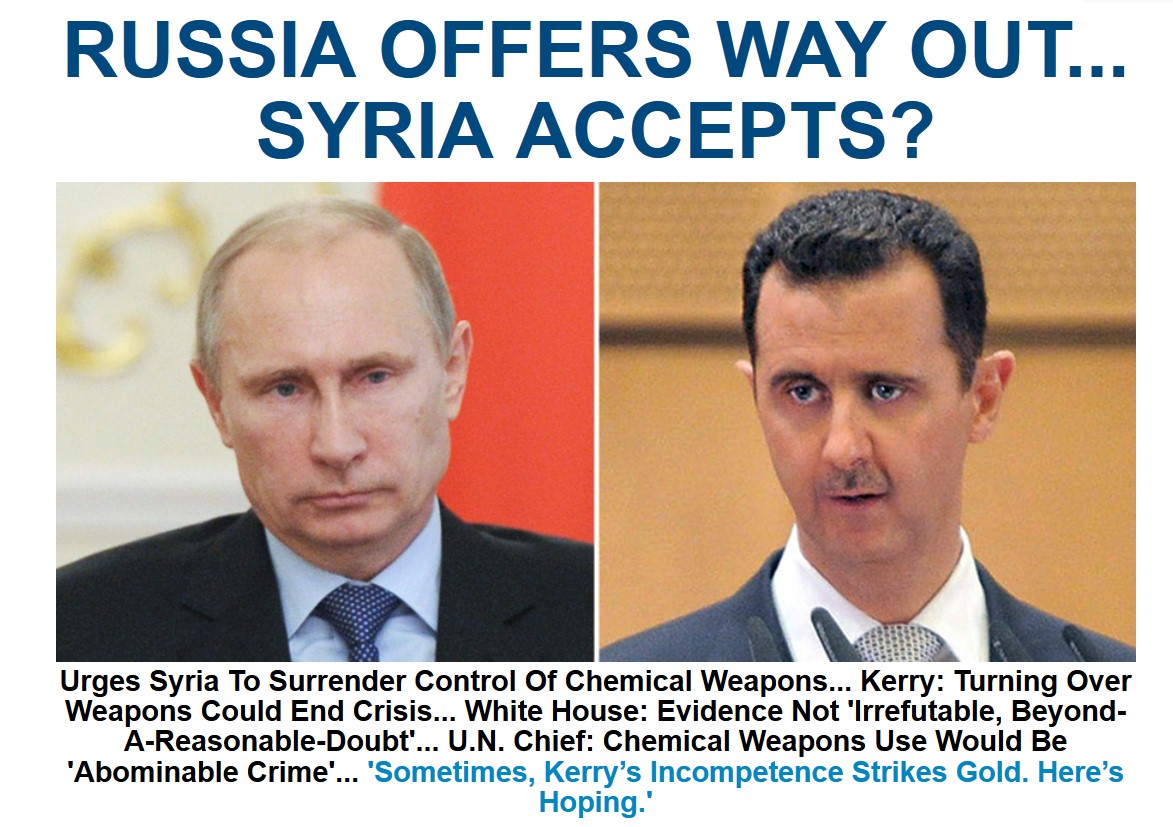
After meeting Syrian counterpart, Russian foreign minister says he’ll push Assad to give up WMDs to avoid airstrikes; Kerry: Attack can be averted if Damascus agrees to cede ‘every single bit’ of its chemical arsenal by week’s end

September 9, 2013, 6:14 pm Updated: September 9, 2013, 6:59 pm
Russian Foreign Minister Sergey Lavrov welcomes his Syrian counterpart Walid Moallem (left), prior to talks in Moscow on Monday, September 9, 2013. (photo credit: AP/Ivan Sekretarev)

Russian Foreign Minister Sergey Lavrov welcomes his Syrian counterpart Walid Moallem (left), prior to talks in Moscow on Monday, September 9, 2013. (photo credit: AP/Ivan Sekretarev)

Syrian Foreign Minister Walid Moallem on Monday welcomed Moscow’s proposal to submit Syria’s chemical weapons stockpiles to international control, Reuters reported. The surprise announcement came hours after US Secretary of State John Kerry said such a move could avert a limited US strike on the country in retaliation for a lethal August 21 chemical weapons attack.

“Syria welcomes the Russian proposal out of concern for the lives of the Syrian people, the security of our country and because it believes in the wisdom of the Russian leadership that seeks to avert American aggression against our people,” Moallem said.

British Prime Minister David Cameron, a key US ally, reacted favorably to Syria’s declaration, saying the notion of putting the Assad regime’s stockpile of chemical weapons under international supervision was “a big step forward.” He warned, however, that “we have to be careful, though, to make sure this is not a distraction tactic to discuss something else rather than the problem on the table.”

Earlier Monday, Kerry said that Syrian President Bashar Assad could resolve the crisis surrounding the alleged use of chemical weapons by his forces by surrendering control of “every single bit” of his arsenal to the international community by the end of the week.

Kerry added that he thought Assad “isn’t about to do it,” but Russian Foreign Minister Sergey Lavrov, who had just wrapped up a round of talks in Moscow with Moallem, said that Moscow would try to convince the Syrians to do so.

“If the establishment of international control over chemical weapons in that country would allow avoiding strikes, we will immediately start working with Damascus,” Lavrov said.

“We are calling on the Syrian leadership to not only agree to placing chemical weapons storage sites under international control, but also on its subsequent destruction and fully joining the treaty on prohibition of chemical weapons,” he said.

His statement followed media reports alleging that Russian President Vladimir Putin, who discussed Syria with President Barack Obama during the G20 summit in St. Petersburg last week, sought to negotiate a deal that would have Assad hand over control of chemical weapons.

Speaking earlier in the day, Lavrov denied that Russia was trying to sponsor any deal “behind the back of the Syrian people.”

The Russian move comes as Obama, who has accused Assad of killing over 1,400 of his own people in the chemical attack last month, is pressing for a limited strike against the Syrian government. Assad has denied responsibility for the attack, insisting that it had been launched by the rebels to drag the US into the war.

Lavrov and Moallem said after their talks that UN chemical weapons experts should complete their probe and present their findings to the United Nations Security Council.

Moallem said his government was ready to host the UN team, and insisted that Syria is ready to use all channels to convince the Americans that it wasn’t behind the attack.

He added that Syria was ready for “full cooperation with Russia to remove any pretext for aggression.”

Neither minister, however, offered any evidence to back their claim of rebel involvement in the chemical attack.

Lavrov said that Russia would continue to promote a peaceful settlement and may try to convene a gathering of all Syrian opposition figures to join in negotiations. He added that a US attack on Syria would deal a fatal blow to peace efforts.

Lavrov wouldn’t say how Russia could respond to a possible US attack on Syria, saying that “we wouldn’t like to proceed from a negative scenario and would primarily take efforts to prevent a military intervention.”

Putin said that Moscow would keep providing assistance to Syria in case of a US attack, but he and other Russian officials have made clear that Russia has no intention of engaging in hostilities.

US official to ‘Post’: Russia proposal to put Syria chemical arms under global control will go ignored

September 9, 2013

US official to ‘Post’: Russia proposal to put Syria chemical arms under global control will go ignored | JPost | Israel News.

( No mechanism?  So even if they are willing, rather than create a mechanism we’ll bomb them anyway?  Obama’s US is sounding more like the old USSR than Russia. – JW

By MICHAEL WILNER, JERUSALEM POST CORRESPONDENT
LAST UPDATED: 09/09/2013 19:10
Russia proposes Syria put chemical arms under int’l control to avoid US strike; Damascus “welcomes” proposal, but stops short of saying Assad accepts it; US official: “There’s no mechanism to implement proposal.”

Russian Foreign Minister Sergei Lavrov.

Russian Foreign Minister Sergei Lavrov. Photo: REUTERS/Sergei Karpukhin

A US government official told The Jerusalem Post on Monday that a Russian proposal urging Syria to place its chemical weapons arsenal under international control, in order to avoid a US strike, would be ignored.

“There’s no mechanism to implement what the Russians are proposing,” said the official.

The Organization for the Prohibition on Chemical Weapons is the only organization that has monitoring power over chemical arms, the official noted. But the OPCW only has jurisdiction over signatories of the Chemical Weapons Convention, of which Syria is not a member. And the OPCW does not tolerate the existence of such weapons, but oversees their destruction, which the Russians have not proposed.

Foreign Minister Sergei Lavrov, who called a news conference to announce the proposal, said he had already conveyed the idea to Syrian Foreign Minister Walid al-Moualem at talks in Moscow.

Moualem, who spoke to reporters through an interpreter after Russia expressed hope the proposal could avert military strikes against Syria, stopped short of saying explicitly that President Bashar Assad’s government accepted it.

“I state that the Syrian Arab Republic welcomes the Russian initiative, motivated by the Syrian leadership’s concern for the lives of our citizens and the security of our country, and also motivated by our confidence in the wisdom of the Russian leadership, which is attempting to prevent American aggression against our people,” he said.

Crisis in Syria – full JPost.com coverage

The Russian government was responding to comments made off the cuff by US Secretary of State John Kerry during a press availability with British Foreign Minister William Hague on Monday.

“He could turn over every single bit of his chemical weapons to the international community in the next week— turn it over, all of it,” Kerry said, throwing up his hands in London. “But he isn’t about to do it, and it can’t be done, obviously.”

In response to questions about the Russian proposal, UN Secretary-General Ban Ki-moon said Monday that he may ask the Security Council to demand Syria move its chemical arms stocks to Syrian sites where they can be safely stored and destroyed.

Speaking to reporters in New York, Ban said he may also ask the 15-nation body to demand that Syria join the international anti-chemical weapons convention, a treaty that Damascus has never signed.

British Prime Minister David Cameron said on Monday that Syria should be encouraged to place its chemical weapons arsenal under international supervision, but said the world needed to ensure that discussion of such an idea did not become a distraction.

“If Syria were to put its chemical weapons beyond use under international supervision clearly that would be a big step forward,” Cameron told parliament. “We have to be careful though to make sure this is not a distraction tactic to discuss something else rather than the problem on the table.”

Reuters contributed to this report.

Russian ultimatum to Assad: Give up chemical arsenal – or face US attack alone

September 9, 2013

Russian ultimatum to Assad: Give up chemical arsenal – or face US attack alone.

( If Putin succeeds in getting Assad to give up his WMDs, well gentlemen, we have a new world leader.  His protection of Snowden already won him the favor of most liberty loving people around the world.  If he cleans up his act in Russia there will be no stopping him. – JW )

DEBKAfile Exclusive Report September 9, 2013, 7:22 PM (IDT)
Russian FM Sergey Lavrov: Assad must surrender chemical arsenal

Russian FM Sergey Lavrov: Assad must surrender chemical arsenal

In an unexpected turn of events along the road to a US military strike on Syria, Russian Foreign Minister Sergey Lavrov said Monday afternoon, Sept. 9  that he had urged Syria to hand over its nuclear arsenal to international control if that would stop an American attack. Moscow had lost no time in picking up the gauntlet thrown down by US Secretary of State John Kerry in London a short time before.

Asked if there were steps the Syrian president could take to avert an American-led attack, Kerry replied: “Sure, he could turn over every single bit of his chemical weapons to the international community in the next week — turn it over, all of it, without delay and allow the full and total accounting.”

The Obama administration had in this way given Bashar Assad a week to turn in his chemical weapons to an international team that would no doubt be put together by the US, Russia and the United Nations.

Syrian Foreign Minister Walid Moallem, who arrived in Moscow earlier Monday, was informed that the Kremlin expected a positive and expeditious answer from President Assad. Within the hour, he came back with a welcome for the Russian “proposal” to place his country’s chemical weapons under international control. But he said nothing about letting the arsenal be moved out of the country and destroyed , as both Lavrov and Kerry specified.

Sunday, debkafile reported that a secret US proposal had been presented to Assad and that negotiations were in progress on a deal for a way out of the crisis generated by the chemical attack east of Damascus on Aug. 21. The transfer of Syria’s entire chemical stockpile to international control was a part of that proposition.

Our military sources add that Assad was in no position to flatly rebuff the Russian ultimatum; only to try and maneuver and haggle to buy time. If Moscow stops the air corridor lifting military supplies to Damascus, the Syrian army will quickly run out of ordnance for fighting the rebels.

Russia To Push Syria To Put Chemical Weapons Under International Control

September 9, 2013

Russia To Push Syria To Put Chemical Weapons Under International Control.

By VLADIMIR ISACHENKOV 09/09/13 10:31 AM ET EDT AP

russis syria chemical weapons

MOSCOW — The Russian foreign minister says Moscow will push Syria to place its chemical weapons under international control.

Sergey Lavrov said Monday that if such a move would help avert a possible U.S. strike on Syria, Russia will start work “immediately” to persuade Syria to relinquish control over its chemical arsenals.

Lavrov told reporters that Russia would urge Syria to concentrate its chemical weapons in certain areas under international oversight and then dismantle them.

THIS IS A BREAKING NEWS UPDATE. Check back soon for further information. AP’s earlier story is below.

Russian and Syrian foreign ministers on Monday strongly pushed for the return of United Nations inspectors to Syria to continue their probe into the use of chemical weapons and again warned Washington against launching an attack.

The statement comes as President Barack Obama, who blames President Bashar Assad for killing hundreds of his own people in a chemical attack last month, is pressing for a limited strike against the Syrian government. It has denied launching the attack, insisting along with its ally Russia that the attack was launched by the rebels to drag the U.S. into war.

Russian Foreign Minister Sergey Lavrov said after Monday’s talks with his Syrian counterpart Walid al-Moallem that U.N. chemical weapons experts should complete their probe and present their findings to the U.N. Security Council.

“We have agreed to push for the soonest return of inspectors,” Lavrov said.

Al-Moallem said his government was ready to host the U.N. team, and insisted that Syria is ready to use all channels to convince the Americans that it wasn’t behind the attack.

He added that Syria was ready for “full cooperation with Russia to remove any pretext for aggression.”

Neither minister, however, offered any evidence to back their claim of rebel involvement in the chemical attack.

Lavrov said that Russia will continue to promote a peaceful settlement and may try to convene a gathering of all Syrian opposition figures to join in negotiations. He added that a U.S. attack on Syria would deal a fatal blow to peace efforts.

Lavrov wouldn’t say how Russia could respond to a possible U.S. attack on Syria, saying that “we wouldn’t like to proceed from a negative scenario and would primarily take efforts to prevent a military intervention.”

President Vladimir Putin said that Moscow would keep providing assistance to Syria in case of U.S. attack, but he and other Russian officials have made clear that Russia has no intention to engage in hostilities.

Lavrov also denied allegations that Russia may have sponsored a deal between the U.S. and Syria during the Group of 20 summit in St.Petersburg last week, where Putin discussed the Syrian crisis with Obama.

“There won’t be and there can’t be any deal behind the back of the Syrian people,” Lavrov said.ji098

Israel worries as Obama hesitates on Iran

September 9, 2013

Israel worries as Obama hesitates on Iran.

ByBenny Morris

President Barack Obama has repeatedly and publicly declared that the United States will not allow Iran to acquire nuclear weapons; he has, apparently, promised Israeli Prime Minister Benjamin Netanyahu as much.

While he has not explicitly declared that the United States will employ military means if all else fails, a succession of senior American officials has stated that all options are “on the table.”

In part, these declarations were prompted by a fear that, once diplomacy and sanctions were perceived in Jerusalem to have failed, Israel would go it alone and launch military operations against the Iranian nuclear project, sucking in the U.S. and risking a wide Middle Eastern conflagration. The American assurances were designed to staunch Israeli fears and give diplomacy and sanctions more time.

But as Obama has waffled on Syria, he has convinced most Israelis that there is no depending on Washington to pull the Iranian nuclear chestnut out of the fire. Israel will have to take out the Iranian nuclear installations itself — or learn to live with a nuclear Iran led by a fanatical Islamist leadership that seeks Israel’s destruction.

Israeli officials have carefully avoided expressing these thoughts during recent days; Israel continues to need Obama and American goodwill in a whole range of contexts. But most Israelis, to judge by comments in the media and by the man in the street, have despaired of Obama and the America he leads. Israel is alone (and, some might say, as the Jews of Europe were alone during the Holocaust).

Obama has enviable intellectual and moral qualities. But during the last weeks, he has displayed muddled thinking and a clear lack of leadership and resolution. A year or so ago, he drew a line over the use of chemical weapons by the Syrian government. Since then, U.S. intelligence counts nine such attacks, according to news reports in Israel, culminating in the Aug. 21 attack that killed an estimated 1,400 Syrians, more than 400 of them children. And the United States has done nothing except talk.

Indeed, at first the talking appeared to be geared toward justifying an imminent military strike against Bashar Assad’s assets, to degrade the Syrian president’s ability to launch poison gas attacks and to deter him from resuming this form of warfare.

Then came Obama’s Aug. 31 speech, providing for a delay — of a week, two weeks, more? — and calling for congressional endorsement of the prospective military strike. As the constitution arguably allows a president, as commander in chief, to order limited strikes without such endorsement, many around the world have interpreted Obama’s move as a failure of will rather than keen democratic scruples.

Both Secretary of State John F. Kerry (explicitly) and Obama (implicitly) have mentioned Israel and Iran in arguing in favour of a strike: Kerry refers to America’s “credibility” with its allies and enemies; the president talked of the need to confront a “world of many dangers.”

But Obama’s Aug. 31 announcement sent a contrary signal: Clearly, he and America are irresolute and hesitant about launching a short, limited strike against Assad’s government, and they can be expected to be much more irresolute and hesitant when it comes to tackling the far greater threat posed by Iran’s nuclear project. That could require a weeks- or months-long campaign against a more powerful enemy than Assad’s Syria and might involve the United States in extended challenges around the globe, given Iran’s allies in the Middle East and its terrorist proxy networks around the world.

The administration’s spokespersons have been careful to declare that the president could launch a strike against Assad even if Congress voted against taking action. But this is probably hogwash. Having called on Congress for endorsement, as Prime Minister David Cameron did with Britain’s Parliament, does anyone seriously expect Obama to strike Syria if Congress votes no (a vote that reflects current U.S. public opinion)?

No matter how Congress votes, Obama’s manoeuvre has clearly signalled Jerusalem that, at the very least, Obama can be expected to vacillate when it comes to the Iranian nuclear installations, and to turn to Congress then as well — and Congress, one may assume, will be even more chary to issue a green light, given the far greater challenges posed by the Iranian issue.

Israel’s political and military leadership has surely come away from Obama’s Hamlet-like zigzagging with a sense of shock and, even more important, with a sense of isolation in the Iranian context — one that won’t disappear, even if the U.S. finally delivers a slap on the wrist against Assad.

By most counts, Iran, if not stopped, will have nuclear bombs in the course of 2014. Diplomacy and sanctions have failed over the last decade. In “negotiating” with the West, Iran has simply bought more time for its centrifuges to produce a growing stockpile of enriched uranium. In a few months’ time, Israel will face its hour of truth — and it will face it alone.

Sadly, we have seen Obama’s mettle; we will shortly see Netanyahu’s.


Benny Morris, an Israeli historian, is the author, most recently, of 1948: A History of the First Arab-Israeli War. He wrote this for the Los Angeles Times.

Report: Syria Has 1,000 Tons of Chemical Weapons

September 9, 2013

Report: Syria Has 1,000 Tons of Chemical Weapons – Defense/Security – News – Israel National News.

A report Monday said that Syria had plenty of chemical weapons, and is likely to use them if attacked by the U.S. or Western countries.

By David Lev

First Publish: 9/9/2013, 4:48 PM


Illustration: Chemical warfare drill

Illustration: Chemical warfare drill
IDF spokesman’s unit

A report presented Monday at the International Institute for Counter-Terrorism’s (ICT) World Summit on Counter-Terrorism said that Syria had a large stockpile of chemical weapons, and was likely to use them if attacked by the U.S. or Western countries. According to the report, Syria has one of the largest stores of VX, a deadly nerve gas, as well as of Sarin, the chemical said to have been used in the attack that killed some 1,400 people in a Damascus suburb last month.

Syria has been stockpiling chemical weapons since the 1980s, the report said, and the army now possesses more than 1,000 tons of chemical weapons, stored in over 50 cities throughout the country. Syria has many methods to deploy those weapons, according to the report, including rockets, artillery shells, aerial bombs, and ballistic missiles.

Syria also manufactures chemical weapons in five locations throughout the country, the report said. Damascus even has a special institute – Centre d’Etudes et de Recherches Scientifiques (CERS) – dedicated to developing chemical and biological weapons, the report said. The institute works closely with the Syrian army, and reports directly to President Bashar al-Assad.

Syria’s biggest chemical factory is at Al Safira, about 20 kilometers south of Aleppo, the report said, and contains the country’s biggest stash of Sarin. This site was established in the 1980s with the help of Russia, and contains some of Syria’s biggest military secrets.

There are also large caches in Syrian cities, including Damascus, Aleppo, and Latakia. These are under the direct control of the army, the report said.

However, it added, it is possible that some of these stores have been taken by rebel groups, who have in turn conquered and lost some of the cities where chemical weapons are stored.

As many of the rebel groups are associated with Al Qaeda, it is highly possible that some of the chemical weapons will end up in the hands of terrorist groups. Meanwhile, the report added, it was possible that Assad would hand over some of the weapons stores to his ally Hezbollah for “safekeeping” if he felt they were threatened. Such scenarios could happen “at any time,” the report added.

Assad could avert attack by giving up chemical arms, Kerry says

September 9, 2013

Assad could avert attack by giving up chemical arms, Kerry says | The Times of Israel.

Secretary of state surmises it is unlikely Syrian leader will turn over all of weapons stock, asserts evidence regime behind gassing

September 9, 2013, 12:50 pm
Secretary of State John Kerry speaks at the State Department in Washington, Monday, August 26, 2013 (photo credit: AP/Manuel Balce Ceneta)

Secretary of State John Kerry speaks at the State Department in Washington, Monday, August 26, 2013 (photo credit: AP/Manuel Balce Ceneta)

LONDON — Syrian President Bashar Assad could resolve the crisis surrounding a chemical weapons attack simply by turning over “every single bit” of his weapons stock to the international community within a week, US Secretary of State John Kerry said Monday.

But Kerry, holding a news conference in London with British counterpart William Hague on Monday, said he thinks Assad “isn’t about to do that.”

“Sure, he could turn over every single bit of his chemical weapons to the international community in the next week, turn it over, all of it without delay and allow the full and total accounting, but he isn’t about to do it and it can’t be done,” he said.

Kerry was asked about comments that Assad made to CBS anchorman Charlie Rose in which the Syrian president said there was no conclusive evidence about who is to blame for the chemical weapons attack.

Asked about Assad’s denial, Kerry said, “I just gave you real evidence.”

“Evidence that as a former prosecutor in the United States I could take into a courtroom and get admitted,” the secretary added. Kerry said he had personally tried people who had been sent to prison for life for less than what Assad is accused of doing.

“So the evidence is powerful and the question for all of us is what are we going to do about it,” Kerry said. “Turn our backs? Have a moment of silence?”

“We know that his regime gave orders to prepare for a chemical attack. We know they deployed forces.”

Kerry added that Washington “knows where the rockets came from and where they landed … and it was no accident that they all came from regime -controlled territory and all landed” in opposition-held territory.

He added that the United States knows “where the rockets came from and where they landed … and it was no accident that they all came from regime -controlled territory and all landed” in opposition-held territory.

Meanwhile, Russian and Syrian foreign ministers said Monday they planned to push for the return of United Nations inspectors to Syria to continue their probe into the use of chemical weapons.

Lavrov said after Monday’s talks with his Syrian counterpart Walid al-Moallem that Moscow will continue to promote a peaceful settlement and may try to convene a gathering of all Syrian opposition figures who are interested in peaceful settlement. He said a U.S. attack on Syria would deal a fatal blow to peace efforts.