Archive for February 2013

Even Iran diplomat confirms nuke plant blast

February 7, 2013

Even Iran diplomat confirms nuke plant blast.

Meanwhile, Ahmadinejad says his bomb is ready if Israel attacks

Published: 5 hours ago

A European intelligence agency, an Iranian diplomat and a Latin American intelligence source have joined the growing list of those who have confirmed to WND the deadly explosions at Iran’s Fordow nuclear site.

Media and unofficial speculation points to Israel as the culprit in its efforts to keep Iran from building nuclear weapons. Several Iranian leaders have said repeatedly in the past it is their duty to wipe out the Jewish state.

Iranian President Mahmoud Ahmadinejad, in interviews Wednesday with media, said the Islamic regime has already achieved nuclear capability but is not interested in attacking the “Zionist entity.” If Israel attacks first, he said, Iran is ready destroy it.

WND reported the Jan. 21 explosions exclusively on Jan. 24, with updates on Jan. 27, 29, 30, 31, and Feb. 3. The blasts at first trapped 219 workers, including 16 North Koreans: 14 technicians and two military attaches. A Fordow security source told WND that as of three days ago, at least 40 people have been killed, including two North Koreans, and more than 60 injured, some in critical condition.

The foreign services division of a European intelligence agency, in confirming the explosions, said its information was verified by assets in Iran’s government. The Islamic regime is now cleaning up the site and assessing the damage. The agency above cannot be named due to the sensitivity of the issue, which could derail talks scheduled for Feb. 26 in Kazakhstan between Iran and the 5-plus-1 countries: the five permanent members of the U.N. Security Council plus Germany.

A high-ranking Iranian diplomat serving in an Iranian consulate in Asia, whose name cannot be revealed due to security, told WND that an order from Iran’s Foreign Ministry was issued days after the explosion to all of its embassies, ambassadors, deputy chiefs and spokesmen that no interviews on Fordow can be given to news agencies and that any response to queries by reporters should refer only to a statement by the White House and a report by news agencies on behalf of the International Atomic Energy Agency.

White House spokesman Jay Carney told reporters last week, “We have no information to confirm the allegations in the report and we do not believe the report is credible.”

Then in an unusual move, IAEA spokeswoman Gill Tudor emailed reporters a brief statement: “We understand that Iran has denied that there has been an incident at Fordow. This is consistent with our observations.”

However, when pushed by WND, Tudor could neither confirm nor deny the incident had taken place and would not say whether IAEA inspectors had visited the site after the explosions, despite some media reports that they had.

In fact, the IAEA has not visited the site since the explosions despite media rumors it has, said the security source at Fordow who originally provided the information on the explosions.

In a letter to the IAEA two days after the explosions, Iran said it plans to install thousands of its upgraded centrifuges at its Natanz facility. The source said this was a direct result of the explosions at Fordow. The White House called it a “provocation,” and Israeli Prime Minister Benjamin Netanyahu said the addition of upgraded centrifuges at Natanz would be “unacceptable.”

The Islamic regime, while preparing for talks with the 5-plus-1 powers and bilateral talks with representatives of the Obama administration, is also preparing to retaliate against the U.S., some European countries and Israel, according to an officer in a Latin America intelligence agency who confirmed the explosions to WND.

This further verifies information provided by a former intelligence officer of the regime, Hamidreza Zakeri, and Iranian sources of the explosions.

Interestingly, in a Feb. 2 interview with Fars News Agency, an outlet of the Revolutionary Guards, Brig. Gen. Mohammad Hossein Sepehr boasted that Iran is “the fourth biggest cyber power among the world’s cyber armies.”

Reports on Feb. 4 indicated that in a major cyber attack on the U.S. Department of Energy two weeks ago, 14 computer servers and 20 workstations were penetrated. The FBI is investigating the attack. Iran has previously been accused of conducting cyber attacks on U.S. banks and oil facilities in the Persian Gulf region.

Iran, through its official news agency IRNA,assailed WND as a media outlet “under the direct control of the CIA” and WND’s Reza Kahlili as a tool of the CIA to expand propaganda against the regime in the face of its nuclear progress.The Fordow nuclear site was central to the regime’s nuclear bomb program, built 300 feet under the belly of a mountain where over 2,700 upgraded centrifuges were enriching uranium to the 20 percent level. That level could within weeks be further enriched to nuclear weapons grade.

Documents on the explosions at Fordow and further verification will be revealed on WND soon.
Reza Kahlili, author of the award-winning book “A Time to Betray”, served in CIA Directorate of Operations, as a spy in the Iranian Revolutionary Guard, counterterrorism expert; currently serves on the Task Force on National and Homeland Security, an advisory board to Congress and the advisory board of the Foundation for Democracy in Iran (FDI). He regularly appears in national and international media as an expert on Iran and counterterrorism

Tough Times For Hezbollah In Fast Changing Region

February 7, 2013

Tough Times For Hezbollah In Fast Changing Region : NPR.

February 06, 2013 3:18 PM

BEIRUT (AP) — These are tough times for Hezbollah. The Shiite militant group’s uncompromising support for Syrian President Bashar Assad and allegations that it attacked Israeli tourists in Bulgaria are both unpopular in Lebanon, where it is increasingly accused of putting the interests of longtime patrons Iran and Syria over those of its home country.

For many in the deeply polarized and war-weary nation, Hezbollah’s involvement in last year’s bus attack that killed five Israelis, if confirmed, constitutes further proof that the group is willing to compromise the country’s security for external agendas.

“Hezbollah uses the Lebanese people like sandbags, they don’t care about the people,” complained Michel Zeidan, echoing the views of others who called in to a talk radio show Wednesday.

“These are very serious accusations which would demonstrate once again that Hezbollah is completely driven by foreign agendas,” Ahmad Fatfat, a Lebanese lawmaker in the pro-Western camp opposed to Hezbollah, told The Associated Press.

Hezbollah has denied involvement in the Bulgaria attack and has not made any direct comments since the findings of an investigation were announced Tuesday.

Asked to comment at a cabinet meeting Wednesday, Hezbollah minister Mohammed Fneish said: “Israel has been pointing fingers at Hezbollah from the first moment of the explosion took place.”

The group’s deputy chief, Sheik Naim Kassem, said Israel is conducting an international terror campaign against Hezbollah because it failed to defeat it militarily.

“All these accusations against Hezbollah will have no effect, and do not change the facts or realities on the ground,” Kassem told supporters Wednesday, without referring to the Bulgarian charges directly.

Bulgarian officials said Tuesday that the Lebanese group has been linked to the sophisticated bombing carried out by a terrorist cell that included Canadian and Australian citizens. They said the two living suspects have been identified and are in Lebanon.

The announcement put pressure on European countries such as France and Germany, which haven’t designated Hezbollah a terrorist organization despite the urgings of Israel and the U.S.

“If the evidence proves to be true, that Hezbollah is indeed responsible for this despicable attack, then consequences will have to follow,” said Steffen Seibert, a spokesman for German Chancellor Angela Merkel.

He didn’t say what those consequences could be. But a ban on Hezbollah’s activities in Germany, where authorities believe it has almost 1,000 members, could limit its ability to collect funds for the group’s main branch in Lebanon.

In Lebanon, there were calls for Hezbollah to come out with a clear statement outlining and responding to the accusations.

“We are waiting for Hezbollah’s response,” said Fatfat, the lawmaker.

The Bulgaria accusations come less than a week after an Israeli airstrike in Syria that U.S. officials said targeted a convoy of sophisticated weapons bound for Hezbollah.

A Lebanese radio talk show host on Wednesday morning fielded calls from people commenting on the fallout for the country from the airstrike in Syria and the Bulgarian findings.

“The economic repercussions on Lebanon will be disastrous,” said Zeidan.

Issam, a tour operator, said he was worried it would become harder for Lebanese to get visas to Europe if the group is declared a terrorist organization there.

“We don’t want to be involved in any proxy wars anymore,” he told the AP, declining to give his full name. His words reflected a view shared by many Lebanese who are not interested in further warfare with Israel. Even among supporters of the group who have seen their homes and villages destroyed too many times, there is reluctance to endorse anything that may be seen as provoking a war.

Fawaz A. Gerges, director of the Middle East Center at the London School of Economics, said there remained big question marks about whether Hezbollah was really involved in the Bulgaria attacks. He argued that the group was “too skilled and too intelligent” to carry out an operation in Europe that would play so bluntly into the hands of Israel and the U.S.

“By traveling this road, Hezbollah risks becoming a pariah organization, in particular given the importance of Europe to Lebanon and to the Hezbollah community,” he said.

Like others, he said Hezbollah must come out with a very clear statement outlining and responding to the Bulgarian claims and assertions about its role in the attack against tourists.

“Hezbollah doesn’t have the luxury to remain silent,” Gerges said.

Despite its formidable weapons arsenal and political clout in Lebanon, the group’s credibility and maneuvering space has been significantly reduced in the past few years.

The civil war in Syria, the main transit point of weapons brought from Iran to Hezbollah, presents the group with its toughest challenge since its inception in 1982.

Once lauded on the Arab street as a heroic resistance movement that stood up to Israel, it has seen its reputation and popularity plummet in the Arab world because of its staunch support for Assad.

The group has faced repeated accusations that its members were helping the Assad regime’s military crackdown against rebels in Damascus — a claim the group denies.

Officials and analysts say there is real anxiety within Hezbollah that if Assad falls, it might lose not only a crucial supply route for weapons but also political clout inside Lebanon, where it currently dominates the government, along with its allies.

Hezbollah still suffers from the fallout of the 2006 war, which many in Lebanon accused it of provoking by kidnapping soldiers from the border area. Since then, the group has come under increasing pressure at home to disarm. Sectarian tensions between its Shiite supporters and Sunnis from the opposing camp have often spilled over into deadly street fighting.

Furthermore, four Hezbollah members have been named suspects by a U.N.-backed tribunal in the 2005 Beirut truck bombing that killed former Prime Minister Rafik Hariri, who was then Lebanon’s top Sunni politician. Hezbollah denies the charges and has refused to hand over the suspects.

As the Assad regime in Damascus becomes weaker, analysts expect Hezbollah to come under more pressure and Israel to take advantage of the group’s perceived vulnerability at home, particularly ahead of parliament elections scheduled for this summer.

“Hezbollah remains preoccupied with domestic stability in Lebanon and will not want to shoot itself in the foot by launching an offensive against Israel prior to the 2013 general elections,” said Anthony Skinner, an analyst at Maplecroft, a British risk analysis company .

“Hezbollah may also want to keep its powder dry for an offensive against Israel if the Israelis launch airstrikes against Iranian nuclear facilities,” he said.

Israel Steps Into Syria | Foreign Affairs

February 7, 2013

Israel Steps Into Syria | Foreign Affairs.

What the IDF Air Strike Means for the Conflict

Last week, after two years of watching the Syria crisis unfold with quiet unease, Israel departed from its policy of restraint and staged an aerial raid near Damascus. The facts are still murky. Israel issued no statement and took no responsibility for the strike, although Israeli Defense Minister Ehud Barak, speaking at a major security conference in Munich, came close to conceding involvement. The Syrian government, however, was swift to announce and condemn an Israeli raid on a “research center” in the vicinity of Damascus, as did the regime’s allies, Iran and Hezbollah. The international and Israeli press speculated that Israel had attacked a convoy of game-changing ground-to-air missiles that were about to be transferred by Syria to Hezbollah and that may have been stationed in that “research center” on their way to Lebanon.

The event underlined a curious aspect of the unfolding Syrian crisis: that unlike Syria’s other four neighbors — Turkey, Iraq, Lebanon, and Jordan — Israel has remained largely uninvolved in the country’s affairs, albeit with two noteworthy exceptions. First, in May 2011, hundreds of Palestinians crossed the undefended cease-fire line into the Golan Heights, with the encouragement, or at least the tacit agreement, of the Syrian authorities. Second, in November of that year, a few mortar shells fired from Syria landed in the Golan Heights. Both incidents proved to be insignificant, especially compared with the gravity of the Syrian civil war and its impact on regional and global politics.

Israel’s passive stance did not reflect a lack of interest in the future of Syria and President Bashar al-Assad’s regime. On the contrary, Israeli policymakers and analysts are acutely aware of the massive repercussions that Assad’s fall would have for Israeli security. But they also know that Israel’s ability to affect Syria’s domestic policy is limited, and that any Israeli intervention would deal great damage to the opposition. From the very outset of the conflict, Assad and his spokesmen have tried to depict the rebellion not as an authentic domestic uprising but as a conspiracy hatched by such external enemies as the United States and Israel. An Israeli intervention, even one with ostensibly humanitarian goals, would be seized upon by the regime and presented as proof that its position had been vindicated.

Although Israel has remained passive, it has closely monitored the course of events in Syria. It has been worried by several potential negative outcomes: that the Assad regime could be replaced by an Islamist, perhaps even a jihadist, one; that the regime’s fall could lead to anarchy, and that jihadists might launch terror attacks against Israel from north of the Golan Heights; that the regime could transfer some of its chemical and biological weapons to Hezbollah, or that such stockpiles could fall into the hands of radical rebels; and finally, that the regime itself, when its death knell has sounded, could fire missiles into Israel in a final act of Samson-like glory. In more general terms, Israel has feared that the regime and its allies might try to transform the crisis into another conflict with Israel. Israel has acted tacitly, often in coordination with Washington, in order to forestall some of these developments. On several occasions, it has released public statements regarding its “redlines” in the Syrian crisis.

The transfer of advanced weapons systems to Hezbollah has been one of these redlines. It seems that at the end of January, Israel’s leaders came to the conclusion that such a transfer was about to take place and decided to act. They were fully aware of the downside of a strike: the regime was likely to take political advantage of Israel’s military action, and the prospect of a response by Syria or Hezbollah and the provocation of a larger crisis could not be ruled out.

Such scenarios materialized only in part. The Syrian regime launched a full-scale propaganda campaign designed to depict the Israeli raid as a major component of the current crisis and portray the conflict as an Arab-Israeli one, not a Syrian civil war.

Iran and Hezbollah took a similar line and issued vague threats of retaliation. Assad’s regime, though, made it clear that it did not intend to respond with force. Syria’s minister of defense indicated that Damascus did not retaliate because Israel’s action was itself a retaliation for the damages inflicted on Israel by Syria. The whole episode stands in sharp contrast to the course of events in September 2007, when Israel destroyed a nuclear reactor that North Korea had been building for Syria. Israel kept silent in order to help Assad avoid the need to retaliate, and Assad played the same game. This time around, Assad had every interest in playing up the Israeli attack — but he is still proceeding cautiously. The political dividends of stoking tension with Israel are obvious, but given the sorry state of Syria’s armed forces, a military collision with Israel could provide the rebels with the golden opportunity that has eluded them so far.

It is difficult to determine at this time how successful Israel’s raid was. The political fallout has been limited, and the course of the Syrian civil war has not been affected. But the strike has not necessarily had the deterrent effect Israel sought, and the regime and its allies may still make further efforts to transfer sophisticated weapons systems to Hezbollah.

The current episode may well fade into memory, but there is still a real danger of a broader crisis drawing Israel more fully into the Syrian morass. Assad could still try to transfer sophisticated weapons to Hezbollah, and the future of the Syrian arsenal, including stockpiles of chemical and biological weapons, is still in question. Israel may decide to act again, and if it does, Syria, Hezbollah, or Iran could well retaliate. Their calculus in such an event would be determined by the state of the Syrian civil war, Hezbollah’s predicament in Lebanon, and the state of Iran’s give-and-take with the United States and its allies over the Iranian nuclear issue. Their response, if any, would be more likely come in the form of a terrorist attack, such as the one perpetrated by Hezbollah against Israeli tourists in Bulgaria, rather than a conventional military attack.

Given these threats to regional stability, the need for the United States to take the lead in seeking a resolution to the Syrian crisis has never been more acute. U.S. President Barack Obama’s decision to visit the region this spring and include the Syrian crisis on his agenda is a step in the right direction.


White House: Obama will not present new peace initiative

February 6, 2013

White House: Obama will not present new peace initiative – Israel News, Ynetnews.

Published: 02.06.13, 20:30 / Israel News

White House Spokesman Jay Carney said that President Barack Obama’s visit to Israel next spring will not focus on specific suggestions to the peace process.

Regarding whether Obama intends to pressure Israel on the settlements issue Carney said that “We expect Iran and Syria will be topics of conversation. But I’m sure a variety of issues will be discussed, as they always are when the president meets with Prime Minister Netanyahu and other Israeli leaders.” (Yitzhak Benhorin, Washington)

Syrian Forces Step Up Attacks in Capital

February 6, 2013

Syrian Forces Step Up Attacks in Capital.

( Just received this: [5:38:09 PM]    BREAKING: Operation ‘Epic’ – the Battle for Damascus Underway – 7,200 FSA Troops Arrive. Sirens being Heard! Assad Troops Retreat – JW )

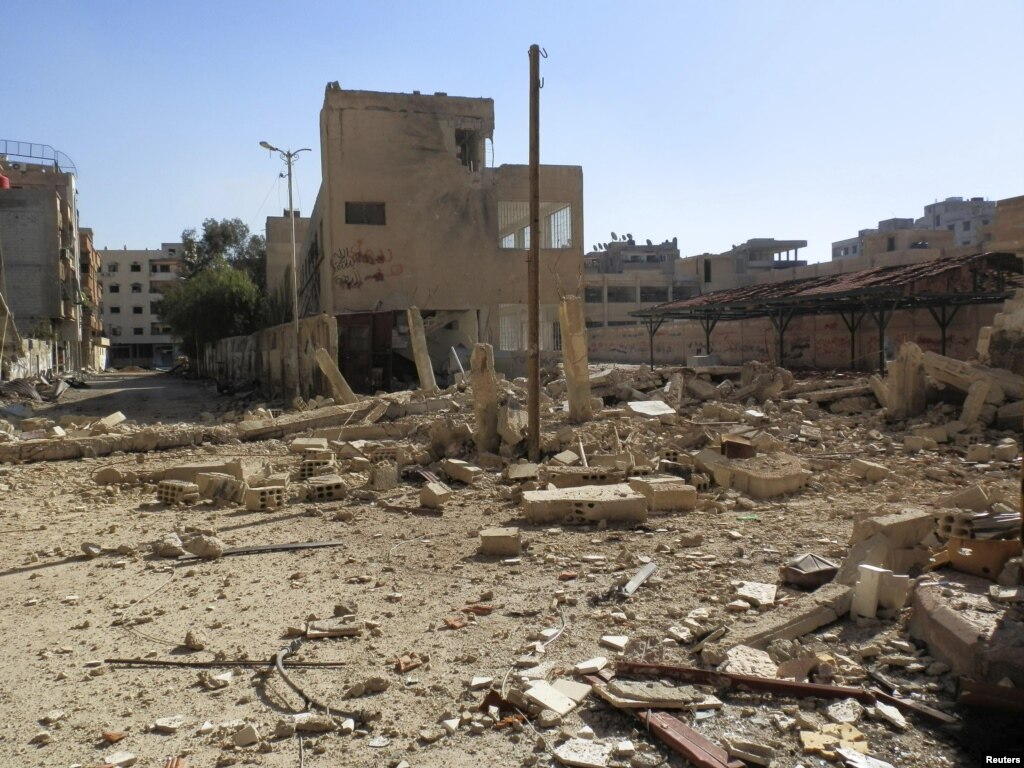
A view of rubble and damaged buildings after what activists said was shelling by forces loyal to Syria’s President Bashar al-Assad, Daraya, Feb. 4, 2013.

Government forces responded with heavy shelling of inner districts of the capital and closed off the city’s main Abbassid Square.

Amateur video shows what Syrian rebel fighters claim to be an attack on a government position in the Damascus district of Joubar.

Opposition activists say that the attack is part of a multi-pronged rebel attack on government forces near the capital’s southern ring road.

Witnesses inside Damascus say that government forces have been shelling to try and repel the rebel attack. Sources inside the capital also say that the city’s historic Abbassid Square was closed as fighting raged nearby.

Rebel declaration

The rebel Free Syrian Army issued a declaration calling Wednesday’s assault “Operation Epic in the Capital of the Omayyids” to liberate Damascus. The statement listed six rebel brigades that were participating in the battle, including the al-Qaida-linked Jabhat al-Nusra.

Earlier, a government security compound was hit in the central city of Palmyra, where a pair of suicide car bombs exploded. Activists said the bombings targeted a military intelligence compound, killing at least 12 Syrian security personnel.

State media described the explosions differently, saying they went off in a residential area and killed several people.

Peter Harling of the International Crisis Group said that the rebel attack in Damascus may be an attempt to relieve pressure on the rebel-held suburb of Daraya, which has been under heavy government shelling and aerial bombardment for days.

He said despite reports that government forces have pulled back from certain areas of the capital under rebel pressure, it was unlikely that the government was about to collapse.

“The regime has rebuilt itself into a rather cohesive fighting force and I think this notion that it’s losing ground is partly an illusion,” Harling said. “I mean the regime has been losing ground consistently on the economic, political, moral levels, but I think militarily it’s still extremely strong.”

Harling added that the government has “massive human resources and military assets in the capital” and that its forces are “entrenched in a large and very defensible area in the heights of Damascus.”

A recent call for a negotiated solution to the conflict by opposition leader Mouaz al-Khatib has hit resistance from various opposition groups. The opposition Syrian National Council said that it would meet soon to discuss the proposition.

After hating Israel, nothing in common

February 6, 2013

Israel Hayom | After hating Israel, nothing in common.

Prof. Eyal Zisser

Iranian President Mahmoud Ahamadinejad’s visit to Cairo on Tuesday started off on the wrong foot. The visitor recited his usual hateful and hostile invective against Israel to Egypt’s citizens, but they preferred instead to press Ahmadinejad on Syria, where Iran is supporting its ally President Bashar al-Assad while he slaughters the Syrian people.

And so Ahmadinejad’s hosts throughout the day leveled harsh criticism against him — some of it embarrassing — concerning the negative role of Iran in Syria, but also against Iran’s subversive behavior against the Gulf oil emirates and Saudi Arabia. Then there was criticism as well on Iranian efforts to wield influence in Iraq. It’s not surprising that someone tried to physically attack the Iranian president during his visit to one of Cairo’s mosques.

Ahmadinejad’s host, Egyptian President and Muslim Brotherhood member Mohammed Morsi, doesn’t try to conceal his criticism of and hostility toward Israel. Morsi is part of a movement that Shiites consider either a rival or outright enemy. Morsi identifies with Sunni Muslims throughout the Muslim world in their struggle against Shiite Iran and its allies, whether in Syria, Iraq or the Persian Gulf.

Following the recent wave of unrest in Egypt, Morsi better understood the importance of the special relationship between Cairo and Washington. After all, Egypt’s ability to feed 86 million hungry mouths depends on both America’s goodwill and the depth of its pockets. Morsi also knows to safeguard the relationship and coordination between Egyptian and Israeli security forces. In short, Ahmadinejad discovered in Egypt’s presidential palace a Mubarak with a beard, as Morsi’s staunch critics have dubbed the current Egyptian president.

Morsi has his own political considerations, and he was wise to invite Ahmadinejad to participate in the Organization of Islamic Cooperation summit, taking place in the Egyptian capital. But apart from mutual resentment of Israel, the two leaders can’t reach an agreement on anything else. The two nations have failed to renew full diplomatic ties, which have been severed since 1979 when Egypt moved to make peace with Israel.

This visit to Egypt was Ahmadinejad’s swan song. He will disappear from our lives in the next couple of months, following the Iranian elections this June. Even in Tehran they understand that media stunts are not a substitute for real statesmanship. Although it may be appropriate to be concerned that a better skilled and more sophisticated leader will replace Ahmadinejad, still, the divide between Shiite Iran and the Sunni Arab world, led by Egypt, remains wider than ever.

Iran’s Advanced Centrifuges – Assessment and Significance

February 6, 2013

Iran’s Advanced Centrifuges – Assessment and Significance.

The Iranian announcements concerning the country’s intention to install centrifuges at the Natanz enrichment facility remains vague. While the use of these centrifuges is not a technological leap forward, it does represent Iran’s advancement towards nuclear weapons


Iran's Advanced Centrifuges – Assessment and Significance

According to Reuters (January 31, 2013), Iran informed the IAEA by letter of its plans to install and operate advanced centrifuges at its main uranium-enrichment facility near Natanz. The report did not include details about the identity of the advanced model or the amount of centrifuges that Iran intends to install.

However, despite the vague information in the Reuters, report, the IAEA’s reports from the latter half of 2012 might shed some light on Iran’s advanced centrifuge plan. In recent years, Iran has developed two advanced versions of centrifuges: IR-2m, which is a second-generation Iranian centrifuge model, and the fourth-generation IR-4. The rotor in the IR-1 model, Iran’s first generation of centrifuges, which is the primary component in the centrifuge, is composed of an aluminum alloy. However, the rotor in the advanced models is not metallic, but made of carbon fibers. In one of the photos of Iranian President Ahmadinejad, apparently when he visited a factory for the production of centrifuge components, he is seen holding a centrifuge rotor made of carbon fiber. The use of carbon fiber makes it possible to increase the diameter of the rotor, and even significantly increase its rotation speed – thus increasing the yield of the centrifuge considerably. However, at least from the Iranian perspective, while the IR-2m and IR-4 centrifuges are advanced, the technology they are based on was actually developed in the 1970s and 1980s. They are very much copies of second-generation centrifuges, which is itself based on German design, just as the IR-1 is a copy of first-generation Pakistani centrifuges, which are based on Dutch design.

The technological knowledge in the field of centrifuges was sold to Iran in the late 1980s and the 1990s by Pakistani scientist Dr. Abdul Qadeer Khan, who gained the knowledge while working at a Dutch research facility that took part in the URENCO centrifuge project, which was shared by Germany, Britain and the Netherlands. In the 1970s, Dr. Khan returned to Pakistan, after cunningly copying the URENCO programs and smuggled them into the country. It is quite possible that detailed technological knowledge that helped in the development of the advanced Iranian centrifuges made its way to Iran from the Iraqi centrifuge program, via Iranian intelligence agents who worked in Iraq before the First Gulf War and afterwards.

The centrifuges developed by Iraq before 1990 were also based on the German centrifuge, according to plans that were covertly acquired by the country from German experts. In any case, the operation of the advanced centrifuges might be an advancement from Iran’s perspective, by significantly increasing its uranium-enrichment capability. According to David Albright, manager of the Institute for Science and International Security (ISIS) in Washington, who deals with intelligence assessments on the issue of nuclear circulation around the world, the yield from Iran’s advanced centrifuge models is five times higher than that of the IR-1 model. According to the IAEA reports, the pilot plant of the Natanz facility has advanced centrifuges installed for a while now. As of the second half of 2012, some of them are operational when fed UF6 gas. The status of these centrifuges, as of August 2012, is as follows: a small and experimental cascade of 10 IR-4 centrifuges, which was operated from time to time to carry out tests and measurements; another cascade of 123 IR-4 centrifuges, installed but not operated; and a third cascade of 162 IR-2m centrifuges, which were installed but not operated.

In the past, the Iranian cascades contained 164 centrifuges. However, according to a new design, the new cascades have 174 centrifuges. It is therefore likely that Iran’s recent announcement to the IAEA comes due to the vast experience acquired in Natanz in the experimental operation of the advanced centrifuges, and in Iran’s view that the time has come for their regular operation in industrial scope. Iran’s latest announcement to the IAEA was apparently vague. It lacks details on the number of advanced centrifuges Iran intends to operate soon, nor did it provide the rate of uranium enrichment that it will be used for. The IAEA reports that have been published so far also lack information about the amount of advanced centrifuges produced by Iran thus far, and about the production capability of the Iranian factories, which produce and assemble the centrifuges.

In any case, it can be assumed that Iran will operate at least the two cascades in Natanz in the near future; Most of the advanced centrifuges have already been installed in these cascades – whose full installation may have already concluded, or will conclude soon. It is possible that these things will be made clear in the IAEA report that will be published in the coming month.

**

Lt. Col. (Res.) Dr. Rafael Ofek is an expert of physics and Iranian technology. He has served in the past as a senior researcher and analyst in the Israeli intelligence community.

U.S., Egypt defense chiefs back security ties: Pentagon

February 6, 2013

U.S., Egypt defense chiefs back security ties: Pentagon.

U.S. Defense Secretary Leon Panetta agreed on the importance of continued U.S. military assistance for Egypt with his Egyptian counterpart. (Reuters)

U.S. Defense Secretary Leon Panetta agreed on the importance of continued U.S. military assistance for Egypt with his Egyptian counterpart. (Reuters)

U.S. Defense Secretary Leon Panetta spoke by phone with his Egyptian counterpart on Tuesday to hear an update on the tense political situation in Cairo and the “role” of the army amid recent street demonstrations, a Pentagon spokesman said.

Defense minister and military chief General Abdel Fattah al-Sissi, who has warned the state could collapse in the face of political upheaval, voiced support for maintaining strong security ties with Washington and reassured Panetta that the armed forces remained committed to his country’s peace treaty with Israel, spokesman George Little said in a statement.

Panetta called Sissi “today to receive updates on the political situation in Egypt, the role of the Egyptian Armed Forces during the recent protests, and express U.S. commitment to the defense relationship,” the statement said.

Sissi “reiterated his support for the defense relationship, and thanked Secretary Panetta for his leadership and support,” it said.

The minister “reiterated the Egyptian Armed Forces’ commitment to the Peace Treaty with Israel, and underscored that his commitment that the Sinai will not be used as a base to threaten Israel,” it said.

Both men agreed on the importance of continued U.S. military assistance for Egypt, “so that the Egyptian Armed Forces can continue to address shared security objectives while modernizing their equipment and capabilities,” the statement said.

The talks follow a wave of demonstrations and violent clashes in Egypt and a dire warning from Sissi that the country’s stability was in the balance.

Egypt’s opposition says the police have failed to reform since the uprising to topple authoritarian leader Hosni Mubarak. And the U.S. State Department on Monday called on Egypt to investigate all cases of alleged police abuse after a man was brutally beaten outside the presidential palace in Cairo last week.

The United States has maintained its longstanding relations with Egypt’s armed forces despite the political turmoil and is going ahead with deliveries of F-16 fighter jets to Cairo as part of a massive arms package, despite objections from some U.S. lawmakers.

Russia hopes to see ‘serious progress’ at Iran nuclear talks

February 6, 2013

Russia hopes to see ‘serious progress’ at Iran nuclear talks.


Deputy Foreign Minister Sergei Ryabkov said the two sides had made no progress since the last round of top-level negotiations were held in Moscow at the end of June 2012. (AFP)

Deputy Foreign Minister Sergei Ryabkov said the two sides had made no progress since the last round of top-level negotiations were held in Moscow at the end of June 2012. (AFP)


Russia said on Wednesday it hoped to see “serious progress” at this month’s talks in Kazakhstan between world powers and Iran over Tehran’s disputed nuclear program.

Deputy Foreign Minister Sergei Ryabkov said the two sides had made no progress since the last round of top-level negotiations were held in Moscow at the end of June 2012.

But he stressed that pressure will be high on both Iran and the world powers to climb down from their respective positions and seek middle ground at the February 26 meeting in Almaty.

“Despite everything, I would very much hope to see the upcoming round result in — if not an outright breakthrough — then serious progress,” Ryabkov said in a wide-ranging interview with the state-run RIA Novosti news agency.

“Because so far, we have not advanced past the stage at which we found ourselves in June” in Moscow.

“We have lost a lot of time,” Russia’s top nuclear negotiator said.

“We do not think you can lose time anymore.”

Talks between Iran and the so-called P5+1 powers — the five permanent U.N. Security Council members and Germany — have been held on three occasions at the highest level in the past year.

None of the meetings has drawn a promise from Tehran to scale back its controversial nuclear enrichment program to levels that world powers believe cannot be used to make atomic weapons.

Iran denies its nuclear program has a military component and insists on global recognition of its right to enrich uranium for peaceful purposes.

World powers counter that Iran sacrificed its enrichment rights by refusing to cooperation with international nuclear inspectors.

The dispute has resulted in four rounds of global sanctions against Tehran — in addition to unilateral U.S. and EU measures — that have crippled the Iranian economy and hit its oil exports.

Understanding Israel’s stance on Syria

February 6, 2013

Understanding Israel’s stance on Syria.

( An Arab who lives in REALITY… – JW )

Al Arabiya

By Hazem Saghieh

Hazem Saghieh

The recent Israeli airstrike, whose target remains somewhat vague, has renewed the “dispute” between the supporters of the government and the opposition in Syria. The first camp has concluded that the strike was irrefutable evidence that Israel stands against the regime of Bashar al-Assad, and is doing everything in its power to complement what has been initiated by the armed opposition and its allies, from Doha to Washington D.C.

 To say that Israel has a strategy that goes beyond these security interests and is related to the future of Syria, would entail a generosity on the side of the Israelis that experience tells us is inexistent towards the Syrians or other Arabs  

Hazem Saghieh

The revolution camp, meanwhile, has highlighted the lack of an official Syrian response, as yet another proof that the Assad regime is in collusion with the Hebrew state, having kept the Golan front quiet since 1974 to our present day.

It is clear here that both arguments build on partially correct premises, to reach a conclusion that is challengeable and questionable.

Meanwhile, building on Israel’s supposed position to demonstrate the validity of the stance of each party is a vestige of an old political culture that is common to Arab factions when they squabble and fight. This culture has become so established and entrenched decade after decade that it has become difficult for us to make sense of the world without determining in advance where Israel stands. If it seemed for a moment that any side intersects with a move made by Israel, or benefits therefrom, the side in question will be quick to engage in denial and reinterpretation of the situation to ensure its innocence and purity are preserved.

While the opposition is drawn to this mentality of taboos with naive loyalty to the “righteous intellectual predecessors,” the regime adopts the same mentality with clear cynicism that does not need to be exposed for the lies, deception and insults to intelligence and reality that it implies. This is in addition to the huge self-serving role played by the Syrian regime in fostering that worldview and method of judgment.

What makes this “dispute” even worse is that Israel is neither on this side nor on that side. Israel is first and foremost concerned about its narrow security interests, specifically in maintaining the front with Syria quiet and undisturbed, and preventing the transfer of chemical or advanced weapons to other actors especially Hezbollah. This is in addition to the concern about the alleged presence of al-Qaeda and similar groups along its border.

These “concerns” prompt the Israeli side to prefer weakening the regime while keeping it in place. To be sure, Israel has benefited from the continuation of the regime, especially in the Golan, not to mention the fact that the regime has been able to clamp down on any radical Islamists that Israel say trouble it. This is while weakening the regime would be sufficient to reduce its backing of its allies on the Lebanese arena.

But to say that Israel has a strategy that goes beyond these security interests and is related to the future of Syria, would entail a generosity on the side of the Israelis that experience tells us is nonexistent towards the Syrians or other Arabs – exactly like we cannot assume that such a thing exists among any Arab side towards the Israelis.

This may help explain the stance of Israel and its close allies in Washington D.C. on the “need to preserve the Syrian regime,” just like it explains the painful and humiliating strikes Israel carries out, from time to time, against that regime.

What is even worse, in the utilitarian sense of the word, is that this intra-Syrian “dispute” ignores the fact that when it comes to the Syrian issue, the Israeli concerns (the borders, the chemical weapons, and al-Qaeda) represent the international common denominator on Syria. In this sense, the “dispute” preoccupying us is nothing but an effort being wasted in the wrong place.

This article was published in al-Hayat daily on Feb. 5, 2013.


