Archive for February 2012

How Would Israel Destroy Iran’s Nuclear Production Facilities?

February 19, 2012

How Would Israel Destroy Iran’s Nuclear Production Facilities? « EMP and Solar Protection Technologies.

As the debate heats up, the real question is:

How Would Israel Destroy Iran’s Nuclear Production Facilities?

It has long been known that Iran’s nuclear production facilities were designed to be capable of withstanding a conventional bombing attack from aircraft. It is now strongly suspected that the Iranian Nuclear Development Facilities at Natanz and Qom have been built underground at depths beyond the reach of advanced conventional weapons such as “Bunker-Busting” missiles or bombs.

This leaves Israel with two choices.  Both choices would force Israel into using at least some of their nuclear weapons to attack Iran.

Israel could attack each of Iran’s numerous hardened nuclear facilities with nuclear warheads designed to bury deep into the earth and then detonate. The result of this type of nuclear attack would be the total destruction of the production facility.  Unfortunately, this option would also result in massive human, environmental and atmospheric devastation. Not to mention the world-wide condemnation that would be leveled against Israel following such an attack.

Or, Israel could detonate a nuclear warhead in outer-space above Iran creating an Electromagnetic Pulse (EMP).  If detonated at the proper altitude above Iran, it would largely affect only Iran. An EMP attack would knock the Iranian electric grid back into the modern-day equivalent of the “Stone-Age.”

A high-altitude nuclear EMP attack over Iran would produce no immediate human casualties, would create no blast damage and would leave no dramatic physical evidence that a nuclear attack had occurred. Politically, Israel could claim, “No Human Harm – No Foul.” Yet, the future of Iranian nuclear weapon development would, thankfully, be eliminated for a very, very long time.

The Iranin population, in the meantime, would be left without electricity. No power to their nuclear facilities, no power to their factories, no power to their cities and, of course, no electric power to the people of Iran. Iran would be blasted back into the industrial equivalent of the mid – 1800′s.

Eventually, with massive international assistance, millions of Iranians would be saved from starvation, which would certainly result from the total elimination of electricity from a modern society.

Depending on decisions made in Israel over the next several months, we might be looking at the first use of a High-altitude nuclear EMP (HEMP) that eliminates an entire nation from modern civilization.

Israeli ICBM Test Raises Possible EMP Attack on Nuclear Iran

February 19, 2012

Israeli ICBM Test Raises Possible EMP Attack on Nuclear Iran.

(Bibi’s “ace in the hole?” – JW)

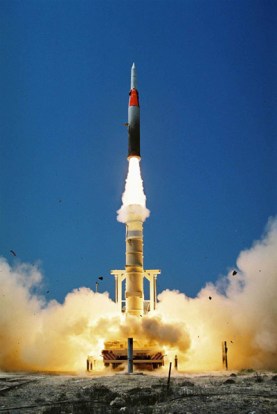
https://warsclerotic.com/wp-content/uploads/2012/02/jericho-3intercontinentalballisticmissile.jpg?w=200

Israel announced Wednesday, the successful test of a Jericho III ICBM with a range of 4000 kilometers, approximately 2,500 miles. Yaakov Katz, Jerusalem Post military analyst, commented in an article today, “Rattling the Cage”:

“The Israel Air Force announced that it had returned from a week of joint maneuvers with Italy over Sardinia that included long-range flights, midair refueling and complicated bombing runs. On Thursday, the Home Front Command held a large-scale civil defense exercise aimed at preparing the public for missile attacks in the center of the country.”

The Jericho III ICBM equipped with a nuclear warhead provides Israel with a powerful deterrent against a nuclear Iran. It gives Israel a credible Electronic Magnetic Pulse (EMP) capability to loft a low kiloton yield warhead to an apogee over Iran that upon detonation would destroy the country’s industrial infrastructure, frying motherboards of hundreds of thousands of computers, disabling telecommunications, transportation and industrial systems.

According to veteran Iran watcher, Ken Timmerman, President and CEO of the Foundation for Democracy in Iran, that possibility was confirmed by ex-CIA case officer Chet Nagle at a Capitol Hill EMPact America press conference in Washington, DC on Tuesday, the day before the Jericho III test was announced.

Doubtless an Israeli EMP attack would cause thousands of whirling centrifuges enriching uranium at the Natanz cascade hall and the Bushehr nuclear plant producing plutonium to be shut down. It might spare Iran’s vital oil and natural gas producing region in the Gulf. It would free Iran’s restive people from the nuclear nightmare of the Mullahs.

If the EMP apogee was low enough, then according to Timmerman, it would largely spare Iran’s agrarian rural areas and the country’s bread basket. The Islamic regime and industrial infrastructure concentrated in the Tehran region could collapse. Moreover, he said, the neighboring Gulf region would be spared collateral effects.

The Israelis hope that Supreme Leader Ayatollah Khamenei, President Ahmadinejad and the Islamic Revolutionary Guards Corps (IRGC) leaders got the message behind the ICBM test on Wednesday…

Israel has a full quiver of options. These include its own nuclear capable missile the Jericho III, cruise missiles launched from its Dolphin submarine fleet, and cyber warfare techniques like Stuxnet that have disabled Iran’s nuclear development infrastructure. Conventional air attack scenarios that would endeavor to reduce the Natanz and other nuclear underground facilities would be fraught with complex air route and logistical problems. Obtaining Saudi, Iraqi and even Turkish airspace permission would be doubtful.

In the wake of the Jericho III test there are Ha’aretz reports about Security Cabinet debates in the Netanyahu government pressing for an attack on Iran’s nuclear facilities and the IRGC. According to MSNBC, polls show that the Israeli population is divided about such a prospect. This despite an assessment by Iranian Defector and ex-CIA spy Reza Khalili in a recent report in the Washington Times who said that Iran already has nuclear arms.

Iran Threatens ‘Crushing Response’ If Attacked

February 19, 2012

Iran Threatens ‘Crushing Response’ If Attacked – Defense/Security – News – Israel National News.

Iran heats up tensions and warns Israel of a “crushing response to Israel’s slightest move.” US jawbones against a pre-emptive strike.
By Tzvi Ben Gedalyahu

First Publish: 2/19/2012, 11:36 AM


Iran fires long-range missile

Iran fires long-range missile
Israel news photo: IRNA Iranian news agency

Iran has threatened a “crushing response to Israel’s slightest move” as the United States raises the volume against a pre-emptive strike. Iran also has announced new war games for next month.

The Ahmadinejad regime chose its ambassador to Lebanon, Qazanfar Roknabadi, to deliver a message on Saturday that “Iran will not start a possible war with the Zionist regime but will deliver a decisive response to any aggression by the regime.” As usual, he refrained from using the term “Israel.”

Regardless of Israel’s intentions, Iran’s Revolutionary Guards Corps is planning new war games next month in a desert area in the central part of the country.

Commander of the IRGC Ground Forces, Brigadier General Mohammad Pakpour, said on Saturday that the drill will implement “modern defensive tactics,…taking advantage of advanced indigenous military equipment,” the state-run Fars News Agency reported.

Iran’s media, most of it government controlled, played up advice by General Martin Dempsey, the chairman of the U.S. Joint Chiefs of Staff,  that it would be unwise to attack Iran now.

“It’s not prudent at this point to decide to attack Iran,” Dempsey told CNN on Saturday. “I think it would be premature to exclusively decide that the time for a military option was upon us. A strike at this time would be destabilizing and wouldn’t achieve their (the Israelis’) long-term objectives. I wouldn’t suggest, sitting here today, that we’ve persuaded them that our view is the correct view and that they are acting in an ill-advised fashion.”

The Obama administration has been jaw-boning in the media against a military strike, claiming that harsh sanctions against Iran are working and that Israel should wait. the dilemma for Israel is that most military and intelligence officials warn that postponing military action will close the “window of opportunity” as Iran continues to race ahead towards nuclear capability, especially at its underground nuclear facilities.

The BBC reported Sunday that Iran appears to be preparing to speed up production of enriched uranium, a key ingredient of a nuclear weapon. It announced last week it has installed an additional 3,000 centrifuges in its underground nuclear plant near the city of Qom.

The Obama administration is increasing pressure on Israel by sending U.S. National Security Advisor Tom Donilon to Jerusalem for talks with government and military officials.

Analysis: Wishful thinking or faulty intelligence?

February 19, 2012

Analysis: Wishful thinking or fau… JPost – Diplomacy & Politics.


By YAAKOV KATZ 02/19/2012 01:15
Barak’s repeated predictions on Assad’s demise may have been premature.

Arab Israelis step on photo of Assad as Hitler.

By REUTERS/Ammar Awad

Is it wishful thinking or based on poor intelligence assessments? Either way, Defense Minister Ehud Barak’s predictions regarding the fate of Syrian President Bashar Assad do not seem to have been so accurate and are also not shared by his counterparts in the Pentagon.

A review by The Jerusalem Post of Barak’s comments on Assad’s fate reveals that the defense minister has been making predictions for over half-a-year that Assad will fall within weeks or months, even when US intelligence officials claim that Assad’s regime is stable.

On Thursday, for example, Lt.-Gen. Ronald Burgess, the director of the Defense Intelligence Agency in the Pentagon, told the Senate’s Armed Services Committee that despite the ongoing upheaval in Syria, Assad’s regime was stable.

“After 10 months of unrest, the regime and opposition in Syria are in a stalemate; however, the regime is cohesive,” Burgess said in his prepared statement to the committee.

“The Syrian military, despite some desertions and defections to the armed opposition, on the whole remains a viable, cohesive, and effective force.”

That same day, Barak’s office released a statement following his meeting with Japanese Defense Minister Naoki Tanaka in Tokyo. Assad, Barak told Tanaka, would fall “within weeks.”

Barak’s public predictions regarding Assad’s fate began in June when he attended the Paris Air Show. Speaking to the Associated Press, Barak said that Assad would probably fall in three to six months.

“He probably will stay around for another quarter or two but that will not change his fate,” Barak said on June 20, meaning that six months would have been some time in December.

On November 19, during a gathering of defense ministers in Halifax, Nova Scotia, Barak said that Assad would not remain in power for long. Two weeks later, on December 6, Barak said during a tour of the Golan Heights that Assad will fall, although he did not know if it will take “a few weeks or months.”

Five days later, at the World Policy Conference in Vienna, Barak decided it would take weeks. Assad’s downfall, he added, would be a “blessing for the Middle East.” Three days later, on December 14 and ahead of a trip to the United States, Barak told The Washington Post that “it might take many weeks, but it’s not a matter of months or years.”

A day later, he told a class of schoolchildren in Washington that Assad would be gone before Passover, which begins on April 6. A few weeks after that, on January 2, Barak repeated his earlier prediction in a briefing to the Knesset’s Foreign Affairs and Defense Committee.

“The Assad family has no more than a few weeks to remain in control in Syria,” he said.

So when will Assad fall? The answer is still unclear, but what is noticeable is that Barak is the only Israeli official issuing such forecasts. In interviews to TV stations on Saturday night, IDF Chief of Staff Lt.-Gen. Benny Gantz, for example, shied away from predicting when Assad’s regime will collapse.

Ultimately, Israel believes that it will happen, although it could still take some time.

The two main factors are the stability of the Syrian economy – Assad is receiving unprecedented support from Iran – and the ongoing defections in his military. Unless “weeks” means months, Assad’s fall might take longer than the defense minister thinks.

IDF Doesn’t Stay Silent in Wake of Rocket Attacks

February 19, 2012

IDF Doesn’t Stay Silent in Wake of Rocket Attacks – Defense/Security – News – Israel National News.

IDF strikes terror targets in Gaza twice, after terrorists fire a barrage of rockets at southern Israel.
By Elad Benari

First Publish: 2/19/2012, 2:41 AM


IAF Counterstrike (Gaza)

IAF Counterstrike (Gaza)
Arutz Sheva: Flash 90

Southern Israel’s residents are spending the night near shelters and protected spaces, after a barrage of rockets fired from Gaza over the weekend brought about several retaliations by the IDF.

At around 10:30 p.m. (Israel time) on Saturday night, IAF aircraft attacked a rocket production site in Gaza. The IDF Spokesperson said that the aircraft scored direct hits on their targets.

The second IAF attack occurred around 1:45 a.m., this time on a terrorist base and a weapons storehouse. In this attack, as well, direct hits were scored. All aircraft safely returned to their bases.

Over the weekend, Palestinian Authority terrorists fired at least six rockets at southern Israel.

A Grad missile exploded outside the city of Be’er Sheva shortly after the noon hour on Saturday afternoon. The missile landed in an open area. No property damage was reported and no one was physically injured.

Two short-range Qassam rockets were also fired in a separate attack on the western Negev, slamming into the Eshkol Regional Council district. Both landed in open areas. No property damage was reported, and no one was physically injured.

On Friday there were several attacks on southern Israel by Gaza terrorists that prompted the IDF to move to high alert. One rocket reached the Ashkelon Coast Regional Council district. The other exploded in the Eshkol Regional Council district.

Gaza terrorists also fired an RPG (rocket-propelled grenade) anti-tank missile at IDF soldiers patrolling near the southern border on Friday evening. None of the Israeli soldiers were wounded in the attack, and IDF forces responded with tank fire.

Israel ‘will make own decision’ on Iran, says military chief

February 19, 2012

Israel ‘will make own decision’ on Iran, says military chief | thetelegraph.com.au.

ISRAEL will ultimately decide on its own whether to strike Iranian nuclear facilities, its military chief of staff says, as a senior US official arrived for talks on the Islamic Republic.

“Israel is the central guarantor of its own security; this is our role as army, the State of Israel should defend itself,” Lieutenant General Benny Gantz told state-owned Channel One TV.

“We must follow the developments in Iran and its nuclear project, but in a very broad manner, taking into account what the world is doing, what Iran decided, what we will do or not do,” he said.

In recent weeks, there has been feverish speculation that Israel was getting closer to mounting a pre-emptive strike on Iran’s nuclear program, though Israel has denied reaching such a decision.

Tensions between Iran and Israel have been simmering with Iranian warships entering the Mediterranean through the Suez Canal in a show of “might”, a move Israel said it would closely monitor.

On Wednesday, Iran said it had installed another 3000 centrifuges to increase its uranium enrichment abilities and was stepping up exploration and processing of uranium yellowcake.

And Israel blamed a recent wave of attacks targeting Israeli diplomats on agents of Tehran, allegations that Iran denies.

US National Security Advisor Tom Donilon will begin talks with Israeli officials on a range of issues including Iran, two weeks ahead of a Washington visit by Israeli Prime Minister Benjamin Netanyahu for White House talks with US President Barak Obama on the same topic.

A recent article in the Washington Post said that US Defense Secretary Leon Panetta thinks Israel may strike Iran’s nuclear installations in the coming months.

According to Gantz, whose interview was conducted prior to the developments, Iran was not only an “Israeli problem”, but also “a world and regional problem”.

Israeli Defence Minister Ehud Barak called on the world to tighten sanctions on Iran before the country enters a “zone of immunity” against a physical attack to stop its nuclear program.

Iran has been slapped with four sets of UN sanctions and a raft of unilateral US and European Union measures over its nuclear drive, which Tehran maintains is peaceful.

Top White House official arrives for talks on Iran

February 19, 2012

Top White House official arrives… JPost – Iranian Threat – News.

By HERB KEINON AND HILARY LEILA KRIEGER 02/19/2012 04:33
US National Security Adviser Donilon to meet with PM; Dempsey: Israeli attack would be “destabilizing”; Clinton, Ashton welcome letter from Tehran expressing willingness to return to negotiations.

Ahmadinejad looks on next to nuclear scientists By REUTERS

US National Security Adviser Tom Donilon is scheduled to meet Prime Minister Binyamin Netanyahu in Jerusalem Sunday evening for talks on Iran, a day after the head of the US military said an Israeli attack now would not be “prudent.”

This will be Donilon’s first visit here as US President Barack Obama’s national security adviser, having replaced James Jones in October 2010.

Jones was the last national security adviser to visit Israel, doing so in January 2010 for talks that also centered on Iran.

The White House issued a statement saying Donilon will be in Israel from Saturday to Monday for consultations with senior officials about a range of issues, including “Iran, Syria and other regional security issues.” The statement said Donilon’s visit was the “latest in a series of regular, high-level consultations between the United States and Israel, consistent with our strong bilateral partnership and part of our unshakeable commitment to Israel’s security.”

Israeli government officials did not provide any more details regarding the visit by the national security adviser, which, while not rare, is also not routine.

Donilon is the latest in a parade of high-level visitors to both country’s capitals in recent weeks, including Foreign Minister Avigdor Liberman, Defense Minister Ehud Barak and Mossad head Tamir Pardo in Washington, and a visit here last month by the chairman of the US Joint Chiefs of Staff, Gen. Martin Dempsey.

Dempsey, in a CNN interview to be broadcast on Sunday, said an Israeli attack on Iran would be “destabilizing.”

“It’s not prudent at this point to decide to attack Iran,” he said, according to an emailed transcript. The US government is confident that Israelis “understand our concerns.

“A strike at this time would be destabilizing and wouldn’t achieve their long-term objectives,” Dempsey said of the Israeli leadership. “I wouldn’t suggest, sitting here today, that we’ve persuaded them that our view is the correct view and that they are acting in an ill-advised fashion.”

He said the economic sanctions imposed on Iran and international pressure are beginning to have an effect, without elaborating.

“We are of the opinion that Iran is a rational actor,” Dempsey said. “We also know, or we believe we know, that the Iranian regime has not decided” to make a nuclear weapon, he said.

Netanyahu, during a visit to Cyprus on Thursday, said that while he hoped the international sanctions work, “so far they have not.” The prime minister said that Iranian President Mahmoud Ahmadinejad’s high-profile “guided tour” last week of the country’s “centrifuge hall” was evidence that Tehran remained committed to continuing its nuclear program.

Donilon’s visit follows Iran’s indication on Friday that it was willing to return to talks, after the world powers leading the negotiations received a formal letter from Tehran to do so.

“We think this is an important step and we welcome the letter,” US Secretary of State Hillary Clinton said following a meeting with EU foreign policy chief Catherine Ashton.

Clinton described the Iranian letter as appearing to accept that its nuclear program would be a subject of talks, whereas it has refused to broach the topic in earlier rounds of negotiations.

Ashton, who appeared alongside Clinton at a US State Department press conference, also described the letter as having “no preconditions and a recognition of what we’ll be talking about,” but said that it must be possible to “sustain” new negotiations. Therefore, she said the world powers – the US, Britain, France, Germany, China and Russia – “need to set in train the process whereby we can be clear what it is we mean to achieve and what we’re expecting from the Iranians.”

Both leaders said they were still evaluating the letter and formulating their formal response.

Iran’s letter to Ashton, which was obtained by Reuters on Thursday, proposed resuming the stalled talks and said Tehran would have “new initiatives” to bring to the table.

But the brief letter, which responded to a letter Ashton sent to her Iranian counterpart in October, offered no specific proposals, leaving a question mark over Tehran’s willingness to enter substantive negotiations on its nuclear work.

State Department spokeswoman Victoria Nuland said Washington and its allies would be on guard against any more “false starts” to the negotiation process.

“We’ve had negotiations that started and fizzled, or negotiations that ate up a lot of time and didn’t go where they needed to go,” Nuland said.

“We want to make sure… if we go forward, and a decision has not been made, that it is well-planned, well-coordinated among us and that we’re absolutely clear as a unified group about our expectations.”

French Foreign Minister Alain Juppé said on Thursday that a visit to Iran on Monday and Tuesday by top UN nuclear watchdog officials would help determine whether Tehran was serious about tackling international concerns.

The UN team, led by the International Atomic Energy Agency’s chief inspector, will again try to extract Iranian explanations, after three years of stonewalling, for an IAEA investigation driven by intelligence reports that suggest Tehran has researched sophisticated ways to build atomic bombs.

Following an IAEA report in November that cast new doubts over Iran’s nuclear work, the United States and the EU adopted sanctions meant to shut down Iran’s oil export industry, the world’s fifth-largest.

The clampdown on Iranian oil is to take full effect in July, and to join an escalating range of UN and unilateral sanctions that Western officials say are putting unprecedented pressure on the Islamic Republic’s economy.

Ashton said the world powers, known as the P5+1, made no headway in their last talks with Iran on the nuclear issue in Istanbul in January 2011.

“The next question really is to look at, then, where we left off in Istanbul,” Ashton said, noting a series of suggested confidence-building measures such as greater scope for inspections.

“We also said at that time they could come forward with their own ideas about what they wanted to do, so that this was a genuine, open process,” she said.

Clinton, however, stressed that “we must be assured that, if we make a decision to go forward, we see a sustained effort by Iran to come to the table, to work until we have reached an outcome that has Iran coming back into compliance with their international obligations.”

Reuters and Bloomberg contributed to this report.
At least 21 killed in Syria as mass protest erupts close to Assad’s palace in Damascus

February 19, 2012

At least 21 killed in Syria as mass protest erupts close to Assad’s palace in Damascus.

Thousands of protesters proceeded with demonstrations in Damascus against the Syrian regime during a funeral procession for three protesters killed on Friday. (Reuters)

Thousands of protesters proceeded with demonstrations in Damascus against the Syrian regime during a funeral procession for three protesters killed on Friday. (Reuters)

At least 21 people were killed during mass opposition protests in the Syria on Saturday, including one in the capital Damascus where a large demonstration was held close to the presidential palace.

The protest in Damascus broke out during a funeral procession held for three people killed by security forces on Friday.

An activist who witnessed the violence said the procession numbered around 15,000, the largest in the capital since the 11-month-old uprising against President Assad began. It took place in al-Maza neighborhood overlooking the presidential palace.

“It was a huge funeral that turned into a protest,” said the activist, who spoke on condition of anonymity for fear of reprisals. “There was no fear among the participants.”

Amateur videos filmed by activists and posted online showed a crowd of people shouting “Allahu Akbar,” or God is great, and “One, one, one, the Syrian people are one!”

Maza is considered home to a fortified intelligence building where protesters are detained and tortured, and it has other places where the military intelligence has tortured soldiers who backtracked and rejected orders to shoot at civilian protesters. The tight-security area has various diplomatic headquarters and government institutions.

On Friday, anti-regime protests spread to al-Hamadiya neighborhood near al-Amawi mosque in Damascus, where dozens of people were killed.

Areas such as al-Qadar, al-Hajr al-Aswad, Kafr Sousa, al-Barza have all seen anti-regime protests.

Meanwhile, the Syrian Council for Civilian Protection said that crimes against humanity are being directed against Syrians and that self-defense is a legal right as well as defending public sectors.

The council said that there is increasing defection by the Syrian soldiers, and added that a group of defected soldiers announced the formation of the “Capital’s Martyrs” brigade.

On Saturday, the Syrian opposition said that more than 2,500 Syrian soldiers have defected, making the number the largest. In a Youtube video, the defected Syrian soldiers were shown swearing their allegiance to protect their country.

Diplomatic front

The fresh violence erupted during a visit by an envoy from China, which along with Russia recently supported Syria by vetoing a U.N. Security Council resolution that would have condemned Assad’s regime. Chinese Vice Foreign Minister Zhai Jun called on all parties to stop violence that has killed more than 5,400 people since March of last year, according to the United Nations.

Tunisia, which hosted a first international conference on Syria in December and broke off ties with Damascus earlier this month, is hosting a “friends of Syria” conference next week, but Syrian opposition representatives are reportedly not invited to the event.

“There will certainly not be an official SNC representative” at the conference, Tunisian Foreign Minister Rafik Abdesalem told reporters while recognizing that the topic had caused wide debate.

“Each thing in time,” the minister said, adding that he hoped to see the creation of an opposition group with “real representation.”

The SNC said last week recognition by the Arab League was imminent, though members did not specify the extent of recognition they expected.

Tunisia has invited members of the Arab League and the European Union, along with the United States, to attend the February 24 conference.

Abdesalem confirmed invitations were also sent to Russia and China, the two powers have that have gone furthest to defend the regime of President Bashar al-Assad.

Iran reportedly building up nuclear site near Qom days ahead of IAEA visit

February 19, 2012

Iran reportedly building up nuclear site near Qom days ahead of IAEA visit.


A group of scientists are seen near the control room area at the Tehran Research Reactor. Iran appears to be poised to install thousands of new centrifuges at an underground site in the northern city of Qom just days ahead of a visit by U.N. nuclear inspectors. (Reuters)

A group of scientists are seen near the control room area at the Tehran Research Reactor. Iran appears to be poised to install thousands of new centrifuges at an underground site in the northern city of Qom just days ahead of a visit by U.N. nuclear inspectors. (Reuters)


Iran may be preparing to expand its nuclear program at an underground plant near the city of Qom, a diplomat has told the BBC, just days ahead of a visit by United Nations nuclear inspectors.

Iran appears to be poised to install thousands of new centrifuges at the underground site in the northern city, a Vienna-based diplomat told the British broadcaster late Saturday.

The BBC said the centrifuges could speed up the production of enriched uranium, which can be used both for generating nuclear power and to manufacture atomic weapons.


Iran said on Wednesday it had installed another 3,000 centrifuges to increase its uranium enrichment abilities, but it was unclear Sunday whether these were the same as those mentioned by the diplomat.

Inspectors from the International Atomic Energy Agency, the U.N.’s nuclear watchdog, are due to visit Tehran this week.

Iran insists that its nuclear drive is peaceful, but Western countries suspect the Islamic Republic of trying to develop an atomic bomb.

Iran has been slapped with four sets of U.N. sanctions and a raft of unilateral U.S. and European Union measures over its nuclear drive.

There has been feverish speculation in recent weeks that Israel is preparing to mount a pre-emptive strike on the country’s nuclear program, though Israel has denied reaching such a decision.

Britain’s Foreign Secretary William Hague warned over the weekend that Iran’s nuclear ambitions could spark an atomic arms race in the Middle East


Israel will make its own decision

Meanwhile Israel said later on Saturday that it will ultimately decree on an Iranian strike on its own, as a senior U.S. official arrived for talks on the Islamic Republic.

“Israel is the central guarantor of its own security; this is our role as army, the State of Israel should defend itself,” military chief of staff Lieutenant General Benny Gantz told state-owned Channel One TV.

“We must follow the developments in Iran and its nuclear project, but in a very broad manner, taking into account what the world is doing, what Iran decided, what we will do or not do,” he said.

Tensions between Iran and Israel have been simmering with Iranian warships entering the Mediterranean through the Suez Canal in a show of “might”, a move Israel said it would closely monitor.

On Wednesday, Iran said it had installed another 3,000 centrifuges to increase its uranium enrichment abilities and was stepping up exploration and processing of uranium yellowcake.

And Israel blamed a recent wave of attacks targeting Israeli diplomats on agents of Tehran, allegations Iran denies.

U.S. National Security Advisor Tom Donilon will on Sunday begin talks with Israeli officials on a range of issues including Iran, two weeks ahead of a Washington visit by Israeli Prime Minister Benjamin Netanyahu for White House talks with U.S. President Barak Obama on the same topic.

A recent article in the Washington Post said that U.S. Defense Secretary Leon Panetta thinks Israel may strike Iran’s nuclear installations in the coming months.

According to Gantz, whose interview was conducted prior to the Saturday developments, Iran was not only an “Israeli problem”, but also “a world and regional problem”.

On Saturday, Israeli Defense Minister Ehud Barak called on the world to tighten sanctions on Iran before the country enters a “zone of immunity” against a physical attack to stop its nuclear program.

China supports Arab League’s proposals for Syria – CBS News

February 19, 2012

China supports Arab League’s proposals for Syria – CBS News.

(AP)

BEIJING – China said Saturday that it supports the Arab League’s proposals for ending the violence in Syria, a striking show of support just two weeks after Beijing vetoed a U.N. Security Council resolution backing the league’s plans.

The seemingly contradictory stances on the Arab League’s proposals appear to reflect Beijing’s desire for mediation but aversion to U.N. involvement that could lead to authorizing force, as happened with Libya.

China conveyed its support for the Arab League’s proposals in a statement posted late Saturday on the Foreign Ministry’s website. That followed a meeting earlier in the day in Damascus between Chinese Vice Foreign Minister Zhai Jun and Syrian President Bashar Assad.

The statement quoted Zhai as telling Assad that China was willing to work with the Syrian government and opposition, the Arab League and Arab countries to find a solution.

Chinese envoy calls on Syrians to stop acts of violence

“China supports all the mediation efforts by the Arab League to find a political solution to the Syrian crisis and calls upon relevant parties to increase communication and negotiations to find a peaceful and appropriate solution to the Syrian crisis within the framework of the Arab League and on the basis of the Arab League’s relevant political solution proposals,” Zhai was quoted as saying.

Also Saturday, a ruling party newspaper said in an editorial that China courageously defied the West when it opposed a nonbinding resolution in the U.N. General Assembly condemning human rights violations in Syria.

The vote against the resolution, which was overwhelming approved Thursday, indicates China’s rising influence in world affairs, the Global Times said.

“The country’s courage to truly express itself and to calmly stand its ground is worthy of merit,” the paper said.

“It is wrong to blindly come down on the side of the West in each vote,” it said.

Global Times is published by the Communist Party’s flagship People’s Daily newspaper and its editorials generally reflect the more pugnacious, jingoistic side of government opinion.

China, which carried out a bloody crackdown on pro-democracy protesters in 1989, has refused to condemn Syria over the violence.

Beijing’s authoritarian leaders generally oppose any moves that could lead to humanitarian interventions, such as last year’s NATO air campaign in Libya, and have themselves used overwhelming force against anti-government protests in Tibet and the traditionally Muslim northwestern region of Xinjiang.

Syria has seen one of the bloodiest crackdowns in the Arab uprisings that began a year ago. The U.N. says more than 5,400 people were killed in Syria last year, and the number has risen daily. In addition, 25,000 people are estimated to have sought refuge in neighboring countries and more than 70,000 are internally displaced.


