Archive for February 19, 2012

Israel attack Iran: Odds of an Israel attack on Iran are 50-50

February 19, 2012

Israel attack Iran: Odds of an Israel attack on Iran or 50-50 – Sun Sentinel.

February 18, 2012|Rachel Patron, COLUMNIST

To be or not to be? That is the question.

In other words: Will Israel attack Iran?

For any judgement in this matter, we must consider Israel’s history. In the late 1940s and 1950s, Israel’s first prime minister, David Ben-Gurion, led a desperate and fatalistic people who’d recently emerged from the Holocaust. To assure them that “Never Again” was not a mere slogan, Ben-Gurion resolved to acquire nuclear weapons.

Furthermore — revealed or clandestine — Israel had to remain as the only country in the Middle East possessing such capability.

In May 1967, it appeared as if Israel might use its nuclear arms. Eerily, to people my age, it feels the same today.

Fifty-five years ago, there was no Israeli occupation, and no settlements. Egyptian President Gamal Abdel Nasser announced to the world that he would wipe Israel off the map. Why? Well, Nasser replied, because it’s there — and it has no right to be.

Then, Holocaust survivors lined up in front of the Ministry of Health (Kafka, where art thou?) demanding cyanide pills, and the government ordered that space be allocated for 150,000 graves. Prime Minister Levi Eshkol decided to act.

The plan to destroy Egypt’s air force on the ground had been devised as a contingency by Yitzhak Rabin. But when he was informed his plan would be implemented, he suffered a nervous breakdown and disappeared for three days.

Israel’s victory in the Six Day War changed the Middle East forever. If there’s a war with Iran, it’ll change the region — perhaps the world — in similar fashion.

Everyone in the Middle East wants nuclear weapons. They ask why should Israel — their enemy — be the only one.

This doesn’t sit too well with the descendants of David Ben-Gurion. In 1981, Israel knocked out Saddam Hussein’s reactor, and in 2009, a similar facility in Syria.

Iran has a large, sophisticated and, according to intelligence sources, nearly-operational nuclear facility. I’m no fan of Benjamin Netanyahu, but we should know the survival of Israel is his core belief. No one can imagine Netanyahu resigning himself to go down in history as the prime minister on whose watch Iran acquired the ability to carry out another Holocaust. Still, maybe Iran is just bluffing. Since Israel’s establishment, and until the advent of the ayatollahs, Israel and Iran maintained friendly diplomatic relations.

Moreover, Jews have lived in Persia for millennia with no anti-Semitism. The hatred we see today is orchestrated by fanatics.

So, may I ask the reasonable Iranians: “If you really don’t mean to destroy Israel, is it smart to scare to death — metaphorically speaking —  the descendants of Holocaust survivors?”

Besides, what will Iran gain by destroying Israel? Not much, since Jerusalem and the Dome of the Rock would be gone; and the Palestinian people would be incinerated together with the Jews.

So maybe they’re bluffing after all? But what if they’re not?

After all, the Pentagon calculates that Israel can be erased in eight minutes.

Actually, however, America and Saudi Arabia should fear Iran more than Israel. Saudi Arabia holds the spoils: consolidation of most of the world’s oil in Iranian hands, and Shiite dominion over Mecca and Medina. No one should be surprised if the Sunni Saudis are conferring somewhere with Israeli emissaries.

As illusory as it may seem, Iran’s rulers believe it’s possible to diminish U.S. influence in the Middle East and pave way for Iranian hegemony, especially since President Obama’s attention is directed towards China and the Pacific Rim.

What they fail to take into account is that for this very reason, Washington needs a gatekeeper for America’s interests in the Middle East, and this role can be played only by Israel.  (Note: Israel has guaranteed the survival of the Jordanian monarchy.)

So do I think that an Israeli attack on Iran is imminent? I dunno. It’s a 50-50 proposition.

Rachel Patron is a writer in Boca Raton. Her commentary runs on alternate Saturdays. Email her at rachel_patron@yahoo.com.

Egypt recalls its ambassador to Syria amid persisting violence

February 19, 2012

Egypt recalls its ambassador to Syria amid persisting violence – Haaretz Daily Newspaper | Israel News.

Egyptian ambassador called back to Cairo, following reports of U.S. drones over Syria and protests in Damascus on Saturday.

By Reuters, The Associated Press and Haaretz

Egypt recalled its ambassador to Damascus, state television said on Sunday, in what appeared to be the latest step in a series of Arab diplomatic moves to intensify pressure on President Bashar al-Assad, who is trying to crush a popular uprising in Syria.

Egypt’s decision follows moves by Tunisia, Libya, Qatar, Saudi Arabia, and other Arab nations to reduce ties with Damascus.

Syria funeral - Reuters - 18.2.2012 Syrian soldiers carrying the coffins of their colleagues during a funeral ceremony at Teshrine military hospital in Damascus on February 18, 2012.
Photo by: Reuters

State news agency MENA said the decision was made after a visit from Egypt’s ambassador Shawky Ismail to Cairo. The foreign ministry decided to keep him in the Egyptian capital “until further notice.”

Egyptian daily Al-Masry Al-Youm reported that thousands of Egyptians have been staging a sit-in outside the Syrian embassy in Cairo demanding the dismissal of the Syrian ambassador to Egypt.

On Saturday, tens of thousands of protesters marched in Damascus, in one of the largest expressions of the uprising in the Syrian capital in the 11-month uprising.

Also Saturday, U.S. defense officials told NBC television that the United States is flying unmanned reconnaissance planes over Syria. According to the report, the drones are being used to gather evidence of the violent crackdown by Syrian security forces against pro-democracy protesters, which unnamed officials said could be used to “make a case for a widespread international response.”

Pentagon officials denied that the U.S. seeks to build a case for military intervention in the country.

Syria did not respond to the report.

Iran FM: We are ready to face ‘worse-case scenario’ in defense of nuclear program

February 19, 2012

Iran FM: We are ready to face ‘worse-case scenario’ in defense of nuclear program – Haaretz Daily Newspaper | Israel News.

Ali Akbar Salehi says Tehran believes it is in the right in regards to its ‘civilian’ nuclear program, adding that Iran plans ‘to move ahead with vigor and confidence.’

By Haaretz

Iran is determined to pursue the advancement of its nuclear program, Iranian Foreign Ministry Ali Akbar Salehi said on Sunday, adding that Tehran was prepared for any “worse-case scenario” in attempt to defend its nuclear aspirations.

Salehi’s comments came after U.S. National Adviser Tom Donilon arrived in Israel to discuss Iran’s nuclear standoff with the West with Prime Minister Benjamin Netanyahu.

Ali Akbar Salehi - AP - 19.1.2012 Iran’s Foreign Minister Ali Akbar Salehi speaking during a news conference in Ankara, Turkey, Thursday, Jan. 19. 2012.
Photo by: AP

Speaking with Haaretz just prior to Donilon’s visit, a U.S. official has told Haaretz that all the messages from Israel in recent months pointed to the likelihood of an Israeli strike on Iran.

The senior U.S. official said that in the past six months the messages reaching Washington from Jerusalem have increasingly pointed to the likelihood of an Israeli strike, more so than in the previous two years.

“We think that Israel still has not decided whether to attack or not, but it is clear to us that it is being considered seriously,” he said.

Referring to the continued controversy concerning Iran’s nuclear program, Salehi told reporters in Tehran on Sunday: “Since we believe that we are right, we do not have the slightest doubt in the pursuit of our nuclear program.”

“Therefore, we plan to move ahead with vigor and confidence and we do not take much heed of [the West’s] propaganda warfare,” Salehi was cited by Press TV assaying, adding that “even in the worse-case scenario, we remain prepared.”

Salehi also criticized western powers for accusing Iran for developing nuclear weapons while advancing the P5+1 nuclear talks, which he revealed will take place in Istanbul, Turkey.

“Since they have an arrogant nature, they have not learned to engage in political interactions with prudent and humane manners,” Press TV quoted Salehi as saying, advising “western countries” to “amend their policies towards Iran.”

Israel, Iran, Syria and What’s Coming

February 19, 2012

Part 2: Israel, Iran, Syria and What’s Coming.

Erick Stakelbeck

CBN News Terrorism Analyst

Vodpod videos no longer available.

Stakelbeck on Terror Show: Iran’s War on America, posted with vodpod

In Part 1 of my analysis on the coming Middle East war, I wrote that the Obama administration believes—absurdly–that it can contain a nuclear-armed Iran and, therefore, will not strike the Iranian regime’s nuclear facilities. I added that, due to the apocalyptic ideology of Iran’s leadership, nothing—not sanctions, not sabotage, not cyber viruses like Stuxnet—will stop Iran from acquiring the Bomb, other than military action.

While Europe has shown a willingness to impose tougher sanctions than the U.S. (hence the storming of the British Embassy by Khomeinist fanatics on Tuesday) it similarly has no stomach for a military confrontation with Iran, particularly with the European Union on the precipice of economic disaster. So where does that leave us? In the same place we’ve been since December 2007, when a bogus National Intelligence Estimate ended any possibility that the Bush administration would use military force against Iran.

You guessed it. Israel must go it alone and attack Iran’s nuclear facilities.

Israel does not want to do it. Israel should not have to do it. But thanks to the feckless appeasement strategy of the West vis-a’-vis Iran’s mullahs, Israel must do it. There is simply no other way for Israel to deal with the prospect of a genocidal regime that publicly vows to destroy the Jewish state acquiring nuclear weapons and the missiles to deliver them to Tel Aviv. To say that the ramifications of such a strike could be unpleasant is an understatement. But Israel has no other option. And judging by the recent IAEA report on Iran’s nuclear program and various Israeli and Western intelligence estimates, it would appear that time is of the essence.

As I wrote in Part 1, 2012 will very likely by the Year of Reckoning for Iran’s nuclear weapons program. Either the mad mullahs get their blood-stained hands on the world’s deadliest weapons, or Israel stops them. Period.

So what is coming? Here are some of my thoughts and observations.

1) If you still doubt that Israel will take action against Iran after everything I laid out in Part 1, then I encourage you to take a quick look at Israel’s recent history. An existential threat was gathering in 1967. Israel struck first, obliterating Egypt’s air force on the ground and effectively ending the Six Day War before it even started. In 1981, Saddam Hussein was developing a nuclear weapon and the Israeli Air Force promptly took out Iraq’s Osirak reactor in a daring raid. Ditto in 2007, when Israel bombed Syria’s secret nuclear reactor. Notice a pattern here? Israel has a history of preemptively striking against existential threats. One notable instance when Israel did allow threats to gather occurred with 1973’s Yom Kippur War. The results were high casualties and some hairy early moments before Israel recovered and mounted a ferocious counterattack, earning an astounding victory. Lesson learned. Or so you would think. You could certainly argue that Israel has once again allowed a major threat to gather, this time in southern Lebanon in the form of Hezbollah and its arsenal of some 50,000 rockets and missiles aimed at every inch of the Jewish state. More on that shortly.

2) So when will Israel strike? One school of thought says it will wait until after the 2012 U.S. election, hoping beyond hope that President Obama–who has been openly hostile to Israel in a manner unprecedented for an American president–does not get reelected. Israel would no doubt be thrilled to see a new U.S. leader who, unlike the passive, outreach-obsessed Obama (the “Container-in-Chief”), will take the lead on the Iran issue and form a NATO coalition to take out Iran’s nuke facilities upon taking office in January 2013.

But here’s the problem: Israel might not have a year-and-a-half or so to wait around and Obama, despite his current abysmal poll numbers, may yet win reelection. So if Israel believes Iran is on the brink of having nuclear weapons, as appears the case, the strike will come before the 2012 election. It bears repeating here that Israel absolutely does not want to hit Iran’s nuclear facilities. They would prefer that a U.S.-led coalition do it, because America is obviously the most capable militarily and stands in a better position to handle the ugly international blowback and screeching UN condemnation that would follow.

More importantly, lest we forget, Israel is only the Little Satan in the eyes of the Iranian regime. America is the Great Satan and ultimate prize. We are the Iranians’ ultimate target. There’s a reason, after all, that the Iranians are working on EMP technology, not to mention intercontinental ballistic missiles that could reach the shores of the United States.

Iran has been at war with America for 32 years, a fact successive U.S. administrations have refused to accept or acknowledge. And sorry, Ron Paul, but this is America’s fight as much as it is Israel’s. If you had any knowledge or intellectual curiosity about the Middle East and Islam or the Iranian regime’s ideology, you would realize that. Judging by your stubbornly clueless GOP debate performances concerning national security issues, I won’t hold my breath for a breakhrough any time soon.

3) How will it all go down? I’m not a military strategist, but an Israeli strike on Iran’s nuclear facilities would seem to require a coordinated bombing campaign with missiles from air and sea, with the possibility of special forces on the ground in a sabotage role. Perhaps Israel has a trump card up its sleeve as well. Eli Lake of Newsweek recently wrote a fascinating piece about the possibility of Israel conducting electronic warfare against Iran as part of a preemptive strike. Here’s a snippet:

For much of the last decade, as Iran methodically built its nuclear program, Israel has been assembling a multibillion-dollar array of high-tech weapons that would allow it to jam, blind, and deafen Tehran’s defenses in the case of a pre-emptive aerial strike.

A U.S. intelligence assessment this summer, described to The Daily Beast by current and former U.S. intelligence officials, concluded that any Israeli attack on hardened nuclear sites in Iran would go far beyond airstrikes from F-15 and F-16 fighter planes and likely include electronic warfare against Iran’s electric grid, Internet, cellphone network, and emergency frequencies for firemen and police officers.

For example, Israel has developed a weapon capable of mimicking a maintenance cellphone signal that commands a cell network to “sleep,” effectively stopping transmissions, officials confirmed. The Israelis also have jammers capable of creating interference within Iran’s emergency frequencies for first responders.

In a 2007 attack on a suspected nuclear site at al-Kibar, the Syrian military got a taste of this warfare when Israeli planes “spoofed” the country’s air-defense radars, at first making it appear that no jets were in the sky and then in an instant making the radar believe the sky was filled with hundreds of planes.

Read Lake’s entire piece. Would the Israelis carry out an EMP attack, crippling the Iranian infrastructure and early warning systems prior to the bombing raid?

No matter what strategy the Israelis employ, you have to think that they’ll also target some important Revolutionary Guards and Iranian military sites, and of course, Iran’s missile capabilities (the latter tactic may have already begun). Anything to minimize the inevitable Iranian counter-strike. In that same vein, you would also think that Israel would seek to preemptively cripple Hezbollah, Hamas and Syria’s rocket and missile-launching capabilities. Does Israel have enough firepower–and manpower–to strike Iran and its proxies simultaneously? It sounds like a very tall order. But I expect them to at least try.

One thing that has to be concerning at this point is that the element of surprise that served Israel so well in ’81 with Iraq and ’07 with Syria has essentially been lost. For a decade now, Israeli leaders have warned that they will not allow Iran to go nuclear. Western leaders have done the same (although, unlike Israel, they apparently don’t really mean it). The chatter about a possible Israeli strike has gone into overdrive in the past few weeks, as have sabotage efforts against Iran’s missile and nuclear facilities. We’re likely approaching the end game here and everyone–whether Israeli, Iranian or American–seems to know it. Or maybe not, in Iran’s case.

I do not expect regime change to be among Israel’s goals, by the way, although Jerusalem would be glad to leave the Iranian regime weakened, embarrassed and ripe for an overthrow by the Iranian people.

4) How will Iran and its proxies respond? Some worst case scenarios:

–Missiles are fired at Israel from Iran. Hezbollah rains down missiles and rockets from southern Lebanon; Hamas and Palestinian Islamic Jihad do the same from Gaza. The “Reign of Fire” of 150,000 rockets and missiles that the Iranian regime has threatened commences from all directions, including Syria.

–Tel Aviv is targeted. Israeli civilian casualties are significant.

–Some other things to watch for: Hezbollah has been talking about conducting a ground incursion into the Galilee region that would see them seek to conquer and occupy towns in northern Israel. Does Syria push troops into the Golan as well? And what about the Palestinians living in Judea and Samaria (a.k.a. the West Bank)? Do they rise up and attack local Jewish communities? How about the 1 million Israeli Arabs living in places like Nazareth and Uhm Al Fahm? Are they a potential Fifth Column in the event of a major war?

–More fallout: Does Iran activate Hezbollah and Qods Force terror cells in Europe, Latin America and the U.S to hit American and Jewish/Israeli targets? Does it cause havoc in the Strait of Hormuz, hampering the world oil supply, and target U.S. troops in Afghanistan (assuming this all goes down after the last U.S. soldier leaves Iraq)?

–The Obama administration’s instinct will be to condemn Israel’s unilateral action and stay in the background in order to appease the angry Muslim masses. But if America is attacked in the aftermath and pulled into the conflict, even in a limited role, the Obamis may find themselves in the unsavory position (for them) of standing with Israel, at least in the short term. Of course, Iran’s allies, Russia and China, might not only condemn, but even threaten Israel.

–Markets may go crazy, with oil and gas prices through the roof. Israel will be blamed by the world for all of the repercussions. The UN will threaten sanctions. Obama will distance himself from Israel publicly as much as he can. Europe will condemn Israel fiercely. And if Israel is forced to use nuclear weapons in any capacity in this conflict–including tactical nukes against Iran’s most hardened nuclear facilities–pressure will be intense for Israel to give up its nukes and make the Middle East a “nuclear free zone.”

–The Muslim world will be on fire—and that’s an understatement. We’ll see Islamo/leftist protests—many of them violent—at Israeli embassies and consulates here and across the world. We could see an upsurge in global anti-Semitism. Iran will be licking its wounds and looking for revenge. Egypt, Turkey and the other Islamist regimes will demagogue the conflict endlessly. Their populations will be in the streets demanding retaliation.

Now, remember, the preceding were my “sky is falling,” absolute worst-case scenarios. If I’m mulling over it all, you know that Israeli military and intelligence officials, a very shrewd bunch, have considered each of these scenarios over and over again for the past several years.They undoubtedly have contingency plans to deal with the blowback and prepare/protect Israel’s civilian population (see here and here, for instance).

Indeed, here are some best case scenarios for Israel:

–Iran’s nuclear weapons program is set back by at least five years in a brilliant and daring Israeli operation. The Iranian military’s response is weaker than expected, thanks to the aforementioned Israeli electronic warfare tactics. The mullahs are humiliated and more vulnerable to a democratic overthrow from within.

–Since Israel is already striking Iran, it figures it might as well go for broke and eliminate Tehran’s proxies, Hezbollah and Hamas, once and for all as a threat. It demolishes both terror organizations and also hastens regime change in Syria, removing the Assad dynasty.

–Surrounding Islamist regimes like Turkey are intimidated by Israel’s overwhelming show of military might and less eager to saber rattle.

–To review: the Iranian regime is weakened and humiliated, its nuclear weapons program set back significantly; Hamas and Hezbollah are destroyed; the Assad regime is toppled; Turkey and the various emerging Muslim Brotherhood satellites in the Middle East and North Africa are intimidated. Casualties are lower than expected. If you’re Israel, that would have to be considered a good outcome and worth the trouble. Again, that is “best case.”

Here’s what former Mossad chief Danny Yatom said recently about the pros and cons of an Israeli strike against Iran:

“There is a big argument over whether to attack Iran or not,” Yatom said. “The argument is legitimate. Some say Israel will pay a high price, no matter who does the attacking.”

“As difficult a price it may be, and even if those predicting apocalyptic results are correct – and I don’t think they are – this is still not as bad as the threat of an Iranian nuclear bomb,” he argued.

Israel can’t afford to find itself in the position of having “to wake up every morning and ask, ‘Will they go crazy and throw a bomb on us or not?’” Yatom said, adding that “the damage that an Iranian nuclear bomb can cause is so great.”

It was impossible to stake the nation’s security on predictions by those who claim a nuclear Iran can be deterred, and that the Iranian regime would not launch a nuclear attack, he said.

Yatom acknowledged that rocket attacks would likely ensue from Lebanon and Gaza following a strike, but added that Israel’s response would be “so painful and crushing that rockets will come to an end.”

“Civilian facilities and infrastructures in Lebanon and Gaza will be hit. Innocent civilians could be hurt. But the barrage of rockets will no longer be falling over our heads,” he added.

The world did not have much time left to act on Iran, the former Mossad head warned, adding that “there is an evaluation that they crossed the red line. They have the knowledge to make the bomb. All that is needed now is the decision to do it… The world has a year, probably less.”

5) Perhaps the ultimate wild card in all of this is, what does Syria do? As long as Bashar al-Assad is still in power (a very uncertain proposition at this point), I believe that Syria, an Iranian client state, does indeed get involved this time and fire rockets at Israel. Assad may see attacking the hated Zionist entity as a last gasp way to distract from his domestic troubles. If he hangs on to power–and remember, that’s a big “if“–I believe seeing Hezbollah, Hamas and Iran fire away at his mortal enemy would be irresistible to Assad. He would join in. And remember, Syria has the largest chemical weapons stockpile in the Middle East.

Of course, if Assad dared use WMD’s against Israeli population centers, Israel would react with overwhelming force. This is where I take off my “secular” analyst hat and don my Believer hat.

In the Book of Isaiah, Chapter 17, verse 1, the Hebrew prophet says the following:

The burden of Damascus. Behold, Damascus is taken away from being a city, and it shall be a ruinous heap.

Ladies and gents, Damascus is the oldest inhabited city in the world. It has never been utterly destroyed, even by the Mongols. But the Bible is clear that a day is coming when Damascus will cease to exist. What could provoke such destruction? Could it be that the Assad regime will make a monumental miscalculation in regards to Israel and target Tel Aviv? What do you suppose Israel’s response would be in such a scenario? If you said “Damascus would be a ruinous heap,” you’d be in the ballpark. Perhaps Assad will not be the Syrian leader that provokes such wrath, and perhaps Israel will not be the one to administer it. But given all that we know, we have to at least consider the possibility.

Whatever the case, we will find out the answers to all of these questions very soon.

The bottom line, once again, is this: for Israel, the only thing worse than attacking Iran’s nuclear facilities is Iran acquiring the Bomb.

Fasten your seat belts for a very interesting 2012.

How Would Israel Destroy Iran’s Nuclear Production Facilities?

February 19, 2012

How Would Israel Destroy Iran’s Nuclear Production Facilities? « EMP and Solar Protection Technologies.

As the debate heats up, the real question is:

How Would Israel Destroy Iran’s Nuclear Production Facilities?

It has long been known that Iran’s nuclear production facilities were designed to be capable of withstanding a conventional bombing attack from aircraft. It is now strongly suspected that the Iranian Nuclear Development Facilities at Natanz and Qom have been built underground at depths beyond the reach of advanced conventional weapons such as “Bunker-Busting” missiles or bombs.

This leaves Israel with two choices.  Both choices would force Israel into using at least some of their nuclear weapons to attack Iran.

Israel could attack each of Iran’s numerous hardened nuclear facilities with nuclear warheads designed to bury deep into the earth and then detonate. The result of this type of nuclear attack would be the total destruction of the production facility.  Unfortunately, this option would also result in massive human, environmental and atmospheric devastation. Not to mention the world-wide condemnation that would be leveled against Israel following such an attack.

Or, Israel could detonate a nuclear warhead in outer-space above Iran creating an Electromagnetic Pulse (EMP).  If detonated at the proper altitude above Iran, it would largely affect only Iran. An EMP attack would knock the Iranian electric grid back into the modern-day equivalent of the “Stone-Age.”

A high-altitude nuclear EMP attack over Iran would produce no immediate human casualties, would create no blast damage and would leave no dramatic physical evidence that a nuclear attack had occurred. Politically, Israel could claim, “No Human Harm – No Foul.” Yet, the future of Iranian nuclear weapon development would, thankfully, be eliminated for a very, very long time.

The Iranin population, in the meantime, would be left without electricity. No power to their nuclear facilities, no power to their factories, no power to their cities and, of course, no electric power to the people of Iran. Iran would be blasted back into the industrial equivalent of the mid – 1800′s.

Eventually, with massive international assistance, millions of Iranians would be saved from starvation, which would certainly result from the total elimination of electricity from a modern society.

Depending on decisions made in Israel over the next several months, we might be looking at the first use of a High-altitude nuclear EMP (HEMP) that eliminates an entire nation from modern civilization.

Israeli ICBM Test Raises Possible EMP Attack on Nuclear Iran

February 19, 2012

Israeli ICBM Test Raises Possible EMP Attack on Nuclear Iran.

(Bibi’s “ace in the hole?” – JW)

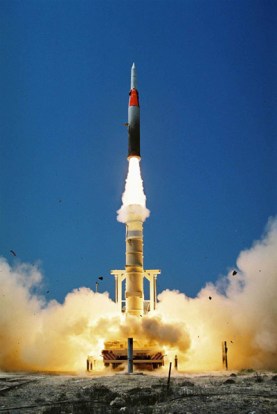
https://warsclerotic.com/wp-content/uploads/2012/02/jericho-3intercontinentalballisticmissile.jpg?w=200

Israel announced Wednesday, the successful test of a Jericho III ICBM with a range of 4000 kilometers, approximately 2,500 miles. Yaakov Katz, Jerusalem Post military analyst, commented in an article today, “Rattling the Cage”:

“The Israel Air Force announced that it had returned from a week of joint maneuvers with Italy over Sardinia that included long-range flights, midair refueling and complicated bombing runs. On Thursday, the Home Front Command held a large-scale civil defense exercise aimed at preparing the public for missile attacks in the center of the country.”

The Jericho III ICBM equipped with a nuclear warhead provides Israel with a powerful deterrent against a nuclear Iran. It gives Israel a credible Electronic Magnetic Pulse (EMP) capability to loft a low kiloton yield warhead to an apogee over Iran that upon detonation would destroy the country’s industrial infrastructure, frying motherboards of hundreds of thousands of computers, disabling telecommunications, transportation and industrial systems.

According to veteran Iran watcher, Ken Timmerman, President and CEO of the Foundation for Democracy in Iran, that possibility was confirmed by ex-CIA case officer Chet Nagle at a Capitol Hill EMPact America press conference in Washington, DC on Tuesday, the day before the Jericho III test was announced.

Doubtless an Israeli EMP attack would cause thousands of whirling centrifuges enriching uranium at the Natanz cascade hall and the Bushehr nuclear plant producing plutonium to be shut down. It might spare Iran’s vital oil and natural gas producing region in the Gulf. It would free Iran’s restive people from the nuclear nightmare of the Mullahs.

If the EMP apogee was low enough, then according to Timmerman, it would largely spare Iran’s agrarian rural areas and the country’s bread basket. The Islamic regime and industrial infrastructure concentrated in the Tehran region could collapse. Moreover, he said, the neighboring Gulf region would be spared collateral effects.

The Israelis hope that Supreme Leader Ayatollah Khamenei, President Ahmadinejad and the Islamic Revolutionary Guards Corps (IRGC) leaders got the message behind the ICBM test on Wednesday…

Israel has a full quiver of options. These include its own nuclear capable missile the Jericho III, cruise missiles launched from its Dolphin submarine fleet, and cyber warfare techniques like Stuxnet that have disabled Iran’s nuclear development infrastructure. Conventional air attack scenarios that would endeavor to reduce the Natanz and other nuclear underground facilities would be fraught with complex air route and logistical problems. Obtaining Saudi, Iraqi and even Turkish airspace permission would be doubtful.

In the wake of the Jericho III test there are Ha’aretz reports about Security Cabinet debates in the Netanyahu government pressing for an attack on Iran’s nuclear facilities and the IRGC. According to MSNBC, polls show that the Israeli population is divided about such a prospect. This despite an assessment by Iranian Defector and ex-CIA spy Reza Khalili in a recent report in the Washington Times who said that Iran already has nuclear arms.

Iran Threatens ‘Crushing Response’ If Attacked

February 19, 2012

Iran Threatens ‘Crushing Response’ If Attacked – Defense/Security – News – Israel National News.

Iran heats up tensions and warns Israel of a “crushing response to Israel’s slightest move.” US jawbones against a pre-emptive strike.
By Tzvi Ben Gedalyahu

First Publish: 2/19/2012, 11:36 AM


Iran fires long-range missile

Iran fires long-range missile
Israel news photo: IRNA Iranian news agency

Iran has threatened a “crushing response to Israel’s slightest move” as the United States raises the volume against a pre-emptive strike. Iran also has announced new war games for next month.

The Ahmadinejad regime chose its ambassador to Lebanon, Qazanfar Roknabadi, to deliver a message on Saturday that “Iran will not start a possible war with the Zionist regime but will deliver a decisive response to any aggression by the regime.” As usual, he refrained from using the term “Israel.”

Regardless of Israel’s intentions, Iran’s Revolutionary Guards Corps is planning new war games next month in a desert area in the central part of the country.

Commander of the IRGC Ground Forces, Brigadier General Mohammad Pakpour, said on Saturday that the drill will implement “modern defensive tactics,…taking advantage of advanced indigenous military equipment,” the state-run Fars News Agency reported.

Iran’s media, most of it government controlled, played up advice by General Martin Dempsey, the chairman of the U.S. Joint Chiefs of Staff,  that it would be unwise to attack Iran now.

“It’s not prudent at this point to decide to attack Iran,” Dempsey told CNN on Saturday. “I think it would be premature to exclusively decide that the time for a military option was upon us. A strike at this time would be destabilizing and wouldn’t achieve their (the Israelis’) long-term objectives. I wouldn’t suggest, sitting here today, that we’ve persuaded them that our view is the correct view and that they are acting in an ill-advised fashion.”

The Obama administration has been jaw-boning in the media against a military strike, claiming that harsh sanctions against Iran are working and that Israel should wait. the dilemma for Israel is that most military and intelligence officials warn that postponing military action will close the “window of opportunity” as Iran continues to race ahead towards nuclear capability, especially at its underground nuclear facilities.

The BBC reported Sunday that Iran appears to be preparing to speed up production of enriched uranium, a key ingredient of a nuclear weapon. It announced last week it has installed an additional 3,000 centrifuges in its underground nuclear plant near the city of Qom.

The Obama administration is increasing pressure on Israel by sending U.S. National Security Advisor Tom Donilon to Jerusalem for talks with government and military officials.

Analysis: Wishful thinking or faulty intelligence?

February 19, 2012

Analysis: Wishful thinking or fau… JPost – Diplomacy & Politics.


By YAAKOV KATZ 02/19/2012 01:15
Barak’s repeated predictions on Assad’s demise may have been premature.

Arab Israelis step on photo of Assad as Hitler.

By REUTERS/Ammar Awad

Is it wishful thinking or based on poor intelligence assessments? Either way, Defense Minister Ehud Barak’s predictions regarding the fate of Syrian President Bashar Assad do not seem to have been so accurate and are also not shared by his counterparts in the Pentagon.

A review by The Jerusalem Post of Barak’s comments on Assad’s fate reveals that the defense minister has been making predictions for over half-a-year that Assad will fall within weeks or months, even when US intelligence officials claim that Assad’s regime is stable.

On Thursday, for example, Lt.-Gen. Ronald Burgess, the director of the Defense Intelligence Agency in the Pentagon, told the Senate’s Armed Services Committee that despite the ongoing upheaval in Syria, Assad’s regime was stable.

“After 10 months of unrest, the regime and opposition in Syria are in a stalemate; however, the regime is cohesive,” Burgess said in his prepared statement to the committee.

“The Syrian military, despite some desertions and defections to the armed opposition, on the whole remains a viable, cohesive, and effective force.”

That same day, Barak’s office released a statement following his meeting with Japanese Defense Minister Naoki Tanaka in Tokyo. Assad, Barak told Tanaka, would fall “within weeks.”

Barak’s public predictions regarding Assad’s fate began in June when he attended the Paris Air Show. Speaking to the Associated Press, Barak said that Assad would probably fall in three to six months.

“He probably will stay around for another quarter or two but that will not change his fate,” Barak said on June 20, meaning that six months would have been some time in December.

On November 19, during a gathering of defense ministers in Halifax, Nova Scotia, Barak said that Assad would not remain in power for long. Two weeks later, on December 6, Barak said during a tour of the Golan Heights that Assad will fall, although he did not know if it will take “a few weeks or months.”

Five days later, at the World Policy Conference in Vienna, Barak decided it would take weeks. Assad’s downfall, he added, would be a “blessing for the Middle East.” Three days later, on December 14 and ahead of a trip to the United States, Barak told The Washington Post that “it might take many weeks, but it’s not a matter of months or years.”

A day later, he told a class of schoolchildren in Washington that Assad would be gone before Passover, which begins on April 6. A few weeks after that, on January 2, Barak repeated his earlier prediction in a briefing to the Knesset’s Foreign Affairs and Defense Committee.

“The Assad family has no more than a few weeks to remain in control in Syria,” he said.

So when will Assad fall? The answer is still unclear, but what is noticeable is that Barak is the only Israeli official issuing such forecasts. In interviews to TV stations on Saturday night, IDF Chief of Staff Lt.-Gen. Benny Gantz, for example, shied away from predicting when Assad’s regime will collapse.

Ultimately, Israel believes that it will happen, although it could still take some time.

The two main factors are the stability of the Syrian economy – Assad is receiving unprecedented support from Iran – and the ongoing defections in his military. Unless “weeks” means months, Assad’s fall might take longer than the defense minister thinks.

IDF Doesn’t Stay Silent in Wake of Rocket Attacks

February 19, 2012

IDF Doesn’t Stay Silent in Wake of Rocket Attacks – Defense/Security – News – Israel National News.

IDF strikes terror targets in Gaza twice, after terrorists fire a barrage of rockets at southern Israel.
By Elad Benari

First Publish: 2/19/2012, 2:41 AM


IAF Counterstrike (Gaza)

IAF Counterstrike (Gaza)
Arutz Sheva: Flash 90

Southern Israel’s residents are spending the night near shelters and protected spaces, after a barrage of rockets fired from Gaza over the weekend brought about several retaliations by the IDF.

At around 10:30 p.m. (Israel time) on Saturday night, IAF aircraft attacked a rocket production site in Gaza. The IDF Spokesperson said that the aircraft scored direct hits on their targets.

The second IAF attack occurred around 1:45 a.m., this time on a terrorist base and a weapons storehouse. In this attack, as well, direct hits were scored. All aircraft safely returned to their bases.

Over the weekend, Palestinian Authority terrorists fired at least six rockets at southern Israel.

A Grad missile exploded outside the city of Be’er Sheva shortly after the noon hour on Saturday afternoon. The missile landed in an open area. No property damage was reported and no one was physically injured.

Two short-range Qassam rockets were also fired in a separate attack on the western Negev, slamming into the Eshkol Regional Council district. Both landed in open areas. No property damage was reported, and no one was physically injured.

On Friday there were several attacks on southern Israel by Gaza terrorists that prompted the IDF to move to high alert. One rocket reached the Ashkelon Coast Regional Council district. The other exploded in the Eshkol Regional Council district.

Gaza terrorists also fired an RPG (rocket-propelled grenade) anti-tank missile at IDF soldiers patrolling near the southern border on Friday evening. None of the Israeli soldiers were wounded in the attack, and IDF forces responded with tank fire.

Israel ‘will make own decision’ on Iran, says military chief

February 19, 2012

Israel ‘will make own decision’ on Iran, says military chief | thetelegraph.com.au.

ISRAEL will ultimately decide on its own whether to strike Iranian nuclear facilities, its military chief of staff says, as a senior US official arrived for talks on the Islamic Republic.

“Israel is the central guarantor of its own security; this is our role as army, the State of Israel should defend itself,” Lieutenant General Benny Gantz told state-owned Channel One TV.

“We must follow the developments in Iran and its nuclear project, but in a very broad manner, taking into account what the world is doing, what Iran decided, what we will do or not do,” he said.

In recent weeks, there has been feverish speculation that Israel was getting closer to mounting a pre-emptive strike on Iran’s nuclear program, though Israel has denied reaching such a decision.

Tensions between Iran and Israel have been simmering with Iranian warships entering the Mediterranean through the Suez Canal in a show of “might”, a move Israel said it would closely monitor.

On Wednesday, Iran said it had installed another 3000 centrifuges to increase its uranium enrichment abilities and was stepping up exploration and processing of uranium yellowcake.

And Israel blamed a recent wave of attacks targeting Israeli diplomats on agents of Tehran, allegations that Iran denies.

US National Security Advisor Tom Donilon will begin talks with Israeli officials on a range of issues including Iran, two weeks ahead of a Washington visit by Israeli Prime Minister Benjamin Netanyahu for White House talks with US President Barak Obama on the same topic.

A recent article in the Washington Post said that US Defense Secretary Leon Panetta thinks Israel may strike Iran’s nuclear installations in the coming months.

According to Gantz, whose interview was conducted prior to the developments, Iran was not only an “Israeli problem”, but also “a world and regional problem”.

Israeli Defence Minister Ehud Barak called on the world to tighten sanctions on Iran before the country enters a “zone of immunity” against a physical attack to stop its nuclear program.

Iran has been slapped with four sets of UN sanctions and a raft of unilateral US and European Union measures over its nuclear drive, which Tehran maintains is peaceful.